

Gemini 4 Carbon launches at the exact price of Gemini 4 Argon: $2 per million input tokens and $10 per million output tokens, with cached input at $0.10. After an introductory period it becomes $4/$20. Google gave no end date, and you can't buy it yet: it's with a subset of cyber defenders only.
The useful number is cost per task. On Artificial Analysis, Carbon costs $7.76 per task at list price, against $7.68 for Argon, while scoring 59 instead of 50. Same bill, nine points smarter. At the promo rate that's $3.88, cheaper than Claude Opus 5.5 and GPT-6 Astra at max effort, but still 3x GPT-6.1 Sol.
My take: when Carbon reaches the API, it replaces Argon outright, and you should budget at $4/$20. If you're pricing it to answer support tickets, the token bill is about a cent a ticket either way. What you're really paying for is the AI helpdesk agent around the model, and eesel runs that on a fixed monthly plan, so a promo ending at Google doesn't touch your invoice.
Gemini 4 Carbon pricing at a glance
Google announced Carbon on 28 October 2026, two weeks after Argon went on sale. The whole price is only one sentence in the launch post plus a footnote, and that's all. Below is everything published until now, next to the Argon rates which Carbon copies:
| Carbon intro price | Carbon after the promo | Argon today (live) | |
|---|---|---|---|
| Input, per 1M tokens | $2.00 | $4.00 | $2.00 until Nov 30, then $4.00 |
| Cached input, per 1M tokens | $0.10 (95% off) | $0.20 (95% off) | $0.10, then $0.20 |
| Output, per 1M tokens (thinking included) | $10.00 | $20.00 | $10.00, then $20.00 |
| Batch / Flex | Not published | Not published | $1.00 / $5.00, then $2.00 / $10.00 |
| Priority | Not published | Not published | $3.60 / $18.00, then $7.20 / $36.00 |
| Free tier | Not published | Not published | Not available |
| Context window | 1M tokens (per Artificial Analysis) | 1M tokens | 1M tokens |
| Who can buy | Cyber defenders only | Not dated | Paid API, Google AI Pro and Ultra |
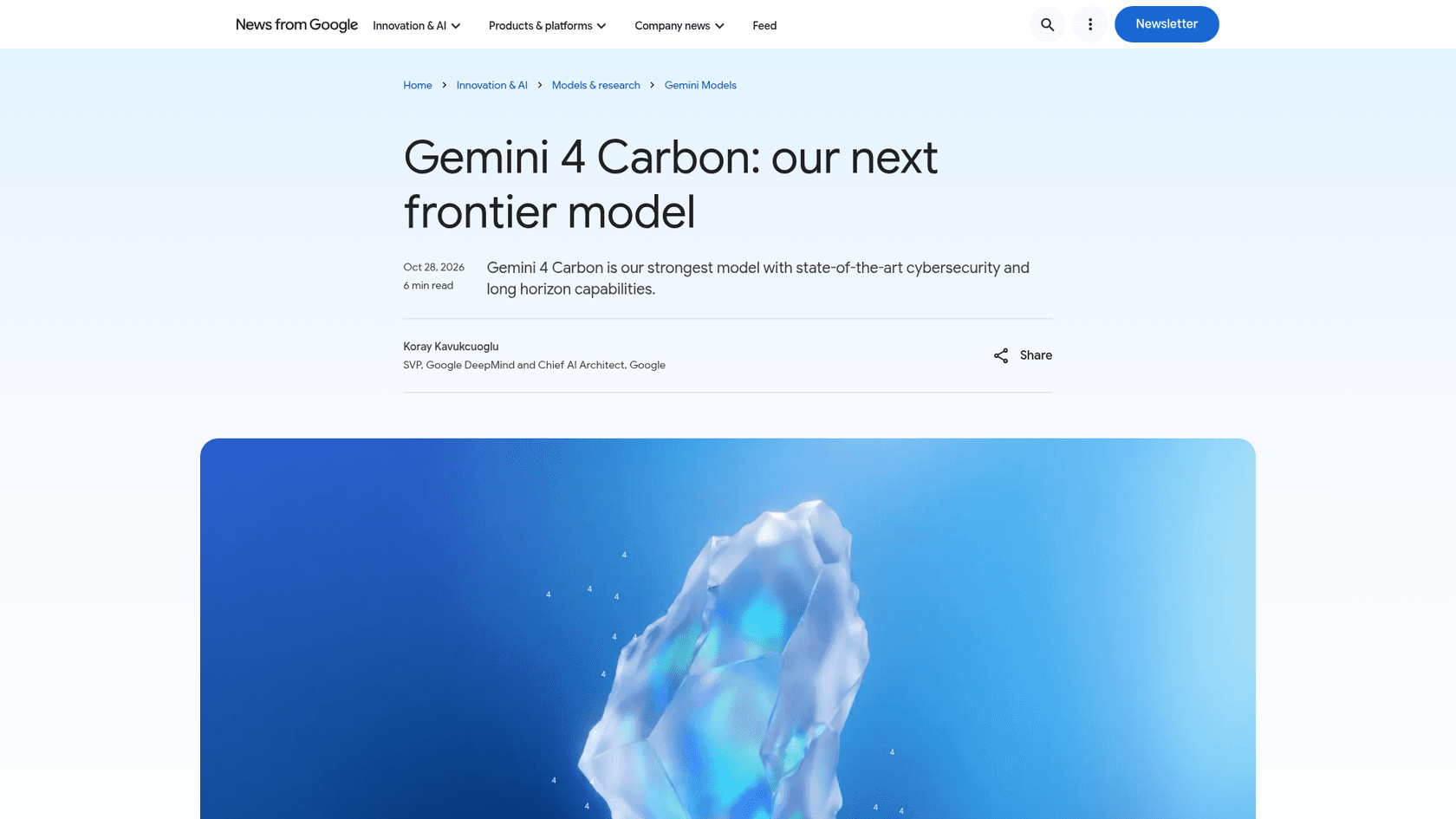
The footnote reads: "After the introductory period expires, the price of $4 per 1M input tokens and $20 per 1M output tokens will apply." The $0.20 post-promo cache rate is my own arithmetic on Google's "95% off input token price", and it also matches the cache price Artificial Analysis lists for Carbon.
The Argon column matters here because it's the only real precedent there is. On the Gemini Developer API pricing page, Argon's promo runs "through November 30, 2026" and the doubled price starts December 1. Argon was announced on 30 September, so its discount lasted about two months. If Google repeats the same move, Carbon's promo would end somewhere around late December, but this is my guess and not anything Google has printed.
For the specs and access story behind the price, my Gemini 4 Argon overview covers the shared Fairwind rollout, and the Argon review covers how it held up. In here I'm sticking only to the money side.
Can you actually pay for Gemini 4 Carbon yet?
No. Google says that "starting this week, we will make Carbon available to a subset of cyber defenders" and then phase in "additional trusted partners" through its Fairwind Program. Developers, businesses, and consumers come after that, "as soon as possible", which is not really a date.
I checked on 29 October 2026. The pricing page lists Gemini 4 Argon at the top, with a banner saying Argon "is now available". Carbon isn't there:
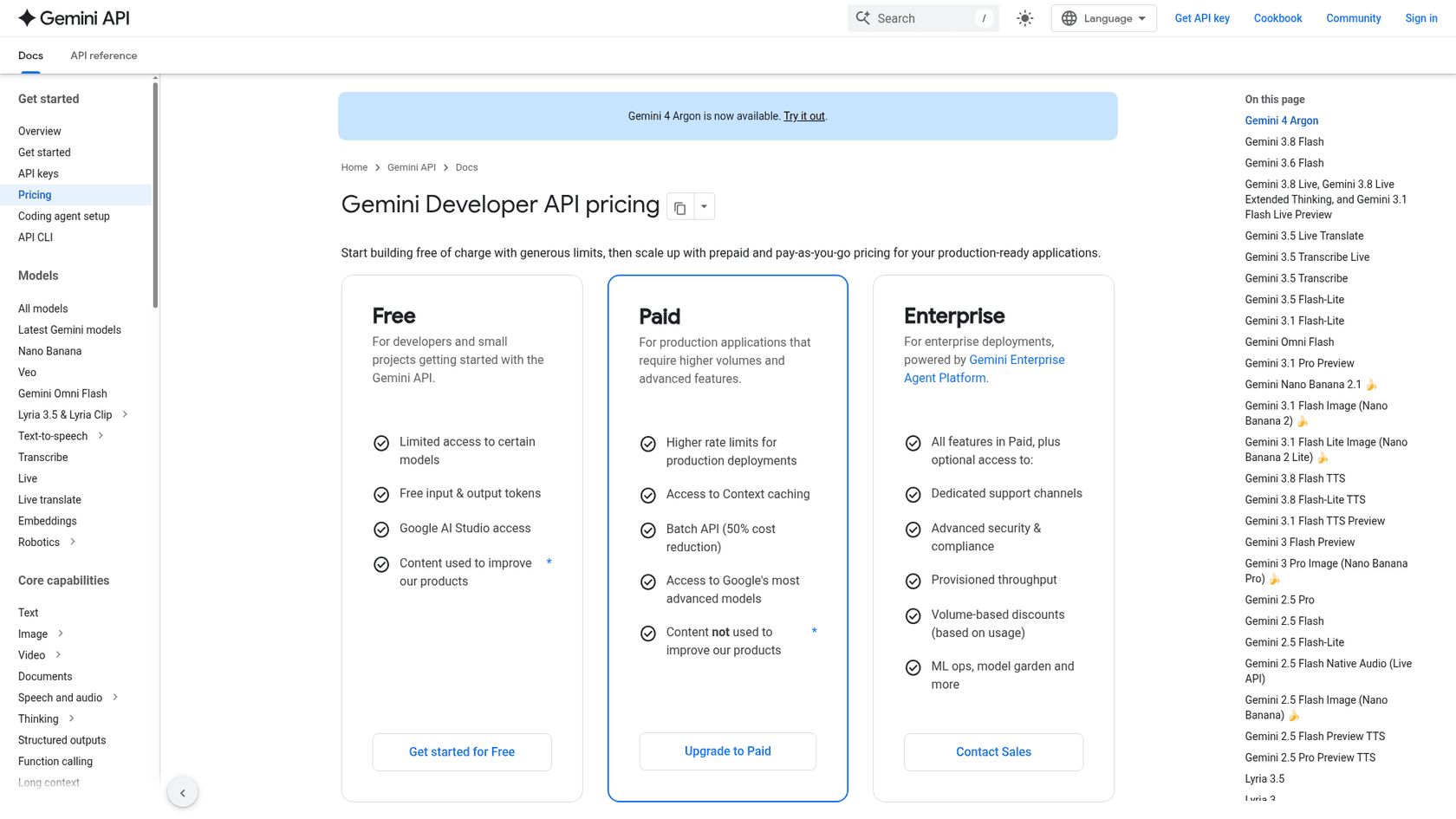
That timing gap is a pricing fact by itself. Argon went from Fairwind-only to paid API and Google AI Pro and Ultra in about two weeks. That is quick for the standards of frontier AI launches with a safety-gated rollout. If Carbon moves at the same pace, it reaches the API in mid-November, with only a couple of weeks left on Argon's promo clock. Whether Carbon gets its own fresh promo window or inherits Argon's November 30 date is the one question I'd like Google to answer before I put a budget on anything.
Readers on Hacker News spotted the same tension in the first minutes after launch:
"Wow, $2/$10 for input and output even if just for introductory pricing is an incredible deal. Wonder how token efficient it is."

The token efficiency question is exactly the right one to ask, and now it has an answer.
Why does Carbon cost the same as Argon?
Because it's priced as a replacement, not as a new tier. Google's post says Carbon is "building on Gemini 4 Argon" and "will launch at the same introductory price as Argon". There's no "Carbon is the premium option" framing anywhere. Most of the Hacker News thread was reading it in the same way:
"This model is the same price and speed and token usage per task of Argon but scores better in ~every test."
The numbers do back that up. On the Artificial Analysis Intelligence Index v5.0, priced at the $4/$20 list rate for both models, a Carbon task costs $7.76 and an Argon task costs $7.68. Carbon writes about 123,000 output tokens per task to Argon's 116,000, so it's a bit more verbose, but it still lands at 59 on the index versus Argon's 50.
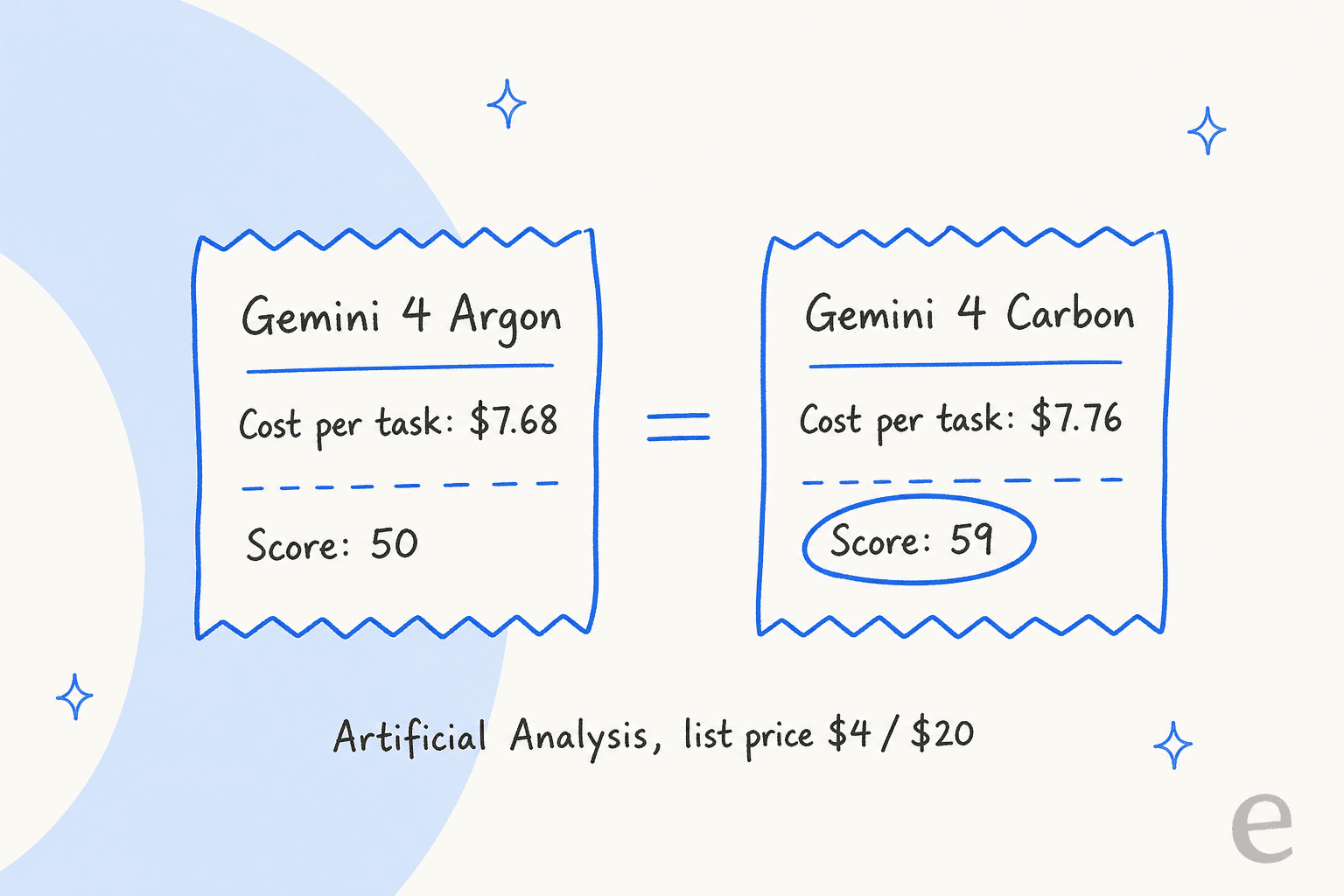
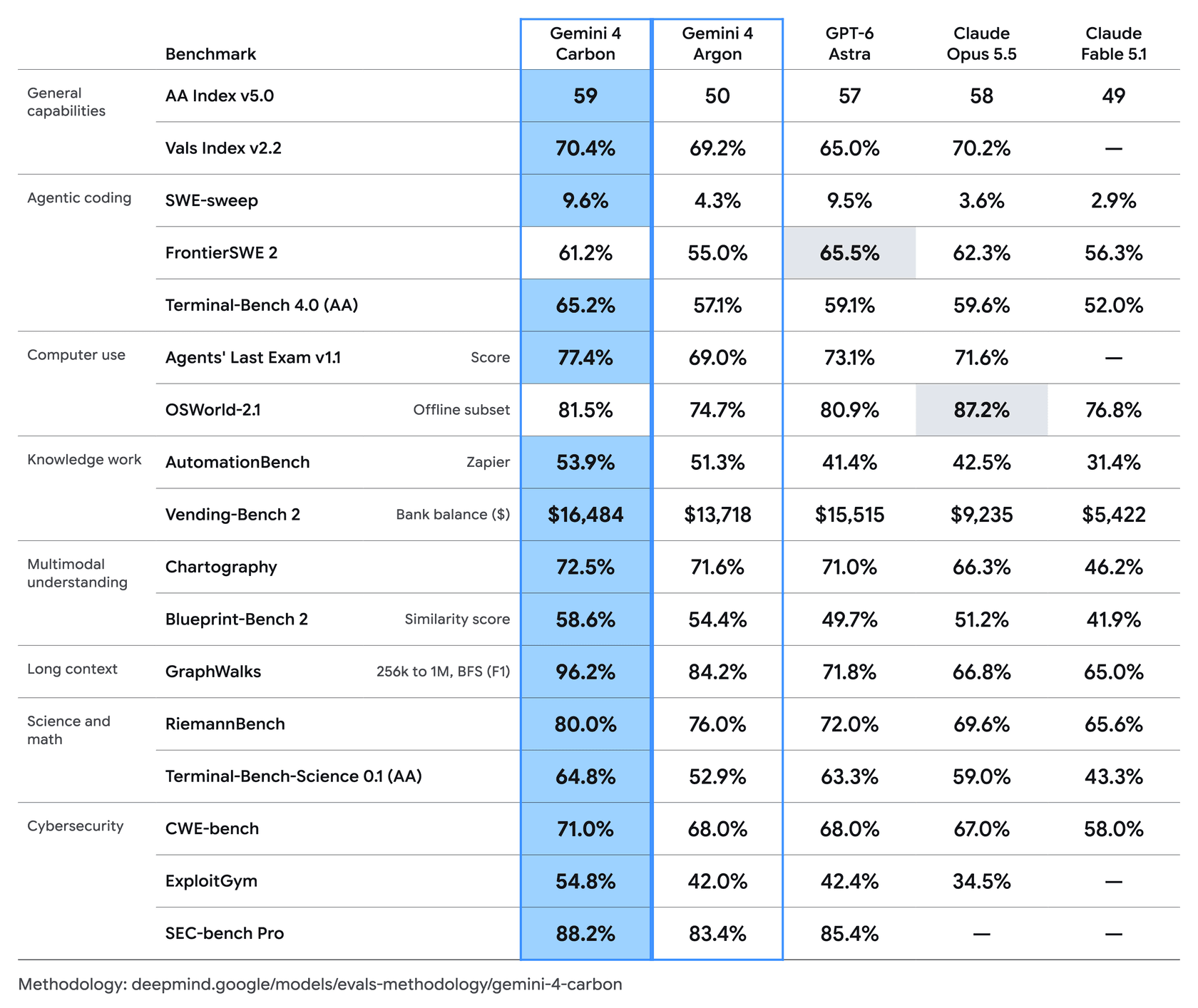
So for anyone who already budgets for Argon, the pricing story is a short one: swap the model name, keep the budget, get a better model. Google's own benchmark table shows Carbon ahead of Argon on every one of its 17 rows, including Terminal-Bench 4.0 (65.2% vs 57.1%) and long-context GraphWalks (96.2% vs 84.2%).
One reader pointed out where this pattern leads:
"But if they keep releasing a model every month, then the frontier model will keep being perpetually half price?"
It's a fair joke, and it's also a fair planning question. Two flagship releases in four weeks, each with its own intro window, means that the "after the promo" price may be the one you see the least often. Still, I wouldn't build a budget on top of it.
How does Gemini 4 Carbon compare on price per token?
At list price, Carbon sits on the same rate card as Claude Opus 5.5, and during the promo it matches GPT-6.1 Sol. Here are the list prices Artificial Analysis uses for its cost maths:
| Model | Input / 1M | Cached input / 1M | Output / 1M |
|---|---|---|---|
| Gemini 4 Carbon (promo) | $2.00 | $0.10 | $10.00 |
| Gemini 4 Carbon (list) | $4.00 | $0.20 | $20.00 |
| Gemini 4 Argon (list) | $4.00 | $0.20 | $20.00 |
| Claude Opus 5.5 | $4.00 | $0.20 | $20.00 |
| GPT-6.1 Sol | $2.00 | $0.10 | $10.00 |
| GPT-6 Astra | $10.00 | $1.00 | $50.00 |
| Kimi K3.1 Pro | $2.00 | $0.20 | $10.00 |
| Gemini 3.8 Flash | $0.75 | $0.075 | $3.75 |
Per-token price is the place where most coverage stops, and in this case it's the least useful column. Three of these models share two price cards between them. What separates them is how many tokens each one burns to finish the same job.
The number that matters: cost per task
Artificial Analysis runs every model through the same set of tasks and records what each run costs. That gives a per-task figure which folds in verbosity and thinking tokens, and caching as well. Here is where Carbon lands against the models people will compare it with, each one at its top setting:
| Model (setting) | AA Index v5.0 | Cost per task | Output tokens per task |
|---|---|---|---|
| Gemini 4 Carbon (High), list | 59.4 | $7.76 | 123K |
| Gemini 4 Carbon (High), promo | 59.4 | $3.88 | 123K |
| Claude Opus 5.5 (Max) | 58.4 | $10.03 | 173K |
| GPT-6 Astra (Max) | 56.9 | $6.24 | 52K |
| GPT-6.1 Sol (Max) | 54.5 | $1.27 | 68K |
| Gemini 4 Argon (High), list | 50.4 | $7.68 | 116K |
| Kimi K3.1 Pro | 46.0 | $3.68 | 72K |
The promo row is my own arithmetic: every part of Carbon's bill scales with the price card, so halving the rates halves the $7.76.
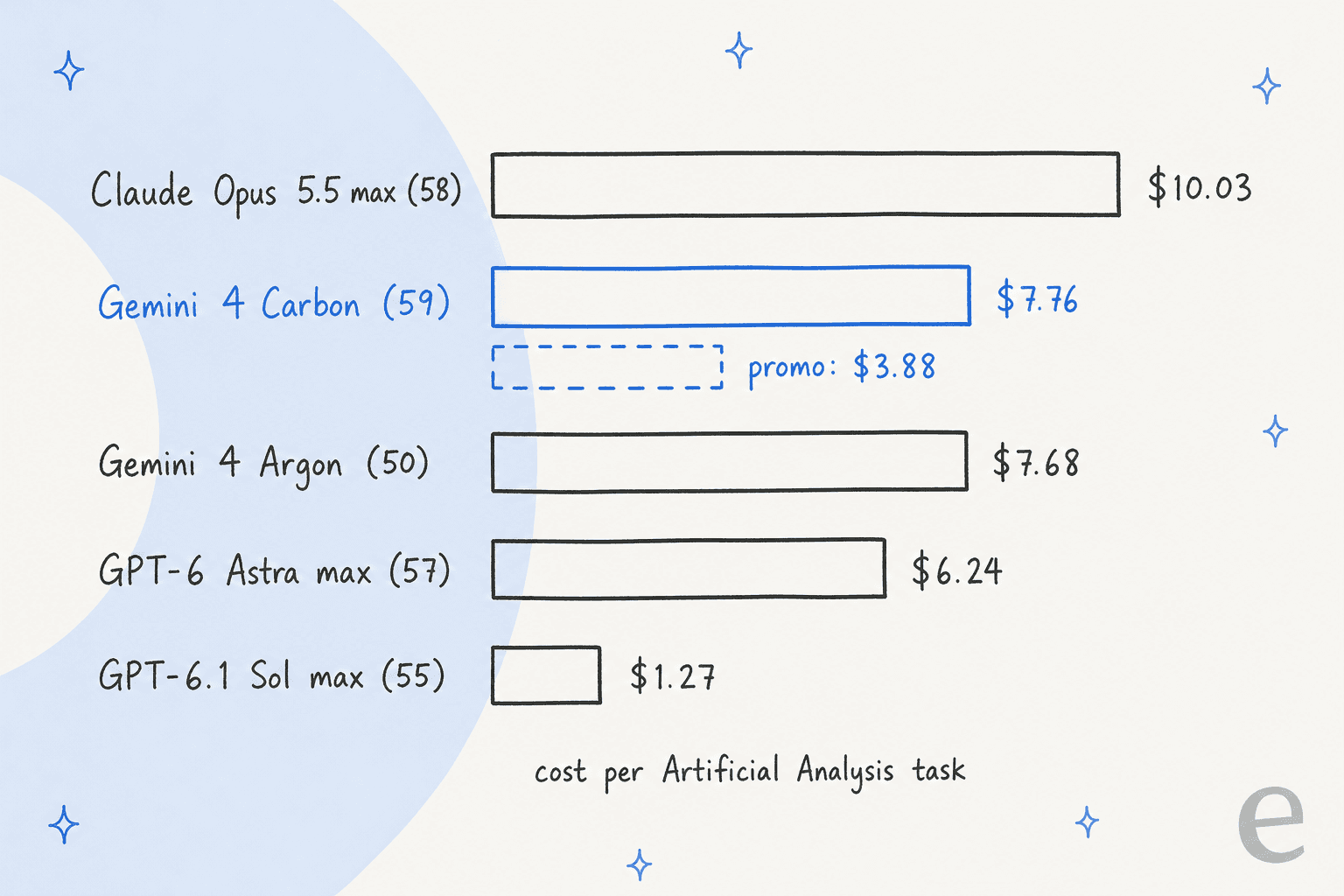
There are three things that stand out to me.
- Carbon beats Opus 5.5 on both axes. It scores a point higher and costs $2.27 less per task at list, on an identical price card, because it writes about 50,000 fewer output tokens per task.
- At list price, Astra is cheaper. GPT-6 Astra at max costs $6.24 per task despite a $10/$50 rate card, because it writes less than half as much as Carbon. Carbon only undercuts Astra while the promo lasts.
- Sol is still the value pick. At $1.27 per task, GPT-6.1 Sol at max effort costs a sixth of Carbon at list and a third at promo, for a five-point lower score. Whether five points is worth 3x to 6x the bill depends entirely on if your work sits inside that gap.
If you want the full field rather than these five, my Gemini 4 Argon alternatives roundup prices each option for one buyer, and Kimi K3.1 Pro and DeepSeek V4.1 Flash are the open-weight picks worth a look in terms of cost. Not everyone on Hacker News was sold on the per-task case for the Gemini 4 family, though:
"I've found its worse in most tasks, especially when ranked on a cost-per-task metric."
Where does the money in a Carbon task actually go?
Mostly it goes to input, not output, which surprised me a bit. Artificial Analysis splits Carbon's $7.76 per task like this:
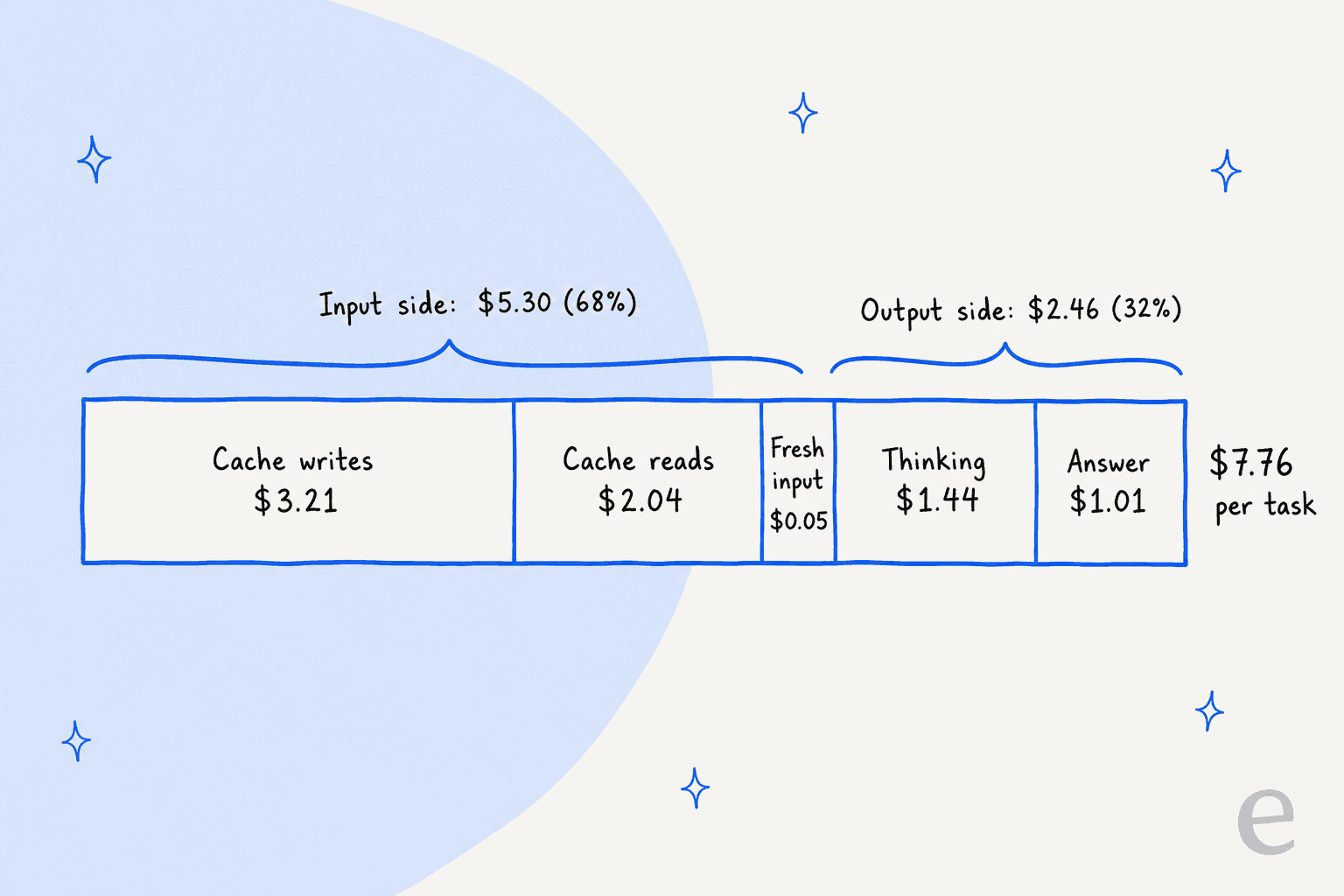
68% of the bill, $5.30, is input-side. Long agentic tasks keep re-reading their own growing context on every step. Working back from the list prices, an average task sends roughly 11 million input tokens, and about 10 million of those are cache hits at $0.20. The rest, around 800,000 tokens, go in fresh at the full $4 rate before they get cached, and that slice alone costs $3.21.
That changes the place where you should look for savings:
- Cache hit rate moves the bill more than output length. Each million tokens that hits the cache instead of going in fresh saves $3.80 at list. Google says Argon supports "implicit caching only (explicit caching is not supported)", so you can't pin a cache by yourself, the only thing you can do is keep prompts stable so the implicit cache keeps hitting.
- Thinking is the smaller cost. Reasoning tokens are $1.44 of the $7.76. Turning effort down will help, but it only attacks a fifth of the bill. The same pattern shows up in Claude Sonnet 5.5 pricing, where lower effort only saves real money on short tasks.
- Short, chat-style calls behave differently. A support reply or a classification call doesn't re-read millions of tokens, so output becomes a bigger share. The calculator below lets you see both shapes.
Gemini 4 Carbon cost calculator
You can plug in your own token counts here. The presets cover a support ticket, an agentic task shaped like the Artificial Analysis average, and a one-off long-document read. All prices are per million tokens, from the tables above.
Worked examples: what Carbon costs on real workloads
Here are three shapes of work, each priced at both rates. The token counts in the first and third are my own illustrative assumptions, stated so you can swap in yours; the second uses the Artificial Analysis per-task cost.
| Workload | Tokens per job | Promo cost | List cost |
|---|---|---|---|
| 10,000 support tickets a month | 4,000 in (30% cached), 600 out | $117 a month | $234 a month |
| 100 long agentic coding tasks a month | Artificial Analysis average task | $388 a month | $776 a month |
| One 800,000-token contract review | 800K in, 4K out | $1.64 per review | $3.28 per review |
Support tickets. At $0.012 a ticket during the promo and $0.023 after, Carbon is not the place where a support budget goes. For comparison, Gemini 3.8 Flash handles the same ticket for under half a cent at its own promo rate, and for most ticket replies a frontier reasoning model is more than the job needs.
Agentic coding. This is the shape Carbon is built for, and it's also the one where the bill gets real. Google says its own teams have seen Carbon "run for days" on multi-step engineering work. A day-long run is many of these tasks back to back, so it's the place to watch cache hit rates closely.
Long documents. Neither Carbon nor Argon has a published long-context surcharge, so an 800,000-token read is billed at the flat rate. That's Carbon's best case on price, and with GraphWalks at 96.2% across 256K to 1M tokens, its best case on quality too.
The hidden costs and open questions
The price card is short, and that means several things which decide your real bill aren't on it yet:
- The promo end date. Unknown. Argon's ran about two months. Budget at $4/$20.
- Batch and Flex. Argon has both at half price. Nothing published for Carbon, so don't count on them until Google prints them.
- Search grounding. Argon includes 5,000 free Google Search grounding requests a month (shared across Gemini 3 and newer), then $14 per 1,000. An agent that searches on every step adds this on top of tokens.
- Explicit caching. Argon doesn't support it, and the cost breakdown above shows why that matters: you can't force cache hits on a $4/M input rate.
- Consumer plans. Argon reached Google AI Ultra and Pro subscribers about two weeks after launch. Carbon hasn't, and Google hasn't said which plans will get it.
Is Gemini 4 Carbon worth the price?
If you're already on Argon, then yes, there is no real argument against it: same price card, same cost per task, nine more points on the index, and Google says about half the unsupported claims. When Carbon reaches the API, switch.
If you're choosing fresh, it depends on the kind of work. For long agentic coding and long-document jobs, Carbon at list beats Claude Opus 5.5 on cost and score, and during the promo it beats GPT-6 Astra too. For anything that doesn't need the top five index points, GPT-6.1 Sol at max is the cheaper call by a wide margin, and my Gemini alternatives guide covers the rest of the field. One Hacker News commenter who mostly runs Opus put the promo case this way:
"For the current introductory price, it provides an exceptional value."
And if what you need is a model you can call this week, Carbon isn't an option at any price. Argon is.
What does Gemini 4 Carbon pricing mean for a support team?
Very little, and that's actually the useful part. A model at a cent a ticket is not what decides whether AI support pays off. What decides it is whether the answers are right (Google's claim that Carbon halves unsupported claims matters more here than its price, and AI hallucinations in support are the real cost to plan for), whether the agent hands off the tickets it shouldn't touch, and how it fits the helpdesk you already run. Those costs live in the AI customer service cost around the model, and they don't halve when a promo starts. The cost per resolution is the number to track, not the cost per token.
The other thing a support team doesn't want is a bill that doubles on a date set by someone else. Right now model prices change every few weeks, but a support budget shouldn't. That is how I would frame any vendor conversation: ask what you pay per ticket, and whether that number moves when the model underneath changes.
SamCart is a good example for the shape that works. It runs one eesel agent on first replies to Freshdesk tickets and another on its website chat, both answering from its 280 help center articles, on a plan sized for 8,000 interactions a month. Which frontier model happens to be the cheapest that week is not something its support team has to keep track of.
Try eesel
If you're pricing Gemini 4 Carbon because you want AI answering tickets, you can skip the token maths. Carbon is infrastructure; eesel is the employee. The eesel AI helpdesk teammate learns from your past tickets and help center, plugs into Freshdesk, Zendesk, and the other helpdesks you already use, and runs a simulation on your real past tickets so you can check its answers before it replies to anyone.
Pricing is a fixed monthly credit plan, where one ticket or chat is one credit however many replies it takes, starting at $299 for 500 credits. Every feature and unlimited seats are included, and you can start free with 100 credits and no card. When Google's promo ends, your bill stays where it was. Try eesel on a slice of your queue and see how it handles your own tickets.