


Kimi K3.1 Pro is the strongest open-weight model announced so far, scoring 55 on the Artificial Analysis Intelligence Index, 2.5 points behind Claude Opus 5.5, at $2 input and $10 output per million tokens. Moonshot launched it on October 23, 2026 as a heavily post-trained version of Kimi K3, and the jump is real: Terminal-Bench 4.0 went from 12.6% to 67.2% on Artificial Analysis.
The catch is everything around the scores. It runs at about 50 tokens per second, near the bottom of its class. The weights are promised "by Nov 4", so today it is API-only. And early Kimi Code subscribers report burning a 5-hour limit in under an hour. The price cut is per token, not per answer: it writes long, so it costs $3,117 to run the full benchmark index against $3,658 for K3, a 15% saving, not 33%.
If you're picking a model for an AI support agent, the model is the smaller half of the job. I've spent years at eesel putting AI on live helpdesk queues, and the hard part is never the engine. It is the helpdesk connection, the handoff rules, and testing on real past tickets. SE Ranking runs that layer across three products on Zendesk, about 4,650 conversations a month.
What is Kimi K3.1 Pro?
Kimi K3.1 Pro is the new flagship model from Moonshot AI, and it is also the first release of its K3.1 series. Moonshot is calling it "our most capable 3T-class open-weight model to date", with a 1-million-token context window. Under the hood, it's a mixture-of-experts model, with 2.8T total and 104B active parameters, per the launch post on X.
It comes in two flavours: Kimi K3.1 Pro is the standard one, and Kimi K3.1 Pro Highspeed is the same model but served "2-3× faster" at twice the price. Both of them went live on the same day, on kimi.ai, the Kimi apps, Kimi Work, Kimi Code and the Kimi API.
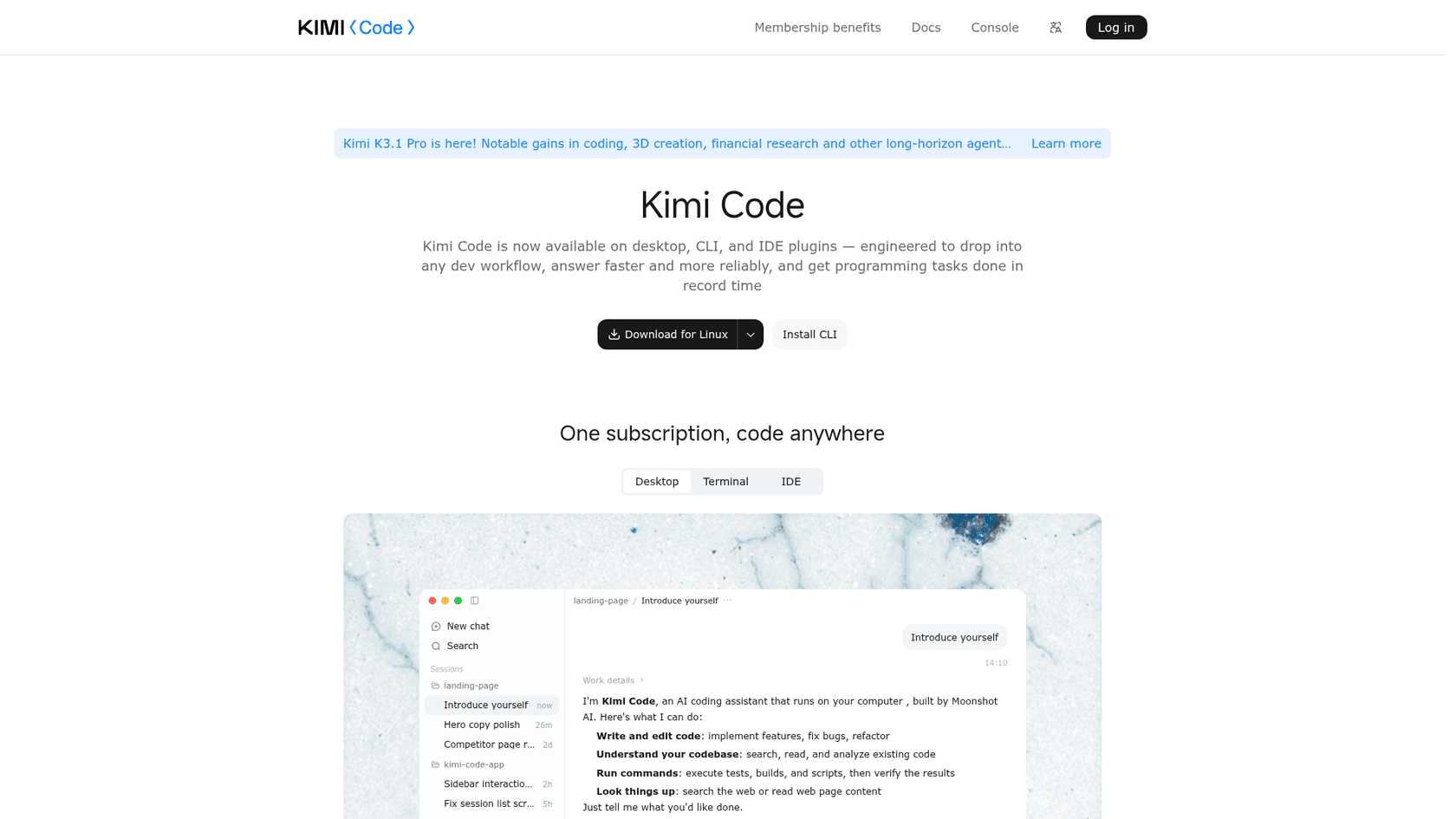
Moonshot pitches four areas where it improved, which are coding, 3D creation, financial research and long-running agent work. If you have been following the Kimi K3 launch in July, the short version is this one: on agent tasks, K3.1 Pro is the model that K3 was supposed to be.
What changed from Kimi K3?
Kimi K3.1 Pro is not a new base model, to be clear. Moonshot describes it as "a post-trained version of Kimi K3, with substantially larger post-training compute", using reinforcement learning across "hundreds of downstream domains". So the 2.8T weights are the same, what changed is how much training went into using them.
On paper that sounds incremental, but the numbers tell a different story. On the Artificial Analysis K3.1 Pro page, measured on the same index version as Kimi K3:
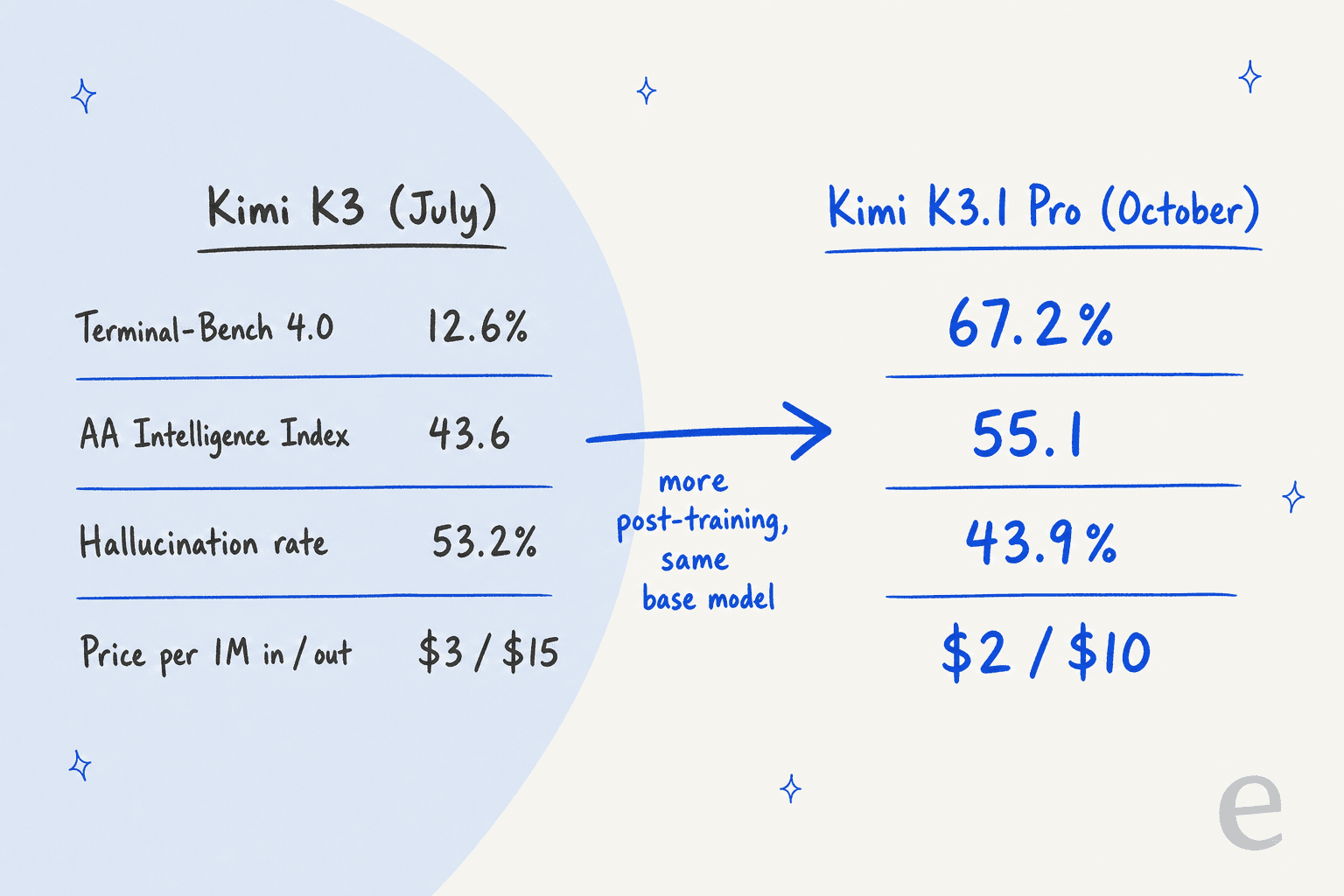
| Kimi K3 (Max) | Kimi K3.1 Pro | |
|---|---|---|
| Released | July 16, 2026 | October 23, 2026 |
| Intelligence Index (v4.3.2) | 43.6 | 55.1 |
| Terminal-Bench 4.0 | 12.6% | 67.2% |
| Hallucination rate (AA-Omniscience) | 53.2% | 43.9% |
| GDPval-AA (Elo) | 1,534 | 1,846 |
| API price per 1M (in / out) | $3 / $15 | $2 / $10 |
| Output speed | 54.5 tokens/s | 49.7 tokens/s |
| Weights | Open | Due by Nov 4 |
Terminal-Bench going from 12.6% to 67.2% is the headline. That benchmark checks if a model can actually finish multi-step work inside a terminal, and that is what coding agents are doing all day. K3 was a smart model that had trouble acting on it, while K3.1 Pro does act.
There is one trap worth watching if you compare with older articles: K3 scored 57 on Artificial Analysis in August, but the index has been rescaled since. On today's version K3 sits at 43.6, so K3.1 Pro is an 11.5-point jump, not a 2-point drop. I made the same comparison in my Kimi K3 review back then, so please treat those older numbers as being on a different scale.
Moonshot also did something a bit unusual, it removed cyber-related training data from the open-weight release on purpose. On its own internal exploit benchmark, the final model is scoring 81.0 against 90.5 for the same model trained without that cut. The rule Moonshot states is to not "release open weights that would extend the absolute frontier of cyber capability."
How good is Kimi K3.1 Pro on benchmarks?
On Moonshot's own chart of 14 evaluations, Kimi K3.1 Pro comes first on 6 and second on 5, against Claude Opus 5.5, GPT-6 Astra, Claude Fable 5.1, DeepSeek V4.1 Flash and GLM-5.3. All of the models were run at maximum thinking effort.
Here are the highlights, taken straight from the Moonshot launch blog:
| Benchmark | Kimi K3.1 Pro | Opus 5.5 | GPT-6 Astra | Fable 5.1 |
|---|---|---|---|---|
| Terminal-Bench 4.0 | 65.7 | 66.4 | 58.2 | 57.9 |
| SWE Marathon | 51.7 | 46.3 | 42.5 | 45.6 |
| OfficeQA Pro v2 | 64.4 | 62.2 | 54.4 | 54.5 |
| Humanity's Last Exam (with tools) | 70.0 | 67.7 | 57.2 | 65.6 |
| OSWorld V2.1 | 79.6 | 81.8 | 75.8 | 80.7 |
| GDPval-AA v2.1 (Elo) | 1846 | 1866 | 1573 | 1754 |
| BenchCAD (with tools) | 92.7 | 96.2 | 95.9 | 92.6 |
| Terminal-Bench-Science 0.1 | 38.1 | 63.3 | 68.1 | 40.0 |
There are two things worth knowing before you go and quote any of this.
First, the coding benchmarks ran inside the harness of Claude Code and not inside Moonshot's own. It's a reasonable choice since most developers use that harness, but it does mean the results show you how Kimi performs when it gets driven like Claude. A post from Lisan al Gaib raised exactly this question on the launch day.
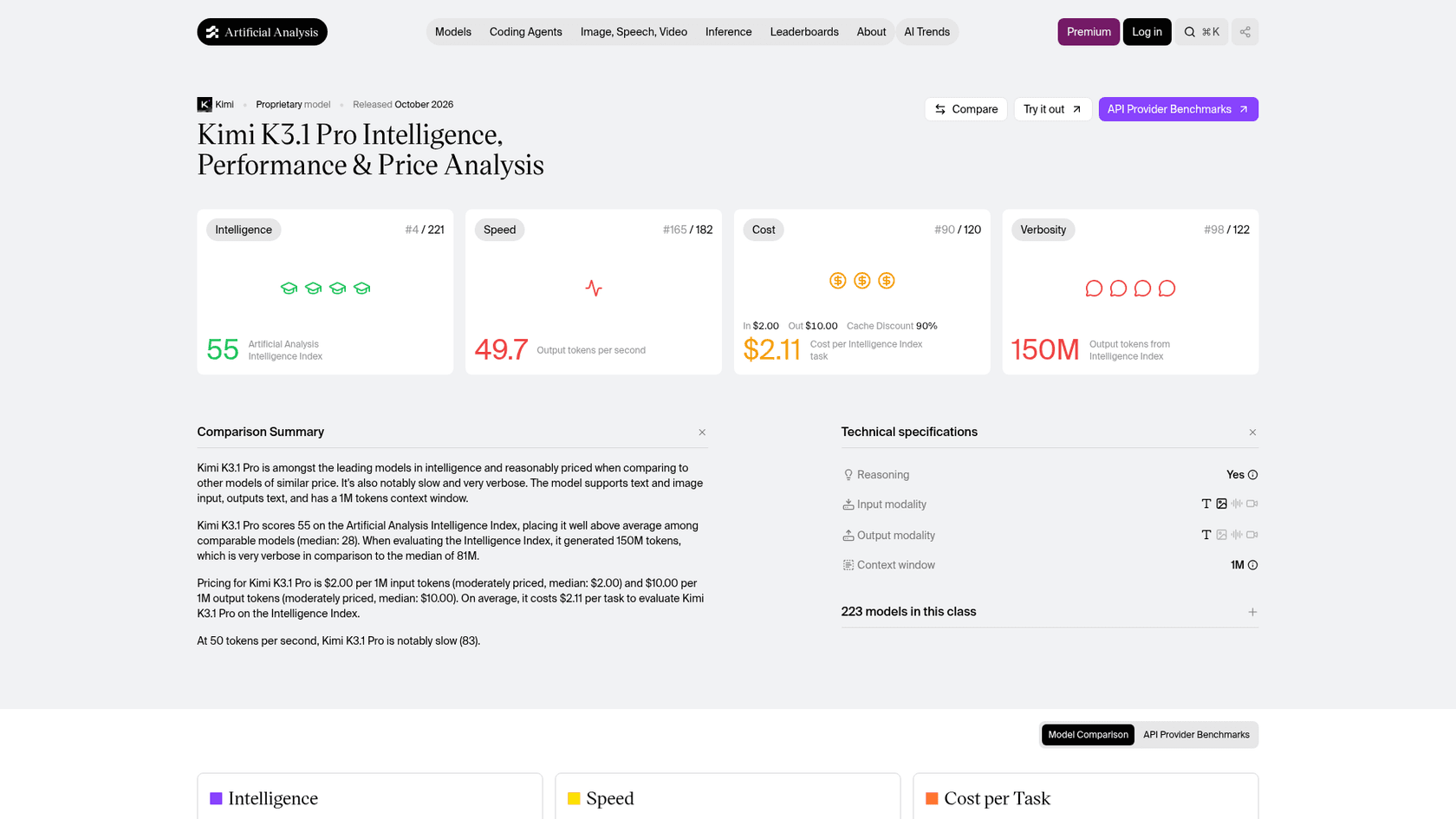
Second, the third-party numbers and the vendor ones don't match exactly. Artificial Analysis puts K3.1 Pro at 67.2% on Terminal-Bench 4.0 and Opus 5.5 (Max) at 59.6%, a much wider win than Moonshot's own 65.7 vs 66.4. Several other headline results (Kimi Code Bench, the finance tests, Kimi Hallu Bench) are internal benchmarks from Moonshot itself. The independent index is the number I'd lean on: 55.1, fourth of 215 models.
Coding and long-running agents
For coding, the pitch is about full projects rather than only patches. According to Moonshot, K3.1 Pro can build games in Unity, Unreal Engine and Godot, and the showcase it picked is a long run on the open-source human-atlas project: 167 missions and 420 independent reviews to build a walking simulator for a body model with 296 skeletal and 402 muscle components. In the end the simulated human went from collapsing within seconds to walking for 11.2 seconds.
On SWE Marathon, which is a long-horizon coding benchmark, it posts 51.7 against Opus 5.5's 46.3. If I had to watch only one result it would be this one, because long tasks are where the price gap with Claude keeps compounding.
3D modeling and design
This part is the most distinctive thing in the launch. K3.1 Pro writes scripts for Blender and CAD software and runs them directly, "without MCP connectors", and Moonshot built a consumer feature around that, called 3D Make.
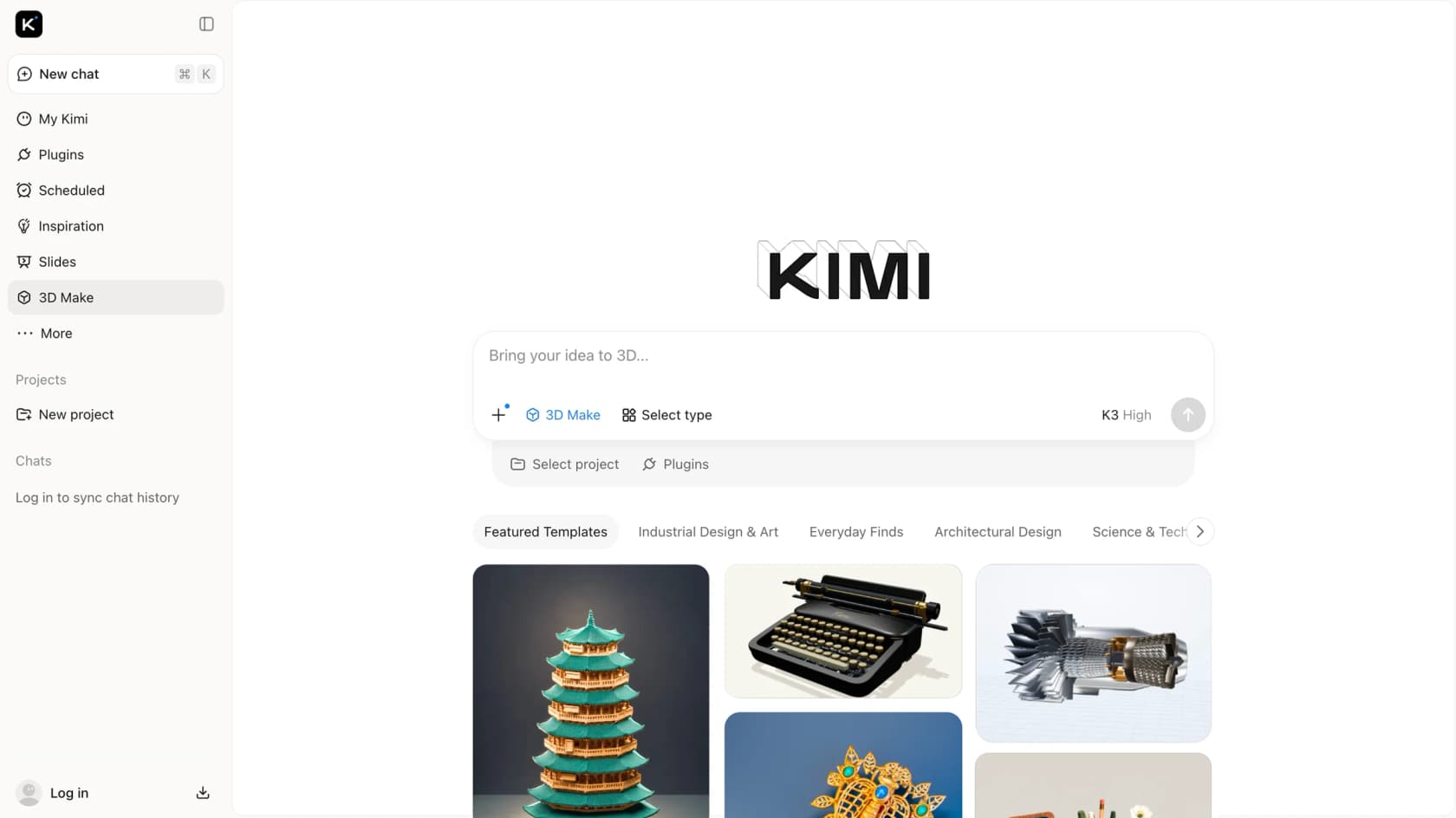
On BenchCAD with tools it scores 92.7, behind Opus 5.5 (96.2) and GPT-6 Astra (95.9). Without tools, it is almost exactly tied with Opus: 72.8 vs 73.0. Moonshot says where it is strongest is parametric work, so mechanical parts and architectural models, plus configurable products and furniture.
Finance work and factual accuracy
Moonshot's finance claim is "hallucination down by 65%". That roughly matches its internal Kimi Hallu Bench, where the share of false claims on a hard test with tools dropped from 23.4% (K3) to 8.3%.
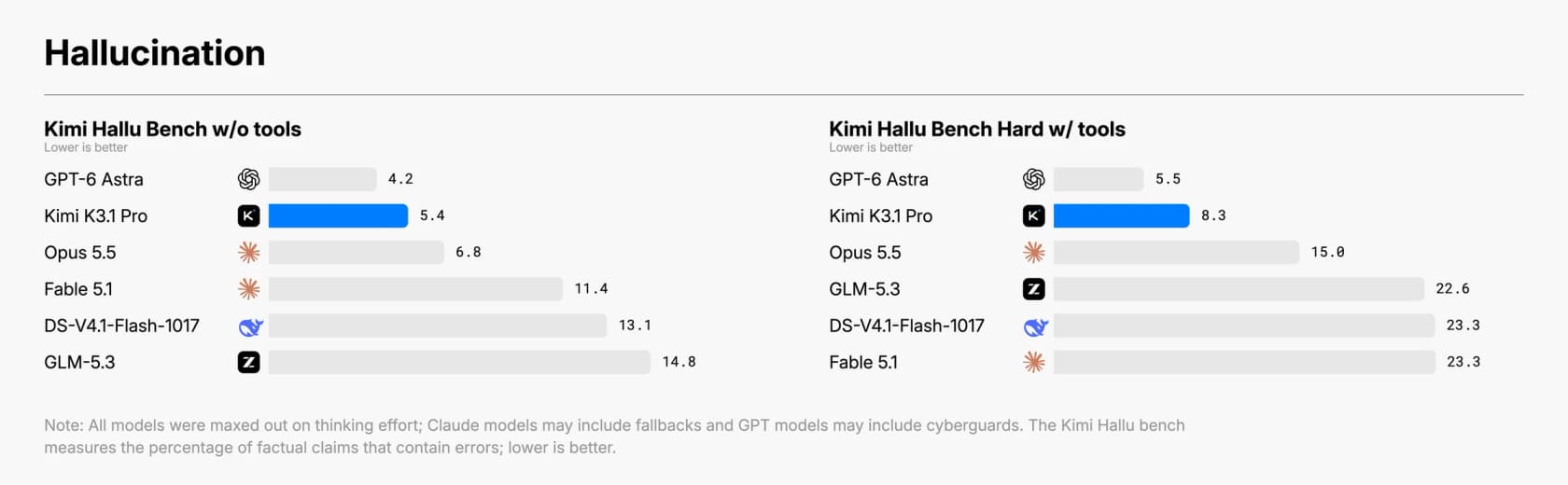
To give credit where it is due, Moonshot also adds that these rates "do not represent overall error rates in daily use." On the independent AA-Omniscience test, K3.1 Pro's hallucination rate is 43.9%. That's better than Opus 5.5 Max (58.6%) but well behind Gemini 4 Argon (15.1%). If a wrong number in a spreadsheet will cost you money, you should still check its work.
How much does Kimi K3.1 Pro cost?
Kimi K3.1 Pro costs $2 per million input tokens, $0.20 per million cached input tokens, and $10 per million output tokens on the Kimi API, and Highspeed doubles that. The prices stay flat across the full 1M context, with "no tiering by context length", per the K3.1 Pro quickstart.
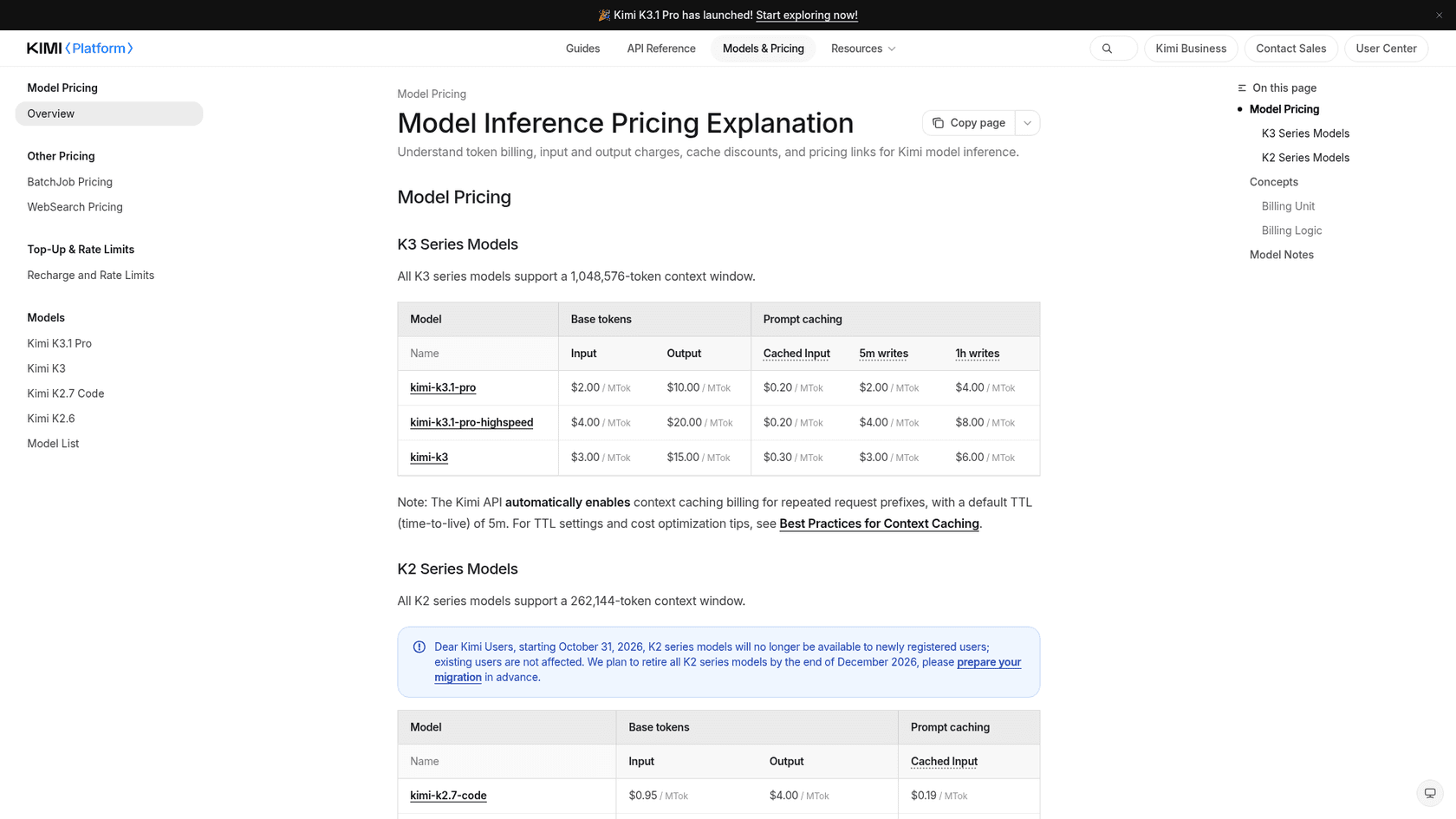
From the Kimi pricing page, per million tokens:
| Model ID | Input | Cached input | Output | Cache write (5 min) | Cache write (1 hour) |
|---|---|---|---|---|---|
kimi-k3.1-pro | $2.00 | $0.20 | $10.00 | $2.00 | $4.00 |
kimi-k3.1-pro-highspeed | $4.00 | $0.20 | $20.00 | $4.00 | $8.00 |
kimi-k3 | $3.00 | $0.30 | $15.00 | $3.00 | $6.00 |
Some billing details that change what you really pay:
- Caching is automatic for repeated prompt prefixes, with a default 5-minute window. Cache hits cost 90% less. When your agent reuses a long system prompt, this ends up mattering more than the headline rate.
- You need a $1 top-up before K3.1 Pro unlocks, and it's your total top-ups that set your rate-limit tier.
- No batch discount yet. The 60% batch price only covers the older K2 models, which close to new users on October 31, 2026.
- K3 is still priced at $3 / $15, so for new work there's not much reason to stay on it.
On the list prices tracked by Artificial Analysis, it matches Claude Sonnet 5.5 pricing, Gemini 4 Argon pricing and GPT-6.1 Sol exactly. It is half of Claude Opus 5.5 pricing at $4 / $20.
Kimi app and Kimi Code plans
If you prefer paying a subscription instead of per token, K3.1 Pro is included in Kimi's membership plans. The prices below are from the Kimi Code page:
| Plan | Monthly | Billed yearly (per month) | K3.1 Pro access |
|---|---|---|---|
| Plus | $19 | $15 | Standard |
| Pro | $39 | $31 | Standard and Highspeed |
| Max | $99 | $79 | Standard and Highspeed |
| Ultra | $199 | $159 | Standard and Highspeed |
Highspeed burns credits at 2x the rate. Kimi renamed the plans recently "with pricing unchanged", and Kimi Code still shares one quota with the rest of the membership. With the new plans the weekly Kimi Code limit is gone but the rolling 5-hour one stayed, and that limit is the loudest complaint up to now (more on it below).
Cheaper per token, not always per task
Here is the part that most of the launch coverage skips. Per token, K3.1 Pro is a third cheaper than K3, but it thinks a lot and it writes a lot. Artificial Analysis rates it "very verbose": it used about 150M output tokens to run the index, against a median of 87M for similar models.
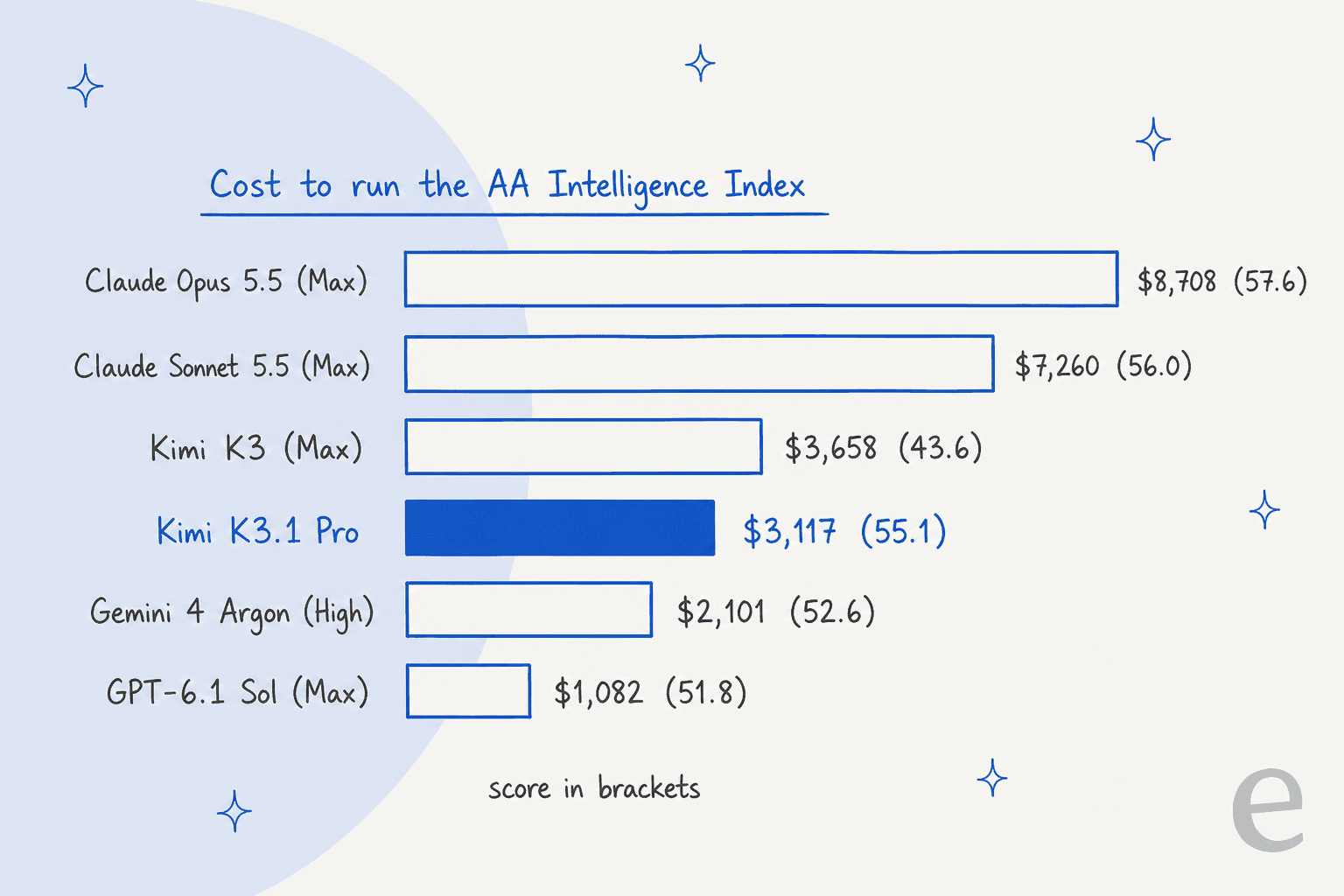
So the more honest way to compare is cost per job:
- Against Claude, it's a real deal. It scores within 2.5 points of Opus 5.5 (Max) for
36%of the cost to run the index, and it costs well under half of Sonnet 5.5 (Max), which burned416Mtokens. - Against K3, the saving is smaller than it looks.
$3,117vs$3,658is about 15% cheaper, and you get a much better model for it. - Against the cheap seats, it isn't the bargain. GPT-6.1 Sol (Max) ran the index for
$1,082and Gemini 4 Argon (High) for$2,101, scoring 3.3 and 2.5 points lower.
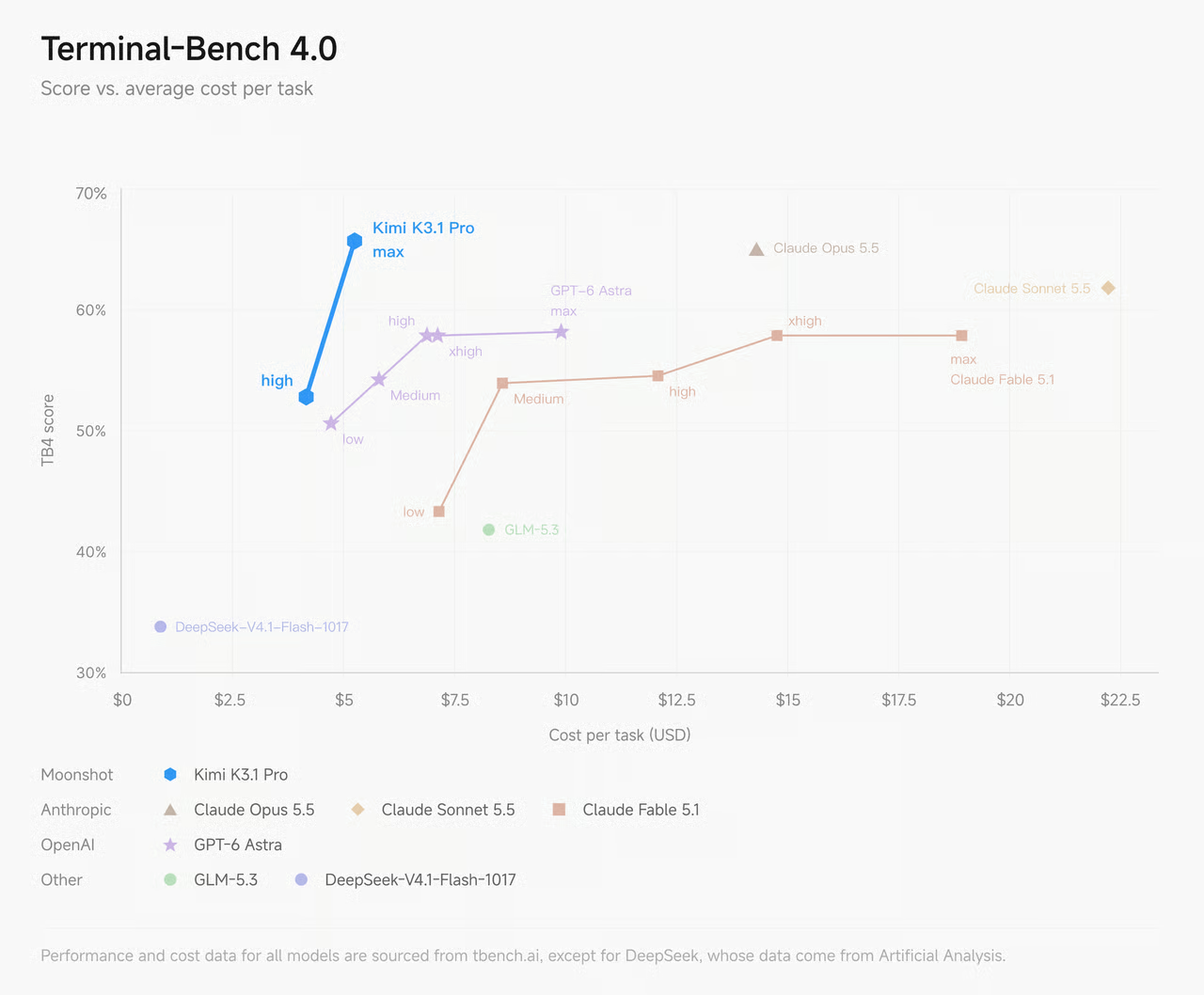
Moonshot's own chart does the Claude comparison on Terminal-Bench, where K3.1 Pro at max effort comes in around $5 per task against roughly $14 for Opus 5.5:
Nathan Lambert, a researcher at Ai2, pointed out the same trade-off on the launch day:
"K3.1 is also cheaper than K3 per token, but some benchmarks in the blog show it uses meaningfully more tokens per answer, so it may be about the same price."
Is Kimi K3.1 Pro open source?
Not yet. Moonshot says "Full model weights will be released by Nov 4, 2026", and as of October 27 there isn't any Hugging Face repo for it yet. For now Artificial Analysis lists it as a proprietary model, and the API is being served by 5 providers against 20 for K3.
Moonshot does have a track record here: K3's weights did go up on Hugging Face, and the K3 repo shows about 2.78T parameters in 8-bit. You can expect K3.1 Pro to be similar, meaning that running it yourself is a job for a server cluster and not for a laptop.
"a 3T parameter model is still a bit beyond even many enthusiasts for running locally."

The license terms for K3.1 Pro are not published yet. K3's license allowed commercial use with some restrictions, so do read the new one before building on it. If you need an open model you can deploy today, DeepSeek V4.1 Flash scores 45.1 on the same index at a fraction of the cost.
How fast is Kimi K3.1 Pro?
Slow. Artificial Analysis measures 49.7 output tokens per second on the Kimi API, which ranks #165 of 182 models, against a peer median around 83. The time to first token is fine, at 2.95 seconds. Where it hurts is how long it keeps on writing, an average index task took about 17 minutes.
In practice it is still an improvement over K3, since K3.1 Pro wastes less time on thinking. One developer measured this:
"Biggest gripe with K3 was slow responses, partly due to inefficient thinking. So far K3.1 pro is almost twice as fast as k3 on our benchmark."
Moonshot's answer to that is Highspeed: "2-3× the speed" at twice the price. Artificial Analysis has not benchmarked it so far, and the reaction on launch day was lukewarm:
"I'll wait for the openweight... btw double the price for 67 TPS... Hardly 'nitro'."
My take on it: for background agents that run an hour while you are doing something else, speed barely matters, so the standard model is the right call. For anything where a person is waiting, like a chat window, either pay for Highspeed or go with a faster model.
What are developers saying about Kimi K3.1 Pro?
The launch thread on Hacker News drew 1,089 points and 674 comments, and the reaction split quite cleanly. Nearly everyone agrees it is a big step up from K3 and also the best open-weight model announced so far, while most of the daily coders still say Claude Opus 5.5 is ahead in practice.
The most positive of the independent tests compared it on 180 code-generated paintings:
"It also does this while thinking less (~6.5k reasoning tokens vs ~8k for K3). Kimi K3.1 is roughly 2/3 the cost of Kimi K3 and ~1/3 the cost of Opus 5.5."
On the negative end, one tester ran it against 105 planted bugs in two real repos, and there it scored 36 against 41.7 for Opus 5.5:
"I'm sorry. Considering the cost, I see no reason to use this model."
The hobby benchmarks land somewhere in the middle, about level with Fable 5.1 and Gemini 4 Argon:
"Ran it on my adversarial programming language (KillSwitch) benchmark[1]. Very significant improvement over K3. On par with Gemini 4 Argon and Fable 5.1. Much slower than both though."
And then you have the usage limits, which took over the thread more than the model quality did:
"Bought the $100/month subscription and hit my 5-hour limit with one prompt on default settings (max effort) in their CLI harness. It might be smart but it's unusable compared to other subscriptions right now."
If you plan to use it through a Kimi Code subscription, lower the reasoning effort before you judge the plan. The API supports low, high and max, and max is what it defaults to. One commenter running it with lighter subagents reported using only 22% of a weekly quota over an 8-hour session, so the setup changes the picture quite a lot.
How do you get access to Kimi K3.1 Pro?
There are four routes in total, and the one that fits will depend on what you are building.
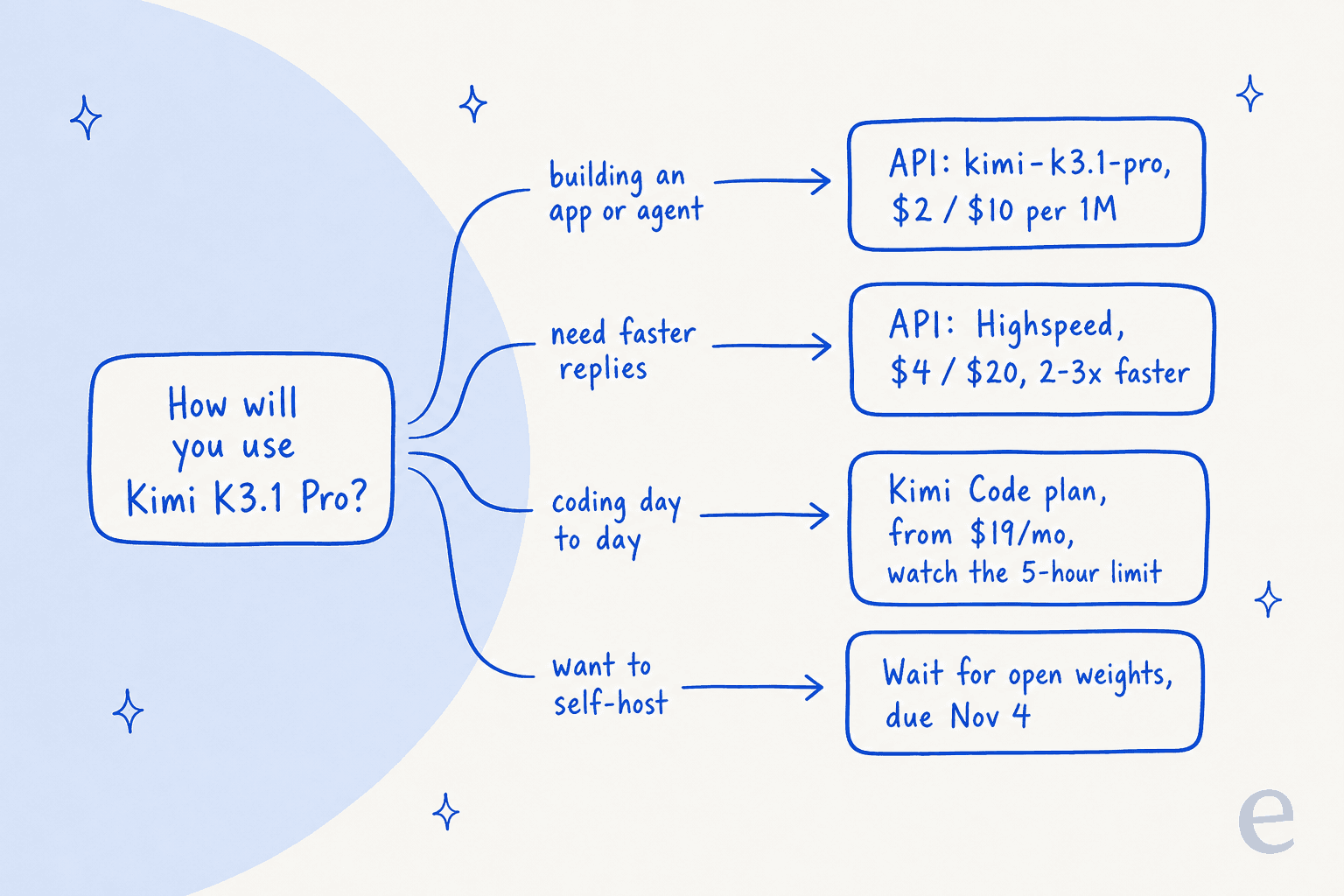
- Kimi API. Use the model IDs
kimi-k3.1-proorkimi-k3.1-pro-highspeedon the Kimi API Platform. Reasoning is always on,reasoning_efforttakeslow,highormax, and output defaults to131,072tokens (settable up to the full 1M). Zero Data Retention is available for API customers. - OpenRouter. It is listed as
moonshotai/kimi-k3.1-pro, with Moonshot as the only provider for now. It's handy if you already route between models, and also useful when you compare it against a free AI API tier. - Kimi Code. You pick it with
/model. This is Moonshot's own coding agent, running on desktop, CLI and IDE plugins, and it competes directly with Claude Code and with Moonshot's earlier Kimi K2.7 Code model. - Kimi apps and Kimi Work. This is the consumer route, and it includes 3D Make. Kimi Work needs desktop version
3.1.0or later. On Kimi Enterprise, K3.1 Pro is off by default, so admins need to switch it on.
Who should use Kimi K3.1 Pro?
This is where I land after going through the docs and the benchmarks, plus the first few hundred reactions from developers.
Pick it if you run long, unattended agent jobs (coding, research, spreadsheet-heavy finance work) where you would otherwise pay Claude prices and you can wait for the results. Quality is close to Opus at roughly a third of the run cost, and there is no long-prompt surcharge on the 1M context. It's also the one to keep an eye on if you need a frontier-class model you can eventually host yourself.
Skip it if a person waits on every reply, because at 50 tokens per second live chat and quick back-and-forth coding feel sluggish. You can skip it as well if you are cost-first more than quality-first: GPT-6.1 Sol and Gemini 4 Argon finish the same benchmark work for less. And if you're weighing it against other open models, my Qwen 3.8 Max vs K3 comparison and the Kimi K3 alternatives list still hold for the wider field.
The deciding factor is whether your workload is long-and-patient or short-and-interactive, and K3.1 Pro is built for the first kind.
What Kimi K3.1 Pro means for support teams
Many people who read launch posts like this one have a narrower question in mind, which is: should my support agent run on this? I think it's the wrong first question. A model like Kimi K3.1 Pro is an engine. To answer tickets with it you would still need to connect it to your helpdesk and sync your help center and past tickets, then decide what it can do on its own and what it hands over to a person, and also test it before customers ever see it. I've seen confident-sounding bots give wrong answers on live queues, which is why eesel simulates every rollout against a team's own historical tickets first.
That layer is exactly what eesel is. You hire a ready-to-work AI helpdesk teammate that joins your existing queue in Zendesk, Freshdesk or Gorgias, learns from your docs and past tickets, then follows the handoff rules you write in plain English. If you're comparing the broader category, my AI employee explainer covers the difference between hiring a teammate and building one.
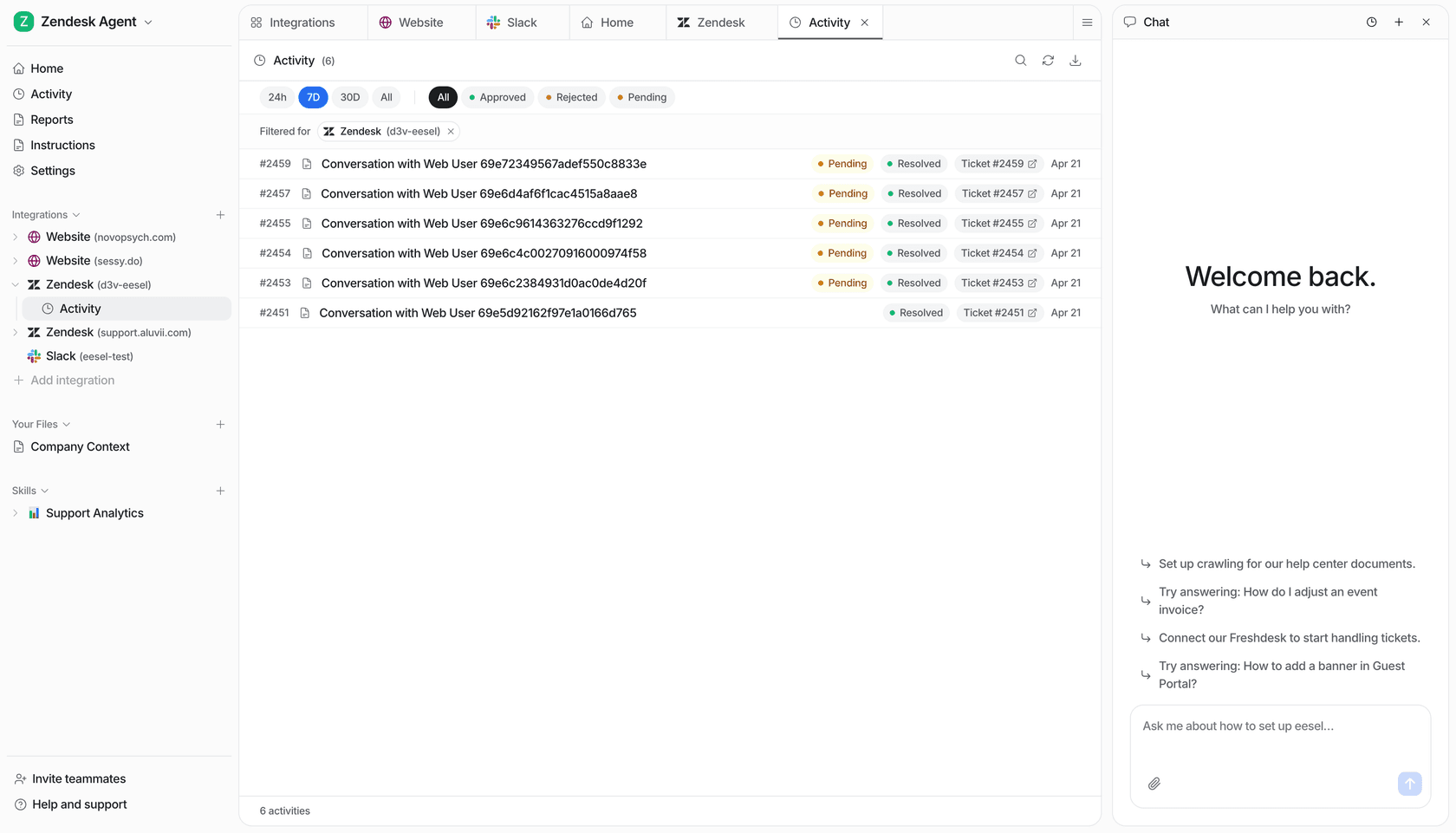
SE Ranking gives a good picture of how that looks in production. It runs three products (SE Ranking, Planable and SE Visible) out of one Zendesk team, with one eesel agent per product. Each agent searches about 16,800 pages of help center and website content before it answers, replies to live chat in the customer's language, and hands refunds, trial extensions and Tier 2 questions to a person with the customer's details attached. Between August 8 and September 8, 2026, it handled about 4,650 conversations. None of this depends on which model happened to score highest last week.
If Kimi's agent-first angle appeals to you, the eesel CLI brings it to support. You can run the same teammate from a terminal, for example to check its recent work with eesel activity or approve and deny pending actions with eesel approvals, and you can edit its standing rules with eesel instructions too. The commands print JSON and the write commands support --dry-run, which means scripts and coding agents like Claude Code are able to drive it, and there's an MCP server too. I cover the wider pattern in my guide to the AI agent CLI.
Want the result without the model shopping? Try eesel free on your own helpdesk and see how it deals with last week's tickets, or browse through the best AI teammates to compare the options first.
Frequently Asked Questions
What is Kimi K3.1 Pro?
Kimi K3.1 Pro is Moonshot AI's flagship model, launched on October 23, 2026. It is the same 2.8T-parameter base as Kimi K3 with much more post-training, a 1M-token context window, and a faster Highspeed variant. It scores 55 on the Artificial Analysis Intelligence Index, close to Claude Opus 5.5.
How much does Kimi K3.1 Pro cost?
On the Kimi API, Kimi K3.1 Pro costs $2 per million input tokens, $0.20 for cached input, and $10 per million output tokens. The Highspeed version is $4 and $20. That is a third cheaper than Kimi K3 pricing and the same list price as Claude Sonnet 5.5.
Is Kimi K3.1 Pro open source?
Not yet. Moonshot says the full Kimi K3.1 Pro weights will be released by November 4, 2026, and until then it is API and app only. At 2.8T parameters it will need a server cluster, not a laptop. If you want an open model you can run today, my roundup of open-source AI agents covers the options.
Is Kimi K3.1 Pro better than Claude Opus 5.5?
On Moonshot's own chart, Kimi K3.1 Pro wins 6 of 14 benchmarks and trails Opus 5.5 on Terminal-Bench 4.0 by 0.7 points. On Artificial Analysis it scores 55.1 vs 57.6. Independent testers mostly say Opus is still ahead in daily use, but Kimi costs about a third as much to run. My Claude Opus 5.5 review covers the other side.
What is Kimi K3.1 Pro Highspeed?
Kimi K3.1 Pro Highspeed is the same model served 2 to 3 times faster, at double the price: $4 input and $20 output per million tokens. On Kimi's consumer plans it needs the Pro tier or higher and uses credits twice as fast. It matters most for chat and coding loops where waiting hurts, like work in Claude Code.
How do I use Kimi K3.1 Pro in Kimi Code?
Kimi K3.1 Pro is available in Kimi Code on the Plus plan ($19/month) and up. Run Kimi Code and switch with the /model command. Watch the rolling 5-hour usage limit, which testers hit quickly at max effort. For more options, see my list of AI coding assistants.
Can I use Kimi K3.1 Pro for customer support?
You can, but Kimi K3.1 Pro is a raw model, so you would still build the helpdesk connection, knowledge sync, handoff rules and testing yourself. Its 50 tokens per second is also slow for live chat. A ready-made AI customer support teammate like eesel handles that layer, and my guide to the best AI model for support tickets compares the engines.