


DeepSeek V4.1 Flash is a rare release where the newer model is cheaper and better than the tier it replaces. It landed on 10 September 2026 as deepseek-flash, a 552B-parameter model with native vision, and DeepSeek is retiring its own V4 Pro because this smaller model beats it on most tests.
The price is the headline: off-peak, $0.15 per million input tokens and $0.60 per million output, which undercuts the outgoing V4 Flash and runs about a third of V4 Pro. The clever part is the architecture, which shrinks the memory cost of long contexts down to 890 bytes per token.
For builders shipping cheap agent tasks, this is genuinely exciting. For anyone thinking about pointing it at customer conversations, the model is the easy part. The knowledge, guardrails, and testing around it are what actually make a support agent work, and that is where a raw API model leaves you the most to do.
I build AI agents at eesel, so I spend a lot of my week watching what happens when a model meets a real support queue instead of a benchmark. The short version of what we have learned running AI across thousands of live tickets: a confident-sounding model that is wrong is worse than no model at all, which is why I read a launch like this for what it changes in production, not just what it scores. DeepSeek V4.1 Flash changes a lot on cost and speed, so it is worth a proper look.
What actually changed with V4.1 Flash
DeepSeek shipped V4.1 Flash on 10 September 2026 and called it "the smallest model in our new architecture family, with native visual understanding." That phrasing matters: this is not a tweak of last month's model, it is a new design, and it comes with a bit of housekeeping.
The tidy-up is the interesting bit. DeepSeek is collapsing three models into one. The old deepseek-v4-flash and the experimental deepseek-v4-flash-vision-exp are both retired and now route to V4.1 Flash. More surprisingly, the flagship V4 Pro is being phased out too: from 04:00 UTC on 14 September 2026, every deepseek-v4-pro request gets served by V4.1 Flash at Flash prices until a future V4.1 Pro ships. DeepSeek's reasoning is blunt, that the smaller model has "comprehensively surpassed" the bigger one.

Not everyone loved the routing part. The loudest reaction on Hacker News was not about the model at all, but about swapping paying customers onto a different one without a deprecation window:
"If I'd carefully tested and optimized prompts against Pro I wouldn't be keen on this particular news. I feel like API model providers should lean towards not swapping out models on their paying customers, no matter how much "better" the new model is meant to be."

It is a fair gripe, and one worth remembering if you pin models in production. The counter-argument, also fair, is that DeepSeek is a small lab that can realistically host one frontier model at a time, and it does open-source every version, so anyone who needs a frozen target can self-host the exact weights forever. Either way, if you build on the DeepSeek API, treat "the model can change under me" as a real design constraint, the same way you would with any hosted LLM.
The architecture: why a bigger model got faster and cheaper
Here is the part I find genuinely clever, and it is worth understanding because it explains the price. Most models keep one big pile of parameters active the whole time they read your prompt and write their answer. V4.1 Flash splits that job in two with what DeepSeek calls a Causal Encoder-Decoder architecture. A 20-layer encoder reads your input using just 8 billion active parameters, then a 20-layer decoder writes the reply using 16 billion. The full model is 552B parameters, but only a sliver is ever switched on at once.

The reason to care about "8B to read" is that agent work is input-heavy. When your model is chewing through a long ticket history, a knowledge base, and a pile of tool definitions, most of the tokens are input, and V4.1 Flash reads them cheaply.
The other half of the trick is the KV cache, the running memory a model keeps as it works through a long context. This is usually the thing that makes long-context calls expensive and slow. DeepSeek got its cache down to 890 bytes per token, which it says is about a quarter of V4 Flash's and roughly 437 times smaller than its original V1 model. In hardware terms that is a quarter of the high-bandwidth memory and an eighth of the SSD footprint of the previous generation.

That compression is the whole reason DeepSeek could raise the parameter count and still cut the price. It also shows up as speed. Operators testing the preview reported eye-watering throughput:
"I've been trying out the 4.1 flash preview for some bulk tasks [...] I was getting something like 300-400 tok/s which was just insanity. It was running so much faster than the toolcalls themselves."
At 250 to 400 tokens per second, several people pointed out that Gemini Flash is no longer the fastest option for high-volume work. The model also keeps DeepSeek's continuously adjustable reasoning effort, an integer dial from 1 to 100 that trades cost for accuracy. One honest ergonomics complaint: in practice the API's presets jump from "low" straight to "high" and "max", and people want a proper "medium" because high burns tokens fast.
Benchmarks: better than V4 Pro, short of the frontier
DeepSeek's own comparison table is the clearest picture, and I will take it at face value while flagging that these are vendor-reported numbers.

The story the table tells is consistent. On agentic and coding work, V4.1 Flash tends to top the group: Terminal-Bench 2.1 at 90.6, DeepSWE at 74.2, a Codeforces rating of 3471, and HLE-with-tools at 63.9, which nudges past Claude Opus 5's 63.6. It clears V4 Pro on nearly every shared row, which backs the decision to retire Pro.
The honest caveat is raw reasoning without tools. On Humanity's Last Exam, V4.1 Flash scores 36.8 (39.1 on the text-only slice), well under GPT-5.6 Sol at 44.5 and Claude Opus 5 at 56.3. So this is a superb tool-using workhorse, not a new reasoning champion. That matches what people actually report using it for:
"I used a lot V4 flash to implement plans built by other models, and it was honestly top notch. The thing was a workhorse."
Reddit's take on the benchmark thread was similar: impressed by the efficiency, sceptical that a Flash model truly outclasses a giant like Kimi K3 in day-to-day use. That skepticism is healthy. Benchmarks oversample tidy puzzles and undersample messy real work, and support tickets are about as messy as work gets.
DeepSeek V4.1 Flash pricing
Price is where this release earns its attention. The rates below are per million tokens, and DeepSeek runs a peak/off-peak schedule where off-peak is exactly half of peak.

| Meter (per 1M tokens) | Off-peak | Peak |
|---|---|---|
| Input, cache hit | $0.003 | $0.006 |
| Input, cache miss | $0.15 | $0.30 |
| Output | $0.60 | $1.20 |
| Context window | 1M | 1M |
| Max output | 384K | 384K |
| Concurrency | 2,500 | 2,500 |
A few things worth knowing. Peak hours are 01:00-04:00 and 06:00-10:00 UTC on weekdays, which map to Chinese business hours, so a US or European support queue mostly bills at the cheaper off-peak rate. It is a real saving and a slightly fragile one, since your bill quietly depends on the clock. The model also supports tool calls, JSON output, the OpenAI Responses API, and an Anthropic-format endpoint, and it allows 2,500 concurrent requests versus V4 Pro's 500.
For context, the outgoing V4 Flash cost $0.22 off-peak on a cache miss and $0.66 on output, so V4.1 Flash is a genuine price cut on top of a capability bump. Community members ran the numbers against the obvious rival and were blunt about the result:
"The direct competition is Gemini Flash, and these models are much better on agentic tasks with fraction of the task price compared to Gemini... 20-30% of the price per task. And especially Deepseek Flash produces better quality than Gemini does."
To see what that means for your own workload, here is a rough monthly estimator. Plug in your token volumes and it does the arithmetic.
What people are actually saying
Beyond the price-and-speed excitement, a few themes are worth flagging before you build on it.
The first is size. The old V4 Flash was 284B and reasonable to run locally. V4.1 Flash is nearly double that, which sparked a fun debate about whether it still counts as "Flash":
"The bad news is that the original v4 flash was 284B, which was large but still somewhat reasonable for running locally. This one is 552B so almost twice that [...] it's not really flash anymore, imo... it's probably the newest king of the hill amongst open weights models."
If you do want to self-host the MIT weights, budget for it. One commenter's math put it at about 384GB of memory, roughly a quad RTX PRO 6000 setup. That is a serious box, though still cheaper than a developer's salary if the workload justifies it. For most teams, open-source options that fit smaller hardware are a saner starting point.
The second is the "answers in Chinese" quirk that keeps coming up:
"the web ui chat version of flash has very poor language following abilities in my experience: You may ask it something in English, and get a thinking chain in Chinese with an answer in Chinese."
The useful nuance here is that people repeatedly pin this to the web UI and to cheap third-party providers running low quants, not to DeepSeek's own API. If you call the first-party API, you are much less likely to hit it, but it is a reminder that where you run the model matters as much as which model it is.
Should you point V4.1 Flash at customer support?
This is the question I actually care about, and the answer is a clear "as an engine, yes, but with your eyes open."
The strengths are real. It is cheap, fast, has a 1M-token context, reads images, and ships under an MIT license you can self-host. For high-volume, well-scoped tasks, that is a great combination, and it is exactly the kind of model I would happily route repetitive work to.

The cautions are just as real, and they are about data, not quality. DeepSeek's paid API terms do not spell out whether your inputs are used to train the model, there is no published zero-retention option or data processing agreement, and requests are processed in the PRC. For a support queue full of customer names, order details, and personal information, that is a compliance conversation you want to have before, not after. If this is your world, our write-up on SOC 2 and GDPR for support chatbots is a good primer, and the same questions we raise about AI data privacy apply to any hosted model.
The bigger point, though, is one I keep coming back to after years of shipping this stuff: the model is maybe 2% of what makes a support agent good. The other 98% is whether it has the right company knowledge, whether it knows when to stop and hand off to a human, whether it can actually take actions in your helpdesk, and whether you tested it before it faced a customer. A brilliant, cheap model wired up carelessly still gives confident wrong answers, and we have watched exactly that happen enough times to build our whole product around preventing it.
Try eesel
DeepSeek V4.1 Flash is infrastructure. It is a fantastic engine, but an engine is not an employee. eesel is an AI teammate platform: instead of a raw model you have to wrap in knowledge, guardrails, and integrations, you hire a ready-to-work teammate for a specific job. The AI helpdesk teammate joins your existing queue, learns from your past tickets and help center, and knows when to escalate, so the model underneath is a detail you do not have to manage.
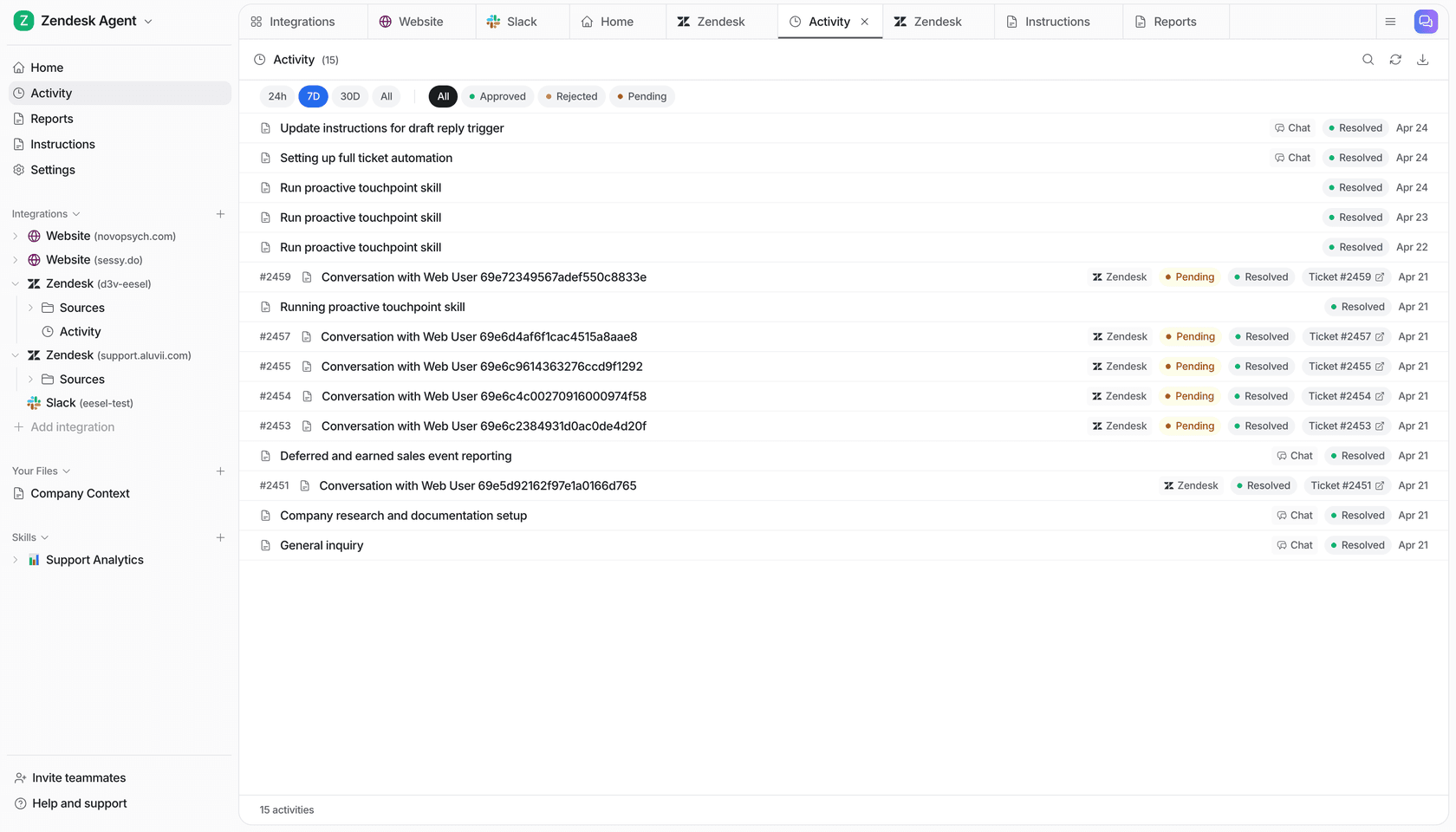
Because posts about a new model tend to attract people who like working in a terminal, one thing worth calling out: eesel is not a dashboard-only product. It ships a real command-line interface, @eesel/cli, and every workspace is also an MCP server. That means a person can drive the same teammate from a terminal, scripts can automate it in CI, and coding agents like Claude Code or Cursor can operate it directly, the same way you would manage agents from the terminal. You can connect an integration, edit the standing instructions, run a simulation against your real ticket history to check answer quality, and inspect every run with eesel activity, all without opening a browser. It is the API-first way to run support that a lot of DeepSeek's audience will feel at home in, documented in the eesel CLI docs.
Pricing is one fixed monthly price, from $299/month for 500 credits (1 credit per ticket or chat) with no per-seat fee, and there is a free plan with 100 credits so you can point it at your own tickets before committing. If you have been eyeing a cheap model to cut support costs, that simulation step is the part I would not skip: try eesel and see the real answer quality on your own data first.
Frequently Asked Questions
What is DeepSeek V4.1 Flash?
DeepSeek V4.1 Flash is DeepSeek's newest open-weight model, released on 10 September 2026 and callable on the API as deepseek-flash. It is a 552B-parameter mixture-of-experts model with native image input, and DeepSeek says it beats the older DeepSeek V4 Flash and even the V4 Pro tier it is replacing.
How much does DeepSeek V4.1 Flash cost?
Off-peak, it is $0.15 per million input tokens on a cache miss, $0.003 on a cache hit, and $0.60 per million output tokens. Peak hours (01:00-04:00 and 06:00-10:00 UTC on weekdays) double those rates. That is cheaper than the outgoing V4 Flash and far cheaper than V4 Pro. See the DeepSeek V4 Flash pricing post for how the earlier tier compared.
Is DeepSeek V4.1 Flash better than DeepSeek V4 Pro?
On DeepSeek's own benchmark table it edges out V4 Pro on most agentic and coding tests while costing roughly a third as much, which is why DeepSeek is retiring V4 Pro. On raw reasoning without tools it still trails frontier models like Claude Opus 5. For a heavier head-to-head, see DeepSeek V4 Flash vs GPT-5.6.
Can I run DeepSeek V4.1 Flash locally?
Yes, the weights are MIT-licensed on Hugging Face, so self-hosting is allowed. The catch is size: at 552B params it needs roughly 384GB of memory (think a quad RTX PRO 6000 rig), so it is no longer casual laptop hardware. If you want a lighter starting point, browse open-source chatbot platforms.
Is DeepSeek V4.1 Flash safe for customer data?
Its paid API terms do not spell out whether your inputs are used for training, there is no published zero-retention option or DPA, and data is processed in the PRC. For regulated support work, read up on SOC 2 and GDPR for support chatbots before pointing it at real tickets.
Does DeepSeek V4.1 Flash support vision?
Yes. Vision is now native to the mainline model, replacing the earlier experimental V4 Flash Vision build. It can read images and text together, though some users note the DeepSeek harness does not yet expose an image tool for every flow.
Should I use DeepSeek V4.1 Flash for customer support?
As a raw model it is a strong, cheap engine, but a support agent needs company knowledge, guardrails, testing, and helpdesk actions on top. A platform like eesel handles that layer, and its AI helpdesk teammate plugs into your existing tools rather than leaving you to wire a model up yourself.