


What is my verdict on MiniMax M3.1 Flash?
I spend most of my week looking at what people search before they buy, and the searches around this launch are blunt: "is M3.1 Flash better than DeepSeek", "is it open source", "what does it cost". This review answers those, in that order. If you want the plain spec sheet from the preview days, my colleague's M3.1 Flash overview still covers the effort dial and the 1M context.
I also sit on a team that has run AI on live support queues for years, and that history shapes how I score a model. A cheaper model makes "build it ourselves" sound easy. One churned mid-market customer told us exactly that on the way out:
"We switched to a system that is working well at half the cost. But long term we will just build our own, which is so possible now with AI."
Models like M3.1 Flash are why that sentence feels true. Whether it is true depends on everything around the model, so I score both the engine and how far it gets you.
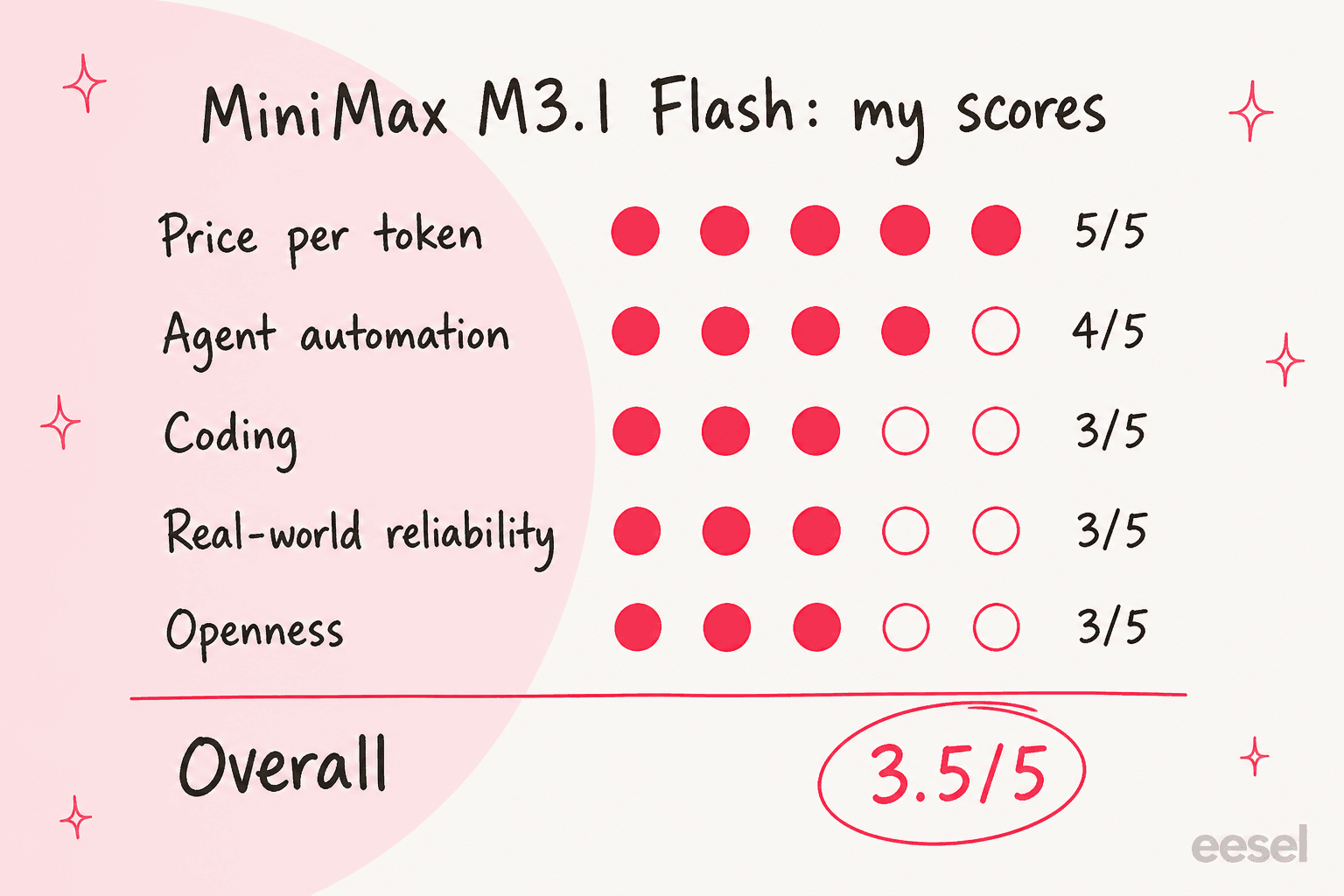
| Area | Score | Why |
|---|---|---|
| Price per token | 5/5 | $0.15/$0.60 flat across 1M tokens, half of MiniMax M3's short-context rate |
| Agent automation | 4/5 | Best on Automation-Bench in MiniMax's table, ties Opus 5 on BankerToolBench |
| Coding | 3/5 | Trails DeepSeek V4.1 Flash 1017 on DeepSWE, Terminal-Bench 4.0, and NL2Repo |
| Real-world reliability | 3/5 | Early testers report laziness and wandering at high effort |
| Openness | 3/5 | Weights promised for October 23, not out yet |
| Overall | 3.5/5 | A strong cheap engine for agent loops, not the cheap coding king |
These scores are mine. They come from MiniMax's launch post, its docs and pricing pages, rival price pages, and what developers posted in the first 24 hours.
What actually launched on October 19?
The preview I wrote about in September is gone. MiniMax's docs now list MiniMax-M3.1-Flash as the latest M-series model, and the M Plan docs say the old MiniMax-M3.1-Flash-Preview name has been retired, with requests now served by the new model. It also confirmed the rumour from the stealth period: "Space Bunny", the anonymous model that processed over 200 trillion tokens, was an early version.
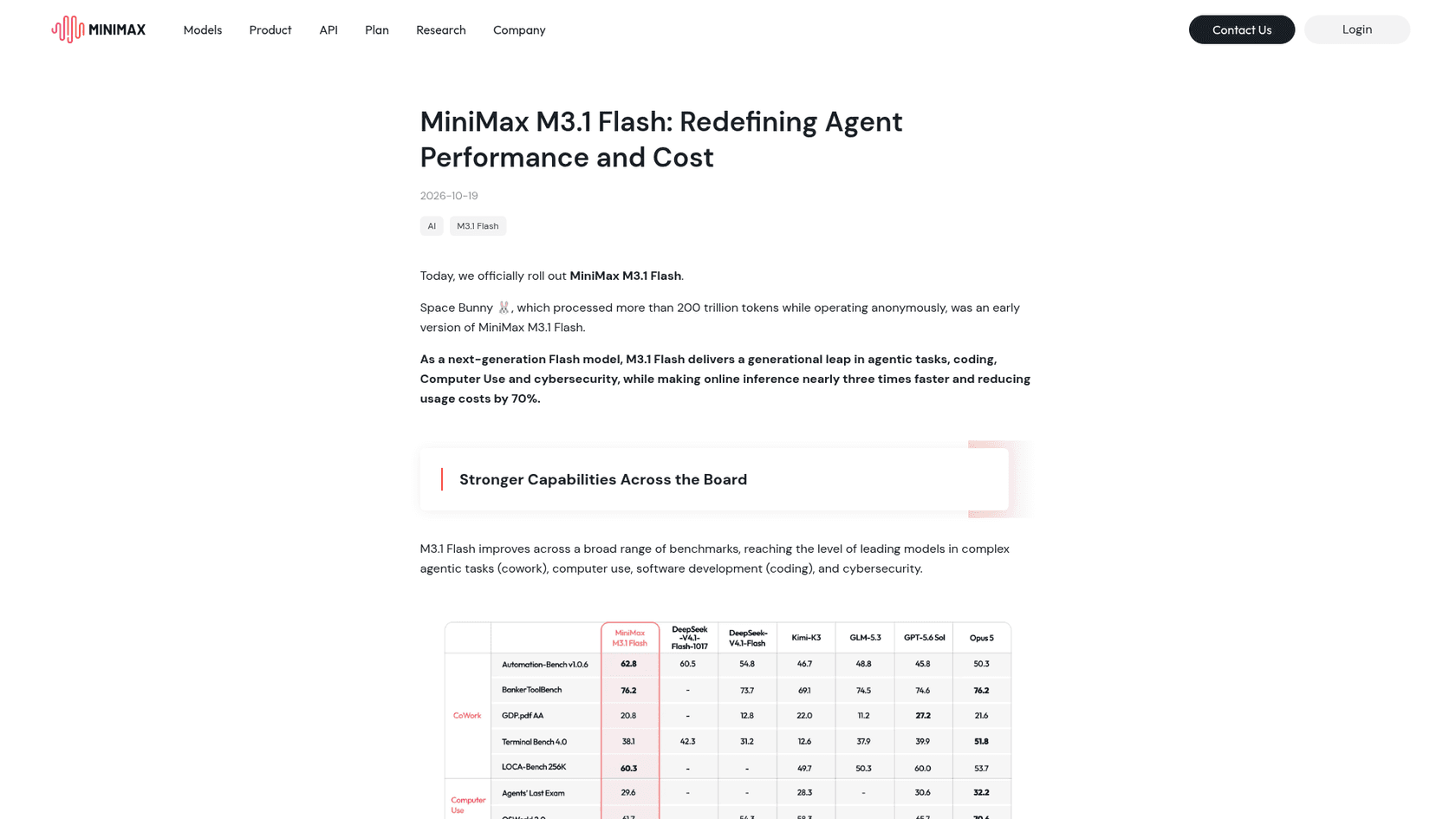
Here is what changed between the preview and the general release:
| Preview (Sept 27) | General release (Oct 19) | |
|---|---|---|
| Model id | MiniMax-M3.1-Flash-Preview | MiniMax-M3.1-Flash |
| Where | MiniMax Code and Token Plan only | API, M Plan, and MiniMax Code |
| Per-token price | None published | $0.15 in / $0.60 out / $0.015 cached |
| Speed claim | None | 200+ tokens per second, P50 170+ |
| Benchmarks | None | 15-row table vs six rivals |
| Weights | None | Promised for October 23 |
Three things stayed the same, and they still shape how you use it. The context window is 1,000,000 tokens. Input can be text, images, or video. And thinking is always on: you set effort from low to max (default max), and sending effort: "none" returns a 400 error, per the text generation docs.
One more detail matters for anyone planning to self-host. The "Flash" name does not mean small. MiniMax's Code page lists a mixture-of-experts design with 428B total parameters and about 23B active, which is the same size class as MiniMax M3. A Reddit commenter put it well:
"yeah fair point, the "flash" name is kinda misleading. same 428b / 23b active as m3, so if you could run m3 you can run this."

Where does it win?
The wins cluster in office-style agent work: multi-step tasks across business software, chained tool calls, and long documents. MiniMax's own table is the source here, so read these as vendor-reported scores.
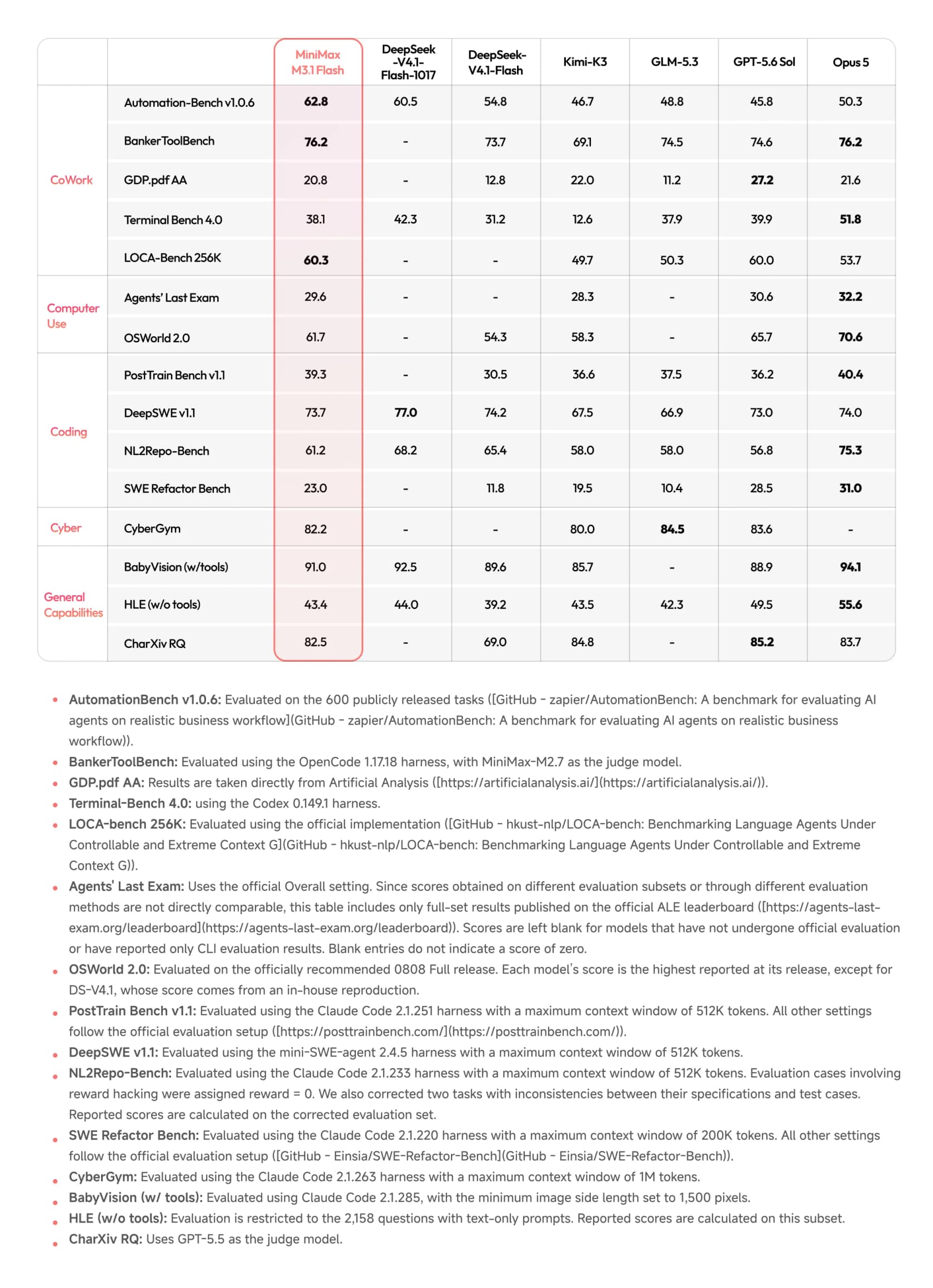
- Automation-Bench
62.8, the top score in the table, ahead of DeepSeek 1017 (60.5), Claude Opus 5 (50.3), and GPT-5.6 Sol (45.8). MiniMax describes it as real workflows across sales, marketing, operations, customer service, finance, and HR. - BankerToolBench
76.2, a tie with Opus 5 and ahead of Kimi K3 (69.1). - LOCA-Bench 256K
60.3, the best long-context agent score in the table. - CyberGym
82.2, behind only GLM-5.3 (84.5) and GPT-5.6 Sol (83.6).
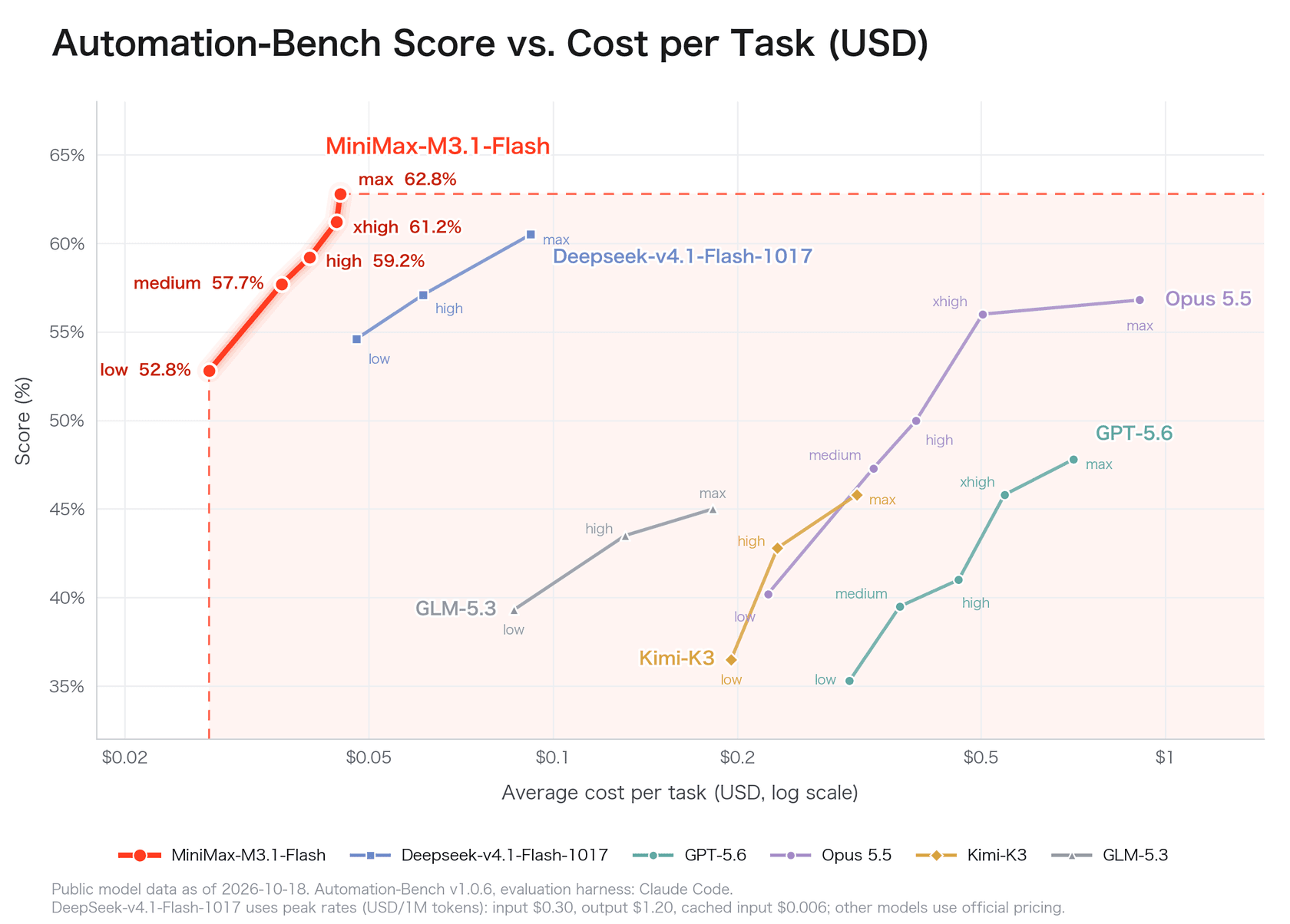
The cost charts are where M3.1 Flash looks best. On MiniMax's Automation-Bench chart, M3.1 Flash at max effort lands at 62.8% for roughly $0.045 per task, and even low effort scores 52.8%, above GPT-5.6, Kimi K3, and GLM-5.3 at their best settings. On the Agents' Last Exam chart, it hits 29.6% for $111 in total, the cheapest point on the frontier.
Speed is the other win. MiniMax says output reaches 200+ tokens per second, with a median of 170+, nearly three times faster than M3. Early users backed up the feel of it, if not the exact number:
"first impression of minimax m3.1 flash been using model for the last few hours and it's a huge step up from m3. pretty good for flash model"
Where does it trail DeepSeek V4.1 Flash 1017?
This is the section most launch coverage skipped. DeepSeek V4.1 Flash 1017 has a score in six of MiniMax's rows, and it beats M3.1 Flash in five of them:
| Benchmark (MiniMax's table) | M3.1 Flash | DeepSeek V4.1 Flash 1017 | Winner |
|---|---|---|---|
| Automation-Bench v1.0.6 | 62.8 | 60.5 | M3.1 Flash |
| Terminal-Bench 4.0 | 38.1 | 42.3 | DeepSeek |
| DeepSWE v1.1 | 73.7 | 77.0 | DeepSeek |
| NL2Repo-Bench | 61.2 | 68.2 | DeepSeek |
| BabyVision (with tools) | 91.0 | 92.5 | DeepSeek |
| HLE (no tools) | 43.4 | 44.0 | DeepSeek |
Three of those losses are coding tests, which is why I give coding a 3. On MiniMax's own DeepSWE cost chart, DeepSeek 1017's line sits both higher and further left: about 77% for roughly $0.20 a task at max, against M3.1 Flash's 73.7% for roughly $0.27. The DeepSeek 1017 overview covers why that model got so cheap per task.
Then there is the footnote. The Automation-Bench chart prices DeepSeek 1017 at peak rates, $0.30 input and $1.20 output. DeepSeek's pricing page charges those only on weekdays, 01:00 to 04:00 and 06:00 to 10:00 UTC. Every other hour is off-peak at half price, $0.15/$0.60, the exact same rate as M3.1 Flash. My arithmetic: at off-peak rates DeepSeek's max-effort point moves from roughly $0.09 to roughly $0.045 a task, right where M3.1 Flash sits, with a score only 2.3 points lower.
Hacker News readers noticed the pattern within hours:
"Not as strong as DeepSeek V4.1 Flash 1017 on deepswe so it's already dead to me."

That is harsher than I would be. M3.1 Flash still wins agent automation and charges less for nothing extra. But it is not the clean "cheaper and better" story the launch post tells.
What does it really cost?
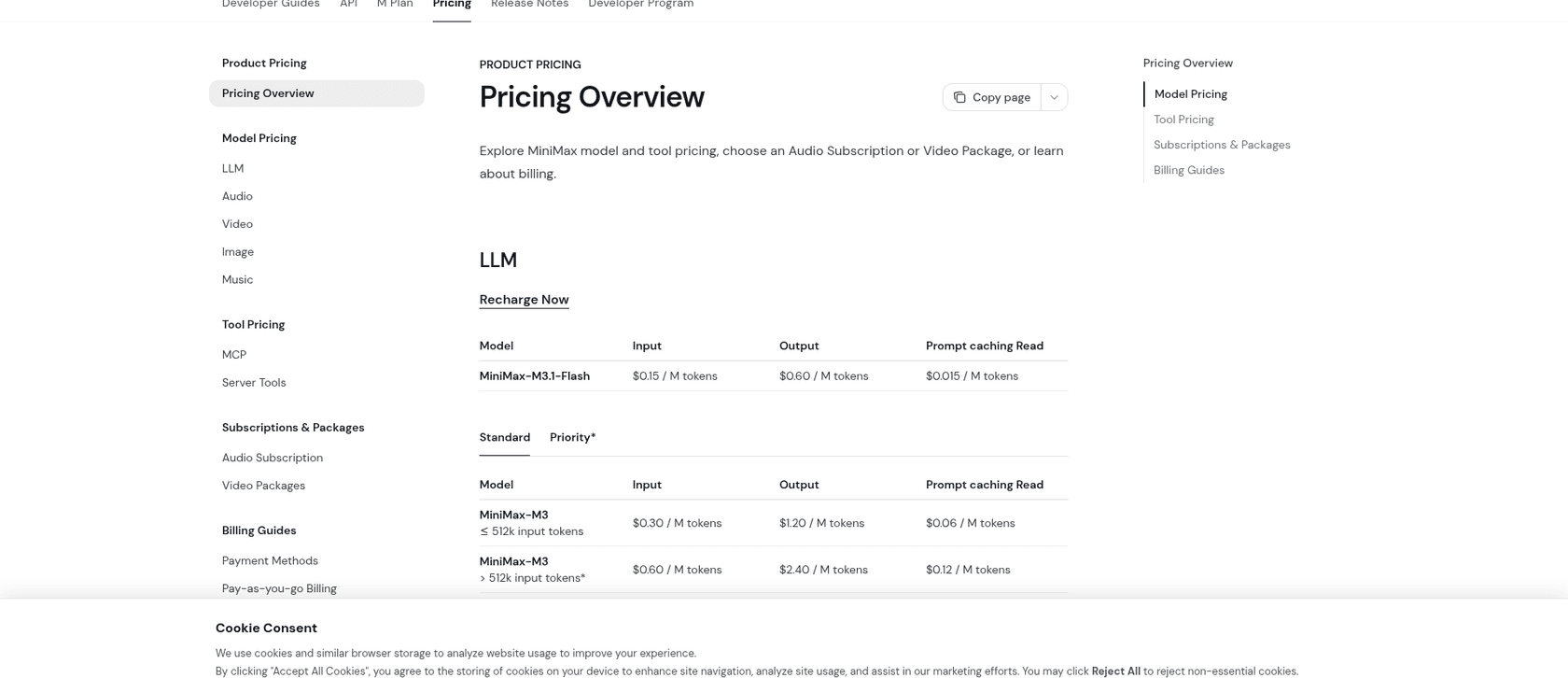
The price is simple, which I like. M3.1 Flash has one rate across the whole 1M window, while MiniMax M3 doubles above 512K input tokens.
| Model (per 1M tokens) | Input | Cached input | Output | Source |
|---|---|---|---|---|
| MiniMax M3.1 Flash | $0.15 | $0.015 | $0.60 | MiniMax |
| MiniMax M3 (up to 512K) | $0.30 | $0.06 | $1.20 | MiniMax |
| MiniMax M3 (over 512K) | $0.60 | $0.12 | $2.40 | MiniMax |
| DeepSeek V4.1 Flash, off-peak | $0.15 | $0.003 | $0.60 | DeepSeek |
| DeepSeek V4.1 Flash, peak | $0.30 | $0.006 | $1.20 | DeepSeek |
| GPT-6 Luna | $0.10 | $0.01 | $0.50 | OpenAI |
| Gemini 3.8 Flash (to Dec 31, 2026) | $0.75 | $0.075 | $3.75 |
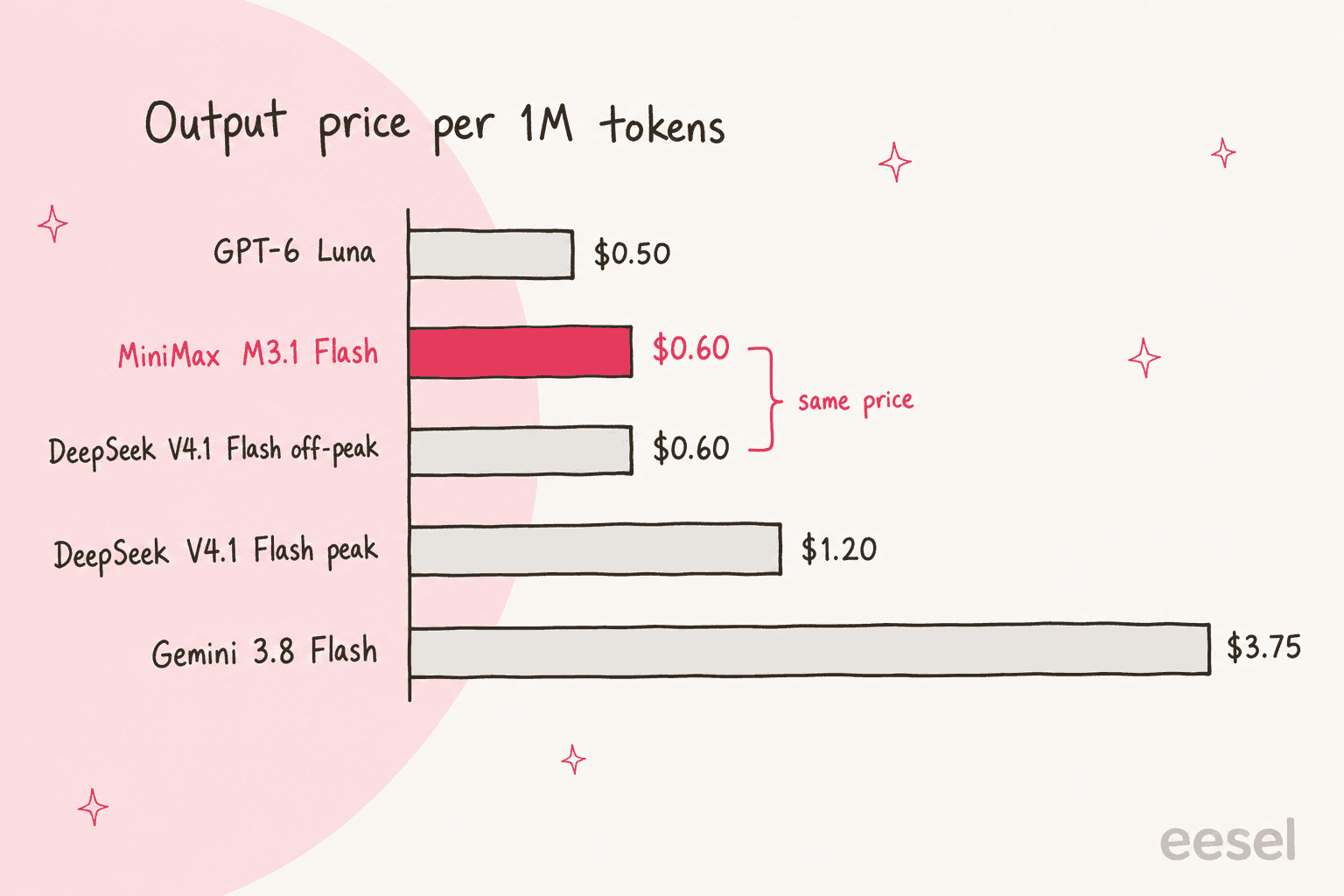
Two things stand out. First, cached input is where DeepSeek still wins: $0.003 off-peak against M3.1 Flash's $0.015, five times cheaper. Agent loops reread the same context over and over, so a cache-heavy workload can tilt the bill toward DeepSeek even at the same headline price. Second, GPT-6 Luna is cheaper per token than either, and the Luna pricing breakdown shows its cached rate too. On MiniMax's Agents' Last Exam chart, though, M3.1 Flash's $111 total sits well under GPT-5.6 Luna's point, so token price alone does not settle it.
If you would rather pay a subscription, the M Plan bundles M3.1 Flash with MiniMax Code and other models. Annual billing is $220, $550, or $1,320 a year for the Go, Explore, and Build tiers, which give 1x, 3x, and 7.5x Go's usage, reset on 5-hour and weekly windows. MiniMax's own M Plan FAQ says the plan is designed for individual, interactive use and recommends pay-as-you-go for production. Take that at its word: the subscription is for your own coding sessions, not for a product that serves customers.
What do real users say after one day?
The first reactions split cleanly. The benchmarks impressed people. Hands-on testers were more mixed, and the most common complaint is about behaviour at high effort, which is the default.
"I might get downvoted for this, but this model was WAY too lazy, even at Max effort"
The same theme came from an X tester who otherwise liked it:
"hallucinates alot on xhigh or max and starts doing stuff i didn't ask for, and cuz of that model ends up being slow despite giving 100+ tok/s"
On Hacker News, one user who had tried the stealth version flagged a gap between the scores and day-to-day results:
"The deepswe and terminalbench4.0 scores don't seem to jive with what many opencode users' experience has been of this model while it was being tested as "space bunny"."
MiniMax says Space Bunny was an earlier checkpoint, so some of that may be fixed. Not every report was negative. One developer who had used the preview inside MiniMax Code liked how it handled uncertainty:
"it found the real bug instead of patching around it, refused to pad weak results, wrote its own tests and got to 12/12 green, and said UNVERIFIED when it couldn't confirm something"
The fairest single comment I read was about time, not tokens. Cheap models that take twice as long are a hard sell at work:
"For a hobby project I do not mind that a cheaper model takes twice as long but at work it's hard to justify using a "cheaper" model if the time per task is so much higher than the frontier models."
What are the pros and cons?
Pros
- Flat
$0.15/$0.60pricing across 1M tokens, with no long-context tier. - Best Automation-Bench score in MiniMax's table, and a tie with Opus 5 on BankerToolBench.
- 200+ tokens per second claimed, about three times M3.
- Works with Anthropic- and OpenAI-style clients, so Claude Code, Codex, Cursor, and OpenClaw can point at it.
- Open weights promised for October 23.
Cons
- Trails DeepSeek V4.1 Flash 1017 on five of six shared benchmarks, including every coding test.
- Cached input costs five times DeepSeek's off-peak rate.
- Thinking cannot be turned off, and the default is
max, where testers report laziness and drift. - 428B total parameters, so local use needs a large machine.
- The M Plan is for personal use, so production traffic goes on pay-as-you-go keys.
Which cheap model fits your job?
Pick the job you want to run. The widget shows the model I would start with and why.
Who should use it, and who should skip it?
Use it if you run agent loops over business tools, spreadsheets, or long documents and you care about cost per task. The Automation-Bench and BankerToolBench results point straight at that work, and the flat price makes long contexts painless. It also suits developers already inside MiniMax Code who want a fast default model.
Skip it, for now, if your main job is hard repo work. DeepSeek V4.1 Flash 1017 scores higher on every coding row in the table for the same off-peak price, and Qwen 3.8 Flash Next comes up often among people who self-host.
If you want a frontier model and can pay for it, GPT-6 Sol and Claude Opus 5.5 are still a tier above.
Wait if you want to run it yourself. The weights are due on October 23, and the size means you need a big multi-GPU box or a large unified-memory machine.
What does it mean for a support team?
AutomationBench lists customer service among its workflows, so it is tempting to read a high score as "ready for my queue". I would not. A benchmark checks whether the model finished a scripted task. Your queue asks whether the answer was right for this customer, under your policy, with your refund rules, and whether the model knew to leave a ticket alone.
If you build your own support flow on M3.1 Flash, here is what you still own:
- The knowledge pipeline that feeds it your help center and past tickets.
- The helpdesk connection that reads tickets and writes replies.
- The rules for when to hand over, the core of tier-1 deflection.
- Testing on real history, which is how you catch hallucinations in support.
None of those is a model problem, which is why a cheaper model lowers one line of the bill, not the project. The AI customer service cost guide covers the rest, and the AI vs human agent cost breakdown puts it in context.
How does eesel fit next to M3.1 Flash?
MiniMax M3.1 Flash is infrastructure. eesel is the employee. eesel is an AI teammate platform where you hire ready-to-work teammates for specific jobs, and for support that is the AI helpdesk teammate. It joins the queue you already run, such as Zendesk or Freshdesk, learns from your help center and past tickets, and replays historical tickets so you see its answers before a customer does.
Here is what that looks like at scale. smava, a Berlin loan comparison platform, runs three eesel agents on one Zendesk for two brands: one categorises every ticket, one drafts the reply from about 820 macros and help center articles, and one per brand prepares the customer-ready answer. Between August 8 and September 8, 2026 that was about 27,000 tickets, with people approving the drafts. SE Ranking runs a separate agent for each of its three products on Zendesk live chat, about 4,650 conversations in a month, with refunds and Tier 2 issues handed to the team with the customer's details attached.
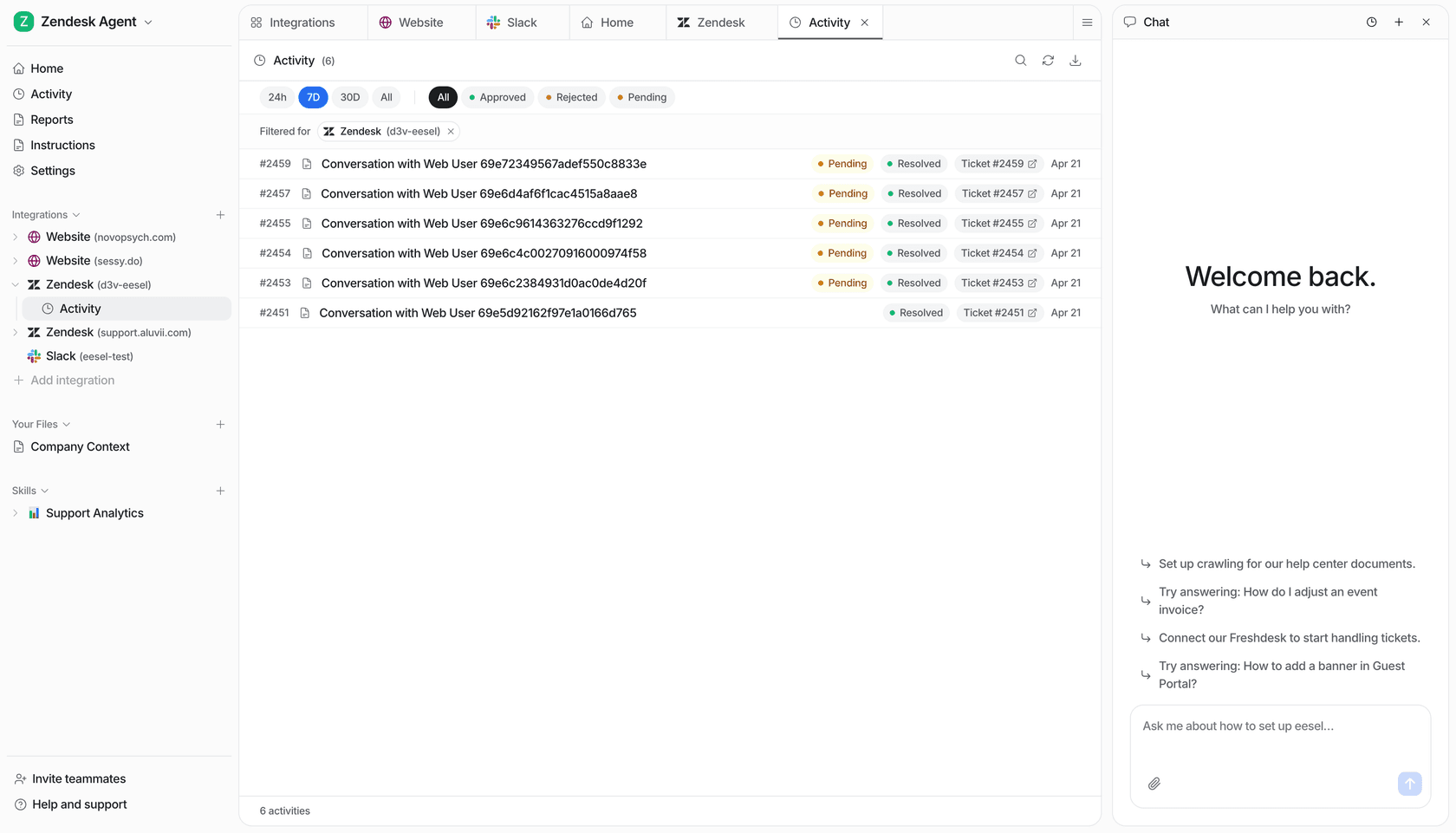
If you are the kind of builder who reads a model review, you will probably want the terminal. The eesel CLI (@eesel/cli) drives the same teammate you see in the dashboard. eesel integrations connect zendesk wires up a helpdesk, eesel files upload adds knowledge, eesel instructions edits the standing rules, eesel approvals lists actions waiting on a person, and eesel activity shows what the agent did. Every command prints JSON, so Claude Code or Cursor can run the setup for you, and each workspace also works as an MCP server. The agent CLI guide shows the pattern.
To compare support options side by side, start with the list of best customer service agents or the broader case for AI teammates.
Try eesel
Use M3.1 Flash where it shines: cheap, fast agent loops you can check. If what you need is AI answering tickets in your helpdesk next week, eesel's AI helpdesk teammate plugs into the tool you already use, learns from your past tickets, and shows how it would have answered them before any customer sees a reply. That is how smava gets 15,300 drafts a month without handing control away. Try eesel free and run it on your own ticket history first, or check eesel pricing before you start.