


What Qwen 3.8 Flash Next actually is
I build AI agents at eesel, which means I watch the model layer churn every couple of weeks and I have learned to read past the launch graphics. So when the Qwen team dropped Qwen 3.8 Flash Next on 26 August 2026, the first thing I did was untangle the name, because it is genuinely confusing.
Here is the clean version. "Flash" is Qwen's cheap-and-fast tier. "Next" is not a bigger or newer Flash. It is the label Qwen puts on an architectural preview, the same role Qwen3-Next played before Qwen3.5. Flash Next exists so the community can poke at the new plumbing before the full Qwen4 family is built on top of it.
The practical split matters because it changes what you can do with it:
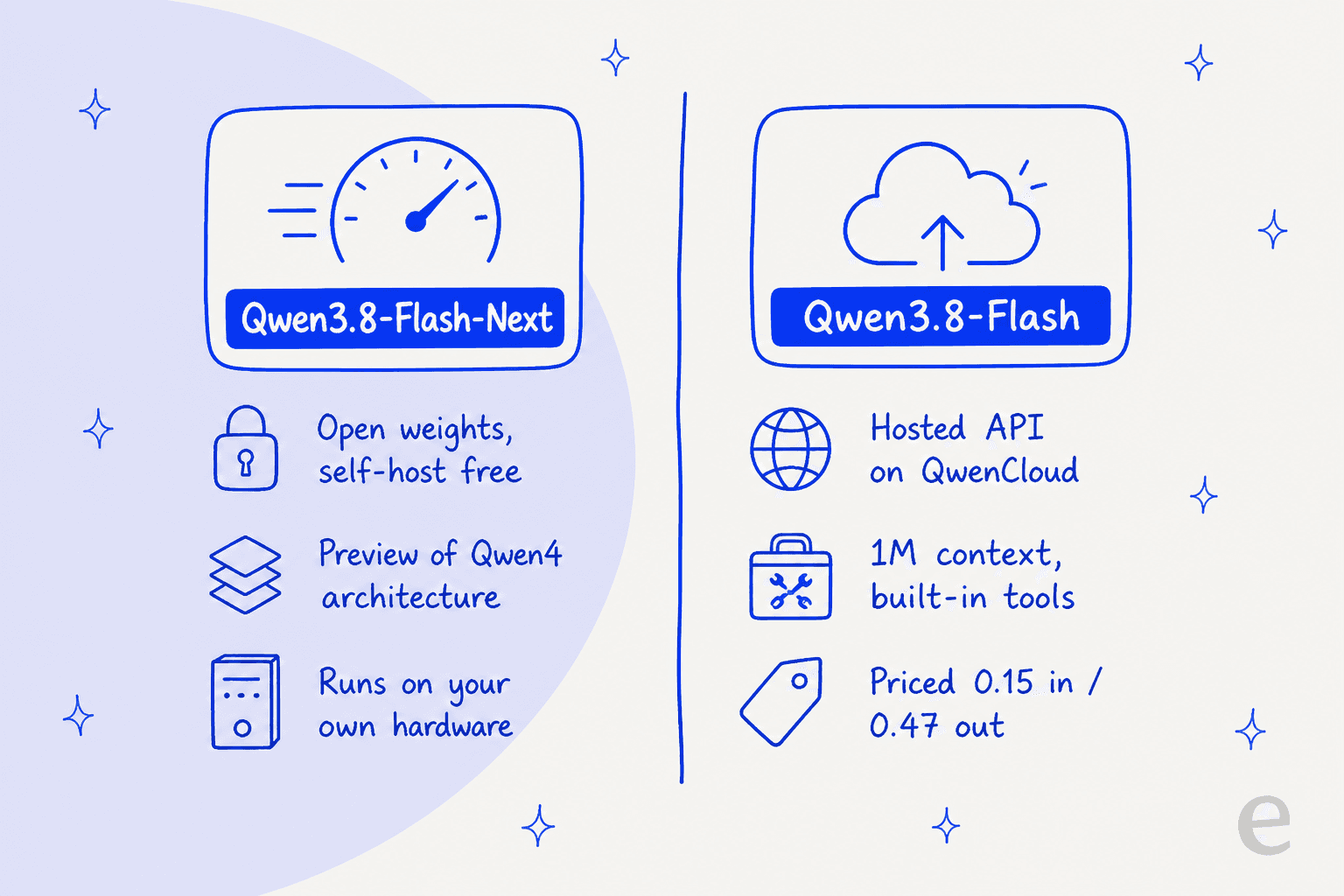
- Qwen3.8-Flash-Next is the open-weight release on Hugging Face and ModelScope, under the Qwen Community License 1.0. You download it and run it yourself.
- Qwen3.8-Flash is the production version served on QwenCloud, with 1M context by default and official built-in tools. That is the one you hit over an API.
This is already a real change from Qwen 3.7 Flash, which shipped closed, with no weights and no benchmarks at all. This time you get open weights and a detailed benchmark table on day one. It is a multimodal reasoning model: it takes text, images, and video in, produces text out, and thinking mode is on by default.
The architecture that earns the "Next"
This is the part I actually care about, because the architecture is the reason the price can be what it is. Flash Next extends the Qwen3-Next hybrid design along four axes, and each one is a bet on trading memory for compute.
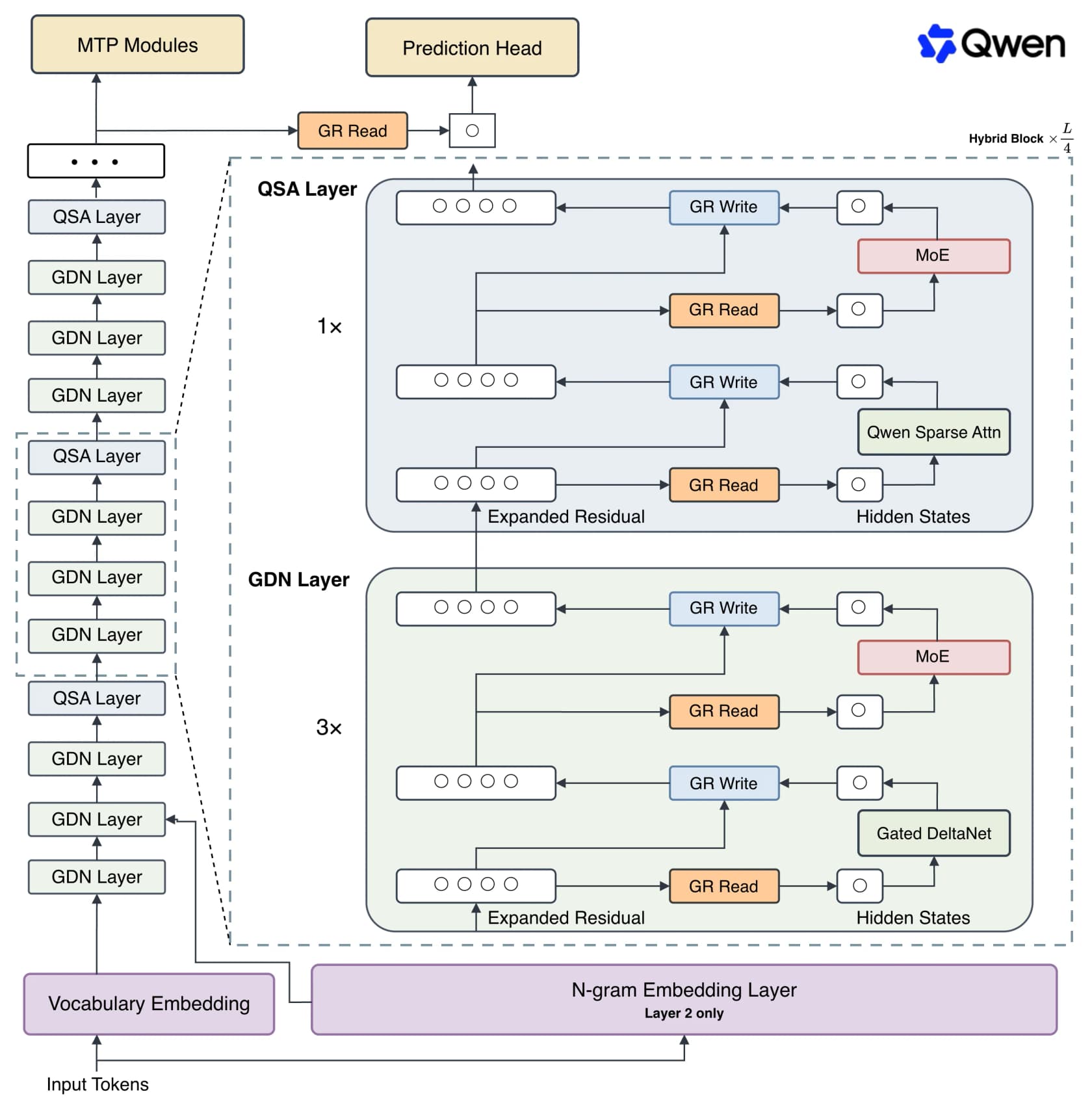
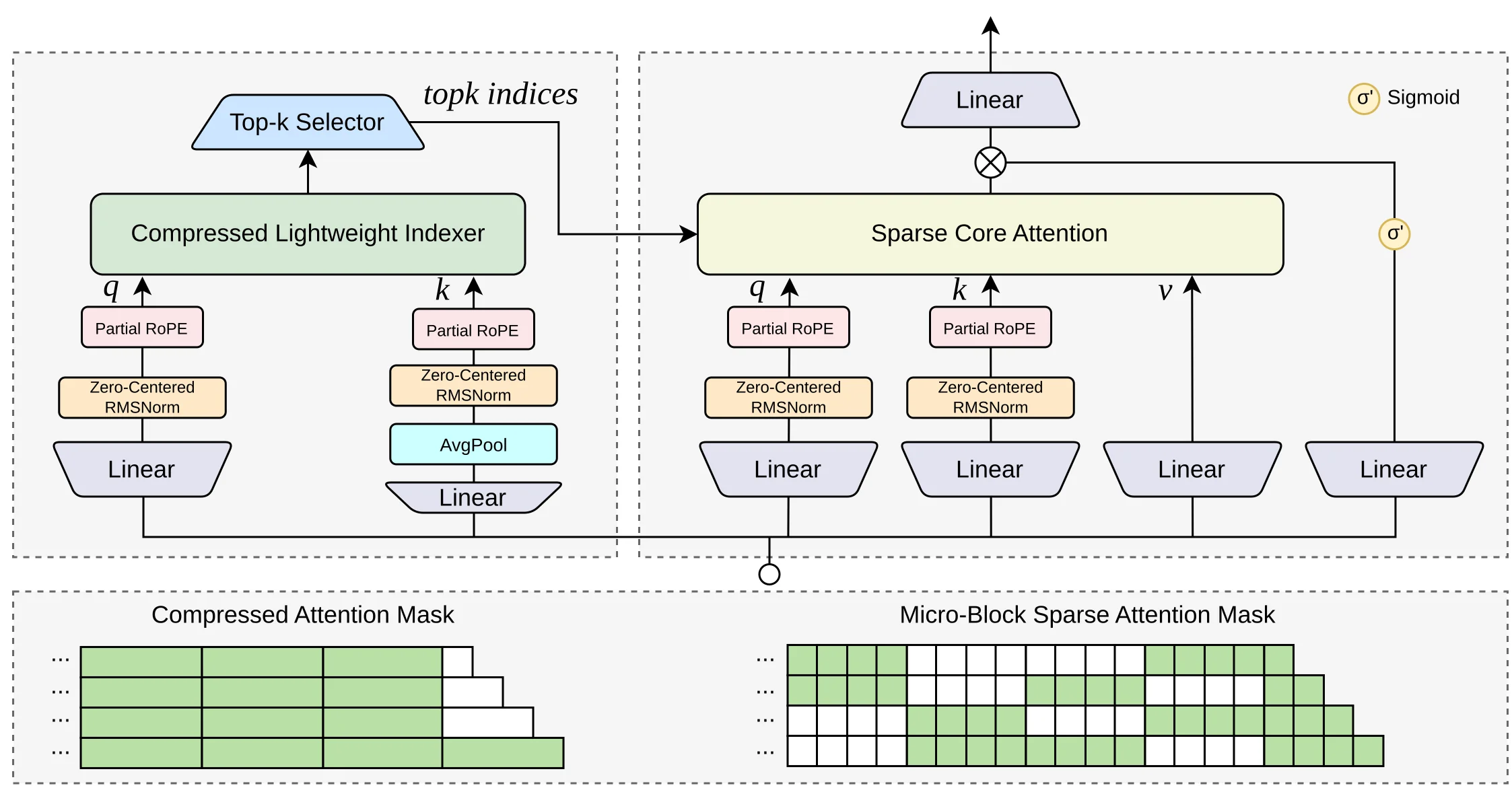
Attention: a GDN and QSA hybrid. Three of every four layers use Gated DeltaNet to compress history into a fixed-size state, which is far cheaper than storing a full key-value cache. The fourth layer uses global attention, but it is replaced by Qwen Sparse Attention, which picks the important context at micro-block granularity instead of token by token.
Embedding: a 51B N-gram table. This is the clever bit. Qwen adds 51 billion parameters of context-based bigram and trigram lookups that can be offloaded to host memory and async-prefetched. You get a huge capacity bump with almost no extra per-token compute, which is why people are running a "180B-ish" model on machines with modest GPUs.
The other two axes are a Gated Residual stream, which widens the residual into four parallel branches with FP8 storage, and a switch to the Muon optimizer for the 2D linear maps. Qwen says the combination cut training cost to roughly one-ninth that of Qwen3.7-Plus while beating it on coding and office tasks.
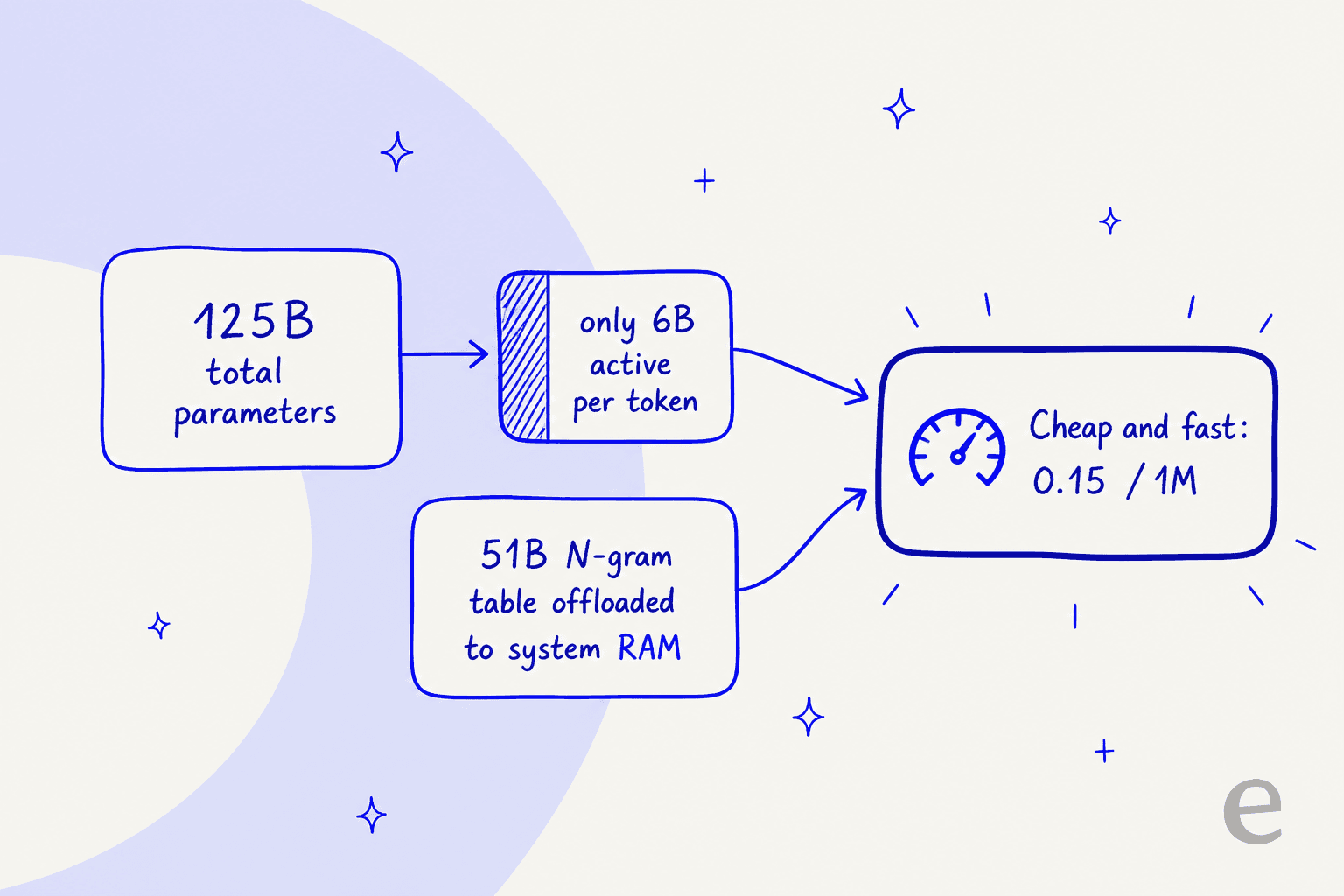
Put the specs together and the shape is clear: 125B main parameters, 6B activated per token, plus the 51B N-gram embedding and a 4B multi-token-prediction head (Artificial Analysis rounds the total to 180B). It runs 512 experts with 10 routed plus 1 shared active, a native 262,144-token context extensible to 1M via YaRN. One honest caveat worth flagging: the context number is inconsistent across sources, with the model card saying 262K native, QwenCloud running 1M by default, and Artificial Analysis listing 256K. Read it as "very long, exact ceiling depends where you run it."
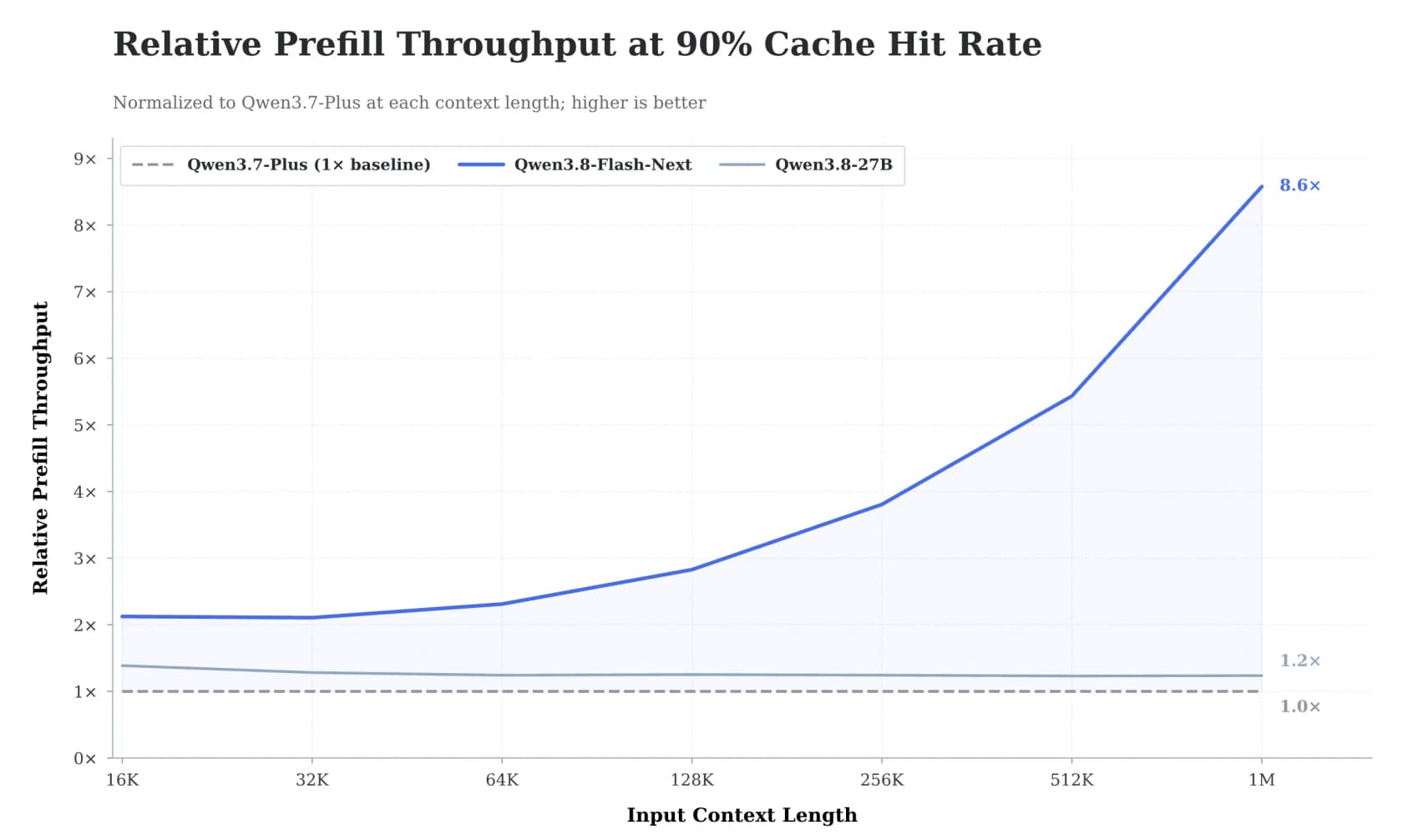
The efficiency payoff shows up hardest at long context. Qwen reports the QSA kernel hitting up to 7.6x prefill and 4.9x decode speedups at 1M tokens, and 8.6x the prefill throughput of Qwen3.7-Plus at 1M with a 90% cache hit rate.
What Qwen 3.8 Flash Next can actually do
Benchmarks come in two flavours here, and the difference matters. There is Qwen's own table, which is impressive but vendor-reported, and there is one genuinely independent anchor.
Lead with the independent one. Artificial Analysis scores Flash Next at 56 on its Intelligence Index, ranking it #5 of 111 in its class against a median of 29. It clocks 77 output tokens per second and costs about $0.10 per Index task. Their one-line verdict is that it is "amongst the leading models in intelligence and reasonably priced," but "very verbose," burning 200M output tokens to finish the Index versus a 110M median. Hold onto that verbosity point, because it quietly inflates real bills.
Qwen's own numbers, which you should read as "Qwen reports" rather than neutral fact, put it ahead of its stablemates on most rows:
| Benchmark | Qwen3.8-Flash-Next | Qwen3.8-27B | Qwen3.7-Plus | DeepSeek-V4-Flash | Claude-Opus-4.6 |
|---|---|---|---|---|---|
| SWE-bench Pro | 62.5 | 61.7 | 55.8 | 56.0 | 53.4 |
| SWE-bench Multilingual | 81.0 | 73.8 | 75.8 | - | 77.5 |
| LiveCodeBench v6 | 91.9 | 90.3 | 89.6 | 90.6 | 88.8 |
| GPQA Diamond | 91.7 | 89.2 | 90.3 | 90.8 | 91.3 |
| IFBench (instruction following) | 81.3 | 79.5 | 79.1 | 79.2 | 62.5 |
| CoWorkBench (long office tasks) | 73.9 | 70.7 | 65.1 | 45.1 | 68.2 |
| Humanity's Last Exam | 35.9 | 30.8 | 34.7 | 33.8 | 40.0 |
Source: Qwen's benchmark tables. Two things stand out. It is genuinely strong on coding and agentic tasks, edging out much larger models on SWE-bench Pro. And it is not a clean sweep: Claude Opus 4.6 still wins Humanity's Last Exam, and DeepSeek V4 Flash beats it on repo-level generation. On the vision side, Qwen reports 84.5 on AndroidWorld and 88.5 on RealWorldQA, both leading the comparison set.
Qwen 3.8 Flash Next pricing
The open weights are free. If you have the hardware, you pay compute and nothing else, which is the entire appeal for the self-hosting crowd.
For the hosted Qwen3.8-Flash API, the pricing is flat, with no context-length brackets like Qwen 3.7 Flash had:
| Meter | Rate (USD / 1M tokens) |
|---|---|
| Input | $0.15 |
| Output | $0.47 |
| Input, cached read | $0.016 |
| Explicit cache creation | $0.20 |
| Explicit cache read | $0.016 |
That cache read is about 89% cheaper than fresh input, and it is not theoretical: OpenRouter observed a 91.1% cache-hit rate in live traffic, which drags the effective input price down to roughly $0.028 per million. So the number you actually pay on repetitive, cache-friendly workloads is well under the sticker.
One asterisk on the "cheap" headline. Because the model is very verbose, output-heavy workloads pay more than the low per-token rate suggests, since you are billed for all those thinking tokens. For a chatty support reply that is a rounding error; for long agentic runs it adds up. If you are weighing this against DeepSeek V4 Flash or Kimi K3 on price, model the output tokens, not just the input rate.
There is also, for now, only one API provider: Alibaba Cloud International. OpenRouter forwards straight to it, so there is no multi-provider routing or failover yet.
What people are actually saying
The community reaction has been loud, and it is almost entirely a local-inference story rather than an API or enterprise one. The Hacker News launch thread hit 698 points, and r/LocalLLaMA ran a 650-plus-comment release megathread. People are obsessed with running it on their own machines.
The tooling crowd set the tone. Unsloth got it running fast and made a big claim:
"Qwen3.8-Flash can now be run locally! The 125B MoE model outperforms Claude-Opus-4.6 (Max). Run on 75GB RAM via Unsloth GGUFs. Qwen3.8-Flash-Next enables CPU RAM / unified mem setups to deliver near VRAM speeds."
That "outperforms Opus 4.6" line is theirs and is not independently benchmarked, so treat it as enthusiasm, not fact. The more grounded voices added the caveat that keeps coming up. Here is the clearest explanation of what "Next" really means, from the HN thread:
"This model is a preview of Qwen's upcoming Qwen4 architecture... They said the model is intentionally under-trained since it is mainly for R&D purposes of proving the new architecture."

And the practical gotcha, from Simon Willison, who ran it at several reasoning levels on a DGX Spark and came away preferring the smaller dense model, blaming the low-bit quantization needed to fit it. That is the recurring theme: the architecture is exciting, but this specific checkpoint is a preview, and squeezing it onto consumer hardware costs quality. If you want the finished-feeling option in this weight class today, plenty of threads point at GLM 5.3 Flash instead.
So, should you use it?
Here is where I land after a week of watching this one.
Reach for it if you are a local-inference tinkerer with a unified-memory machine or a spare GPU, you want an early look at the Qwen4 architecture, or you have a cache-friendly, coding-heavy workload where the low hosted price and strong SWE-bench numbers pay off. The sparse-activation design genuinely does let it punch above its hardware footprint.
Hold off if you need a stable, production-grade model right now. It is an under-trained preview by Qwen's own admission, quantization hurts, and the hosted Qwen3.8-Flash API only has a single provider. For mission-critical work, a more finished model, whether that is GLM 5.3 Flash, a Claude Opus 5 tier, or Qwen 3.8 Max, is the safer call until the full Qwen4 line lands.
Either way, the more important point is what a model actually is: a component. Which brings me to the thing I keep having to explain to teams shopping for "cheap AI."
Where a model like this fits into real support work
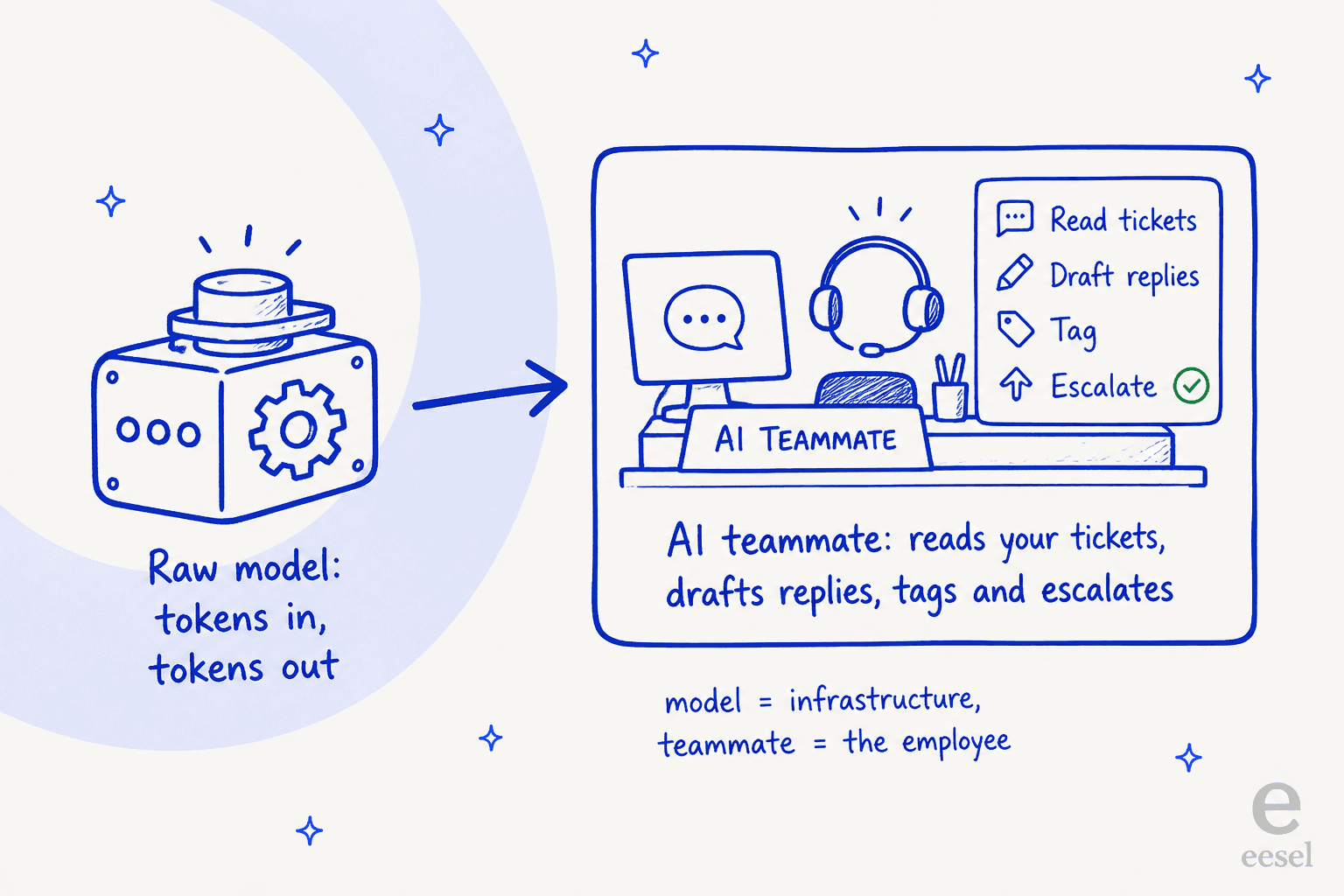
A lot of people read a launch like this and think "great, I will point my support inbox at Qwen 3.8 Flash Next and cut my AI bill." That is a category error. A raw model takes tokens in and gives tokens out. It does not know your refund policy, cannot read a customer's order history, will not draft a reply in your helpdesk, and has no idea whether its confident answer is actually correct. The model is infrastructure; the thing that does the job is the employee.
That employee layer is what we build at eesel. The frame we use is simple: eesel is an AI teammate platform, and you hire ready-to-work teammates for specific jobs, currently an AI helpdesk teammate and an AI blog writer. Each one shows up with the skills, integrations, and company context for its role, so the question of which model runs underneath becomes an implementation detail rather than your problem.

The part I would flag hardest, because I have watched it burn people, is testing. We have all seen a confident-sounding bot quietly give a wrong answer, which is why the eesel helpdesk teammate simulates every rollout against your historical tickets before it ever touches a live customer. You see the resolution rate and the exact replies it would have sent on real past conversations, then decide what to automate. A brand-new, under-trained model is precisely the kind of thing you want to run through that gate rather than trust on a benchmark table. And because eesel plugs into your existing help desk and reads from your knowledge base and past tickets, the context problem, the one a raw model can never solve on its own, is handled.
If you want the short version: models like Qwen 3.8 Flash Next are getting cheap and capable fast, which is great news, but picking one is the easy 10% of the job. The other 90% is turning it into a teammate that actually resolves tickets, and that is the layer worth spending your time on.