


Why people look for a Granite 4.2 alternative
Let me be fair to Granite first, because it earns it (I went deep on the family in my full Granite 4.2 review). Granite 4.2 shipped on August 25, 2026 as three dense reasoning models under an Apache 2.0 license. The small ones run fast on commodity hardware (the 3B is a 2.2GB download), the training data is recent, and the community consensus is that Granite is quietly excellent at structured, grounded work: tool calling, summarization, and document tagging and extraction. If you need an on-prem, licensable model that behaves well in an agent loop, it is a strong default.
So why switch? A few real reasons keep coming up, and none of them are marketing spin.
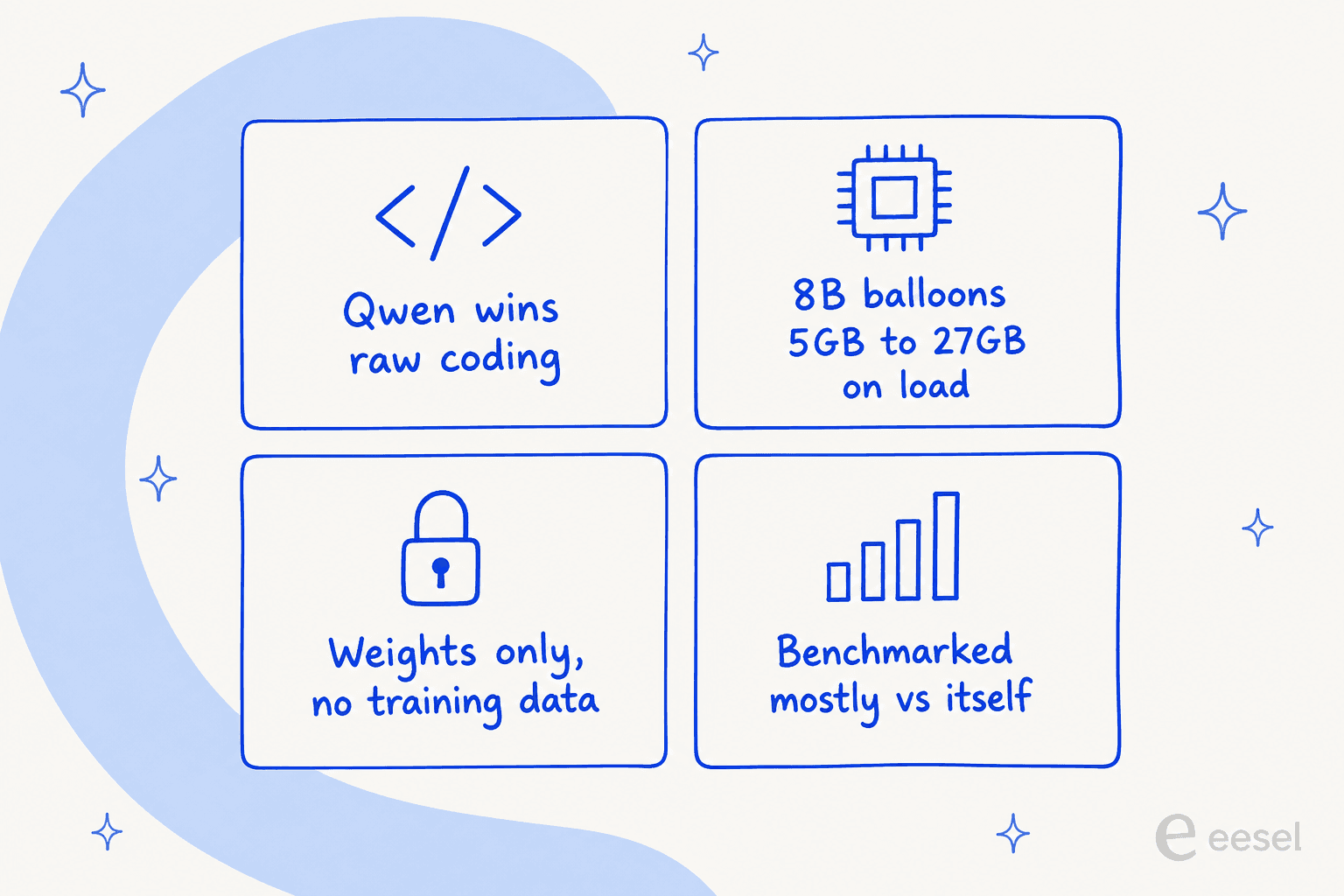
Raw capability, especially coding. This is the loudest one. On Hacker News, the recurring line is blunt:
"Granite 8B is impressive, but Qwen still wins on raw capability, especially for coding."

Even people who liked Granite kept their old favourite for the hard stuff:
"I test drove it yesterday. It's pretty impressive at 8b. Runs on commodity hardware quickly. Qwen3.6 35b a3b is still my local champion but I may use this for auto complete and small tasks."
IBM mostly benchmarks against itself. Granite's model cards compare it to previous Granite versions and a narrow set of rivals like NVIDIA's Nemotron and Google's Gemma, not to Qwen. That breeds a specific kind of skepticism:
"No comparison with competitor models other than the previous granite version strongly implies that it does not compete well with other comparable models."
A real operational gotcha. The 8B is a 5.3GB download, but a widely-shared r/LocalLLaMA thread flagged that it can balloon to 27GB in memory on load once the KV cache is allocated, which is enough to knock it off a consumer GPU. That is worth checking before you commit.
"Weights-only isn't really open source." Granite ships weights under Apache 2.0, but not the training data or recipe, and part of the community holds a stricter line on what "open" should mean. If reproducibility matters to you, that gap is a reason to look at models that publish more.
Here is the practical cost angle, too. Say you are running a support-style workload of 5 million output tokens a month. On Granite 4.2's cheapest confirmed hosted rate that is about $1.25; on Kimi K3 the same tokens cost $75. That 60x spread is exactly why the "which alternative" question is worth answering carefully rather than grabbing whatever topped a leaderboard last week.
How I picked these alternatives
I weighted the list toward what Granite actually is: an open, small-to-mid, reasoning-capable model you can self-host cheaply. So the bar was:
- Open weights first. Six of the seven publish downloadable weights, because that is the whole reason people run Granite instead of a closed API. Gemini 3.6 Flash is the one hosted-only pick, included because plenty of teams would happily trade openness for a managed endpoint.
- Reasoning and tool use. Granite's headline feature is switchable thinking and reasoning-augmented tool calling, so every model here can reason and call tools in an agent loop.
- Real, checkable pricing. No "contact sales." Every price below traces to a vendor page. (If your actual question is which engine to put behind a support bot, I compared that separately in best AI model for support tickets.)
- Primary sources only. Specs come from model cards and pricing pages; sentiment comes from Hacker News, Reddit, and X, not from aggregator listicles.
Here is the whole field at a glance before we go tool by tool.
| Model | Best for | Open weights | License | Context | Hosted in/out per 1M | Reasoning |
|---|---|---|---|---|---|---|
| Granite 4.2 (incumbent) | On-prem enterprise agents | Yes | Apache 2.0 | 128K–512K | $0.06 / $0.25 | Switchable |
| Qwen 3.8 | Raw coding capability | Yes (27B Apache) | Mixed | 1M | $2 / $6 (Max) | On (xhigh) |
| DeepSeek V4 Flash | Cost at scale | Yes | MIT | 1M | $0.22 / $0.66 (off-peak) | On (high) |
| GLM 5.3 Flash | Cheap multimodal agents | Yes | Open | 1M | $0.075 / $0.25 (promo) | Thinking-only |
| Kimi K3 | Long-horizon agents | Yes | Modified | 1M | $3 / $15 | Always on |
| Mistral Large 3 | European / on-prem | Partial (small models Apache) | Mixed | 128K+ | $0.50 / $1.50 | Optional |
| Gemini 3.6 Flash | Managed hosted API | No | Proprietary | 1M | $1.50 / $7.50 | Optional |
| NVIDIA Nemotron 3 | NVIDIA stack, open recipes | Yes | Open | up to 1M | Free endpoints / compute | Yes |
The 7 best Granite 4.2 alternatives in 2026
1. Qwen 3.8 - best for raw capability and coding
Best for: teams who picked Granite for the license but keep hitting its ceiling on hard coding and reasoning tasks.
If there is a single model the local-LLM crowd reaches for instead of Granite, it is Qwen. The comparison is so reflexive that when Granite 4.2 launched, the top question on X was literally just asking how it stacked up:
"Anyone tested Granite 4.2 30B from IBM yet? How does it compare to Qwen-3.8-27B?"
Qwen 3.8 comes in two shapes. The flagship Qwen 3.8 Max is a 2.4T-parameter mixture-of-experts model (95B active) with a 1M-token context, sold as a hosted API. Below it sits the open Qwen3.8-27B checkpoint under a true Apache 2.0 license, which is the direct like-for-like against Granite's open sizes. Worth knowing: the open Max base weights use Alibaba's own restrictive license, not Apache, so "open Qwen" for commercial freedom means the 27B, not the giant.
Where it beats Granite: raw capability, full stop. On LMArena, Qwen 3.8 Max sits near the top for text and web development, and the community verdict on coding is settled. The 1M context also dwarfs Granite's native 128K.
Where it falls short: the Apache-clean option is the 27B, not the headline Max, so the openness story is narrower than it first looks. And Qwen's own coding harness ships configured for a 64K output ceiling, so the "1M context" number is more theoretical than most workloads will ever touch.
Pricing: the open 27B is free to self-host. Qwen 3.8 Max on Alibaba's cloud is $2 per million input tokens and $6 per million output, with cached input reads at $0.25.
Verdict: if you left Granite because it could not keep up on coding or hard reasoning, Qwen is the first place to look. Take the 27B if a clean license matters, or the hosted Max if you want the strongest version and do not mind Alibaba's terms.
2. DeepSeek V4 Flash - best for cost at scale
Best for: high-volume workloads where the per-token bill is the thing that actually decides the architecture.
DeepSeek V4 Flash is the budget champion of this list, and unlike Qwen's headline model, it is genuinely MIT-licensed, one of the most permissive licenses going.
It is a 284B-parameter mixture-of-experts model (13B active) with a 1M-token context, released as roughly 167GB of open weights. Reasoning is on by default at "high," and here is the quirk that makes it interesting: the cheap config and the good config are literally different runs of the same weights (the RAG-versus-raw-LLM tradeoff shows up here too, since more thinking means more billed tokens). DeepSeek's own numbers show Flash scoring 8.1 on HLE with thinking off versus 34.8 at max effort. You choose how hard it thinks, and you pay for the reasoning tokens at the output rate.
Where it beats Granite: price, and a cleaner license. It is also a much bigger model than Granite's 30B, so at max effort it reaches capability Granite's small sizes cannot.
Where it falls short: it is text-only (no documented image input), it can be verbose, and there is a real data-governance catch. DeepSeek's paid-API terms are silent on whether they train on your inputs, and the service runs under PRC law, so it is not a drop-in for regulated customer data (if you are handling support data, the SOC 2 and GDPR angle matters here). Also watch the pricing clock: rates double during peak hours (01:00–04:00 and 06:00–10:00 UTC), which happen to be off-hours for most Western queues.
Pricing: off-peak, cache-miss input is $0.22 per million and output is $0.66; peak rates are exactly double. Self-hosting the MIT weights is free.
Verdict: if your workload is large and your data is not regulated, nothing here beats DeepSeek on cost per unit of capability. Just build your cost model on the peak rate so a timezone shift never surprises you, and keep customer PII off the first-party API.
3. GLM 5.3 Flash - best for cheap multimodal agents
Best for: builders who want tool-happy, multimodal agents on open weights without paying frontier prices.
GLM 5.3 Flash from Z.ai (Zhipu) is the newest model here, and it leans into exactly the agentic, tool-calling niche where Granite is strongest, then undercuts it.
It is a 320B-parameter MoE (18B active), the first natively multimodal model in the GLM-5 line, with a 1M context and open weights on Hugging Face. It scores an Artificial Analysis Intelligence Index of 57, matching much pricier models, at a fraction of the cost per task.
Where it beats Granite: it is natively multimodal (Granite 4.2 has no vision variant), the context is 8x larger, and the promo pricing is close to free. It also topped OpenRouter's usage charts for a stretch, so it is battle-tested at volume.
Where it falls short: reasoning is always on and cannot be disabled, so there is no true "fast, cheap, non-thinking" mode the way Granite offers. The first-party API is also slow (~49 tokens/second); you will want a faster host like Databricks for latency-sensitive work.
Pricing: promotional rates of $0.075 per million input and $0.25 per million output (list is $0.15/$0.50), with the promo running to September 9, 2026, and cached input at $0.015. A separate GLM Coding Plan runs $18/$80/$168 per month. Open weights are free to self-host.
Verdict: for cheap agents that need to see images and call tools, GLM 5.3 Flash is the most direct "Granite but bigger and multimodal" swap on this list. Just budget for the fact that it always thinks.
4. Kimi K3 - best for long-horizon agentic work
Best for: complex, multi-step agent runs where you would rather pay more than babysit a weaker model.
Kimi K3 from Moonshot AI is the premium open-weight option: bigger, pricier, and tuned for sustained agentic reasoning rather than cheap throughput.
It is a 2.8T-parameter MoE (104B active) with a 1M-token context and native vision, and Moonshot shipped the open weights on schedule. On the Artificial Analysis Intelligence Index it lands around 57 (#4 overall), beating some frontier models on many tasks.
Where it beats Granite: it is a much stronger model on hard, long-running tasks, and it is a serious agentic reasoner where Granite's small sizes run out of room.
Where it falls short: the price. At $3 in / $15 out per million tokens, it sits in the same band as Claude Sonnet, roughly 50x DeepSeek's output rate, so it is the opposite of a budget pick. Reasoning also cannot be turned off at any level (the effort setting is a latency control, not a cost tier), and the open weights are a 1,561GB download, so "self-hosting" here means serious infrastructure.
Pricing: $3 per million input, $0.30 cache-hit, $15 per million output. Consumer app tiers run Free / $19 / $39 / $99 / $199 a month.
Verdict: Kimi K3 is what you pick when the task is hard enough that a cheaper model would fail, and the cost of failure beats the cost of tokens. For routine, high-volume work, it is overkill next to Granite or DeepSeek.
5. Mistral (Large 3 + open models) - best for European teams and clean on-prem
Best for: teams that want a non-US vendor, EU data residency, and genuinely permissive small-model licensing.
Mistral is the European answer to the "open, licensable, on-prem" pitch that draws people to Granite in the first place, and its small models ship under Apache 2.0.
The lineup splits cleanly: Mistral Large 3 is the hosted flagship, Codestral and Devstral cover coding and agentic work, and a family of smaller open models covers the self-host case. Mistral's consumer assistant, once called Le Chat, is now branded Vibe.
Where it beats Granite: European jurisdiction and a mature enterprise story (EU data residency, on-prem deployment). The small open models give you an Apache-licensed self-host path with a Western vendor behind it, which matters for procurement in a way the license text alone does not capture.
Where it falls short: the biggest, best Mistral models are the hosted paid ones, so the open tier is not the frontier. And on pure benchmark capability the Chinese open models (Qwen, DeepSeek, GLM) tend to lead right now.
Pricing: Mistral Large 3 runs about $0.50 per million input and $1.50 per million output; Codestral is roughly $0.30/$0.90. Vibe consumer plans are Free / $14.99 / $24.99 per user per month. The small open models are free to self-host.
Verdict: if your reason for going open was governance and vendor jurisdiction rather than squeezing the last cent out of a benchmark, Mistral is the most comfortable fit here. If it was raw capability, look at Qwen or DeepSeek first.
6. Google Gemini 3.6 Flash - best for a managed hosted API
Best for: teams that would rather never touch weights and just want a fast, cheap, reliable hosted endpoint.
Not every Granite user actually wants to self-host; some just want an open-ish, cheap workhorse and picked Granite because it was inexpensive. For them, Gemini 3.6 Flash is the closed-but-easy alternative.
It is Google's "workhorse" Flash tier, launched July 21, 2026, with a ~1M-token context, built-in computer use, and a knowledge cutoff of March 2026. Google reports it uses roughly 17% fewer output tokens than the previous Flash on the same tasks, which quietly lowers the real bill.
Where it beats Granite: zero operational overhead. No GPUs, no vLLM config, no KV-cache surprises. It is strong on computer-use and long-context tasks, and it is genuinely fast.
Where it falls short: it is proprietary and hosted-only, so there is no self-host, no on-prem, and no license freedom, which is the exact thing most people came to Granite for. And the output price is high for this list.
Pricing: $1.50 per million input and $7.50 per million output, with batch requests at 50% off ($0.75/$3.75).
Verdict: if you never actually cared about open weights and just wanted a cheap, capable API, Gemini 3.6 Flash is a cleaner life than running Granite yourself. If openness or on-prem was the point, it is the wrong direction.
7. NVIDIA Nemotron 3 - best for the NVIDIA stack and truly open recipes
Best for: teams already on NVIDIA hardware, and anyone who wants the reproducibility Granite does not ship.
NVIDIA's Nemotron family is one of the rivals IBM actually benchmarks Granite against, which makes it a natural head-to-head, and it answers the "weights-only isn't open" complaint directly.
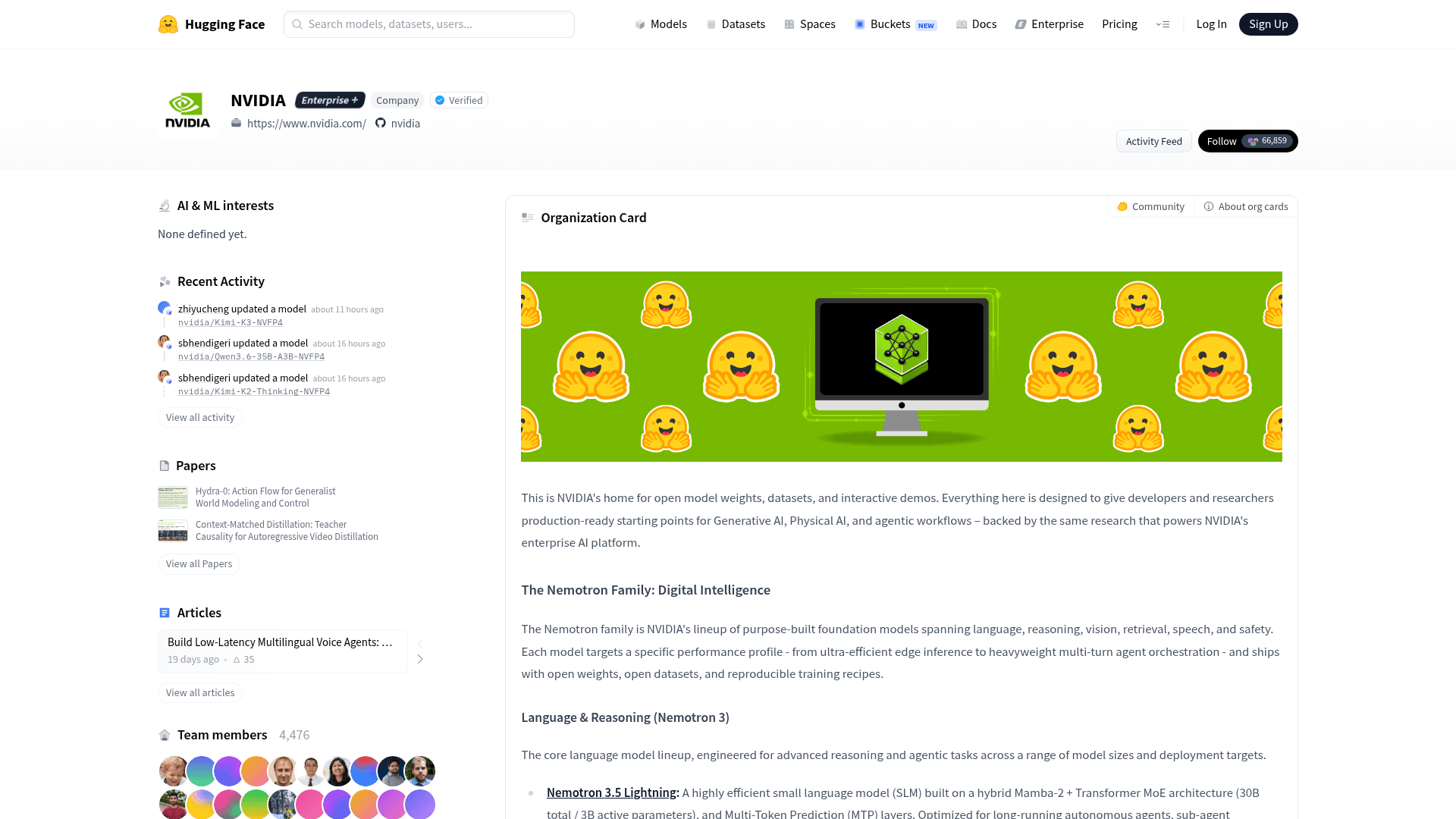
Nemotron is NVIDIA's lineup of purpose-built foundation models spanning language, reasoning, vision, and retrieval. The current language models range from nemotron-3.5-lightning-30b-a3b (a 30B-total / 3B-active MoE tuned for long-running autonomous agents) up to nemotron-3-ultra-550b-a55b (an open hybrid Mamba-Transformer MoE with a 1M context, built for agentic reasoning, coding, and tool calling). Crucially, NVIDIA says the family ships with "open weights, open datasets, and reproducible training recipes."
Where it beats Granite: that reproducibility line is the whole pitch. Where Granite gives you weights, Nemotron gives you weights, data, and recipe, which is the stricter definition of open that part of the community holds out for. It is also optimized for NVIDIA silicon, and you can call the models for free on build.nvidia.com before committing.
Where it falls short: the strongest Nemotron models are large (the ultra is 550B), so the "runs on a laptop" story that makes Granite's 3B lovable does not really apply at the top of the range. And retail per-token pricing is less clean than the others here; production hosting goes through NVIDIA NIM or cloud partners and is priced by compute.
Pricing: open weights are free to download, and NVIDIA offers free hosted endpoints on build.nvidia.com. Production hosting via NVIDIA NIM or a cloud partner is priced by the underlying compute rather than a public per-token rate.
Verdict: if you are already on NVIDIA infrastructure, or if the "is it really open" question is the reason you are leaving Granite, Nemotron is the most principled swap on the list. Just size it to your hardware.
The thing every model on this list has in common
Here is the part that gets lost in benchmark threads. Whether you pick Granite, Qwen, DeepSeek, or Nemotron, you have chosen an engine. A model, on its own, does not know your refund policy, cannot see your Zendesk tickets, and has no idea whether the answer it just generated is safe to send to a real customer. This is the whole reason AI for customer service is a product category and not just an API key.
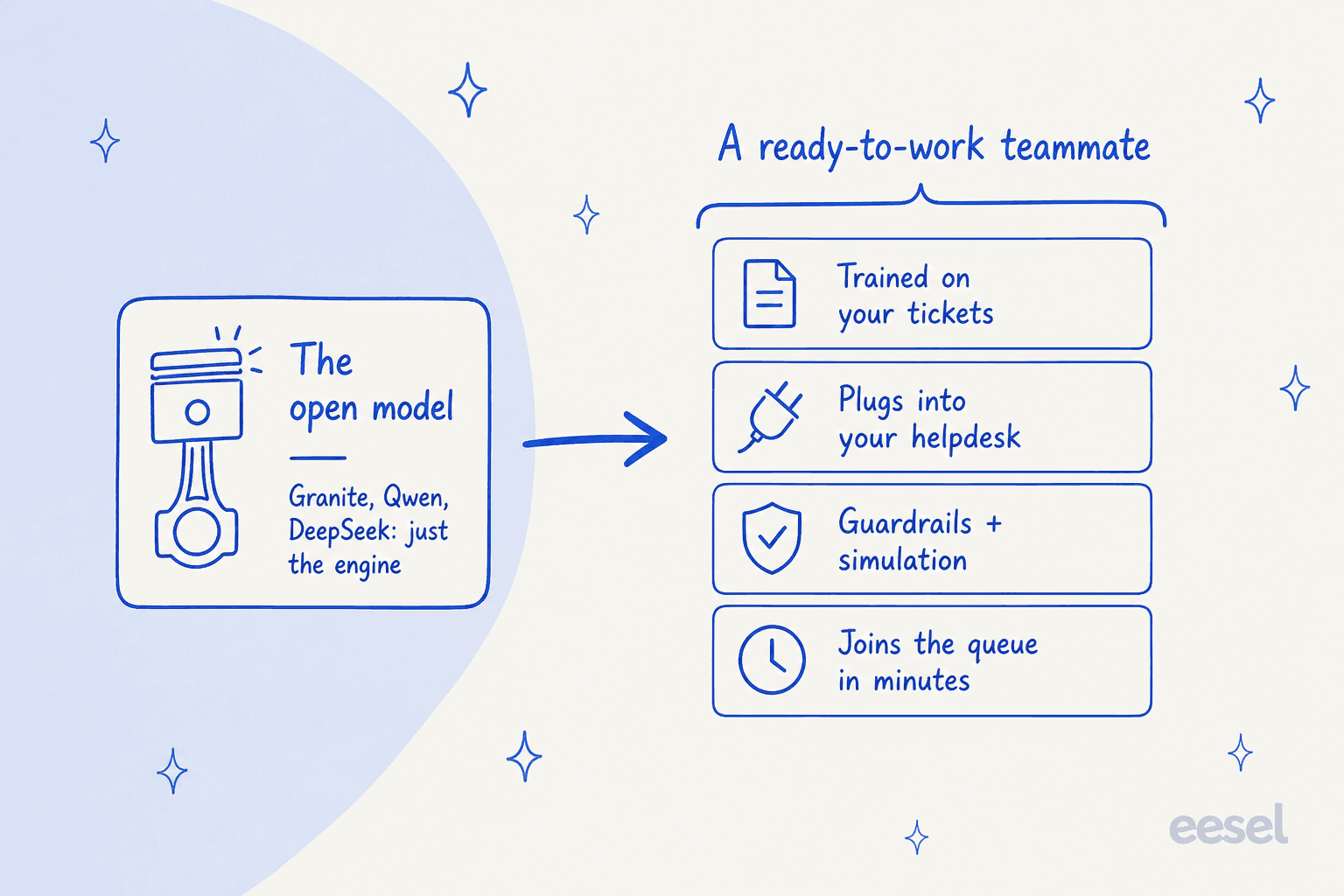
If you are choosing between these models to build something, brilliant; pick the engine that fits and go. But if the real goal is a working AI agent that resolves support tickets, swapping Granite for Qwen changes the easy 10% and leaves the hard 90% untouched: connecting to your knowledge base, plugging into the helpdesk, writing the guardrails, and proving it is safe before it goes live. That is the difference between an AI agent and a rule-based chatbot, and it is where all the actual work lives.
Try eesel: the layer no model on this list gives you
If your goal is answering tickets rather than picking a model to build on, that is exactly the gap eesel fills. Every model above hands you an engine. eesel is the ready-to-work AI helpdesk teammate that already has an engine, plus everything around it: it trains on your past tickets and help center, plugs into the helpdesk you already run (Zendesk, Freshdesk, Gorgias, and 1,000+ other integrations), and joins the queue in minutes instead of quarters.

The differentiator is the safety net a bare model, Granite or otherwise, does not come with: before eesel answers a single real customer, you can simulate it on thousands of historical tickets to see exactly how it would have replied and what it would have resolved. Use any model on this list if you are building. Use an AI helpdesk teammate if you are trying to answer tickets. You can try eesel free, no credit card and no sales call to start.
Frequently Asked Questions
What is the best open-weight alternative to IBM Granite 4.2?
For raw capability, the local-LLM community keeps pointing at Qwen: its open 27B checkpoint is Apache 2.0 and beats Granite on coding. If cost is the deciding factor, DeepSeek V4 Flash is MIT-licensed and cheaper to run at scale. Both are covered in full above, alongside our sibling Granite 4.2 overview.
Is there a cheaper alternative to Granite 4.2?
Granite is already close to the floor: the weights are Apache 2.0, so self-hosting is free, and Replicate's 8B runs at $0.06/$0.25 per million tokens. Among hosted rates, GLM 5.3 Flash's promo pricing ($0.075/$0.25) is comparable, and DeepSeek V4 Flash's off-peak output is $0.66. The model is rarely the expensive part of an AI agent, though; the knowledge, integrations, and guardrails are.
Which Granite 4.2 alternative is best for coding?
Qwen is the consensus pick for coding among people running models locally, and DeepSeek V4 Flash scores well too. Granite 4.2's 30B is credible (57.0 on SWE-Bench Verified), but for pure code generation most reviewers still reach for Qwen. If you are choosing a model to power support automation instead of a coding tool, see our guide to the best AI model for support tickets.
Do Granite 4.2 alternatives run on your own hardware?
Most of them do. Qwen, DeepSeek V4 Flash, GLM 5.3 Flash, Kimi K3, Mistral's small models, and NVIDIA Nemotron all publish open weights you can download and run through Ollama, vLLM, or llama.cpp. Google's Gemini 3.6 Flash is the exception; it is hosted-only. Running any of them for real customer work still needs retrieval and guardrails around the model.
What should I use instead of Granite 4.2 to build a support agent?
If the goal is resolving tickets rather than building infrastructure, you do not want a raw model at all; you want the layer on top of it. eesel is an AI helpdesk teammate that trains on your past tickets and help center, plugs into your existing helpdesk, and can be simulated on historical tickets before it answers a single live customer. The model underneath is the easy part.