


What Z.ai actually released on 12 October
Z.ai published GLM-Legal as a research post titled "Advancing Agentic Legal Intelligence," with two buttons at the top: one for a consultation form, one for AutoClaw, its desktop agent app. The launch post on X has more than 7,000 likes, and the Hacker News thread reached 594 points and 332 comments.
Here is what is in the box, and what is not:
| What Z.ai says or shows | |
|---|---|
| Base model | GLM-5.3-Flash, a 320B-parameter mixture-of-experts model with 18B active |
| Context window | 1M tokens; 128k max output (Vals model card) |
| Input | Text only in Vals testing, even though the base model handles images |
| Target work | Contract review, evidence analysis, compliance research |
| Target users | Law firms, legal tech companies, in-house teams, solo practitioners |
| Access | API trial by application; AutoClaw support "soon" |
| Price | Not published |
| Weights | No download on Z.ai's Hugging Face page as of 14 October |
If you followed the GLM-5.2 launch or the Flash release in August, the pattern will feel familiar: Z.ai takes a strong general model and points it at a specific job. What is new is that the job is a regulated profession, and the release is gated.
How GLM-Legal works under the hood
Z.ai describes three training stages, and the third one is the interesting one.
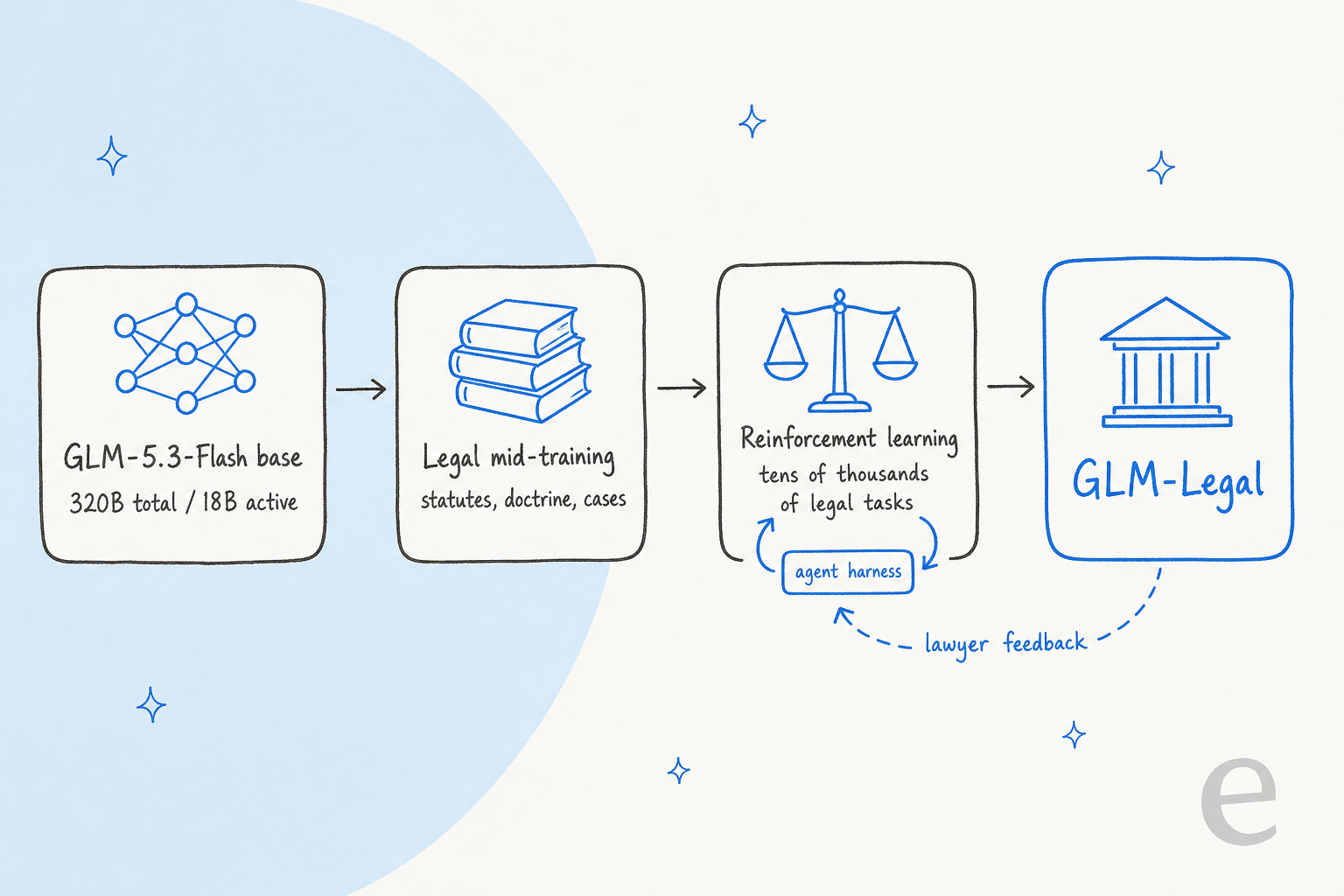
1. Mid-training on legal text. Z.ai "expanded the volume of high-quality legal corpora" so the model learns statutes, doctrine and how lawyers interpret them. This is the standard domain-specific LLM move, and on its own it mostly helps with recall.
2. Reinforcement learning inside an agent harness. This is the part I would pay attention to. The model was trained "across tens of thousands of realistic legal environments," where it plans an analysis, opens files, drafts a deliverable and gets graded. The harness (the code that hands the model its files and tools) was trained alongside it. When the model failed, Z.ai fixed the harness too, and the reverse.
I have built agents on top of general models for years, and most of the bugs I chase are not "the model is dumb." They are "the model did not read the right file" or "it formatted the answer wrong for the next step." Training the model and its harness together attacks exactly that class of failure. It also means GLM-Legal will probably behave best inside Z.ai's own harness, AutoClaw, and less predictably inside yours.
3. A loop with practicing lawyers. Z.ai says lawyers grade outputs on questions like "Are all critical issues and edge cases addressed?" and "Are arguments well-substantiated and citations legally sound?" Those grades feed back into the next round of training.
None of this is published as a paper with data sources. One HN commenter pointed out that without knowing the training set, you cannot rule out tasks that look a lot like the test. Keep that in mind for the next section.
The three demos Z.ai shows
The launch post compares GLM-5.3-Flash and GLM-Legal on the same three tasks. The difference is mostly specificity. On a software-services contract, the base model suggests you "consider shortening the notice period." GLM-Legal says cut it "from 60 to 30 days," remove the cure period for IP, confidentiality and data-security breaches, and add "up to 90 days of transition assistance."
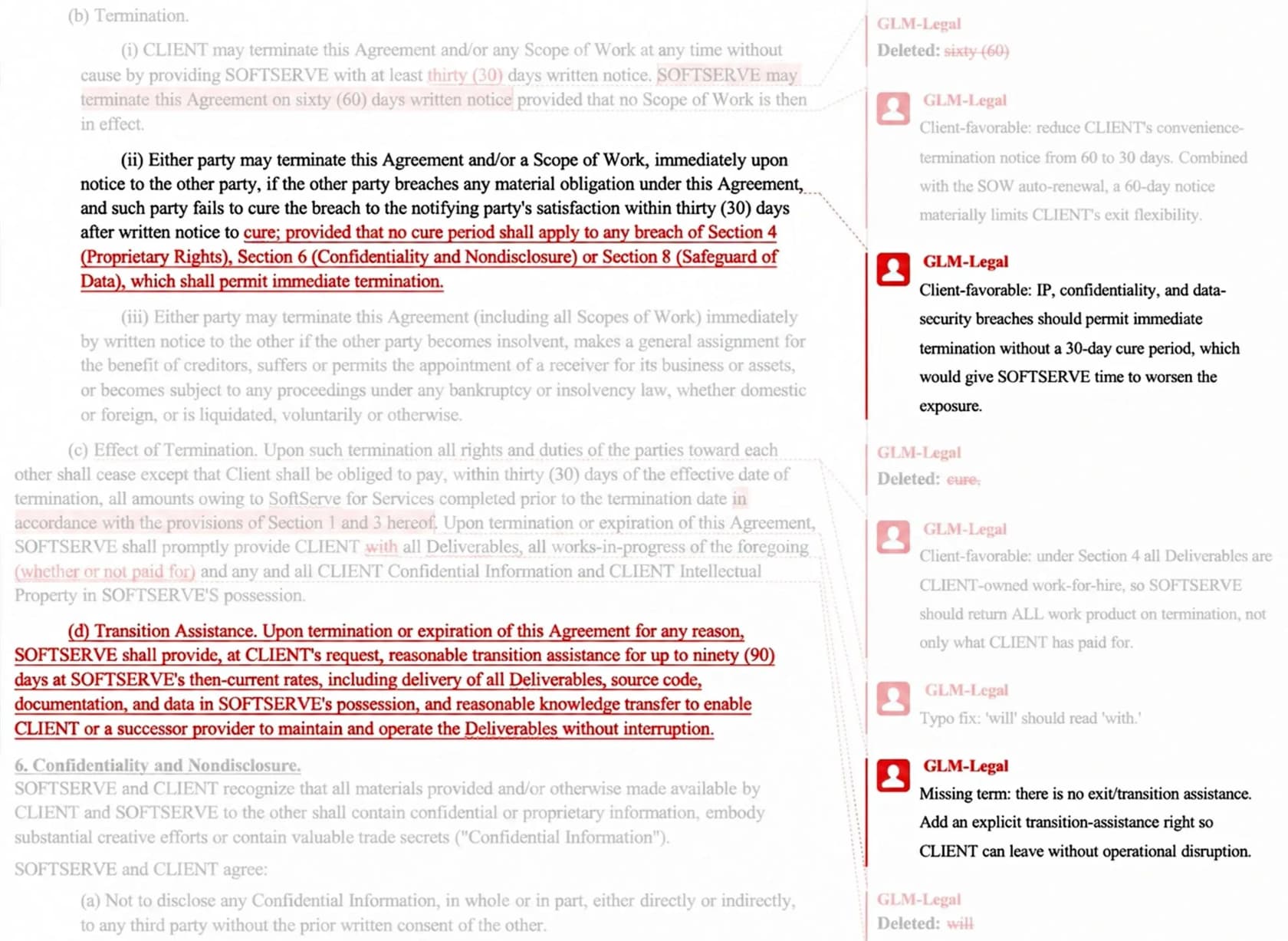
The output lands as tracked changes and comments in a Word file, which is the right shape: a lawyer accepts or rejects each edit instead of trusting a summary.
The second demo reads 40 documents from a software project dispute and builds a timeline with every entry cited to a document number. GLM-Legal ties a "60% complete" client report to an internal snapshot of about 41% and to an email telling staff to keep invoicing. The third plans privacy compliance for a launch in Singapore, Malaysia and Indonesia, with section references for each country's data law.
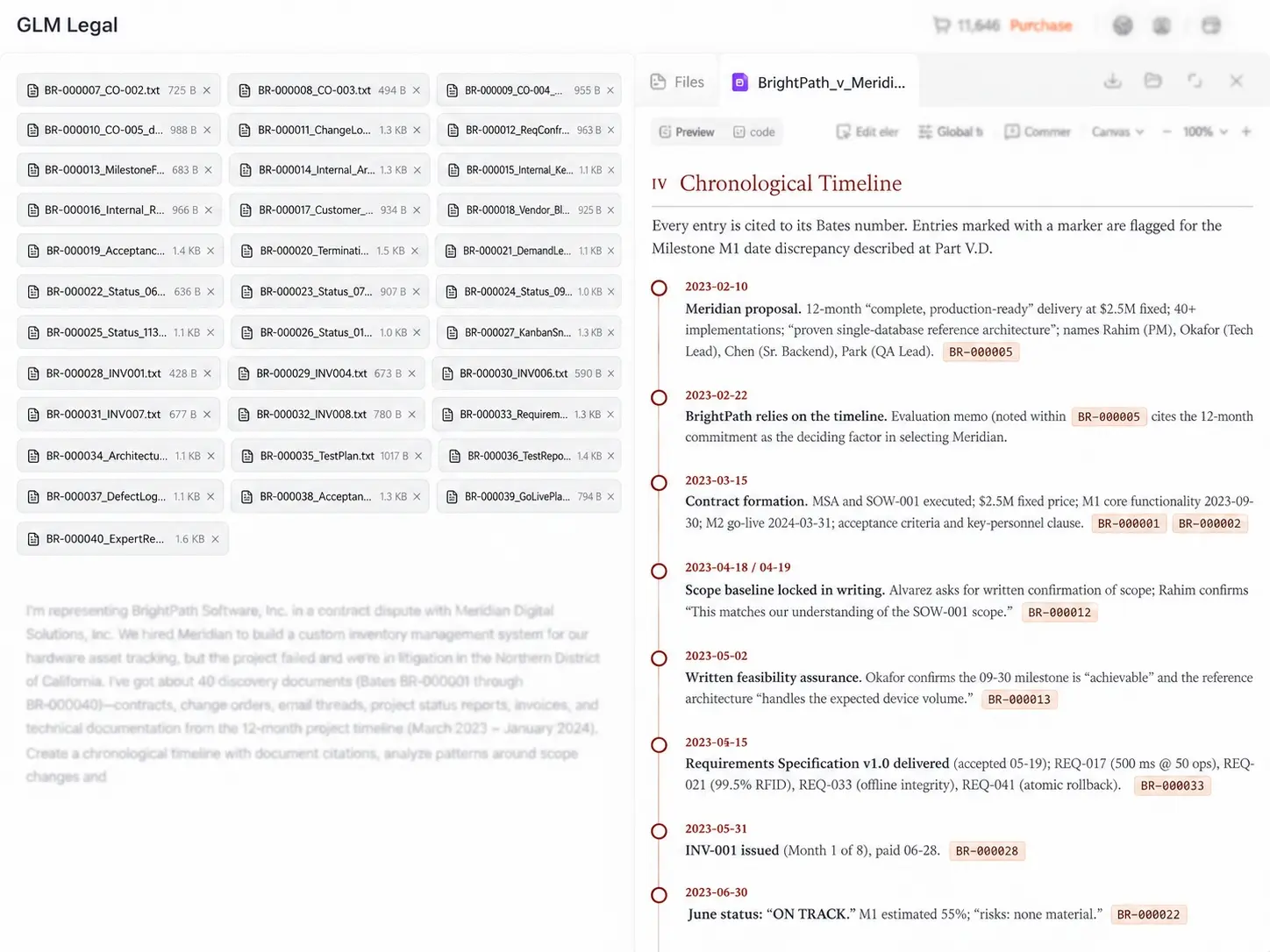
These are cherry-picked by definition. Still, the habit they show (cite the source document for every claim) is the habit that makes AI output checkable, and checkable matters more than clever in legal work.
GLM-Legal benchmarks: what the 19.2% actually means
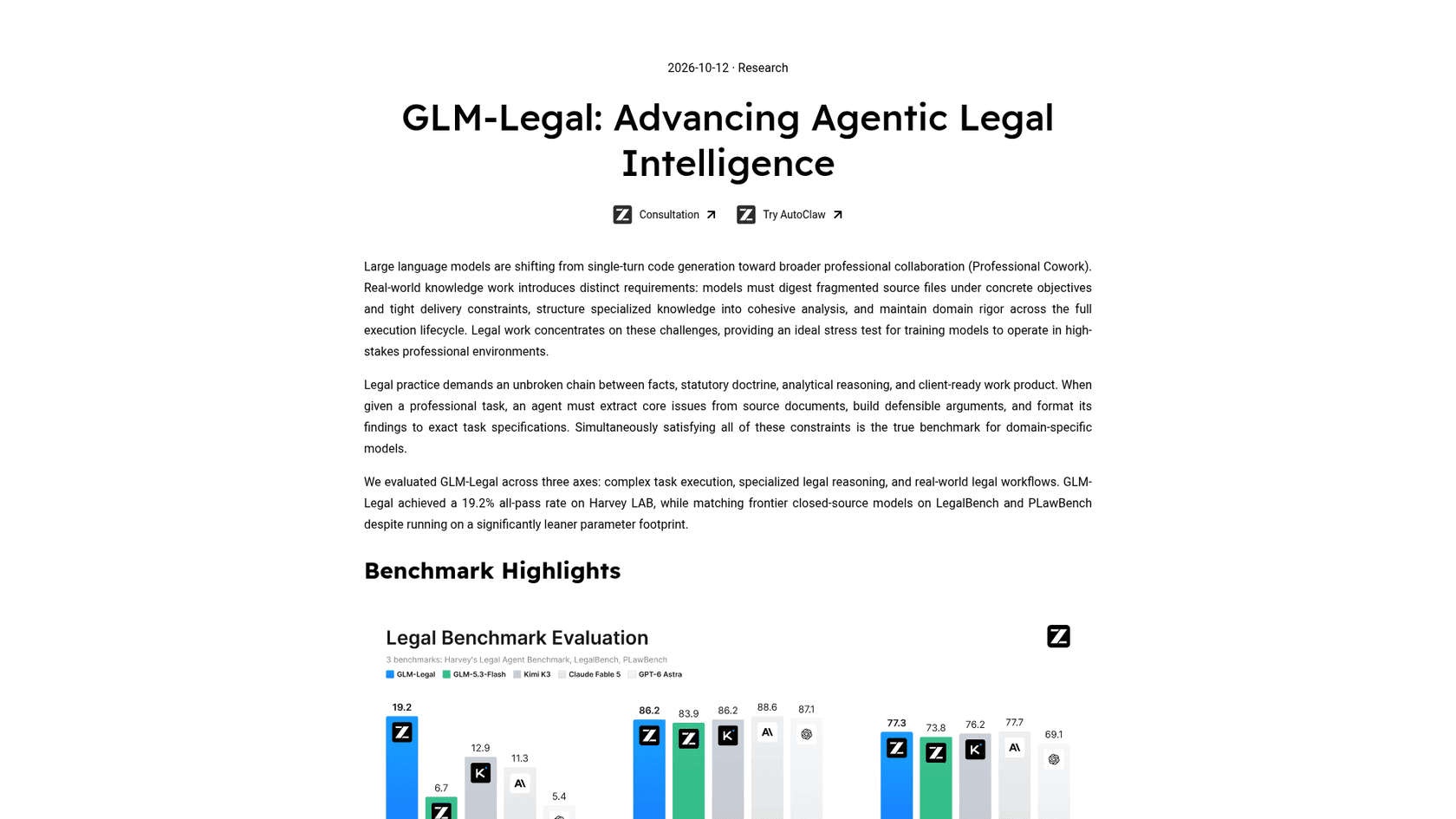
Z.ai's chart compares GLM-Legal with its own base model, Kimi K3, Claude Fable 5 and GPT-6 Astra on three tests.
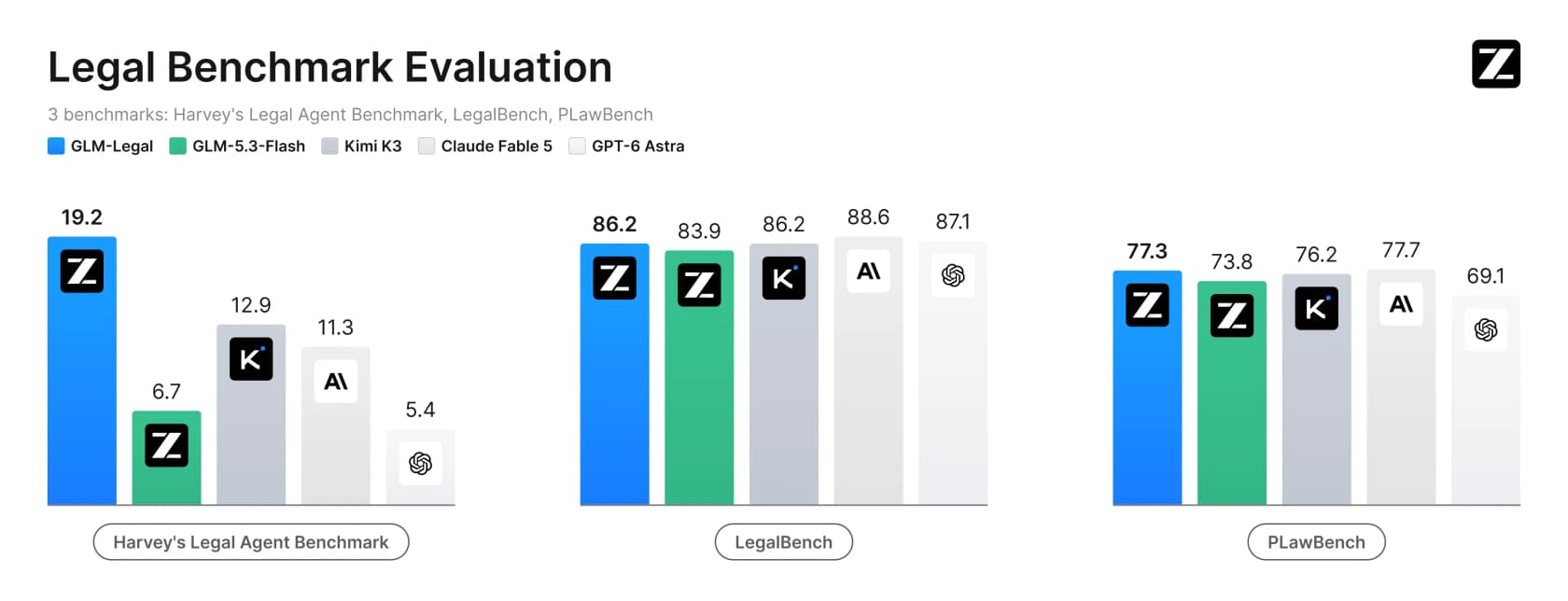
| Benchmark (Z.ai's chart) | GLM-Legal | GLM-5.3-Flash | Kimi K3 | Claude Fable 5 | GPT-6 Astra |
|---|---|---|---|---|---|
| Harvey Legal Agent Benchmark | 19.2 | 6.7 | 12.9 | 11.3 | 5.4 |
| LegalBench | 86.2 | 83.9 | 86.2 | 88.6 | 87.1 |
| PLawBench (Chinese law) | 77.3 | 73.8 | 76.2 | 77.7 | 69.1 |
Read it closely and "matches frontier models" means something narrower than it sounds. GLM-Legal wins one column clearly. On LegalBench and PLawBench it ties or trails Claude Fable 5 by a point or two. That is still a strong result for a model with 18B active parameters, but it is parity on the older tests and a lead on one new one.
Why the scores look so low
Harvey's Legal Agent Benchmark gives an agent a folder of files, six tools (read, edit and write files, plus search and a shell) and Word, Excel and PowerPoint skills. Each task has a rubric of criteria, and the headline number is an all-pass rate: the task only counts if every criterion passes.
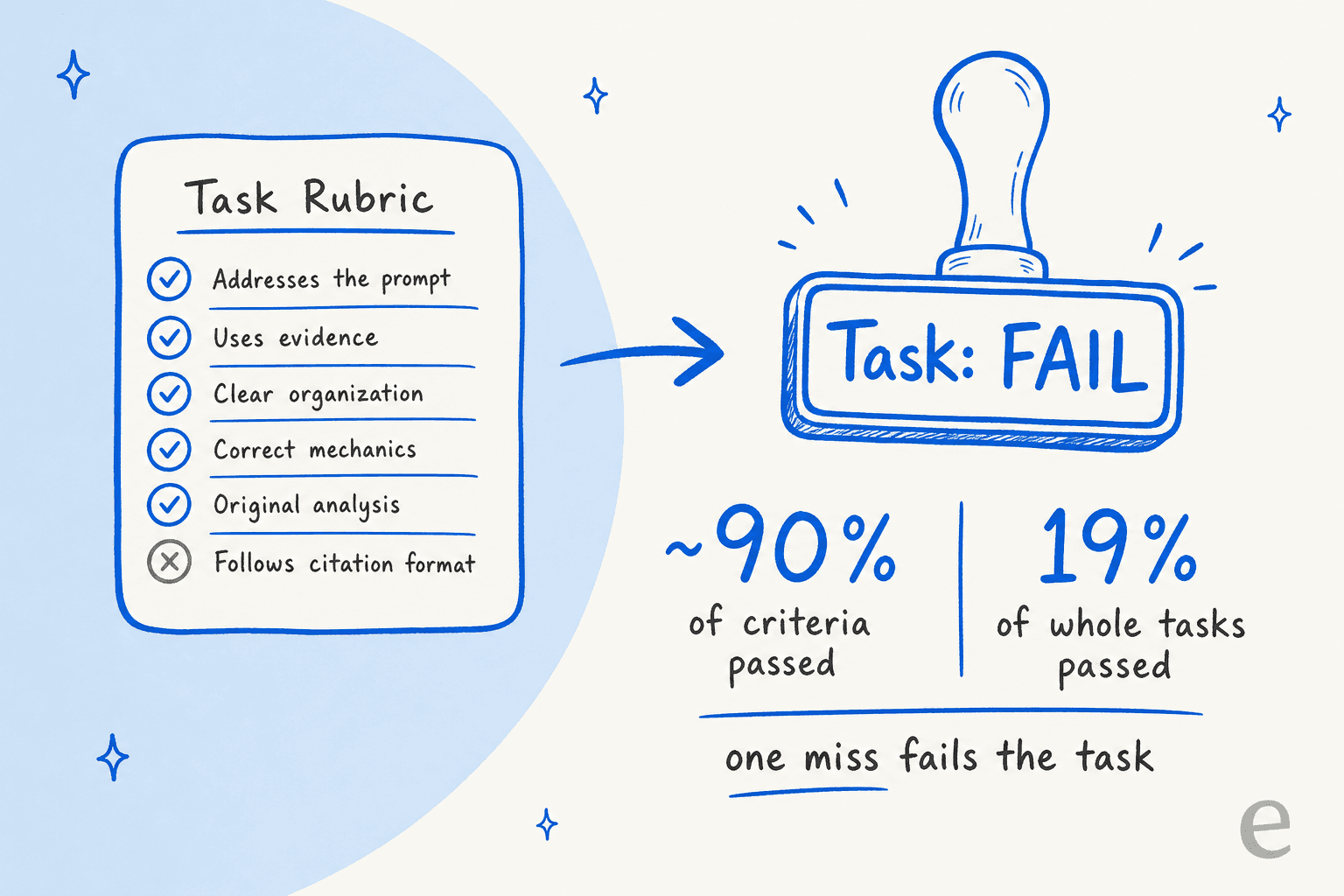
Vals notes that top models pass around 90% of individual criteria, while the best whole-task score is 25.42%. So a 19% model is not wrong four times out of five. It usually gets most of the work right and misses one requirement. In legal work, that one miss can be the whole problem, which is why the strict scoring is defensible.
"This is why I severely dislike using all pass rate. A model could be at like 93%, meeting practically every requirement except the broken ones and all pass would give it like 20%."

What the independent leaderboard adds
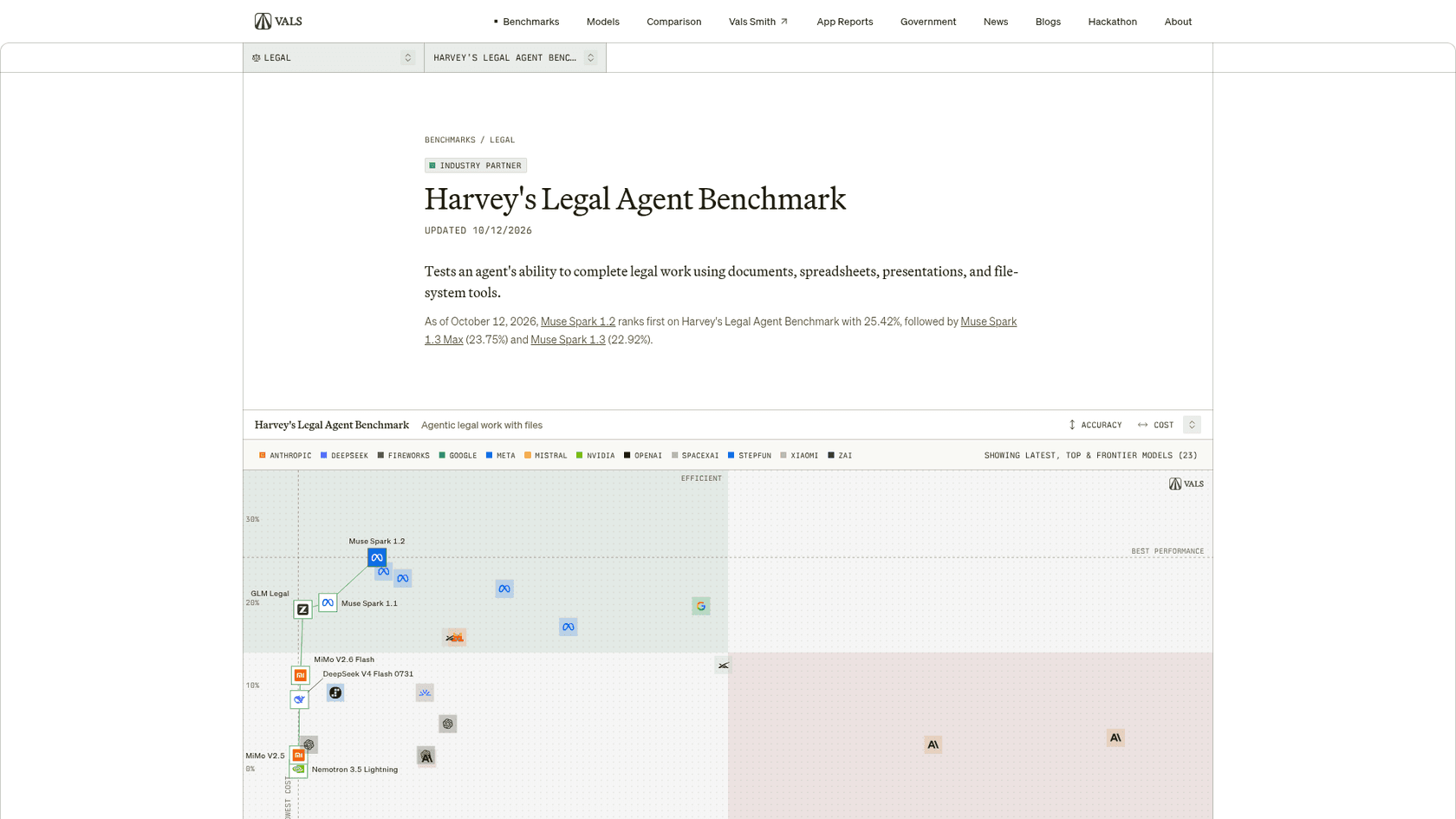
Z.ai sent GLM-Legal to Vals AI for independent testing, and the Vals HLAB leaderboard is the more useful view because it includes everyone:
| Rank | Model | Task pass rate | Cost per task | Time per task |
|---|---|---|---|---|
| 1 | Muse Spark 1.2 | 25.42% | $2.09 | 24m16s |
| 2 | Muse Spark 1.3 Max | 23.75% | $2.26 | 14m43s |
| 3 | Muse Spark 1.3 | 22.92% | $2.76 | 17m04s |
| 4 | Muse Wonder Full | 21.67% | $5.41 | 53m21s |
| 6 | Gemini 4 Argon | 19.58% | $10.55 | 43m55s |
| 7 | GLM-Legal | 19.17% | $0.15 | 1h12m |
| 9 | Mistral Large 4 | 15.83% | $4.18 | 39m25s |
| 12 | Kimi K3 | 12.92% | $3.83 | 13m58s |
| 31 | GLM-5.3-Flash (base) | 6.67% | $0.57 | 52m17s |
| 41 | Claude Opus 5.5 | 3.75% | $21.38 | 52m55s |
Two things stand out. First, the jump from 6.67% to 19.17% is exactly the 12.5 points Z.ai claims, so the vendor number holds up. Second, four Meta models beat GLM-Legal and none appear on Z.ai's chart. One HN commenter caught that on launch day. On Vals' model page, GLM-Legal also scores 86.23% on LegalBench (14th of 150, the best GLM result there) and 41.83% on Legal Research Bench (24th of 78).
Harvey's test itself has critics too. One HN commenter who went through agent traces said they "found multiple problematic tasks and rubrics" and linked an open issue on Harvey's repo. A ±3.25 point margin on a 19% score is wide. I would treat GLM-Legal and Gemini 4 Argon as tied, not ranked.
The real story: cost per task, and the wait
If GLM-Legal had come in at 19% for $10 a task, nobody would be writing about it. The reason it matters is the bill.
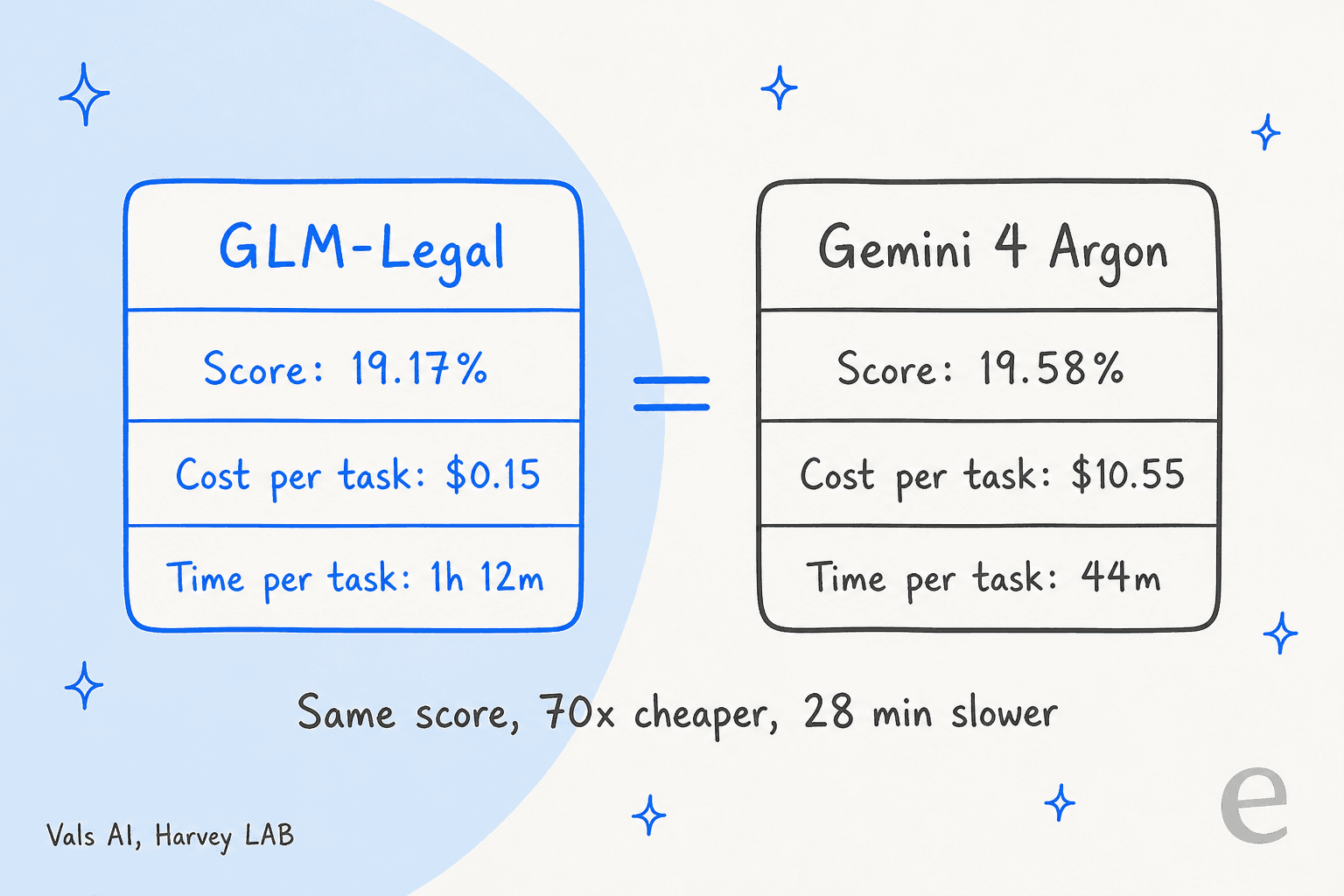
On Vals' numbers, GLM-Legal reaches Gemini 4 Argon's score for about 1/70th of the cost, and Vals calls it the cheapest model in the top 10. The catch is time: 72 minutes per task against 44 for Argon and 24 for the leader. For an overnight batch of due-diligence reviews, that does not matter. For a lawyer waiting on a redline before a call, it does.
Plug in your own monthly task volume to see how the trade plays out:
At 500 tasks a month, the Vals numbers work out to about $75 for GLM-Legal against $5,275 for Gemini 4 Argon, with roughly 600 agent-hours against 366. Muse Spark 1.2 lands in between at about $1,045 and passes more tasks than either. If you only look at score per dollar, GLM-Legal wins easily. If you look at passes per hour, the Meta model does.
GLM-Legal pricing and access
This is the part of the launch that is still mostly blank. Here is everything that is public today:
| Question | Answer as of 14 October 2026 |
|---|---|
| Can I sign up and use it? | No. You fill in the consultation form (company, size, role, use case) to apply for API access |
| Is there a GLM-Legal price? | Not on Z.ai's pricing page |
| What does the base model cost? | GLM-5.3-Flash: $0.15 per 1M input tokens, $0.03 cached, $0.50 output |
| What rate did Vals test at? | $0.075 in and $0.25 out, the Flash launch promo that ended on 9 September |
| Can I use it in AutoClaw? | "Soon," per the launch post |
| Can I download the weights? | Not today; no GLM-Legal repo on Z.ai's Hugging Face page |
The weights question is unsettled. Vals' model card says "Weights: Open," while Z.ai's launch post never mentions a license and several HN readers concluded it is closed. The base model is open, as my GLM-5.3-Flash review covers. Until Z.ai posts weights or a license, I would plan as if GLM-Legal is API-only. For a full breakdown of the base model's rate card, see GLM-5.3-Flash pricing.
That matters for one reason above the rest: where client documents go. Law firms that will not send a contract to a US lab's API are unlikely to send it to a Chinese one either, and an API-only release closes the self-hosting route that made earlier GLM models popular with privacy-sensitive teams.
"Wait, so this not an open weight model, correct? Only available via z.ai?"
What lawyers and developers are saying
The HN thread split roughly into three camps. Practicing lawyers were unimpressed by the absolute number:
"As an attorney, I am not particularly impressed about a 20% pass rate on a benchmark. The name of the game for litigation practice is about being prepared for novel situations, not relitigating past ones."
People who know the benchmark pointed at the relative position instead:
"To be fair to them, on this particular benchmark (Harvey's Legal Agent) 20% puts it almost top of the pack of any model, and certainly top for any remotely in its price class."
And a third group worried about the oldest problem in legal AI: invented case law. One commenter noted that the launch leans on "tracked changes and human review" but says nothing about catching "LLMs outright hallucinating cases or holdings." Another, a lawyer, made a subtler point about redlining: "I don't just see what's there but also what is missing." Spotting an absent clause is harder for a model than editing a present one.
On X, the top reply to Z.ai's announcement was simply "We need glm illegal," with more than 1,200 likes. The internet remains the internet.
GLM-Legal vs frontier models and legal AI products
Three comparisons are worth keeping straight.
Against general frontier models, GLM-Legal wins on Harvey's agent test and roughly ties on LegalBench. Claude Opus 5.5 costs about 140 times more per task on Vals' run and scores 3.75%. A general model is still the better pick if your legal work is mixed with everything else, or if you need image input, which GLM-Legal did not take in Vals' tests.
Against Meta's Muse Spark line, GLM-Legal loses on score and speed. Muse Spark 1.2 passes a third more tasks in a third of the time for about $2 each. If $2 a task is fine, the Meta model is the stronger choice today.
Against legal products like Harvey AI, it is not the same category. Harvey sells the workflows, permissions, audit trails and firm rollout around models, and its pricing reflects that. GLM-Legal is a component a legal tech company might build on. The HN commenter who wondered whether this relates to Harvey's margins was pointing at that: cheap specialized models make the product layer the only part left to charge for. My Harvey AI review covers what that layer actually does.
So who should apply for the beta? Legal tech teams running high-volume, overnight first-pass review (diligence, contract triage, discovery timelines) where a human checks every output anyway. That is where $0.15 and 72 minutes is a great trade. Everyone else can wait for pricing, weights and an independent review from someone who has run it on real matters. If you are shopping for a finished tool rather than a model, my list of AI writing tools for law firms is a better starting point.
What GLM-Legal means if you run a support team
Most people reading about a legal model do not work at a law firm. They run a support or ops team that fields questions with legal edges: refund terms, warranty claims, data deletion requests, "can you send me a copy of my data under GDPR."
A legal model is the wrong tool for that. Those questions are not about case law. They are about your policy, written in your help center and your internal docs, and the right answer is whatever your policy says, even when a smarter model could argue otherwise. That is a retrieval problem with a human handoff, not a reasoning one.
I have spent years building the agents that sit on live support queues at eesel, and the lesson from GLM-Legal's benchmark is the one we keep relearning: the dangerous output is the one that passes 90% of the checks. A support lead at a DTC supplements brand put the requirement plainly on a call with us:
"The AI will never be able to answer 100% of the questions... I need an AI who is only handling the tickets that it's confident to handle and all the other ones, leave them alone."
That is why we run every eesel rollout against a team's historical tickets before it answers a live customer, and why anything touching refunds, legal threats or data compliance can be routed straight to a person. Our hallucination guide covers the setup. If you serve legal clients yourself, AI customer service for legal goes deeper on that case.
Try eesel
GLM-Legal is infrastructure: a model you apply for, wire into a harness, prompt, monitor and pay for by the token. eesel is the employee. The AI helpdesk teammate joins your existing queue in Zendesk, Freshdesk, Gorgias and the rest, learns your refund, warranty and data policies from your help center and past tickets, and hands anything it is unsure about to a human with a summary. Before it replies to anyone, you can watch how it would have answered hundreds of your historical tickets.
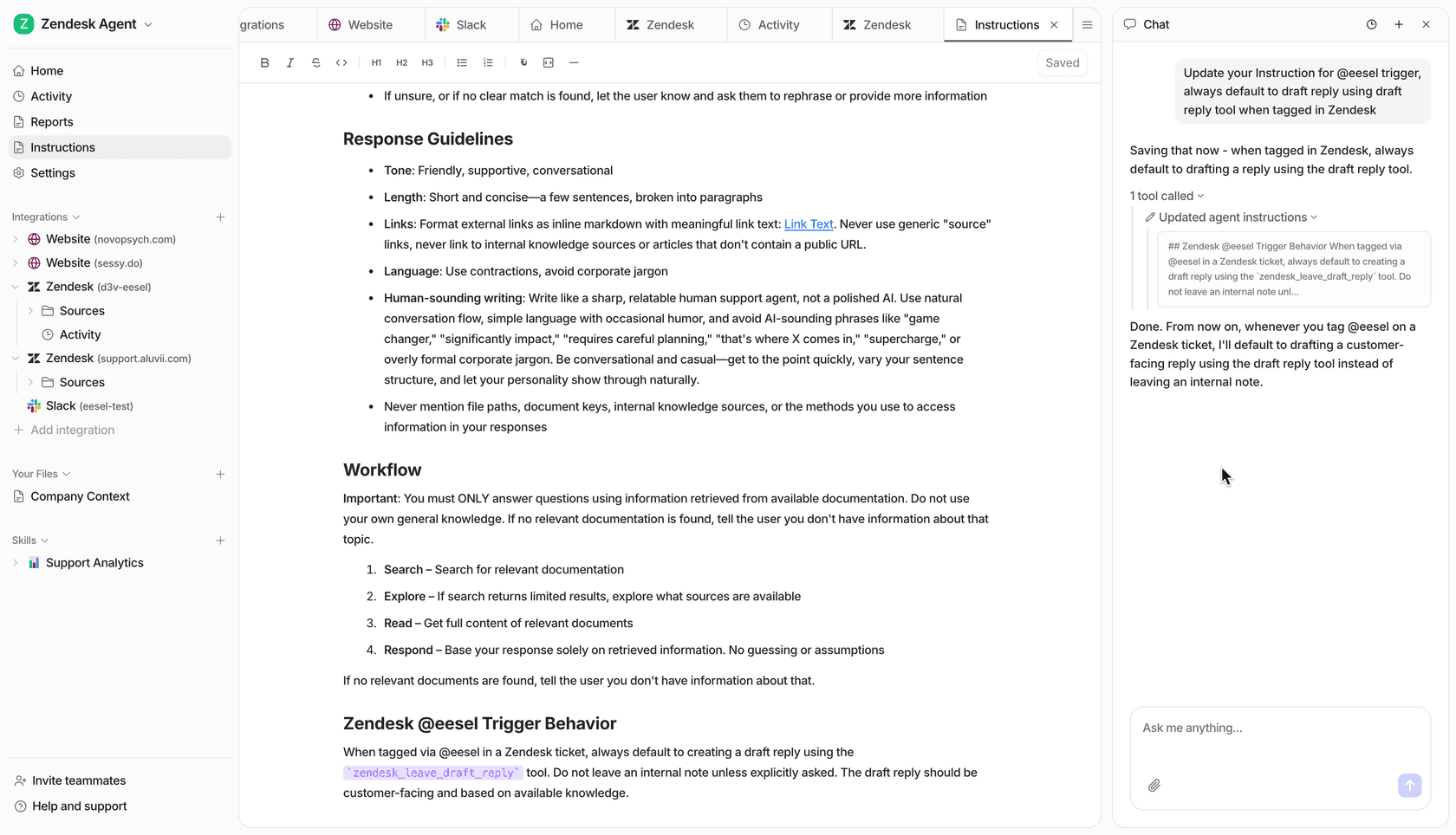
If your team would rather drive it from a terminal, the eesel CLI lets you read and edit the teammate's standing rules, review actions waiting on approval, and see what it did and why, so a coding agent can manage your support teammate the way it manages your repo. If you write content instead, the same roster includes an AI blog writer.
Want an AI that answers policy questions from your own policies, and knows when to stop? Try eesel on last month's tickets and see which ones it would have handled.