What Meta actually shipped on 5 August
Two things landed together, from Matthias Reso and Josh Walters on Meta's developer blog: the model, and the agent built to run it.
Muse Spark 1.2 is the model. Meta's own description is unusually restrained: it calls 1.2 "a moderate improvement over Muse Spark 1.1", optimised for "multi-file refactors, long debugging sessions and tasks that run well past a single prompt". The research post is blunter still, framing the release as "our next step toward the frontier, with larger and much more capable models on the way." Nobody at Meta is claiming a frontier model here, and I would take them at their word. It is a different posture from the rest of Meta's AI push, where the consumer-facing work gets the bigger promises.
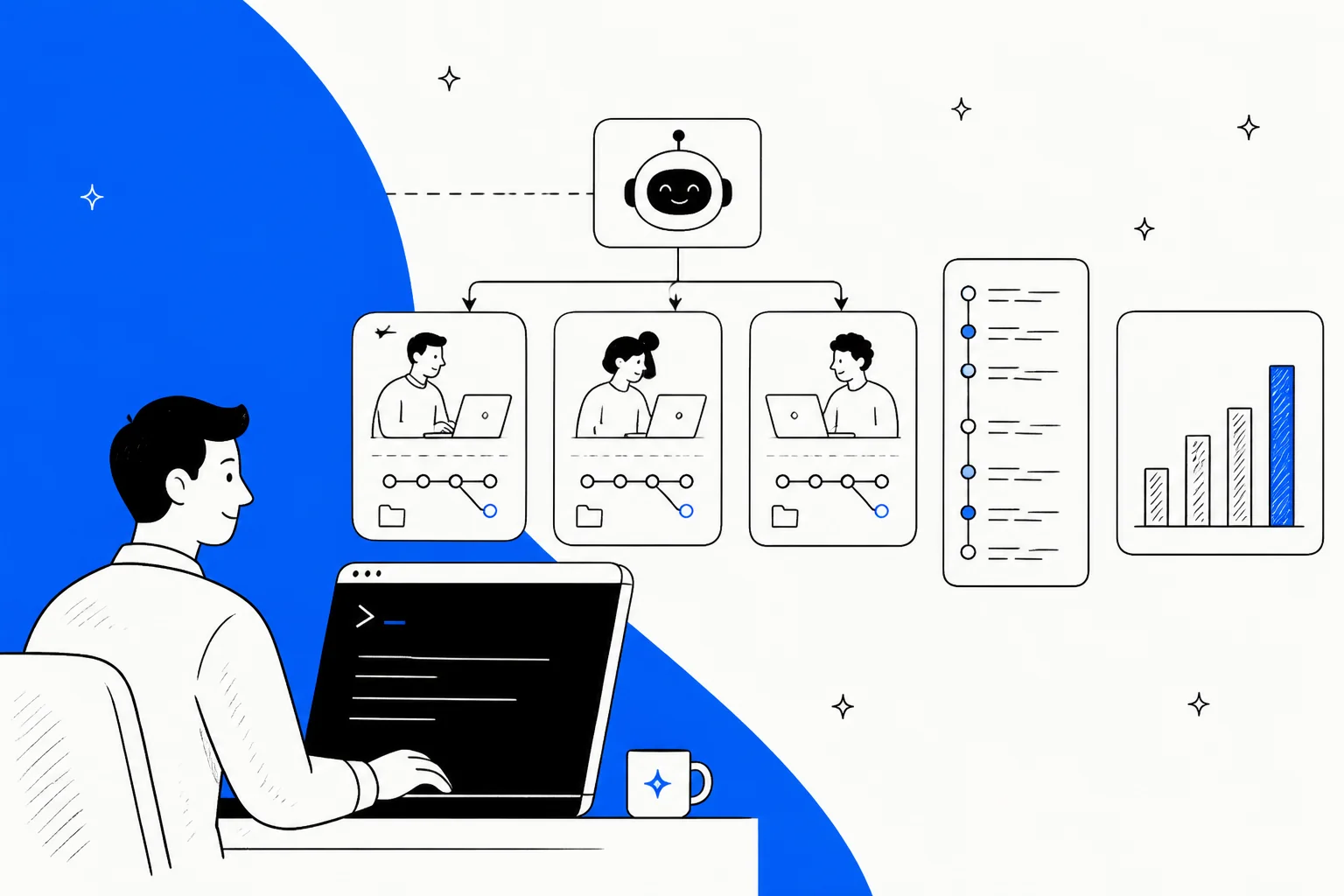
Muse Code is the agent, in beta. It installs with one command, runs in your terminal, spawns parallel subagents, and logs everything it does. It is the piece of this release that is new, and I think it is the piece most coverage skipped past. If you have not used a terminal AI coding tool before, that is the category it joins.
Three things carried over from Muse Spark 1.1 unchanged: the 1,048,576-token context window, the standard rate card, and the closed weights. What changed outside the model is availability. Meta expanded the public preview beyond the United States, which for anyone who tried to reach 1.1 from outside the US was the actual headline.
Artificial Analysis has already marked Muse Spark 1.1 deprecated and points it at 1.2, which tells you how Meta wants the lineage read.
Where Muse Spark 1.2 actually improved
Here is the part I would put on the whiteboard. Meta sold this as a coding model. The coding numbers moved least.
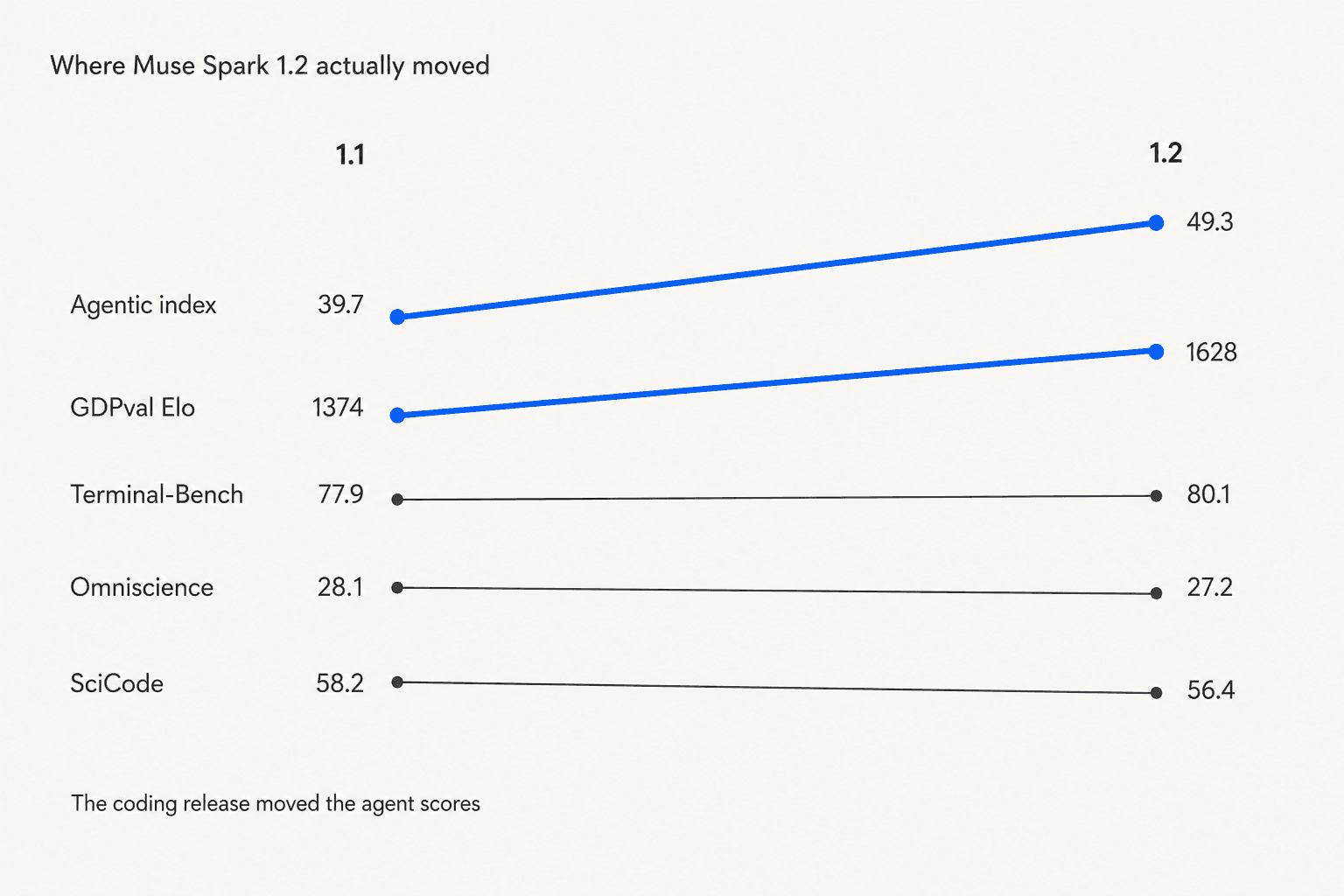
These are all from Artificial Analysis, running both versions on the same harness, which is what makes the comparison worth anything:
| Benchmark | Muse Spark 1.1 | Muse Spark 1.2 | Change |
|---|---|---|---|
| Agentic index | 39.7 | 49.3 | +9.6 |
| GDPval-AA v2 (Elo) | 1374 | 1628 | +254 |
| Intelligence Index | 53.2 | 56.8 | +3.6 |
| tau-3 Banking | 31.8% | 34.9% | +3.1 |
| CritPt | 15.1% | 17.7% | +2.6 |
| Terminal-Bench 2.1 | 77.9% | 80.1% | +2.2 |
| AA-LCR (long context) | 81.3% | 83.3% | +2.0 |
| GPQA Diamond | 89.8% | 90.4% | +0.6 |
| Humanity's Last Exam | 46.2% | 45.5% | -0.7 |
| AA-Omniscience Index | 28.1 | 27.2 | -0.9 |
| SciCode | 58.2% | 56.4% | -1.8 |
SciCode, a coding benchmark, went backwards. Terminal-Bench, the coding benchmark Meta led with, moved about a fifth as much as the agentic index. Meanwhile GDPval-AA v2, the eval that scores blind pairwise comparisons of real professional deliverables, moved 254 Elo points, which took the model from the bottom of that board to second behind Opus 5 on Meta's own chart.
I flagged in my Muse Spark 1.1 review that the strangest thing about that model was the contradiction at its centre: Meta marketed an agent model, and the independent agentic evals were its worst results. That is the hole 1.2 fills. It just is not the hole Meta's launch post is pointing at.
For context on the company it now keeps, 56.8 puts Muse Spark 1.2 thirteenth of twenty on that board, behind Claude Opus 5 at 63.1 and Grok 4.6 at 60.9, and a nose ahead of GPT-5.6 Terra at 56.6.
The hallucination number needs reading twice
One more line from the same source, because it is the kind of thing a single index score hides. Artificial Analysis breaks AA-Omniscience into accuracy and hallucination rate:
| Measure | Muse Spark 1.1 | Muse Spark 1.2 |
|---|---|---|
| Accuracy | 52.0% | 45.4% |
| Hallucination rate | 50.0% | 33.3% |
1.2 hallucinates about a third less and gets roughly an eighth fewer answers right. It learned to decline. That is a real improvement for anything with a customer on the other end and a real regression for anything that needs an answer, and it nets out to a slightly worse composite index. If you are choosing a model for a workflow where a wrong answer is expensive, that trade is probably the single most relevant number in this post, and it is not in any of Meta's charts. The wider version of that problem is in AI hallucinations in support, and the tooling side of catching it is in LLM tracking tools.
The harness catch in Meta's own charts
Now the part that made me go back and re-read the launch post.
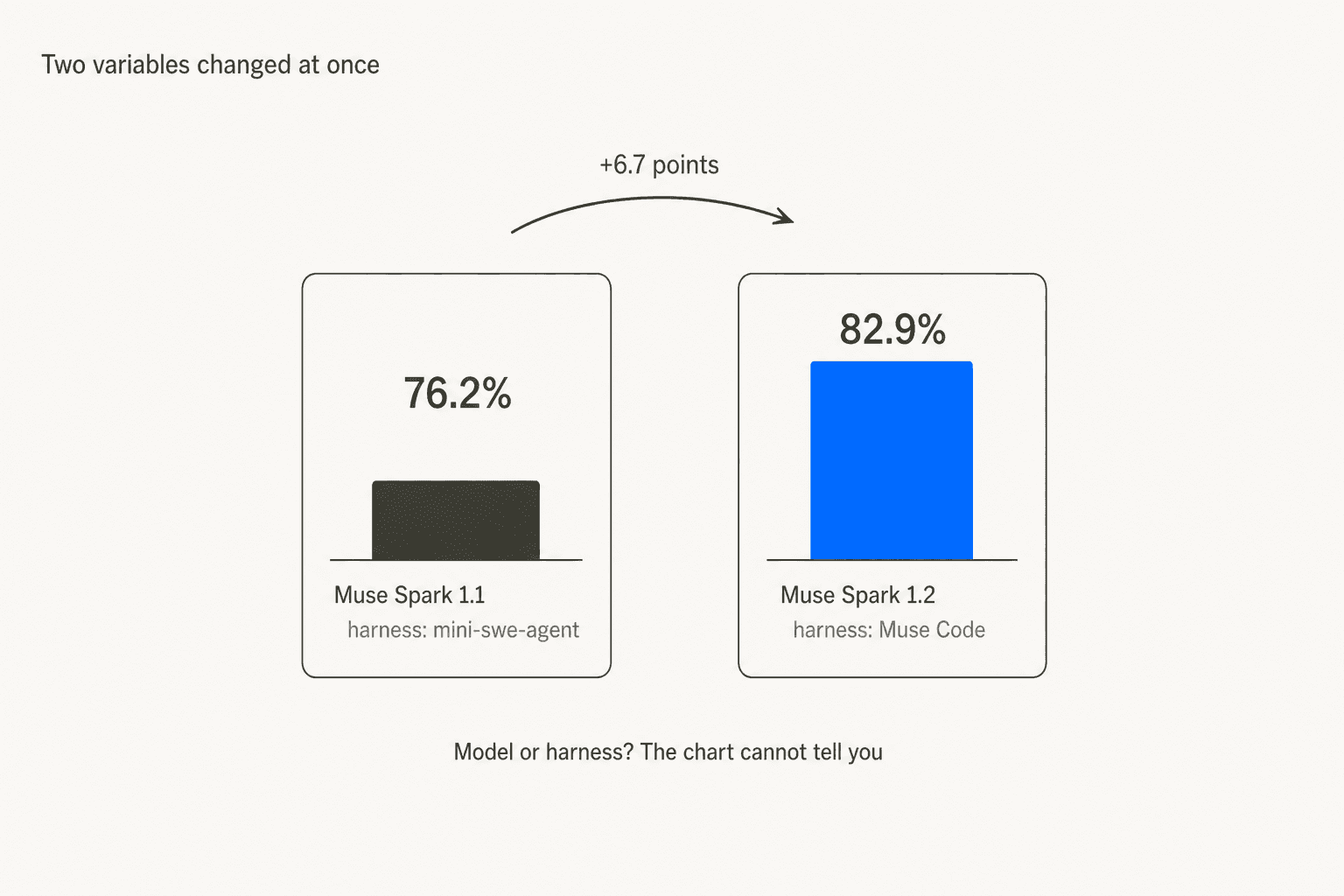
Meta's Terminal-Bench 2.1 chart shows Muse Spark 1.2 at 82.9% and Muse Spark 1.1 at 76.2%. In the small grey text under each bar it also names the harness each model ran in: 1.2 ran in Muse Code, 1.1 ran in mini-swe-agent. Same on the DeepSWE chart. Meta is not hiding this, it is printed right there, but the eye reads the bars and not the footnote.
Meta also says outright that it "co-trained Muse Spark 1.2 with Muse Code", including "rejection sampled harness trajectories" and recipe optimisations for goals, compaction and subagents. So the model was tuned against the harness it is being scored in.
The one chart where no harness is named is Meta's internal coding bench, and it is the flattest one on the page:
| Model | Meta Internal Coding Bench |
|---|---|
| Opus 5 (max) | 79.4% |
| Muse Spark 1.2 | 70.6% |
| Muse Spark 1.1 | 68.3% |
| GPT 5.6 Terra (max) | 65.4% |
| Gemini 3.6 Flash (high) | 63.9% |
2.3 points, on the chart where the harness stops being a variable. Compare that to the 6.7 points on Terminal-Bench and the 6.3 on DeepSWE, where it is. I am not saying Meta cooked anything. I am saying that if you are going to run this model in your own tooling, the harness-controlled number is the one that predicts your experience, and it is the smallest number on the page.
A commenter on the Hacker News launch thread put the general version of this better than I can:
"Outputs are a little bit more deterministic if you control the harness. It is easy to benchmark across one harness, one system prompt and extract the most performance when you control the harness."

This is not a Meta-specific problem, by the way. Every lab now ships a first-party agent and benchmarks inside it, from Claude Code to Codex to Grok Build. It is just unusually legible here because Meta printed the harness names on the chart.
Muse Code, the part that is actually new
Muse Code installs in one line and runs as muse in any project directory:
curl -fsSL https://dev.meta.ai/install.sh | bash
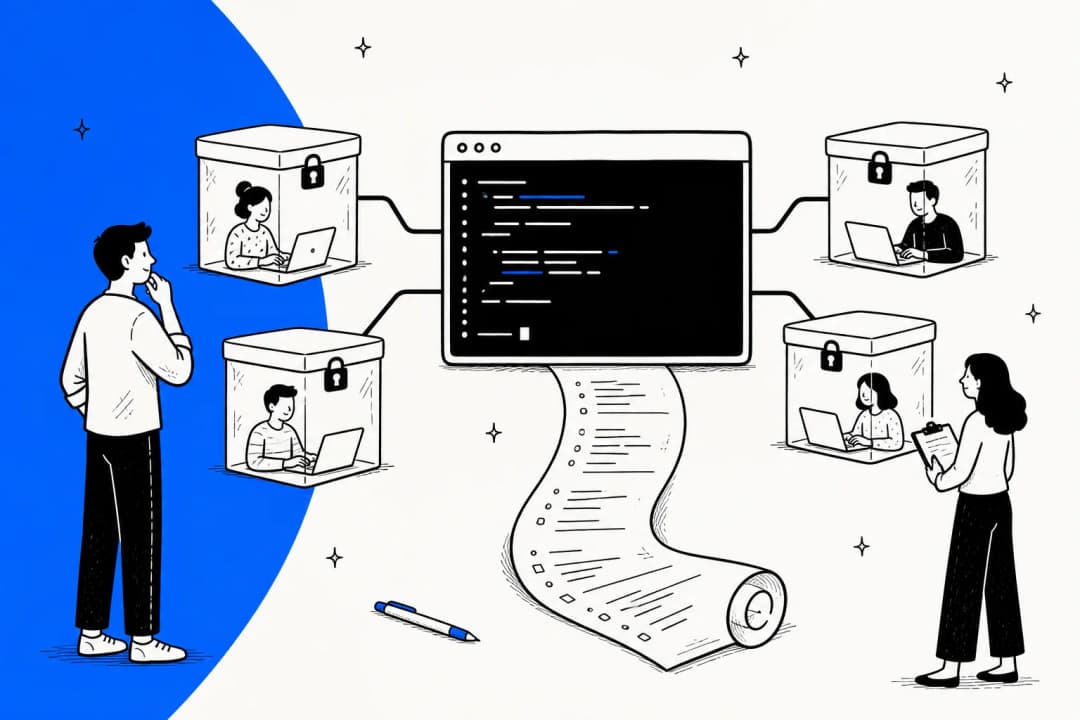
The design idea is fan-out. You hand the parent agent a batch of tasks in one prompt, and it spawns a write-capable child per task, each in its own git worktree, so parallel children never touch the same files.
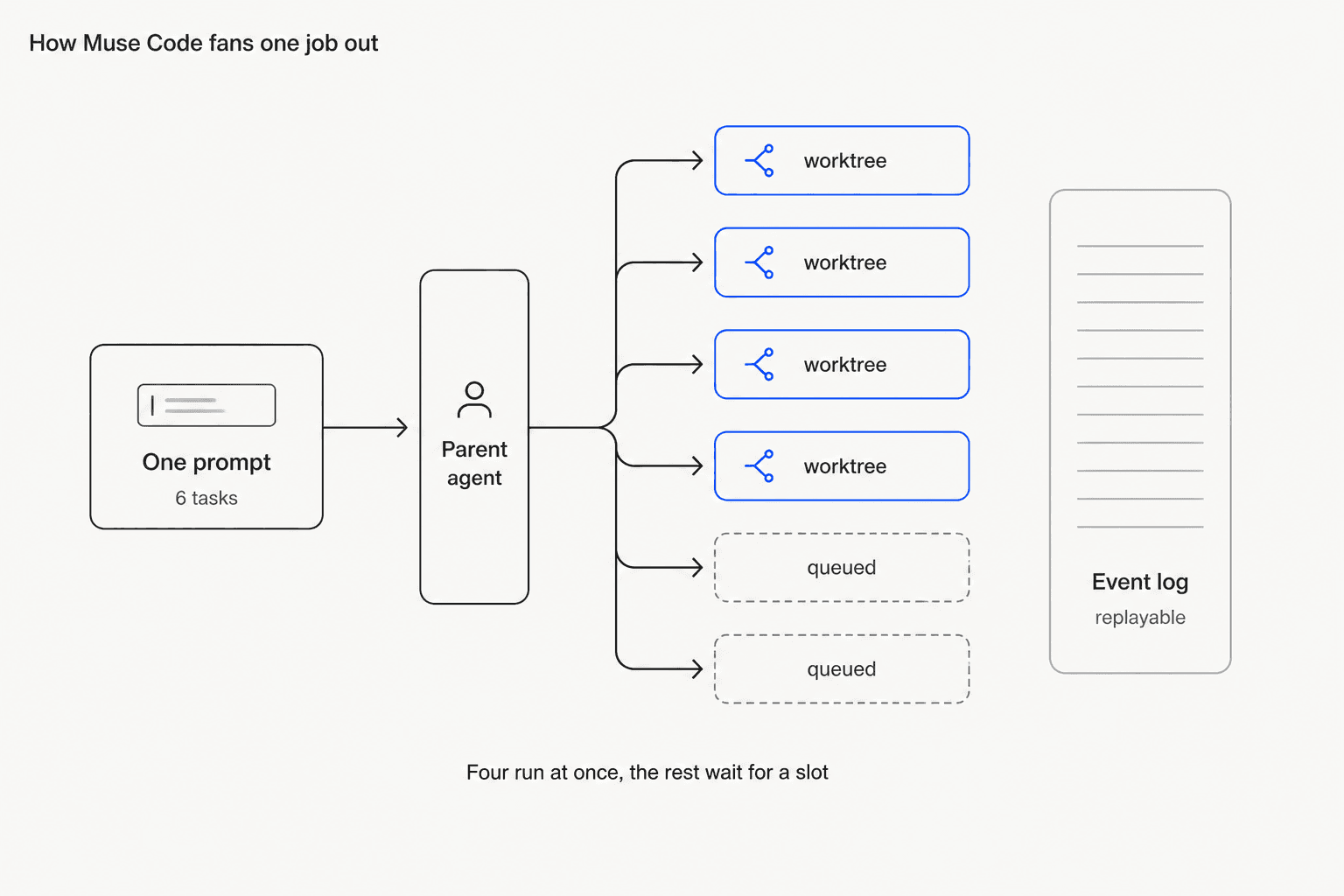
Meta's own fan-out cookbook walks a six-task batch on a sample game repo. The parent spawns six children, the host's concurrency limit works out to four, and tasks five and six queue until slots free.

subagent_status returns that roster, with each child's task, state and a one-line summary of what it changed. Note the status bar in Meta's own capture: muse-spark-1.2 · xhigh. Effort is set high in the demo, which is worth remembering when you compare the numbers to your own bill. The worktrees land under .muse/worktrees/ in detached-HEAD state, checked out from the parent's HEAD, with no manual git worktree command. In Meta's run, the child that fixed the bug passes the full test suite inside its own worktree while the parent's master still fails that same test.
Two other pieces are worth naming:
- A replayable event log. Every model call, tool run, approval and edit is appended to plain JSONL on your disk, which you can grep with
jq. The same log powersmuse resume, so a crashed session picks up from the last recorded step instead of being re-prompted from scratch. - Bundled skills. Four playbooks ship built in:
/plan(grounds a plan in your real files, then stops for approval),/grilling(interviews you one decision-forcing question at a time),/grill-with-docs, and/taste(an anti-slop checklist of visual defaults to avoid). They are explicit-invocation only, so the agent will not reach for/grillon its own, and a skill loads only for the turn you invoke it on.
If you want a longer look at how this category is shaking out, my agentic coding CLI piece covers the field. Rolling your own is a different project, and the Claude Code SDK walkthrough is the closest comparison to what Meta has built here.
For the wider tool market, there is the best AI coding assistant tools roundup. Anyone weighing this against the incumbent should start with the Claude AI coding assistant overview.
The honest read on Muse Code: worktree isolation per subagent and a replay-exact event log are good engineering, and one Hacker News commenter's reaction matched mine, that "Muse code is more interesting than the new model." Whether it beats the harness you already use is a question a beta and a blog post cannot answer.
Muse Spark 1.2 pricing and the contributor trade
Meta publishes two model IDs for one model, and the gap between them is the story.
| Model ID | Context | Input / Mtok | Cached input / Mtok | Output / Mtok | Data policy |
|---|---|---|---|---|---|
muse-spark-1.2-contributor | 1M | $0.10 | $0.002 | $0.20 | "Used to improve our products" |
muse-spark-1.2 | 1M | $1.25 | $0.15 | $4.25 | "Not used to improve our products" |
Those labels are Meta's own wording, from its model page. The standard rate is unchanged from 1.1, so if you were already paying for the old model, 1.2 is a free upgrade on price.
The contributor tier is rate-limited by tokens in a rolling 5-hour window rather than by request count, and Meta says it is available in select countries. Meta also notes it is now accepting zero data retention requests through sales, which is the enterprise door on the standard tier.
On a normal 3:1 input-to-output blend, that works out to $0.125 per million tokens on the contributor ID against $2.00 on the standard one. 16x, and the exchange rate is your traffic.
Two numbers to sanity-check that against. Artificial Analysis measured Muse Spark 1.2 at $0.399 per Intelligence Index task on the standard rate, up 37% from 1.1's $0.292 because the model thinks more. Run the same token mix through the contributor rate card and it lands near $0.017 a task, which would be below DeepSeek V4 Flash at $0.027, the cheapest model on that board. That second figure is my own arithmetic on AA's published per-task token costs, not a measured result, and it assumes cache writes bill at the input rate, which Meta does not publish. The DeepSeek comparison is the one to sit with, because that model is open weights and you can run it where nobody trains on you. My DeepSeek V4 Flash review has the full picture.
Even at the standard rate the value case holds up. Muse Spark 1.2 scores 56.8 on the Intelligence Index at $0.399 a task; Claude Opus 5 scores 63.1 at $2.34. Six times the cost for eleven percent more index. Whether that eleven percent matters is entirely a question about your workload, which is the same argument I made in Claude Opus 5 alternatives.
One caveat on the reasoning bill: $339.82 of the $639.27 it cost Artificial Analysis to run the full index went on reasoning tokens you never see. Meta's /effort control dials that up and down, and on straightforward tasks it is the first knob I would reach for. It is the same hidden line item that makes Anthropic API pricing hard to forecast from a rate card alone.
What developers are saying
The launch thread drew 333 points and 266 comments, and the reaction split along a clean line: the pricing is interesting, the trust question is not settled, and the harness lock-in is real.
On the price, the read was immediate:
"If you are happy to share data for training, the contributor mode offers amazing price $0.10 / $0.20"
Someone else framed the same fact as an open question about what the data is worth:
"Very interesting they have a way cheaper "contributor" version "used to improve our products", how much of that is price discrimination vs the data being that valuable? Roughly DeepSeek V4 Flash pricing, though you can get V4 from providers that don't train on your data"
The sharpest data point for anyone planning to use the model outside Meta's own agent came from a developer who tried exactly that:
"It's useless. Tried with OpenCode + OpenRouter and it couldn't complete an simple task. It stuck using grep/search tools. I think Muse Spark was so heavily RL'd on the Meta harness that it make it useless or very token inneficient to use in other harness like Opencode."
That is one person's run and it sits directly against Meta's claim that it trained across multiple harnesses so the model "still generalizes to other coding agents you already use." I would not treat either as settled. I would treat it as the specific thing to test first, with a small paid run in your own tooling, before you move a workflow onto it. The same advice applies to any domain-specific model tuned hard against one environment.
Another commenter clocked OpenRouter throughput at around 150 tokens per second, which is fast for this class. The API itself takes OpenAI-format requests, so swapping it in is mostly a base URL change, the same shape of migration covered in OpenAI vs Anthropic APIs.
And the "expanded global access" line got a flat contradiction from at least one user, who reported the contributor tier still being US-only. Meta's own wording is narrower than the headline: the cheap ID is "available in select countries", which is not the same promise as the model being globally available.
Open weights are coming, without a date
Four days after the launch, Meta's Chief AI Officer made the announcement a lot of people had been waiting three model generations for:
"1/ big announcement today: we will be releasing an open weight version of muse spark 1.2 soon. we also are releasing muse glimmer, a 30B agentic model with open weights under apache 2.0. muse glimmer can run on 24GB of VRAM without losing agentic reliability. 🧵"
Glimmer shipped. Spark 1.2's weights did not, and "soon" carries no licence and no date. I would plan around what is actually downloadable today, which is Glimmer at 30B under Apache 2.0, and treat open-weight Spark as a nice surprise if it lands. Meta has form on shipping the adjacent thing first: the same pattern showed up with Muse Image.
If open weights are the whole reason you are reading this, Qwen3.8 Max is the serious alternative shipping today. The DeepSeek vs Kimi K3 comparison is the one I would read before picking between the other two.
So who should actually use Muse Spark 1.2?
Where it lands, after a week with the numbers:
- Worth trying if you run long agentic jobs on a budget. The agentic index jump is real, the context is a genuine 1M, and at $0.40 a task on the standard rate it is roughly a sixth of Opus 5. The kernel-optimisation case study is the honest shape of it: over 1,000 tool calls and up to 24 hours, Muse Spark 1.2 reached +68.7% over baseline, fourth of six, behind Opus 5 at +74.0%, GPT-5.6 Sol at +71.2% and Opus 4.8 at +69.6%. Read the curve rather than the endpoint and it is slower off the line too, sitting near 27% at 200 tool calls while Opus 5 was already past 60%. It gets there. It takes the long road.
- Worth trying if your code is not sensitive. The contributor tier is priced like an open-weights model and Meta tells you exactly what you are paying with. For side projects, OSS work and throwaway prototypes that is a straightforward yes.
- Probably not, if you need the top of the board. Opus 5 leads every single chart Meta published, including Meta's own internal one. GPT-5.6 Sol sits in front on the index too. If raw speed is what you are short of rather than intelligence, Gemini 3.6 Flash is the cheaper answer.
- Probably not, yet, if you are committing to a harness. The strongest coding numbers come from the Muse Code pairing, Muse Code is in beta, and the one public report of running the model elsewhere was bad. That combination argues for a test, not a migration.
- Not on its own, if the job is customer support. The accuracy drop alongside the hallucination drop is exactly the trade a support workload cares about, and neither number is something you can fix from the API. The picks that actually hold up for a queue are in my top AI agents roundup, and the budgeting frame is in AI customer service cost.
Try eesel
That last point is where I want to end, because it is the mistake I watch teams make every quarter. A model release like this one makes a support automation project look like a pricing decision. It is not. Between muse-spark-1.2 and an AI that can safely answer a real customer sits retrieval over your own content, confidence thresholds, escalation rules, and a way to know what it will do before it does it. That is the difference between an AI agent and a chatbot, and it is where the project actually lives.
eesel is that layer. It plugs into the helpdesk you already run, learns from your own resolved tickets rather than a generic web crawl, and simulates on your ticket history first so you see the resolution rate and the answers before a single customer sees them. That simulation step exists because I have watched a confident-sounding bot quietly give wrong answers, and a 33% hallucination rate is not a number you want to discover in production.

If you are evaluating models because your queue is drowning, start at the other end. Run a simulation on your last few thousand tickets, see what actually deflects, and then argue about tokens. Free to try, and no card to start.
Two more reads if you are earlier in that decision. My best LLM for support piece covers the model choice properly. For the business case, the numbers live in AI agent vs human cost.
Frequently Asked Questions
How much does Meta Muse Spark 1.2 cost?
muse-spark-1.2 ID costs $1.25 per million input tokens, $0.15 cached and $4.25 output, identical to Muse Spark 1.1 pricing. The muse-spark-1.2-contributor ID costs $0.10 input, $0.002 cached and $0.20 output, and Meta's model page states that traffic is used to improve its products. Reasoning tokens bill at the output rate on both.What is the difference between Muse Spark 1.1 and 1.2?
Is Muse Spark 1.2 better than Claude Opus 5 or GPT-5.6?
What is Muse Code and do I need it to use Muse Spark 1.2?
Will Meta release Muse Spark 1.2 open weights?
Can I use Muse Spark 1.2 for customer support automation?
Is the Muse Spark 1.2 contributor tier safe for private code?
Does Muse Spark 1.2 work outside Muse Code?


Article by
Alicia Kirana Utomo
Kira is a writer at eesel AI with a Computer Science background and over a year of hands-on experience evaluating AI-powered customer service tools. She focuses on breaking down how helpdesk platforms and AI agents actually work so that support teams can make better buying decisions.