

Pick your workload, then read the verdict
The single most useful thing I can give you is not another benchmark table. It is the answer to "does this apply to me." Grok 4.6's verdict flips completely depending on what you are building.
What actually changed since Grok 4.5
xAI released Grok 4.6 on August 12, 2026, roughly five weeks after Grok 4.5. Five weeks is a fast cadence, and you can see it in what moved and what did not.
The training story is unusually candid. xAI says it ran a longer supplemental training pass than 4.5, then used Grok 4.5 itself to regenerate the SFT trajectories across reasoning efforts and agent harnesses, filtering bad traces with model-based checks. In other words, the previous model taught this one, and the RL stage was pointed at agentic tasks: kernel optimization, web development, computer-aided design.
The spec sheet barely moved. Per the grok-4.6 model page, context stays at 500,000 tokens, the model is text and image in, text out, with function calling, structured outputs, and reasoning. Rate limits are 150 requests per second and 50M tokens per minute, across us-east-1 and us-west-2.
What moved was the scores. Artificial Analysis has it at 61 on the Intelligence Index, up 5 points from Grok 4.5 and 23 from Grok 4.3. Five points in five weeks is a real generational step, not a version-number bump.
Reading the eval table properly

Below is xAI's own table. I find it more revealing than the blog post wrapped around it. Bold is the winner per row.
| Evaluation | Grok 4.6 High | Grok 4.5 High | GPT-5.6 Sol Max | Fable 5 Max |
|---|---|---|---|---|
| AA Intelligence Index | 61 | 56 | 61 | 62 |
| GDPVal-AA v2 | 1753 | 1526 | 1728 | 1741 |
| CursorBench v3.2 | 69.9% | 66.7% | 67.2% | 70.5% |
| DeepSWE v1.1 | 65.9% | 54% | 73% | 70% |
| FrontierCode v1.1 (Extended) | 61.3% | 56.6% | 60.6% | 63.6% |
| APEX-Agents | 57.5% | 47.1% | 56.7% | 59.2% |
| Terminal-Bench v3.0 | 26% | 15.7% | 34.6% | 34.1% |
| APEX-SWE | 56.4% | 53.6% | — | 58.8% |
| AA-Briefcase | 1577 | 1313 | 1502 | 1574 |
| Harvey LAB (Vals) | 15.8% | 12.9% | 2.5% | 11.3% |
Four things jump out.
Grok 4.6 wins the knowledge-work rows and loses the software-engineering rows. It takes GDPVal-AA, AA-Briefcase, and Harvey LAB outright. It loses DeepSWE by 7.1 points and Terminal-Bench by 8.6. For a launch post titled around agentic coding, that is a curious shape.
The Harvey number is the strangest cell in the table. Grok 4.6 scores 15.8% on the legal analysis benchmark against GPT-5.6 Sol's 2.5%. A 6x gap on one eval usually means the eval is measuring something narrow, or one model was tuned for that shape of task. I would not build a legal product on one row, but it is worth knowing.
Terminal-Bench has two live version numbers and they disagree completely. xAI's card reports 26% on v3.0. Artificial Analysis reports 88.4% on v2.1 and calls it in line with the leaders. Both are true. v3.0 is the harder revision. If you see a Terminal-Bench figure quoted without a version, it is not telling you anything.
The 4.5 to 4.6 deltas are largest exactly where agents live. DeepSWE went from 54% to 65.9%. APEX-Agents 47.1% to 57.5%. AA-Briefcase 1313 to 1577. Whatever the agentic RL stage did, it worked on the tasks that run for many steps.
One more table row that is not in xAI's chart. Artificial Analysis measures 𝜏³-Banking, a multi-turn customer service eval with tool use, and Grok 4.6 scores 50.7%. That puts it in the top two alongside Qwen3.8 Max at 51.3%. I will come back to that number, because top two turns out to mean less than it sounds like.
Speed and cost, measured rather than claimed
This is where Grok 4.6 makes its strongest case, and it is not really a benchmark argument.
Headline pricing is unchanged from Grok 4.5: $2.00 per 1M input, $0.50 cached, $6.00 output, per xAI's pricing page. Cross 200k prompt tokens and every rate doubles to $4.00 / $1.00 / $12.00. Holding price flat across a generation is unusual at the frontier, and Artificial Analysis says so explicitly.
The comparison that matters is against models within two points on the index. Claude Opus 5 is $5/$25. GPT-5.6 Sol is $5/$30. Grok 4.6 ties Sol at a fifth of the output rate, and output rate dominates cost in reasoning-heavy work.
Measured rather than listed, on OpenRouter's Grok 4.6 page, the picture holds:
| Measure | xAI standard | xAI (ZDR) |
|---|---|---|
| Effective input paid | $0.7249/M | $0.7812/M |
| Effective output paid | $6.125/M | $6.116/M |
| Cache hit rate | 90.3% | 88.0% |
| Throughput (3-day avg) | 94 tok/s | 92 tok/s |
| Latency (3-day avg) | 0.62s | 0.96s |
| Tool call error rate | 0.08% | 0.02% |
| Structured output error rate | 4.00% | 0.00% |
Two of those deserve a second look. The effective input price is $0.72, not $2, because real traffic hits cache 90% of the time. And the 4.00% structured output error rate on the standard endpoint against 0.00% on the ZDR endpoint is a real operational difference, not a rounding artifact. If you are pinning JSON schemas for tool calls, test both.
Artificial Analysis put the whole-index bill at $1,068.47 to evaluate Grok 4.6, working out to $0.84 per task, the same as Kimi K3 at slightly lower intelligence. It generated 72M tokens doing it, against a 71M median, so it is a touch verbose but not egregiously so.
The one line that moved against buyers is cached input, and the community caught it within hours:
"Seems the cache read pricing almost doubled from $0.30 in Grok 4.5 to $0.50 in Grok 4.6. In my experience in heavy coding sessions most pricing is just cache read and cache write like 80% of my token bill."

That is a fair catch and the arithmetic is right. It is a 67% increase on the line item that dominates long agent sessions. It is also still a $0.50 cache read on a model that ties GPT-5.6 Sol, so I would call it a real regression inside a still-excellent deal. Our xAI pricing guide has the full ladder.
What people actually testing it are saying
Benchmarks are one input. Below is what the first day of real use looked like. I picked reports with numbers in them rather than impressions.
The most useful data point I found was a straight head-to-head run through the same feature on the same codebase:
"Tested both DS v4 pro 0813 and Grok 4.6 (all from openrouter) on Codex cli. Worked on a same new feature development on my project. Deepseek 4 pro: Worked for 12m 02s, cost $0.12, has bug. Grok 4.6: Worked for 3m 18s, cost $1.41, no bug."
That is 3.6x faster and 11.75x more expensive, with a working result against a broken one. It is a single trial by one person, so treat it as a signal rather than a finding, but it captures the actual tradeoff against a cheap open-weights model like DeepSeek V4 Flash better than any index score does.
The speed theme repeated:
"I used to be a Claude user. Since trying Grok 4.5 and especially Grok 4.6, I don't want to go back to Claude any more (I have early access to 4.6). Grok is 3x+ faster than Claude and I can't tell the diff in engineering work quality. As an engineer, speed is important to me."
And one engineer described the workflow shift precisely, which is the kind of detail that makes me trust a report:
"My go-to workflow was Sol for planning and Grok for building. But my in my first tests with Grok 4.6, I found it quite good and I'll start using it for both; assuming it's as good at is shows at benchmarks it's unbeatable at cost/time."
Skepticism showed up too, and it was mostly about whether the index is measuring the right thing:
"I haven't tried so it's pure speculation based on benchmarks, but I'd assume Grok 4.6 is around Opus 4.8 in real world use, but clearly below Opus 5."
That is a reasonable prior. Index parity and real-world parity are different claims, and the honest answer a day after launch is that nobody has enough hours on it yet. What I can say is that the price-per-unit-of-intelligence argument does not depend on resolving that debate.
The row the launch post left out

xAI's eval table has ten rows and none of them is about being wrong. Artificial Analysis measures that one, and the numbers are the ones I would put at the top of the page if I were writing the launch post.
AA-Omniscience accuracy: 48.2%. Non-hallucination rate: 65.7%.
Read the second one carefully, because it is easy to misread as "hallucinates 34% of the time." It is the rate of avoiding a hallucination among responses that were not correct. So when Grok 4.6 does not know something, it says so about two times in three, and invents an answer the other time. The benchmark exists precisely because refusing to answer should not be penalized the way being confidently wrong is.
For a coding agent, a wrong answer gets caught by a test. For a customer-facing agent, a wrong answer gets sent.
I build AI agents at eesel, and I have watched this exact failure mode in production more than once. One I think about often: a European vehicle-telematics team running Zendesk, doing around 200 tickets a month and scaling toward 2,000, found their agent cheerfully confirming support for car brands that were nowhere in their database. The AI had not malfunctioned. Their help center said "we support all models," and the model believed it. Their engineer summarized the first weeks as trial and error, which is about the most honest description of raw-model deployment I have heard.
That is a 65.7% non-hallucination rate meeting a knowledge base written for humans. Nothing in Grok 4.6's training run fixes it. What fixes it is bounding what the model is allowed to draw from, and gating what it is allowed to send.
So should you put Grok 4.6 behind a support queue?
Fair question. The honest answer has two parts, and they point different ways.
As an engine, it is a legitimately good choice. 50.7% on 𝜏³-Banking is top two among everything Artificial Analysis tested, and 𝜏³-Banking is the closest public benchmark to what a support agent actually does: multi-turn, tool-using, customer-facing. A 0.08% tool call error rate and 94 tok/s mean it will not stall mid-conversation. At $2/$6 the unit economics of support ticket automation look fine.
As a product, it is not one. Top two on customer service means it resolves roughly half of those conversations. The other half is where the actual work lives: knowing when to stop, when to hand to a human, which macro to fire, which order lookup to run, and what never to promise. None of that is a model capability. It is escalation design, retrieval scope, and a confidence score threshold you tuned against your own history.
I say that as someone whose team loses deals to this exact reasoning. Several eesel customers have left to build directly on a frontier model API, and it is the most common competitive alternative we see from technical teams. Sometimes it works. What usually brings them back is not model quality, it is the second month: nobody wants to own ticket triage rules, brand voice drift, permissions on the knowledge base, and an on-call rotation for a chatbot.
If you are choosing a model this week, Grok 4.6 belongs on the shortlist alongside Claude Opus 5 and GPT-5.6. If you are choosing how to answer customers, the model is the least interesting decision you will make.
Want a frontier model on your helpdesk without the second month?
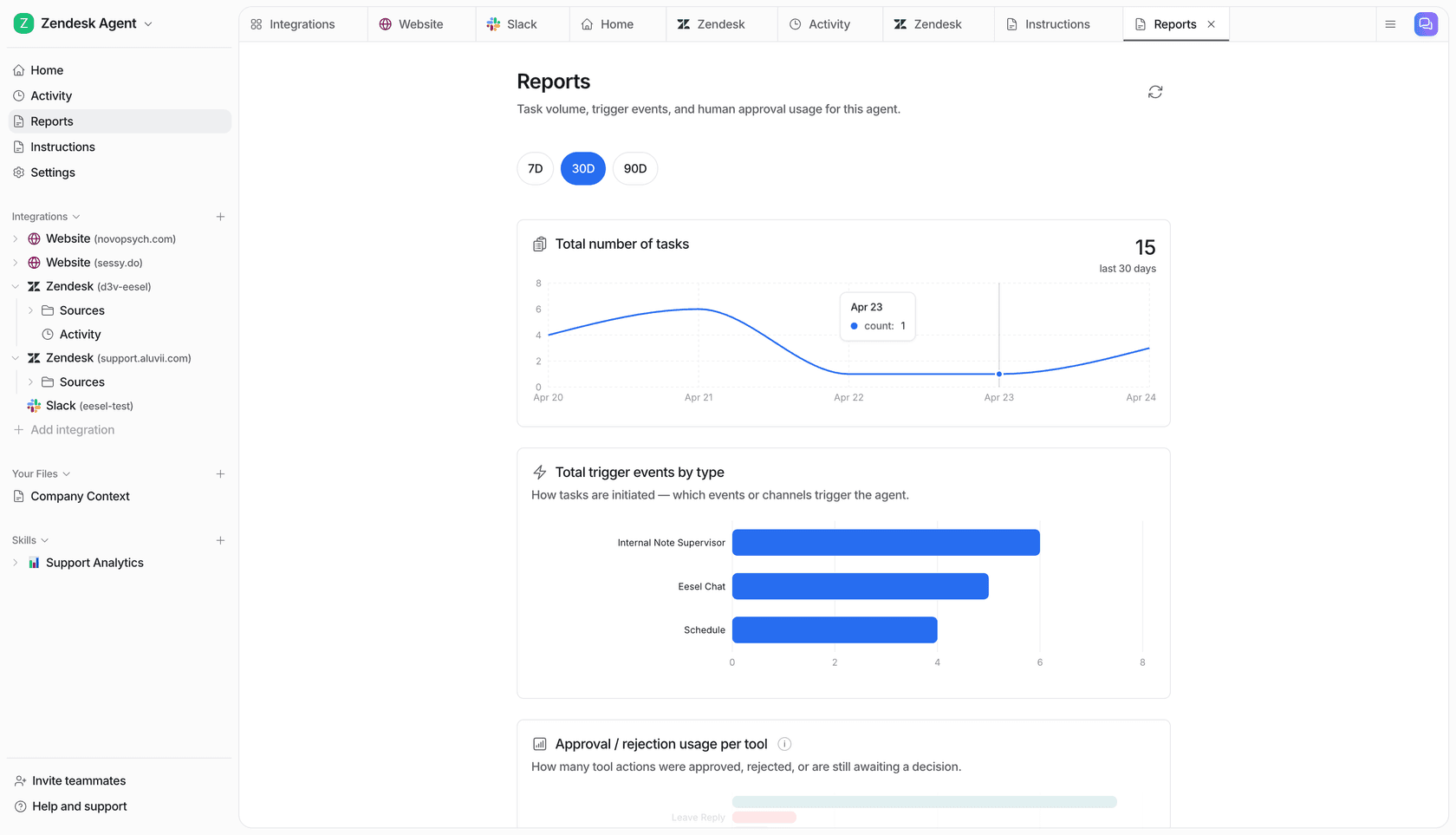
This is the part a raw API cannot hand you. Before eesel answers a single live ticket, it replays your agent over your own historical tickets and shows you what it would have said, on your data, with your knowledge base and its gaps included. So the 65.7% question stops being a benchmark and becomes a number you actually measured, on your queue, before a customer ever saw it. Connect a helpdesk, watch the simulation, then decide. Try eesel, free.
Verdict
Buy it if you are running long agentic sessions on knowledge work, research, analysis, or document-heavy tasks, and cost matters. Best-in-table GDPVal-AA and AA-Briefcase scores at $2/$6, finishing tasks in half the turns of Claude Opus 5, is a hard combination to argue with. Also buy it if raw speed changes your workflow. Multiple engineers independently reported 3x, and one measured 3m 18s against 12m 02s on the same task.
Skip it if your workload is autonomous software engineering or terminal-heavy operations. DeepSWE 65.9% against Sol's 73%, and Terminal-Bench v3.0 at 26% against 34.6%, are not close calls, and those are xAI's own published numbers.
Be careful if it is going in front of customers. It is one of the two best models on the customer service benchmark and it still fails half of those conversations, with a 65.7% non-hallucination rate underneath. That is not a Grok problem, every frontier model has a version of this row. It is a reason the helpdesk layer matters more than the model choice.
My overall read: the best price-to-intelligence ratio at the frontier as of August 2026, mislabeled as a coding release when its real strength is knowledge work. Five points of index gain in five weeks at flat pricing is the story, and the cache-rate increase is the asterisk.
If you want the fuller comparison set, start with Grok 4.5 alternatives and read the Claude Opus 5 review next.
For the token math on its own, the xAI pricing ladder goes deeper than this review does.
Frequently Asked Questions
Is Grok 4.6 good? What does this Grok 4.6 review conclude?
How does Grok 4.6 compare to Grok 4.5?
How much does Grok 4.6 cost to run?
Does Grok 4.6 hallucinate?
Is Grok 4.6 good for customer service?
Where can I use Grok 4.6?
What is the Grok 4.6 context window?
Which alternatives should I compare against Grok 4.6?


Article by
Alicia Kirana Utomo
Kira is a writer at eesel AI with a Computer Science background and over a year of hands-on experience evaluating AI-powered customer service tools. She focuses on breaking down how helpdesk platforms and AI agents actually work so that support teams can make better buying decisions.