Why anyone leaves a model that cheap
Grok 4.6 is not a weak model. It scores 61 on the Artificial Analysis Intelligence Index, level with GPT-5.6 Sol and one point behind Claude Fable 5, while charging a fifth of Sol's output rate. On paper the switching case barely exists.
Then you run it in production and hit one of four walls.
The 200k cliff reprices the whole request. This is the one that surprises people. xAI's pricing page says it plainly at the bottom of the table: models with long-context pricing bill the long rates for all tokens in a request once the prompt crosses the threshold. So a 199k prompt costs $0.40 in, and a 201k prompt costs $0.80, not $0.398 plus a bit. The advertised 500k context window is real, but only the first 200k of it is priced the way the marketing implies. The full rate card sits in our Grok 4.6 pricing breakdown.
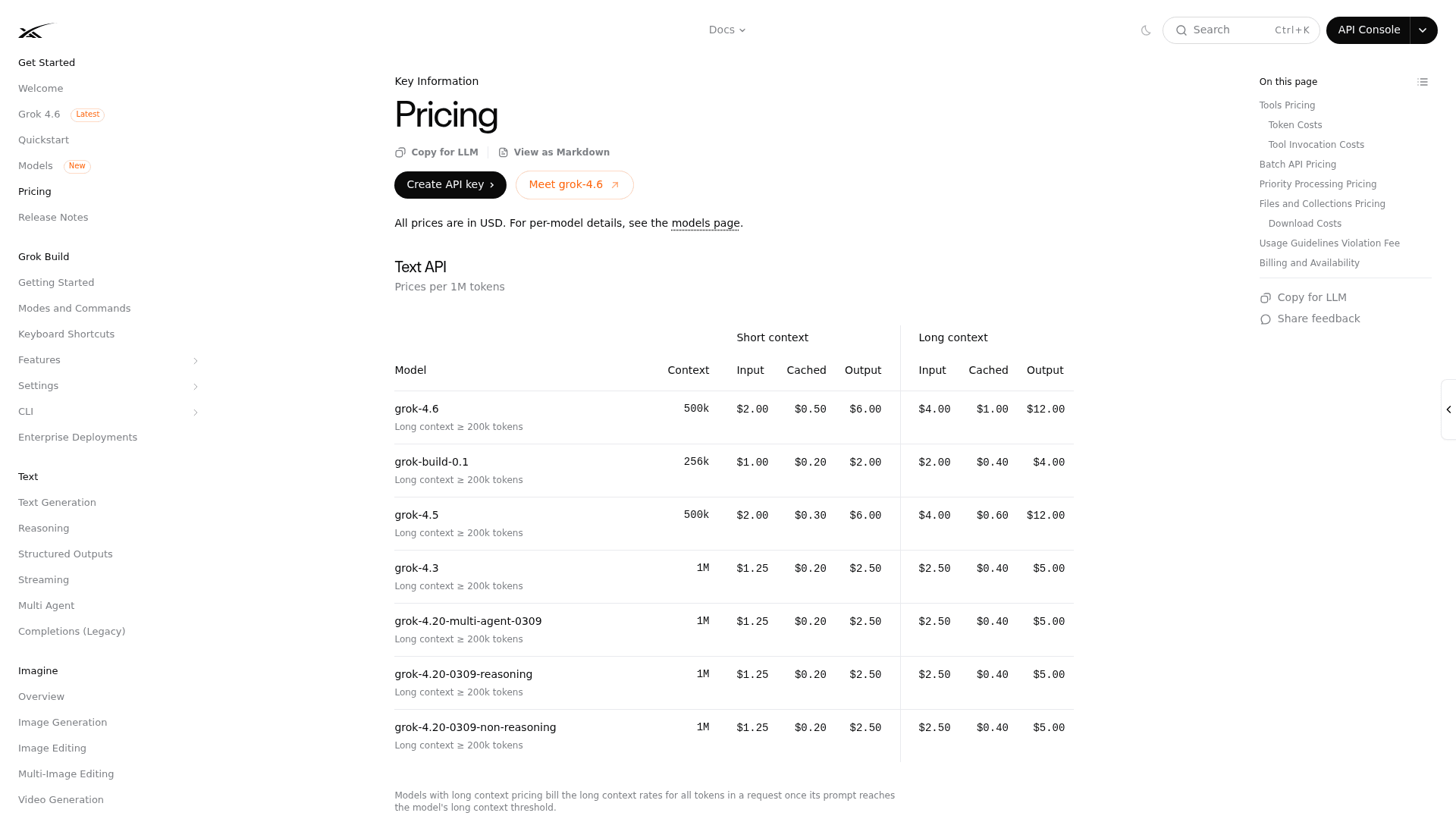
There are seven meters, not one. Web search, X search and code execution bill $5 per 1,000 calls. File attachment search is $10 per 1,000. Collections search, the retrieval one, is $2.50 per 1,000. Then file storage at $0.025 per GiB per day, collections storage at $0.10, and downloads at $0.20 per GiB. An agent that searches on every turn is running a second bill next to the token bill, on top of the per-token line everyone budgets for.
Batch does not cover the flagship. xAI's 20% batch discount applies to grok-4.3 and the three grok-4.20 variants. Grok 4.6, 4.5 and grok-build-0.1 get nothing. For an overnight backfill, the two-generations-old 4.3 in batch works out at half the flagship's rate.
You cannot buy it through your cloud. Azure AI Foundry tops out at Grok-4.3 and Bedrock sits on the same generation. If your company procures models through a cloud marketplace, Grok 4.6 is not on the menu at all, and no benchmark argument changes that. The wider ladder is in our xAI pricing guide.
"We switched to a system that is working well at half the cost. But long term we will just build our own, which is so possible now with AI."
That is a churned mid-market customer of ours, and the instinct is right more often than vendors admit. The question is only ever which constraint you are actually solving. If you are still on the previous generation, start from Grok 4.5 alternatives instead.
The 7 alternatives at a glance
Rates below are the vendors' own published list prices per 1M tokens, checked on 13 August 2026. The column that does the most work is the fourth one.
| Model | Input | Output | Long-prompt penalty | Cache read | Context | Batch | Open weights | On AWS / Azure / GCP | AA Index |
|---|---|---|---|---|---|---|---|---|---|
| Grok 4.6 (incumbent) | $2.00 | $6.00 | 2x all tokens ≥200k | $0.50 | 500k | No | No | No | 61 |
| Claude Opus 5 | $5.00 | $25.00 | None | $0.50 | 1M | 50% | No | Yes | 63 |
| Claude Fable 5 | $10.00 | $50.00 | None | $1.00 | 1M | 50% | No | Yes | 62 |
| Claude Sonnet 5 | $2.00 | $10.00 | None | $0.20 | 1M | 50% | No | Yes | - |
| GPT-5.6 Sol | $5.00 | $30.00 | 2x ≥200k | $0.50 | Long tier | Yes | No | Yes (Bedrock) | 61 |
| GPT-5.6 Terra | $2.00 | $12.00 | 2x ≥200k | $0.20 | Long tier | Yes | No | Yes (Bedrock) | - |
| GPT-5.6 Luna | $0.20 | $1.20 | 2x ≥200k | $0.02 | Long tier | Yes | No | Yes (Bedrock) | - |
| Gemini 3.6 Flash | $1.50 | $7.50 | None published | $0.15 | 1M | 50% | No | Yes (Vertex) | - |
| Kimi K3 | $3.00 | $15.00 | None | $0.30 | 1M | No | Yes | No | 57 |
| Qwen3.8 Max | $2.00 | $6.00 | None | $0.25 | 1M | No | Not yet | No | Not listed |
| DeepSeek V4 Flash | $0.14 | $0.28 | None | $0.0028 | 1M | No | Yes (MIT) | No | 50 at max effort |
Two rows are worth pausing on. Qwen3.8 Max charges exactly what Grok 4.6 charges, $2 and $6, with no cliff and double the window, which makes it the closest thing to a drop-in on price alone. And Claude Sonnet 5 matches Grok's input rate while charging $10 out instead of $6, buying you a flat 1M window for the difference.
How I picked these
Every model here had to be generally available today, priced publicly per token, and reachable through a normal API key. That rules out preview-gated models and anything quote-only. I then read each vendor's own pricing page rather than a comparison site, because the long-context and tool-meter rules are exactly the details that get lost in a third-party summary.
I have not ranked them by benchmark. Five points of index will not decide your architecture. The bill shape and the procurement path will.
1. Claude Opus 5 - best if long prompts are the problem
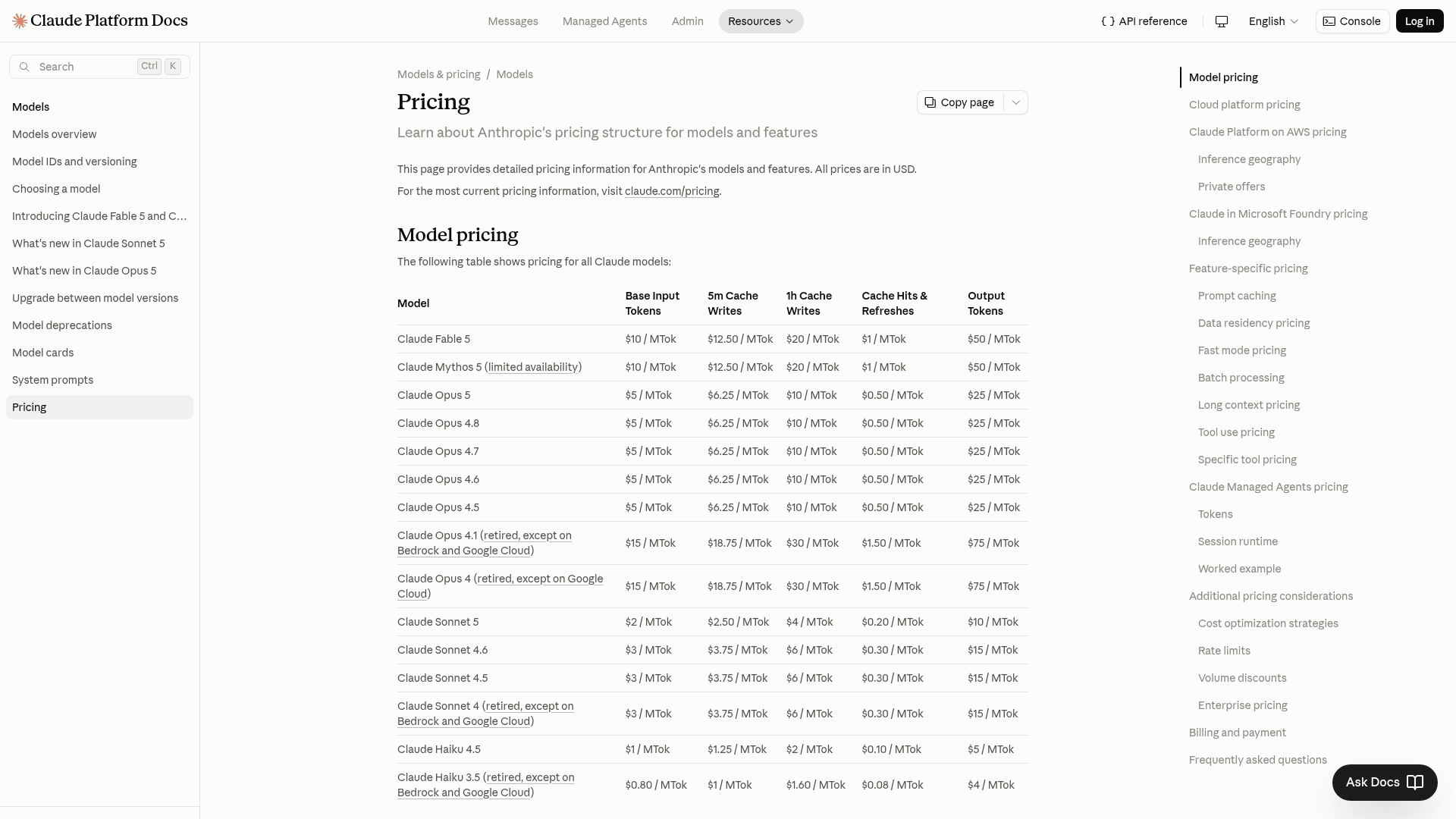
What it is. Anthropic's flagship, shipped 24 July 2026, and currently first on the Artificial Analysis Intelligence Index at 63.
Where it beats Grok 4.6. The long-context behaviour, unambiguously. Anthropic's pricing docs state that Claude 4.6 and later include the full 1M window at standard pricing, and spell out the consequence: a 900k-token request bills at the same per-token rate as a 9k one. Caching and batch discounts apply across that whole window too. It is also on Bedrock and Vertex, which solves the procurement wall in one move.
Where it does not. The sticker is 2.5x Grok's input and roughly 4x its output, and the real gap is wider than that. Community testing put Opus 5 at about twice the output tokens of Opus 4.8 at matched effort, and independent cost-per-task on the AA index came out at $2.03 against Grok 4.6's $0.84. It also runs a lot more turns: 103 per task against Opus 4.8's 55.
Pricing. $5.00 in, $0.50 cache read, $25.00 out. Batch halves it. Fast mode doubles it. Our Claude Opus 5 pricing page has the full ladder, and Opus 5 versus Sonnet 5 covers the cheaper sibling.
Verdict. The right swap when your prompts really are long, when you need the cloud marketplaces, or when a task failing is more expensive than a task costing more. Read the Claude Opus 5 review before you assume the index lead translates to your workload.
2. Claude Fable 5 - best if you want the top of the eval table
What it is. Anthropic's most expensive model, and the one that actually beats Grok 4.6 on most of xAI's own published comparison table.
Where it beats Grok 4.6. On xAI's launch table, Fable 5 takes CursorBench, FrontierCode, APEX-Agents, APEX-SWE and the AA Index outright. That is five of ten rows going to the competitor in the incumbent's own marketing. It carries the same flat 1M window as the rest of the Claude line.
Where it does not. $10 in and $50 out is more than eight times Grok's output rate. On AA-Briefcase and GDPVal-AA, Grok 4.6 actually wins, so this is not a clean sweep in either direction.
Pricing. $10.00 in, $1.00 cache read, $50.00 out, batch 50% off. Anthropic also lists a Claude Mythos 5 at the same rate under limited availability.
Verdict. Reach for it when a wrong answer is expensive and volume is low. At high volume the arithmetic gets brutal fast, which the Opus 5 versus Fable 5 comparison covers in detail.
3. GPT-5.6 - best if you want three price points from one vendor
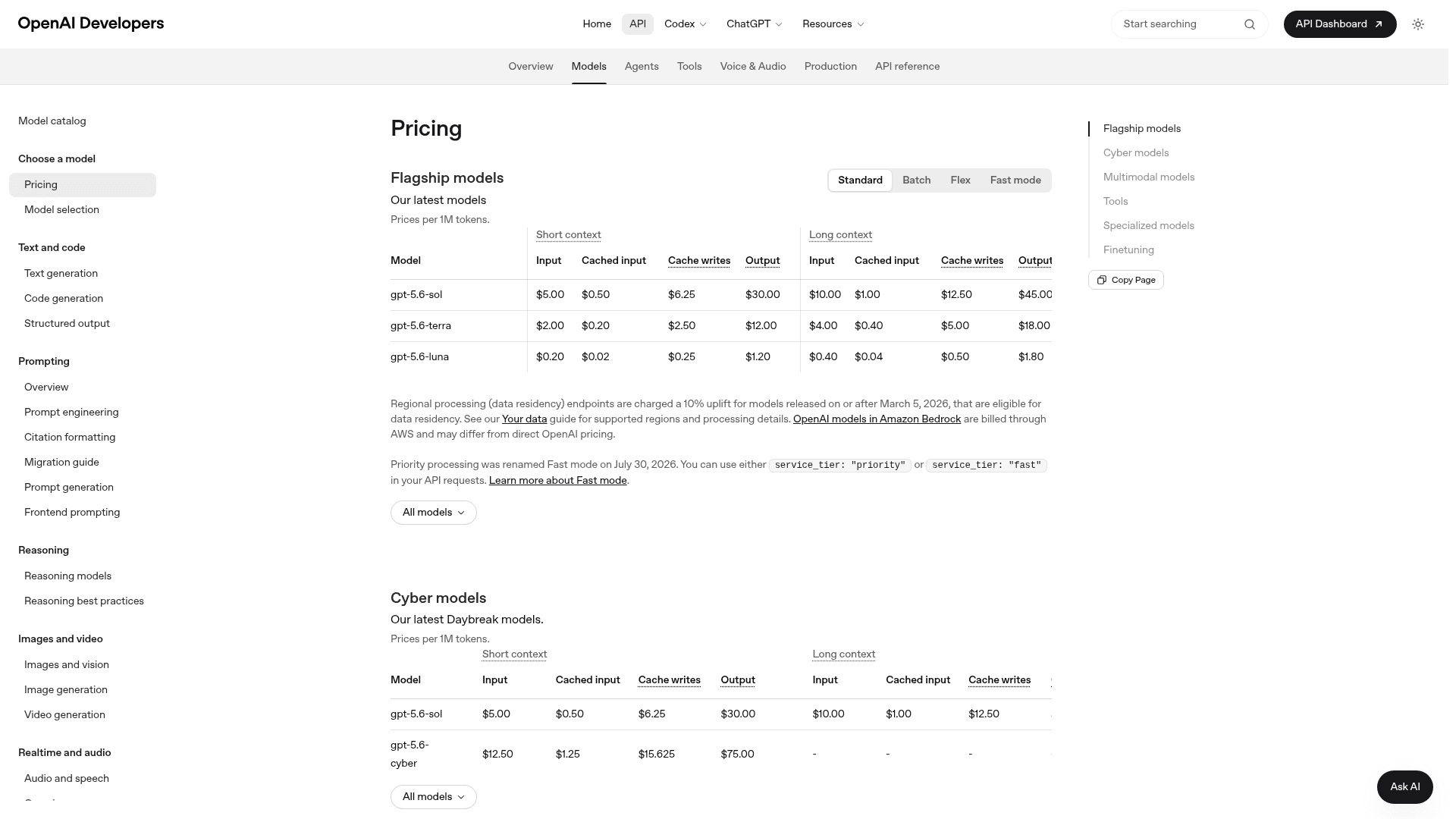
What it is. One family, three tiers. Sol at the top, Terra in the middle, Luna at the bottom, all behind the same API surface.
Where it beats Grok 4.6. Sol wins the two evals Grok loses worst: DeepSWE 73% against 65.9%, and Terminal-Bench 34.6% against 26%. If your workload is autonomous software engineering, that is the switch. The tiering also means you can route cheap turns to GPT-5.6 Terra or Luna without changing SDK.
Where it does not. It carries the same cliff. OpenAI's pricing page publishes a long-context column for all three tiers, so Sol goes $5 to $10 in and $30 to $45 out on long prompts. Switching from Grok to GPT-5.6 to escape the 200k threshold moves the problem rather than solving it. Data-residency endpoints add a 10% uplift for models released on or after 5 March 2026, and priority processing was renamed Fast mode on 30 July 2026.
Pricing. Sol $5.00/$30.00, Terra $2.00/$12.00, Luna $0.20/$1.20, all per 1M. See our GPT-5.6 pricing breakdown for the rest of the family.
Verdict. The best like-for-like frontier swap if coding is the job. Check GPT-5.6 Sol pricing against your own prompt length distribution before you commit, because the cliff is in the same place. The GPT-5.6 review has the eval detail, and OpenAI versus Anthropic compares the two API surfaces.
4. Gemini 3.6 Flash - best cost-to-capability if you can live on Google
What it is. Google's workhorse model since 21 July 2026, positioned for speed with frontier-adjacent quality.
Where it beats Grok 4.6. Cheaper input at $1.50, a 1M window with no long-context tier published, a real free tier for prototyping, and a knowledge cutoff of March 2026. It also ships computer use natively and wins the long-context and computer-use rows in Google's own comparison table.
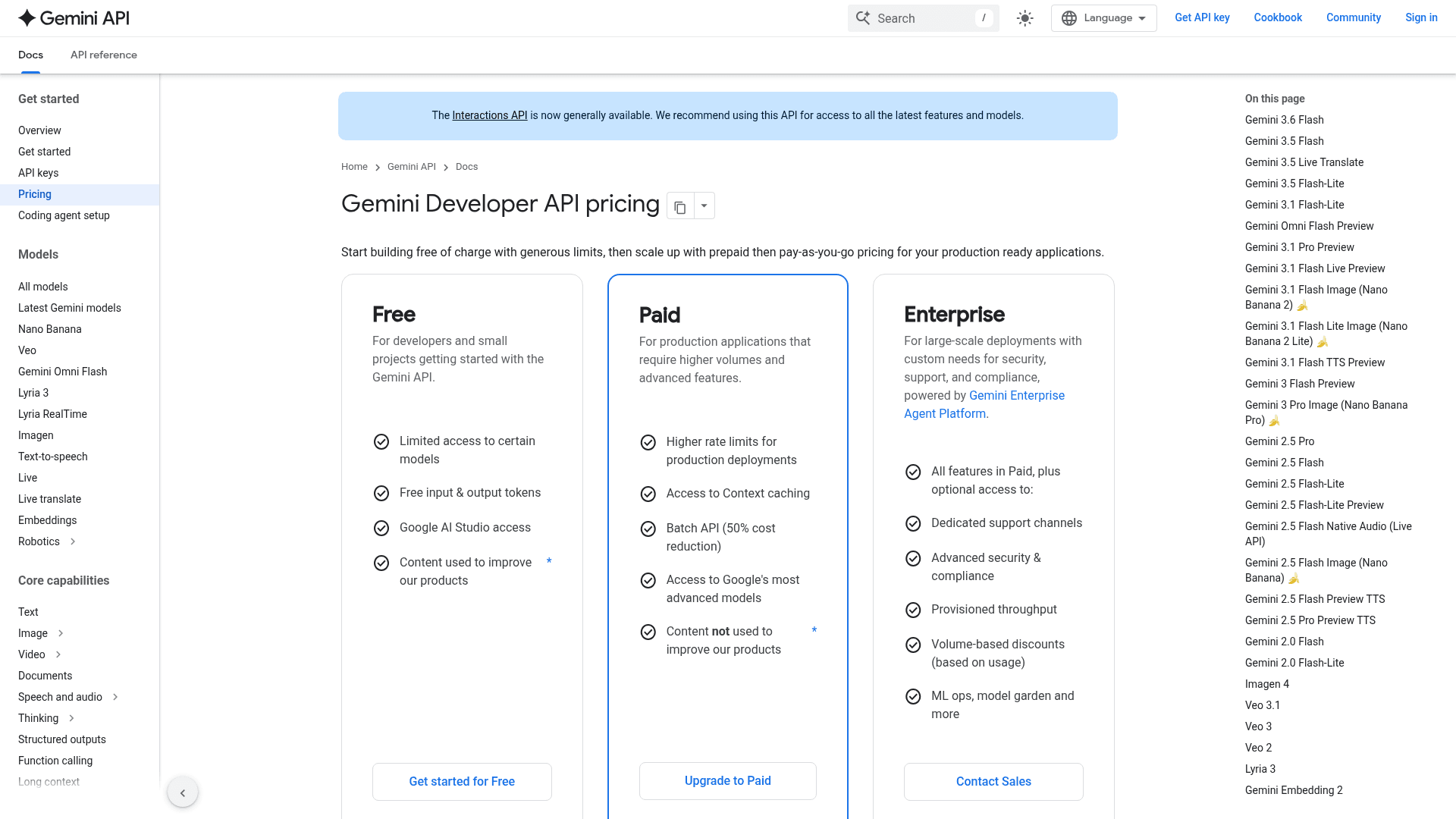
Where it does not. Output is $7.50 against Grok's $6.00, so on output-heavy work it is more expensive, not less. Search grounding is $14 per 1,000 requests, nearly three times xAI's search meter, though Google includes 5,000 free per month shared across the Gemini 3.x models. On the free tier your content is used to improve Google's products; on paid it is not.
Pricing. $1.50 in, $0.15 cache read, $7.50 out. Batch is half. Full detail in Gemini 3.6 Flash pricing.
Verdict. The strongest value pick if your prompts are long and your outputs are short, which describes most retrieval-heavy support work. The Gemini 3.6 Flash review has the benchmark detail, and the Gemini 3.6 Flash overview covers what shipped alongside it.
5. DeepSeek V4 Flash - best if the rate itself is the problem
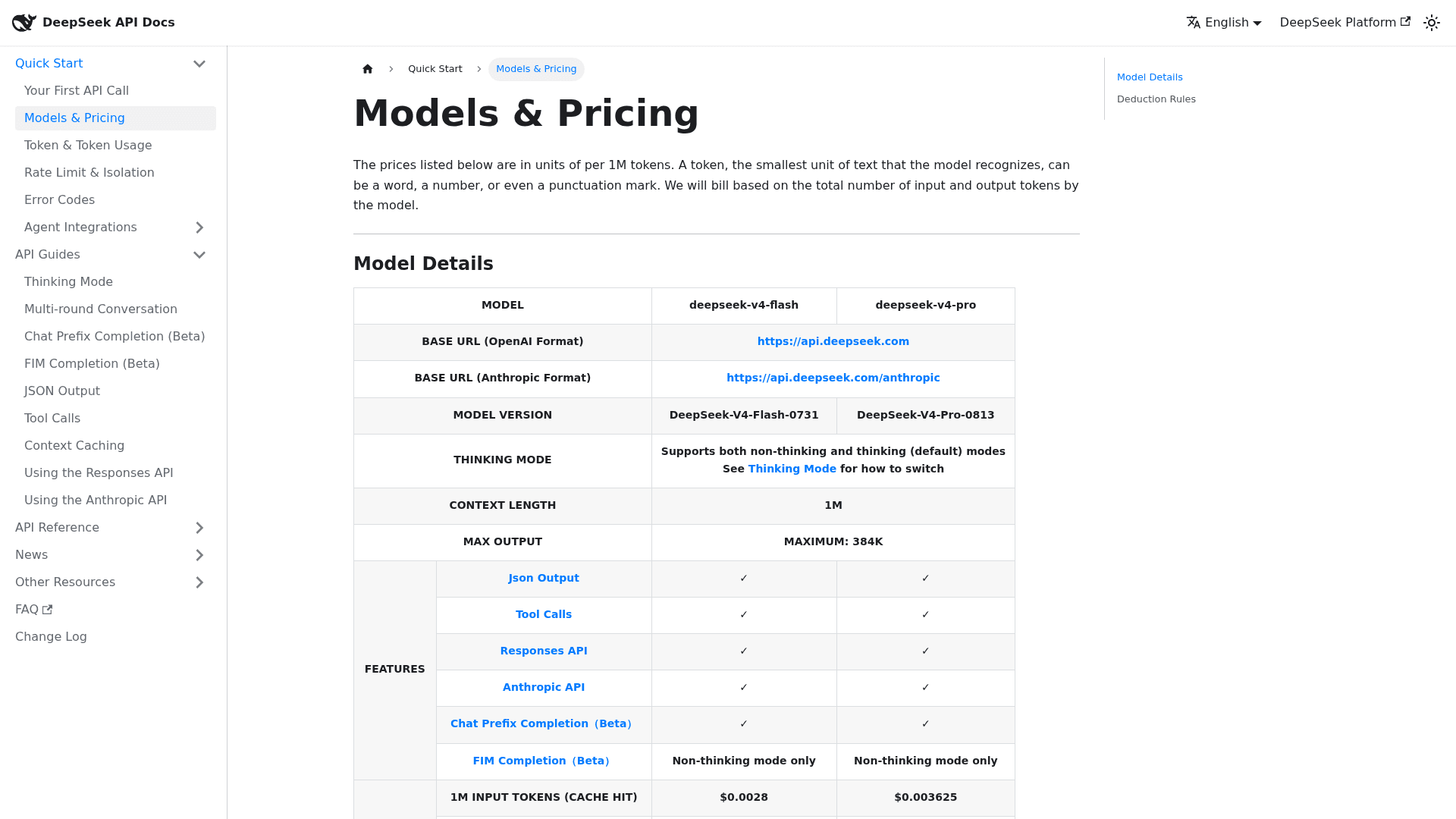
What it is. A 284B-total, 13B-active mixture-of-experts model with MIT-licensed open weights, in public beta since 31 July 2026.
Where it beats Grok 4.6. Price, by an order of magnitude, at $0.14 in and $0.28 out. Cache hits are $0.0028. It also ships an Anthropic-format endpoint alongside the OpenAI-format one, which shortens a migration considerably, and MIT weights mean you can move the whole thing in-house if the vendor relationship goes wrong.
Where it does not. The cheap configuration and the good configuration are different runs. DeepSeek's own cross-mode table shows HLE at 8.1 non-thinking against 34.8 at maximum effort, and reasoning tokens bill at the output rate. Artificial Analysis measured an 84% AA-Omniscience hallucination rate, and needed 210M output tokens to run the index against a 100M class median. Our guide to preventing hallucinations covers what that means in front of customers. There is also a pending 2x peak-hour surcharge announced with no start date.
On customer data, be precise. DeepSeek's paid-API terms are silent on training use rather than permissive, there is no published DPA or zero-retention option, and data sits under PRC jurisdiction. That is a real procurement question, not a settled one.
Pricing. $0.14 cache-miss in, $0.0028 cache-hit in, $0.28 out. See DeepSeek V4 Flash pricing.
Verdict. The obvious pick for classification, routing, summarisation and other high-volume, low-stakes turns. The DeepSeek V4 Flash review covers where the quality gap actually shows up.
6. Kimi K3 - best open-weight model at frontier scale
What it is. Moonshot AI's flagship: 2.8T total parameters, 104B active, 1M context, native vision, launched 16 July 2026.
Where it beats Grok 4.6. Open weights actually shipped, on the promised date, and the safetensors index confirms the 2.8T figure from outside the press release. It carries native image and video input, and a flat 1M window.
Where it does not. $3 in and $15 out is above Grok on both sides, so this is not a cost play. Reasoning cannot be turned off at any effort level, and the levels bill at the same rate, so reasoning_effort is a latency control rather than a cost tier. At low effort it scores 47 on the index at $0.24 per task, which is both weaker and pricier than DeepSeek V4 Flash. Public image URLs are not accepted, only base64 or a file ID.
Pricing. $3.00 in, $0.30 cache hit, $15.00 out. Consumer tiers run from free to $199. See Kimi K3 pricing.
Verdict. Take it when you want frontier-scale open weights and vision in one model, and you can absorb the rate. The Kimi K3 review has the benchmark comparison against Grok, and Flash versus K3 settles the budget question between the two open-weight picks.
7. Qwen3.8 Max - the closest thing to a like-for-like swap
What it is. Alibaba's flagship, GA since 2 August 2026: 2.4T total parameters, 95B active, 1M context.
Where it beats Grok 4.6. Identical headline pricing at $2 in and $6 out, with double the context window and no long-prompt penalty. On LMArena it is strong: Text #5, Vision #2, WebDev #4. It ships xhigh reasoning on by default with thinking preserved.
Where it does not. It is not on the Artificial Analysis board at all, so any "independent intelligence score" you see quoted for it is describing a different Qwen model. Automated composites and human preference point in opposite directions here, so a single-number verdict would be dishonest either way. Weights were promised at GA and are still unpublished. There is no batch discount and no cloud-marketplace path.
Pricing. $2.00 in, $0.25 implicit cache read, $6.00 out, per Qwen Cloud. Detail in Qwen3.8 Max pricing, and the practical routes in how to access Qwen3.8 Max.
Verdict. The swap to make if the 200k cliff is your only complaint and you want to keep the same budget line. Compare it directly in Qwen3.8 Max versus Kimi K3 before deciding.
What you actually pay, versus what is on the card
There is one more layer worth knowing about before you migrate anything. OpenRouter publishes the weighted average price its customers really pay, next to the list price, and for Grok 4.6 the two do not match.
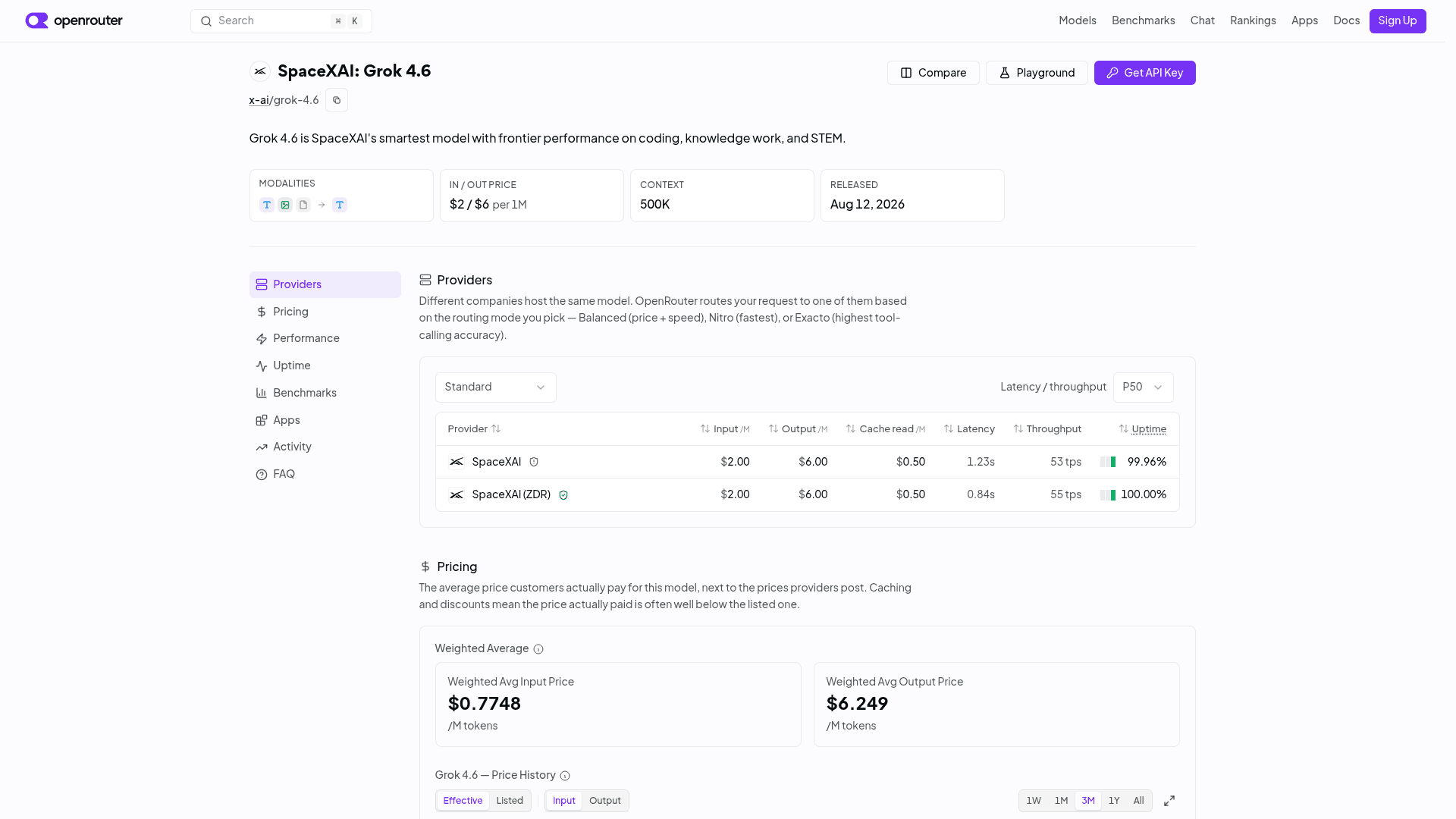
| Measure | List | Measured on OpenRouter |
|---|---|---|
| Input per 1M | $2.00 | $0.7748 |
| Output per 1M | $6.00 | $6.249 |
| Providers | - | SpaceXAI and SpaceXAI (ZDR) |
| Throughput (P50) | - | 53 and 55 tok/s |
| Latency (P50) | - | 1.23s and 0.84s |
| Uptime | - | 99.96% and 100% |
Input lands 61% below list, because caching is doing enormous work across real traffic. Output lands slightly above list, because a slice of that traffic is crossing 200k and paying $12. Both effects are invisible on the rate card, and both moved since I last checked this a few days ago, when input measured $0.7448.
The lesson generalises past Grok. Before you migrate on price, work out your own cache hit rate and your own prompt length distribution. A model with a worse sticker and a better cache story can be cheaper in practice, and a switch made on list prices alone is a guess dressed up as analysis.
Does the model even matter for support?
Less than the shortlist implies, which is an uncomfortable thing to write in a post that just spent 2,000 words on a shortlist.
Grok 4.6 is one of the two best models on the multi-turn customer service benchmark, scoring 50.7%. Read that as it is: the best model available fails half of those conversations. Swapping to Opus 5 for two index points does not touch the failure mode, and neither does any escalation-free architecture. The half that goes wrong goes wrong on knowing when to stop, when to hand to a human, which macro to fire, and what to never promise. None of that is a model capability.
I say this as someone who builds the layer above the model. eesel customers do occasionally leave to build directly on a raw frontier API, and it is the most common competitive alternative we see from technical teams. It sometimes works. What usually brings them back is not model quality, and it is rarely retrieval quality either. It is the second month.
Nobody wants to own ticket triage rules, brand voice drift, permissions on the knowledge base, a confidence score threshold, and an on-call rotation for a chatbot.
The buyer I mentioned at the top, the one who burned 200 interactions in a test day, was not asking a model question. They were asking what 9,000 a month costs and whether the answers would be right. No rate card answers either half, which is why cost per resolution is the number worth modelling.
Choosing between Grok 4.6 and its alternatives for a support queue?
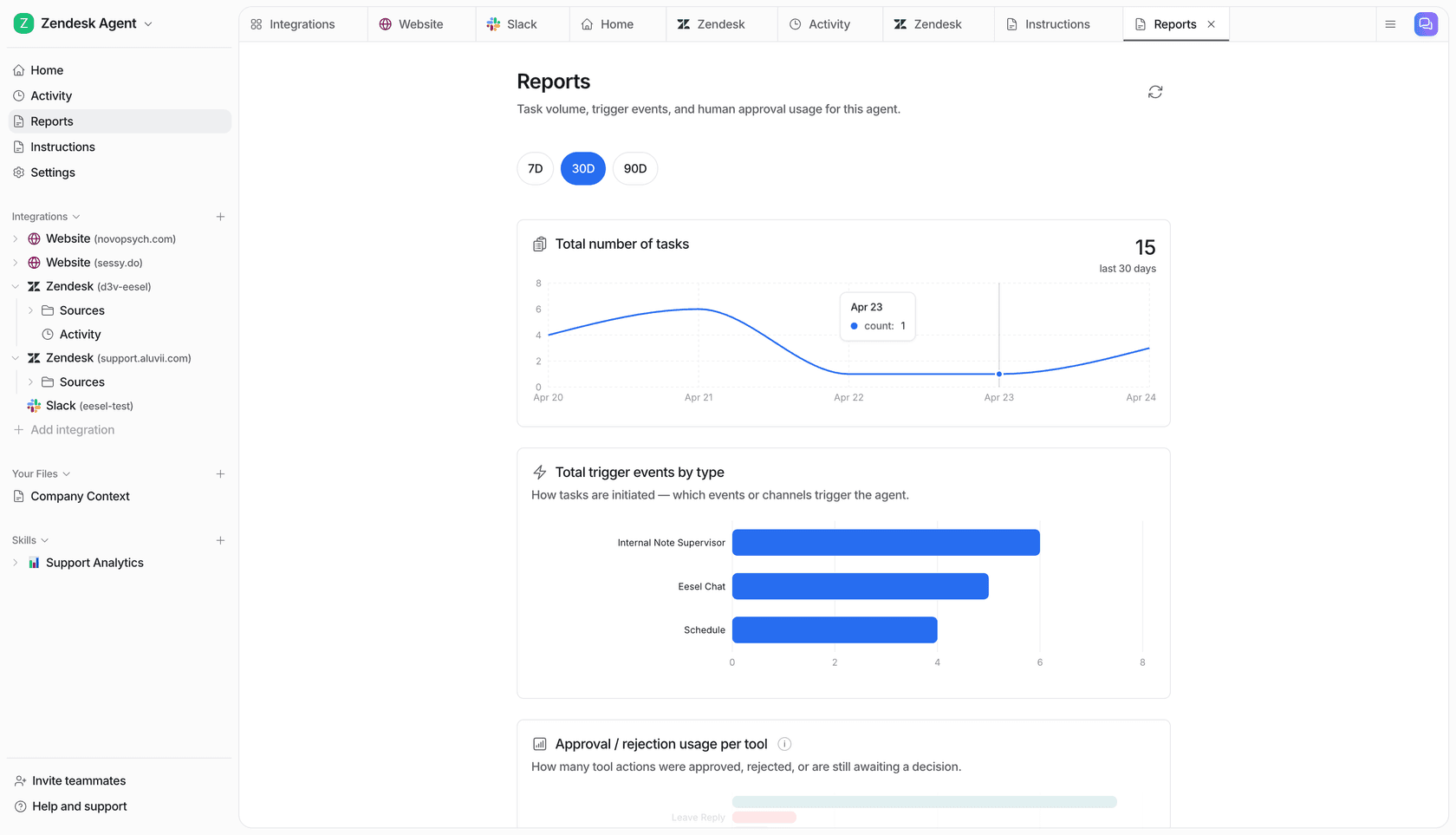
Here is the part a raw API cannot hand you. Before eesel answers one live ticket, it replays your agent across your own past tickets and shows what it would have said, on your data, with your knowledge base gaps included. So "which model" stops being a benchmark argument and becomes a resolution rate you measured on your own queue, before a customer saw a single answer. Connect a helpdesk, watch the simulation, then pick the model. Try eesel, free.
Verdict
Stay on Grok 4.6 if your prompts sit comfortably under 200k, you are not blocked on cloud procurement, and your traffic caches well. Tying GPT-5.6 Sol on the index at a fifth of its output rate is a strong position, and no model here strictly dominates it.
Switch to Claude Opus 5 if long prompts, Bedrock or Vertex procurement, or index-leading quality is the binding constraint. You will pay roughly 2.4x per task for it.
Switch to Qwen3.8 Max if the cliff is your only complaint. Same $2 and $6, double the window, no penalty, at the cost of an independent referee score.
Switch to DeepSeek V4 Flash for the high-volume, low-stakes half of your traffic, and route the hard turns somewhere else. At $0.14 and $0.28 you can afford to be wrong about the routing.
Switch to GPT-5.6 if autonomous coding is the workload, knowing the long-context cliff comes with you.
And whichever you land on, measure it on your own tickets before it meets a customer. The best AI agent for a queue is rarely the one at the top of the index, and the helpdesk layer moves resolution rate more than the model swap does. See AI for customer service for the full picture.
Frequently Asked Questions
What are the best Grok 4.6 alternatives right now?
Is there a cheaper alternative to Grok 4.6?
Why does Grok 4.6 pricing double on long prompts?
Which Grok 4.6 alternative has the biggest context window?
Can I run Grok 4.6 on AWS or Azure?
Do the Grok 4.6 alternatives charge for web search too?
Is Grok 4.6 or Claude Opus 5 better for customer support?
Should I switch off Grok 4.6 at all?


Article by
Alicia Kirana Utomo
Kira is a writer at eesel AI with a Computer Science background and over a year of hands-on experience evaluating AI-powered customer service tools. She focuses on breaking down how helpdesk platforms and AI agents actually work so that support teams can make better buying decisions.