


What Gemini 3.6 Flash actually is
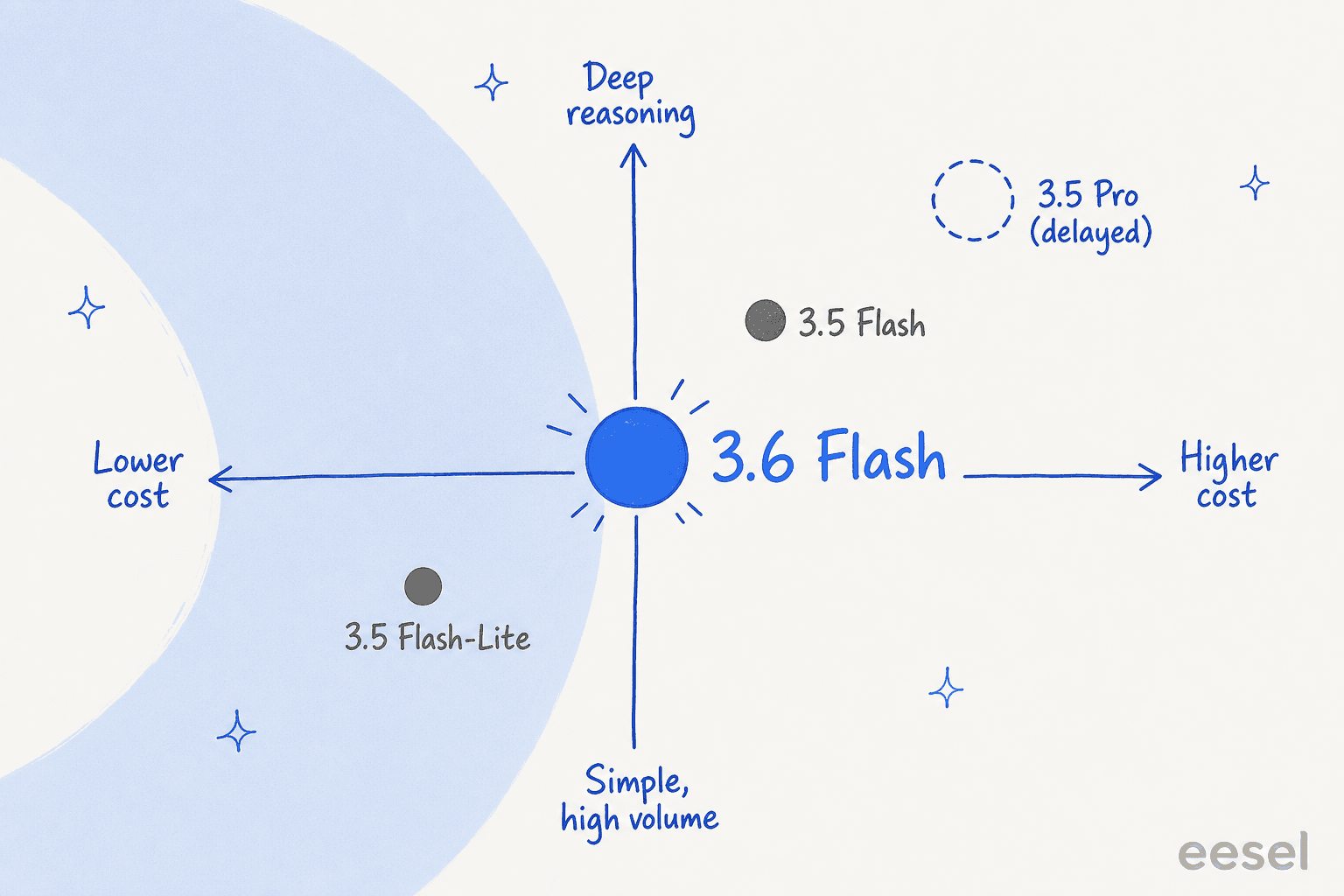
Google splits Gemini into tiers: Pro for the hardest reasoning, Flash for the everyday work, and Flash-Lite for cheap high-volume tasks. Gemini 3.6 Flash is the middle one, and Google calls it the "workhorse" on purpose. It is the model you reach for when you are running something thousands of times a day and you care about cost and latency as much as raw smarts.
It builds directly on 3.5 Flash and on feedback from developers using it. The headline pitch is efficiency: fewer reasoning steps and tool calls to finish a multi-step job, less rambling in its answers, and a lower price per output token. It also ships with a fresher knowledge cutoff, advanced from January 2025 to March 2026.
Under the hood you get the things you would expect from a modern model: a 1,048,576-token context window, multimodal input across text, image, video, audio, and PDF, plus function calling, structured output, code execution, context caching, and search grounding. Computer use, where the model drives a browser or desktop, is now a built-in client-side tool in preview.
The efficiency story is the real story
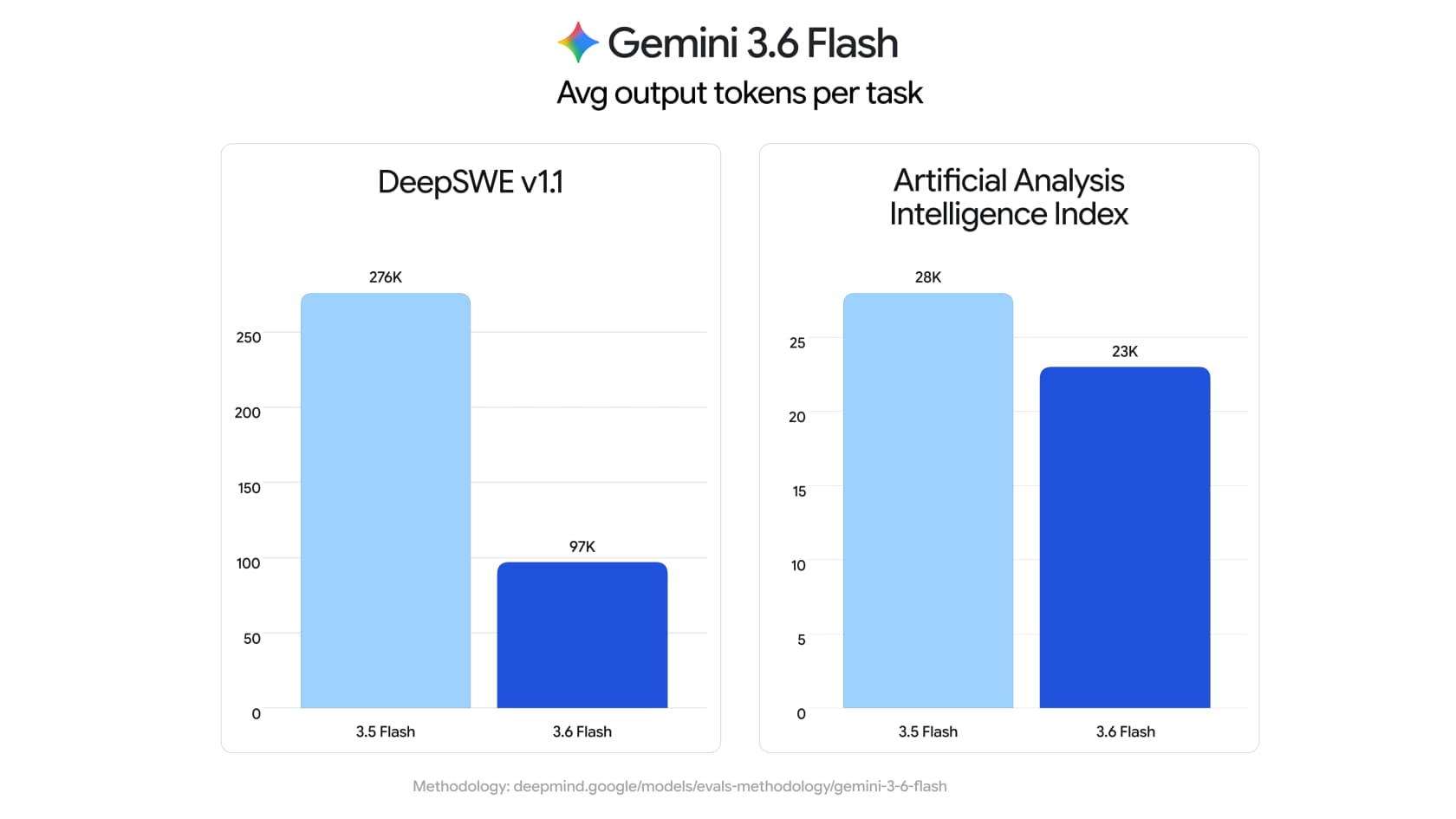
Here is the number that made me sit up. On the DeepSWE coding benchmark, 3.6 Flash finishes the average task in 97,000 output tokens where 3.5 Flash burned 276,000, roughly a 65% cut. On the broader Artificial Analysis Index it is a smaller but still real 28K down to 23K.
Why does token count matter more than the sticker price? Because output tokens are where the bill actually piles up, and an agent is a token-spending machine. A single support ticket handled by an agent isn't one model call, it's a chain: read the ticket, search the knowledge base, decide, maybe call a tool, draft, check. Each hop spends tokens. Cut the tokens per step and you cut the cost of the whole chain, on top of the lower per-token rate.
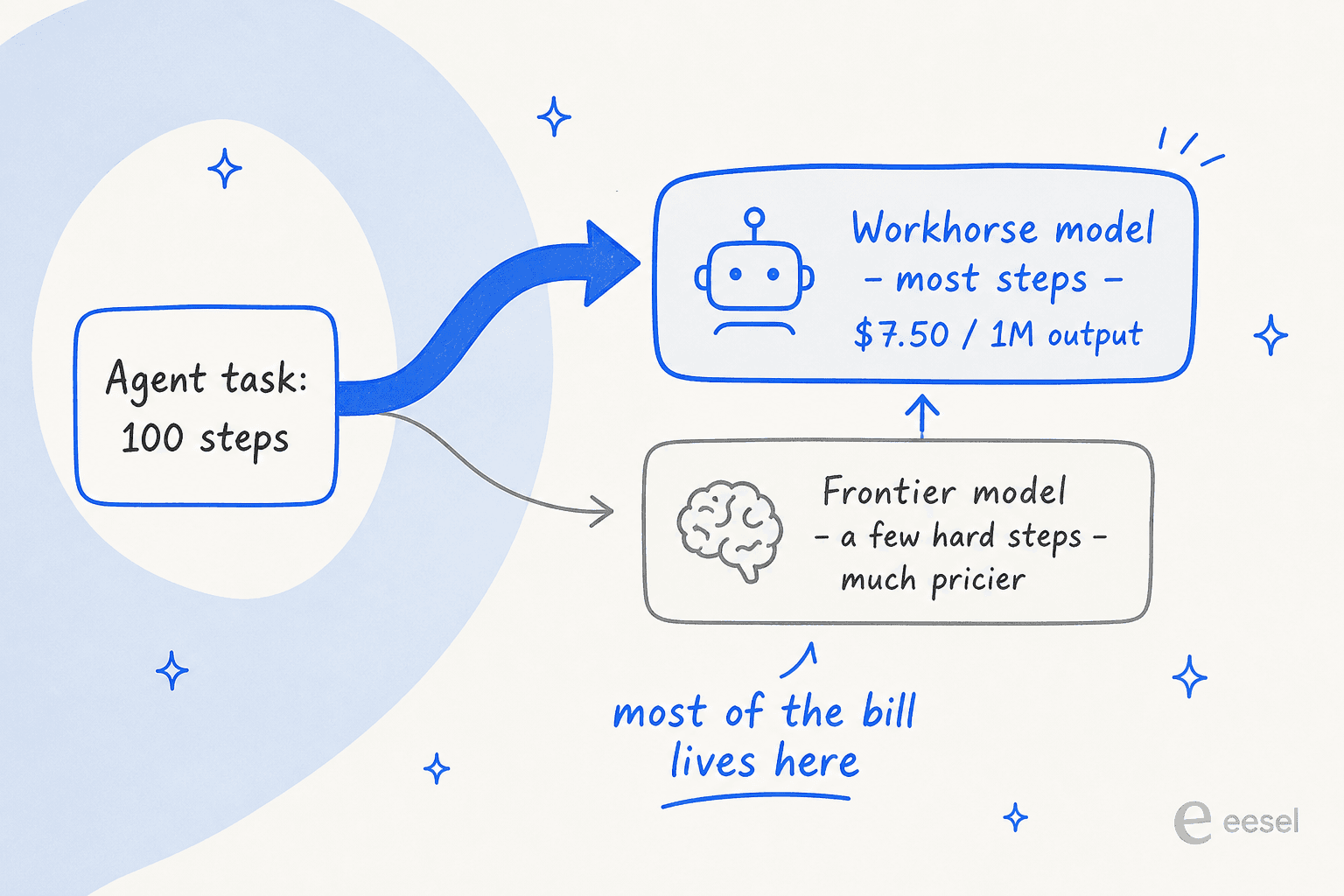
This is also why the "workhorse" framing is honest. In a real agent workflow, most of the steps are routine and get routed to the cheap model, while only the genuinely hard steps need a frontier model, if at all. So most of your bill lives in the workhorse lane, and making that lane 17% cheaper per token and far more efficient per task is a bigger deal than a flashier Pro launch would have been.
Benchmarks: where it wins, where it loses
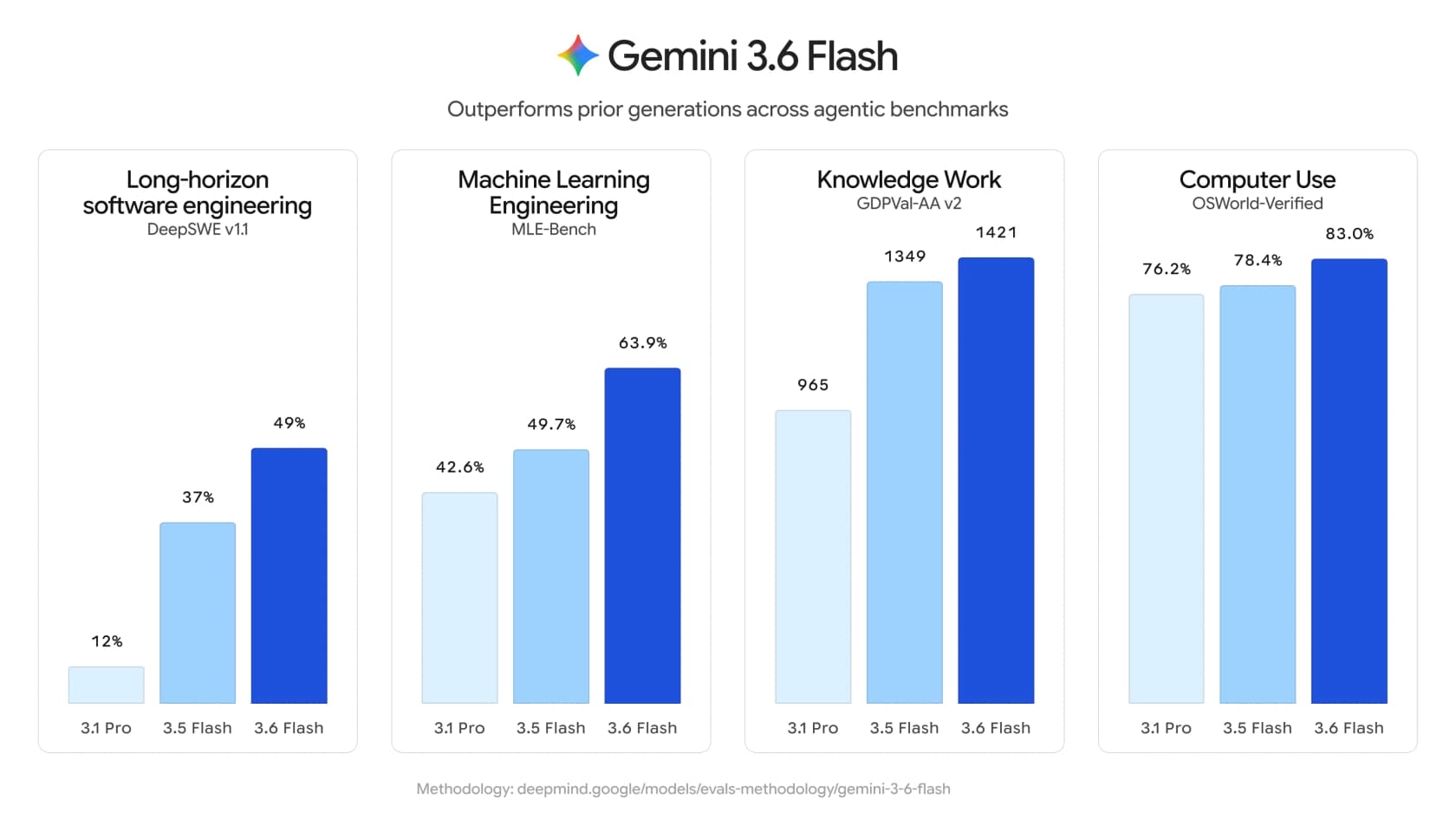
Against its own family, 3.6 Flash is a clean step up. Google's chart shows it beating both 3.5 Flash and last year's 3.1 Pro across long-horizon coding, ML engineering, knowledge work, and computer use.
The more useful question is how it stacks up against the models you would actually pick between. Google published a comparison table, and to its credit it does not hide the losses.
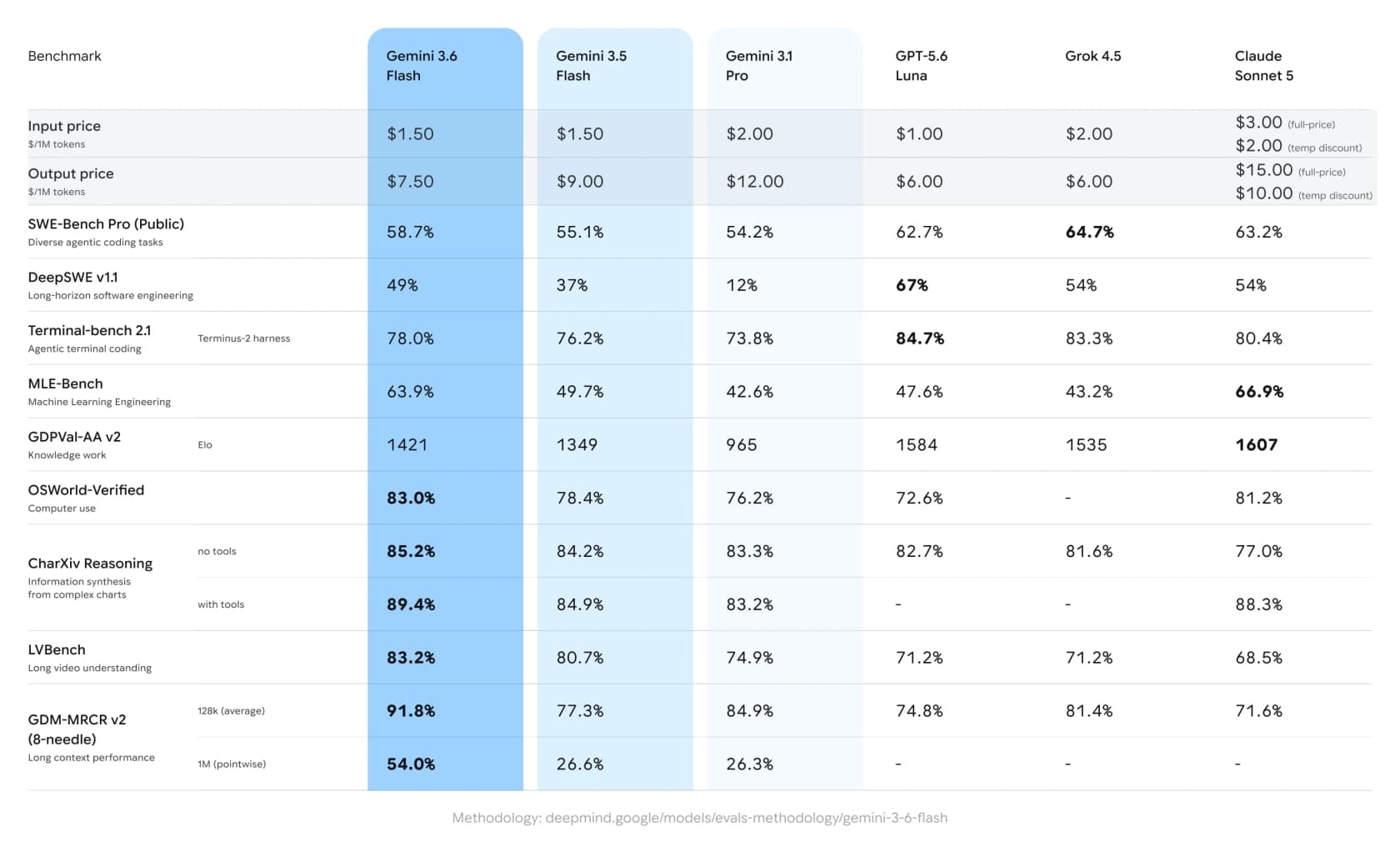
Read that table honestly and a clear shape appears. On the hardest agentic coding tests, 3.6 Flash trails the frontier: 58.7% on SWE-Bench Pro against Grok 4.5's 64.7% and Claude Sonnet 5's 63.2%, and 49% on DeepSWE against GPT-5.6 Luna's 67%. On knowledge work (GDPval-AA v2) its 1421 Elo sits well under GPT-5.6 (1584) and Claude Sonnet 5 (1607).
But flip to the tasks that map to real agent work and it leads the whole board: 83.0% on OSWorld-Verified (computer use), 89.4% on CharXiv chart reasoning, 83.2% on LVBench long video, and a huge 91.8% on GDM-MRCR long-context recall where the nearest rival is in the 70s. For a model that costs a fifth of Claude Sonnet 5 on output, that is a very strong showing on exactly the dimensions that matter for agentic work.
My read: this is a workhorse, not a champion. If your job is deep, novel software engineering, the frontier models still edge it. If your job is running a lot of grounded, tool-using, document-heavy tasks cheaply, 3.6 Flash is one of the best-value picks on the market right now.
Pricing in full
Here is the money view. All figures are per 1M tokens on the paid Standard tier, from the Gemini API pricing page.
| Model | Input | Output | Batch (in / out) | Context caching |
|---|---|---|---|---|
| Gemini 3.6 Flash | $1.50 | $7.50 | $0.75 / $3.75 | $0.15/1M + $1.00/1M/hr |
| Gemini 3.5 Flash (prior) | $1.50 | $9.00 | $0.75 / $4.50 | $0.15/1M |
| Gemini 3.5 Flash-Lite | $0.30 | $2.50 | $0.15 / $1.25 | $0.075/1M |
A few things worth calling out. Input price held flat, so the whole saving is on output, which as we saw is where agents spend. Batch mode is a flat 50% off if you can tolerate async processing. Output includes thinking tokens, so a "reasoning" answer bills its scratch work as output, which is another reason the token efficiency gain compounds. And there is a genuinely free tier for testing, though on Free your content can be used to improve Google's products, so keep production data on paid.
To make the trade-off concrete, plug your own volume in:
At 50M output tokens a month, the move from 3.5 Flash to 3.6 Flash saves $75, before you even count the token-efficiency gain on top. At real agent volume that gap widens fast.
The two companion models
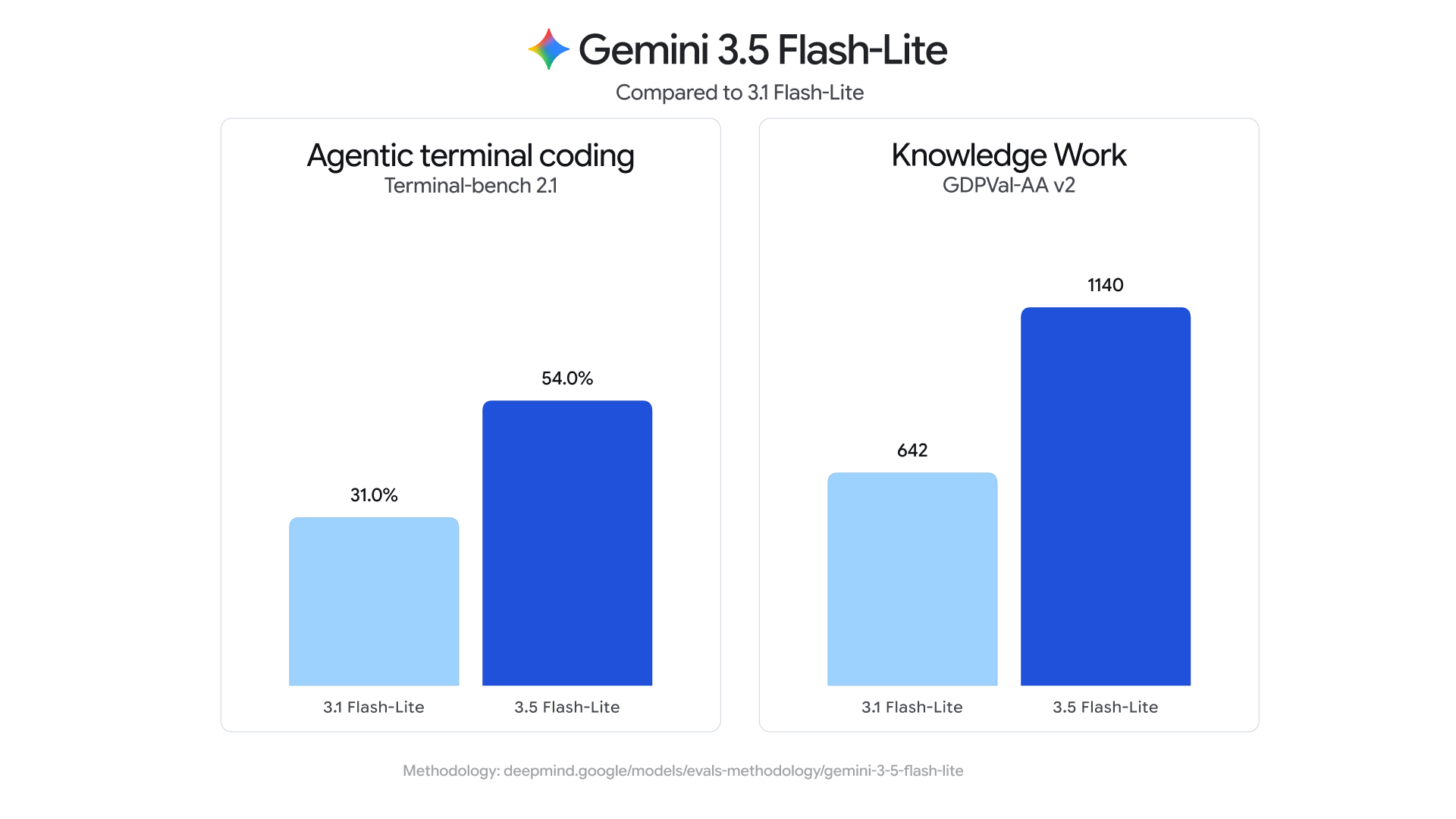
3.6 Flash did not ship alone. Gemini 3.5 Flash-Lite is the budget tier, at $0.30 in / $2.50 out, and Google says it now beats the older 3.1 Flash-Lite comfortably on terminal coding and knowledge work while running fast enough for high-throughput jobs like classification and routing.
The third model, Gemini 3.5 Flash Cyber, is a specialist tuned for cybersecurity work, and it is gated to governments and trusted partners rather than generally available. Most teams will never touch it, but it signals where Google thinks a lot of near-term agent value sits.
What's missing: no Pro, and a Gemini 4 tease
The elephant in the room is the model Google did not ship. The flagship Gemini Pro line was last updated back in February 2026, Google teased a 3.5 Pro in May, and then it slipped. Product lead Logan Kilpatrick framed it as a work in progress rather than a cancellation:
"3.5 Pro is testing with partners and we hope to land it soon."
At the same time, the team is looking past it entirely:
"We've kicked off the pre-training run for Gemini 4, our most ambitious yet."
TechCrunch read the release as Google keeping pace on the cheap, high-volume end of the market while its frontier answer to GPT-5.6 and Claude Sonnet 5 is still in the shop. That is a fair read. It also means, if you need frontier reasoning today, Gemini isn't where you get it this week.
So, is Gemini 3.6 Flash worth it?
If you are already building on Gemini Flash, this is an easy yes. It is cheaper, more efficient, and better on nearly every benchmark than the model it replaces, with no real downside. Switch and move on.
If you are choosing between families, be honest about the job. For deep, first-of-its-kind engineering, the frontier models still have an edge. For grounded, tool-heavy, document- and screen-driven work at scale, 3.6 Flash is a standout on value.
The one place I would push back on the hype is the leap some people make from "great cheap model" to "great support bot." Those are not the same thing, and the gap between them is where most AI support projects quietly fail.
A model is not a support agent
I ship the integrations that put models like this into real support queues, so let me be blunt about what a model launch does and does not change for that work. The model is the commodity layer at the bottom of the stack. Everything that makes an AI agent actually safe to point at customers sits on top of it.
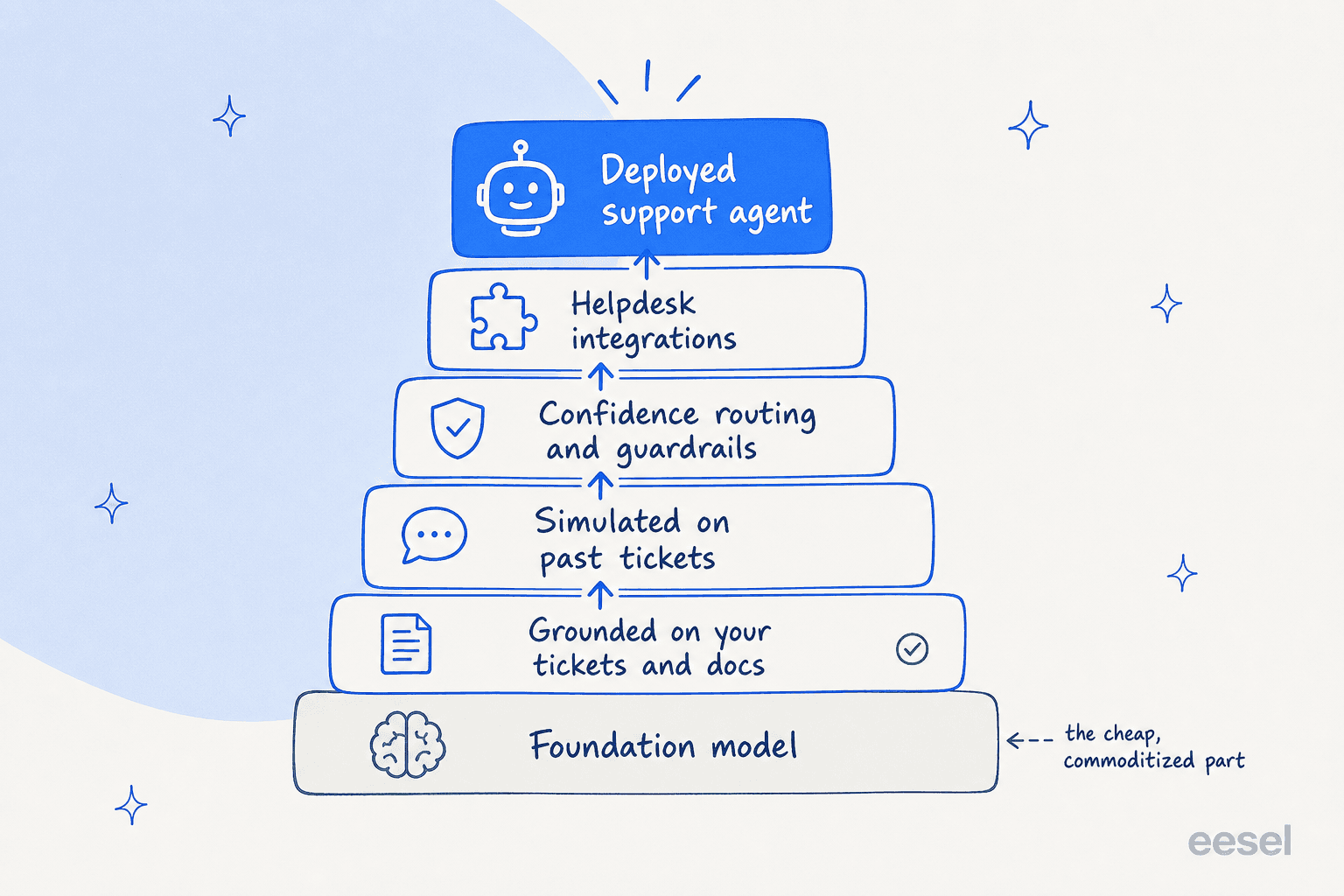
I have watched a confident-sounding model give a customer a clean, well-written, completely wrong answer. That is why every eesel rollout is simulated against your historical tickets before it ever replies to a real person, so you see coverage and accuracy per topic and can fix the gaps first. It is also why we lean on confidence-based routing: low-confidence answers become drafts, not autopilot replies.
That layer is what turns "a fast model exists" into "smava runs a fully automated Zendesk agent on 100,000+ German-language tickets a month," or Gridwise resolving 73% of tier-1 requests in its first month. None of that is the model. It is the grounding, the simulation, the guardrails, and the helpdesk integrations around it.
The good news for anyone on eesel: because it is model-agnostic, a cheaper and more efficient Flash under the hood is a free win. You get the savings without deciding which model to trust or rewriting anything. That is the right way to enjoy a launch like this, as an ingredient upgrade, not a product you deploy raw.
Try eesel
Gemini 3.6 Flash is a genuinely good workhorse model, but if the reason you care is "I want to automate my support queue," the model is the easy 10% of that project. eesel is the other 90%: it learns from your past tickets and help docs, simulates the rollout on your real history so you know the numbers before going live, and plugs into Zendesk, Freshdesk, Gorgias, and 100+ tools in minutes.

Because it is model-agnostic, upgrades like this one land as a quiet cost win rather than a migration. Pricing is one fixed monthly price, from $299/month for 500 credits (1 credit per ticket or chat) with no per-seat fees, and there is a free plan with 100 credits, no card. If you would rather see it on your own tickets than read another benchmark chart, that is exactly what the simulation is for.