


What Tencent Hy4 actually is
Tencent released and open-sourced Hy4 preview on August 28, 2026, calling it a model "built for real-world productivity tasks, delivering outstanding performance across coding, office work, and scientific research." It's the newest model from Tencent's Hunyuan team, following the Hy3 line, and it shipped with open weights on day one.
The framing matters. This isn't pitched as a friendly assistant to compete with a general AI chatbot. Tencent co-designed it with its own CodeBuddy and WorkBuddy products and trained it on work data from software engineers, game developers, finance analysts, and security experts. The headline capabilities are things like long-horizon debugging, turning messy multi-file context into documents and spreadsheets, generating a playable game prototype from a single prompt, and reasoning on research problems in molecular dynamics or pure math.
Here are the specs that matter, from the Hugging Face model card:
| Property | Value |
|---|---|
| Architecture | Mixture-of-Experts (MoE) |
| Total parameters | 770B |
| Active parameters per token | 49B |
| Layers | 78 (1 dense + 77 MoE) |
| Routed / shared experts | 256 routed + 1 shared, top-8 activated |
| Context length | 1M tokens |
| Attention | Gated DeepSeek Sparse Attention (Gated DSA) |
| License | Apache 2.0 |
| Variants | BF16 instruct + official FP8 build |
One nice honesty signal: Tencent labels this a "preview" and openly lists its flaws. The model card admits Hy4 spends longer than necessary reasoning through complex tasks and has "a tendency to over-verify its own work." That ship-early-and-iterate approach is the same one that made Hy3 much stronger between its preview and final builds.
How the Mixture-of-Experts design works
The two numbers people fixate on, 770B and 49B, describe the core trick of a Mixture-of-Experts model, and it's worth understanding because it explains both why Hy4 is fast and why it's a nightmare to run.
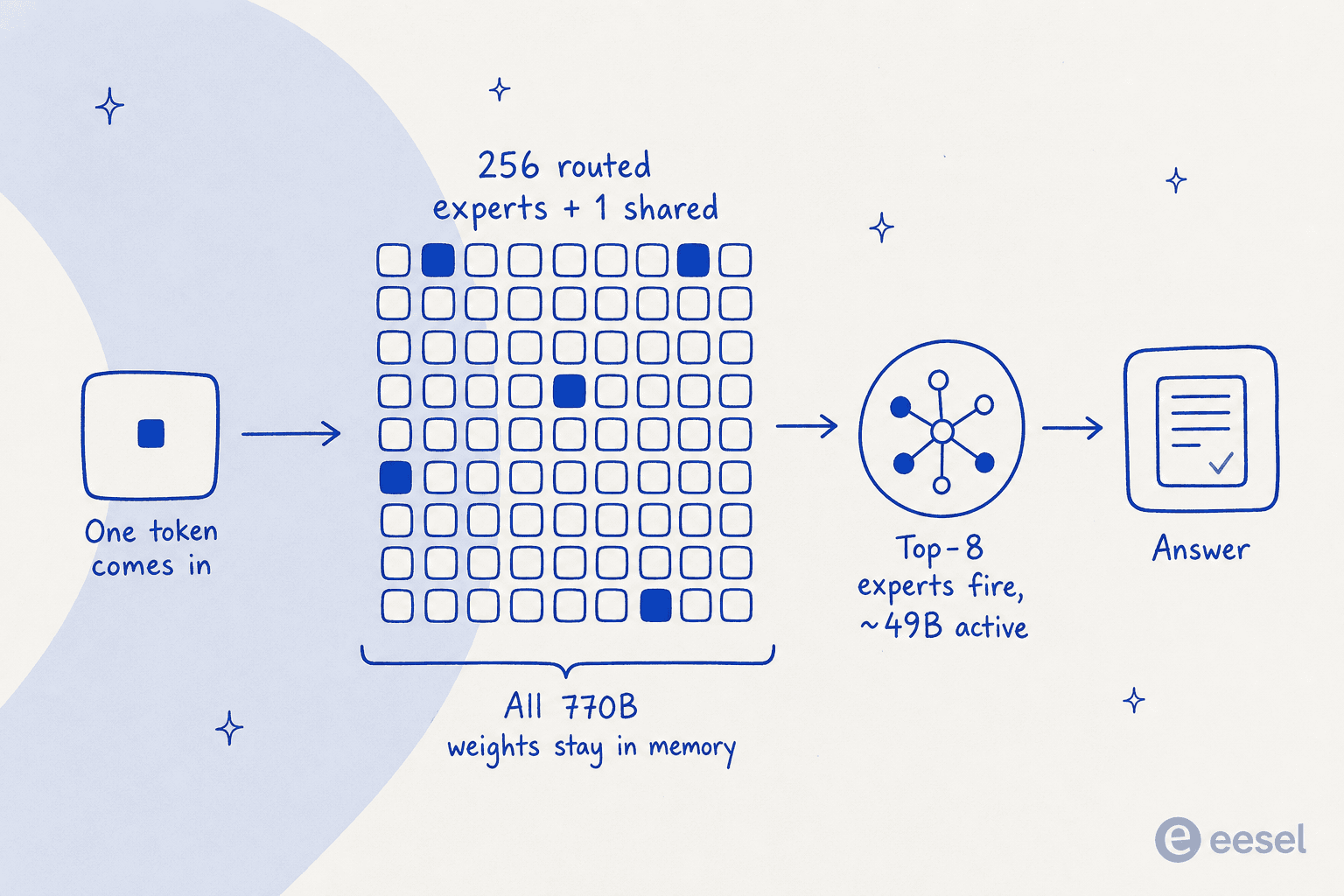
The backbone is 78 layers. The first is a standard dense layer; the other 77 each hold 256 routed experts plus 1 shared expert. When a token comes in, a router picks the top 8 experts most relevant to it, and only those (plus the shared one) actually compute. So even though the model is 770B parameters, roughly 49B fire per token. That's what keeps inference throughput viable, you're not paying the compute cost of a 770B dense model on every token.
Under the hood, Tencent leaned on ideas from DeepSeek and GLM: attention uses Gated Sparse Attention with a reusable index cache, and there's a native multi-token prediction layer bolted on for speculative decoding, which speeds up generation at small batch sizes. The important thing to hold onto is the catch in the next section: MoE saves you compute, not memory. All 770B weights still have to sit in GPU memory at once.
The benchmarks, read honestly
Tencent's launch materials make a "beats GLM-5.3 and Kimi K3" claim, and it's technically true but far softer than it sounds. The claim comes from an internal blind evaluation: 163 in-house experts rated model outputs across 203 engineering tasks, scoring each out of 4.00.
| Model | Blind-eval average (/4.00) | Hy4 pairwise result |
|---|---|---|
| Hy4 preview | 2.99 | - |
| Kimi K3 (Moonshot) | 2.94 | Hy4 wins 51.2% / ties 7.9% / loses 40.9% |
| GLM-5.3 (Z.AI) | 2.92 | Hy4 wins 46.8% / ties 12.8% / loses 40.4% |
A 0.05-point gap on a vendor's own four-point scale is a statistical shrug. Tencent even flags it as "bounded by its tasks, model versions, raters, and procedure... not an independent public benchmark". Against GLM-5.3, Hy4's wins only beat its losses 47 to 40. This is a near-tie dressed as a lead.
The public benchmark chart tells the fuller story, and it's the honest one to look at:
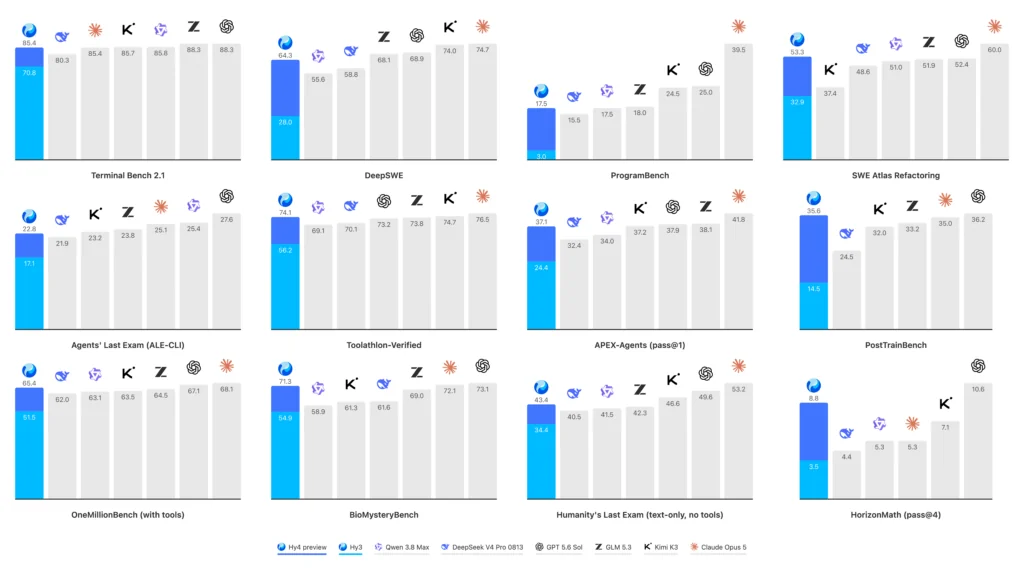
Hy4 does post some strong scores: 92.3 on GPQA Diamond, 85.4 on Terminal Bench, 82.9 on SWE-bench Multilingual, and it leads the open field on HorizonMath and BioMysteryBench. But scan across the twelve panels and Claude Opus 5 or GPT-5.6 usually sits on top, with Hy4 clustered in the middle of the pack alongside Kimi K3, GLM-5.3, and Qwen 3.8 Max. The community caught the framing fast:
Why do they always highlight benchmarks where it scored less than other models the same as the ones where it scored better? It's so misleading. I can't even tell which benchmarks it actually beat other models.

For independent placement, Hy4 isn't listed on the Artificial Analysis intelligence index yet, so there's no neutral aggregate score to quote (for scale, that board's current leader, Claude Opus 5, sits at 63). The one third-party signal so far is from LMArena's coding leaderboard:
Hy4 preview by @TencentHunyuan just landed ~#5 in the Code Arena: WebDev with 1633 pts (AutoEval)... Among open models, Hy4 preview is ~#3, compared to Hy3 at #7.
That's a real jump over Hy3, but note the "AutoEval" qualifier: Arena says a reward model cast automatic votes instead of live human ones, so treat it as provisional. My read: Hy4 is a legitimately strong open model that's roughly level with the other Chinese flagships, and the "beats" language is marketing on a near-tie. If you want a deeper head-to-head, the Qwen 3.8 Max vs Kimi K3 comparison covers the same tier.
Can you actually run it?
This is the question that dominated every launch thread, and the answer is sobering. MoE saves compute, but all 770B weights still have to live in GPU memory.
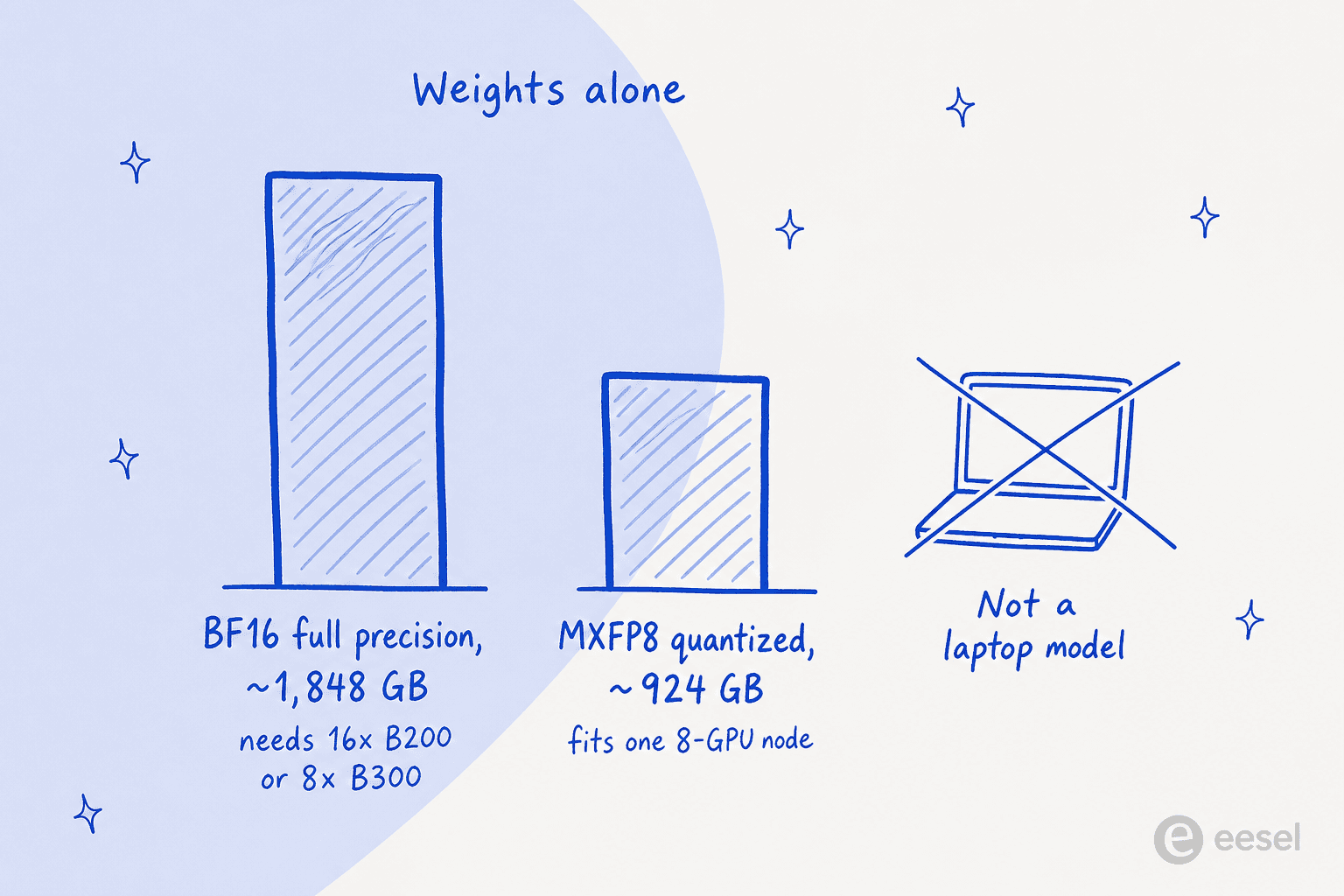
Per the official vLLM recipe, the full BF16 weights come to about 1,848 GB. Its own bottom line is blunt: you need "16x B200 or 8x B300 minimum for weights + KV cache." The MXFP8 quantized build roughly halves that to about 924 GB, which fits one 8-GPU node of the newest high-VRAM accelerators, and that's why the default serving example uses tensor-parallel size 8. There's an official FP8 checkpoint and a quantization toolkit called AngelSlim for squeezing it further, but none of that puts it within reach of a home rig. The r/LocalLLaMA crowd, who run big models for a hobby, mostly gave up on it:
I don't know who around here runs 780b models, but I am happy for them :)
Even the community's own quantization math is grim: a Q4 build lands around 450-512 GB, and a 256 GB machine only fits the 1-2 bit quants. As one commenter put it, if you've got 256 GB, "you'll probably be much better off with GLM-5.3-Flash Q4". So for most people, "open weights" is a licensing fact, not a practical one. You'll use Hy4 through an API.
Pricing and how it compares
Hy4's API pricing is $0.834 per million input tokens, $2.501 per million output, and $0.042 for cache hits. Among the flagship-tier open models, that's the cheapest of the bunch.
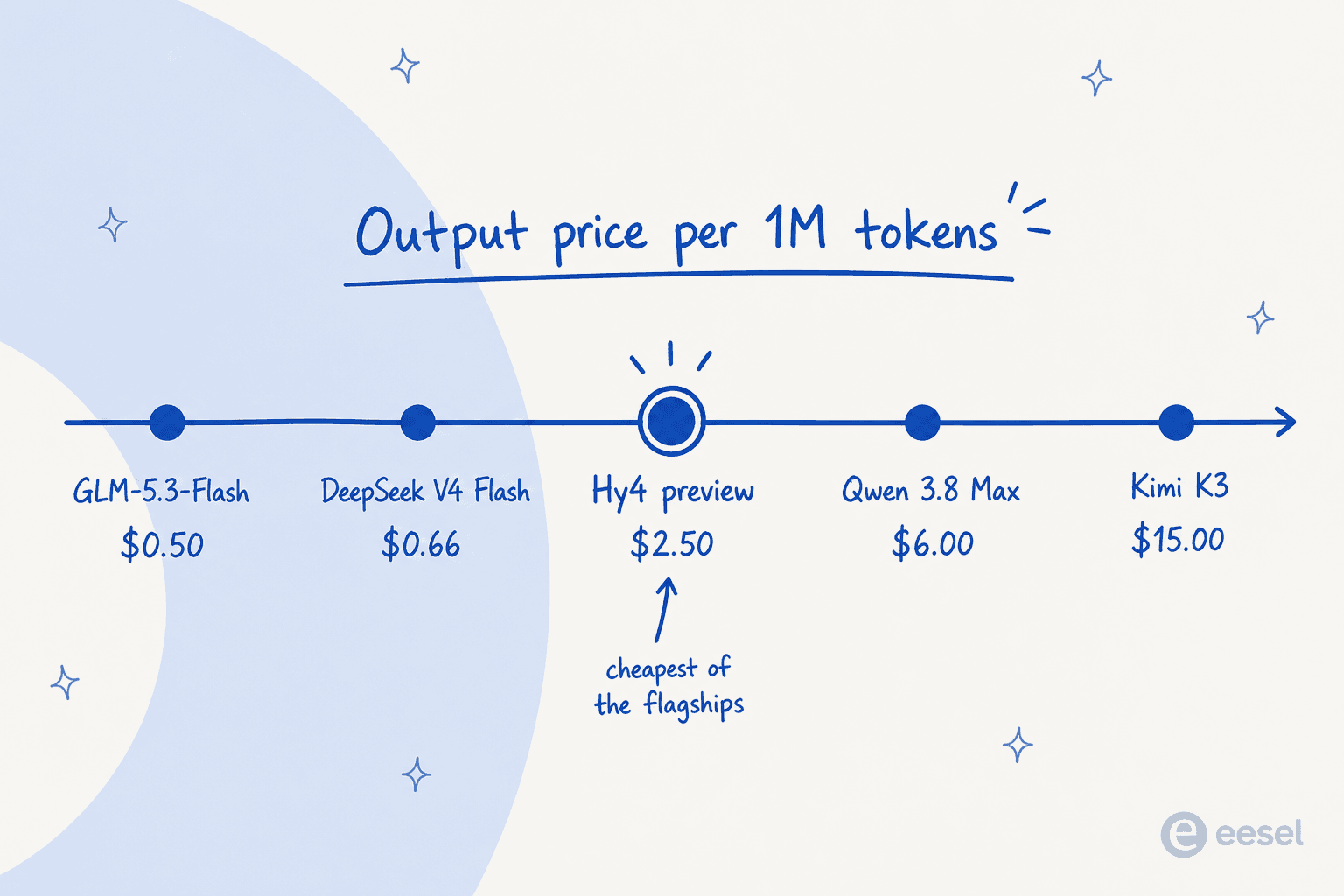
Here's the full picture against the current open-weight field (all per million tokens, checked August 30, 2026):
| Model | Input | Output | Cache-hit in | Weights |
|---|---|---|---|---|
| Hy4 preview (Tencent) | $0.834 | $2.501 | $0.042 | Apache 2.0 |
| GLM-5.3-Flash (Z.AI) | $0.15 | $0.50 | $0.03 | Open |
| DeepSeek V4 Flash | $0.22 / $0.44 | $0.66 / $1.32 | $0.007 | MIT |
| GLM-5.3 (Z.AI) | $1.40 | $4.40 | $0.26 | Open |
| Qwen 3.8 Max | $2.00 | $6.00 | $0.25 | Custom |
| Kimi K3 (Moonshot) | $3.00 | $15.00 | $0.30 | Open |
So Hy4 comfortably undercuts GLM-5.3, Qwen 3.8 Max, and Kimi K3 (which is nearly 6x Hy4's output rate). But it is not the price floor. DeepSeek V4 Flash and GLM-5.3-Flash are both far cheaper, and DeepSeek's off-peak rate makes it a fraction of Hy4's cost. There's also a catch for anyone already on Hunyuan:
But the new HY4 pricing is roughly 5-6x higher than HY3, so you're looking at about a 400-500% increase in input/output cost.
The one genuine bargain in the rate card is context caching at $0.042 per million, which one user noted is much lower than GLM-5.3's. If your workload re-reads a large fixed context (a codebase, a long document) across many calls, that caching rate is where Hy4 gets interesting. For a fuller cost breakdown of the neighbors, the DeepSeek V4 Flash pricing guide and Kimi K3 pricing guide are good companions.
How to access Hy4 today
If you're not standing up an 8-GPU node, here's where to actually reach it:
- API: the model ID is
hy4-preview, served through Tencent Cloud TokenHub and OpenRouter. Both OpenAI- and Anthropic-format APIs are supported, and OpenRouter ships it with a zero-retention data policy, which is a nice edge over some first-party Chinese APIs whose terms are vague on training use. - Free for two weeks: Hy4 is free on WorkBuddy and CodeBuddy from launch, and free Hy3 access on both was extended to September 30. It's also usable inside Tencent's Yuanbao and ima apps.
- Open weights: live on Hugging Face, GitHub, ModelScope, and GitCode, with both a BF16 and an FP8 build.
One thing to clear up, since it circulated at launch: third-party coding CLIs picked Hy4 up quickly via OpenRouter, but those aren't official Tencent free channels. The only first-party free offers are WorkBuddy and CodeBuddy.
The self-improvement angle
The most futuristic claim in the launch is easy to miss. Tencent says Hy4 contributed to its own development, participating in the "automated optimization of training methods, data strategies, evaluation frameworks, and low-level operators," what it calls an "early-stage recursive self-improvement loop." The concrete, checkable version of that: Hy4 analyzed bottlenecks in its own inference stack and the resulting optimizations lifted end-to-end throughput by 31.8%.
I'd take the grander "self-improvement" framing with a pinch of salt (a model proposing operator fusions is a long way from a model redesigning itself), but the 31.8% throughput number is specific and real, and it's the kind of engineering flex that tends to age well. It also feeds the recurring community hope that the eventual GA release lands much stronger than this preview:
And this is a PREVIEW? The actual release must actually be fable level or higher then?
So who should actually use Hy4?
After going through all of it, here's my honest verdict. Hy4 is a serious open-weight flagship with a real price advantage over Kimi K3 and Qwen 3.8 Max, strong coding and science benchmarks, and a permissive Apache 2.0 license. If you're building an AI agent on infrastructure you control, want a genuinely open license, and have the API budget or the hardware, it's a legitimate pick, especially for long-context, cache-heavy coding work.
But be clear-eyed about two things. It's not the cheapest option (DeepSeek and the Flash models win there), and it's not a runaway leader (it's level with its Chinese peers and behind the closed frontier). And critically, Hy4 is infrastructure. It's a raw model that answers prompts. It doesn't know your business, doesn't live in your tools, and doesn't do a job on its own. That gap, between a powerful model and something that actually gets work done, is the whole point of the next section.
Try eesel
Here's the distinction that matters: Hy4 is a model; eesel is the teammate you hire. A base model like Hy4 gives you raw intelligence you then have to wire up, prompt, connect to your data, and babysit. eesel is an AI teammate platform where you hire ready-to-work teammates for specific jobs, each arriving with the skills, integrations, and company context for its role.
The current roster is an AI helpdesk teammate that joins your existing support queue, looks up orders, tags tickets, and drafts or sends replies inside the helpdesk you already run, and an AI blog writer that handles research, writing, and SEO in one pass. Both train on your past tickets, help center, and docs, and go live in minutes rather than needing an ML team. Where a model leaves you with a prompt box, a teammate shows up already knowing the job.
The other thing raw models can't do: before an eesel teammate goes live, you can simulate it against your historical tickets, so you know how it'll actually perform instead of flipping a switch and hoping. It's free to try, no credit card and no sales call. If your goal is getting real work done rather than running an inference cluster, start with eesel.