


What GLM-5.3-Flash actually is
I build AI agents for a living, and most weeks a new "frontier at a fraction of the cost" model shows up. GLM-5.3-Flash is one of the few recent ones where the claim mostly holds up when you look at the numbers.
Z.ai (the company formerly known as Zhipu AI, out of Beijing) shipped it in the GLM-5.3-Flash launch on August 26, 2026, under the tagline "Frontier Intelligence, Flash Cost." It is the first model in the GLM-5 series that is natively multimodal, meaning image and video go in alongside text, and text comes out. Under the hood it is a mixture-of-experts model with 320B total parameters but only 18B active on any given token, which is the trick that keeps it fast and cheap to serve.
A few specs worth pinning down before anything else, all from Z.ai's model docs:
- Context window: 1M tokens, with a 128K max output.
- Inputs: text, image, video, and files. Output is text only.
- Reasoning: thinking mode is always on, and unlike the older GLM models you cannot disable it.
- Tooling: function calling, structured JSON output, streaming, and context caching are all supported.
- Weights: public on HuggingFace, self-hostable via SGLang, vLLM, or TokenSpeed.
The single chart that captures why anyone is talking about this model is Artificial Analysis's cost-versus-intelligence plot. GLM-5.3-Flash lands in the top-left "cheap and smart" corner that almost nothing else occupies.
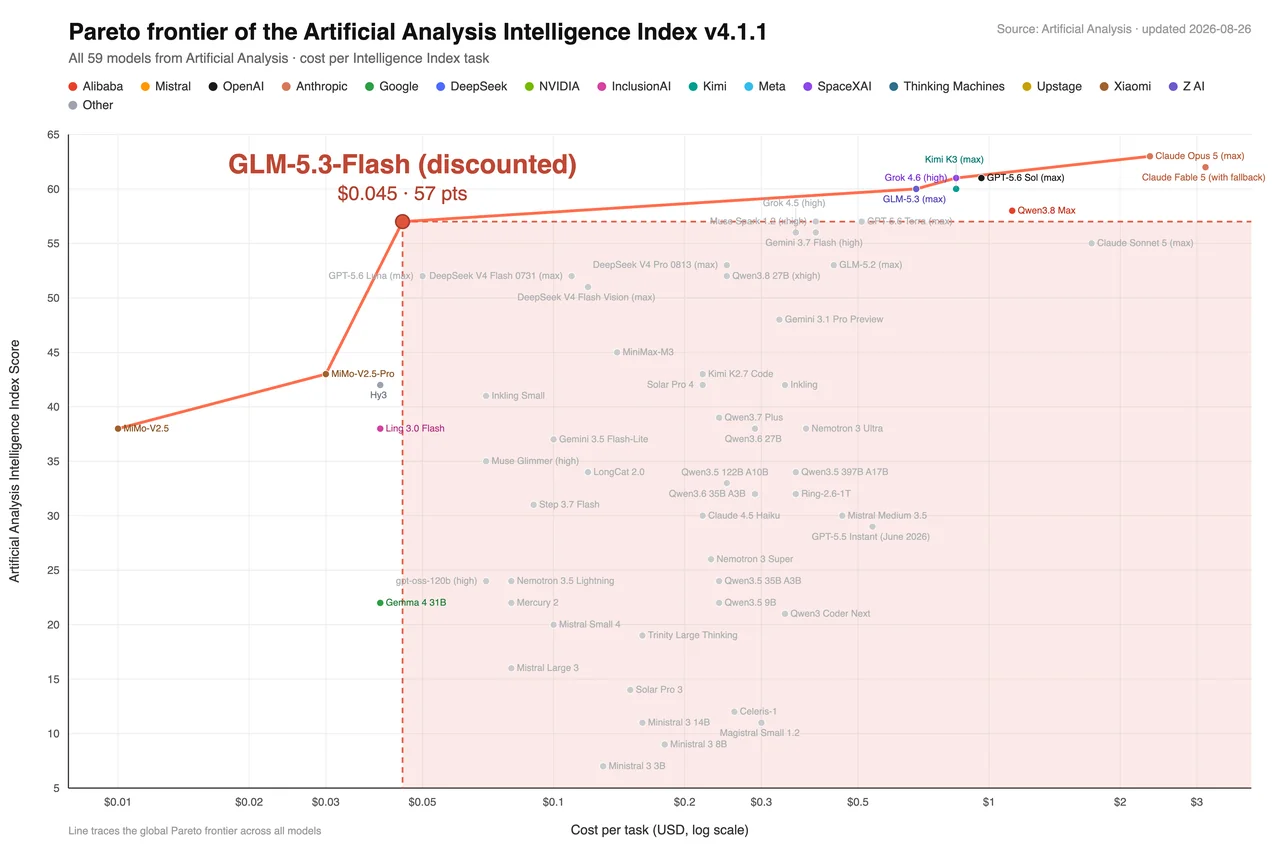
Z.ai's own framing is that it delivers "a level of intelligence previously only available at roughly 10x the cost." The interesting part is that this is not marketing spin from an aggregator, it is a third-party benchmark aggregator's number, which is a much harder thing to fake.
The "Ox Alpha" stealth launch
Here is the detail I found most telling. Before the official release, Z.ai ran it anonymously on OpenCode and OpenRouter as "ox-alpha" to gather real usage feedback. It quietly became the most-used model of the week, processing more than double the tokens of the next model, all served on Chinese AI chips rather than Nvidia hardware.
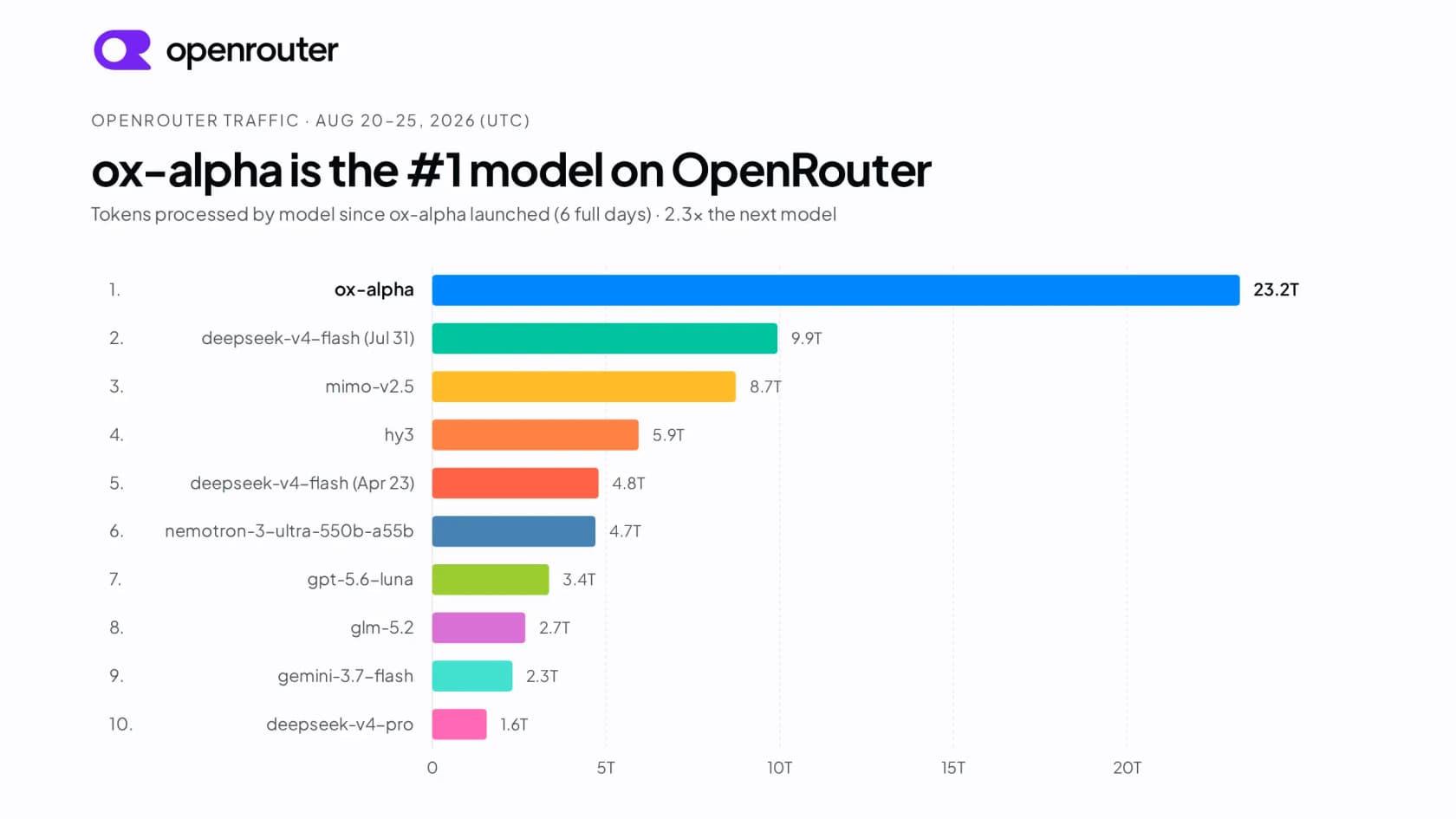
Two things matter here. First, a blind test on public platforms is about the most honest signal a lab can produce, because nobody was picking the model for its brand. Second, the Chinese-chip angle is a genuine story. Z.ai claims this "demonstrates that Chinese chips can support frontier-model inference efficiently and economically at scale," which, if it holds, changes the cost math for a lot of the market that assumed frontier inference meant a very specific vendor's GPUs.
How GLM-5.3-Flash keeps costs down
This is the part I actually care about, because "it's cheap" is only interesting if the cheapness is structural rather than a subsidy that disappears in six months.
Z.ai breaks the savings into three layers, and the architecture diagram is worth sitting with for a second.
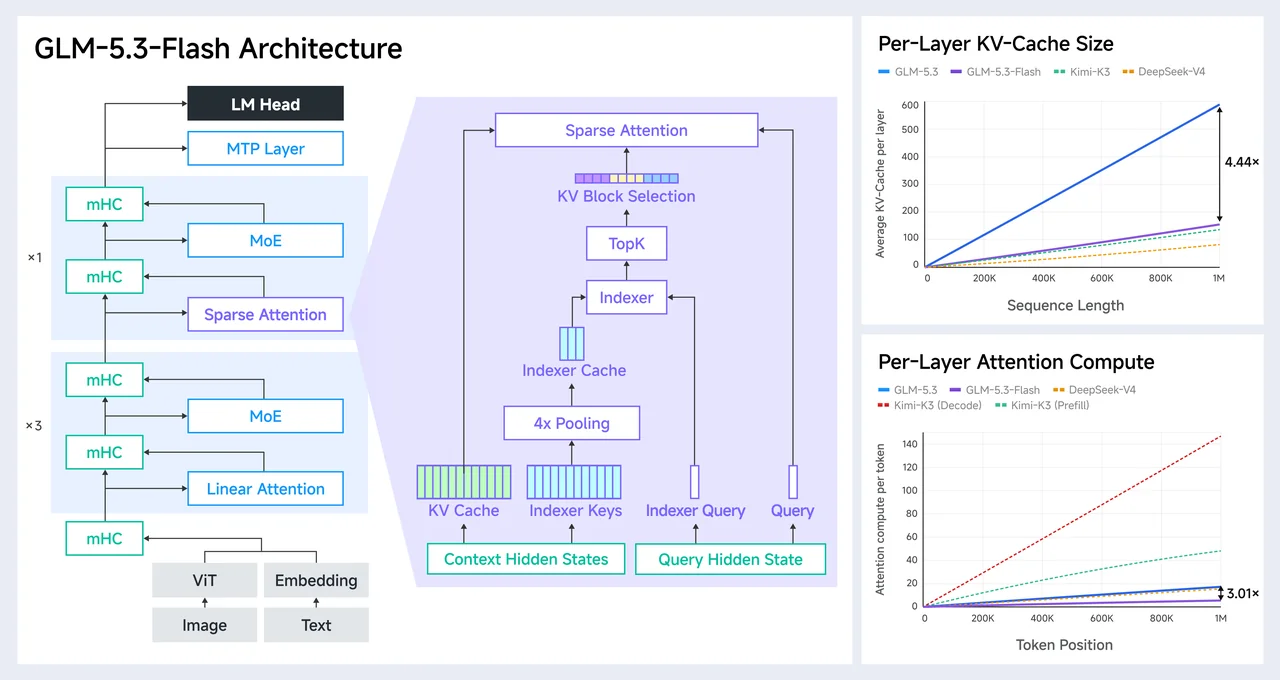
The first layer is the attention design. GLM-5.3-Flash combines sparse and linear attention: linear attention handles local context through state modeling, and a lightweight indexer retrieves the global context that actually matters. The payoff is concrete: versus the flagship GLM-5.3, it cuts attention compute by 3.0x and KV cache size by 4.4x. Long context is where serving costs usually explode, so shrinking the KV cache is the difference between a 1M-token window being a demo feature and an affordable one.
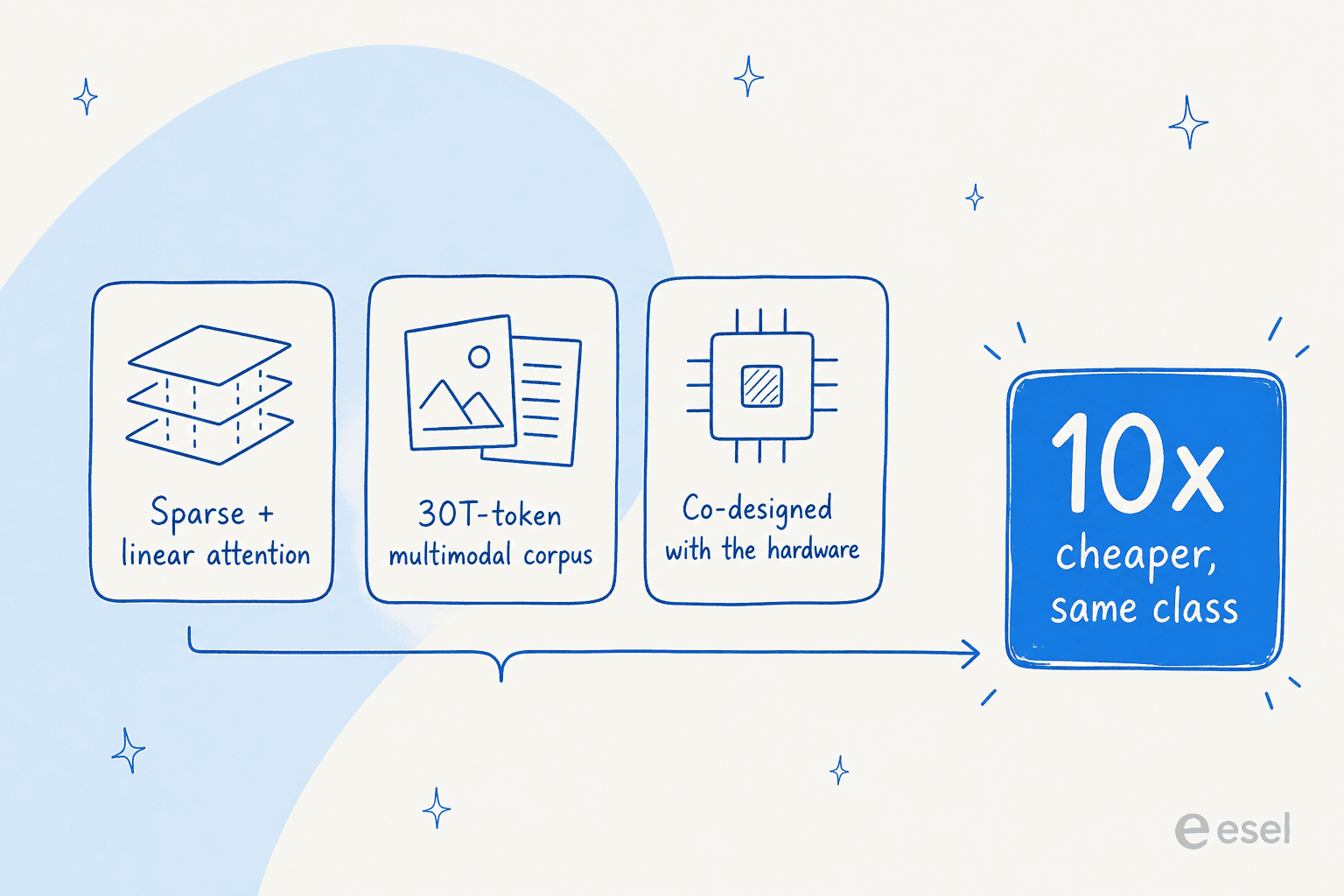
The second layer is the training data, a 30-trillion-token multimodal corpus that bakes in image and video understanding from the start rather than bolting a vision encoder on afterwards. The third is co-designing the whole thing with the inference hardware it runs on.
For comparison, GLM-5.3-Flash nearly halves both the active parameter count (18B vs 32B) and the layer count (45 vs 92) of the older GLM-4.5 series while keeping a similar total size. Fewer active parameters per token is the most direct lever on cost, and it is why a 320B model can be priced like a small one.
GLM-5.3-Flash benchmarks
Benchmarks are where "cheap" usually gets exposed, so this is the section I'd read twice. Z.ai's own comparison puts GLM-5.3-Flash against GLM-5.2, DeepSeek-V4-Vision-Exp, Claude Opus 4.8, GPT-5.6 Terra, and Gemini 3.7 Flash.
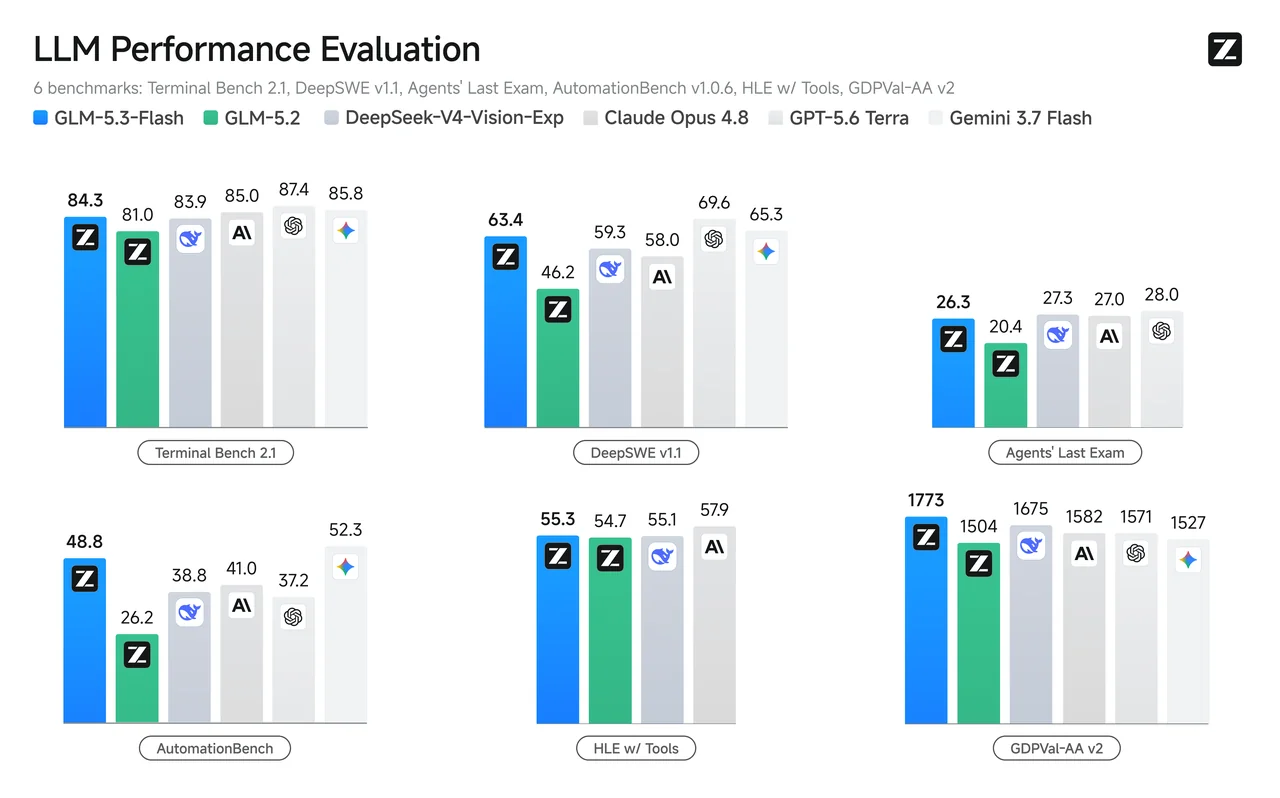
The jump over the previous generation is the real story:
| Benchmark | GLM-5.3-Flash | GLM-5.2 | Opus 4.8 | GPT-5.6 Terra |
|---|---|---|---|---|
| DeepSWE v1.1 (coding) | 63.4 | 46.2 | 58.0 | 69.6 |
| AutomationBench v1.0.6 | 48.8 | 26.2 | 41.0 | 37.2 |
| Toolathlon Verified | 78.4 | 59.9 | 76.2 | 74.9 |
| Terminal Bench 2.1 | 84.3 | 81.0 | 85.0 | 87.4 |
| GDPval-AA v2 | 1773 | 1504 | 1582 | 1571 |
Source: Z.ai's GLM-5.3-Flash benchmarks.
Read that honestly and two things are true at once. GLM-5.3-Flash beats GLM-5.2 across the board, often by huge margins (nearly doubling it on AutomationBench), and it edges past Claude Opus 4.8 on several agentic tasks. It also still trails the top closed frontier models like GPT-5.6 Terra on raw coding. On Z.ai's own Code Bench at max effort it scored 29.0 to Opus 4.8's 29.5, so "nearly matches Opus 4.8" is a fair description, not a stretch. For a model at a tenth of the price, matching last-generation flagships is the whole point.
On the multimodal side the picture is more mixed. It posts strong chart-and-document reasoning scores (89.4 on CharXiv, 78.0 on Chartography) but sits behind Gemini 3.7 Flash on pure video benchmarks like MVbench and MMVU. If your workload is document and interface understanding, that is encouraging; if it is heavy video analysis, test it against Gemini first.
GLM-5.3-Flash pricing
Here is the full rate card, straight from Z.ai's pricing docs. Prices are per million tokens.
| Model | Input | Cached input | Output | Notes |
|---|---|---|---|---|
| GLM-5.3-Flash | $0.075 (list $0.15) | $0.015 | $0.25 (list $0.50) | 50% launch promo until Sep 9, 2026 |
| GLM-5.3 (flagship) | $1.40 | $0.26 | $4.40 | Coding and cyber |
| GLM-5.2 | $1.40 | $0.26 | $4.40 | 1M context |
| GLM-4.7-FlashX | $0.07 | $0.01 | $0.40 | Text |
| GLM-4.7-Flash | Free | Free | Free | Text, fully free |
A couple of things to flag so nobody gets surprised. The $0.075 input price is a launch promotion that ends at midnight on September 9, 2026 (Singapore time), after which it reverts to $0.15. Even at list price it is the cheapest paid GLM-5-series model by a wide margin. Cached input is another ~80% off, which matters a lot for agentic workloads that resend the same system prompt on every turn. Built-in web search is billed separately at $0.01 per call.
There is also a subscription route. The GLM Coding Plan starts at $18/month (Lite), $80/month (Pro), and $168/month (Max), works inside Claude Code, Cline, OpenCode, Cursor, and 20+ other tools, and gives GLM-5.3-Flash 3x the quota of the flagship. Off-peak hours (which include all weekend) bill at half the credit rate.
To make the API side concrete, here is a quick calculator. Plug in your daily token volume and see the monthly bill against the flagship.
GLM-5.3-Flash vs the flagship GLM-5.3 (and the free tiers)
The naming trips people up, so let me be blunt about which model to reach for.
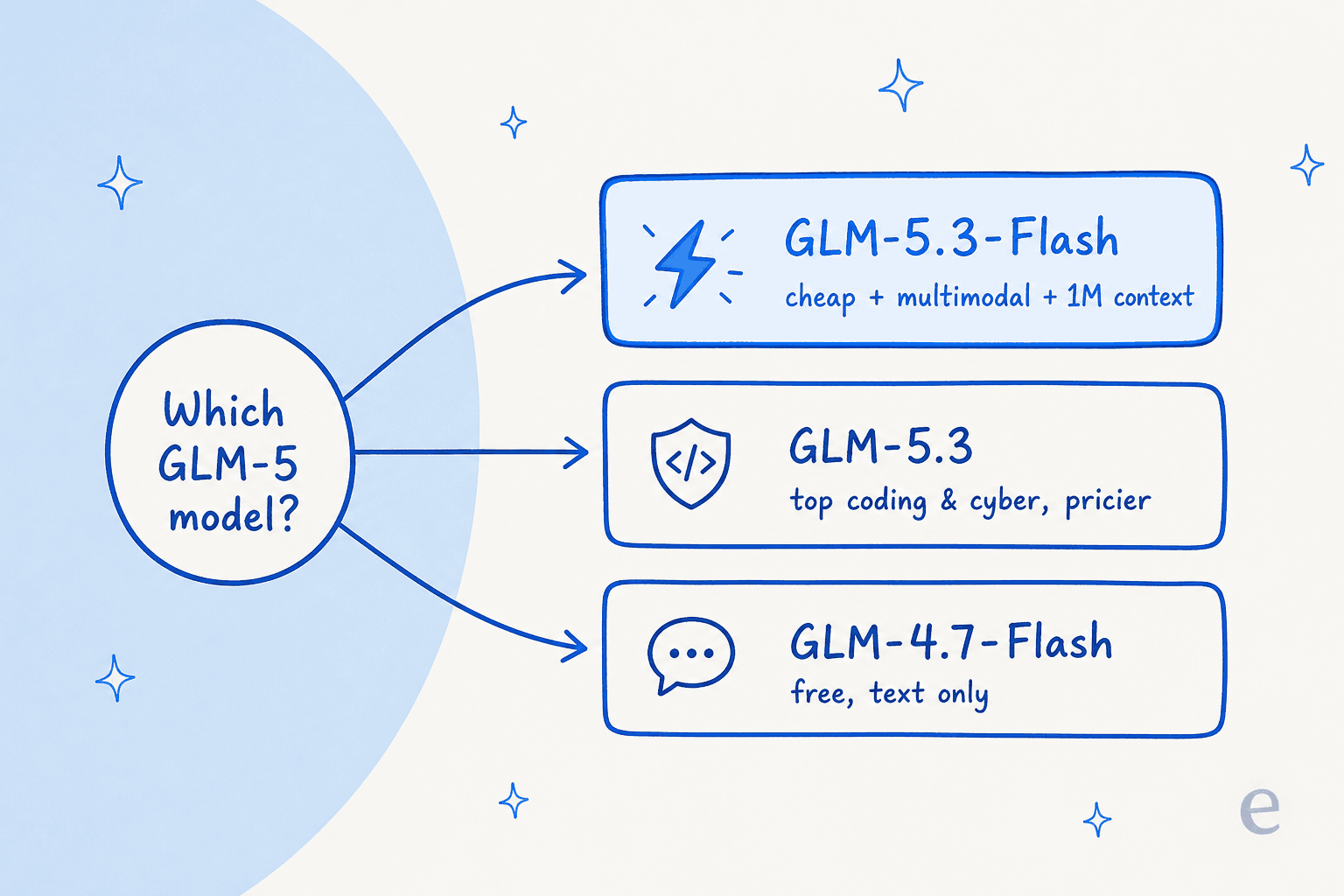
- GLM-5.3-Flash is the one you default to: cheap, multimodal, 1M context, high throughput on third-party hosts. Best for high-volume workloads, vision and document tasks, and anything where cost-per-token is the deciding factor.
- GLM-5.3 (the flagship) is a genuinely different, text-only model built for coding and cybersecurity. It leads its class on CyberGym and, in a Z.ai security study, flagged 2,436 real vulnerabilities across 269 projects, some of which had gone unnoticed for decades. If you are doing hard SWE-bench-style work or security review, pay the premium.
- GLM-4.7-Flash and GLM-4.6V-Flash are fully free (text and vision respectively), but they are older and less capable. Fine for prototyping, not for production quality.
One caveat that comes up constantly: speed depends on where you run it. On Z.ai's own API, GLM-5.3-Flash is slow (~49 tokens/second), and community members were blunt about it. On third-party hosts it is a different animal, with Databricks clocking 272.9 tokens/second on Artificial Analysis. If throughput matters, pick your provider deliberately.
What people are saying
The community reaction has been loud, and it clusters around two things: disbelief at the price, and grumbling about first-party speed.
On cost, the recurring comparison is to the other cheap open-weight models it now sits next to, like Qwen and Kimi K2.5. From a widely-shared Reddit thread:
"Noticeably cheaper even than Gemini Flash 3.7, while being only slightly worse performing. That's actually really impressive."

Security researchers were among the fastest to run real tests. One posted a concrete cost-to-findings number that is exactly the kind of specific result I trust more than a vibe:
"We benchmarked the new GLM-5.3 Flash on VulnPR-100. It found 34/100 vulnerabilities at a total model-review cost of just $4.21. That makes it the strongest sub-$10 model we've tested."
And on the new vision capability, an independent tester put it through a sizeable sample:
"GLM-5.3-Flash vision. With 1,500 samples it scored an 81% accuracy rate, which is reasonable. It works very well."
The honest counterweight is speed. A r/opencode thread called the first-party endpoint "one of the slowest models AA [has ever seen]," which squares with Z.ai's own ~49 t/s number. That is a real limitation, and it is provider-specific rather than a property of the weights.
Where a raw model stops and a teammate begins
Here is the part that gets glossed over in every "cheap frontier model" launch, and it is the thing I've learned the hard way over three-plus years of putting AI on live support queues: a model is not a solution.
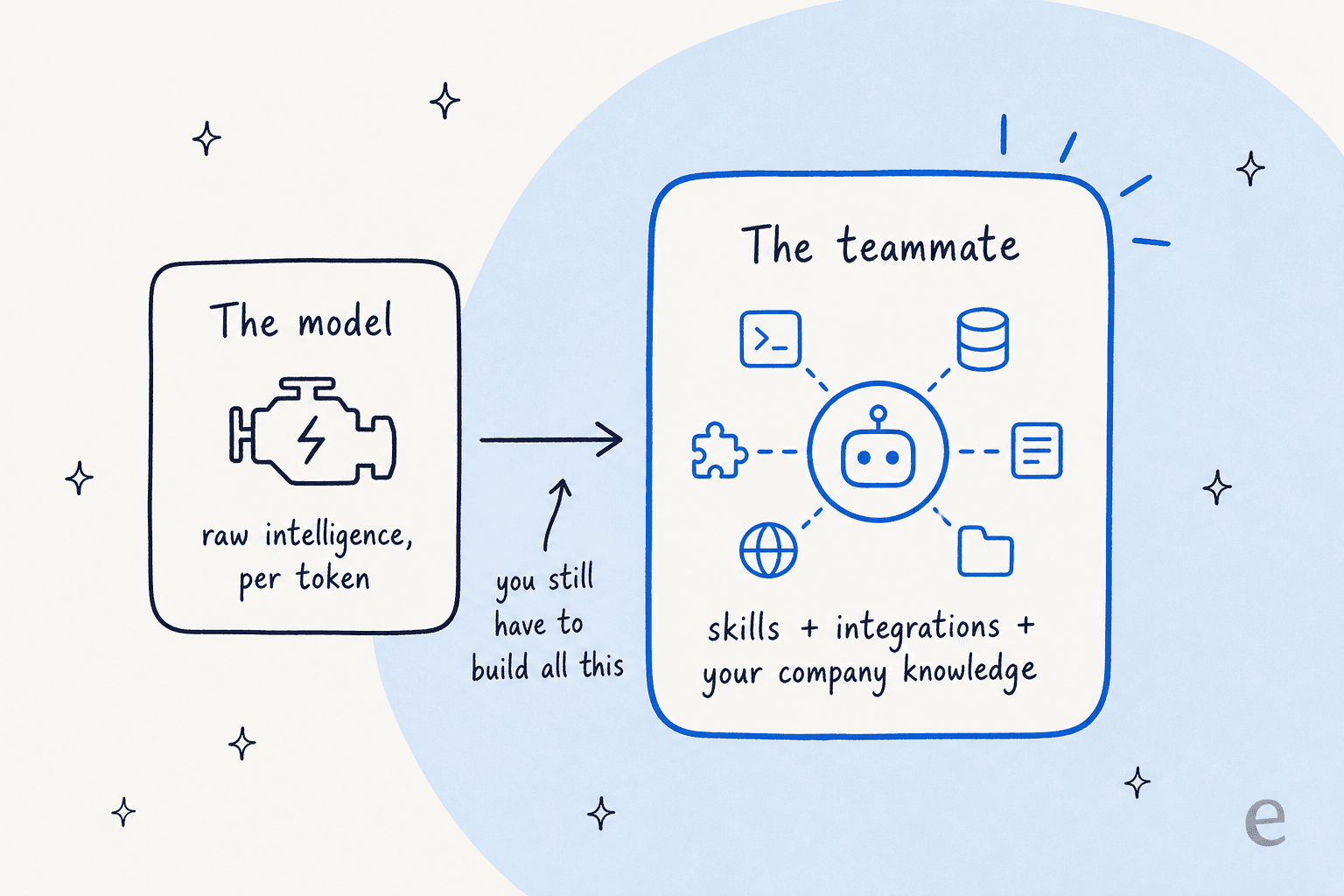
GLM-5.3-Flash gives you cheap, capable intelligence per token. It does not give you a system that knows your refund policy, can read a customer's Zendesk history, retrieves the right help doc via RAG, takes an action in your helpdesk, and gets tested before it talks to a real person. Every one of those is a project. We built our whole product around that gap, and the single most important habit we picked up is simple: never trust a model on live tickets until you've simulated it against your own history first. A confident-sounding answer that is quietly wrong costs more than a slow one.
So if you are a builder who wants raw intelligence to wire into your own stack, GLM-5.3-Flash is a genuinely great, cheap choice, and I'd happily reach for it. If you are a support or content team that just wants the outcome, the model is the easy part and the last mile is the work. That is where an AI agent platform earns its keep. It is the same reason we tell people to compare finished agents, not raw models, when they evaluate the AI for customer support automation.
Try eesel
If you like what GLM-5.3-Flash represents (frontier-class answers without frontier-class bills) but you actually need it doing a job rather than sitting behind an API, that is what eesel is. You hire an AI teammate, plug it into your apps, and it starts working from day one: an AI helpdesk teammate that joins your existing queue in Zendesk, Freshdesk, or Gorgias, and an AI blog writer that ships researched, publish-ready posts.
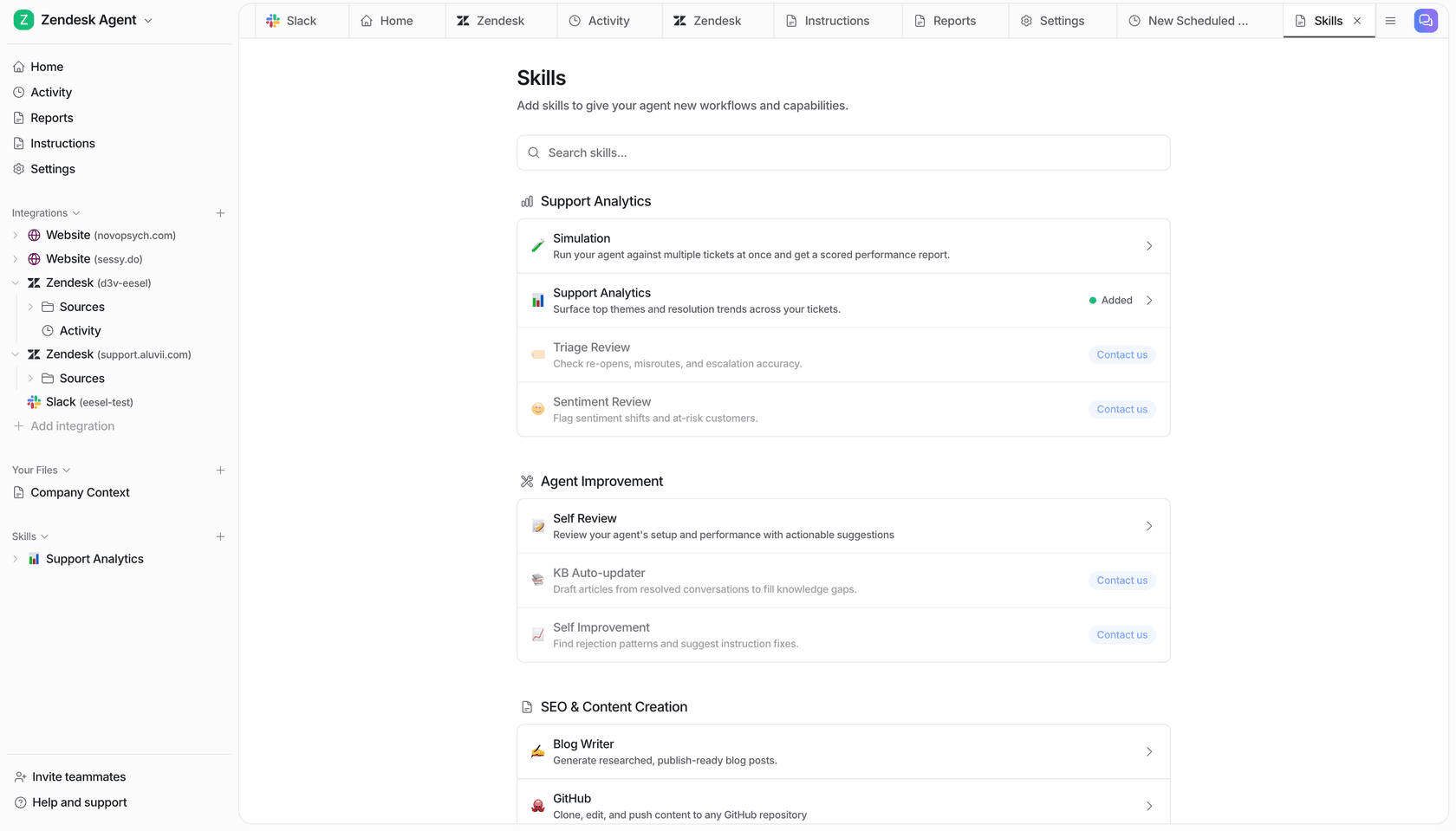
The difference from a raw model is the plumbing that is already done: it reads your knowledge base and past tickets, it comes with the integrations and skills for the role, and (the part I care about most) you can simulate it against thousands of your historical tickets before it answers a single live one. You get the model's intelligence with the safety net a raw API doesn't hand you. It is free to try, no sales call required.
Frequently Asked Questions
What is GLM-5.3-Flash?
GLM-5.3-Flash is the first natively multimodal model in Z.ai's GLM-5 series, a 320B-parameter mixture-of-experts model with 18B active parameters, a 1M-token context window, and open weights on HuggingFace. Z.ai positions it as GLM-5.2-class intelligence at roughly one-tenth the price.
How much does GLM-5.3-Flash cost?
GLM-5.3-Flash API pricing is a launch-promo $0.075 per million input tokens and $0.25 per million output tokens through September 9, 2026, then a list price of $0.15/$0.50, per Z.ai's pricing docs. It is also bundled into the GLM Coding Plan from $18/month. If you are comparing model bills for support work, our AI model for support tickets guide walks through the math.
Is GLM-5.3-Flash open source?
The weights are publicly downloadable on HuggingFace and you can self-host with SGLang, vLLM, or TokenSpeed, so it is an open-weights release. Check the license file for the exact terms before commercial use. If open weights matter to you, our roundup of open-source chatbot platforms covers the surrounding tooling.
GLM-5.3-Flash vs GLM-5.3: what's the difference?
They are two different models. GLM-5.3-Flash is the cheap, multimodal, high-throughput sibling (image and video input, 1M context). The flagship GLM-5.3 is the text-only coding and cybersecurity powerhouse, priced at $1.40/$4.40 per million tokens. Pick Flash for cost and vision, the flagship for the hardest coding jobs.
Can I use GLM-5.3-Flash for customer support?
You can, but a raw model is not a support agent. It has no access to your knowledge base, your helpdesk, or your past tickets until someone wires all that up. eesel gives you an AI helpdesk teammate that already does that plumbing, so you get the model's intelligence without building the retrieval, integrations, and testing yourself.