


GLM-5.3-Flash pricing at a glance
The model is billed pay-as-you-go per million tokens, split into input, cached input, and output. Here's the full picture, promo rates first with list prices in brackets.
| Item | Promo rate | List rate | Notes |
|---|---|---|---|
| Input | $0.075 / M | $0.15 / M | Standard prompt tokens |
| Cached input | $0.015 / M | $0.03 / M | ~80% off standard input |
| Cached input storage | Free | Free | "Limited-time free" |
| Output | $0.25 / M | $0.50 / M | Includes reasoning tokens |
| Web search | $0.01 / use | $0.01 / use | Built-in tool add-on |
Source: the Z.ai API pricing docs.
A few things worth pulling out. Output tokens cost roughly 3.3x more than input, and because GLM-5.3-Flash is a thinking-only model (you can't turn reasoning off), every request spends output tokens on its internal reasoning before it answers you. That's normal for a reasoning model, but it means output, not input, is where your bill actually lives. Budget around the output rate, not the headline input rate.
The other detail is what GLM-5.3-Flash is: a 320B-total / 18B-active mixture-of-experts model with a 1M-token context window and native vision. For a model that reads images and holds a million tokens of context, a quarter of a dollar per million output tokens is strikingly low.
Flash is not the flagship (and the price gap is huge)
This is the single most common mix-up, so it's worth being blunt about it. GLM-5.3 and GLM-5.3-Flash are two different models that happen to share a version number.
- GLM-5.3-Flash is the cheap, multimodal, high-throughput sibling. It's the one at $0.075/$0.25.
- GLM-5.3 (the flagship) is a text-only coding and cyber model, and it's priced at $1.40 input / $4.40 output per million.
That's roughly a tenfold difference. If you copy a "GLM-5.3" price from one place and a token estimate from another, you can be off by an order of magnitude. Cloudflare's framing of Flash is the clean summary: it "outperforms GLM-5.2 across benchmarks and real-world workloads at one-tenth the price."
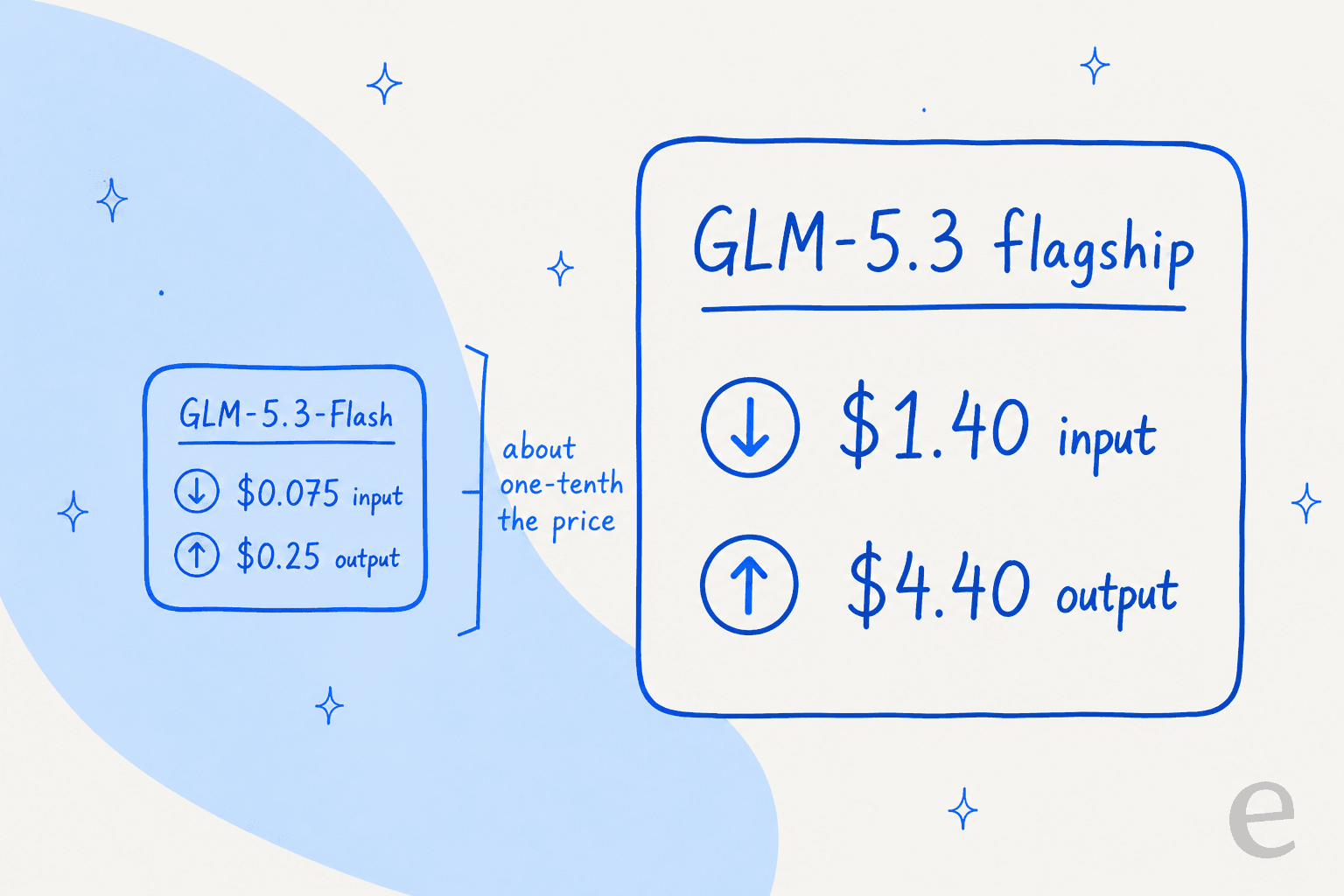
So when you're pricing a workload, the first question isn't "how many tokens?" It's "which GLM-5.3 am I actually calling?" For most non-coding jobs (chat, extraction, vision, summarization), Flash is the one you want, and the one this post is about. If you're doing frontier coding or security research, the flagship exists, but you're paying flagship rates.
The promo cliff: prices double on September 9
The $0.075/$0.25 numbers are a 50% launch discount, not the standing price. Per Z.ai's pricing docs, the promotion ends at 24:00 on September 9, 2026 (UTC+8, Singapore time). After that, the rate card reverts to the $0.15 input / $0.50 output list.
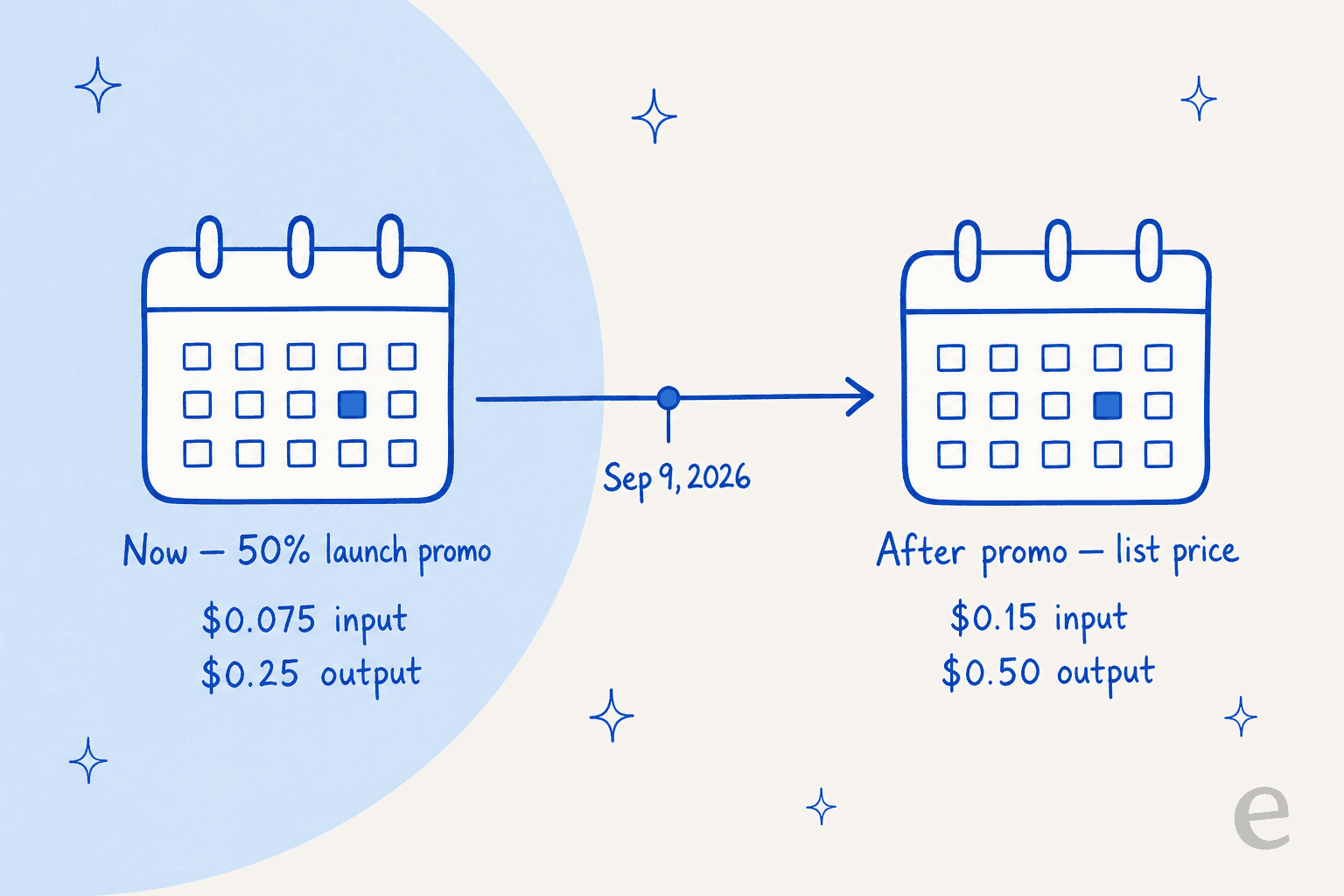
Doubling still leaves GLM-5.3-Flash cheap by any reasonable standard, so this isn't a reason to panic. But if you're building a cost model for a product that ships after September, use the list prices, not the promo ones. A budget built on $0.075 that quietly needs $0.15 is the kind of thing that looks fine in a spreadsheet and stings on the first post-promo invoice.
Cached input and the web search add-on
Two smaller levers change your effective rate.
Cached input is the big one. If your prompts share a large, stable prefix (a system prompt, a knowledge base, a long document you ask many questions about), the repeated part is billed at the cached rate of $0.015/M during the promo, about 80% below the standard input rate. On workloads with heavy prompt reuse, that's the difference between a fine bill and a great one. Cached-input storage is also free for now.
Web search is a built-in tool billed separately at $0.01 per use. It's cheap, but it's metered per call, so an agent that searches on every turn adds up in a way the token rates won't show you. Worth watching if you wire it into a loop.
The GLM Coding Plan: a subscription instead of metering
If you're mainly using GLM inside a coding tool, Z.ai sells a flat subscription that sidesteps token metering entirely. The GLM Coding Plan runs GLM-5.3 and GLM-5.3-Flash inside Claude Code, Cline, OpenCode, Cursor, Roo Code, Kilo Code, and 20-plus other agent tools.
Here are the individual tiers, with the effective monthly rate if you pay annually.
| Plan | Monthly | Yearly (effective /mo) | Weekly credits | Relative usage |
|---|---|---|---|---|
| Lite | $18/mo | $12.60/mo | 10,000 | 1x |
| Pro | $80/mo | $56.00/mo | ~60,000 | 6x Lite |
| Max | $168/mo | $117.60/mo | ~140,000 | 14x Lite |
There are two team tiers as well: a Standard Seat at $88/seat/mo (66,000 weekly credits) and a Premium Seat at $188/seat/mo (155,000 weekly credits, plus early model access), per the Z.ai subscribe page.
The mechanics reward patience. Credits are spent via a per-model multiplier (GLM-5.3-Flash costs far less per token than the flagship), and usage during off-peak hours is charged at 50% of the standard credit rate. Peak is only Monday to Friday, 14:00-18:00 Singapore time, so most of the week is off-peak. Z.ai claims that leaning on off-peak can save up to 92% versus pay-as-you-go flagship API calls. That's a vendor number, so treat it as a ceiling, not a promise, but the direction is real: the subscription is aimed squarely at heavy, daily coding use.
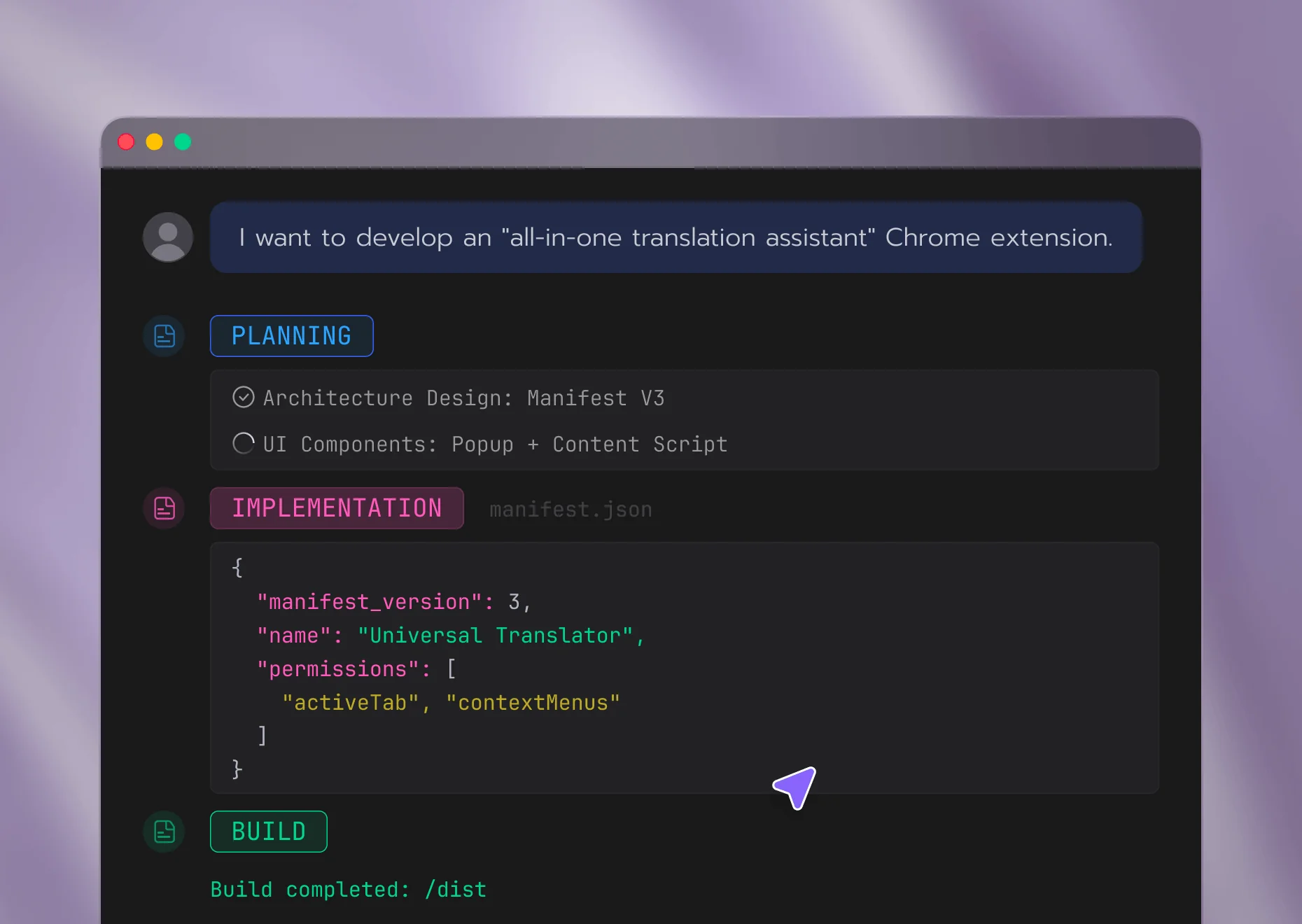
The coding plans are what most people mean when they picture GLM in action: a model chewing through refactors and migrations inside an agent.
The hidden cost: which host you pick
Here's the part the rate card won't tell you. GLM-5.3-Flash has open weights, so you can run it in a lot of places, and throughput varies wildly between them. On Z.ai's own first-party API, output runs around 49 tokens per second, which one Reddit thread called "one of the slowest models AA has ever" benchmarked. Third-party hosts are a different story.
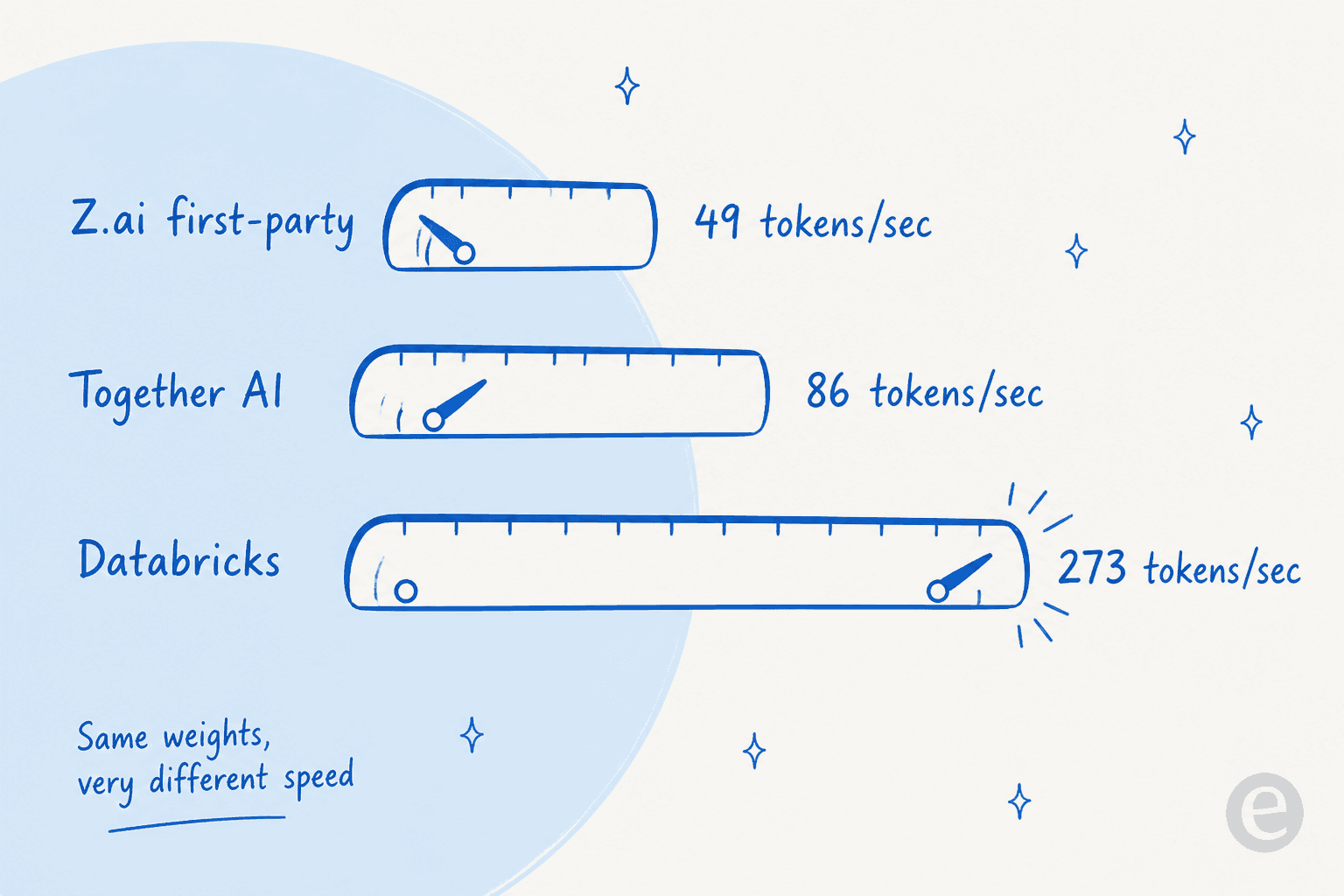
Per Artificial Analysis, across eleven API providers Databricks serves GLM-5.3-Flash at 272.9 tokens/sec with the lowest latency (8 seconds to first token), while the cheapest sticker prices come from GMI and Bitdeer at about $0.05. The point isn't that any one host is best. It's that "GLM-5.3-Flash pricing" is really a matrix of price and speed, and for anything user-facing, throughput is a cost too. A model that's half the price but a fifth of the speed can end up more expensive once you count the latency your users (or your agents) sit through.
If you want the pure price floor, first-party or GMI. If you want speed at a reasonable rate, a host like Databricks. Match the host to whether your bottleneck is dollars or seconds.
What the low price actually buys you
Cheap is only good if the output is usable, so it's worth grounding the number in what the model can do. On the Artificial Analysis Intelligence Index, GLM-5.3-Flash scores 57, versus 60 for the full GLM-5.3, which pushes it right onto the price-to-intelligence frontier. Testers backed that up in specific ways.
"We benchmarked the new GLM-5.3 Flash on VulnPR-100. It found 34/100 vulnerabilities at a total model-review cost of just $4.21. That makes it the strongest sub-$10 model we've tested."
On its new vision capability, one tester ran 1,500 samples and reported 81% accuracy, calling it reasonable for a first multimodal release. And the price-versus-peers reaction was the loudest theme of all.
"Noticeably cheaper even than Gemini Flash 3.7, while being only slightly worse performing. That's actually really impressive."

For a fuller capability read, our GLM-5.3-Flash overview goes deeper on the architecture and benchmarks, and if you're shortlisting on cost it's worth reading it beside our DeepSeek pricing and Kimi K2.5 pricing breakdowns. But for pricing purposes, the takeaway is simple: the model isn't cheap because it's weak. It's cheap because Z.ai priced an 18B-active MoE aggressively and is subsidizing launch on top of that.
A worked example: what a real workload costs
Rates per million tokens are hard to feel, so plug in your own numbers. This calculator uses the promo rates ($0.075 input, $0.25 output); flip the toggle to see the post-September list price.
To put those defaults in context: a mid-size assistant handling 500M input and 150M output tokens a month lands near $75/month on promo rates, or about $150/month once the list price kicks in. Even at list, that's a rounding error next to per-seat AI tooling, which is exactly why the model made noise. The thing to internalize is that your output volume, driven up by thinking-only reasoning, is the dial that actually moves the number. If your goal is content rather than raw tokens, our take on the best LLM for blog writing weighs quality against cost the same way.
Try eesel: the model is the engine, eesel is the teammate
Here's the honest framing. GLM-5.3-Flash is fantastic infrastructure. But a rate card of $0.075 per million tokens isn't an answer to a support ticket or a finished blog post, any more than a barrel of oil is a road trip. Raw model access still leaves you to build the retrieval, the guardrails, the integrations, the testing, and the "what happens when it's wrong" plumbing.
eesel sits one layer up. Instead of tokens, you hire ready-to-work AI teammates: an AI helpdesk teammate that joins your existing Zendesk, Freshdesk, or Gorgias queue and drafts or sends replies, and an AI blog writer that researches and writes SEO posts end to end. Each one arrives already knowing your help center and past tickets, and goes live in minutes rather than a sprint of glue code.
The differentiator that matters most for anyone nervous about handing tickets to an AI: eesel lets you simulate a teammate against your real historical tickets before it ever touches a live customer, so you see the resolution rate and the answers up front instead of flipping a switch and hoping. Models like GLM-5.3-Flash make the tokens cheap; eesel is what turns them into a teammate you can actually trust in the queue. It's free to try, no credit card and no sales call to start.