


First, which GLM-5.3 are we reviewing?
This trips people up, so let me clear it fast. There are two models with "5.3" in the name, and they are not the same thing.
The flagship GLM-5.3 is a text-only coding and cyber model that lists at $1.40 input and $4.40 output per million tokens. GLM-5.3 Flash is the cheaper, multimodal sibling that launched on 26 August 2026, and it is the one this review is about. It carries 320B total parameters with only 18B active in a mixture-of-experts setup, and before launch Z.ai ran it anonymously as "ox-alpha" on OpenRouter and OpenCode, where it briefly became the single most-used model of the week, all of it served on Chinese AI chips.
So when a benchmark table says "GLM-5.3", check which one. The scores I quote below are the Flash numbers unless I say otherwise. If you want the wider family tour, the GLM-5.3 Flash overview lays out how the two fit together.
I graded this the way I grade any large language model I might actually put to work: I read both scoreboards, pulled the vendor's own benchmark table, cross-checked it against Artificial Analysis and Cloudflare's model page, and weighed the marketing claims against what practitioners said after they ran it themselves.
The benchmarks: where it actually lands
Z.ai's headline is that GLM-5.3 Flash "outperforms GLM-5.2 across benchmarks and real-world workloads at one-tenth the price, while approaching Claude Opus 4.8 on coding and agentic benchmarks." The published table backs the first half cleanly.
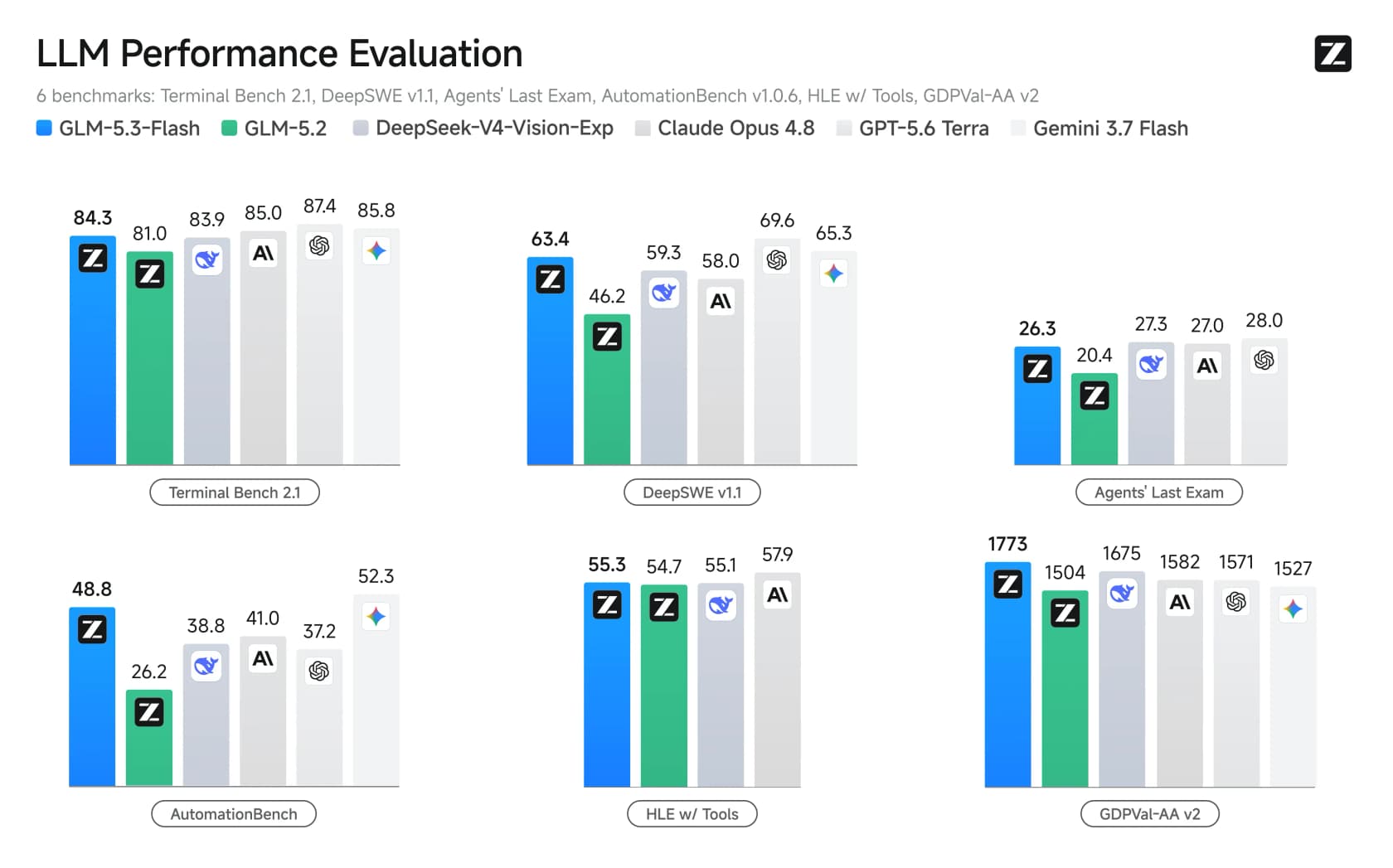
The jumps over GLM-5.2 are large and consistent: DeepSWE v1.1 goes from 46.2 to 63.4, AutomationBench from 26.2 to 48.8, and GDPval-AA v2 from 1504 to 1773. On Z.ai Code Bench v1.0, run inside Claude Code at max effort, Flash scores 29.0 against Claude Opus 4.8's 29.5, which is the "nearly matches Opus" line in the flesh.
The "approaching Opus" framing is fair on coding and agentic work, and it is honest about where it stops. Against the closed frontier, GPT-5.6 Terra takes DeepSWE (69.6) and Gemini 3.7 Flash edges AutomationBench (52.3). GLM-5.3 Flash is not beating the best closed models outright. It is landing in the same neighbourhood for a tenth of the money, which is a different and more interesting claim.
Where it clearly leads the table is the two places nobody expects a budget model to: it tops GDPval-AA v2 at 1773, and on the vision rows it posts 89.4 on CharXiv reasoning and 80.5 on MMVU, ahead of DeepSeek-V4-Vision-Exp and Opus on both. For a model this cheap, that is the surprising part.
One caveat worth stating plainly: there is no MMLU, GPQA, or AIME score on either page. Z.ai reports a coding, agentic, and vision suite, not a traditional academic-knowledge table, so if your use case leans on broad factual recall, the published evidence just does not speak to it. Treat that as a gap in the data, not a pass or a fail.
The price is the whole story
Here is the number that makes GLM-5.3 Flash worth a review at all. On the launch promo it costs $0.075 per million input tokens and $0.25 output, with a cached-input rate of $0.015. The list price after the promo ends on 9 September 2026 is $0.15 and $0.50. Either way, that is roughly a tenth of the flagship GLM-5.3, and it sits it on the efficient frontier of the whole market.
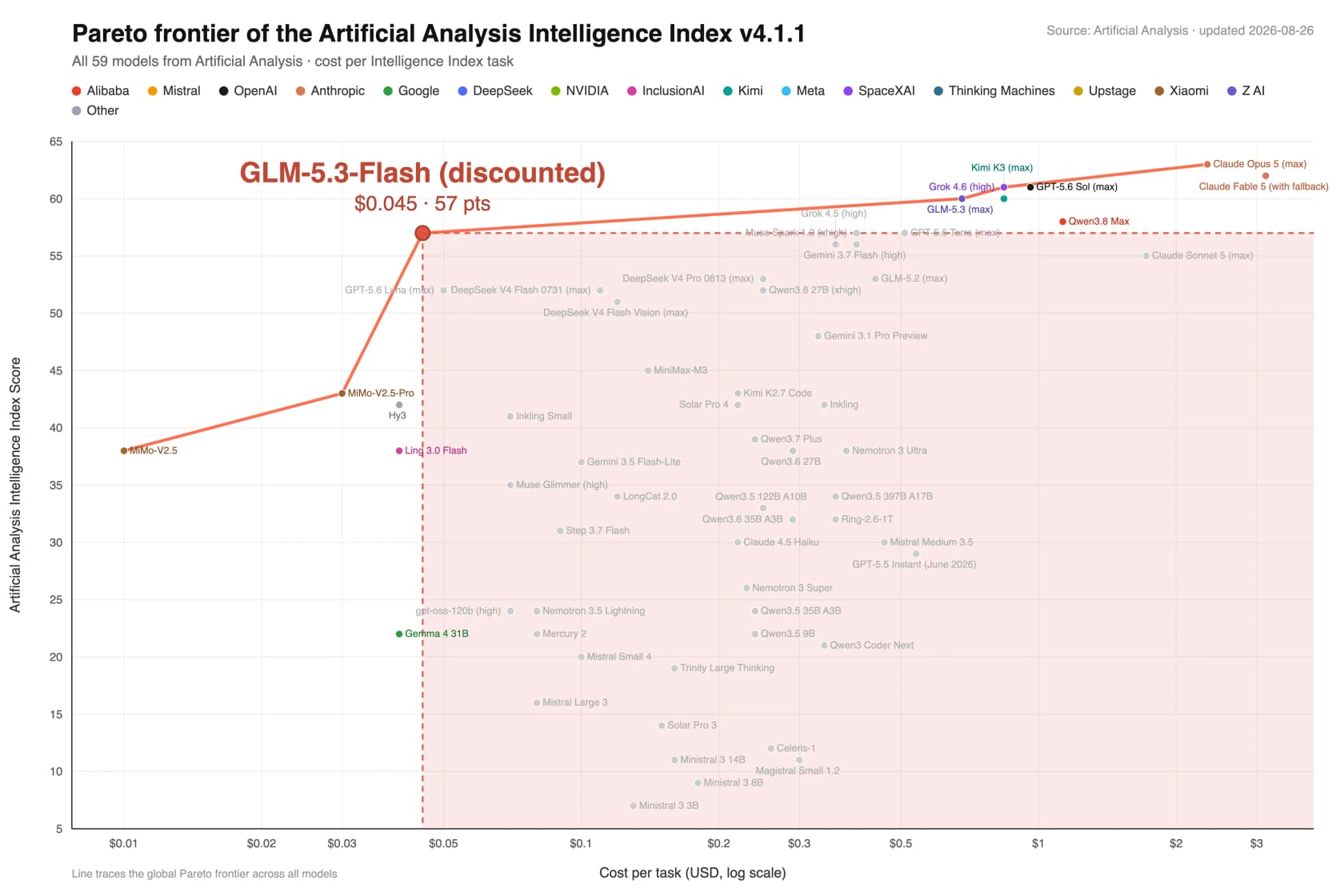
That red dot is the pitch. GLM-5.3 Flash pushes the Pareto frontier: for the intelligence it delivers, nothing on the board is cheaper, and Z.ai's own line is that this is "a level of intelligence previously only available at roughly 10x the cost." The community reaction was mostly disbelief at exactly that.
"Noticeably cheaper even than Gemini Flash 3.7, while being only slightly worse performing. That's actually really impressive."

The Coding Plan route is worth a mention because it is where most people will actually meet this model. Z.ai's GLM Coding Plan runs $18, $80, and $168 a month for Lite, Pro, and Max, works inside Claude Code, Cline, OpenCode, Cursor, and Roo Code, and Flash gives you 3x the usable quota of GLM-5.3 on the same plan. If you already pay for a coding subscription, Flash is the setting that makes the credits last three times longer. For how this stacks against the other cheap frontier options, the DeepSeek V4 Flash review and Kimi K3 review cover the nearest rivals, and Qwen 3.8 Max is the step up in price.
Pick what you care about most, and I will give you the honest read.
Why it can be this cheap
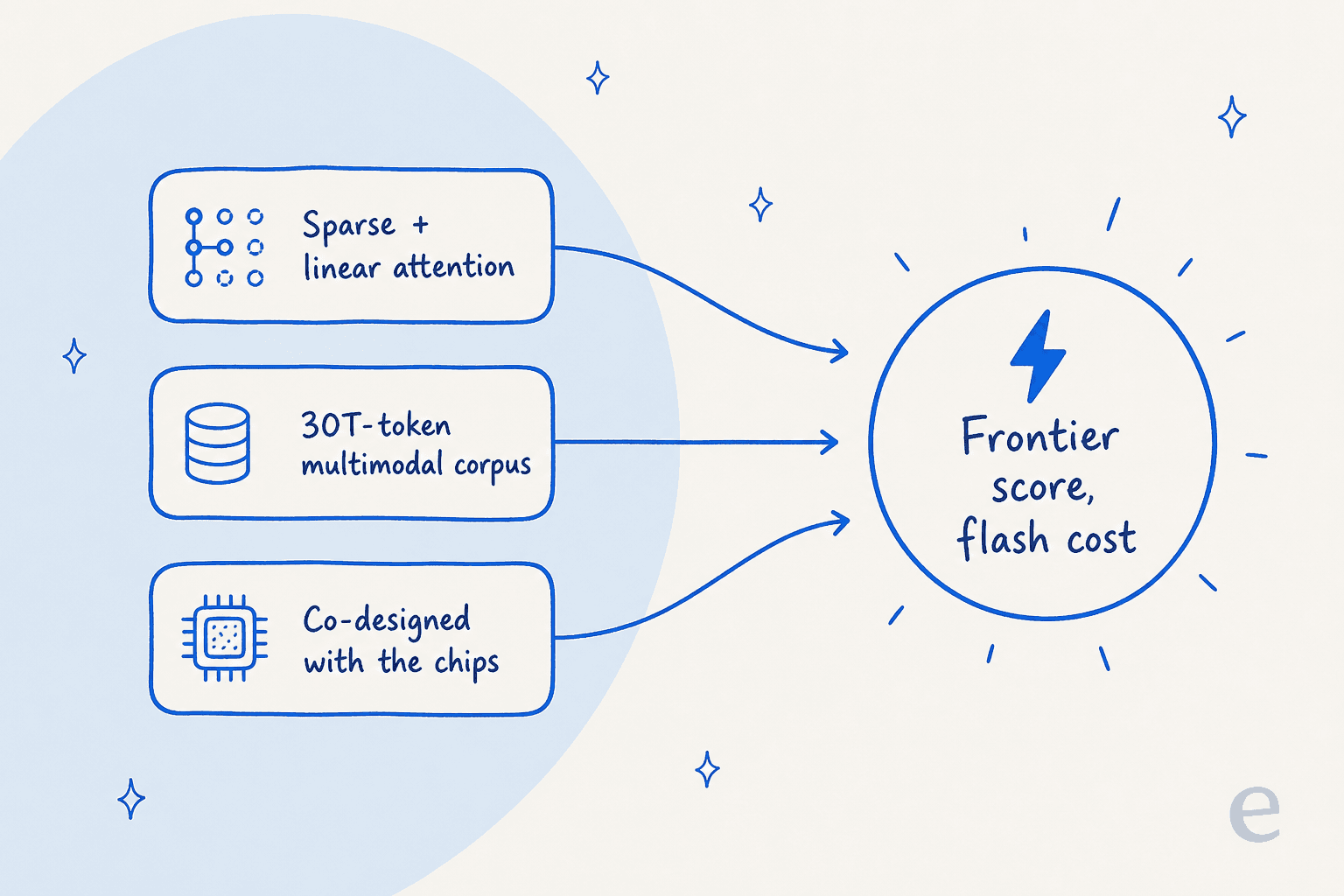
A price this low usually means a small, dumb model. This one is neither, and the reason is architectural rather than a discount that will evaporate. Z.ai's framing is that the cost comes from three layers working together, not one trick.
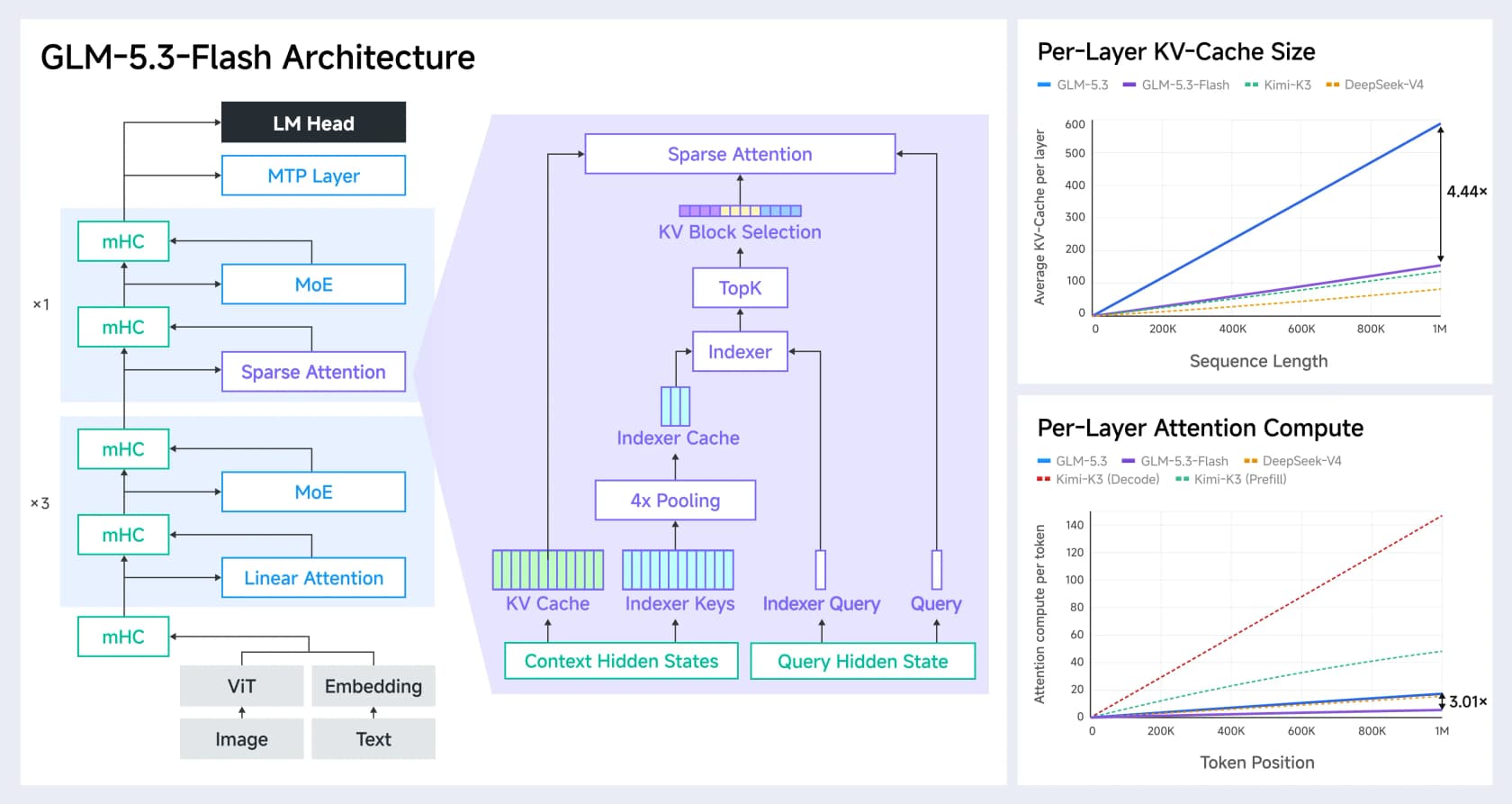
The load-bearing piece is the attention design. GLM-5.3 Flash is the first open model to combine sparse and linear attention: linear attention handles local dependencies through state modelling, while a lightweight indexer retrieves global context. The result, per Z.ai, is 3x less attention compute and a 4.4x smaller KV cache than the flagship GLM-5.3, which is most of why serving it at a 1M-token context stays affordable.
The other two layers matter less to you day to day but are worth knowing. It was trained on a 30 trillion token multimodal corpus, and the whole thing was co-designed with Chinese inference hardware, which is the point Z.ai keeps returning to: "Chinese chips can support frontier-model inference efficiently and economically at scale." Compared with the older GLM-4.5, Flash nearly halves both the active parameters (18B vs 32B) and the layer count (45 vs 92) at a similar total size. This is a real efficiency story, not a launch-week loss leader.
The multimodal bet: vision inside the coding loop
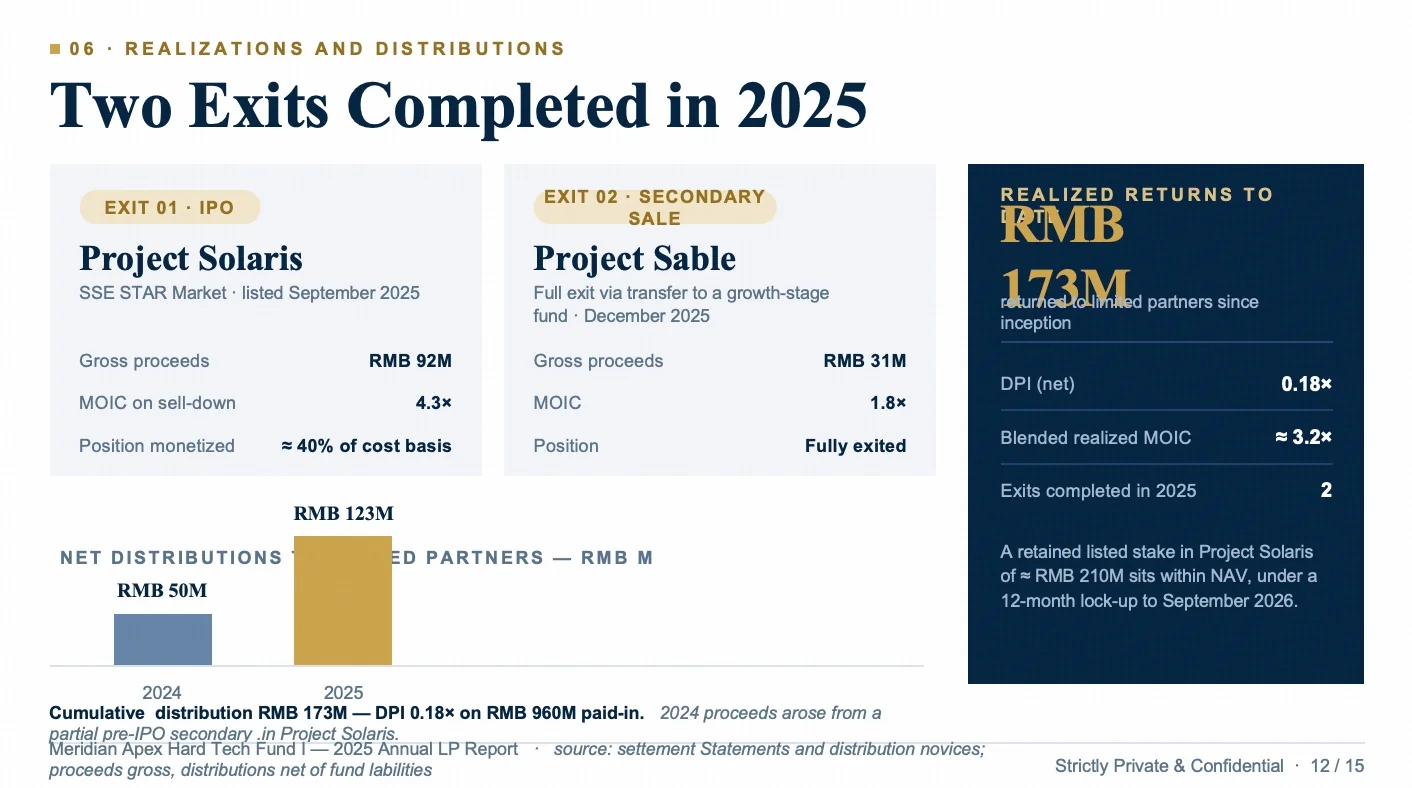
The most interesting thing GLM-5.3 Flash does is not on the benchmark table. It folds vision into the coding loop, so the model can render its own output, look at it, and fix what is wrong. Z.ai's line is the tidy one: "Code lets the model build and change the world. Vision lets it enter the world people see and use."
The clearest demo is a slide it generated and then repaired on its own. Here is the first pass, with overlapping text and a broken layout:
And here is the same slide after the model looked at its own render and corrected the collision:
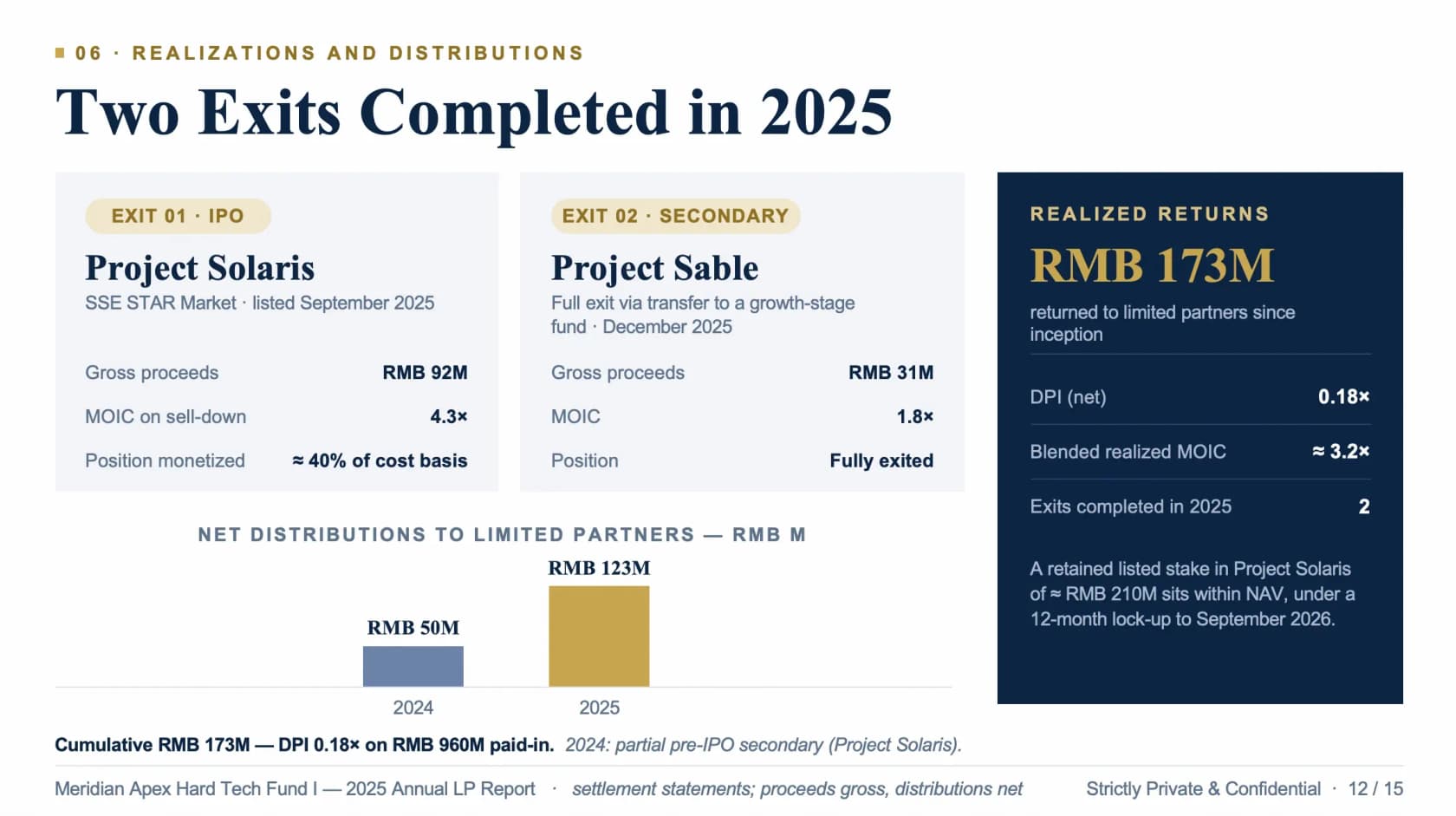
That is a useful loop for frontend, game, and 3D work, where "it compiles" and "it looks right" are different questions. It also extends past code into reading dashboards, spreadsheets, and presentations, plus computer-use and browser-use agents inside ZCode. Practitioners who tested the vision side came away convinced:
"GLM-5.3-Flash vision. With 1,500 samples it scored an 81% accuracy rate, which is reasonable. It works very well."
I would still treat the self-verification as a helpful reflex rather than a guarantee. It catches obvious visual mistakes; it is not a substitute for a human looking at anything that ships. But for a first natively multimodal release, the vision quality is well ahead of what the price would suggest.
Where it falls down
A review that only lists strengths is a press release. GLM-5.3 Flash has two soft spots that are worth knowing before you wire it into anything.
The first-party API is slow, and the reputation is real. On Z.ai's own endpoint it runs at roughly 49 tokens a second, against about 86 for the full GLM-5.3, and one thread put it bluntly.
"GLM 5.3 Flash is one of the slowest models AA [has ever seen]. GLM's visible context grows half as fast as Deepseek Flash and is much more precise and direct."
The important nuance, and the reason I would not let that quote settle the matter, is that it describes the first-party service, not the weights. Artificial Analysis lists 11 providers, and the spread is enormous.
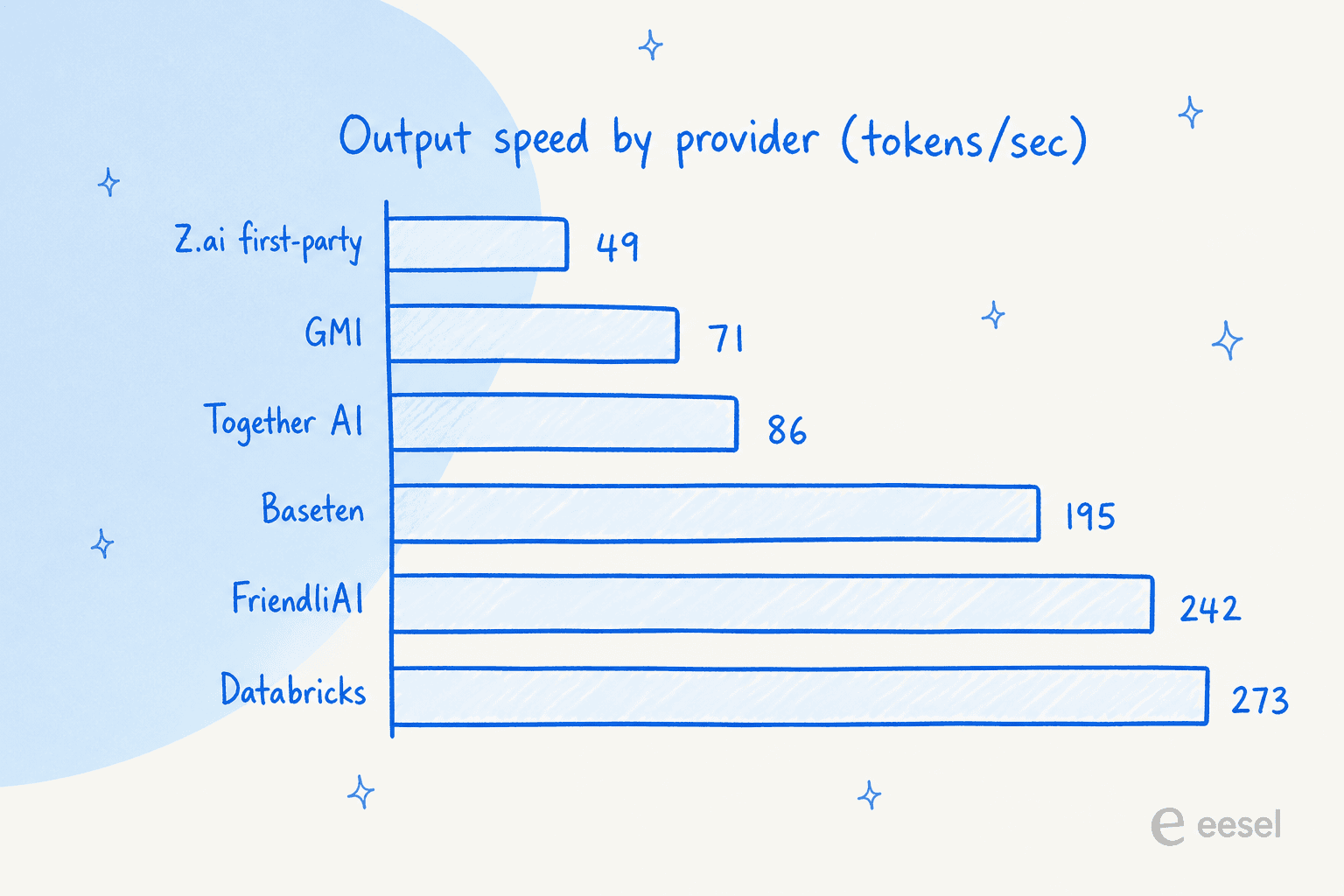
Databricks serves the same model at 272.9 tokens a second, more than five times the first-party rate, with an 8-second time to first token. So "GLM-5.3 Flash is slow" is really "Z.ai's own API is slow." Pick your host deliberately and the problem mostly disappears. The provider benchmarking page is the thing to check before you commit, and if you route real traffic through it, a proper usage tracking setup will save you a surprise invoice.
The data story is thin if you handle customer content. The first-party API ships no published data-processing agreement and no zero-retention option, and the service runs under PRC law. That is a real constraint, not a knock on the model, and the honest fix is the open weights: self-hosting under SGLang, vLLM, or TokenSpeed is how you get a controlled data path. If any of this touches customer data, SOC 2 and GDPR is the thing to read first.
One more thing to plan around: the GLM-5.3 series is thinking-first, so budget for reasoning tokens in your costs. Cloudflare exposes a reasoning_effort control with low, medium, and high settings, so you can turn the dial down for simple work, but there is no free "think nothing" mode the way some models offer. That is also a hallucination note in disguise: more reasoning is not the same as more accuracy, and the vision self-check does not extend to factual claims.
What people are actually building with it
The most telling signal is not a benchmark, it is that vendors and builders picked it up within days. James Grugett put it into a product for free on launch:
"GLM 5.3 Flash is 100% free in our [product]. Leading capabilities at a highly competitive price - Natively multimodal with a 1M-token context window. Previously previewed as Ox Alpha."
The security-review use case is where the price-to-value ratio got the loudest reaction. One team ran it against a vulnerability benchmark and did the math:
"We benchmarked the new GLM-5.3 Flash on VulnPR-100. It found 34/100 vulnerabilities at a total model-review cost of just $4.21. That makes it the strongest sub-$10 model we've tested."
That is the shape of a good GLM-5.3 Flash job: high volume, tolerant of a slightly slower run, and priced so low that you can throw it at work you would never pay a frontier model to do. The best open-source AI agents roundup has more of these patterns, and if the job is support specifically, the best model for support tickets is a narrower read on what actually matters there.
My verdict, by job
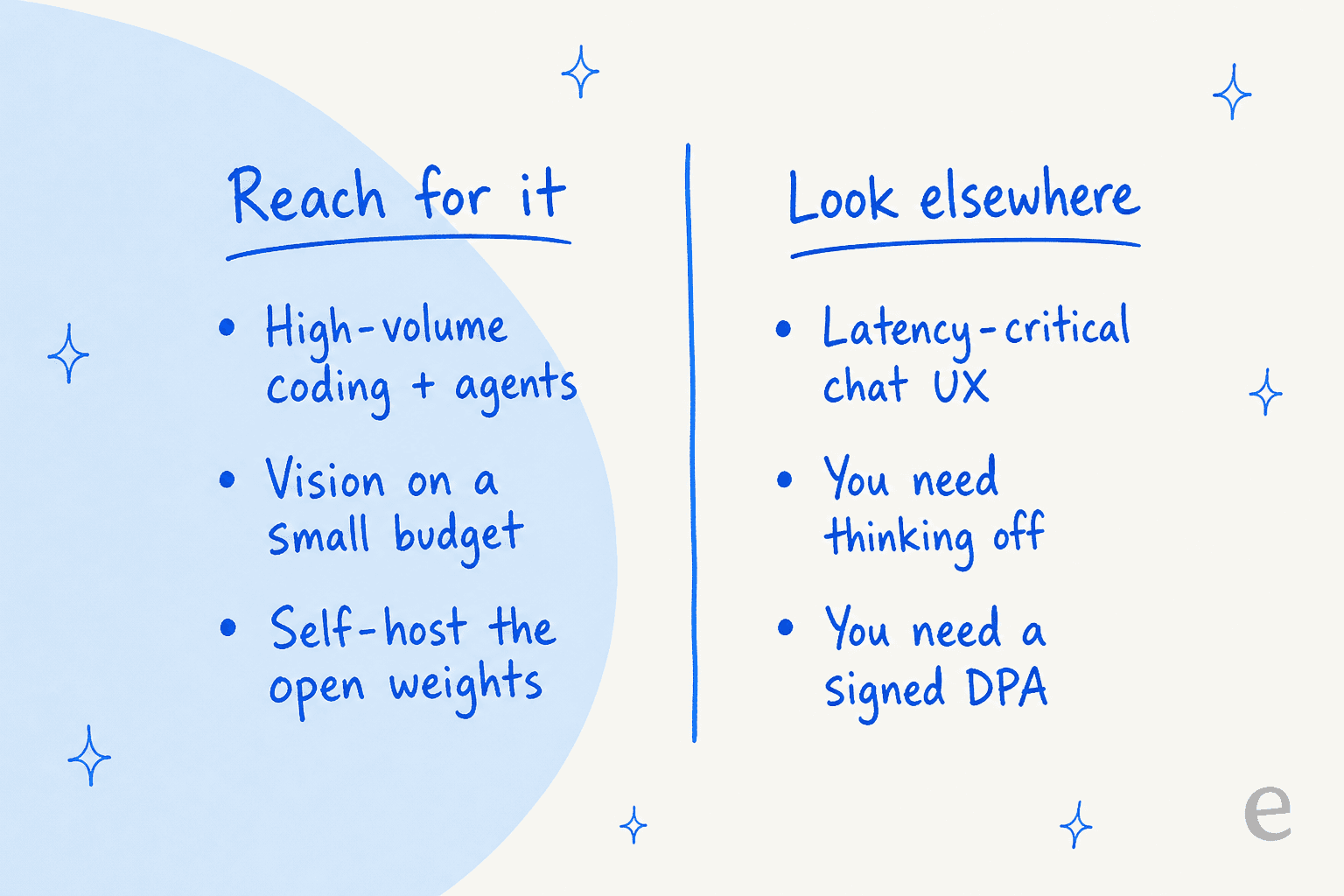
Reach for GLM-5.3 Flash if you are running high-volume coding or agentic work, if you want real vision quality without the frontier price, or if you want to self-host open weights and keep your data in-house. On all three, it is one of the best-value calls available today, and the GLM-5.3 Flash overview is where I would send you to set it up.
Look elsewhere if latency is your product and you cannot control the provider, if you need a mode that skips reasoning entirely, or if you need a signed data agreement you cannot get without self-hosting. None of those are fatal, but they are the situations where a pricier, faster, or more governed model earns its premium. If you are weighing it against a closed frontier option, Claude Opus 5 pricing is the reference point on the other end of the scale.
The one-line version: GLM-5.3 Flash is the model I would default to for cheap, high-volume, tolerant-of-slow work, and the one I would benchmark carefully before betting a latency-sensitive product on it.
Try eesel
If you got here comparing per-token rates because you want an AI to handle support, here is the thing I would say over coffee: the token price was never the hard part. A model like GLM-5.3 Flash is the engine. Wiring it to your helpdesk, grounding it in your real macros and past tickets, and knowing what it will say before a customer sees it, that is the actual work, and it is a different product entirely.
That is where eesel fits. eesel gives you ready-to-work AI teammates for specific jobs, an AI support agent that plugs into Zendesk or your existing helpdesk, and an AI blog writer for content. Each one arrives with the skills, integrations, and company context for its role, so you are hiring a teammate, not renting raw model access.
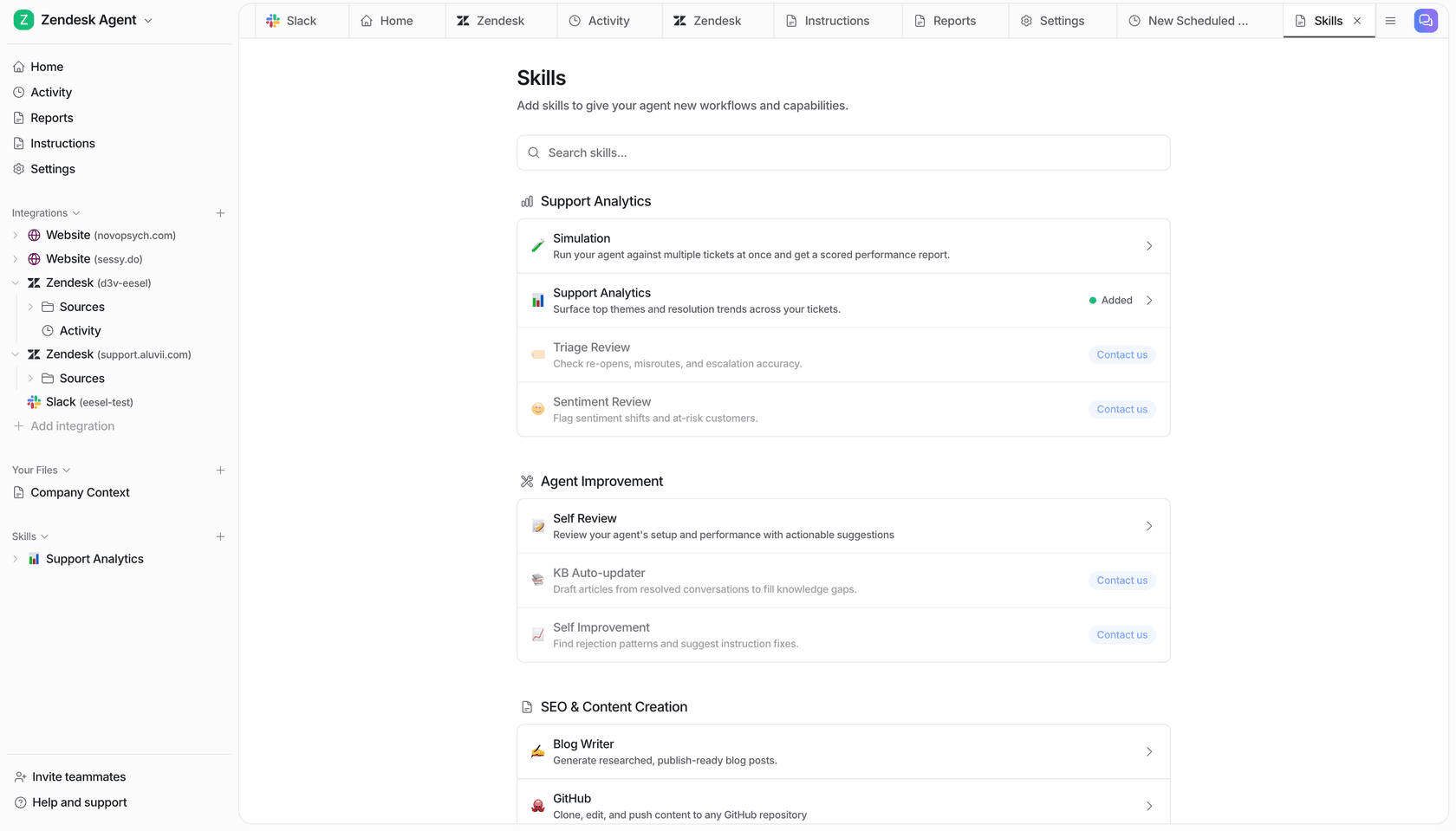
The part that matters most for support: we have spent years putting AI agents on live support queues, and we have watched a confident-sounding bot narrate work it never did. That is exactly why every eesel rollout gets simulated against past tickets before it touches a real conversation. Pricing is one fixed monthly price sized to volume (1 credit per ticket or chat) rather than per seat, so a gradual rollout is real, and there are 100 free credits to start. That credit model is also why the cost of AI customer service works out differently from a raw token bill. Run a simulation on last month's tickets and you will know within an hour whether it is worth your time, which beats benchmarking a model in the dark.