
What DeepSeek V4 Flash actually is
deepseek-v4-flash is one of exactly two models sitting on DeepSeek's price card, right next to deepseek-v4-pro. The legacy deepseek-chat and deepseek-reasoner rows are not there anymore. Those two V4 models, that is the entire lineup.
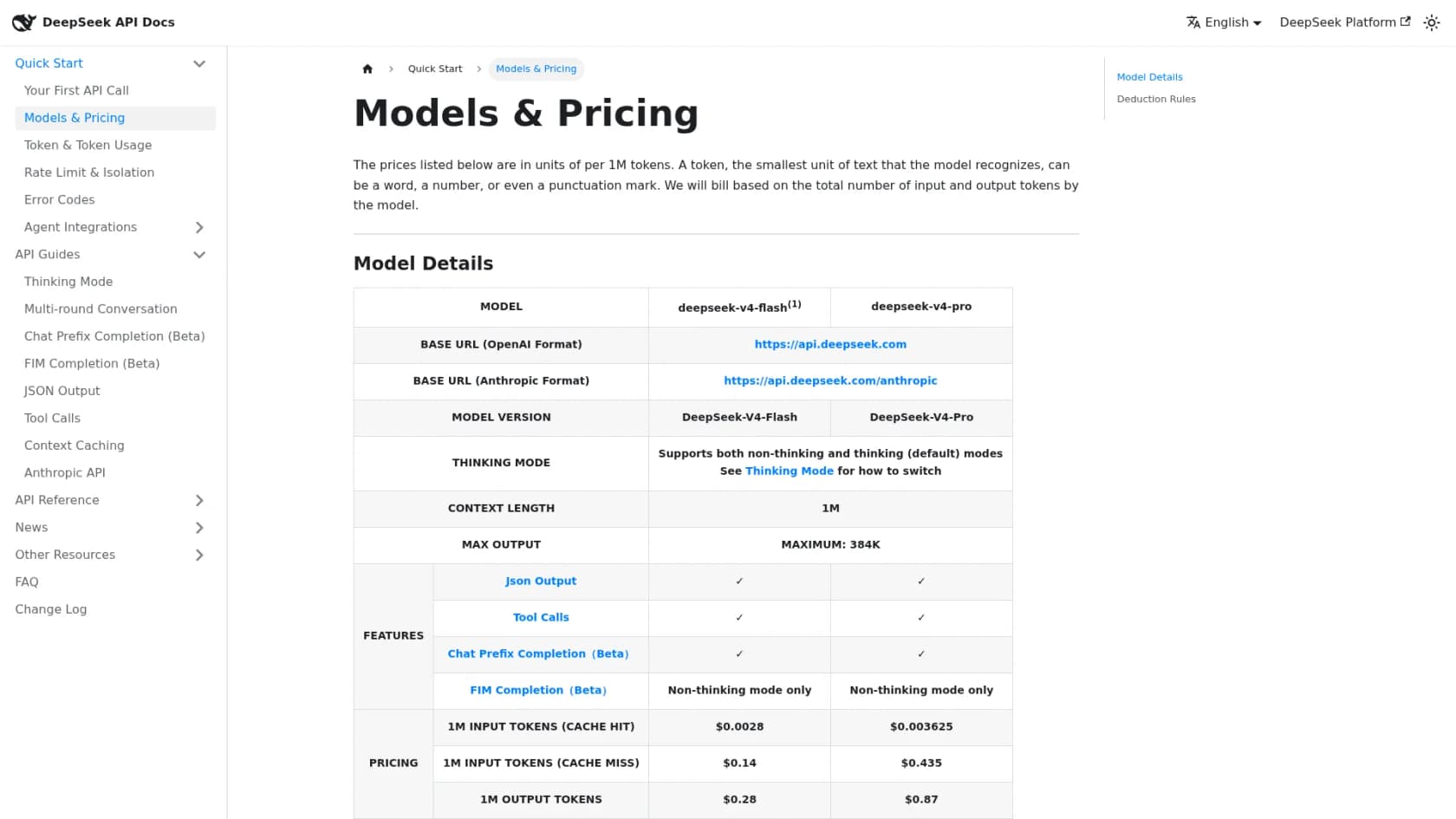
Behind the alias the build is DeepSeek-V4-Flash-0731, and DeepSeek notes the alias auto-tracks the latest build without a calling-method change. In terms of architecture it is a sparse mixture-of-experts model. The vLLM project described it as "a sparse MoE with 256 routed experts and six active per token, a 1M-token context window, and three reasoning-effort levels."
Here is what you get, straight off the card:
| Spec | deepseek-v4-flash | deepseek-v4-pro |
|---|---|---|
| Parameters | 284B total / 13B active | Not published |
| Context window | 1M | 1M |
| Max output | 384K | 384K |
| Thinking mode | Both, thinking is default | Both, thinking is default |
| Tool calls | ✓ | ✓ |
| JSON output | ✓ | ✓ |
| Responses API | ✓ | ✗ until early August 2026 |
| Anthropic API format | ✓ | ✓ |
| Concurrency limit | 2,500 | 500 |
| Input, cache miss | $0.14 | $0.435 |
| Input, cache hit | $0.0028 | $0.003625 |
| Output | $0.28 | $0.87 |
Two Flash-only advantages is worth pulling out of that table. It carries a 2,500 concurrency limit against Pro's 500, and it is also the only model the Responses API supports. Worth to note as well, the context window is identical across both tiers, so the price gap is not a context tradeoff.
The weights are public. DeepSeek ships them under an MIT licence on Hugging Face, which makes fine-tuning into an option that closed models don't offer. Flash lands in the same open-weight bracket as Kimi K3 then, and Alibaba's Qwen3.8-Max.
The cheap tier beat the expensive tier
This is the part people keep on re-reading. Flash's Intelligence Index of 50 is a 10-point jump over the April 2026 Flash release and 6 points ahead of V4 Pro, per Artificial Analysis.
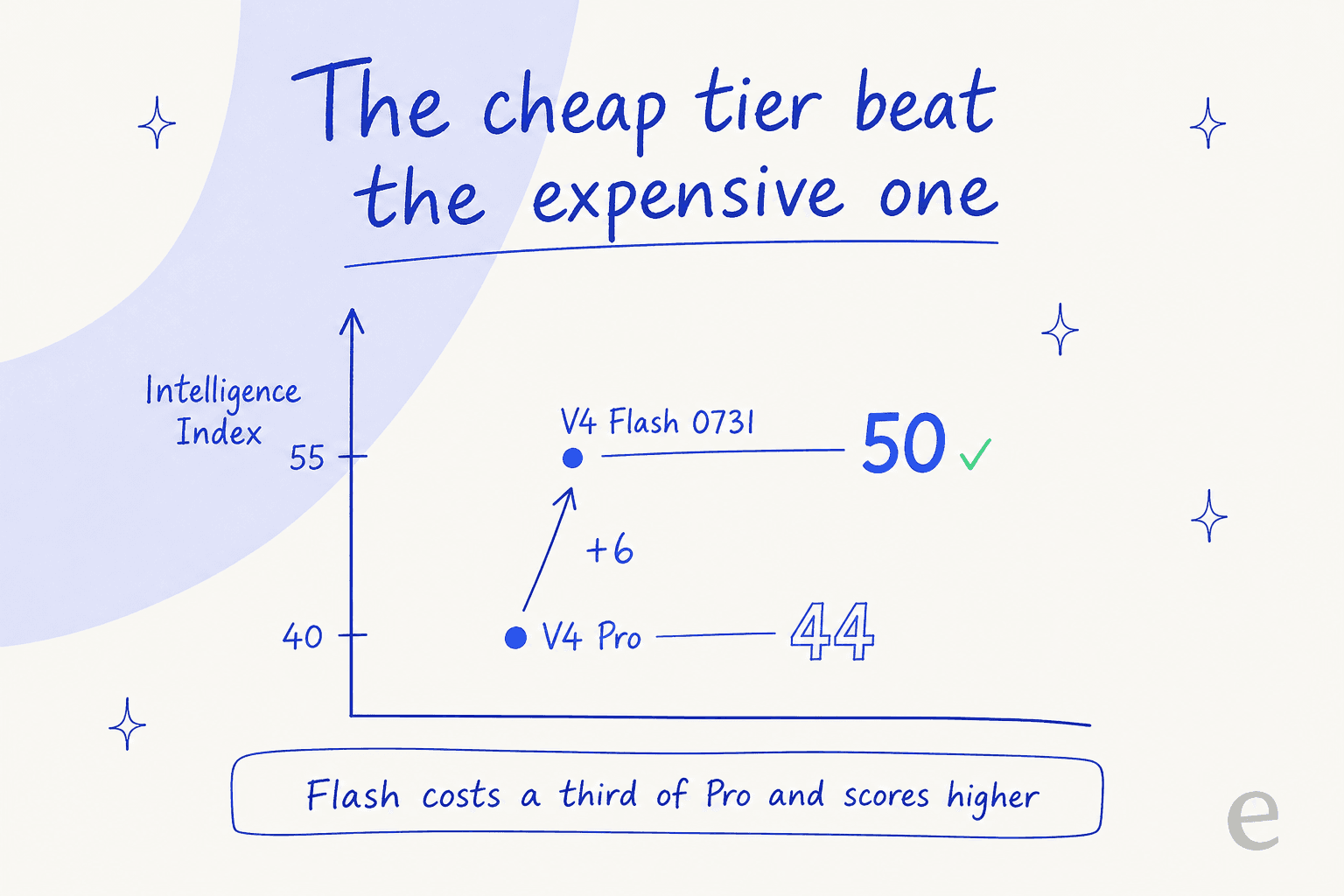
A team who measured it independently gave the clearest explanation for why:
"DeepSeek V4 Flash is the most cost effective model we've tested. We had to really understand why it outperformed DeepSeek V4 Pro (although even on unreliable model cards, Flash was very close to Pro). Pro is slower and smarter in one-shot reasoning problems, but less effective with tools and therefore less performant in long horizon agentic tasks (especially with custom tools it was not trained on)."

That is a useful distinction to have. Pro is the better one-shot reasoner, Flash is the better tool user, and almost every agentic workload is in the end a tool-use workload. If the choice between the two tiers is specifically what you are on, I wrote up the tier decision separately.
Worth to name the caveat too, since the community named it first:
"That said, this is DeepSeek's own benchmark selection, so it's naturally designed to highlight its strengths. The comparison is also almost entirely focused on agentic coding and tool use, not general reasoning or broad knowledge."
And one AI researcher was openly sceptical about the jump. うみゆき@AI研究 pointed out that DeepSWE went from 7.3 to 54.4 on an unchanged 284B-A13B parameter count, and that the previous low score was the thing which exposed benchmark-gaming in the first place. A score-only leap right after an update invites the same suspicion again. That is a fair read, and it is the reason why I would not deploy on leaderboard numbers alone.
What it actually costs you
The token prices are simple. The bill is not, because both DeepSeek V4 models default to thinking mode, and reasoning tokens get billed at the output rate. Plug in your own numbers:
Move the cache slider, and watch how the bill moves more than on any other input. That is not an accident, and it is also the single most misunderstood thing about this model.
The cache cliff is the real pricing story
DeepSeek splits the input pricing into cache-hit and cache-miss rates, and on Flash the gap is $0.0028 against $0.14, a 50x spread. Context caching on disk comes on by default for every account, no code change needed, and this is why so many people quote the cheap number like it was the price.
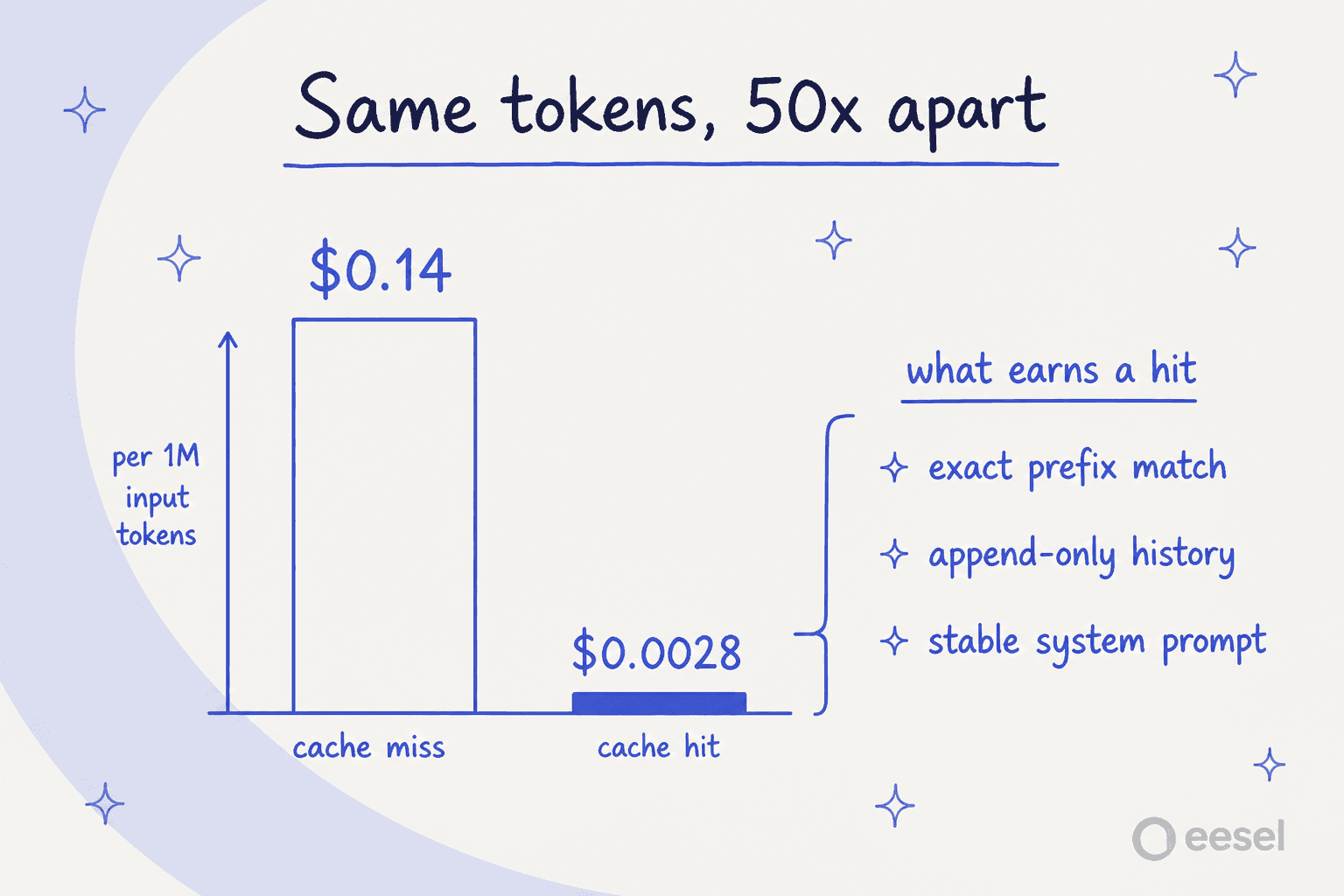
The mechanics is what decides whether you see it:
- A request bills at the hit rate only on a full match with a persisted cache prefix unit. Partial overlap does not count for anything, which DeepSeek attributes to its Sliding Window Attention mechanism.
- Units persist at request boundaries and on common-prefix detection across requests, and also at fixed token intervals when the inputs are long.
- You can audit the split per call. The response
usageblock carriesprompt_cache_hit_tokensandprompt_cache_miss_tokens, so the thing is measurable and not a guess. - Caching is explicitly best-effort, and the entries clear "usually within a few hours to a few days" once they go unused.
Artificial Analysis called that discount out as the structural advantage. Their launch analysis noted Flash's cost per task lands somewhere around 60% below GPT-5.6 Luna at a comparable intelligence, driven by "DeepSeek's ~98% cache hit discount on its first-party API, a significantly more aggressive discount than the 90% cache hit discount offered by most of the industry."
There is a counterweight which has not landed yet. DeepSeek says the API will soon adopt peak/off-peak pricing where the peak-hour prices are 2x regular across all billing items, and the window is published as 9:00 to 12:00 and 14:00 to 18:00 Beijing Time, daily. That is 01:00 to 04:00 and 06:00 to 10:00 UTC. No effective date is set so far, and no peak-rate table is published either. One commenter flagged it early: "in a few days, they'll change their pricing, doubling it during their peak hours [...] It's still cheap, but the price/performance ratio is not that good." If your traffic is synchronous and it lands inside Asian business hours, plan for the surcharge.
It is verbose, and that is where output spend goes
Because the thinking mode is default, a large share of your output bill is reasoning which you never read.
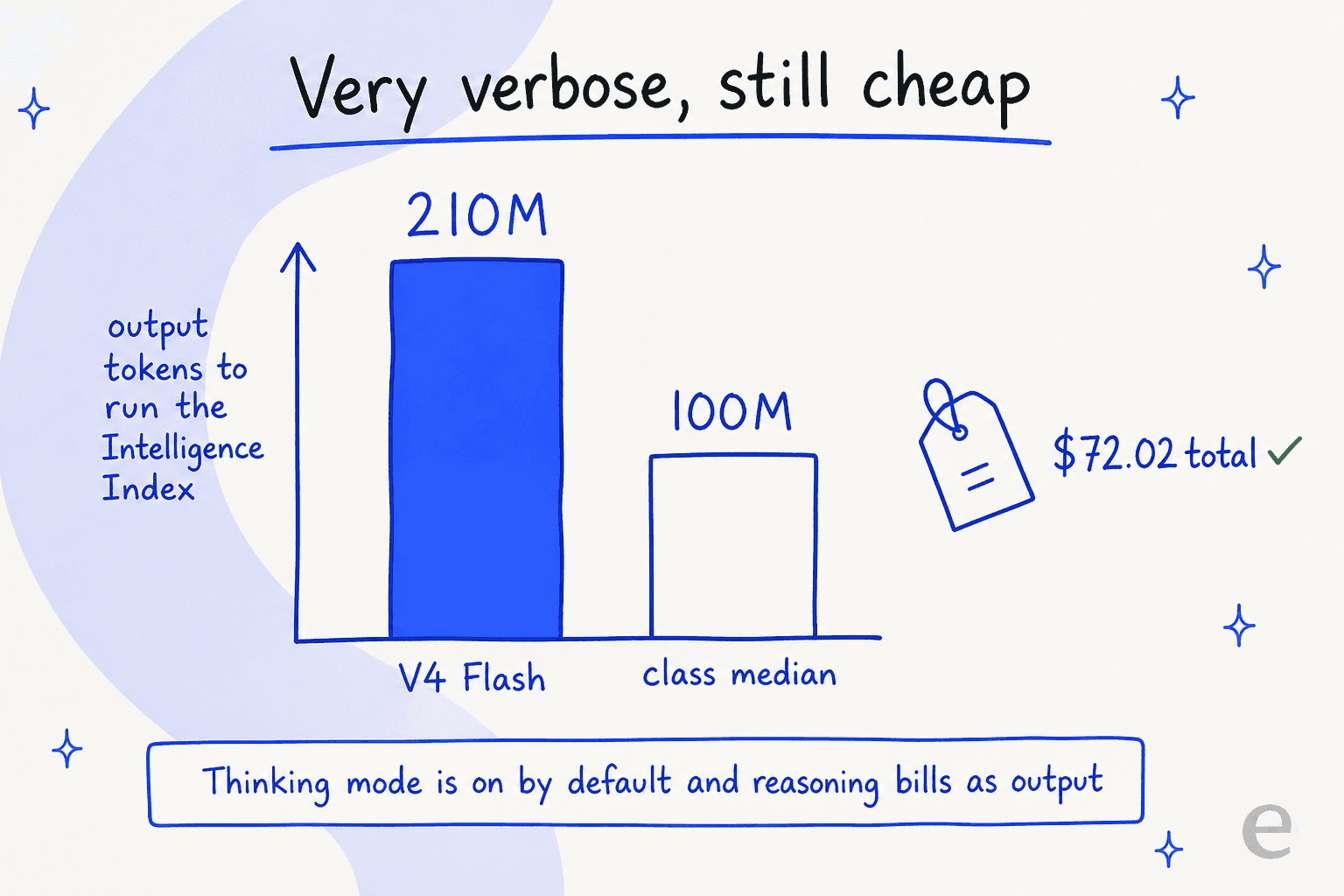
Artificial Analysis publishes a verbosity metric for exactly this, and Flash gets flagged on it. It generated 210M output tokens to complete the Intelligence Index against a class median of 100M, which AA's own page calls "very verbose in comparison." The saving grace here is the token price: 210M tokens still only came to $72.02 to run the whole index. On the same measurement, the token usage fell 12% against the previous Flash release, so it is getting less chatty and not more.
Practical read: if the comparison you are making is Flash against a Western model on sticker price, compare the cost per task instead. One HN commenter did the arithmetic properly against OpenAI's discounted tier and concluded that a fair statement is "OpenAI Luna between 2x and 3x the price of Deepseek Flash, what you get is 2 to 5 times faster inference." Speed is a real cost too, when a human is sitting there waiting. For the full head-to-head on that pairing there is a GPT-5.6 pricing breakdown, and Claude Opus 5 pricing sits on the premium end of the same axis.
The real spend receipts
The most useful data in the whole launch reaction was people who posted their actual dashboards, unprompted:
"I use deepseek for a lot of my personal day-to-day agent needs, and I will simply put this here and let this speak for itself, last 30 days:
Cost: $4.55USDAPI requests: 3,467Tokens: 323,183,886 And as an engineer who leads a small team, I have very high standards for quality, and these carry across to my personal projects where I use deepseek."
A second user went considerably harder, and was honest about why the number is a flattering one:
"Those are rookie numbers. Last 13 days including today, so effectively 12 days of usage:
$19.27 USDAPI requests: 7,877Tokens: 2,116,598,952 Ok this is a bit of lie, a lot of my tasks are very experimental loops whose 99% output is like rubbish and can work forever continuously and take advantage of that 120x cheaper input cache. Still incredible."
That caveat is the honest version of the cache story. Repetitive agent loops with a stable prefix will hit the cache constantly. Varied, one-off traffic does not. A third user put the per-session number at roughly $0.50 for a 30-turn agent session, and said they have not touched their Opus subscription in weeks.
Where it falls down
The complaints are specific and they repeat, and they matter more than the benchmarks do if you are putting this anywhere near a customer.
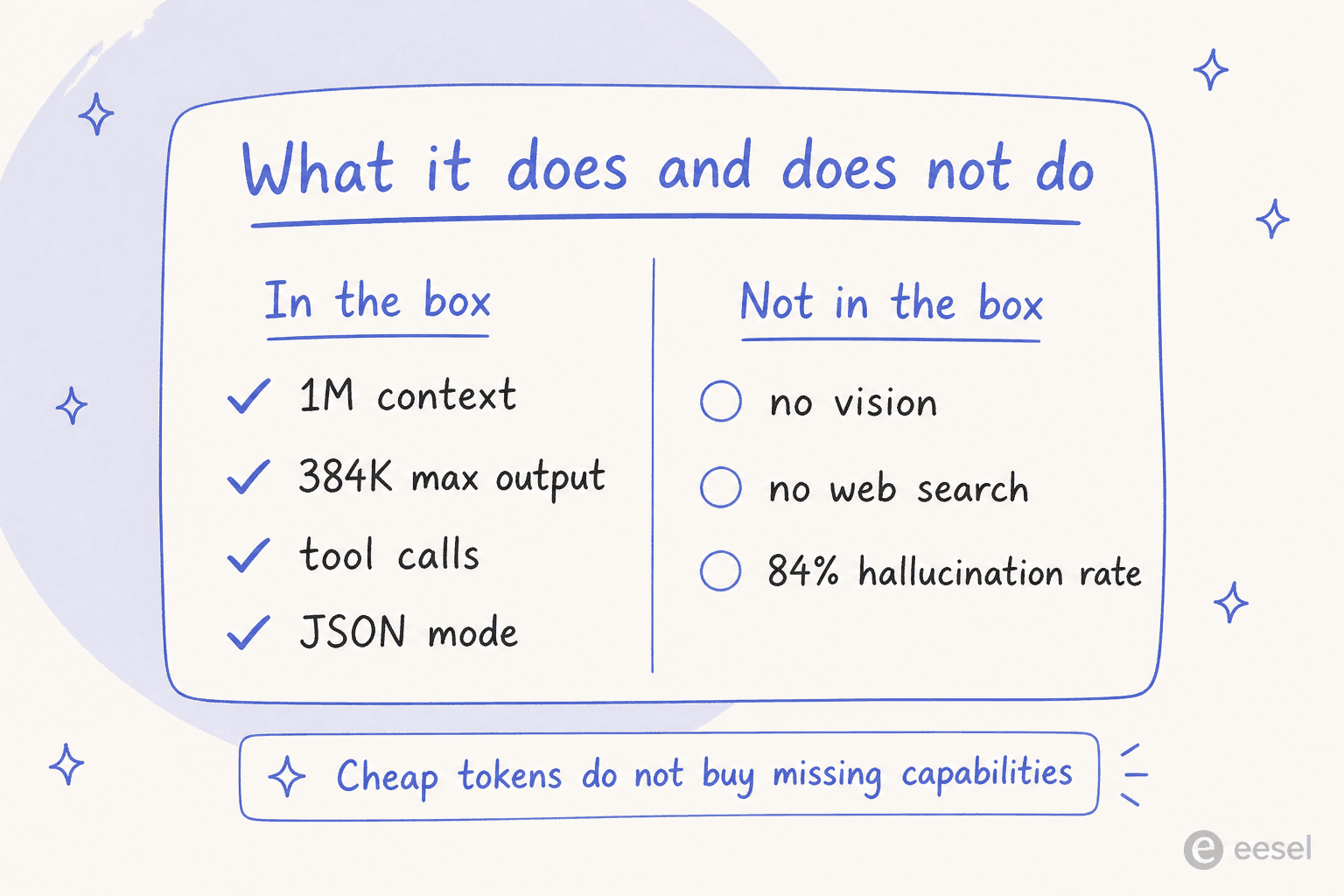
It hallucinates, and it drops context.
"DeepSeek V4 hallucinates like crazy and often forgets explicitly mentioned parts of the context. I guess compressing tokens and cherry-picking attention comes at a cost."
The heaviest user inside that thread confirmed it while calibrating it against peers: "It hallucinates plenty, about the same as Codex models and all other LLMs! I review all code it writes, thoroughly." That review step is the actual cost, and it does not appear on the price card. If you have not read up on AI hallucinations yet, the hallucination glossary entry is a shorter version.
No vision, no web search. Flash is text-only, so a multimodal path is not there. One team wired around it by routing the image work to a different model and calling a separate CLI for the search. That works, but it also means the cheap model is not actually your whole stack.
Long-horizon work in large codebases is the soft spot, which is the exact opposite from the agentic pitch. p1necone put it plainly: DeepSeek V4 is weak "at long running work in large codebases, but really really good at self contained algorithmic/math reasoning."
Billing can surprise you through a reseller. One user reported a $50 burn in under an hour through OpenRouter with a Pi agent, where the agent's own accounting was claiming about $1. Whatever the cause was, the lesson is to meter the spend at the provider and not in the harness.
The version naming will bite anyone who cites benchmarks. PhilippGille flagged it: DeepSeek calls it deepseek-v4-flash while OpenRouter is calling it deepseek/deepseek-v4-flash-0731, "so now when someone talks about DeepSeek V4 Flash, like in benchmarks, or other inference providers, which version do they actually mean?"
The data question
This is the objection which comes up more than quality does, and the honest answer requires to read three separate documents.
DeepSeek's general Terms of Use §4.3 permits the use of inputs and outputs "to a minimal extent" to improve the services, after "strict de-identification," and there is an opt-out through a toggle called "Improve the model for everyone." Its §1.1 scope covers APIs explicitly.
The API-specific agreement is a different thing. The Open Platform Terms of Service has an "Inputs and Outputs" section which runs to §4.1 and §4.2 and then it just stops. There is no §4.3 training clause in the API terms at all, so as of 2026-08-04 no DeepSeek document states either way whether API traffic specifically is used for training. No API-specific opt-out mechanism, no published enterprise data-processing addendum, no zero-retention option either, none of it appears anywhere across the three policies. The storage jurisdiction is stated as the People's Republic of China.
Silence is not the same thing as a denial, and it is not the same as a confirmation either. The community reads it as the former:
"The model is fantastic. And costs almost nothing. The only problem I see is that they will train on your data. There are zero-data-retention providers of DeepSeek models, of which I have used openrouter (with zdr guardrails), and fireworks. But these are 3x to 5x more expensive than directly using DeepSeek, possibly due to poor caching. Thats the price to pay for zdr."
That is the trade, in one paragraph. The headline price assumes the first-party API. Route through a zero-retention provider instead and the cost advantage narrows sharply. Anyone who lived through the Slack AI training policy fight already knows the feeling of discovering a default after the fact, and if you are weighing at all what goes into a model, support AI training data is the one to read next. On the compliance side, SOC 2 and GDPR covers it.
Running the weights yourself
MIT weights at 284B total and 13B active puts self-hosting into the expensive-prosumer bracket rather than the datacentre one. The reports on it are unusually well documented.
Dual DGX Spark is the consensus sweet spot, and one user went and measured it:
"2 sparks currently run this model at 60 t/s single session, up to just over 100 t/s aggregate with concurrency of 4. Going local has as opened up a world of use-cases I never would have entertained the idea of on metered/cloud usage. [...] Cached input tokens on local inference are free, so I don't care about running sessions up to 500k tokens and hundreds of turns."
Tepix priced out the alternatives: roughly €8,200 for dual Sparks today, against about €12,000 for a 256GB Mac Studio M3 Ultra which is both slower and dearer, and then more than $22,000 for a 2x RTX Pro 6000 server. Over on Apple Silicon, one run reported ~30 tok/s of single-request decode on an M3 Ultra 256GB. And on AMD Strix Halo, a mixed-quant profile hit 32 tok/s at ~2.88 bits per parameter.
The economics still favours the API for most people, and the local crowd says it themselves. cmrdporcupine: a dual-Spark box "makes little to no sense as long as API prices are what they are. Except for maybe privacy reasons." Privacy is exactly the reason, which loops us back to the section above. If the open weights are the draw, the best open-source AI agents roundup covers what people build on top of them, and custom AI models covers whether you need to at all.
Should this model answer a customer ticket?
Here is where I have to separate out two questions which get merged constantly. "Is DeepSeek V4 Flash a good model" and "should DeepSeek V4 Flash answer your customers" are two questions with different answers.
An 84% hallucination rate on AA-Omniscience is a real number, and yes, it improved by 12 points. Still not a number which belongs in front of a paying customer without a gate sitting in front of it. And a leaderboard score, however carefully it was measured, tells you nothing about what happens on your own tickets and in your product vocabulary, with all your edge cases.
A CX lead we spoke with put the operational version of this better than any benchmark page could do:
"The AI will never be able to answer 100% of the questions, but if it tries and just answers 'sorry I don't know this,' I cannot go and check all my 7,000 tickets to see if the AI actually made a good answer, then the point is a little bit gone. I need an AI who is only handling the tickets that it's confident to handle and all the other ones, leave them alone."
That is a CX lead at a DTC supplements brand on Gorgias and Shopify, running roughly 7,000 tickets and 30,000 orders a month. What he needed was not any higher score. He needed the model to know when to stay out of the way, and that is a confidence score problem rather than a model-selection one. The mechanism for it is guardrails.
I will name our own worst version of this failure, since it is the reason we built what we built. The nastiest pattern we have observed in production is an agent narrating "executing Zendesk searches" for around ten turns without ever hitting the API, while it reports files saved that do not exist. Fabricated metrics too. Nothing kills the trust in a teammate faster than lying about what it did. That is not a DeepSeek problem, it is what any capable model does when nothing is checking its work.
The layer which fixes it is grounding, plus a rehearsal. RAG ties every answer back to verified knowledge instead of model memory, and that is the short argument for why you never put a raw model in front of a customer.
Then you test it against the reality before go-live and not after, which is the adversarial testing discipline. RAG vs LLM covers the tradeoff if the decision between those two is where you are.
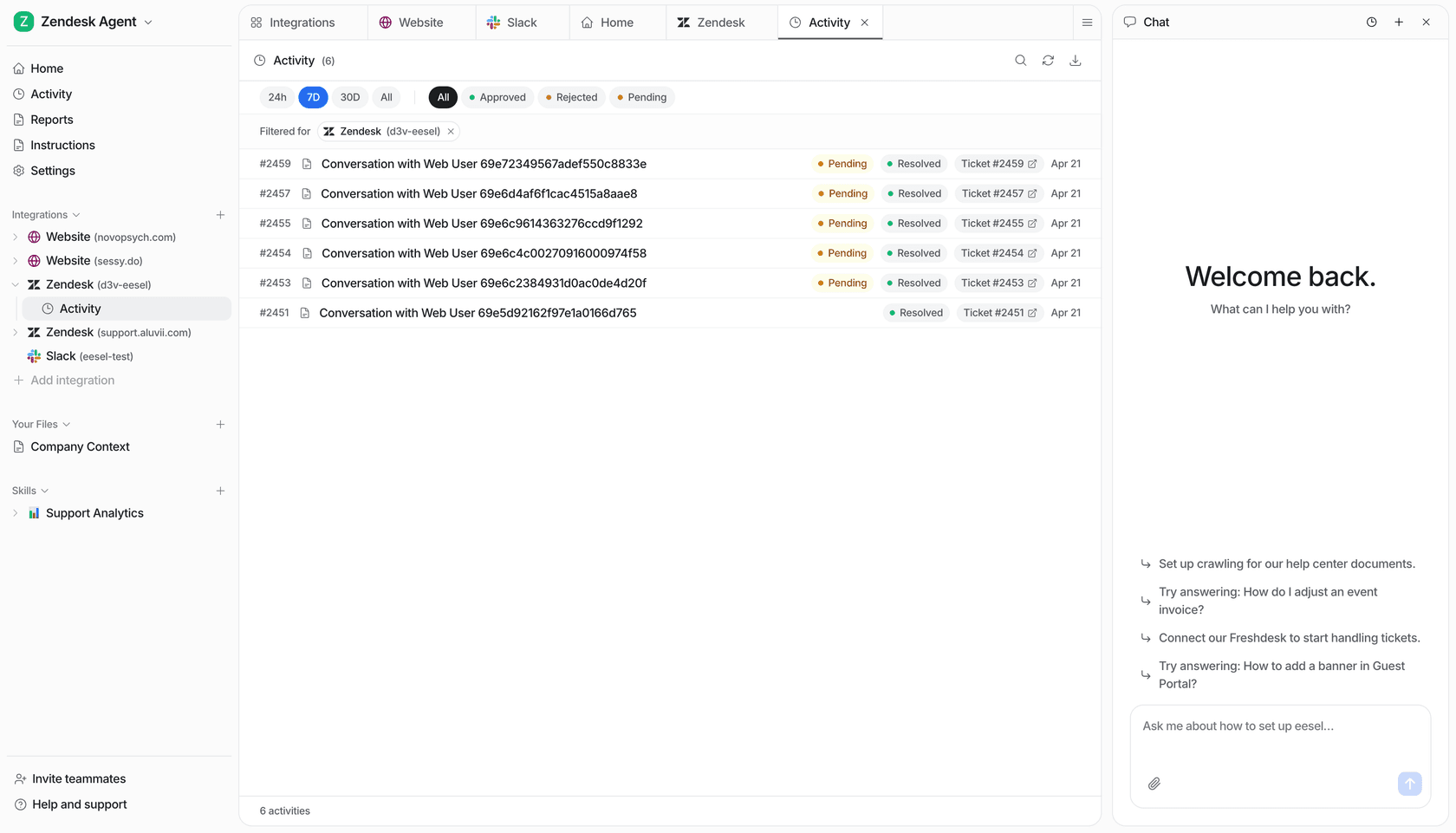
That is the part of the job eesel does. It grounds every reply in your verified knowledge, so help centre articles, past tickets, macros and connected docs, and then it runs simulations on your real past tickets, so you see the accuracy on your own data before anything reaches a customer. You deploy it when it clears your bar, not when a leaderboard clears someone else's. It plugs into Zendesk and the rest of your stack in minutes.
It bills 40¢ per ticket handled with no seat fees at all, so you are never charged for the tickets your humans take. Route only a slice first if you like: 1,000 tickets a month, send 200 of them to the AI, pay $80. There is $50 of free usage with no credit card, and the simulations run before any spend happens. Our security posture page covers the data questions which the DeepSeek policies leave open, and the enterprise plan covers the rest.
The reframe which matters for anyone who is comparing token prices: the unit that decides your budget is cost per ticket, not cost per million tokens. Cost per resolution does that arithmetic properly, and AI customer service cost covers what teams are actually paying in 2026.
How it compares to the rest of the field
Quick orientation, since Flash gets usually shopped against three other models:
| Model | Input / output per 1M | Intelligence Index | Notes |
|---|---|---|---|
| DeepSeek V4 Flash | $0.14 / $0.28 | 50 | Open weights, text-only, 1M context |
| DeepSeek V4 Pro | $0.435 / $0.87 | 44 | Better one-shot reasoner, worse tool user |
| Kimi K3 | $3 / $15 | 57 | Top open-weights score, ~100x the output rate |
| Qwen3.8-Max | $2 / $6 | Not yet scored by AA | Multimodal, 2.4T params, GA 2026-08-02 |
The Qwen comparison is the sharpest one right now. An AI researcher laid the DeepSWE scores out side by side on Qwen's GA day: Qwen3.8-Max at 56.6 against Flash's 54.4. Two benchmark points apart, roughly 14x and 21x apart on price. Qwen's edge is a real one, and the edge is multimodality, not raw text quality. The full Qwen3.8-Max vs Flash comparison goes deeper on it, and Kimi K3 alternatives covers the open-weights field.
One local-versus-local data point which is worth to have, from 3abiton: quantized Qwen3.6 at both 35B and 27B and a Flash quant "all performed within the same tier, DS4 being a bit more efficient." At the small end, the gap closes.
FAQs
What is DeepSeek V4 Flash? It is the cheaper of DeepSeek's two V4-generation models, a 284B-parameter sparse MoE with 13B active parameters, a 1M context window, and MIT-licensed open weights. Thinking mode is on by default, and tool calls plus JSON output are supported. It is a large language model aimed squarely at coding agents and tool use rather than at general chat, and DeepSeek V3.2 is the previous generation if the trajectory is what you want.
How much does DeepSeek V4 Flash cost? $0.14 per million input tokens on a cache miss, $0.0028 on a cache hit, and $0.28 per million output tokens, all of it from DeepSeek's own price card. The announced-but-not-live peak-hour pricing would double all three inside two daily windows. Because reasoning tokens bill at the output rate, your real DeepSeek V4 Flash pricing depends heavily on the verbosity and on cache behaviour, which is the thing the calculator above is for.
Is DeepSeek V4 Flash better than V4 Pro? On the Artificial Analysis Intelligence Index, yes: 50 against 44, and at roughly a third of the price. Pro is still the stronger one-shot reasoner. Flash is the stronger tool user, and this is why it wins on agentic work. The tier comparison walks through which one fits which workload.
Does DeepSeek train on API data? DeepSeek's API-specific terms are silent on it. The general Terms of Use permit training on inputs with an in-product opt-out, and the API agreement does not repeat that clause, and it does not exclude it either. There is no API-specific opt-out published, no enterprise addendum, no zero-retention option. Data gets stored in China. If that matters to you, zero-retention resellers exist at 3x to 5x the first-party price, or else read build vs buy before wiring a raw API into anything customer-facing.
Can DeepSeek V4 Flash handle customer support tickets? Not on its own, and not because it is a weak model either. Its published hallucination rate is 84%, there is no web search, and about your product it knows nothing at all unless you supply it. Wrapped inside RAG with a confidence threshold and a human in the loop, any capable model can work. Start with setting confidence thresholds.
Can I run DeepSeek V4 Flash locally? Yes. The weights are MIT on Hugging Face and GGUF quants exist for it. Dual DGX Spark at roughly €8,200 is the reported sweet spot, at 60 tok/s single-session. An M3 Ultra 256GB gets you about 30 tok/s. Most people who did the maths concluded that the API is cheaper, unless privacy is the driver.
What are the best DeepSeek V4 Flash alternatives? Kimi K3 if you want the highest open-weights score and you can absorb $3/$15. Qwen3.8-Max in the case that multimodality is needed. Claude Sonnet 5 if a Western provider with published data terms is what you want. And Mistral is the European open-weight option.
How do I call the DeepSeek V4 Flash API?
Base URL https://api.deepseek.com in OpenAI format, or else https://api.deepseek.com/anthropic for the Anthropic format, passing deepseek-v4-flash as the model string. DeepSeek documents itself as a drop-in backend for Claude Code and GitHub Copilot, and OpenCode as well, with no code changes. If SDKs is what you are comparing, the three-way API guide walks it through.
The verdict
DeepSeek V4 Flash is the best intelligence-per-dollar on the market right now, and the inversion against its own Pro tier is not some marketing trick. If what you run is coding agents, batch summarisation, code review, or any repetitive loop with a stable prefix, the receipts in this post are real ones and the savings are large.
Three things to hold onto here. The cheap number assumes a cache hit you cannot guarantee. The peak-hour doubling is announced, with no date on it. And the API terms say nothing at all about whether your traffic trains the model, which makes it a decision you have to take rather than a box you can check.
For anything customer-facing, the model is the easy part. Pick whichever one you like, and then spend your effort on the grounding and the confidence gate, plus the rehearsal against your own history. That is the work which decides whether a cheap model saves you money or it costs you a customer. You can try eesel free and simulate against your own tickets before you spend anything.


Article by
Rama Adi Nugraha
Rama is a software engineer at eesel AI with two years of experience writing about B2B SaaS, AI tools, and customer support technology. Based in Bali, Indonesia, he brings a developer's perspective to product comparisons — cutting through marketing copy to what the integrations and APIs actually do.