


Why people are looking past Kimi K3
Let me be fair to K3 first, because the switching case only makes sense once you see what's genuinely good about it.
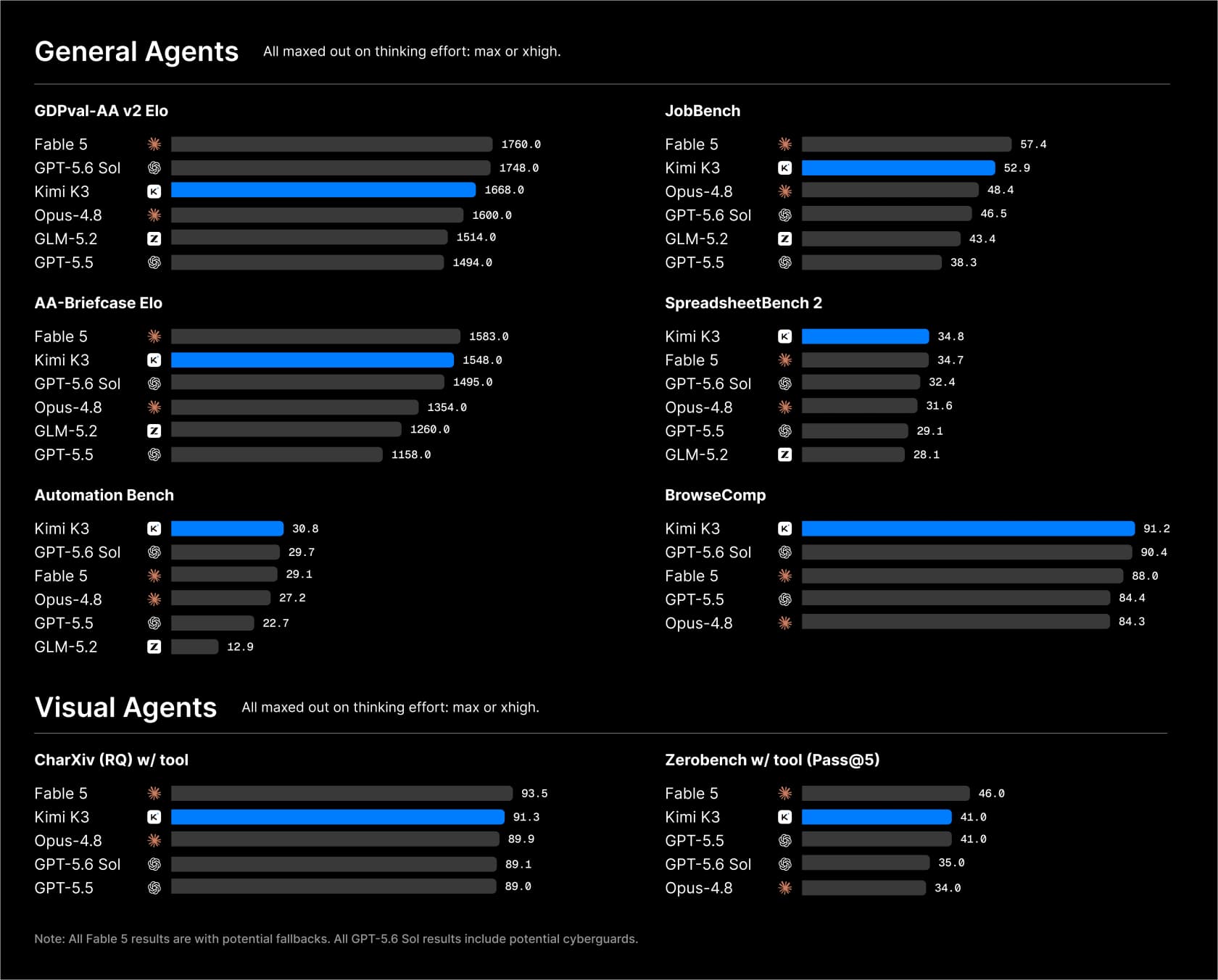
Kimi K3 is the first open model to reach the 3-trillion-parameter class, and on Moonshot's own launch benchmarks it beats Claude Opus 4.8 and GPT-5.5 on most tests, landing just under the very top two. It leads the pack on BrowseComp (91.2) and edges ahead on agentic evals like Automation Bench and SpreadsheetBench. The demos were startling: in one 48-hour autonomous run it designed a chip, and in another it wrote a Triton-like GPU compiler from scratch. For the full breakdown of what it is and how it works, see my Kimi K3 explainer. This is not a catch-up release.
So the reasons to look elsewhere aren't about quality. They're about fit and cost.
It's not cheap anymore. The story that "Kimi is the ultra-cheap Chinese frontier model" was written by Kimi K2. K3 priced up to $3 / $15, level with Claude Sonnet. Simon Willison put it bluntly after running his usual test:
"The new model is notable for the pricing: $3/million input tokens and $15/million output tokens, putting it at the same level as Anthropic's Claude Sonnet series [...] This is expensive - the pelican cost 25 cents!"
The weights are late. K3 is pitched as "the world's first open 3T-class model," but at launch it was API-only. Moonshot says the full weights ship by July 27, 2026. If you need something to self-host today, that's a real gap, and it's exactly where the open alternatives win.
Reasoning is always on, at max. K3 always reasons, and reasoning_effort currently supports only max. There's no cheaper non-thinking SKU, so you can't dial it down for simple calls. Pair that with a running community complaint that K3 burns more tokens than Fable to finish the same task, and the effective cost climbs above the sticker.
It's text-only. K3 accepts images in but only writes text out, and has no built-in web grounding. For multimodal or search-grounded work, the kind of thing a modern AI chatbot leans on, Gemini and MiniMax do things K3 structurally can't.
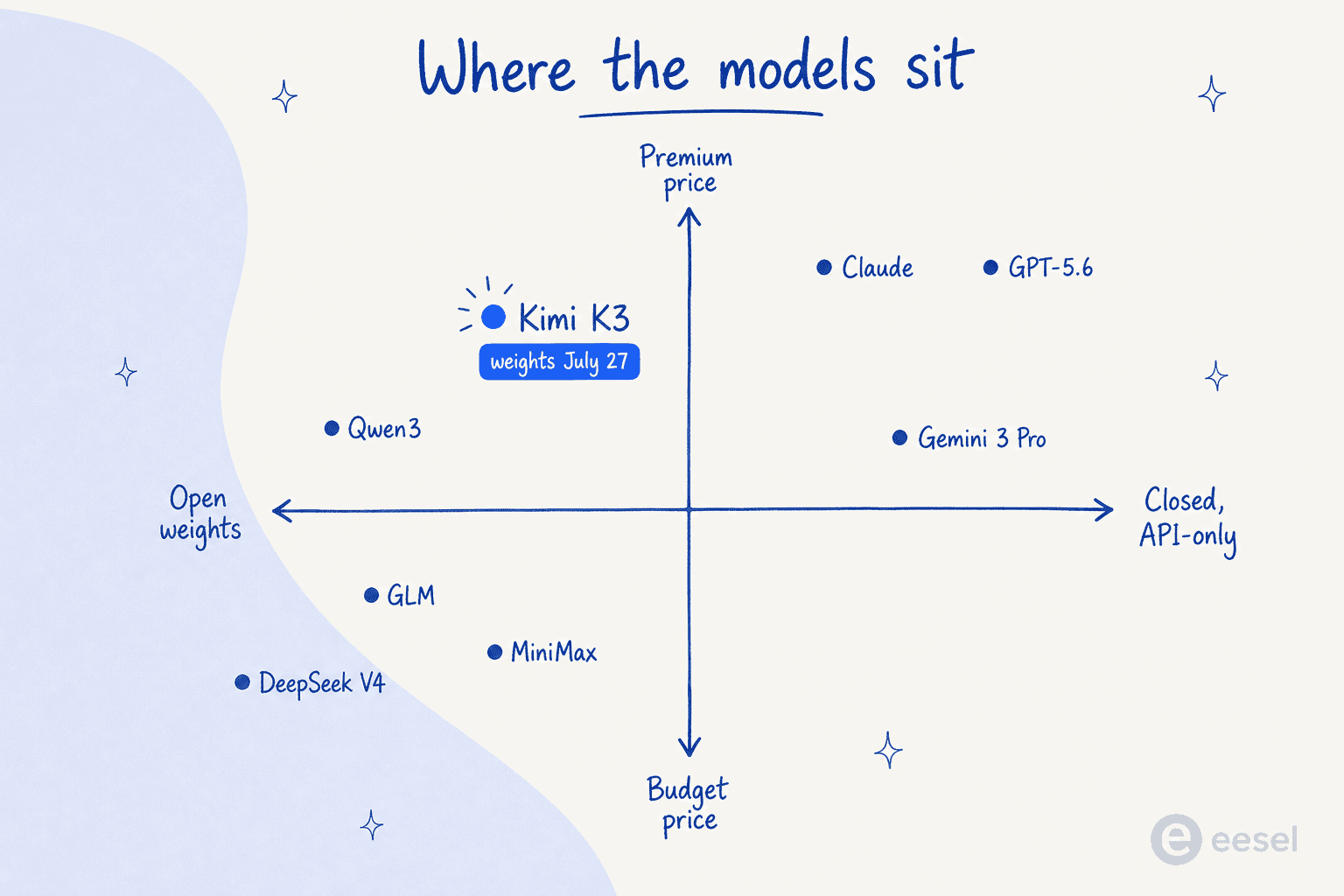
Here's how the field lines up once you plot price against openness.
How I picked these
I build with these APIs, so this roundup leans on what the vendors' own pricing and docs pages actually say, read the week of K3's launch, not on a marketing chart. Every price below is per million tokens and pulled from the model maker's own page. Where a version, license, or context window couldn't be confirmed on a first-party page, I say so rather than guess. The ranking is opinionated but the numbers are yours to check, and if you want to keep watching how these models shift, our LLM tracking tools roundup covers that.
The best Kimi K3 alternatives at a glance
| Model | Maker | Open weights? | Input / Output (per 1M) | Context | Best for |
|---|---|---|---|---|---|
| Kimi K3 (baseline) | Moonshot AI | Weights July 27 | $3.00 / $15.00 | 1M | Open frontier agentic coding |
| DeepSeek V4 | DeepSeek | Historically yes | $0.14 / $0.28 (Flash) | 1M | Lowest cost, budget frontier |
| GLM-5.2 | Zhipu / Z.ai | Yes (MIT) | $1.40 / $4.40 | 1M | Open coding you can run today |
| MiniMax M3 | MiniMax | Yes | $0.30 / $1.20 (promo) | 1M | Cheap open multimodal + long runs |
| Qwen3.7-Max | Alibaba | No (Max tier) | $2.50 / $7.50 | 1M | Alibaba's agentic tuning |
| Claude Fable 5 / Opus 4.8 | Anthropic | No | $10 / $50 · $5 / $25 | Large | Reliability ceiling |
| GPT-5.6 Sol | OpenAI | No | $5.00 / $30.00 | Large | Deepest ecosystem |
| Gemini 3.1 Pro | No | $2.00 / $12.00 | Large multimodal | Cheap multimodal + web grounding | |
| Llama 4 | Meta | Yes (Community) | Partner-hosted | Up to 10M (Scout) | Mature open ecosystem |
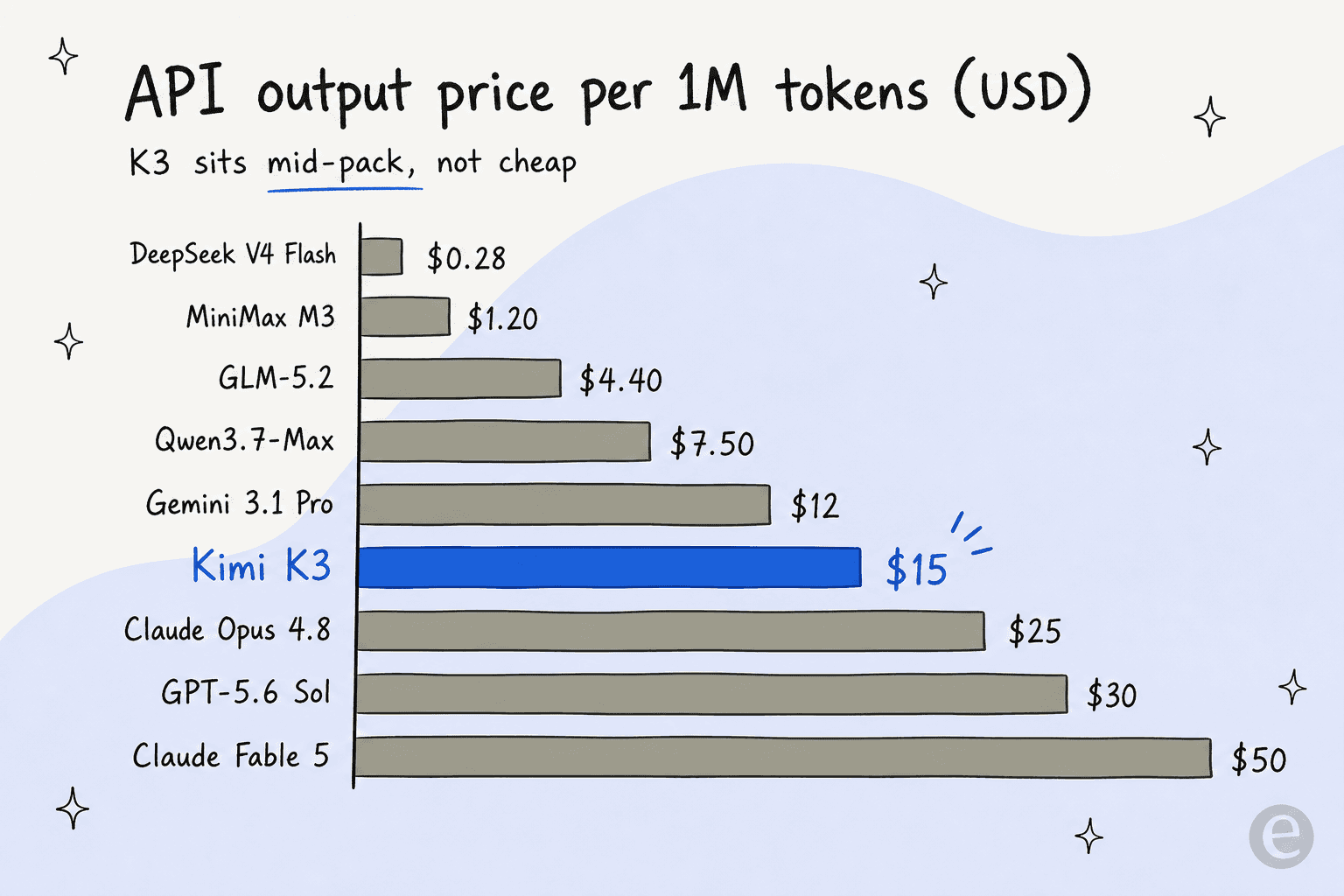
Two things jump out of that table. First, K3 sits in the middle of the price ladder, not the bottom. Second, the models that undercut it on price are mostly the open-weight ones. Here's the output price laid out end to end.
Now the eight, in the order I'd actually consider them.
1. DeepSeek V4
Best for: the lowest possible bill on frontier-tier reasoning.
If your reason for leaving K3 is cost, stop here first. DeepSeek's V4 line is the cheapest genuinely-capable model on this list by a wide margin. DeepSeek V4-Flash is $0.14 input and $0.28 output per million tokens, per DeepSeek's pricing, with a cache-hit input rate near a quarter of a cent. The bigger V4-Pro is $0.435 / $0.87. Both carry a 1M-token context window and a thinking mode that's on by default, so you're not giving up reasoning to get the price. It shows up strong in most AI coding tool roundups for exactly this reason.
Put that next to K3: $0.28 versus $15 on output is roughly 50x. For high-volume workloads where most of the input is cached, DeepSeek is in a different universe on cost.
DeepSeek has historically shipped its models as open weights on Hugging Face under permissive licensing, which is a large part of its appeal. I couldn't confirm a first-party license page for V4 specifically the week of writing, so if self-hosting V4 is the deciding factor, verify the current license before you commit.
Verdict: the default budget pick. If you're switching off K3 to cut spend and you don't need the absolute top of the quality charts, DeepSeek V4 is the one to try first.
2. GLM-5.2
Best for: open-weight coding agents you can download and run today.
This is the alternative that most directly answers K3's biggest weakness. GLM-5.2 from Zhipu AI (which ships under the Z.ai brand) is a ~753B-parameter mixture-of-experts model, and unlike K3, its full weights are on Hugging Face right now under an MIT license. Free to download, fine-tune, self-host, and use commercially, with no July 27 wait.
It's also cheaper on the API: $1.40 input and $4.40 output per million, per the Z.ai docs, against K3's $3 / $15, with the same 1M context. Zhipu positions it as a coding-and-agents model and announced a 46.2% score on DeepSWE, which would make it one of the strongest open coding models around. On Moonshot's own launch charts GLM-5.2 shows up as a credible mid-tier agentic performer, sitting behind the very top models but well inside the frontier conversation, and a natural fit for building AI agents on your own hardware.
Verdict: if "open weights, available now, strong at code" is your checklist, GLM-5.2 beats K3 on every line of it and costs less. My first recommendation for anyone who wanted K3 because it was supposed to be open.
3. MiniMax M3
Best for: the cheapest open, natively multimodal model with proven long-horizon stamina.
MiniMax M3 is the value-and-openness sweet spot. It's an open-weight model with a 1M-token context (guaranteed 512K minimum), and crucially it's natively multimodal, which text-only K3 is not. Pricing is $0.60 / $2.40 pay-as-you-go on its pricing page, and there's a standing 50%-off rate that lands it at $0.30 / $1.20, one of the lowest on this list.
The pitch MiniMax leans on is long-horizon agent stability: its launch demo showed the model running autonomously for about 12 hours, producing 18 commits while reproducing an academic paper. That's the exact "days-long agent run" territory K3 and Fable 5 target, at a fraction of the token cost.
Verdict: the best pick if you want open weights and multimodality and a small bill. It's doing the same long-agent job as K3 for pennies on the dollar.
4. Qwen3.7-Max
Best for: teams that want Alibaba's agentic tuning and don't need open weights.
Qwen3.7-Max is Alibaba's flagship, and it's a close price-and-capability neighbor to K3 rather than a budget play. It runs $2.50 input and $7.50 output per million on the Qwen Cloud pricing page (with a limited-time 50%-off promo halving that), carries a 1M context, and is tuned squarely for agent-centric work: programming, office tasks, and long-horizon autonomous execution.
The catch for open-weight shoppers: the Max tier is closed and API-only. Smaller models in the Qwen3 family are open-weight, but the flagship you'd compare to K3 is not something you can self-host. So Qwen3.7-Max is best read as a K3-alternative on capability and agentic focus, not as an "open like K3 was supposed to be" swap. If you're weighing the wider family, our Qwen alternatives and Qwen pricing guides go deeper.
Verdict: a solid sidestep if you like Alibaba's agent tuning and the ~$2.50/$7.50 band works for you. Not the one to pick if open weights were the whole point.
5. Claude (Fable 5 and Opus 4.8)
Best for: the reliability ceiling on agentic and coding work, when getting it right matters more than the bill.
Anthropic's Claude is where you go when correctness beats cost. Claude Fable 5 is the top long-agentic model, tuned for days-long autonomous runs, and Opus 4.8 sits just below it. On Moonshot's own charts, Fable 5 is the model K3 most often trails, and on real coding work the community read is that K3 approaches Fable rather than passing it.
"I've been playing around with it for the past few hours [...] I'm not sure I could tell the difference between this and Fable in a blind test."
You pay for that ceiling. Fable 5 is $10 input / $50 output per million on Anthropic's pricing page, and Opus 4.8 is $5 / $25, both well above K3's $3 / $15. Claude is fully closed, so there's no self-hosting. If you want the details on how it compares head to head, our ChatGPT vs Claude breakdown and our Claude alternatives roundup both help.
Verdict: the quality-first choice. Pick Claude when a wrong answer costs you more than the extra dollars, especially for long, multi-step agent tasks.
Here's how K3 actually stacks up against Claude, GPT, and GLM on the agent benchmarks Moonshot published, so you can see where the gaps are before you pay the premium.
6. GPT-5.6 Sol
Best for: the deepest ecosystem and the broadest third-party tooling.
OpenAI's GPT-5.6 Sol is the all-rounder. It's a frontier reasoning-and-coding model, and its real edge over K3 isn't a benchmark line, it's the ecosystem: the widest set of SDKs, integrations, and third-party tools of anything here. If your stack already speaks OpenAI, Sol is the least-friction upgrade.
Pricing is $5 input / $30 output per million on the standard tier, per the OpenAI docs, with a batch tier at $2.50 / $15 for non-urgent work. That's above K3, and Sol is closed (OpenAI's open-weight gpt-oss models are a separate thing). On Moonshot's charts, K3 and GPT-5.6 Sol trade wins depending on the eval, so this is a tooling-and-ecosystem decision more than a raw-capability one. Our ChatGPT vs Gemini and ChatGPT vs Mistral guides are useful if those are your finalists.
Verdict: pick Sol for breadth of integration and a mature platform, not to save money. If ecosystem is your bottleneck, it's worth the premium over K3.
7. Gemini 3.1 Pro
Best for: cheap large-context multimodal work with built-in web grounding.
Google's Gemini 3.1 Pro is the value multimodal pick. Its input price actually undercuts K3: $2 per million input for prompts up to 200k tokens and $12 output, per Google's pricing, rising to $4 / $18 above that threshold. Where it pulls ahead of text-only K3 is native multimodality plus first-class Google Search and Maps grounding, which is a real advantage for RAG-style agents that need fresh, cited facts.
It's closed (Google's open family is Gemma, separate), so no self-hosting. But if your workload is multimodal or grounding-heavy and you're price-sensitive, Gemini does things K3 structurally can't, for less.
Verdict: the best cheap multimodal alternative. If you were only using K3 for text reasoning and you also need images or web grounding, Gemini is a straight upgrade on capability and often on price.
8. Meta Llama 4
Best for: the largest open ecosystem and a huge context window, if you can live with an older model.
I'm including Meta's Llama 4 with a clear caveat. It's the most widely-deployed open family in the world, its tooling is everywhere, and the Scout variant shipped with up to a 10M-token context, the largest of any open-weight model at release. If your priority is a mature open ecosystem and enormous context, it still earns a place.
The caveat: Llama 4 landed in April 2025, which makes it roughly 15 months old, and Meta hasn't shipped a newer open Llama since. Its 2026 flagship, Muse Spark, is closed-weight, so the newest open Llama you can run is still the 2025 herd. There's also no first-party per-token Meta API; you consume Llama 4 through partners like Bedrock or Groq, each with its own price. It's licensed under the Llama 4 Community License, which is open-ish with an acceptable-use and monthly-active-user gate.
Verdict: pick it for ecosystem maturity and Scout's giant context, not for being current. On raw recency and quality, the other open picks here (GLM, MiniMax) are ahead.
The model is only the engine
Now the part I care about most, because I ship AI agents for a living. It's tempting to read a comparison like this, pick whichever model tops the chart this month, plug it in, and expect your customer service queue to solve itself. It doesn't work that way, and the gap is where most AI support projects quietly fall over.
A raw model, K3 or any alternative on this list, gives you reasoning. What it does not give you is any idea of your refund policy, your product's edge cases, or the fact that ticket #4021 is a VIP who's already emailed twice. It has no memory of your past tickets, no guardrail to stop it confidently inventing an answer, and no connection to the helpdesk where the work actually happens. A higher benchmark score fixes none of that.
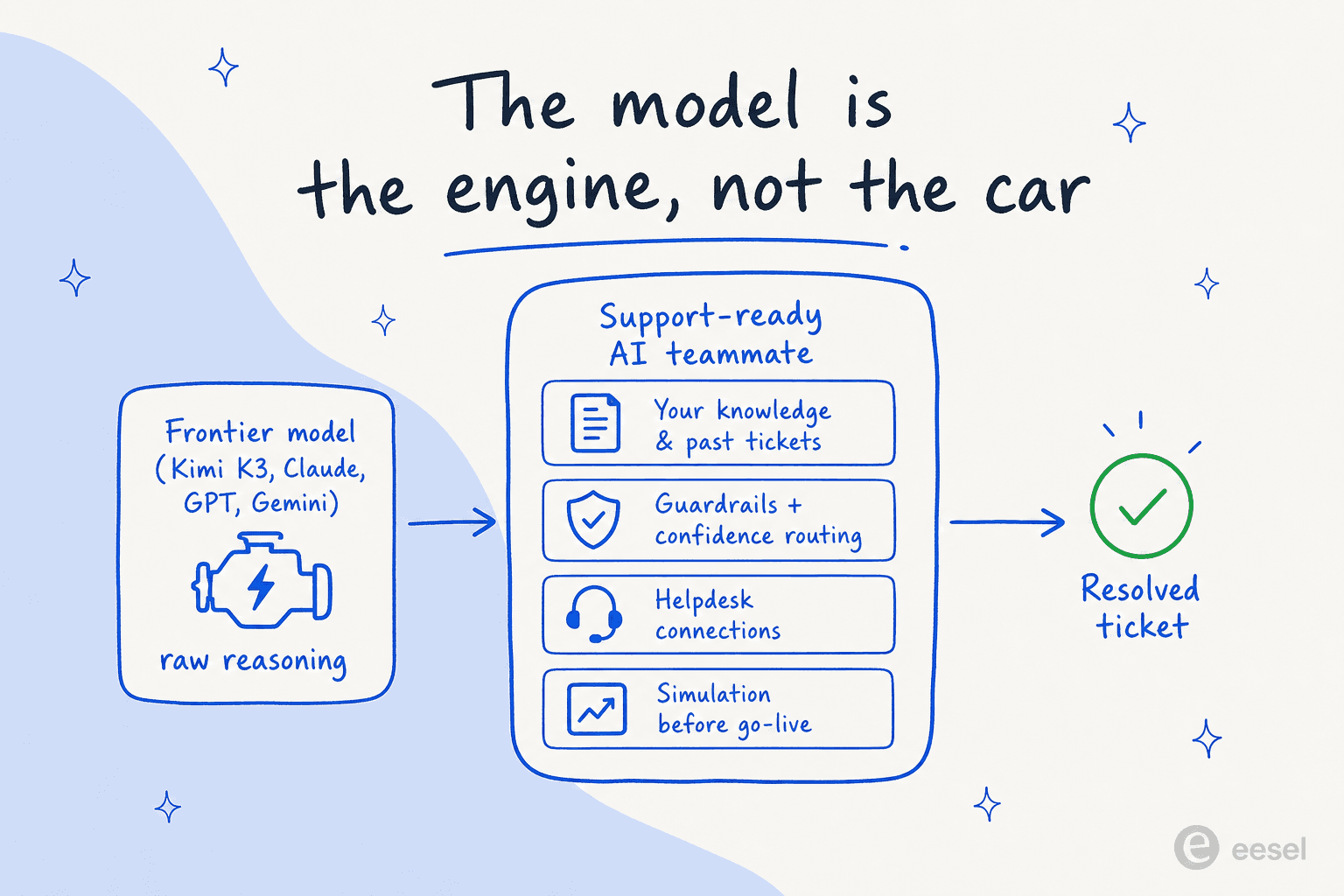
We've spent years putting AI on live support queues, and the lesson that stuck is that a confident-sounding model giving a wrong answer is worse than no answer at all. That's the whole reason eesel AI runs a simulation over your historical tickets before anything goes live, so you see the resolution rate and the exact replies on real past conversations first, not after a customer gets burned. It's also why answers route by confidence: if the AI agent isn't sure, it drafts for a human or escalates instead of guessing, the difference between a rule-based AI chatbot and real support automation.
The quietly good news in this whole roundup: because a well-built AI for customer service treats the model as a swappable engine, the frontier getting cheaper and better (K3, GLM, whatever wins next month) is a tailwind you inherit without re-plumbing anything.
Try eesel AI
If you got here because you want an AI model to actually resolve tickets and not just chat, that's the entire point of eesel AI. It plugs into Zendesk, Freshdesk, Slack and 100+ other tools, learns from your help center and past tickets, and starts drafting or resolving in minutes, not weeks.

The differentiator is the trust ramp: simulate on your real ticket history, watch the numbers, start in draft mode, and go fully autonomous only when you're happy. It's how teams in our customer stories got comfortable handing over tier-1 volume. You get a frontier model's smarts wrapped in guardrails built for support, and you're never locked to whichever model happened to win the week you signed up. Try eesel free, no credit card needed.