
What PromptQL actually is (so the pricing makes sense)
Before the numbers, a quick grounding, because PromptQL's pricing only makes sense once you know what you are buying.
PromptQL is not a chatbot and not a helpdesk. It is a multiplayer AI agent for enterprise data built by Hasura, the company behind the open-source GraphQL engine. Hasura calls it the "spiritual successor to GraphQL for the age of AI": where the old product auto-generated APIs so developers could build apps, PromptQL generates query plans on the fly so a person can ask a question in plain English and get a trustworthy answer off their Slack, docs, CRM, and warehouse tables.
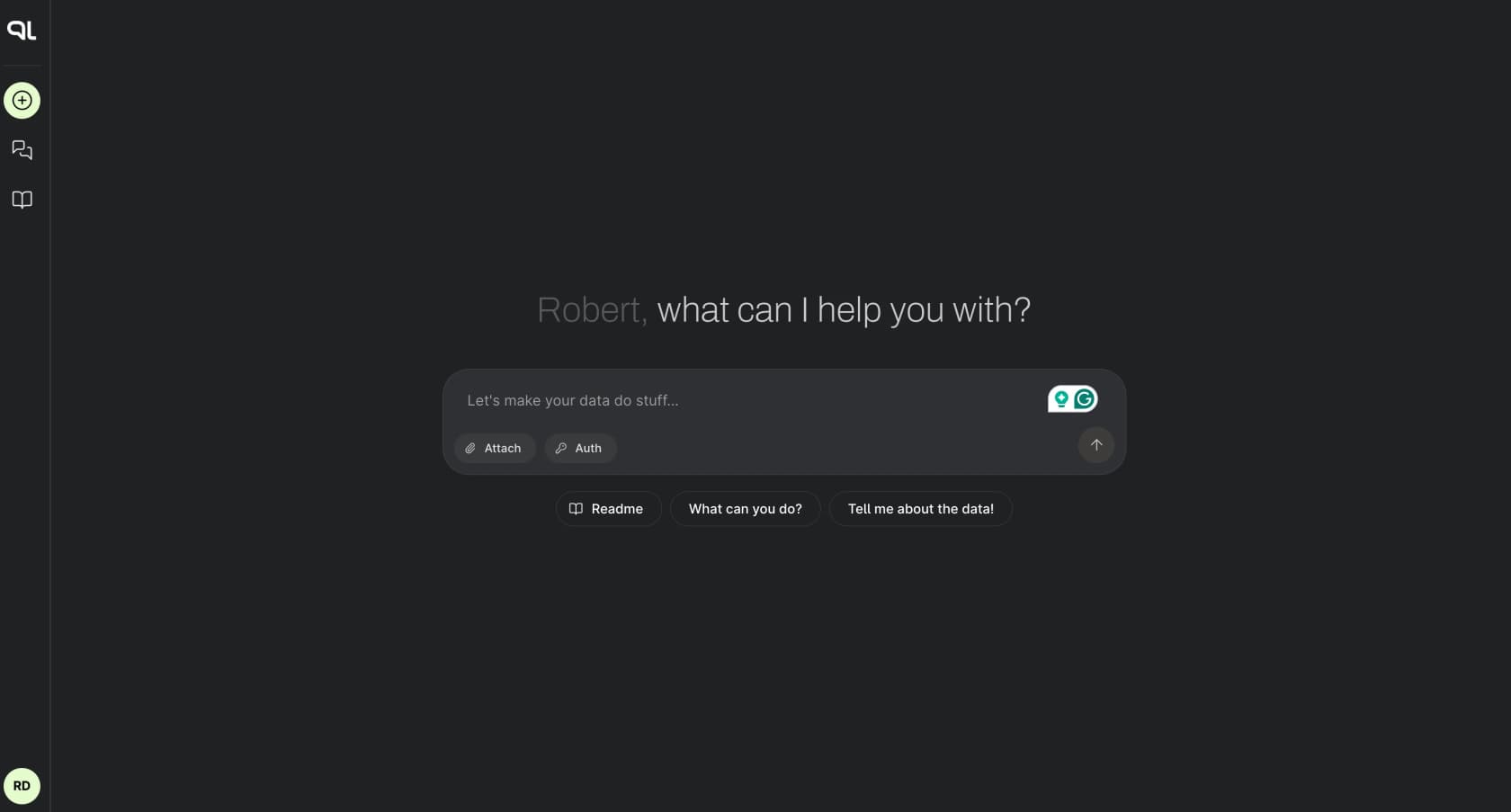
The whole pitch is reliability. Founder Tanmai Gopal frames the problem bluntly:
"The biggest problem is not being able to just accurately answer the question. The big problem is AI pretends to be accurate even when it's not. So AI is confidently wrong. That's the problem."
That framing matters for the bill, because PromptQL charges for compute (the work of planning and executing a query reliably), not for named features or seats. It launched in beta in June 2025, and by late 2025 Hasura was described as a billion-dollar-plus company with named customers including Cisco, McDonald's, Instacart, and Swiggy. So this is an enterprise data tool with enterprise ambitions, and the pricing reflects that.
PromptQL pricing at a glance
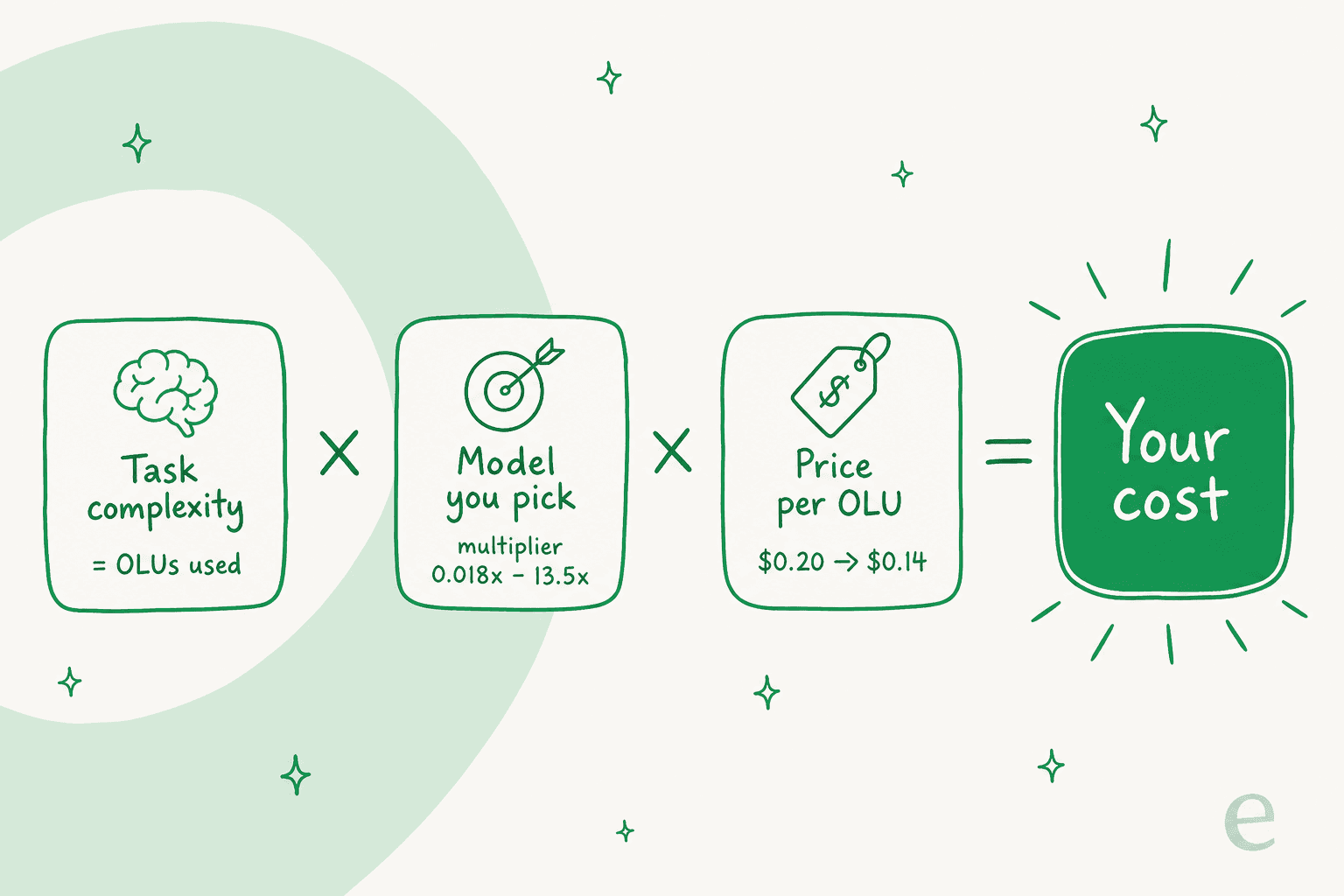
There are effectively two tiers: a self-serve, pay-as-you-go Starter, and a contact-sales Enterprise plan with no public numbers. But before the table, here is the whole pricing model in one picture, because the sticker rate is only one of three things that decide what you pay.
| Starter | Enterprise | |
|---|---|---|
| Price | $0.20 / OLU standard, $0.14 / OLU intro | Custom quote |
| Billing model | Prepaid, pay-as-you-go | Custom contract |
| Free credits | $50 per project + $20 per teammate | Everything in Starter |
| Seat licenses | None | None |
| Model choice | All models, switch per thread | Bring your own LLMs |
| Security | Standard | Fine-grained permissions, audit trails |
| Deployment | PromptQL cloud | Dedicated VPC or BYOC, private networking |
| SSO | No | Yes |
| Support | Self-serve | Forward-deployed engineers |
| Minimums | None | Negotiated |
The headline you will see on the pricing page is written as "$0.20 → $0.14 per OLU." The $0.14 is the introductory at-cost price, which PromptQL says is 1x the underlying token cost with no markup for a limited time; $0.20 is the standard rate, roughly 1.4x token cost. Both are all-in: the per-OLU price covers model tokens plus infrastructure, sandbox hosting, and orchestration. No separate platform fee, no per-seat license.
That is genuinely clean as pricing pages go. The catch is the unit itself.
What on earth is an OLU?
An OLU (Operational Language Unit) is a normalized unit of tokens. PromptQL rolls up the different token types (input, output, cached, cache-creation) and the different models (Opus, GPT, GLM, and so on) into one consistent unit so your bill does not change shape every time you switch models. More complex tasks eat more OLUs, and you can see the exact per-thread and per-step consumption in a usage dashboard.
Here is what that looks like in practice. Ask PromptQL a real question, and it shows its work: a query plan, then the actual code it ran, then the answer. Every one of those steps burns OLUs.
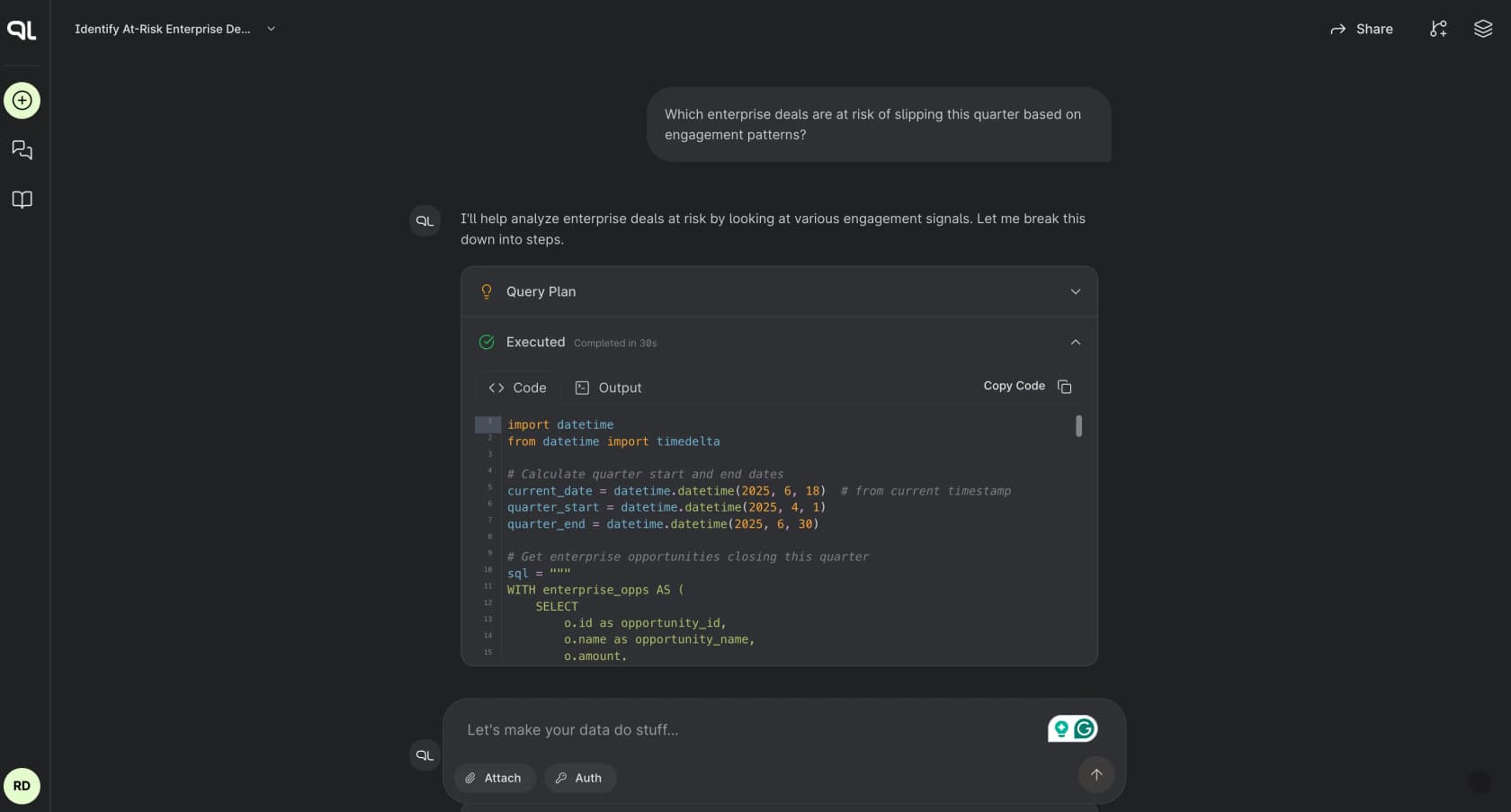
I have a soft spot for how honest this is (you can watch exactly what you paid for), but I also have a bias I should own up front: I have spent a couple of years writing about how AI tools price themselves and what buyers actually search for, and "invented billing unit" is a phrase that makes me wince. It is the single hardest thing to forecast on any AI invoice, because you cannot know your OLU consumption until you have run your real workload on your real model. The typical-cost examples help, but they are examples, not a quote.
Speaking of which.
Typical query costs
PromptQL's own FAQ gives representative numbers at the $0.14 intro rate:
| Task | OLUs used | Cost at $0.14/OLU |
|---|---|---|
| Simple data task | Under 2 OLUs | Under $0.28 |
| Complex report | ~10 OLUs | ~$1.40 |
| Deep investigation | ~40 OLUs | ~$5.60 |
So a data analyst running a dozen complex reports a day sits somewhere around $17 a day, or roughly $370 a month, at the intro rate, on a frontier model. That is the honest ballpark. But swap the model and that number can fall through the floor, which brings us to the real story.
The model multiplier is the actual price lever
This is the part I would tattoo on the pricing page if I could. The per-OLU price is fixed, but the model you pick changes how many OLUs a task consumes. PromptQL anchors its multiplier table to Claude Opus 4.6 = 1.0x and measures everything else against it. Lower multiplier means the model does the same work for fewer OLUs, so it is cheaper.
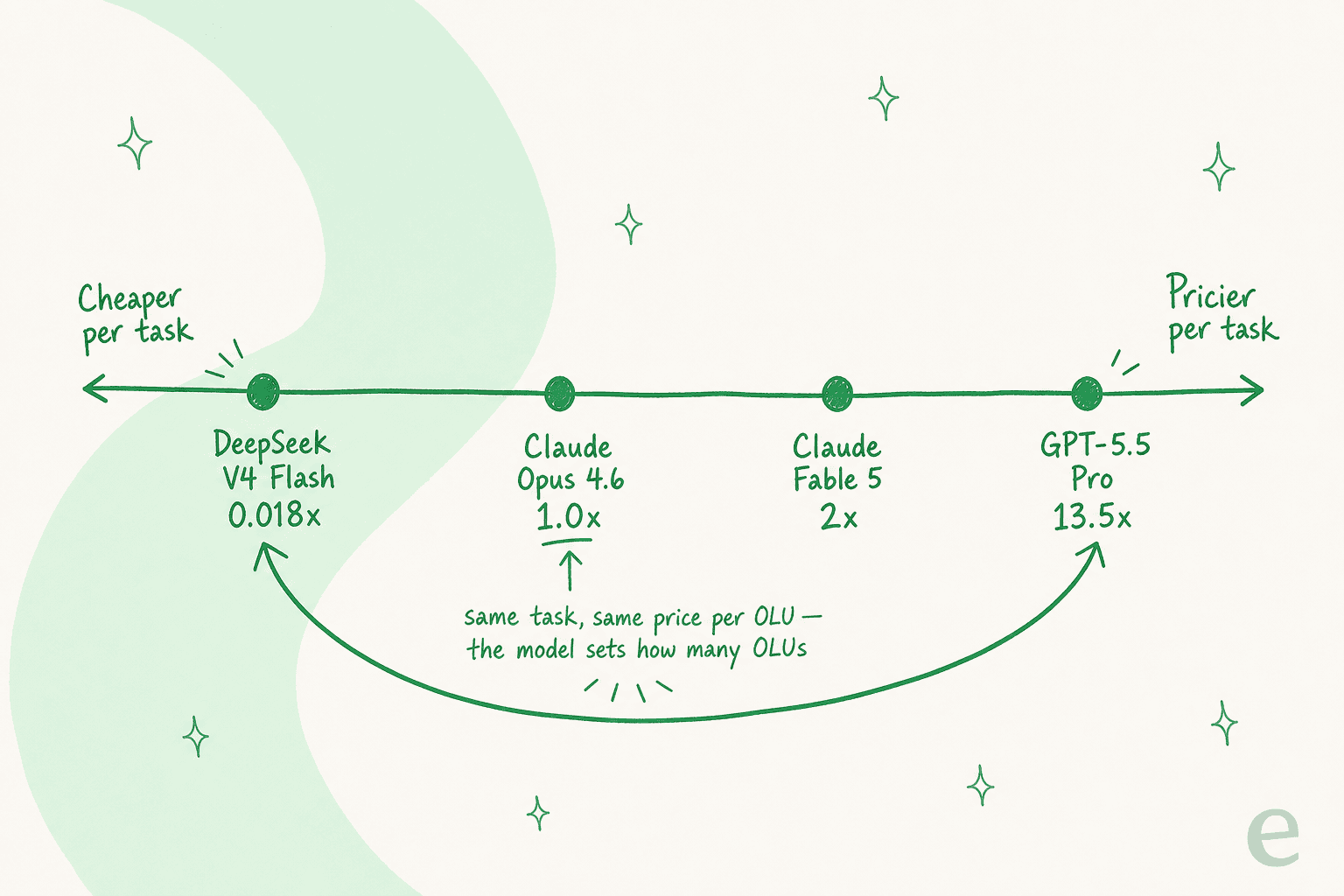
The spread is enormous:
| Model | Type | OLU multiplier (vs Opus 4.6) |
|---|---|---|
| DeepSeek V4 Flash (official API) | Open-weight | 0.018x (57x cheaper) |
| Llama 3.3 70B | Open-weight | 0.036x (28x cheaper) |
| Qwen 3.7 Plus | Open-weight | 0.071x (14x cheaper) |
| Kimi K2.7 | Open-weight | 0.17x (5.8x cheaper) |
| Claude Haiku 4.5 | Proprietary | 0.2x (5x cheaper) |
| GLM-5.2 | Open-weight | 0.23x (4.3x cheaper) |
| GPT-5 / GPT-5.1 | Proprietary | 0.3x (3.4x cheaper) |
| Gemini 3.1 Pro | Proprietary | 0.42x (2.4x cheaper) |
| Claude Sonnet 4.5 | Proprietary | 0.6x (1.7x cheaper) |
| Claude Opus 4.6 / 4.8 | Proprietary | 1.0x (baseline) |
| Claude Fable 5 | Proprietary | 2x |
| GPT-5 Pro | Proprietary | 7.22x |
| GPT-5.5 Pro | Proprietary | 13.53x |
Read that top-to-bottom and the whole pricing conversation flips. That $5.60 deep investigation on Opus? Run it on DeepSeek V4 Flash at 0.018x and the same work costs roughly a dime. Run it on GPT-5.5 Pro and it is closer to $75. PromptQL serves the open-weight models through Fireworks and lets you switch models per thread or mid-thread, so the practical advice is: prototype and run routine work on a cheap open-weight model, and only reach for a frontier model when a task genuinely needs the reasoning.
The reason PromptQL can get away with a cheap model on hard data questions is architectural, and it is worth one section.
Why the architecture affects what you pay
Most "AI on your data" tools wire an LLM straight to a database and hope. PromptQL's core design idea is to decouple query planning from execution. The LLM writes a detailed multi-step plan (the thing LLMs are good at), and then that plan runs as real, deterministic code outside the model, not in the context window.
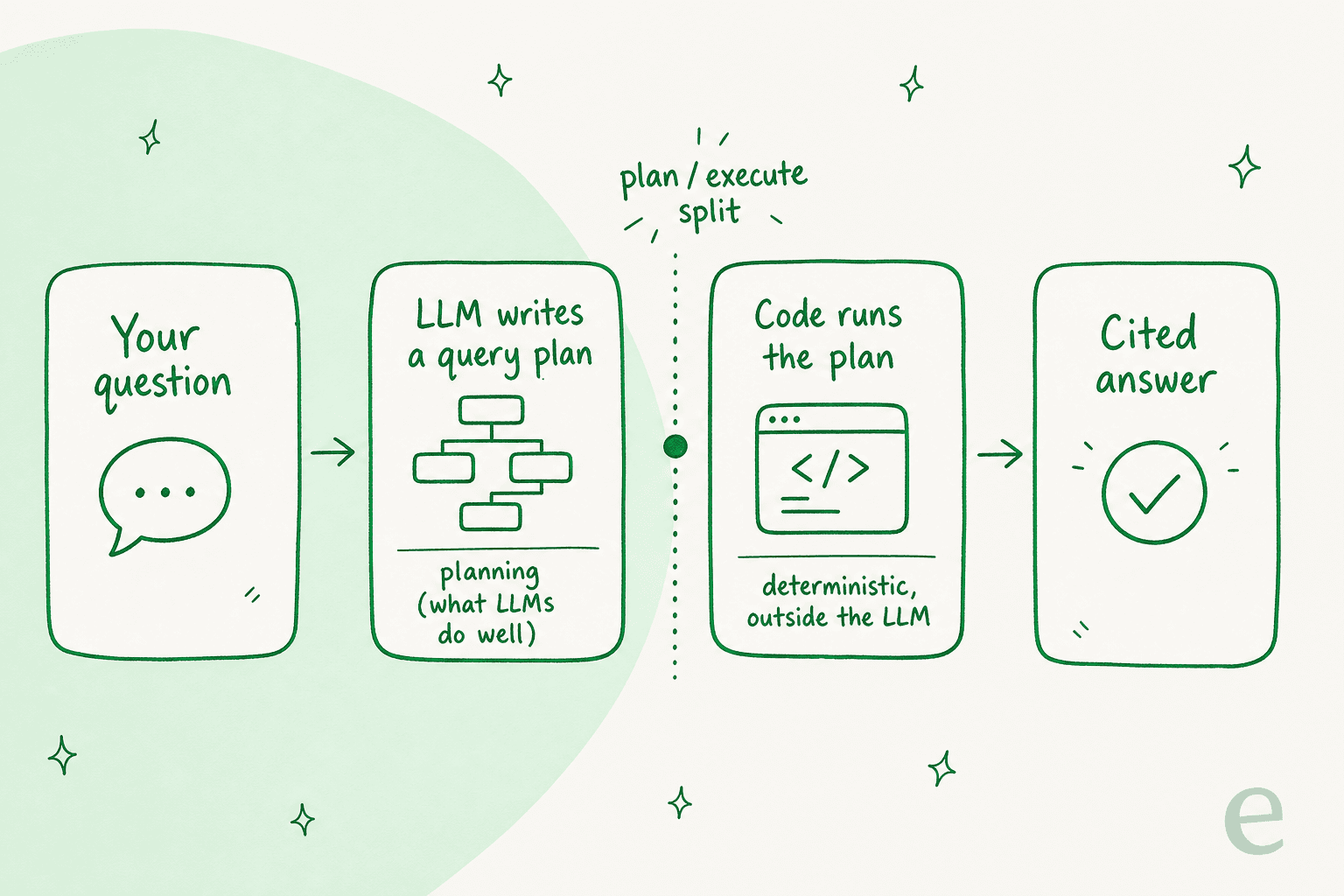
Gopal puts it this way:
"Instead of generating answers, we generate plans in a domain-specific language unique to your business. Those plans compile to deterministic actions with runtime validations and policy checks."
Why does this matter for pricing? Because it means a cheaper model can often do the job. If the model only has to plan, not grind through thousands of rows in-context, a lean open-weight model plans nearly as well as a frontier one, and you pocket the multiplier difference. Hasura leans on the Berkeley Data Agent Benchmark, where even frontier models score just 43% (Opus-4.6), 38% (Gemini-3-Pro), and 25% (GPT-5.2) on real-world data questions, while vanilla database query generation scores "close to 0%". The plan-then-execute split is what closes that gap, which is what you are actually paying the markup for.
Estimate your own PromptQL bill
Because the model multiplier does so much of the work, a static table cannot tell you your number. So here is a calculator: plug in your usage, pick a model, and see the monthly cost at both the intro and standard rates.
Play with the model dropdown and watch the number move. Four hundred complex reports a month costs about $56 on Opus at the intro rate, and roughly $1 on DeepSeek. That is not a rounding difference; that is the entire pricing decision.
The free tier and credits
You can start with no credit card. PromptQL gives $50 in free credits when you create your first project, plus $20 more for every collaborator who joins their first project. Credits are managed at the project level, so a team spinning up several projects accumulates a decent runway.
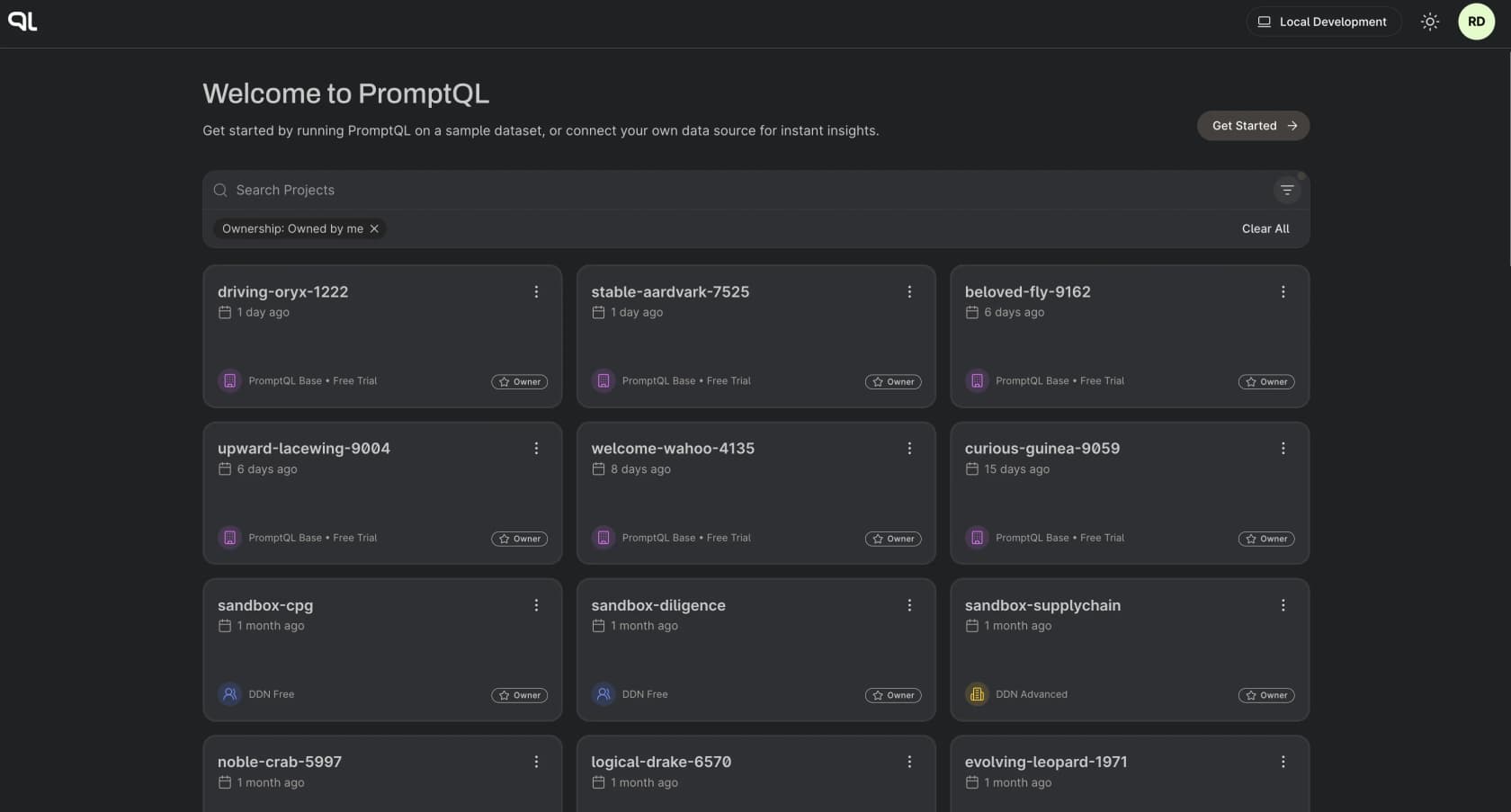
On a lean open-weight model, PromptQL says $50 is enough for "thousands of simple tasks" before you pay a cent. When the credits run out, you add a payment method and switch to prepaid billing: you top up a balance, work auto-pauses if it hits zero, and per-user quotas and spending alerts keep a runaway thread from surprising you. No minimums, no annual lock-in on the Starter plan.
The Enterprise tier
Everything above is the self-serve story. The Enterprise plan is quote-gated, with no public numbers, and it adds the things a regulated buyer needs: advanced security and fine-grained permissions, data-access audit trails (what data was used in which thread, by which user), a dedicated VPC or bring-your-own-cloud, private networking and VPC peering, single sign-on, bring-your-own-LLMs, and forward-deployed engineering support.
If you are the kind of company that has a procurement process, this is the tier you will land on, and the per-OLU math becomes one line item inside a negotiated contract. It is also where Hasura's $900-an-hour AI engineering practice tends to attach, so budget for services on top of consumption if you are going down the enterprise route.
Is PromptQL's pricing good?
For what it is (a reliability layer for AI on enterprise data), the pricing is fair and unusually transparent. No seats, no platform fee, at-cost intro pricing, and a dashboard that shows you exactly what each thread consumed. I would rather see this than a $50k platform minimum with a "contact us" wall.
My one real gripe is the OLU. It is a well-designed invented unit, but it is still an invented unit, and invented units are the thing I have watched trip up buyers over and over. You cannot forecast an OLU bill from a pricing page; you can only forecast it after you have run your own workload. PromptQL softens this with typical-cost examples, spend caps, and auto-pause, and those genuinely help. But "how much will this cost us next quarter?" is a harder question here than the clean $0.14 number suggests, because the honest answer is "it depends entirely on your model mix and your query complexity."
That is not a knock unique to PromptQL. It is the tax you pay for consumption pricing on top of an opaque unit. Which is a nice segue to how I would think about it if you came here from the support-tooling world.
PromptQL vs a support AI like eesel
Quick reality check, because a chunk of people searching "PromptQL pricing" are actually comparison-shopping AI tools in general, not specifically data-analyst agents.
PromptQL and eesel AI do not really compete. PromptQL is a data-access agent for analysts and enterprise data teams; eesel is an AI teammate for the support queue and content, plugging into Zendesk, Freshdesk, Slack, and your help center. If your actual job is deflecting tickets or drafting replies, PromptQL is the wrong shape of tool.

But the pricing lesson does carry over, and it is the reason I built the calculator above. When I helped shape how eesel prices, the one rule that survived every experiment was: price in a unit the customer already thinks in. We tried invented units. "Credit" forced people to do math ("wait, what is a credit worth again?"), and it quietly killed adoption. So eesel's credit is just a ticket: 1 credit is 1 ticket or chat, plans start at $299 a month for 500 credits, no seat fees, because a support manager already lives and breathes ticket counts. You can predict next month's eesel bill from this month's ticket volume in your head. That is the whole point.
So if you are evaluating PromptQL, my advice is to run your real workload on your real model for a week before you extrapolate, because the OLU makes back-of-envelope forecasting unreliable. And if you wandered in from the support world looking for a per-ticket AI you can actually budget for, eesel is free to try and priced in tickets, not tokens.
Try eesel
If your problem is the support queue rather than the data warehouse, eesel AI is the tool shaped for it. It plugs into your existing helpdesk in minutes, learns from your past tickets and help center, and starts drafting and resolving replies from day one, priced per ticket so the bill tracks something you already measure. You can try it free and simulate it against your historical tickets before it ever touches a live customer, which is the closest thing to a forecast you will get in this category.
Frequently Asked Questions
How much does PromptQL cost?
What is an OLU in PromptQL pricing?
Does PromptQL have a free tier?
Why does my PromptQL bill change when I switch models?
Is PromptQL cheaper than building your own text-to-SQL agent?


Article by
Kurnia Kharisma
Kurnia is a software engineer and writer at eesel AI with two years of SEO experience, writing about AI tools, helpdesk software, and customer support. He pairs a developer's understanding of how these products are built with search-driven research into what actually ranks and resonates with the people searching for them.