


What Palmier Pro actually is
I have spent a couple of years watching how search intent behaves when a new tool launches, and "palmier pro pricing" is a clean example of a query that looks like a feature question but is really a budget question. People are not asking what Palmier does, they already half-know. They are asking two things: is the editor actually free, and how badly do the AI credits bite? So that is what I want to answer, grounded in the numbers Palmier actually publishes.
Palmier Pro is a native macOS video editor "built for AI," from a two-person Y Combinator team. The pitch that separates it from every other AI-video tool: generation lives on the timeline. Instead of generating a clip in a web app, downloading it, and re-importing it into Premiere, you generate image, video, and audio directly in the editor, and every clip keeps its prompt, model, and references attached. It is also operable by AI agents, so Claude, Cursor, or Codex can connect through a local MCP server and edit the timeline for you.
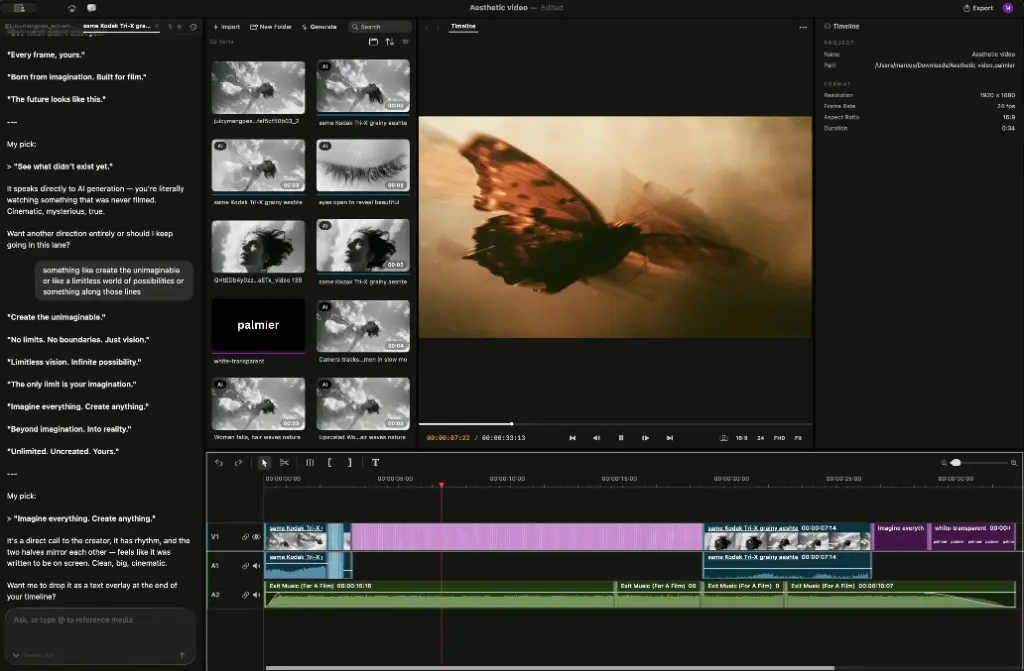
That "agent operates the editor, not a chat sidebar" idea is the part early observers keep singling out. As one write-up put it:
"The agent operates the editor itself, rather than suggesting changes in a separate chat window. It's a clean example of a broader pattern. Instead of bolting an AI assistant onto a product, you expose the product itself as a tool an agent can drive."

Palmier Pro pricing: the plans
Here is the full breakdown as of mid-2026. Note the limited-time launch pricing, the prices in the first column are discounts that will not last.
| Plan | Launch price | Regular price | Credits / month | Key inclusions |
|---|---|---|---|---|
| Free | $0 | $0 | — | Full pro video editor; MCP server for Cursor, Claude Desktop, Codex; no account required |
| Pro | $29/mo | $49/mo | 5,000 | Everything in Free, plus image, video, and audio generation |
| Max | $69/mo | $99/mo | 12,000 | Everything in Pro, plus priority support |
| Custom | Contact sales | — | Volume credits | Private Slack channel, security and procurement support (book a demo) |
The structure is refreshingly honest for the category. Most "AI video" tools gate the editor behind a subscription and meter generation on top. Palmier gives the editor away and charges only for the expensive part, the model calls. If you already shoot your own footage and just want a clean Mac-native NLE, you can use Palmier Pro forever at $0 and never touch a credit.
What you get for free
The free tier is not a crippled trial. It is a real professional editor:
- Multi-track video, audio, image, and text.
- Trim, split, speed, opacity, and transform, the standard editing toolkit.
- Your footage and AI clips on the same timeline.
- Export to MP4 (H.264, H.265, ProRes) and NLE XML for Premiere Pro and DaVinci Resolve.
- MCP server access so Claude, Cursor, or Codex can drive the app.
- No account required.
The catch is that the free tier gives you the editor, not the generation. The moment you want to generate an AI clip, image, or voiceover inside that timeline, you need credits, and credits mean a Pro or Max plan.
How Palmier's credits actually work
Credits are the thing to understand before you pick a plan, because the plan names (Pro vs Max) are really just "5,000 credits" vs "12,000 credits."
Credits are spent only on AI generation: video, image, audio, upscaling, and Palmier chat. Plain editing, trimming, and exporting never touch them. Palmier's own rough guide is that 5,000 credits is about 333 images or 3-7 minutes of generated video, and the real figure depends on which model you call and at what resolution. Heavier models (a high-res Veo 3.1 clip) burn faster than a quick image.
That variability is the honest wrinkle in Palmier Pro pricing. Palmier does not publish a per-generation credit cost, so you cannot yet calculate your bill to the dollar the way you can with a token-priced LLM like GPT-5.6. The "3-7 minutes of video" range is a 2x spread, which for a heavy user is the difference between one plan and the next. To get a feel for which tier fits your output, here is a rough estimator:
Treat the output as a ballpark, not a quote, the real number moves with your model and resolution choices. But it is enough to answer the only question that matters at signup: am I a Pro user or a Max user?
The models you are paying for
Your credits are really buying access to a shelf of frontier generation models, all wired into the timeline:
- Kling V3 (Kling AI)
- Seedance 2.0 (ByteDance)
- Veo 3.1 (Google)
- Grok Imagine (xAI)
- "and more"
This is a genuine convenience: instead of paying four separate subscriptions and juggling four export folders, one credit balance covers all of them in one editor. It is also why Palmier does not commit to a flat per-clip price, the underlying model costs vary, and a heavy Veo render is not the same spend as a Kling image.
The two catches worth knowing before you pay
Pricing is only half the decision. Two constraints matter as much as the sticker price.
1. macOS 26 (Tahoe) only. Palmier Pro is Mac-native and requires the newest macOS. There is no Windows, Linux, or web version, and even Mac users on older OS versions are locked out. For a lot of teams this ends the conversation before pricing even comes up. It is the single hardest gate on the product.
2. Launch pricing is temporary. The $29 and $69 you see today are limited-time launch discounts. Budget for the regular $49 and $99 if you are planning past the promo, because that is the price the subscription will settle at. Locking in early is the value play if you know you will keep using it.
There is also the open-core question early observers keep raising: the editor and MCP server are open source and free, but generation is the paid, credit-based part. That split is clean today, but it is the obvious place future friction shows up if credit costs creep. For now, the model is fair and clearly stated.
Is Palmier Pro worth it?
My read, as someone who watches how these tools get adopted rather than someone who ships cinematic video for a living: the free editor is worth installing the day you are on a Mac running Tahoe and touching AI video at all. There is no account, no cost, and it collapses the generate-download-reimport loop that makes AI video miserable. Even one independent reviewer who disliked the branding landed there:
"Terrible name but Palmier Pro is pretty good as an AI video editor."
The paid tiers are a "try Pro, upgrade if you feel the ceiling" decision. At $29/mo launch, Pro is a low-risk way to test whether the credits cover your output. If you are producing AI video weekly, Max's larger allotment and priority support pay for themselves; if you generate occasionally, Pro is plenty and you may not even exhaust the credits. The thing that would stop me is not the price, it is the macOS-26 requirement, which quietly disqualifies a huge share of would-be users.
The pattern underneath Palmier (and where I actually work)
The most interesting thing about Palmier is not its price, it is the architecture: an agent that operates your tool directly through MCP, instead of an AI chat window stapled to the corner. That is the pattern I spend my days inside, just aimed at support instead of video.
That is the whole idea behind eesel. Where Palmier lets Claude drive your video timeline, eesel is an AI agent that plugs into your existing helpdesk (Zendesk, Freshdesk, Gorgias, Help Scout, and more) and actually resolves tickets, drafts replies, and triages, rather than suggesting things in a sidebar for a human to copy-paste. And because letting AI loose on live customers is scarier than letting it loose on a video edit, you can simulate it on your past tickets before it ever answers a real one. It is free to try, and it takes minutes to connect.
If Palmier's "agent drives the app" model is what caught your eye, that is the same bet, just for the helpdesk instead of the timeline.