


Why look for a PromptQL alternative at all
Let me be fair to PromptQL first, because the reason to switch is easier to understand once you see what it does well. PromptQL uses the model only to write a query plan, then executes that plan as real Python and SQL outside the model. That is a real answer to the "confidently wrong AI" problem, and it can join across systems through Hasura DDN metadata. Its own developer base likes the direction:
"I have built and managed more than 10 production codebases that use Hasura. IMO, I think it's a better option than Supabase, Payload, and others to build your backend. The fact that they are investing time in LLM-related resources for the platform makes me happy we choosed it back when."

So why do people still shop around? Four reasons keep coming up.
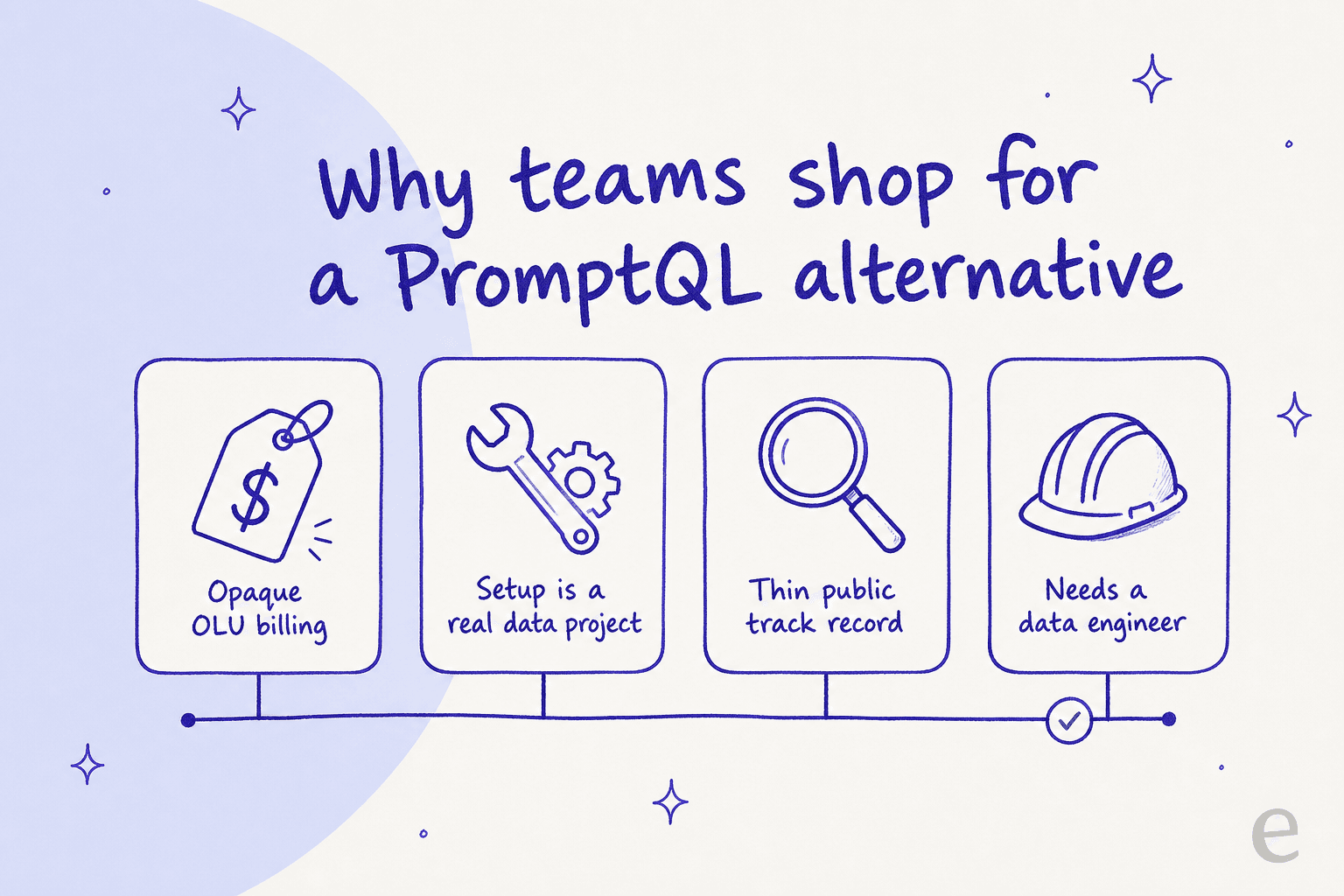
- Opaque billing. PromptQL is 100% consumption-based on a unit called an OLU (Operational Language Unit) at $0.20 each ($0.14 introductory). The per-unit price is fixed, but the model you pick changes how many OLUs a task burns, and the spread runs up to 57x. Forecasting a monthly bill takes real work.
- Setup is a data project. You model a semantic layer, configure connectors, and drive the DDN CLI before you get value. It is not a plug-and-play chatbot.
- Thin public track record. There are no G2 or Capterra reviews at the time of writing, and both "Show HN" launches drew almost no discussion. The strongest performance figures are vendor-stated.
- It might be overkill. If your data already lives in one warehouse, or you just want a chart from a spreadsheet, a lighter tool gets you there faster.
None of that makes PromptQL bad. It makes it specific. The alternatives below each trade PromptQL's cross-system ambition for something else: less setup, transparent pricing, a mature BI surface, or an open-source licence.
The 8 best PromptQL alternatives at a glance
Here's the whole field before we go deep. I've included the billing model, whether it's open-source, whether it reaches across multiple data sources (PromptQL's signature move), and where the AI agent sits.
| Tool | Best for | Pricing model | Entry price | Open source | Cross-source | AI agent |
|---|---|---|---|---|---|---|
| Databricks Genie | Teams already on Databricks | Consumption (DBUs) | $0.07/DBU | No | Lakehouse only | Included |
| Snowflake Cortex Analyst | Teams standardized on Snowflake | Consumption (credits) | $2/credit + metering | No | Snowflake only | REST API |
| ThoughtSpot Spotter | Governed self-serve BI | Per-user or per-query | $25/user/mo | No | Warehouse-backed | Pro+ tier |
| Hex | Analyst teams who want a notebook | Per-seat + compute | $36/editor/mo | No | Multi-source | Pro+ tier |
| Julius AI | Solo, ad-hoc analysis | Credit-based | $20/mo | No | Files + DBs (Business) | All paid tiers |
| Wren AI | Open-source, self-hosted GenBI | Free self-host / cloud | $0 | Yes (Apache 2.0) | 20+ connectors | Included |
| Vanna AI | Developers building text-to-SQL | Free (MIT) | $0 | Yes (MIT) | You build it | You build it |
| Glean | Enterprise-wide work AI | Quote-only (seats + credits) | Contact sales | No | 100+ connectors | Agent Builder |
Two patterns jump out. First, the "buy" options cluster around a single warehouse, while the truly cross-system options are open-source. Second, only PromptQL and Wren AI really share the "agent that plans over many sources" shape. Here's the same field mapped out:
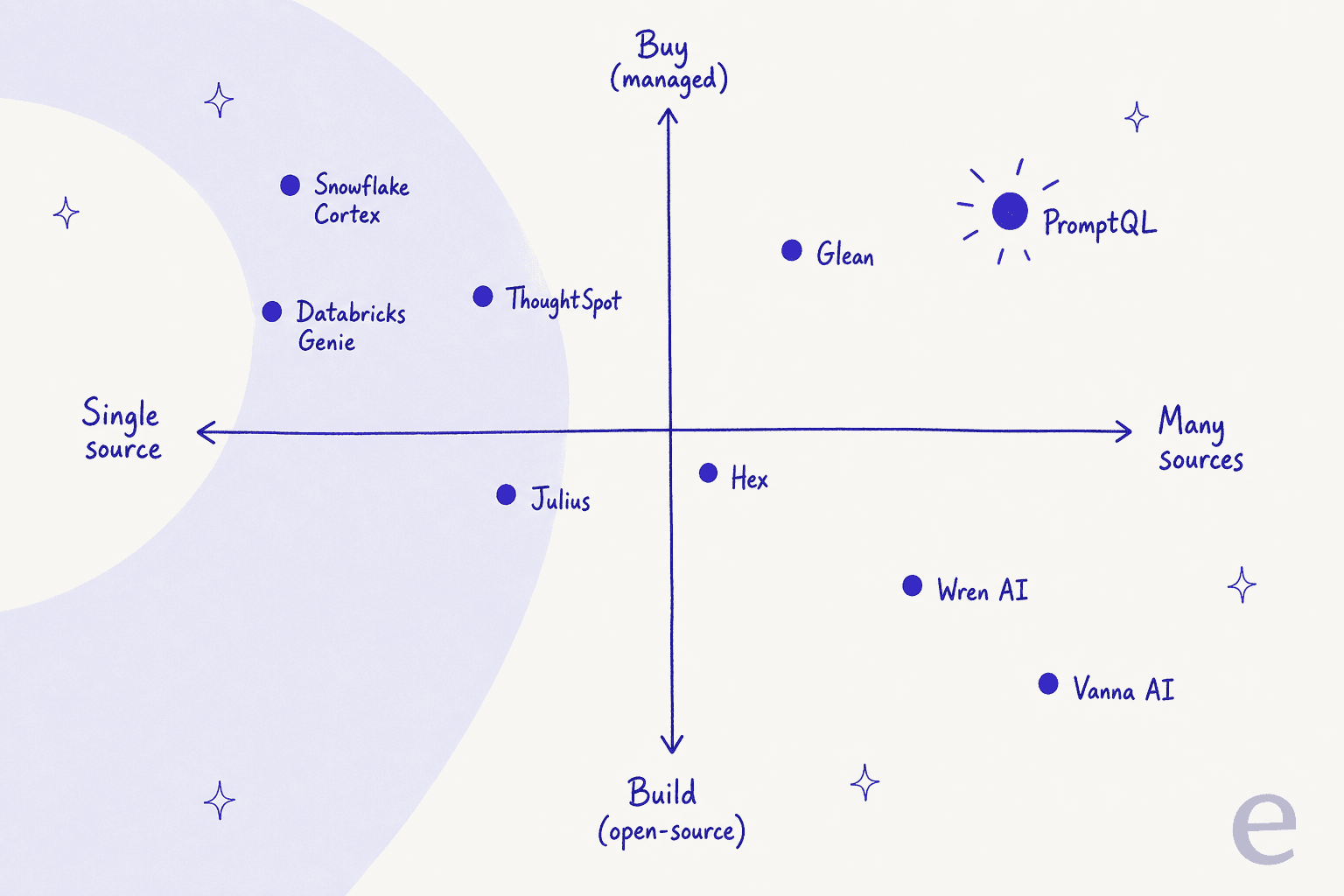
Not sure which quadrant you're in? Walk the picker before you read the deep dives.
1. Databricks AI/BI Genie
Best for: teams whose data already lives in the Databricks lakehouse and who want conversational analytics with zero new infrastructure.
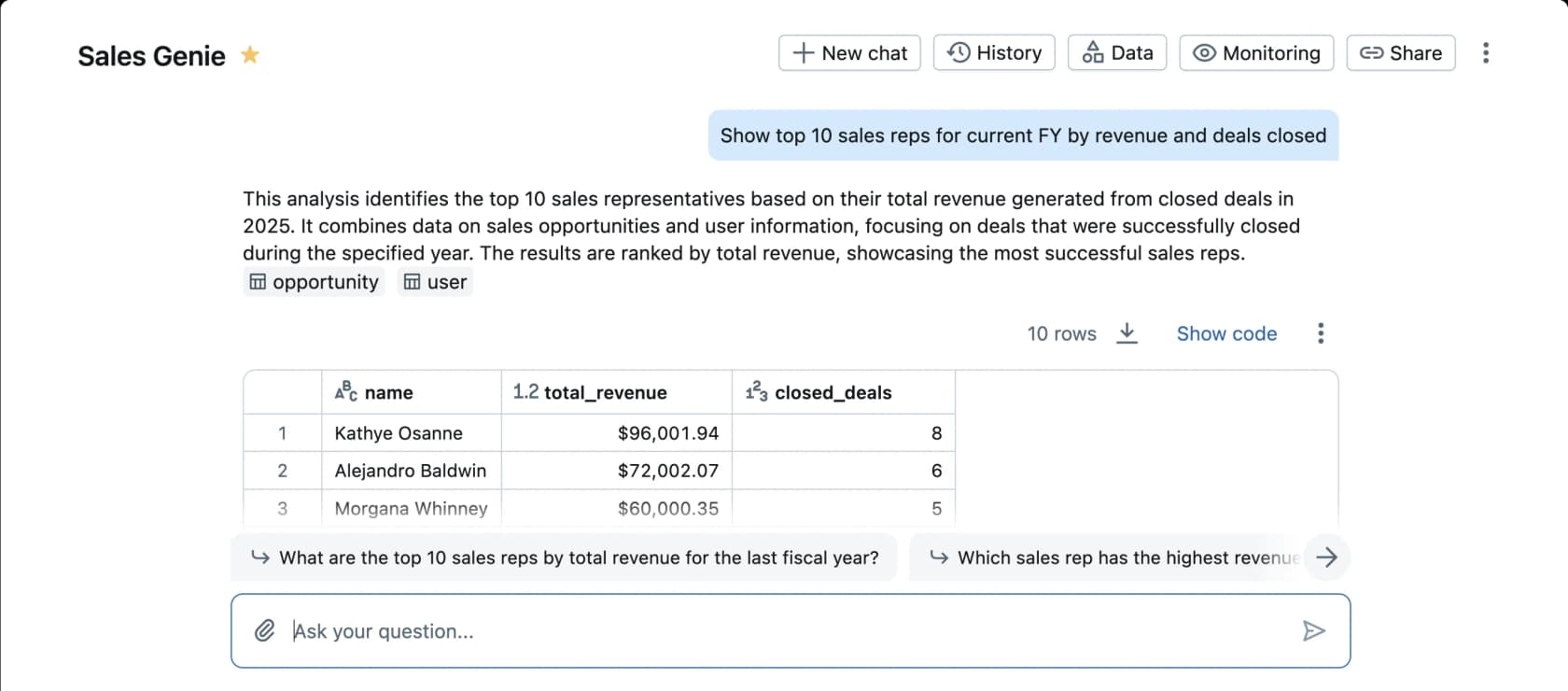
Databricks AI/BI Genie (recently rebranded to "Genie Agents") is a natural-language chat where business users ask questions and get back SQL, results tables, and visualizations, all over the governed lakehouse. Analysts set each Genie space up by registering datasets to Unity Catalog and adding example queries, business-semantic expressions, and text instructions in the org's own terminology.
The standout is trusted assets: authors define parameterized SQL and predefined functions so the most common questions return verified, deterministic answers instead of freshly-generated SQL every time. Combined with Unity Catalog, every answer respects existing permissions and is auditable. Named customers include bp, Nikon, Adobe, and Toyota.
Pricing: consumption-based, $0.07 per DBU beyond free usage, with a big asterisk: free usage covers only Genie's LLM calls, and the SQL that Genie generates runs on your own warehouse compute, billed separately. So the real cost is Genie DBUs plus query compute, riding on top of your existing Databricks spend.
Verdict: if you already live in Databricks, this is the obvious first stop, and the curation loop is a real accuracy lever. If you don't, standing up a lakehouse just to use Genie makes no sense, and the stacked billing is as hard to forecast as PromptQL's OLUs. It's warehouse-locked by design, so it can't do PromptQL's cross-vendor joins.
2. Snowflake Cortex Analyst
Best for: teams standardized on Snowflake who want managed text-to-SQL that never lets data leave the perimeter.
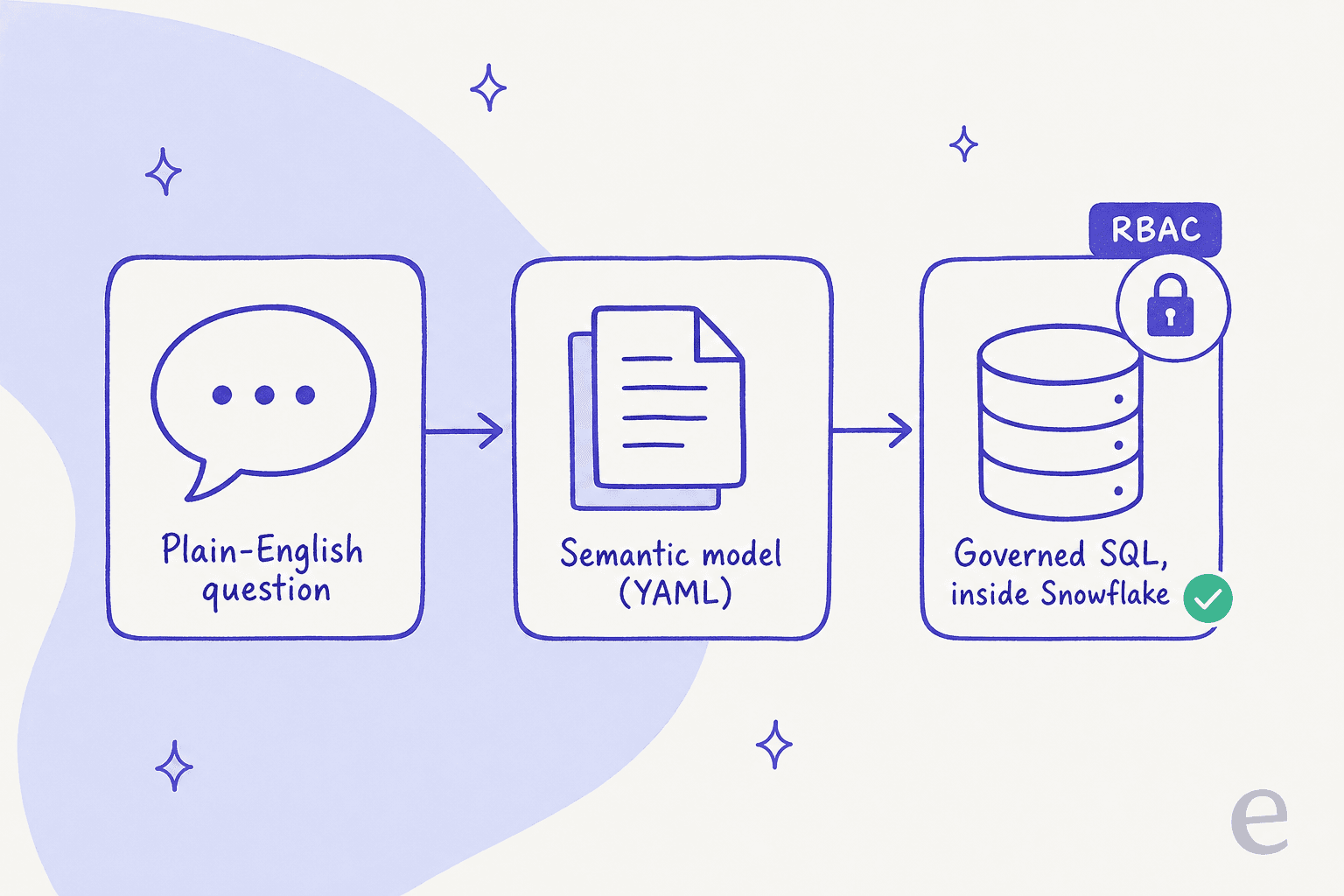
Cortex Analyst is a fully-managed Snowflake feature that answers natural-language questions over your structured data, delivered as a REST API. Snowflake pitches it as a way to skip "complex RAG solution patterns, model experimentation, and GPU capacity planning" entirely, because the whole thing runs inside Snowflake's governance boundary.
The core mechanism, and the direct parallel to PromptQL, is the semantic model. Rather than pointing the model at a raw schema, you author a layer of business concepts: metrics, dimensions, join paths, synonyms, and verified sample queries, either as a YAML file or as native Semantic Views with full RBAC. It can also lean on Cortex Search to resolve high-cardinality values. Because it's API-first, you own the chat UI, whether that's Streamlit, Slack, or Teams.
Pricing: consumption credits, with compute at $2.00 to $4.00 per credit depending on edition and storage at $23/TB/month, per Snowflake pricing. Cortex Analyst itself is metered per message on top, and the generated SQL then runs on your warehouse. So, like Genie, the total is a moving sum rather than a flat price.
Verdict: the "data never leaves Snowflake" story is a strong one for regulated buyers, and the semantic-model approach is philosophically close to PromptQL's. The catch is right there in the name: it's Snowflake-only. If your estate spans Postgres, a BigQuery warehouse, and a pile of SaaS APIs, Cortex Analyst can't reach most of it, and that cross-system reach is the entire reason some teams wanted PromptQL.
3. ThoughtSpot (Spotter)
Best for: enterprise BI teams that want a mature, governed dashboard platform with a conversational AI analyst bolted on.
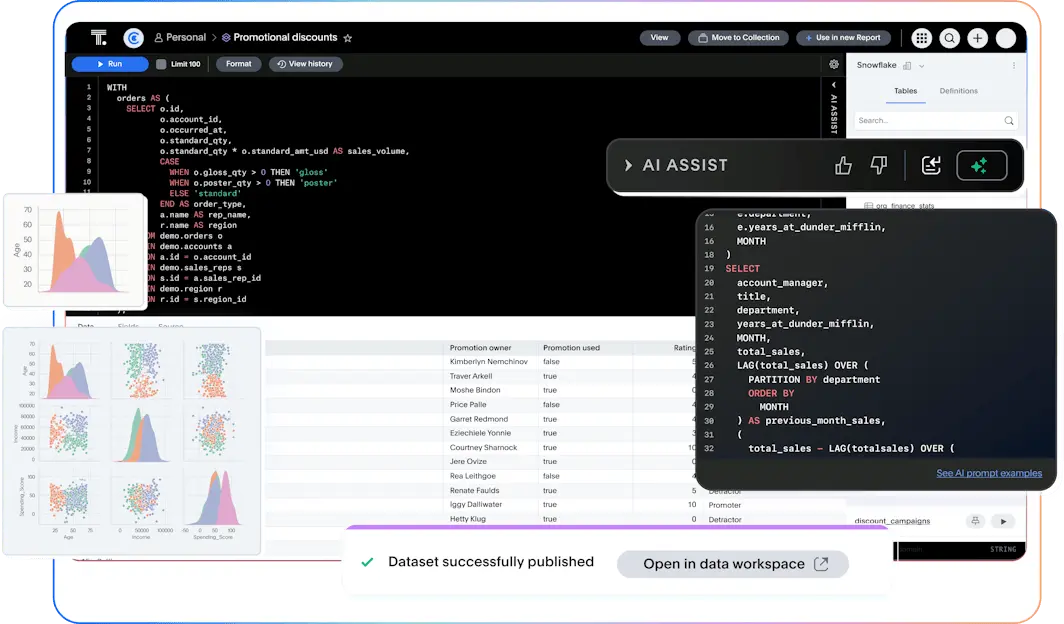
ThoughtSpot is a long-established analytics platform, and Spotter is its AI analyst agent. Ask a question and this AI analyst agent "breaks down questions, does multi-step reasoning, tests assumptions, checks results, reruns analysis, and delivers recommended actions," all against a governed semantic model. On top of the agent you get Liveboards (interactive, drill-anywhere dashboards) and SpotIQ automated insights, plus deep integrations with the governance stack like dbt, Alation, and Fivetran.
The maturity shows: it's a Gartner Magic Quadrant Leader with a 4.4/5 rating across ~340 G2 reviews and logos like Coca-Cola and Capital One. That track record is exactly what PromptQL lacks.
Pricing: public at the low end. Essentials starts at $25 per user/month (but has no Spotter), Pro at $50 per user/month adds Spotter (capped at 25 queries/user/month) or $0.10 per query on the usage model, and Enterprise is quote-gated.
Verdict: the best pick if you want a full BI platform and dashboards, not just a query-answering layer, and the entry price beats the opacity elsewhere. Two watch-outs: the Spotter agent is gated behind Pro and throttled to 25 queries per user per month on the per-seat plan, and the tier most large orgs land on is fully quote-gated. It's also analytics-shaped, so it isn't the general-purpose data agent PromptQL aims to be.
4. Hex
Best for: analyst and data-science teams who want an AI agent inside a real collaborative notebook rather than a black-box chat.
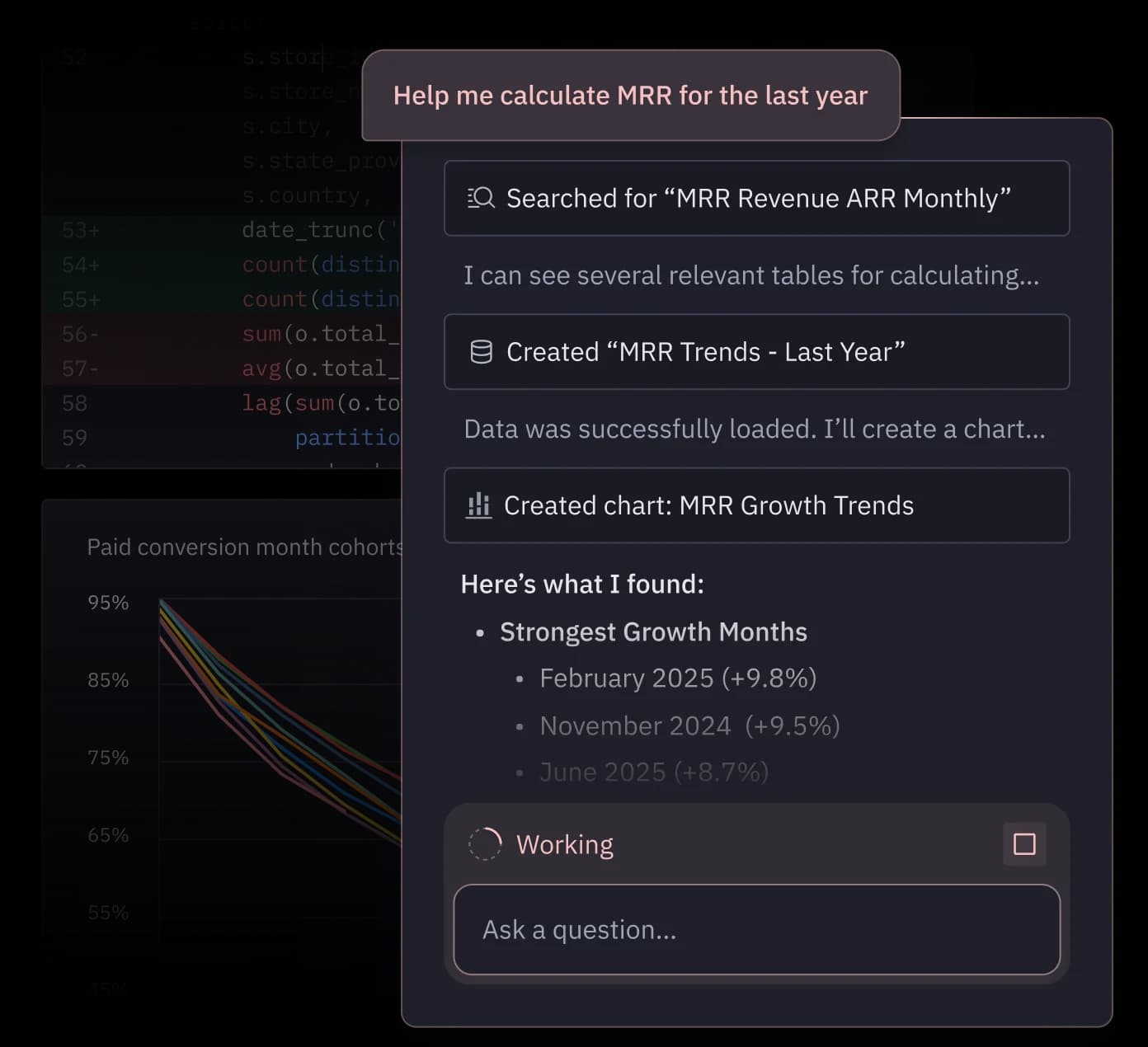
Hex is a collaborative data workspace where SQL, Python, and no-code cells live together, and its Notebook Agent (part of Magic AI) writes SQL and Python, builds charts, and scaffolds whole analyses from a prompt. The clever part for skeptics: every AI answer drops into an editable notebook the data team can open, inspect, and correct, so you get acceleration without losing hands-on control. Its Threads feature brings self-serve analytics into Slack, Claude, or Cursor, and its customer list (Anthropic, Notion, Ramp, Reddit) is a strong signal. One user put the appeal simply:
"Hex's notebook agent just works. I describe what I want and get working SQL back, without having to juggle between tools. It's made us 10x faster at turning questions into insights."
Pricing: per editor, transparently. Community is free, Professional is $36/editor/month, and Team is $75/editor/month (adding Threads and the semantic-model agent). Compute is metered separately (per-minute for larger profiles), and AI usage runs on tiered credits.
Verdict: the strongest pick for teams who think in notebooks and want the AI to be a transparent pair-programmer. The trade-off versus a pure consumption model is the stacked cost (seats + compute + AI credits can be hard to predict at scale), and the full Notebook Agent is gated above the free tier. It's a workspace, not the embeddable, decoupled agent PromptQL positions as.
5. Julius AI
Best for: a single analyst, researcher, or founder who wants fast, cheap answers from a spreadsheet without any setup.
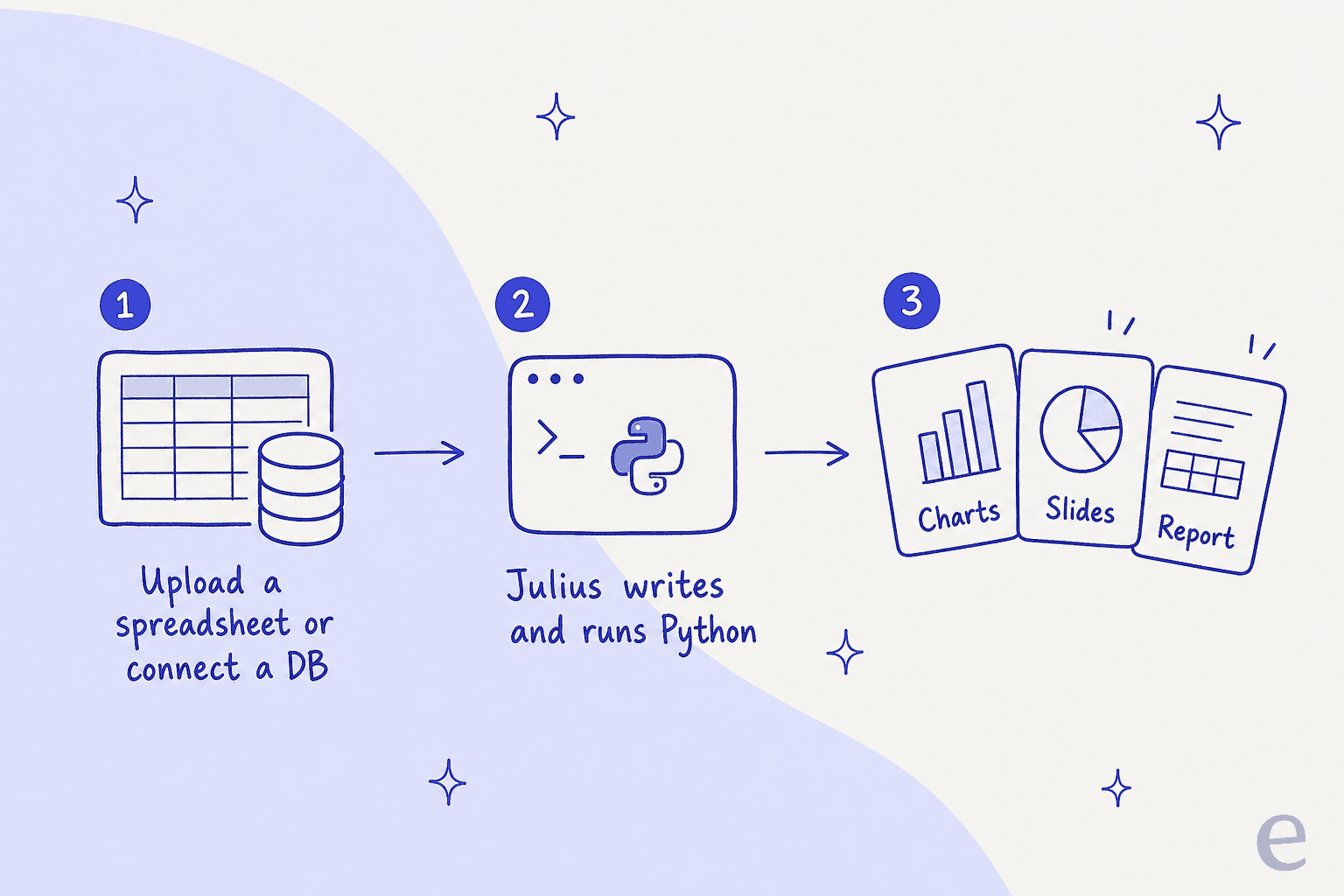
Julius AI is the low-friction option. Upload a spreadsheet or connect a database, ask in plain English, and it writes and runs Python behind the chat to do the actual analysis, then hands back charts, dashboards, slides, and reports. Paid tiers route to frontier models like GPT-5.5 and Claude Opus 4.8. It's an analyst copilot, not a governed platform, and that's the whole point.
Pricing: credit-based, with a wide individual ladder. Free to start, Plus at $20/month (2,000 credits), Pro at $45, up to Ultra at $500. The one team tier, Business at $450/month, is also the only tier with live database connectors (Postgres, BigQuery, Snowflake); everything below it is single-seat and file-upload only.
Verdict: unbeatable for solo, ad-hoc analysis on a budget, and the fastest path from "here's a CSV" to "here's a chart" of anything on this list. But it's the weakest on governed, cross-system enterprise data (database connectors are locked to the single Business plan), and the paid ladder up to $500/month is really "buy more credits," not more collaboration. If your need is a repeatable, multi-source data agent, this isn't it.
6. Wren AI
Best for: teams who want PromptQL's cross-system, semantic-layer approach but open-source and self-hostable.
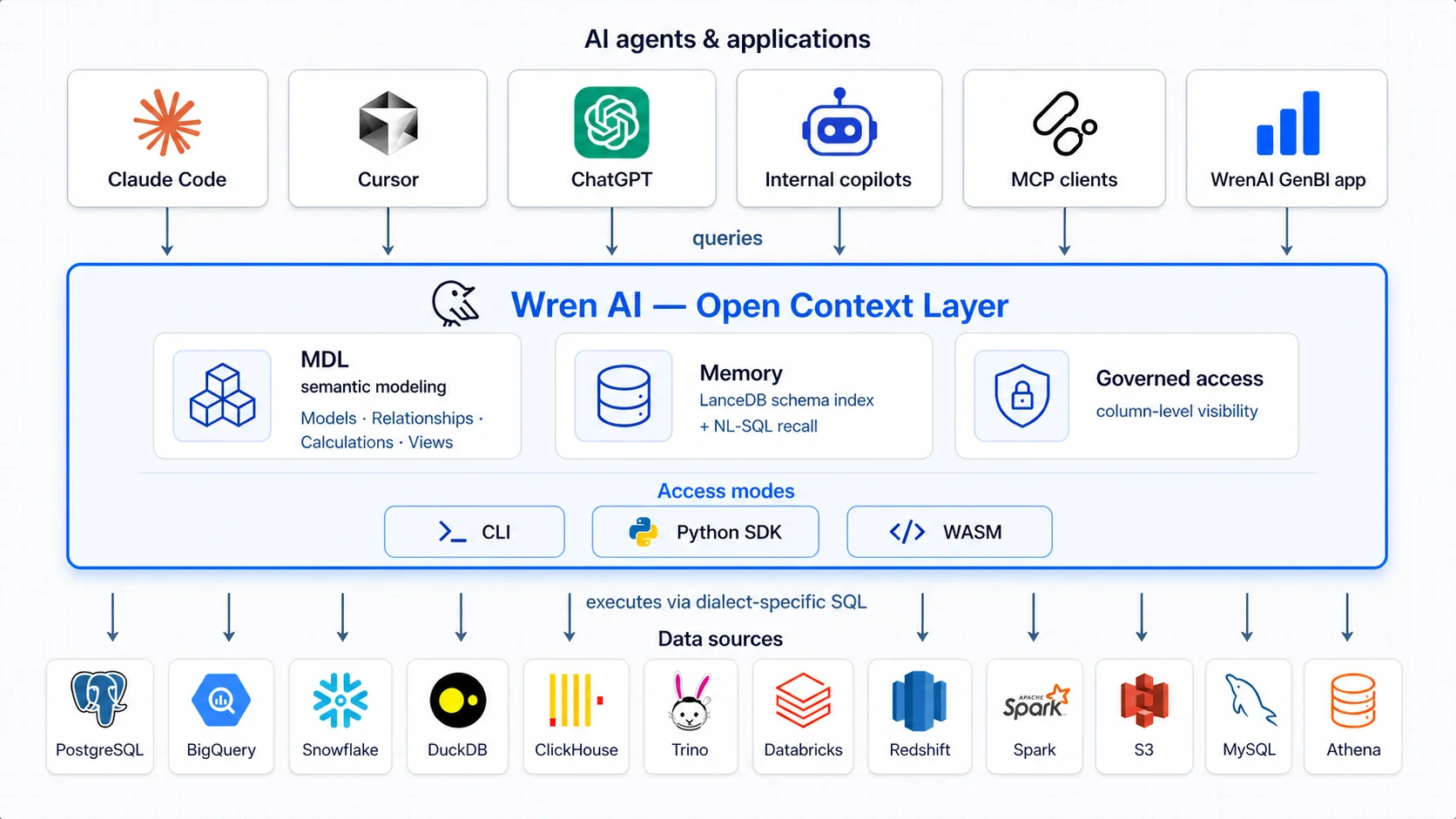
If any tool here is the true spiritual match for PromptQL, it's Wren AI. It's an open-source GenBI engine (Apache 2.0, ~15,800 GitHub stars) that turns plain English into governed SQL across 20+ databases, grounded in an open semantic context layer (MDL) where business definitions live as versionable, Git-friendly files you can review and diff. After a 2026 rearchitecture it works through the agents you already run (Claude Code, Cursor, MCP clients) and deploys via a CLI and Python SDK.
The pitch to anyone skeptical of a "100% accuracy" marketing claim is that the semantic layer is an inspectable set of files, not a black box.
Pricing: self-host is free (you bring your own LLM keys). Wren AI Cloud is credit-based and billed annually: Free ($0), Essential ($179/month), Enterprise ($559/month, adding row/column-level control, MCP, and audit logs). Nothing is gated behind a sales call just to try it.
Verdict: the best PromptQL alternative for teams that want cross-system reach and transparency, especially anyone who distrusts opaque pricing or closed engines. The cost is real setup: Docker or CLI, your own LLM keys, MDL modeling, and connector config before you get value, and the 2026 rearchitecture split the product into a new CLI-first engine and a legacy chat app, so the surface is in flux. But for openness and price, nothing else here competes.
7. Vanna AI
Best for: developers who want to build and embed their own text-to-SQL experience rather than buy a finished product.
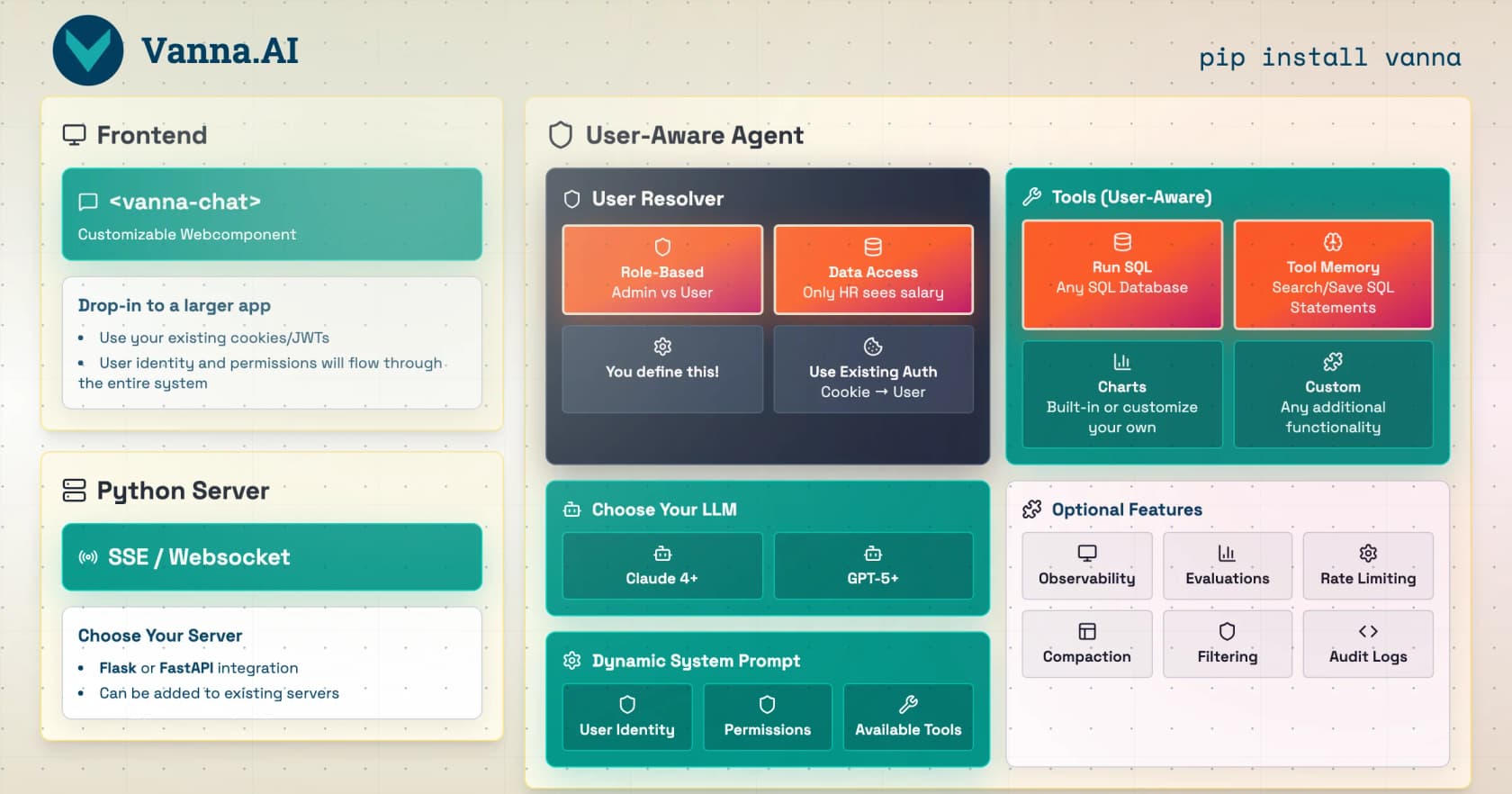
Vanna AI is a different shape: an open-source Python framework (MIT, ~23.8k stars) rather than a product. You "train" it on your schema, docs, and example queries, connect any LLM and any of ~10 databases, and drop a pre-built <vanna-chat> web component into your own app with your own auth. Its 2.0 rewrite adds Tool Memory (a vector store of past successful queries) plus row-level security and audit logs. Microsoft's Azure SQL team even wrote it up on the Azure SQL devblog, a real enterprise signal.
Pricing: free, MIT-licensed, self-hosted. You pay only for your own LLM and infra; an optional hosted cloud adds paid admin features.
Verdict: the right pick when you want maximum control and zero licence cost and you have engineers to build the app, host it, and secure it. Two honest flags: it's fundamentally LLM-generates-SQL (now with retrieval memory), so it doesn't structurally match PromptQL's deterministic plan-then-execute story, and the main GitHub repo was archived and made read-only in March 2026, which is a real durability concern for anything long-lived. Weigh that against a vendor-backed option.
8. Glean
Best for: large enterprises that want a horizontal work-AI assistant across all their SaaS apps, not just structured data.

Glean is the odd one out, and it's here on purpose. It's a "Work AI" platform that indexes everything a company knows across 100+ connectors (Slack, Google Workspace, wikis, code, Salesforce), then layers permissions-aware enterprise search, an Assistant, and a no-code agent builder on top. It raised a $150M Series F at a $7.2B valuation and crossed $100M ARR. When it works, it's striking:
"Glean.com does it for the enterprise I work at: It consumes all of our knowledge sources including Slack, Google docs, wiki, source code and provides answers to complex specific questions in a way that's downright magical... it pointed me to another repository that my team did not own that controlled DNS configs that we were not aware about."
But it's a search-and-retrieval system, not a deterministic computation engine, and reviewers flag the difference:
"It's very very very slow in providing answers. It's also not always consistent. I can query it the same prompt on different occasions and it will use totally different ways to get to an output, which is not helpful."

Pricing: quote-only. Per-user seats plus a pooled FlexCredit consumption layer, with no published dollar figures, so evaluating it is a contact-sales exercise.
Verdict: pick Glean if your real problem is "find and synthesize what the company already wrote down" across unstructured knowledge, where a structured-data agent has nothing to query. Skip it if you need repeatable, exact computation over structured data (reviewers report inconsistent query paths and hallucinated Jira JQL), or if opaque enterprise pricing is a dealbreaker. It's a different category from PromptQL, which is exactly why some teams end up comparing them.
So which PromptQL alternative should you pick?
After living in the docs and pricing pages of all eight, here's how I'd actually decide:
- Data all in one warehouse? Databricks Genie or Snowflake Cortex Analyst. Zero new infra, governance inherited.
- Want a full BI platform with an AI analyst? ThoughtSpot for dashboards, Hex for notebook-native teams.
- Solo analyst on a budget? Julius, every time.
- Want cross-system reach without the lock-in or the price tag? Wren AI if you want a turnkey open-source app, Vanna AI if you want to build it into your own product.
- Enterprise-wide unstructured knowledge? Glean.
The one thing none of them do is customer support. Which brings me to the reason I wrote this in the first place.
Try eesel for the support version of this idea
If you got this far because the "grounded agent that shows its work and tells you when it's unsure" idea clicked, but your data lives in a helpdesk rather than a warehouse, that's the exact problem I work on at eesel AI. Every tool above brings plan-and-verify discipline to the data-analytics world; eesel brings the same "don't guess, ground it, prove it first" instinct to support tickets.
Concretely: eesel connects to your Slack, helpdesk, and knowledge sources like Confluence and Notion, answers from that knowledge with citations, escalates instead of hallucinating, and, the part I wouldn't ship without, simulates on your past tickets before it ever replies to a real customer. Across 8,000+ customers it resolves a real chunk of tier-1 volume in the first month, and pricing is one fixed monthly price from $299 for 500 credits, with no per-seat fee. If PromptQL is the reliable data teammate, eesel is the reliable support teammate.
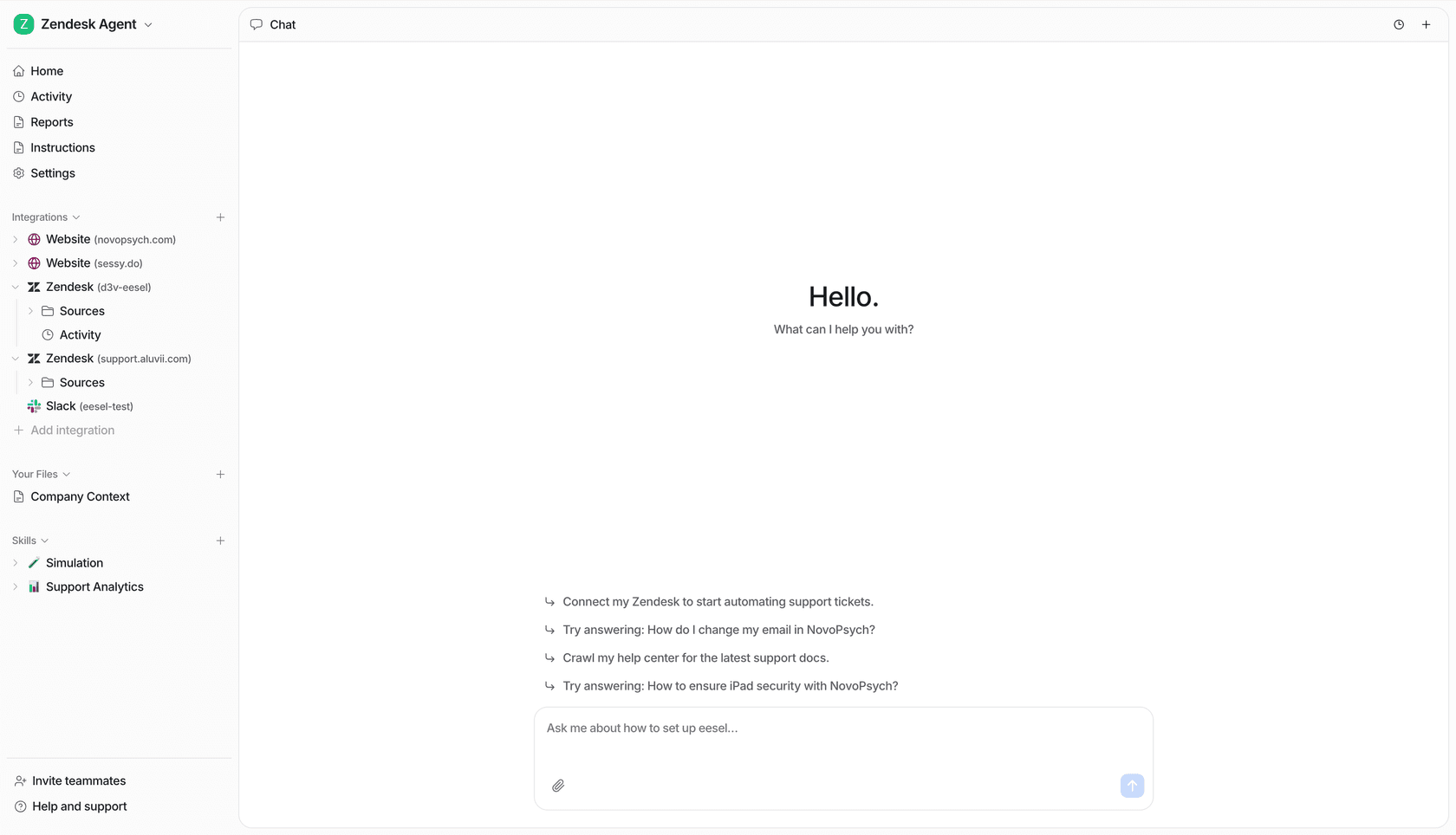
You can try eesel free, connect a source in a few minutes, and run a simulation before you commit to anything.
Frequently Asked Questions
What are the best PromptQL alternatives in 2026?
How much do PromptQL alternatives cost?
Is PromptQL good for customer support teams?


Article by
Rama Adi
Rama is a software engineer at eesel AI with two years of experience writing about B2B SaaS, AI tools, and customer support technology. Based in Bali, Indonesia, he brings a developer's perspective to product comparisons — cutting through marketing copy to what the integrations and APIs actually do.