
What PromptQL actually is
I spend my days on how people search for tools like this, and "what is PromptQL" is a surprisingly loaded query, because the product answers to two different descriptions depending on when you looked at the site.
PromptQL comes from Hasura, the company behind the open-source GraphQL engine that passed 100M+ downloads in two years. Founders Tanmai Gopal and Rajoshi Ghosh raised a $25M Series B and a $100M Series C, and by late 2025 VentureBeat was describing the company as a billion-dollar-plus business selling "$900/hour AI engineers." Tanmai's framing is that the customer for your data changed:
"We realized that apps are no longer the most important things that need access to data. The future is AI talking to data, AI accessing data on the user's behalf."
So the 2025 pitch was a reliable, natural-language layer over enterprise data, positioned against text-to-SQL, tool-calling, and RAG. Then the homepage changed. Today promptql.io leads with "a multiplayer AI agent, think Claude or ChatGPT, but with shared threads and a shared brain," and the headline problem is context decay across Slack, docs, tickets, CRM, and warehouse tables. The named logos are heavy: Cisco, McDonald's, Instacart, Swiggy, and Lightspeed.
Both descriptions are true, and they point at the same engine. But if you arrive cold, you would think PromptQL is a team-knowledge tool a bit like Glean or a shared internal knowledge base. Under the hood it is still a data agent, and the pricing, docs, and benchmarks are all about that engine, not the wiki wrapper. If you remember one thing from this explainer, remember that.
How PromptQL works: plan first, then execute
This is the part that makes PromptQL worth explaining rather than shrugging at. Most "AI on your data" tools hand the whole job to the model at once: read the data, do the math, write the answer, all in one context window. PromptQL splits that in two.
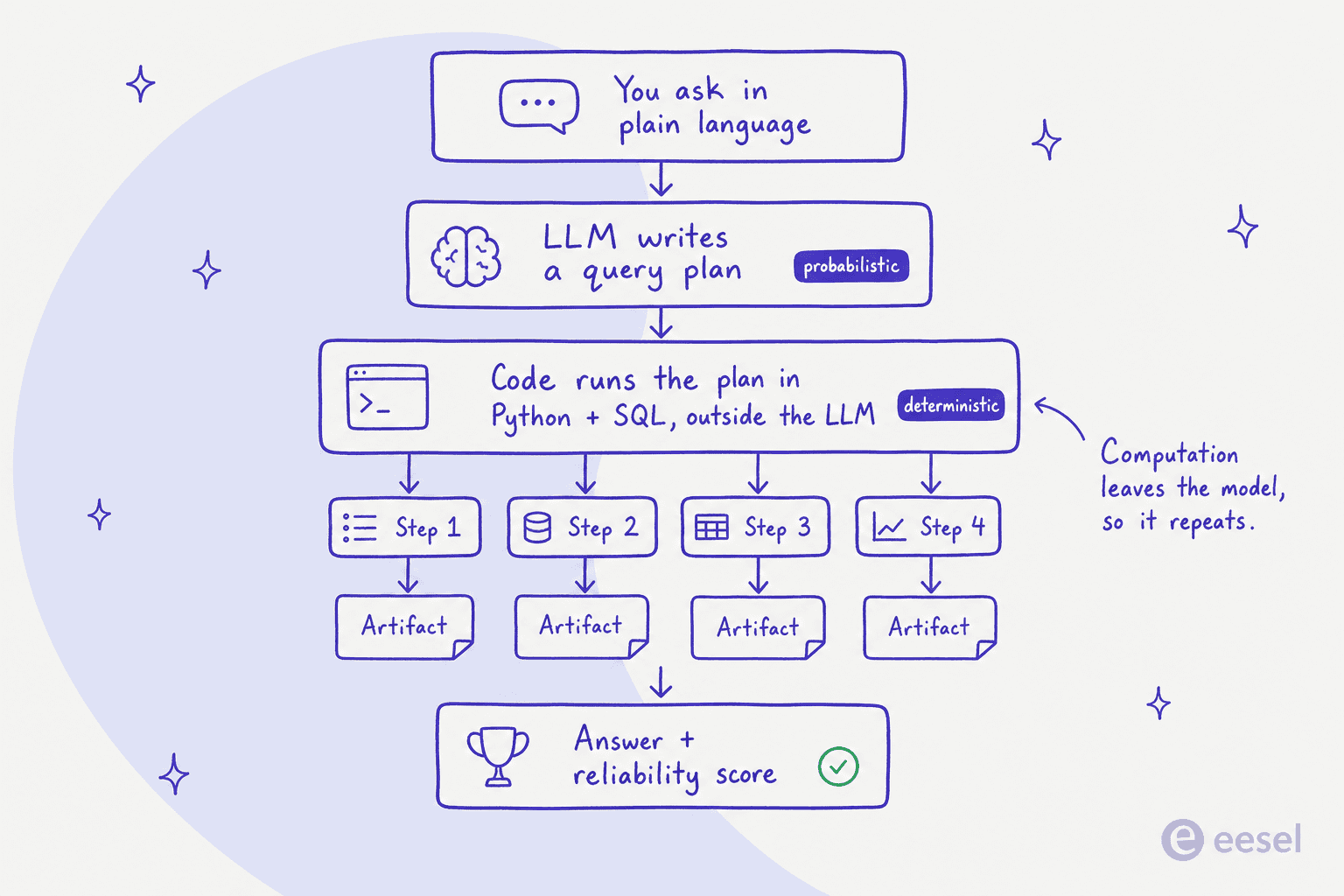
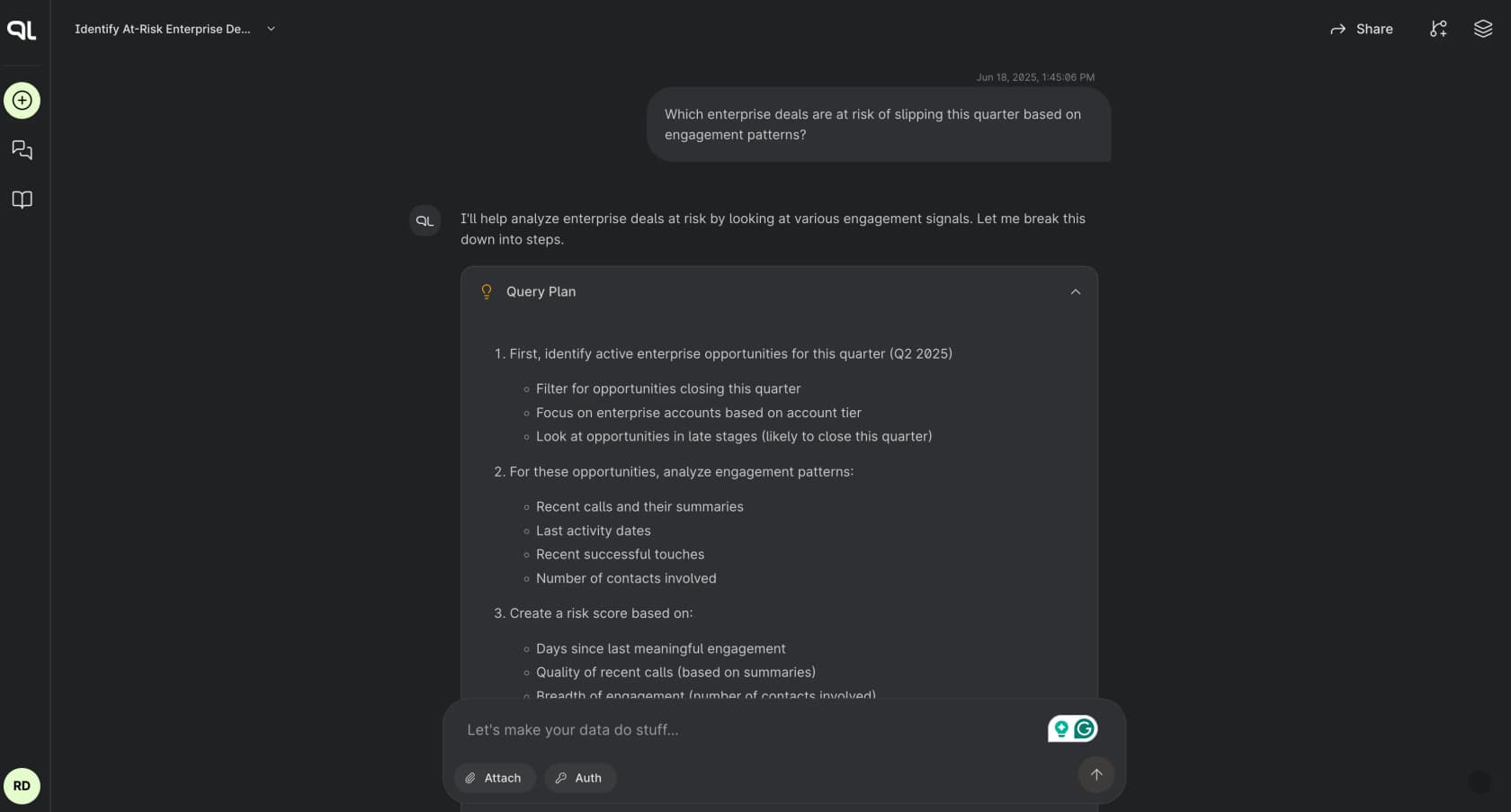
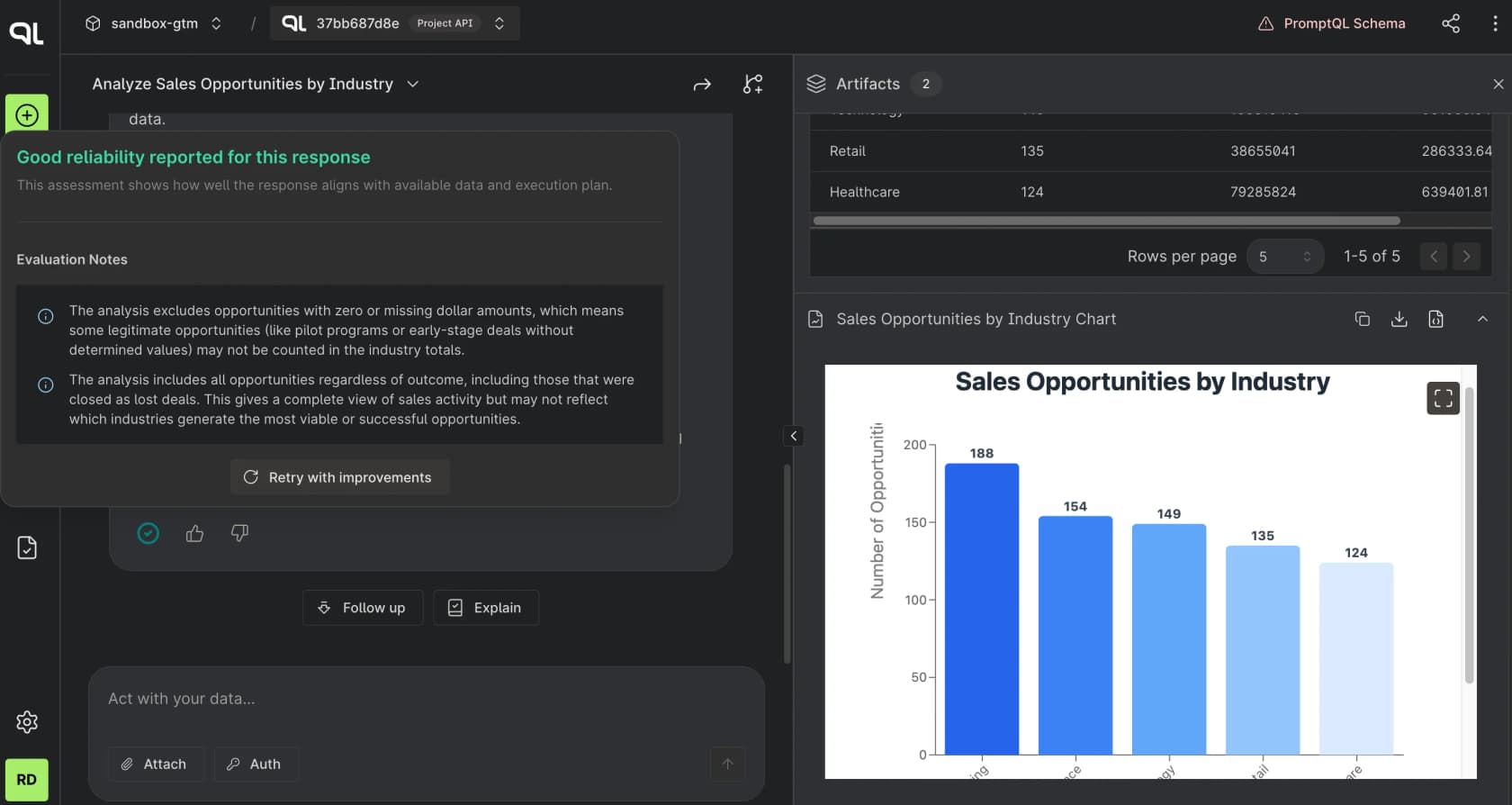
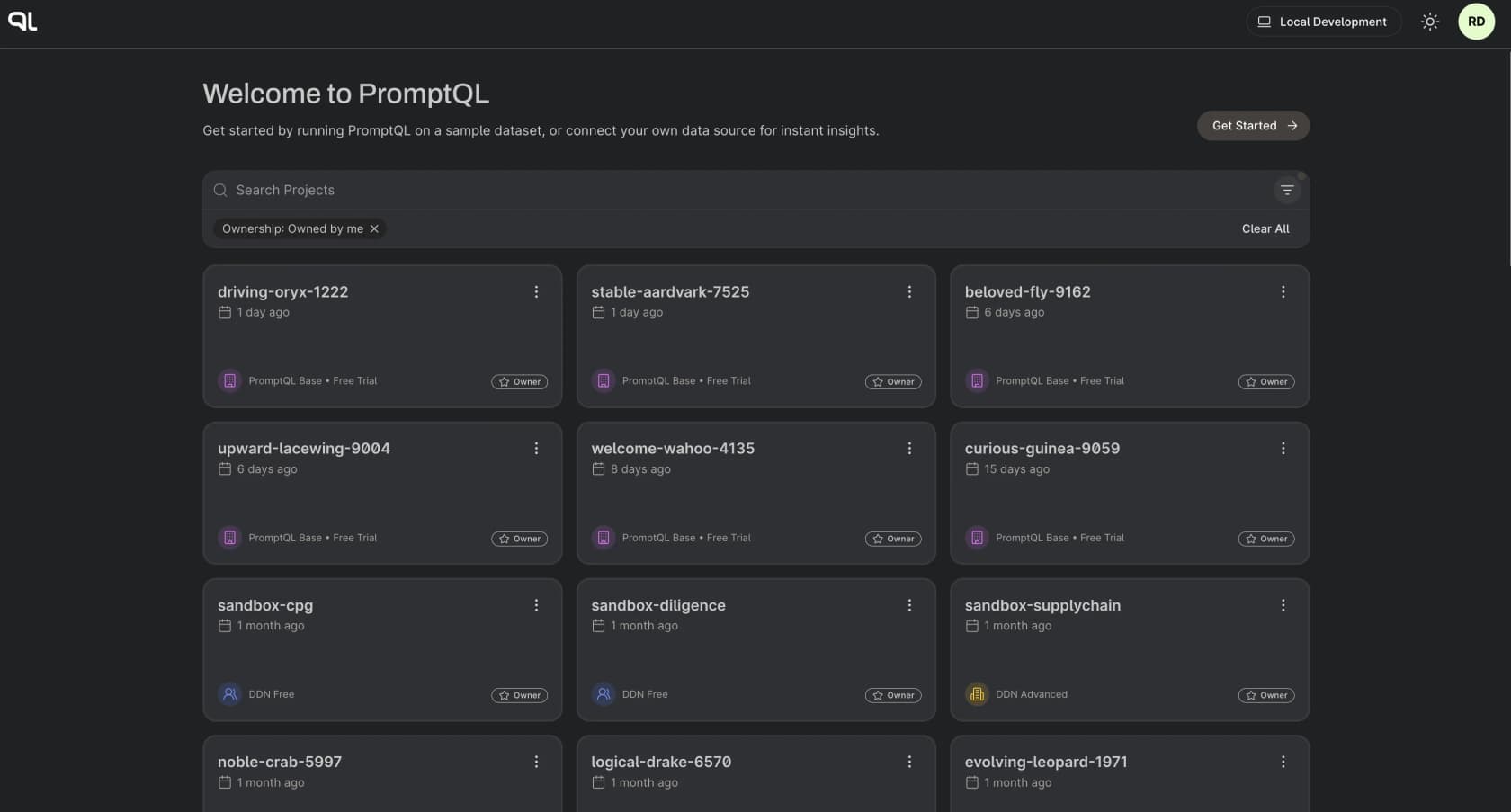
When you ask a question in the Playground, PromptQL first returns a query plan: a step-by-step, plain-language breakdown of how it will pull, filter, and process your data, including the assumptions it is making. You can read it, and you can edit it, at which point PromptQL "remembers and self-corrects for future threads." That transparency is the bit to not skip past: you see the plan before any data moves.
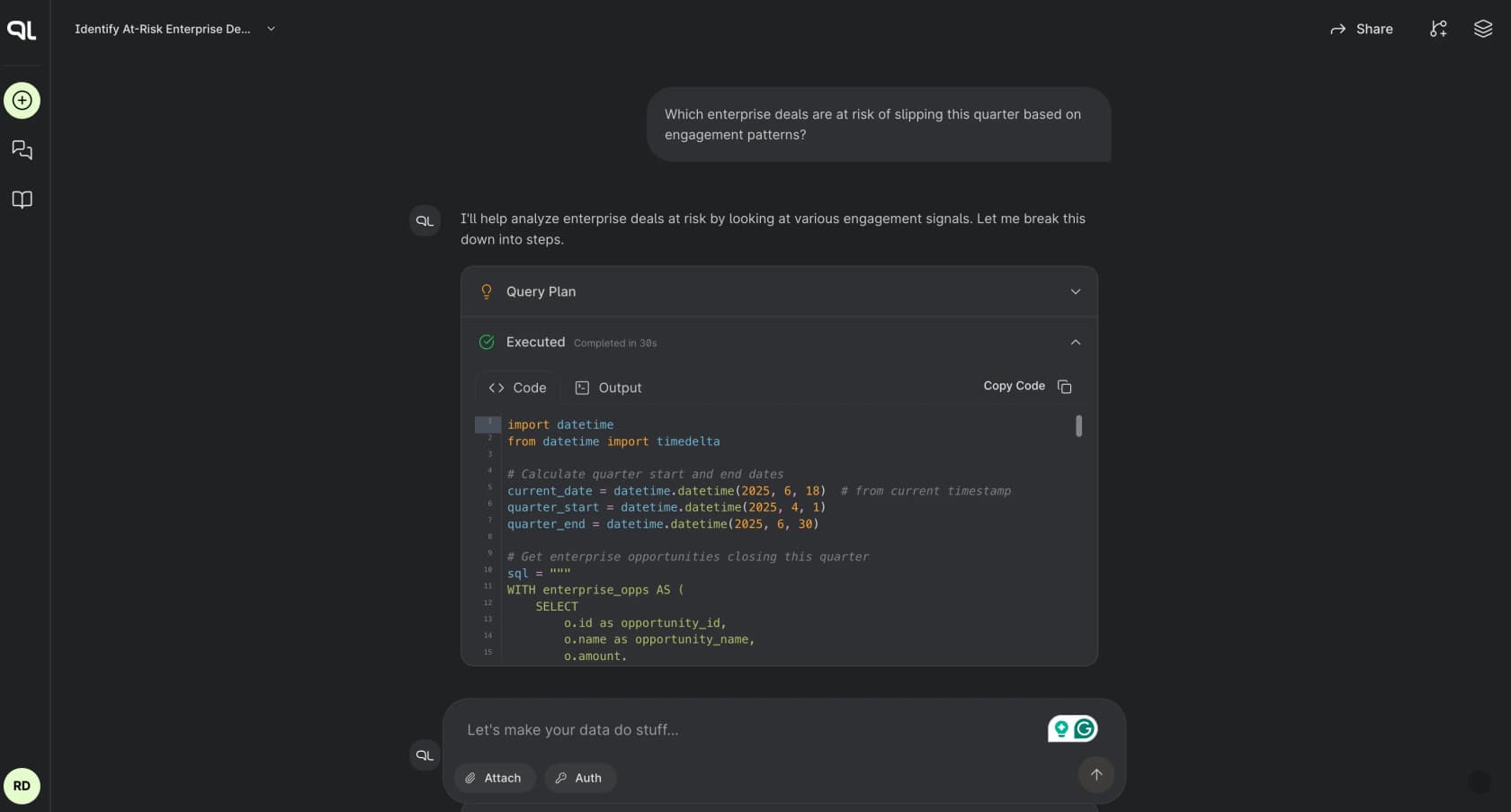
The plan then executes as actual code. PromptQL fetches your data and organizes it with Python, and you can expand any step to see the real Python and SQL it ran against your source. This is the sentence the whole product hangs on:
"Instead of generating answers, we generate plans in a domain-specific language unique to your business. Those plans compile to deterministic actions with runtime validations and policy checks."
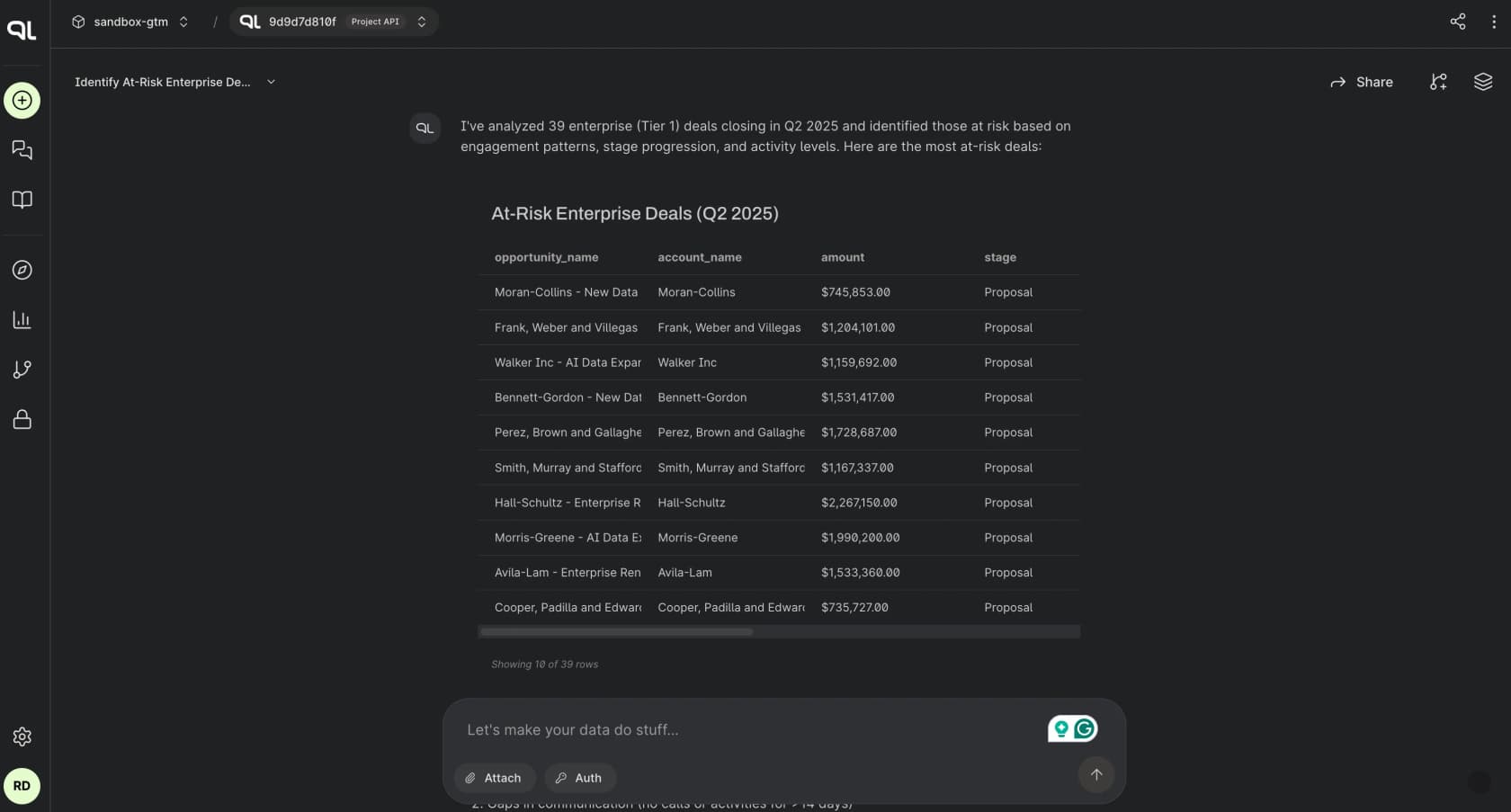
Results land as artifacts: structured tables, text, or charts that live outside the model's context and get referenced by later steps. That is the clever bit for scale, because it means PromptQL can work over data far larger than a context window without the model quietly losing track of it. The semantic work (classify, summarize, extract, visualize) is handled by narrow AI primitives that each run in isolation with a focused context, so the LLM only ever reasons over a small, well-scoped slice.
Finally, every answer gets a reliability score built from query complexity, data accuracy, and model confidence, with notes on what the analysis did and did not include. If the score is low, you correct it, and the correction sticks for next time. Coming from the support world, this pattern is familiar: it is the same instinct behind preventing hallucinations, where the system should tell you when it is unsure instead of guessing with a straight face.
The problem PromptQL is actually solving
To see why plan-then-execute matters, look at how badly raw models do on real data questions. Tanmai points at the Berkeley Data Agent Benchmark, where frontier models land well below what a demo would have you believe.
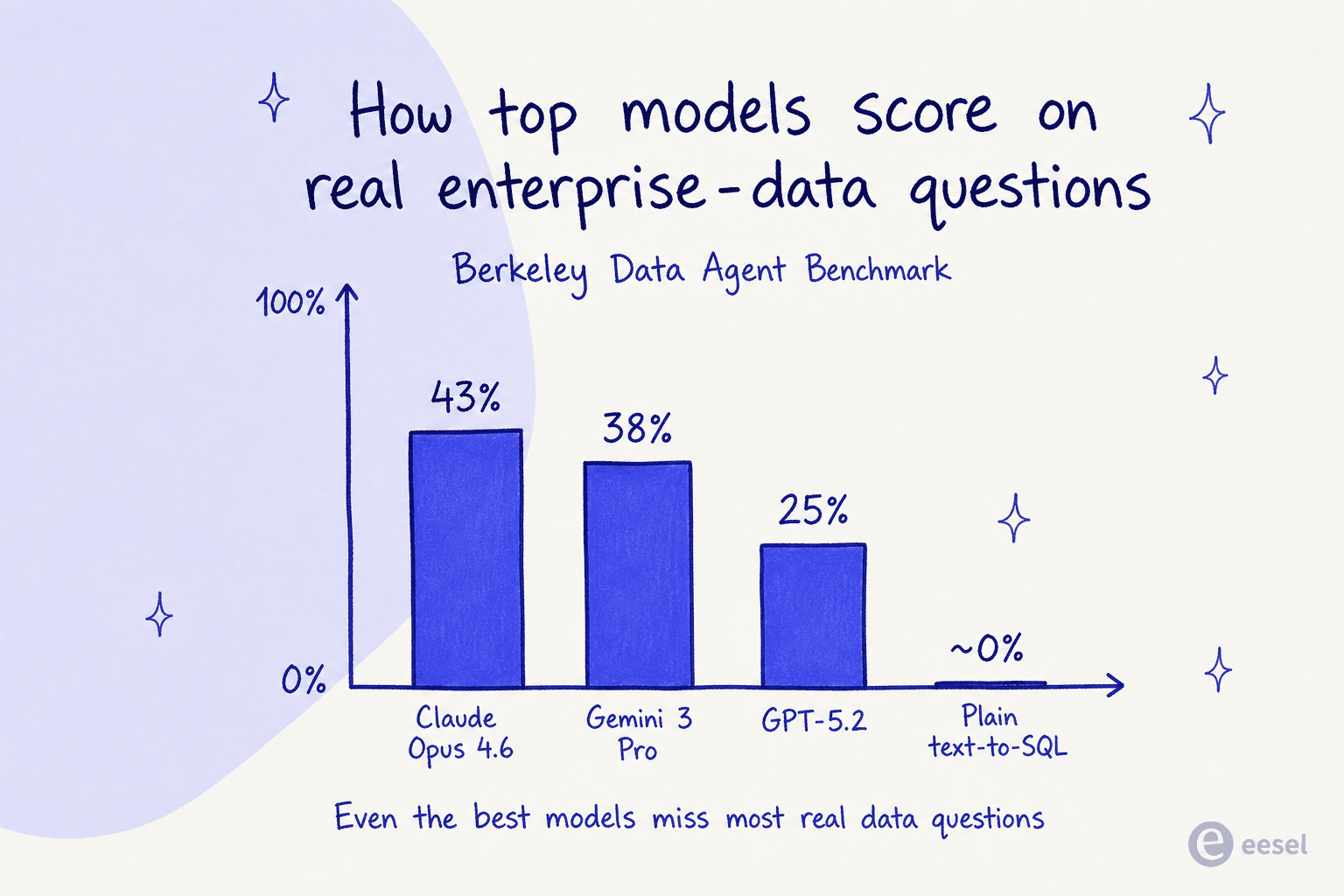
On real-world data questions, the Berkeley benchmark puts Opus 4.6 at 43%, Gemini 3 Pro at 38%, and GPT-5.2 at 25%, while vanilla database query generation scores "close to 0%." The benchmark's own read is that agents "typically select the right data, but fail at planning the computation or implementing it correctly." That is exactly the gap the plan-and-execute split targets, and it is why the founder keeps hammering one word:
"The biggest problem is not being able to just accurately answer the question. The big problem is AI pretends to be accurate even when it's not. So AI is confidently wrong. That's the problem."
Hasura groups the failure into four modes, and this 2x2 is the most useful thing to internalise before you evaluate any AI data analytics tool, PromptQL or otherwise.
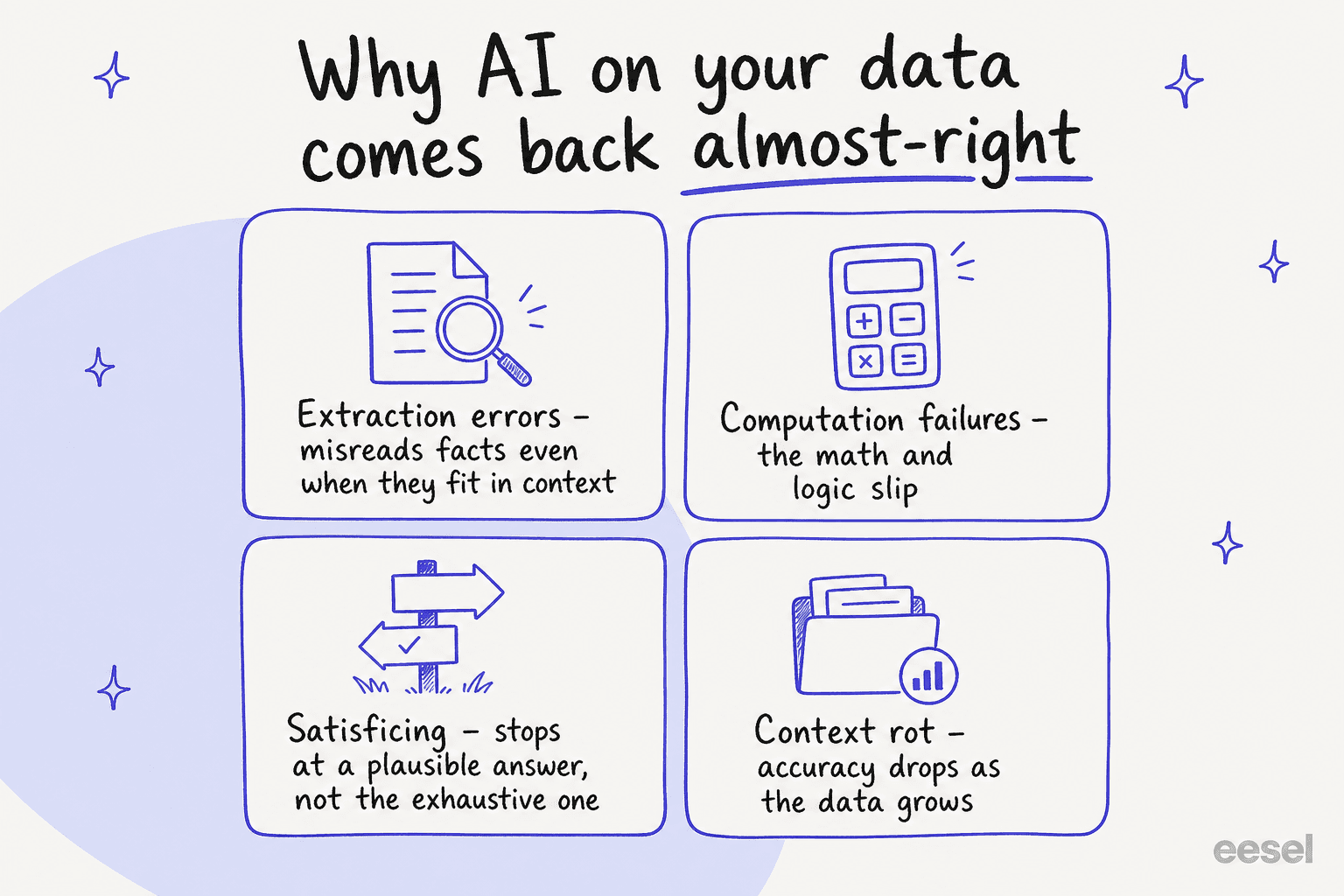
Now, about that "100% accuracy" headline. Hasura is refreshingly honest that it is bait: the company concedes a "100% accuracy claim doesn't technically hold water," and the real claim is 100% repeatability, because the computation runs in code, not through model reasoning. On the narrower CRMArena-Pro database and numerical tasks, they report 100% versus a cited 30 to 60% for state-of-the-art approaches. Read the round number as a conversation starter and the repeatability as the actual feature.
What PromptQL connects to, and what it can do
Being an AI agent is only useful if it reaches your data, and this is where PromptQL's Hasura lineage pays off. It rides on Hasura DDN, so a supergraph stitches multiple subgraphs together, and relationships "do not need to be backed by the same data source." In plain terms, it can join Postgres to a SaaS API and reason across both, which is where tools built only for Snowflake or one warehouse fall down.
The native connector list is long: PostgreSQL, MySQL, SQL Server, Oracle, Snowflake, Amazon Redshift, BigQuery, MongoDB, and Databricks, plus HTTP/API sources, real-time web search, and interoperation over MCP. The 2026 wrapper adds a self-building context layer that seeds a team wiki from Slack, Google Docs, PostHog, and Salesforce, keeps revision history and audit trails, and enforces scoped access.
Two capabilities are worth calling out because they change what "asking a question" turns into:
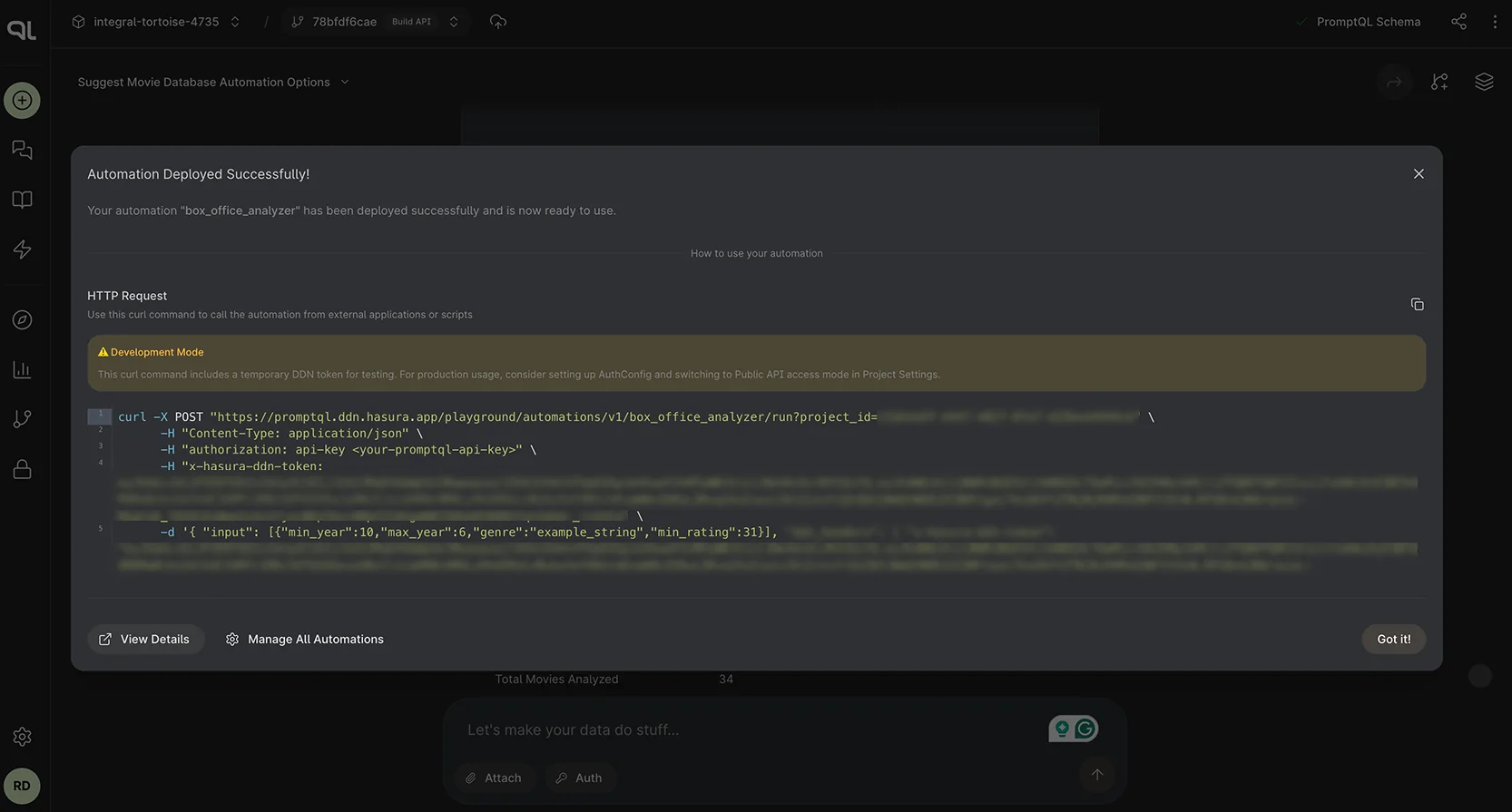
- Automations that become real APIs. Once a workflow runs in the Playground, you deploy it as an HTTP endpoint callable from Zapier, Slack, cron jobs, or your own apps, with no coding. A one-off thread becomes a repeatable business process.
- Bring your own model. PromptQL runs any LLM, from Claude and GPT to open-weight models like DeepSeek, Kimi K2, and GLM. You can switch models per thread, and, as we will see, that dropdown is the single biggest lever on your bill.
How much PromptQL costs
PromptQL has no seat pricing. It is 100% consumption-based, billed in a normalized unit called an OLU (Operational Language Unit), which rolls input, output, cached, and cache-creation tokens across every model into one consistent number so your bill does not change shape when you switch models.
| Plan | Price | Billable unit | What you get |
|---|---|---|---|
| Free credits | $50 per project, +$20 per teammate | OLU | No card required; enough for thousands of simple tasks on an open-weight model |
| Starter | $0.20 per OLU ($0.14 introductory, at cost) | OLU | Pay-as-you-go, prepaid balance, auto-pauses at zero, per-user quotas; all-in (tokens + infra + sandbox) |
| Enterprise | Custom, talk to sales | OLU | Adds SSO, BYOC/VPC, private networking, BYO LLMs, audit trails, forward-deployed engineers |
The typical task costs Hasura quotes (at the $0.14 rate) are honest and small: under 2 OLUs for a simple data task (under $0.28), around 10 OLUs for a complex report ($1.40), and around 40 OLUs for a deep investigation ($5.60).
Here is the catch, and it is the thing most "what is PromptQL" write-ups skip. The per-OLU price is fixed, but the model you pick changes how many OLUs a task burns, and the spread is enormous. Against a Claude Opus 4.6 baseline of 1.0x, GPT-5.2 runs 0.42x, Kimi K2.7 runs 0.17x, and DeepSeek V4 Flash runs as low as 0.018x, which Hasura frames as up to 57x cheaper for the same work. So the same report can cost a few dollars or a few cents depending entirely on the model dropdown. Plug your own numbers in:
The takeaway is a habit, not a number: on PromptQL, picking an open-weight model for routine tasks is the difference between a rounding error and a real line item. It is the same total-cost-of-ownership thinking we apply to AI agent costs, with the model dropdown as the dial.
Who PromptQL is for (and who it isn't)
After living in the docs, the Playground screenshots, and the pricing page, the honest read is that PromptQL rewards a specific kind of team and frustrates everyone else.
It fits data or analytics teams with messy, cross-system data, real reliability requirements, and the engineering appetite to model a semantic layer. Setup is a genuine data project (connectors, HML metadata, the DDN CLI), so it is not plug-and-play, but the payoff is an agent whose every step (query plan, Python/SQL, artifacts, reliability score) you can inspect. The plan-then-execute design is the most credible answer I have seen to confidently wrong AI on your own data.
It doesn't fit if you wanted a turnkey assistant, if you are a small team without a data engineer, or if your actual job is customer support. One thing worth flagging for anyone evaluating it: PromptQL's public footprint is thin, with no G2 or Capterra reviews yet and both official Show HN launches drawing almost nothing (six points and four comments on one, six points and one comment on the other). Its own developer base is warm on the direction, though:
"I have built and managed more than 10 production codebases that use Hasura. IMO, I think it's a better option than Supabase, Payload, and others to build your backend. The fact that they are investing time in LLM-related resources for the platform makes me happy we choosed it back when."

Try eesel for the support version of this idea
If you read this far because the "grounded agent that shows its work and tells you when it is unsure" idea clicked, but your data lives in a helpdesk rather than a warehouse, that is the exact problem I work on at eesel AI. PromptQL brings plan-then-execute discipline to the data-analytics world; eesel brings the same "don't guess, ground it, prove it first" instinct to support.
Concretely: eesel connects to your Slack, helpdesk, and knowledge sources like Confluence and Notion, answers from that knowledge with citations, escalates instead of hallucinating, and, the part I would not ship without, simulates on your past tickets before it ever replies to a real customer. Across 8,000+ customers it resolves a real chunk of tier-1 volume in the first month, and pricing is one fixed monthly price from $299 for 500 credits, with no per-seat fee. If PromptQL is the reliable data teammate, eesel is the reliable support teammate.
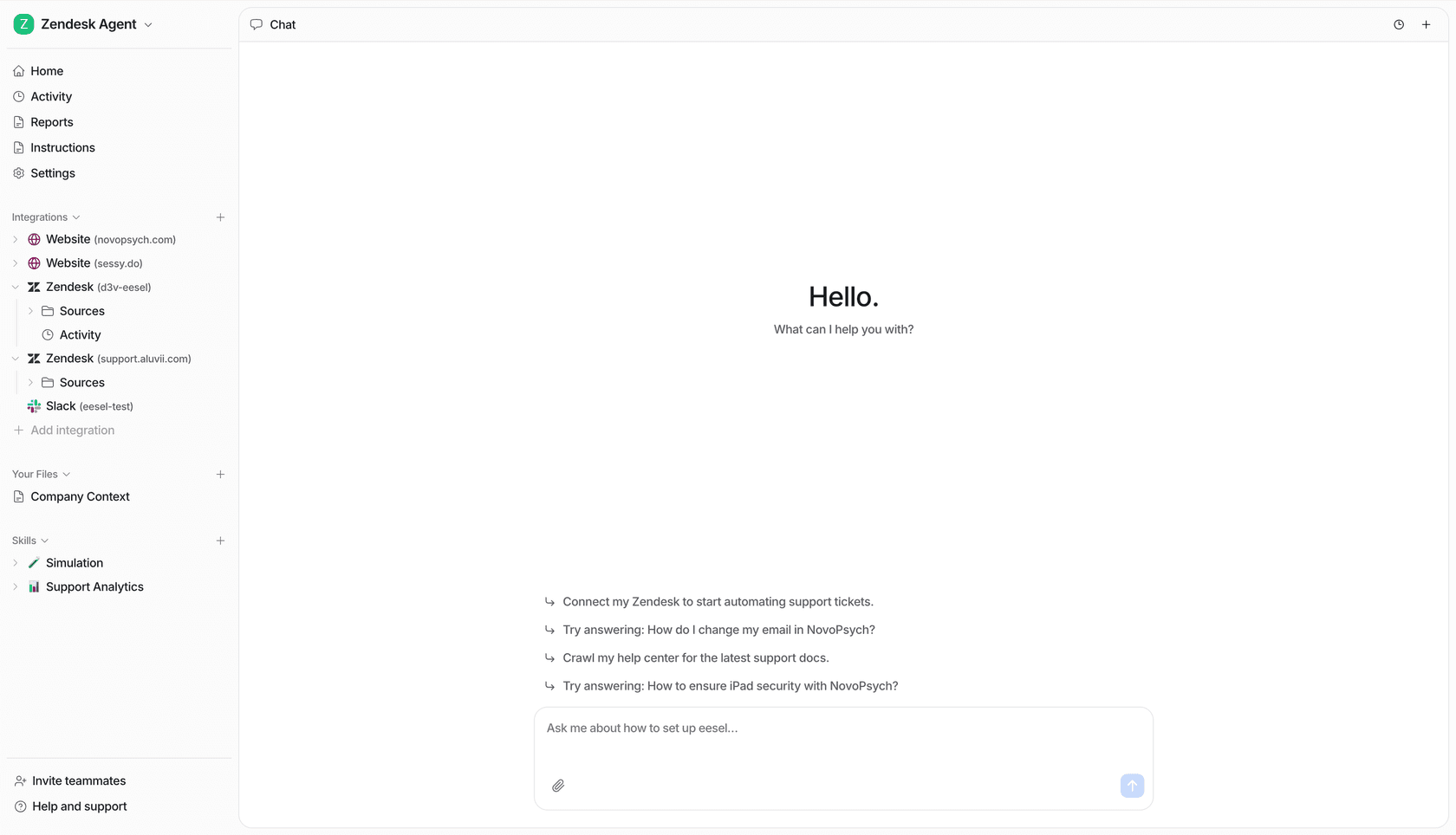
You can try eesel free, connect a source in a few minutes, and run a simulation before you commit to anything.
Frequently Asked Questions
What is PromptQL in simple terms?
Who makes PromptQL and who is it for?
How much does PromptQL cost?
How is PromptQL different from text-to-SQL or RAG?
Is PromptQL's "100% accuracy" claim true?


Article by
Kurnia Kharisma
Kurnia is a software engineer and writer at eesel AI with two years of SEO experience, writing about AI tools, helpdesk software, and customer support. He pairs a developer's understanding of how these products are built with search-driven research into what actually ranks and resonates with the people searching for them.