The way we look for information is changing, and it's happening faster than you can say "Google it." For years, the marketing playbook was pretty straightforward: get your website on the first page of Google. But now, people are getting their answers directly from AI tools like ChatGPT and Google's AI Overviews, often without clicking a single link.
This is a pretty big deal for marketers. A recent Pew Research study found that when an AI summary pops up, users click on the old-school search results way less often, nearly half as much, in fact. We're talking an 8% click-through rate compared to 15% without an AI summary. This is the new "zero-click" world, and if you're not ready for it, your brand could easily get lost in the noise.
The answer is LLM optimization (LLMO). It’s the new strategy for getting your brand seen, not by climbing a list of links, but by becoming part of the AI-generated answer itself. To succeed here, you have to rethink how you create content. That's why tools like the eesel AI blog writer are popping up, to help businesses adapt by generating publish-ready, LLM-optimized articles from just a keyword.
Understanding the shift from SEO to LLM optimization
It's tempting to hear "LLM optimization" and just file it away as a new buzzword for SEO. But it's a bit more than that. It’s a real shift in how we need to approach online visibility. The goal isn't just to rank on a results page anymore; it's to be cited and featured right inside the AI's answer.
What is LLM optimization?
LLM optimization is a marketing strategy that focuses on improving a brand’s visibility and how it’s talked about in the answers generated by Large Language Models (LLMs) like ChatGPT, Google's AI Overviews, and Perplexity.
Now, if you ask an AI engineer, they might use "LLM optimization" to mean the technical work of making AI models faster. For marketers, though, it’s all about getting your brand into the AI’s knowledge base. You might also hear it called Answer Engine Optimization (AEO) or Generative Engine Optimization (GEO). They all point to the same thing.
Think of it this way: Traditional SEO helps your website get a good spot on page one. LLM optimization helps your brand become the answer inside the AI summary.
Traditional SEO
- Goal: Rank high on a Search Engine Results Page (SERP).
- Focus: Keywords, backlinks, page rank, domain authority.
- Metrics: Clicks, impressions, keyword rankings.
LLM Optimization
- Goal: Get included and cited in AI-generated answers.
- Focus: Brand mentions, E-E-A-T signals, structured data, conversational queries.
- Metrics: Citations, share of voice in AI answers, brand sentiment.
Why LLM optimization matters: The impact of AI on search
This isn't some trend you can put on the back burner for a few years. AI is growing incredibly fast. According to an IDC forecast, worldwide spending on AI is projected to reach an eye-watering $632 billion by 2028. This isn't just about tech companies; it's changing how every business talks to its customers.
The risk of getting left behind is very real. As of March 2025, a reported 18% of Google searches were already showing an AI Overview. If you ignore LLMO, you're basically choosing to be invisible on the platforms where your customers are looking for answers.
But it’s not all bad news. This change also opens up a huge opportunity. A Semrush study found that the average AI search visitor is 4.4x more valuable than a traditional organic search visitor. These aren't just people browsing casually; they have a specific question and are looking for a direct, trustworthy answer. Optimizing for LLMs isn't just a defensive play; it's a way to attract some of your best potential customers.
Right now, most brands are still focused on the old SEO game. That means there's a massive advantage for early adopters. By shifting your strategy to LLMO today, you can grab a significant share of the conversation before it gets too crowded.
The core pillars of a successful LLM optimization strategy
So, how do you actually do this? Optimizing for LLMs isn't about finding some secret trick to fool the algorithm. It's about building real authority and making your content super clear, helpful, and easy for both humans and AI systems to digest.
Pillar 1: Using E-E-A-T for successful LLM optimization
E-E-A-T stands for Experience, Expertise, Authoritativeness, and Trustworthiness. While it's not a simple checkbox on a list, it's a framework Google uses to sort high-quality content from the rest. LLMs are trained on enormous amounts of data, and they're built to recognize and prioritize credible, reliable information. E-E-A-T signals are exactly what they're looking for.
Here’s how to work it into your content:
- Share your experience: Don't just list facts; share what you know firsthand. Use phrases like, "In my experience testing this software..." or "When our team tried this, we learned that..." This adds a layer of authenticity that AI can detect.
- Show off your expertise: Your content should be written by people who actually know their stuff. Create detailed author bios with credentials, experience, and links to other work. Make sure these bios link to a dedicated author page on your site.
- Build authority: Back up your claims with data. Link out to reputable sources like studies, industry reports, or official statistics. This proves your content is well-researched and not just your opinion.
- Be trustworthy: Trust comes from being transparent. Make sure your site is secure (using HTTPS) and has clear "About Us" and "Contact" pages. Let people know who's behind the brand and how they can reach you.
Pillar 2: Structuring content for easy AI parsing
LLMs don't just read words; they try to understand the relationships between ideas, a process called entity recognition. A well-structured article makes it much easier for them to figure out what your content is about and how all the information is connected.
- Use Schema Markup: Think of schema as a "cheat sheet" you give to search engines and AIs. It's code that clearly labels your content. For example, "Organization" schema tells an AI you're talking about Apple the company, not the fruit. Using schema for "Person" (your authors), "FAQ", "HowTo", and "Article" gives AI clear context.
- Optimize for Passages: AI answer engines often grab specific paragraphs or "passages" to build their summaries, not whole articles. This means you need to make sure key paragraphs can stand on their own. Use clear, descriptive subheadings that act as mini-headlines for each section.
- Build Topic Clusters: To show an LLM you're an authority on a topic, you need to cover it from all angles. Create a central "pillar" page for a broad topic (like "Customer Support Automation") and then write multiple "cluster" posts that go deep into specific sub-topics (like "AI Triage for Zendesk" or "Benefits of AI Chatbots"). Linking these pages together tells the AI that your site is a reliable resource for that entire subject.
Pillar 3: Expanding your offsite brand footprint
LLMs don't just learn about you from your website. They learn from what everyone else on the internet is saying about you. A strong offsite presence is a huge trust signal. If reputable sources are talking about you, the AI is more likely to see you as a credible source.
- Forums and Q&A Sites: A really interesting Semrush study found that Quora and Reddit are the two most-cited external websites in Google's AI Overviews. This isn't about spamming links. It's about actually participating. Answering questions and providing real value in these communities builds your brand's reputation as a helpful expert.
- High-Authority Publications: Getting mentioned or linked to by respected industry blogs and news outlets is invaluable. This is where digital PR comes into play. Earning these mentions shows that other authorities in your field trust you.
- Reference Sites: Make sure your brand's information is correct on sites like Wikipedia. LLMs often use these as a baseline for factual information.
- Multi-Format Content: People consume information in different ways, and so do AIs. Create YouTube videos, podcasts, and webinars that answer common questions in your industry. These formats are often pulled into AI-generated answers.
How to create content for LLM optimization with the eesel AI blog writer
Automating the pillars of LLM optimization
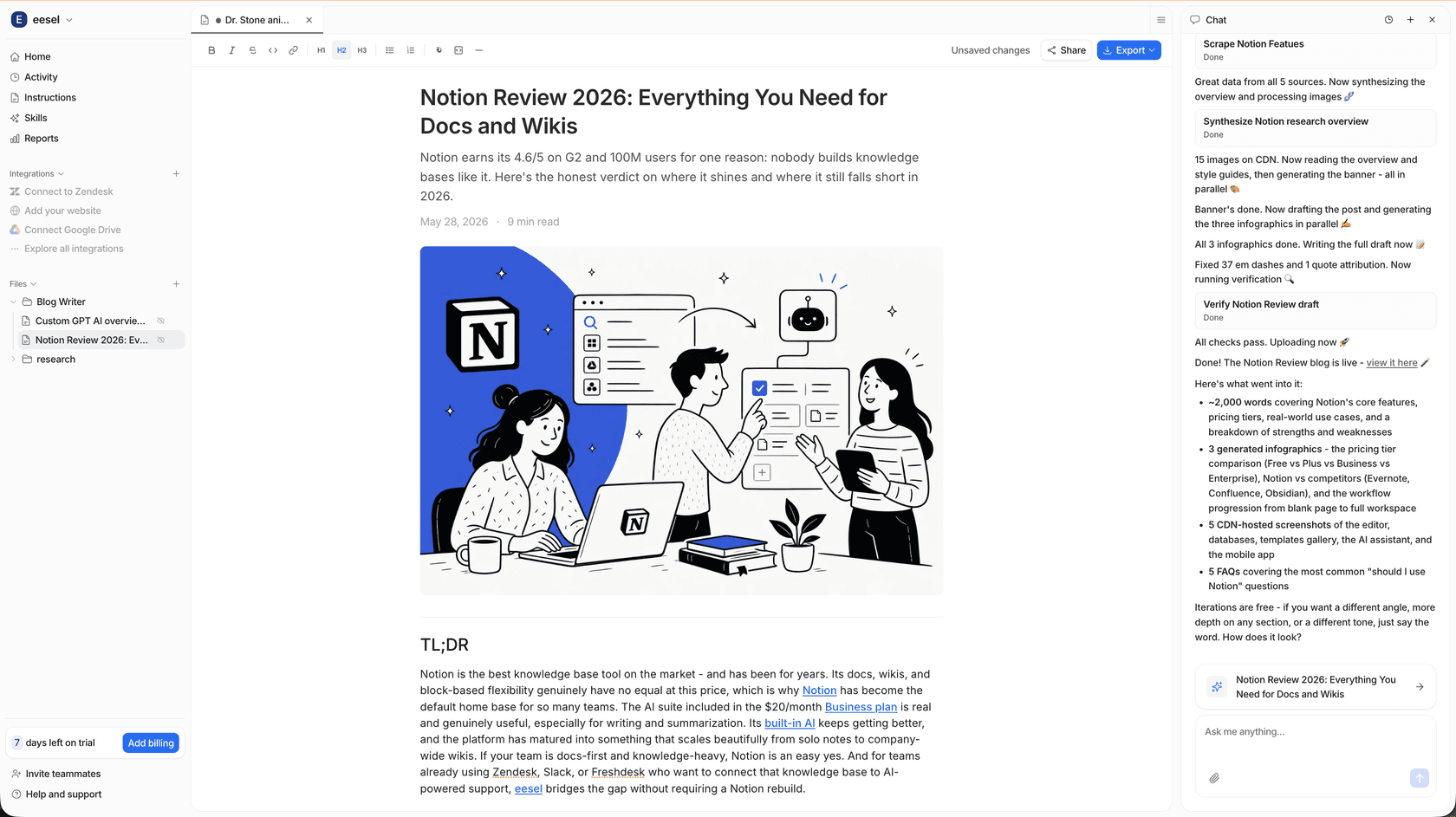
The eesel AI blog writer handles the core pillars of LLMO automatically, so you can focus on strategy instead of getting stuck in the weeds of execution.
- Authority & Trust (E-E-A-T): It conducts deep, context-aware research for each article and automatically includes citations to external sources. The platform also integrates social proof by finding and embedding relevant Reddit quotes and YouTube videos, which adds layers of genuine experience and trustworthiness that LLMs value.
- Structure & Accessibility: From a single keyword, it generates a complete, well-structured blog post. You get a logical flow with an introduction, proper headings and subheadings, a conclusion, and even an FAQ section. The whole thing is formatted to be easily understood by both search engines and answer engines.
- Assets & Media: A wall of text is boring for everyone, including AIs. Our platform automatically creates and embeds relevant visuals like infographics, charts, and tables right into the content. This makes complex information easier to understand and gives LLMs structured data points they can easily pull from.
How to track and measure your LLM optimization efforts
You can't improve what you don't measure. In an AI-first world, the old SEO metrics like keyword rankings and raw clicks don't give you the full picture anymore. You need a new set of metrics to really understand your visibility.
Key metrics for LLM optimization
Here are the key things you should start tracking to measure your LLMO success:
- Brand Mentions: How often does your brand's name show up in AI-generated answers when people ask relevant questions?
- Citations: How often do LLMs link to your content or name your website as a source? This is the new backlink.
- Sentiment: How is your brand being mentioned? Is it positive, neutral, or negative?
- Share of Voice: For your most important topics, what percentage of AI answers feature your brand versus your competitors?
While a new wave of analytics tools is coming to track this automatically, you can start today. Just go to ChatGPT, Perplexity, or Google's AI search and start asking the questions your customers would ask. Keep a record of which brands get mentioned and which sources get cited, and build a baseline to track your progress.
For a deeper dive into how LLM optimization works in practice, especially in relation to SEO, the following video offers some great insights from an expert in the field.
Your next steps in the age of AI search
LLM optimization isn't just another marketing trend to watch; it's a fundamental change in how people find information and how brands need to communicate. It's the new SEO.
The brands that succeed in this new landscape will be the ones that consistently create trustworthy, well-structured, and genuinely helpful content. They'll be the ones that build a credible presence not just on their own site, but across the entire web.
The good news is that we're still in the early stages. Adapting your content strategy now gives you a huge head start before this becomes the norm for everyone. The easiest way to begin is by creating content specifically designed for this new world.
Try the eesel AI blog writer for free and generate your first LLM-optimized article in minutes. See for yourself how simple it can be to start competing in the age of AI search.