

The fight is Flash against Luna, not against Sol
GPT-5.6 is three models, not one, and the gpt-5.6 alias simply routes to Sol. Which is why a lot of head-to-heads read oddly. They put DeepSeek's cheap tier against OpenAI's expensive one, then conclude that cheap models are cheap.
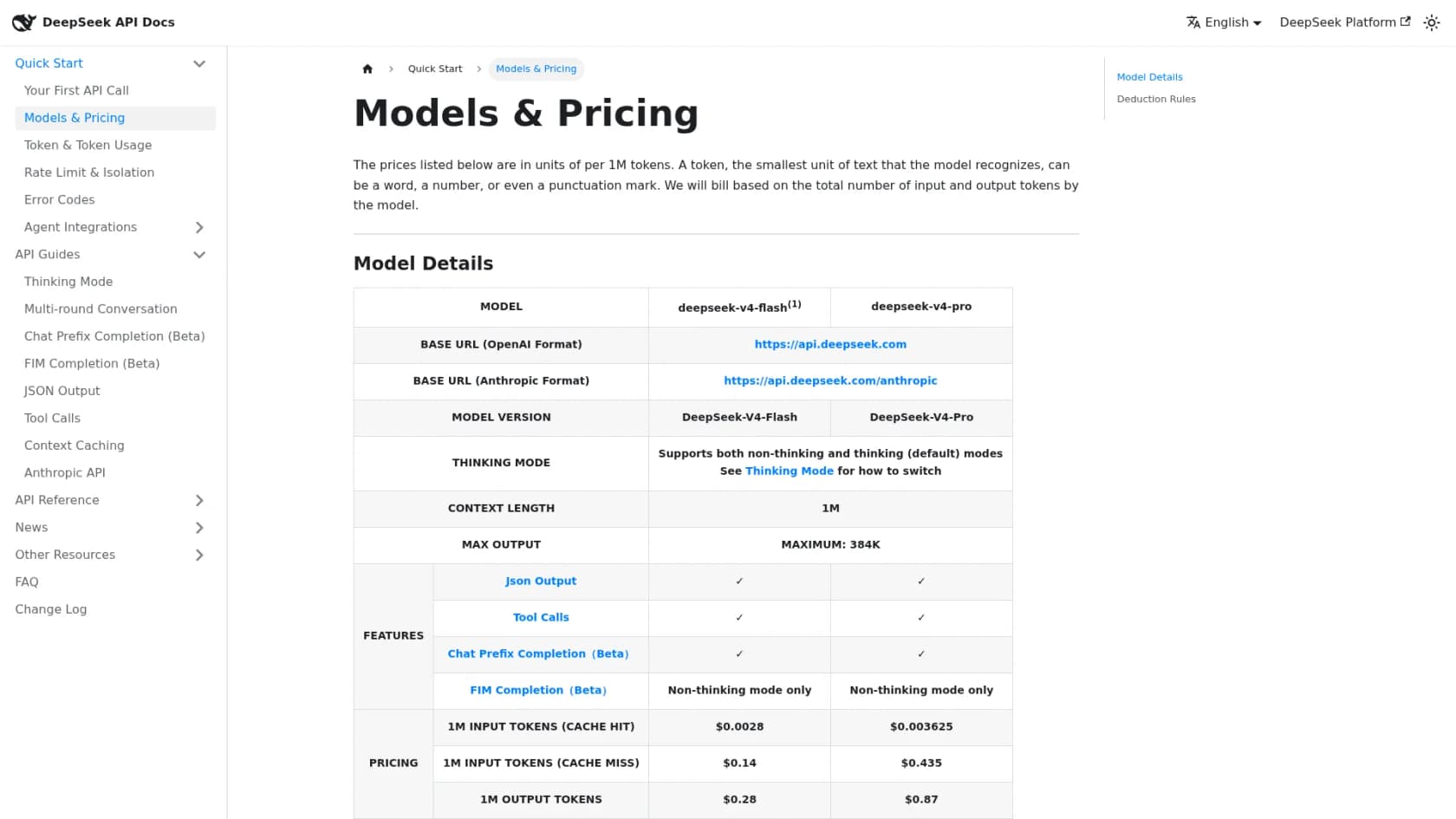
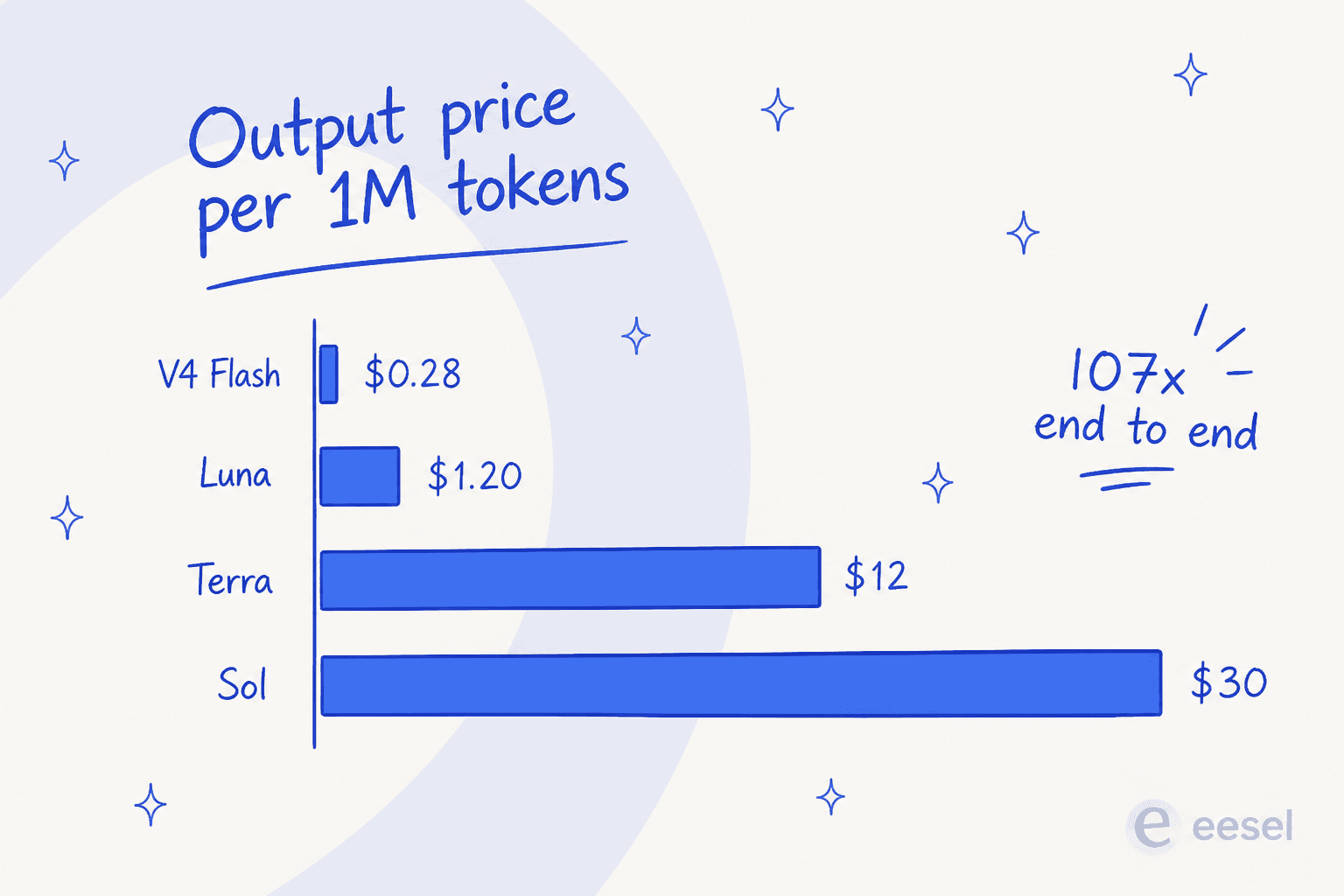
Here is the whole price card as it stands, standard tier, short context, per million tokens.
| Model | Input | Cached input | Output | AA Intelligence Index |
|---|---|---|---|---|
deepseek-v4-flash | $0.14 | $0.0028 | $0.28 | 50 |
gpt-5.6-luna | $0.20 | $0.02 | $1.20 | 51 |
gpt-5.6-terra | $2.00 | $0.20 | $12.00 | 55 |
gpt-5.6-sol | $5.00 | $0.50 | $30.00 | 59 |
deepseek-v4-pro | $0.435 | $0.003625 | $0.87 | 44 |
Prices from DeepSeek's price card and the OpenAI pricing page; index scores from Artificial Analysis. Note the last row, which is its own story: DeepSeek's expensive tier now scores below its cheap one, and I dug into why in Flash versus Pro.
The July 30 cut is the reason this post exists at all. OpenAI dropped Terra 20% and Luna 80% in one announcement: "Starting July 30, API pricing is $2 per million input tokens and $12 per million output tokens for Terra, and $0.20 per million input tokens and $1.20 per million output tokens for Luna. Sol pricing remains unchanged." Any comparison still quoting Luna at $1.00 and $6.00 is off by 5x. If you want the tier-by-tier read, I covered GPT-5.6 Sol and GPT-5.6 Terra separately.
What each model actually is
Flash is a sparse mixture-of-experts model, 284B total parameters and 13B active, shipped under the MIT licence, which means the weights sit on Hugging Face and you are free to run them yourself. The vLLM team described the architecture on release day: "A sparse MoE with 256 routed experts and six active per token, a 1M-token context window, and three reasoning-effort levels. Built for code agents and tool use." Ignore the "304B" figure that shows up on some model widgets; the config says 284B.
GPT-5.6 is closed weights, three tiers, one shared spec sheet. All three carry 1,050,000 context, 128,000 max output, and a February 16, 2026 knowledge cutoff, with text and image input.
| DeepSeek V4 Flash | GPT-5.6 (all tiers) | |
|---|---|---|
| Weights | MIT, open, ~167GB | Closed |
| Parameters | 284B total / 13B active | Not published |
| Context | 1M | 1,050,000 |
| Max output | 384K | 128,000 |
| Image input | Not documented | Yes |
| Web search | Not documented | Yes |
| Knowledge cutoff | Not published | Feb 16, 2026 |
| Thinking mode | Default on, three effort levels | Reasoning tokens supported |
| Cache discount | ~98% | 90% |
| Concurrency | 2,500 | Tier-based, 500 to 30,000 RPM |
Two quirks that are worth to know before you write the config. On Flash, xhigh silently serves as high, so past a point you cannot dial the reasoning up. On GPT-5.6, Fast mode replaced Priority Processing on that same July 30 date, and it doubles the rate for "up to 2.5x faster speeds than Standard processing at twice the price, with no change in intelligence."
If you are weighing open weights more broadly, small language models and open source agents are the two comparisons I get asked about most alongside this one.
The benchmark read: a tie at the bottom, a real gap at the top
On the Artificial Analysis Intelligence Index v4.1, Flash sits at 50, third among the open-weights models, behind Kimi K3 at 57 and GLM 5.2 at 51. Luna is 51, Terra 55, Sol 59, and Sol comes third overall on the whole board behind two Claude models. Artificial Analysis summed the cost side up on launch day:
"DeepSeek V4 Flash 0731 scores 50 on the Artificial Analysis Intelligence Index, a 10-point jump over DeepSeek V4 Flash (released April 2026) that puts it 6 points ahead of DeepSeek V4 Pro. [...] DeepSeek V4 Flash 0731's Cost per Task on DeepSeek's first-party API comes in at ~60% lower than GPT-5.6 Luna (max), a model with comparable intelligence."
Human preference tells a different story than the composite. On the LMArena text board, deepseek-v4-flash scores 1436 ±4 on 48,667 votes at rank 79, while gpt-5.6-sol-xhigh is 15th overall. On WebDev, deepseek-v4-flash-high is 8th at 1577 and Sol is 6th at 1620. So the cheap open model is competitive on the automated index and clearly behind on blind human comparison, which is roughly what you would expect and worth saying out loud.
Three caveats I would not ship this post without.
- DeepSeek's own chart is a selection. As one measured reading put it, the comparison "is also almost entirely focused on agentic coding and tool use, not general reasoning or broad knowledge" (Dr. Tomislav Marinovic, X).
- The jump invited suspicion. DeepSWE went from 7.3 to 54.4 on an unchanged parameter count, and one AI account said plainly that a score-only jump right after an update reads like benchmaxxing, since the earlier low DeepSWE score was what exposed the previous build.
- Flash is verbose and still hallucinates. Artificial Analysis measured 210M output tokens to run the index against a 100M class median, and puts its AA-Omniscience hallucination rate at 84%, down 12 points from its predecessor. Luna is verbose too, at 130M tokens against a 62M median. If either number matters to you, my notes on preventing hallucinations are the practical version.
What it actually costs on your workload
Rate cards mislead, because the ratio between two models moves with the shape of your traffic and not only the volume of it. Cached input shifts it, output-heavy reasoning shifts it, and long prompts shift it too. Pick whichever profile looks the most like yours.
The number I would take away is the boring one. Across every shape, Flash lands roughly 3x cheaper than Luna rather than the 4x the output column suggests. One Hacker News commenter priced the same tradeoff from the cost-per-task column and put it well: "OpenAI Luna between 2x and 3x the price of Deepseek Flash, what you get is 2 to 5 times faster inference" (spwa4, Hacker News). Another posted the rate cards side by side and reached the same shrug:
"The thing is, even if Luna is better in DeepSWE and has the 80% discount. DeepSeek is still cheaper. [...] Both Luna and Flash are heavy on the reasoning > output. And the cache hitrate + prices also matter. Reality is, you can not go wrong with Luna or Flash at those prices."

Where the sticker price stops being the price
Four things move the real bill, and between the two vendors they are not symmetric at all.
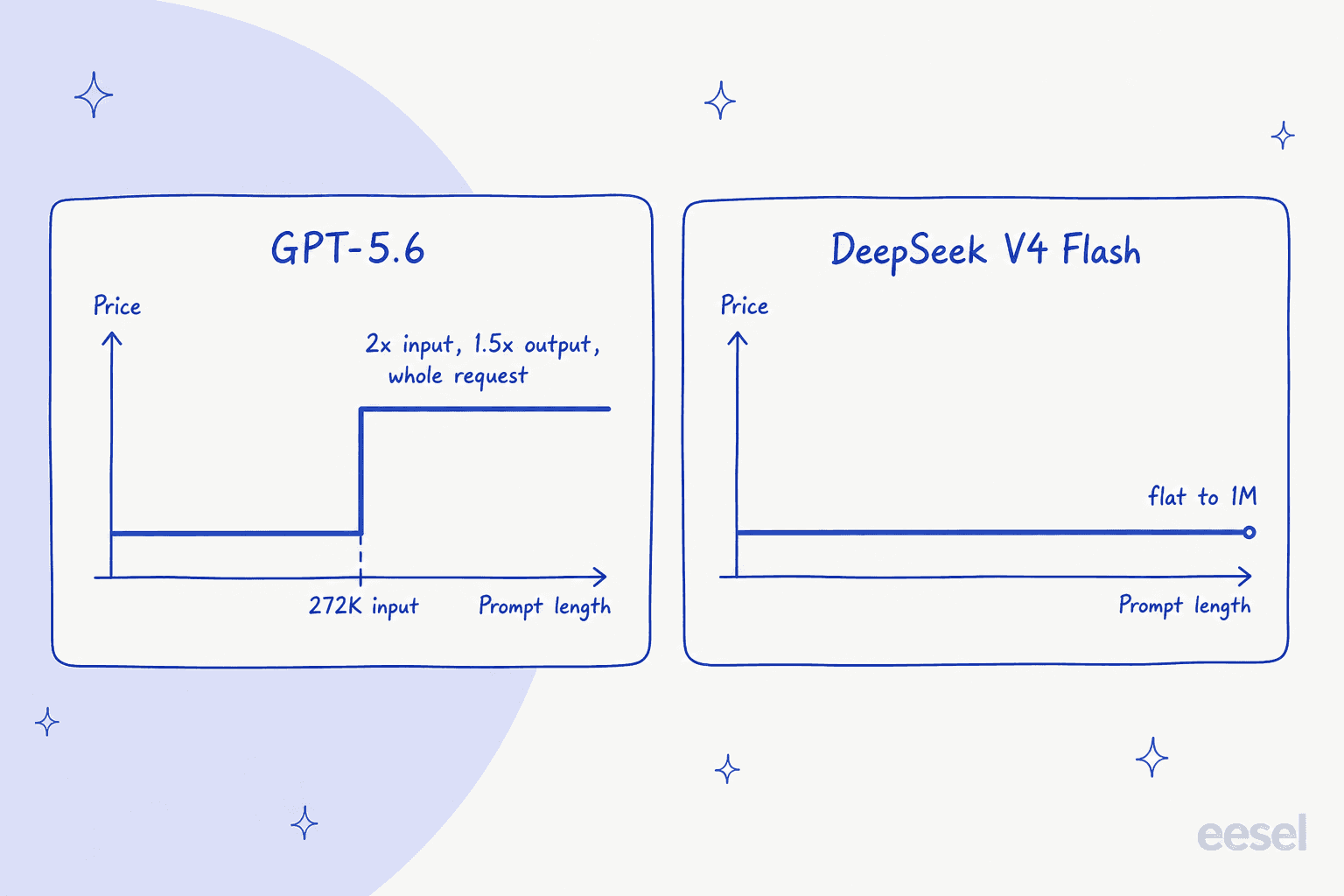
GPT-5.6 has a cliff at 272K input tokens. Every GPT-5.6 model page states it identically: "Prompts with >272K input tokens are priced at 2x input and 1.5x output for the full request." Crossing it re-prices the entire call, so a Sol request goes from $5 and $30 to $10 and $45. Flash's 1M window has no published equivalent, which makes it the flatter choice for whole-repo or whole-history prompts. It also makes a good argument for retrieval over stuffing on either model.
DeepSeek has a pending 2x peak-hour surcharge. The price card says the API "will soon adopt a peak/off-peak pricing policy" where "during peak hours, prices will be 2x the regular prices, applicable to all billing items", with the window set at 9:00 to 12:00 and 14:00 to 18:00 Beijing time, which is 01:00 to 04:00 and 06:00 to 10:00 UTC. No start date is announced and no peak-rate table is published, so treat it as a risk on synchronous traffic rather than a number.
Caching is where DeepSeek's advantage is largest and least reliable. Its ~98% cache-hit discount beats the 90% that OpenAI and most of the industry offer, and it is on by default with no code change. The catch is in the mechanics: a request only bills at the hit rate if it fully matches a persisted cache prefix unit, caching is explicitly best-effort, and entries clear "usually within a few hours to a few days" once unused. Do not model $0.0028 as a steady state.
Third-party billing can surprise you. One user reported the sharpest version of this: "The model was good, but there appeared to be a pricing glitch or something, because it burned through $50 in under an hour on pretty trivial stuff" (onlyrealcuzzo, Hacker News). There are 11 providers serving Flash on OpenRouter and DeepSeek is not the cheapest of them, so per-provider metering is worth checking before you scale a loop.
What people actually report paying
This is my favourite part of the DeepSeek reaction, since people there post receipts instead of opinions. Two of them showed up unprompted in the launch thread.
"I use deepseek for a lot of my personal day-to-day agent needs, and I will simply put this here and let this speak for itself, last 30 days:
"Those are rookie numbers. Last 13 days including today, so effectively 12 days of usage:
$19.27 USDAPI requests: 7,877Tokens: 2,116,598,952 Ok this is a bit of lie, a lot of my tasks are very experimental loops whose 99% output is like rubbish and can work forever continuously and take advantage of that 120x cheaper input cache."
Note what the second one admits: the eye-watering token count is cheap because it is cache-heavy, which is exactly the first profile in the widget above. A third user running a 30-turn agent harness put a session at "~$0.5 cost" and said they had not touched their Opus subscription in weeks (kmarc, Hacker News).
On the other side, GPT-5.6's price cut came with on-record customer numbers, which is the closest OpenAI has to the same kind of receipt. Notion's AI product lead said the newer model "delivered comparable quality to GPT-5.5 at half the cost per task and in 60% less time", and Blitzy's CTO reported that Luna "handles 2.2x more context with 8.5x fewer output tokens - at 87% lower cost than GPT-5.4 mini" after moving from a single structured-output call to a full agent loop. Both are vendor-published, so read them as directional rather than independent.
The capability gaps that actually decide it
If you got this far expecting the price to settle it, here is the turn. The two things that decide this comparison for most teams are not on the pricing page.
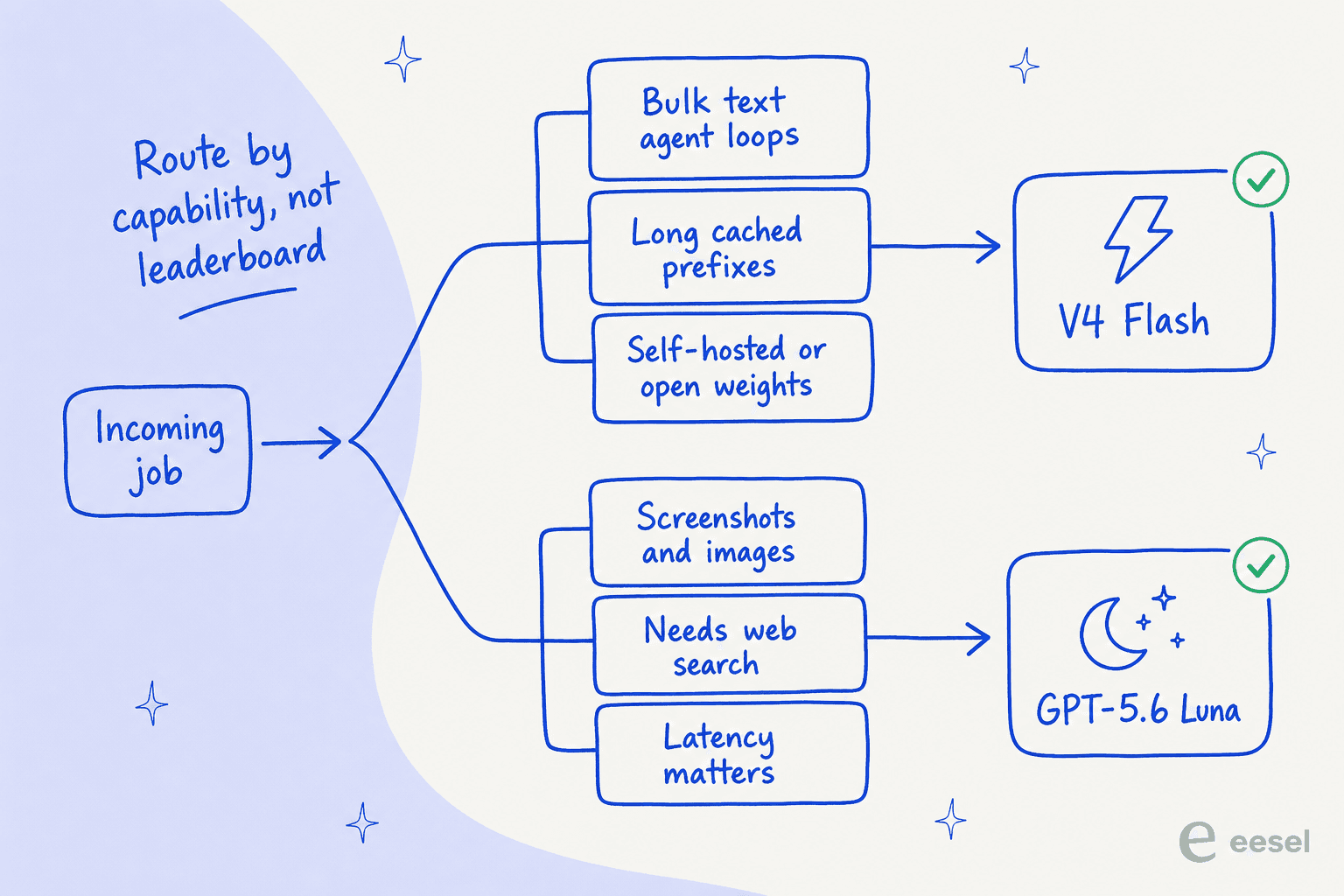
Flash cannot see and cannot search. No image input is documented, and web search is not part of the API. People work around it by pairing models rather than choosing one, which is the pattern I would copy: "Since DeepSeek V4 doesn't have vision so he got OMP to use GPT 5.6 Luna using the Codex sub. DeepSeek also doesn't support web search so he wired up OMP to call agy (Antigravity CLI) directly" (theturtletalks, Hacker News). If your support queue is full of screenshots, that gap ends the discussion on its own.
Speed is unmeasured on one side and published on the other. Artificial Analysis lists Flash's reasoning variant with no output speed, no time to first token and no total response time, marking speed "Unknown out of 4 units". The non-reasoning variant does have numbers, at 107 tokens per second. Luna runs 177.8 tokens per second and Terra 138. Sol is the odd one: 67.7 tokens per second and a 137.84s time to first token, which is below its own price-tier median and worth knowing before you put it behind anything interactive.
Open weights are a real option here, and the arithmetic mostly says do not. Flash runs locally, and the reports are detailed: 60 tokens per second single-session on dual DGX Sparks, ~30 on an M3 Ultra with 256GB, 32 on a Ryzen AI MAX+ 395 at roughly 2.88 bits per parameter. The hardware bill is the problem, around €8,200 for the dual-Spark setup. The consensus verdict from someone who did the sums: "it makes little to no sense as long as API prices are what they are. Except for maybe privacy reasons" (cmrdporcupine, Hacker News). Privacy, though, is not a small exception, which brings us to the last one.
Data retention is the objection that keeps winning. The most repeated complaint about Flash is not quality:
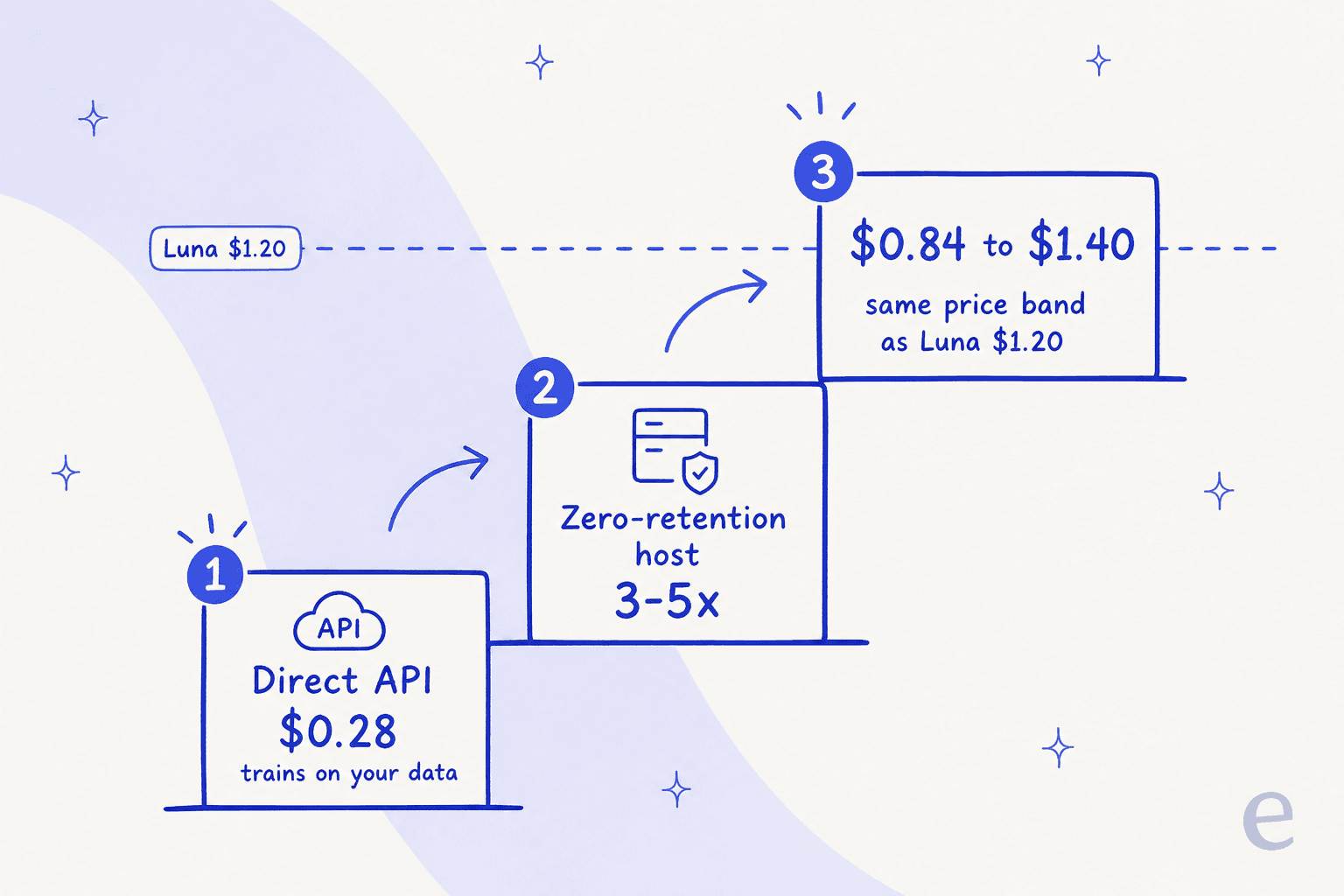
"The model is fantastic. And costs almost nothing. The only problem I see is that they will train on your data. There are zero-data-retention providers of DeepSeek models, of which I have used openrouter (with zdr guardrails), and fireworks. But these are 3x to 5x more expensive than directly using DeepSeek, possibly due to poor caching. Thats the price to pay for zdr."
Run that through the rate card and the headline advantage evaporates. Flash's $0.28 output becomes $0.84 to $1.40, which is the same band as Luna's $1.20, and Luna comes with vision, search and a documented latency profile. If your tokens contain customer data, the cheap-model story and the safe-model story are the same story.
My verdict
Pick DeepSeek V4 Flash for bulk text work where you own the data: coding agents, code review, summarisation, classification, long cached prefixes, anything you would happily run 30 turns of. Right now it is the best intelligence-per-dollar on the board, and the receipts above back that up. It is also the pick if open weights matter to you, since the licence and the Hugging Face weights are real rather than promised.
Pick GPT-5.6 Luna if you need images or search, if latency is user-visible, or if you were going to route through a zero-retention host anyway, since at that point you are paying Luna money for less capability. Pick Sol only when the task really needs the top of the board, and check its time to first token before it goes near a chat window. If neither fits, GPT-5.6 alternatives covers the rest of the field, and my GPT-5.6 review has the tier-by-tier detail.
Or run both, which is what most of the teams posting about this actually do. Route bulk text to Flash, screenshots and search to Luna, and keep the routing logic in your own code so the next price cut is a config change. That is much closer to how I would build it than a single-model bet, and it is the same instinct behind ticket classification running on a cheaper model than the one drafting the reply.
Try eesel
Here is the thing this comparison cannot answer for you: the model is roughly 2% of a resolved support ticket. I ship integrations at eesel, and what really decides whether an AI agent resolves a ticket or just annoys the customer is retrieval over your actual help centre, plus escalation rules that know when to stop, and then a rollout tested against your own ticket history before a customer ever sees it. We have watched confident-sounding bots hand out wrong answers, which is why we simulate every rollout on past tickets first instead of shipping on a benchmark score.
The economics are also not token economics. A support reply's raw token cost on Flash rounds to nothing; the cost per resolution is what shows up on your invoice, and eesel charges per ticket with no per-seat fee, so a good month for your AI is not a punishment. One Gridwise lead put the outcome plainly: "In the first month, eesel is resolving 73% of our tier 1 requests... results quickly during our 7-day trial." A CX lead at a direct-to-consumer supplements brand framed the trust side the way I would: "I need an AI who is only handling the tickets that it's confident to handle and all the other ones, leave them alone."
If you want an AI agent on Zendesk or Freshdesk that already knows your help centre, plugs in during a coffee break, and can be dry-run on last quarter's tickets before it answers anyone, that is what we built. Free to try, and the simulation is the part I would use first.

Worth reading next if you are choosing a model for support specifically: which LLM fits support, domain-specific LLMs, and the honest version of AI support costs.
Frequently Asked Questions
Is DeepSeek V4 Flash better than GPT-5.6?
How much cheaper is DeepSeek V4 Flash than GPT-5.6?
Does DeepSeek V4 Flash support images like GPT-5.6 does?
What is the DeepSeek V4 Flash context window compared to GPT-5.6?
Is DeepSeek V4 Flash safe for customer data?
Which model is faster, DeepSeek V4 Flash or GPT-5.6?
Should I use DeepSeek V4 Flash or GPT-5.6 for customer support?


Article by
Rama Adi Nugraha
Rama is a software engineer at eesel AI with two years of experience writing about B2B SaaS, AI tools, and customer support technology. Based in Bali, Indonesia, he brings a developer's perspective to product comparisons — cutting through marketing copy to what the integrations and APIs actually do.