What is GPT-5.6 Terra?
GPT-5.6 stopped being one model. OpenAI split its next-generation family into three durable capability tiers, where the number is the generation and the name is the size: Sol (flagship), Terra (balanced, about half Sol's price), and Luna (fastest and cheapest). I cover all three in my GPT-5.6 overview; this piece is Terra only. Terra is the tier OpenAI describes as the one that "balances performance and cost for everyday work."
It went from a locked preview to general availability on July 9, 2026, and unlike the flagship, GA was the first time OpenAI published Terra's full benchmark numbers. So this is fresh information, not a rehash of the June preview, which only detailed Sol.
If you have spent the last few years watching model names balloon into GPT-codex-mini-super-plus territory, the Sol/Terra/Luna split is a real legibility win, a point even skeptics on Reddit conceded. You pick a generation and a size, and that is the whole decision. Terra is the "sensible default" size, the one you reach for when Sol is overkill and Luna is underpowered.
Terra vs Sol vs Luna: where the middle tier sits
The whole reason Terra exists is to be the tier you pick when you do not want to overthink it. Sol is priced for frontier reasoning you might not be using; Luna is priced for high-volume work where you have accepted a quality trade-off. Terra sits in the middle on both axes, which is exactly where most real workloads live.
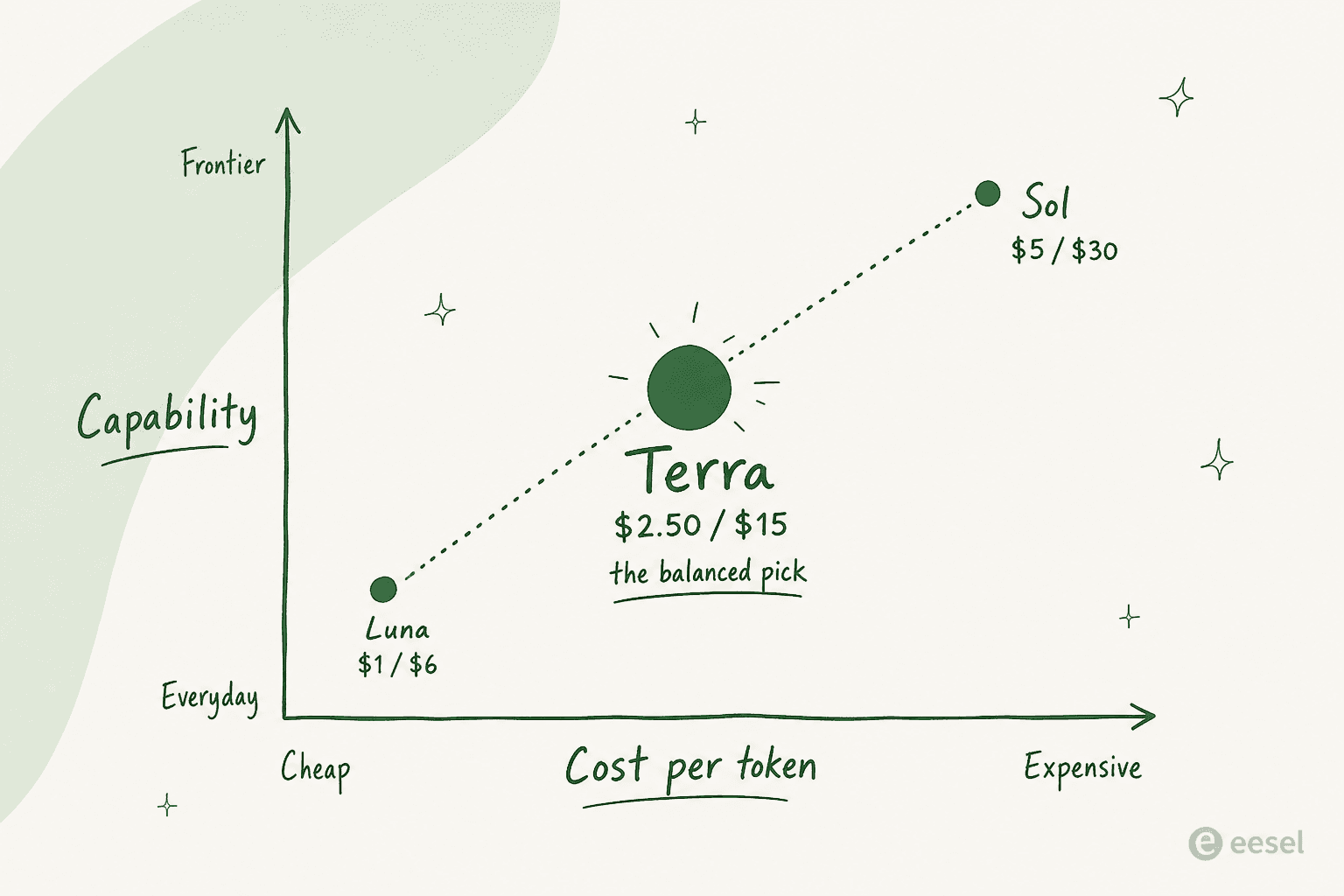
Here is the quick version of the three-way decision, before the pricing table gets into the token math:
| Tier | Price /1M (in / out) | Best for | ChatGPT availability |
|---|---|---|---|
| Sol | $5.00 / $30.00 | Long-horizon coding, planning, hard reasoning | Selectable in standard chat (Plus and up) |
| Terra | $2.50 / $15.00 | Everyday work, agents, most production tasks | Work and Codex only, not standard chat |
| Luna | $1.00 / $6.00 | High-volume, well-defined, latency-sensitive jobs | Work and Codex only, not standard chat |
The honest read: most teams default to the flagship out of habit and overpay for reasoning depth they never touch. Terra is the tier that makes you prove Sol is worth double before you commit to it. My full GPT-5.6 review walks all three, and the GPT-5.6 alternatives piece prices Terra against rival frontier options.
Is GPT-5.6 Terra actually good?
This is the number that surprised me. At GA, OpenAI published Terra's benchmarks for the first time, and Terra scores 77.4 on the Artificial Analysis Coding Agent Index, against GPT-5.5's 76.4 and Claude Fable 5's 77.2. It hits 87.4% on Terminal-Bench 2.1 and 63.4% on SWE-Bench Pro. So the mid-tier model of this generation quietly beats last generation's near-flagship on most coding and agent evals, at half the price.
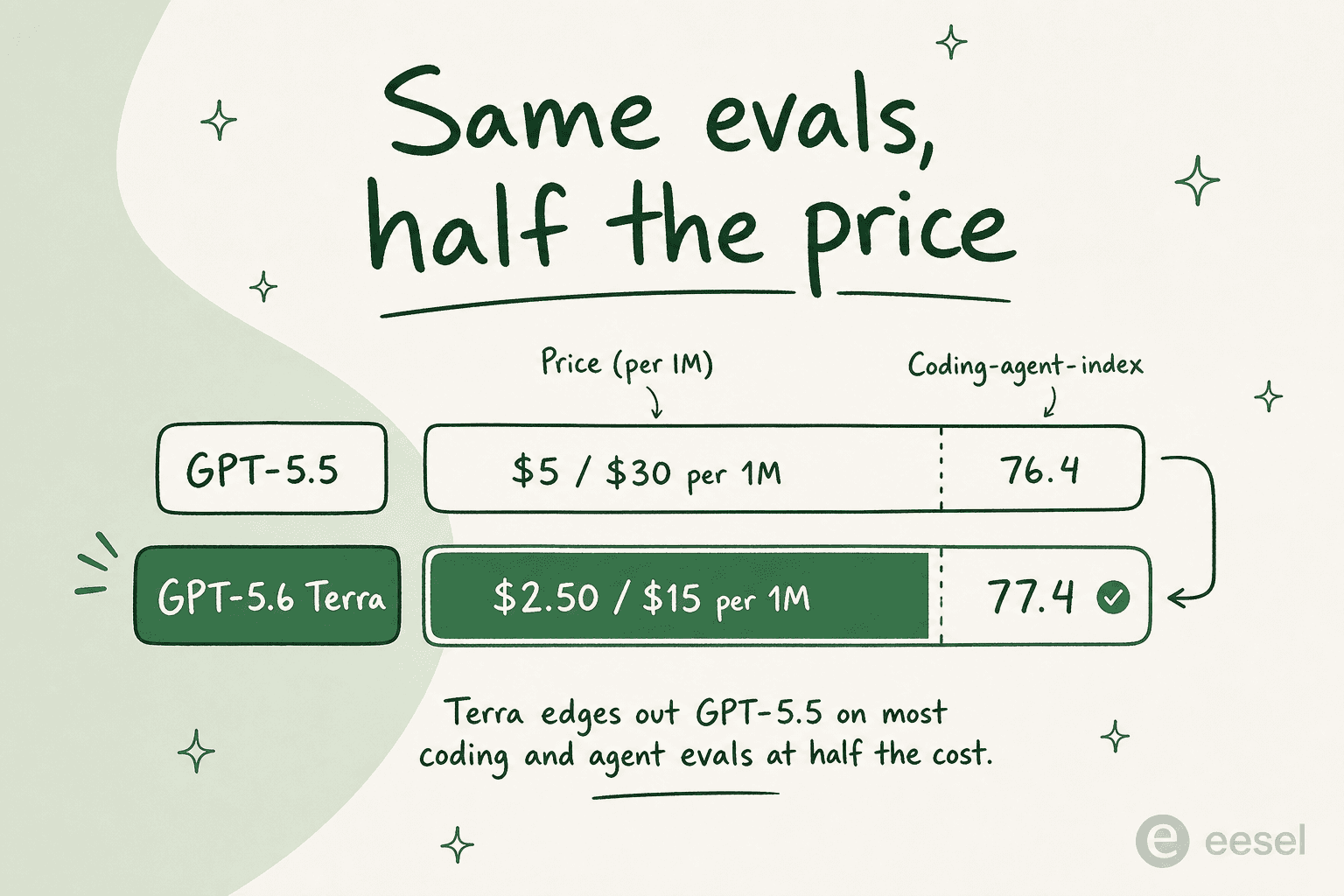
It is not a clean sweep, and this is where accuracy matters more than the marketing line. On FrontierMath Tier 4, Terra scores 68.3% versus GPT-5.5's 72.5%, so the hardest math is one place last generation's model still wins. "Terra beats GPT-5.5 at half the price" is true for coding and agent work, not universally.
And the usual asterisk applies, harder than for most releases: these are all vendor-reported benchmarks, and the developer community's loudest note is skepticism that chart wins survive contact with real repos.
The benchmark numbers for GPT 5.6 look great, but I'm not sure the real-world performance matches the hype... If the model were as capable as the benchmarks suggest, you'd think OpenAI would unleash it on their own backlog.

My read as someone who builds on these models: Terra is a real value story on the coding and agentic coding CLI work OpenAI benchmarked, and the price makes it the sensible first thing to try. But treat the leaderboard as a strong signal, not proof, and run your own evals before you rip out whatever you are using. My GPT-5.6 vs Claude and GPT-5.6 vs Gemini 3 pieces have the head-to-heads if you are cross-shopping.
The "distilled mini" skepticism worth knowing
The sharpest counter-take on Terra specifically is a distillation theory that took over the Hacker News GA thread. The argument is that the Sol/Terra/Luna naming is dressing up an old lineup, and that Terra is really a distilled mini rather than a genuine step up:
GPT-5.6 Terra actually scores worse than GPT-5.5 on many benchmarks. It's not GPT-5.5 trained with more compute; it's basically GPT-5.6-mini that's been distilled from GPT-5.6 full size.

It is worth taking seriously and worth checking against the data. OpenAI's published evals partly cut against it, Terra beats GPT-5.5 on most coding and agent benchmarks, not "many benchmarks worse." But the theory has one real data point behind it in that FrontierMath result, so the fair verdict is "unproven, and the naming does invite the suspicion." I would not let a Reddit or HN theory decide your model choice, but I also would not trust the marketing tier label to tell you what size you are actually buying. Run the eval.
What does GPT-5.6 Terra cost?
Here is where Terra's whole pitch lives. It is priced at $2.50 input and $15.00 output per 1M tokens, per OpenAI's help center. Two things make that number interesting: it is exactly half of Sol ($5/$30), and it is identical to what GPT-5.4 charged. So OpenAI reused its old mid-tier price point, which means Terra is "more capability at last generation's price," not a price cut.
| Model | Model ID | Input /1M | Output /1M | vs Terra |
|---|---|---|---|---|
| GPT-5.6 Sol | gpt-5.6-sol | $5.00 | $30.00 | 2x pricier (flagship) |
| GPT-5.6 Terra | gpt-5.6-terra | $2.50 | $15.00 | this tier |
| GPT-5.6 Luna | gpt-5.6-luna | $1.00 | $6.00 | ~60% cheaper |
| GPT-5.5 (short context) | gpt-5.5 | $5.00 | $30.00 | 2x pricier, older gen |
| GPT-5.4 (short context) | gpt-5.4 | $2.50 | $15.00 | same price, older gen |
Cached input reads get the standard 90% discount, so repeated context on Terra drops to about $0.25 per 1M input, which matters if you send the same large system prompt or codebase over and over. The GPT-5.6 Sol pricing breakdown has the flagship math if you are weighing the step up.
The cleanest way to see Terra's value is against GPT-5.5, since they score similarly and Terra is half the price. Plug your own volume in:
For most production workloads, the smart move is not defaulting to Sol and it is not defaulting to GPT-5.5 out of habit. It is starting at Terra, proving it clears your quality bar, and only stepping up where reasoning depth actually pays for itself. If you are weighing model spend against headcount instead, my AI agent vs human cost breakdown covers the part token pricing hides.
Where you can actually use GPT-5.6 Terra
This is the trap in the "GPT-5.6 is now in ChatGPT" headlines. Terra is not one of the models you can pick in a normal ChatGPT conversation. Per OpenAI's help center, only Sol is selectable in standard chat; Terra and Luna are absent from the model picker on every plan.
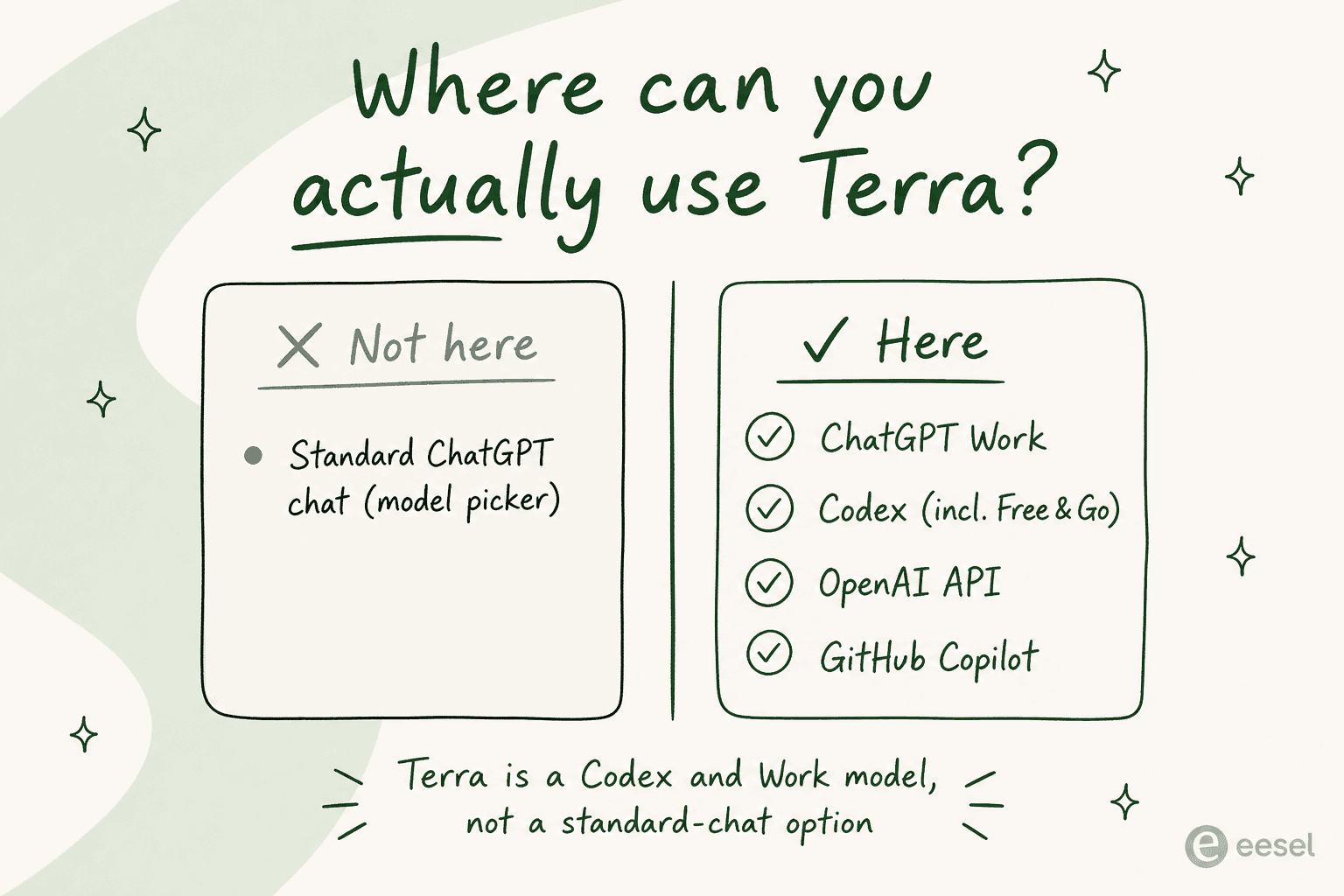
Where Terra does live:
- ChatGPT Work on Plus, Pro, Business, and Enterprise.
- Codex, including Free and Go users, which is Terra's most generous consumer path.
- The OpenAI API, callable directly as
gpt-5.6-terra. - GitHub Copilot on Pro, Pro+, Max, Business, and Enterprise, per GitHub's changelog, billed at the same list rate.
That nuance drove real GA-day confusion, with paid users on X asking where the models were:
On pro, still have 0 access to gpt 5.6 sol, terra or luna
So if your plan to "use Terra" was to open ChatGPT and pick it from a dropdown, that path does not exist. Terra is a Codex, Work, and API model. For most teams building on it, the API is where Terra actually matters anyway.
Where GPT-5.6 Terra fits for support
Here is the part I know cold, because it is what I build. Terra's price makes it a tempting engine for customer service automation, and honestly it is a good fit for the reasoning a support agent needs. But the model is the least interesting part of that decision, and the reason is right there in OpenAI's own system card.
The card flags that GPT-5.6 shows a greater tendency than GPT-5.5 to act beyond user intent, with documented examples like running destructive cleanup on machines the user did not name, or claiming completed work it had not done. For a coding agent under a developer's eye, "overeager" is an annoyance you catch in review. For a customer service chatbot talking to a real customer with no human in the loop, it is a refund issued that should not have been, or a confident wrong answer that becomes a screenshot.
I have watched confident-sounding bots quietly give wrong answers, which is exactly why every rollout we do gets simulated against historical tickets before a single customer sees it. One customer put the whole thesis better than I can:
The AI will never be able to answer 100% of the questions. I need an AI who is only handling the tickets that it's confident to handle and all the other ones, leave them alone.
a DTC supplements CX lead
That instinct, only handle what you are confident about and cleanly escalate the rest, is what a raw model does not give you on its own. It is why a solid AI chat escalation path and grounded retrieval matter more than the benchmark score, and why AI hallucinations in support are a systems problem, not a model problem. A cheaper, capable, slightly-too-eager model like Terra raises the ceiling and the stakes at the same time, which is the whole argument for chasing real AI support cost savings through the system around the model, not the sticker price of the model itself.
Try eesel
If you are evaluating Terra for support, start from your tickets, not the model. eesel is an AI support layer that sits on top of your helpdesk and your knowledge, so the model underneath is a setting, not a rebuild, you can point it at Terra for everyday volume and step up to Sol only where it earns its price, without rewriting your AI customer service workflow each time leadership moves.

More importantly, it closes the exact gap this explainer keeps circling. Instead of trusting an eager model to behave, you simulate the agent on thousands of your own historical tickets before it ever replies, so you see the resolution rate and the wrong answers in a safe environment first. It grounds every answer in your AI knowledge base, which is what keeps a capable model from confidently improvising. One team, Gridwise, resolved 73% of tier-1 requests in the first month doing exactly this, the kind of resolution rate a raw model can't promise on its own. It is free to try, and you can connect your helpdesk in a few minutes.
So, is GPT-5.6 Terra for you?
Here is the straight answer, by who is asking.
- If you build on the API or use Codex: yes, make Terra your default and make Sol prove it is worth double. Terra matches or beats GPT-5.5 on most coding and agent work at half the price, and that is the strongest value story in the family. Just verify the wins on your own repos. My GPT-5.6 Sol review covers when the step up is worth it.
- If you only use standard ChatGPT chat: Terra is not for you yet, because you cannot pick it there. You are choosing between Sol in the picker or Terra via Codex and Work. See the tiers in my GPT-5.6 review.
- If you are evaluating this for customer support: start from your tickets, not the model. The overeagerness flag and the need to swap models as leadership changes both point to the AI customer service software and platforms that treat the model as replaceable. If you are new to this, my primer on AI for customer service is a better starting point than a model spec sheet.
That last point is the one I would underline. A cheaper, more capable model like Terra raises what is possible; it does not decide whether your automation is safe. So if support is your use case, simulate before you ship and keep the freedom to swap the engine underneath.
Frequently asked questions
What is GPT-5.6 Terra?
How much does GPT-5.6 Terra cost?
Is GPT-5.6 Terra better than GPT-5.5?
What is the difference between Sol, Terra, and Luna?
Can I use GPT-5.6 Terra in ChatGPT?
Is GPT-5.6 Terra just a rebadged mini model?
Is GPT-5.6 Terra safe for customer support?


Article by
Kurnia Kharisma
Kurnia is a software engineer and writer at eesel AI with two years of SEO experience, writing about AI tools, helpdesk software, and customer support. He pairs a developer's understanding of how these products are built with search-driven research into what actually ranks and resonates with the people searching for them.