


The short answer: what Xiaomi MiMo V2.6 actually costs
I have spent two years watching AI pricing pages, and most model launches bury the number you actually came for. Xiaomi did the opposite: it open-sourced the whole MiMo V2.6 family on September 22, 2026, under MIT, and held the API pricing flat from the previous generation.
So there are really two prices to think about. There is zero, if you download the weights and run them on your own hardware. And there is a per-token API price, if you would rather someone else host the GPUs. Here is the full hosted price list, from OpenRouter, checked on launch day:
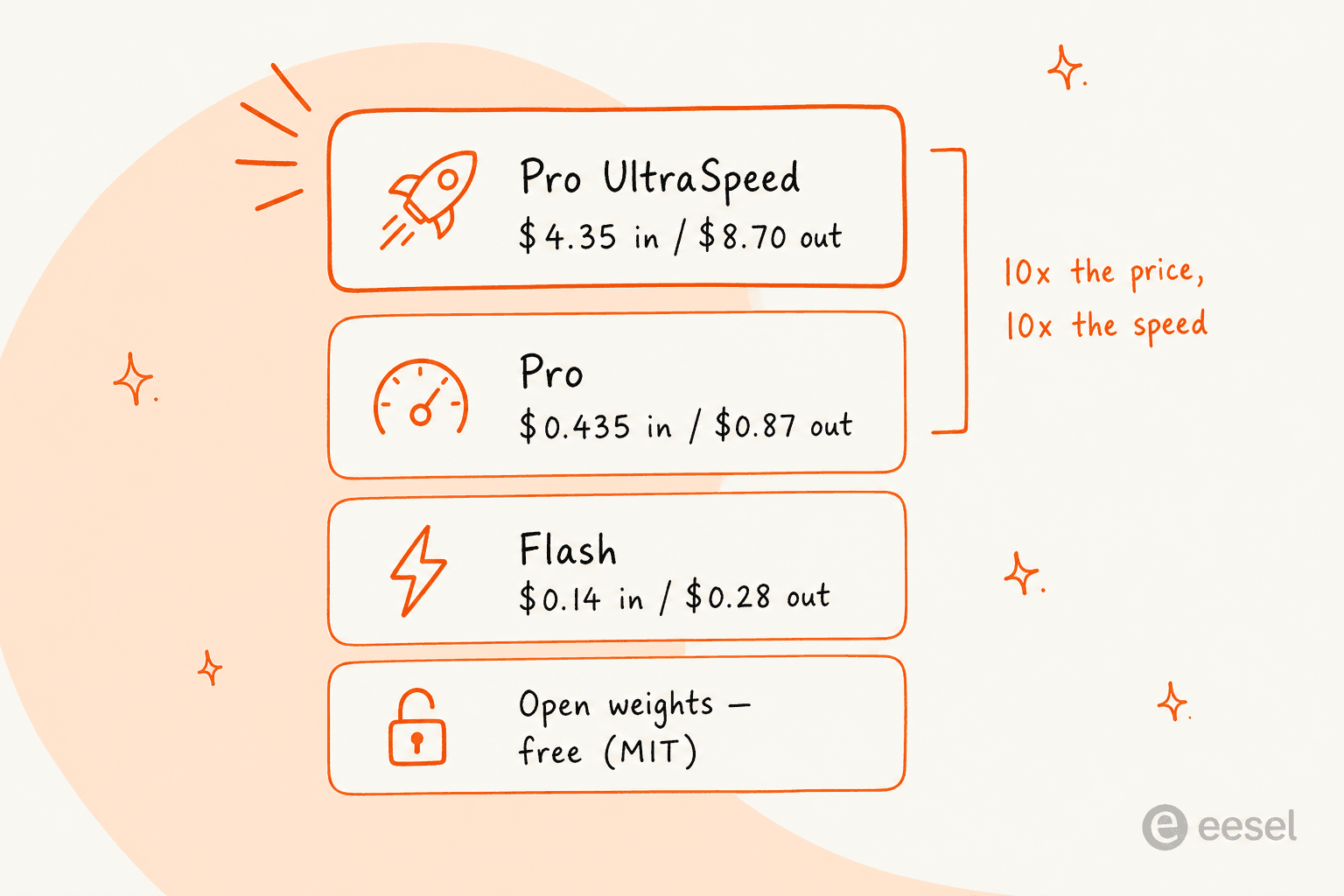
Every variant carries the same 1M-token context window and is natively omnimodal (text, image, video, audio), so you are not paying a premium for the long context or the extra modalities. That is unusual, and it is a big part of why the pricing reads as aggressive.
The four variants and what each one is for
MiMo V2.6 is not one model with one price. It is a family of four checkpoints, and picking the wrong one is the fastest way to overpay. Here is how they line up.
MiMo V2.6 Pro ($0.435 in / $0.87 out)
Pro is the flagship: a sparse mixture-of-experts model with 1.02 trillion total parameters and 42B active. It is the one topping the open-weight benchmarks, and it is the one you want for genuine agentic work, long-horizon coding, multi-step tool use. At $0.435 in / $0.87 out it is cheaper than most of the frontier closed models it trades blows with, which is the whole story of this release.
MiMo V2.6 Flash ($0.14 in / $0.28 out)
Flash is the efficiency checkpoint: 309B total, 15B active, described by Xiaomi as the best balance of intelligence, efficiency, and cost. At $0.14 in / $0.28 out it is a third the price of Pro and, on Xiaomi's own numbers, gives up surprisingly little. On AutomationBench it scores 52.3 to Pro's 53.1. For most high-volume, well-scoped jobs, Flash is the value pick.
MiMo V2.6 Pro UltraSpeed ($4.35 in / $8.70 out)
UltraSpeed is the confusing one until you realise you are not buying more intelligence. It is the exact same Pro checkpoint, served at roughly 10x the output speed (about 116 tokens per second). Xiaomi charges 10x the Pro rate for it. So this is a pure latency tax: pay it only when speed is the actual bottleneck, like a live chat agent a customer is watching type. For a batch job that runs overnight, it is 10x wasted.
MiMo V2.6 Distill-Qwen-9B (free weights only)
The 9B distill is a dense supervised fine-tune of Qwen3.5-9B on MiMo-generated data. It is not on the paid API; it exists as a small, single-GPU starting point for local inference and open research. Community GGUF quants already exist for llama.cpp, LM Studio, and Ollama, so it is the one you can run on a workstation.
The cache discount most people miss
The list prices above are not what heavy users actually pay. MiMo V2.6 Pro lists cache-read tokens at around $0.0036 per million, a 99% discount on the $0.435 input rate. Xiaomi's benchmark partner spelled it out:
"Despite the improvement, it retains the same attractive pricing at $0.435 per 1M input tokens (with a 99% cache-hit discount) and $0.87 per 1M output tokens."
Why does this matter for pricing? Because any real workload sends the same context over and over. A coding agent re-reads the same repo. A support agent re-reads the same policies and macros on every single ticket. Once that context is cached, you are paying cents on the dollar for the input tokens. If your use case reuses prompts, your effective input price is far below list, and that gap is where MiMo's total cost really pulls away from the frontier.
How MiMo V2.6 pricing compares to the frontier
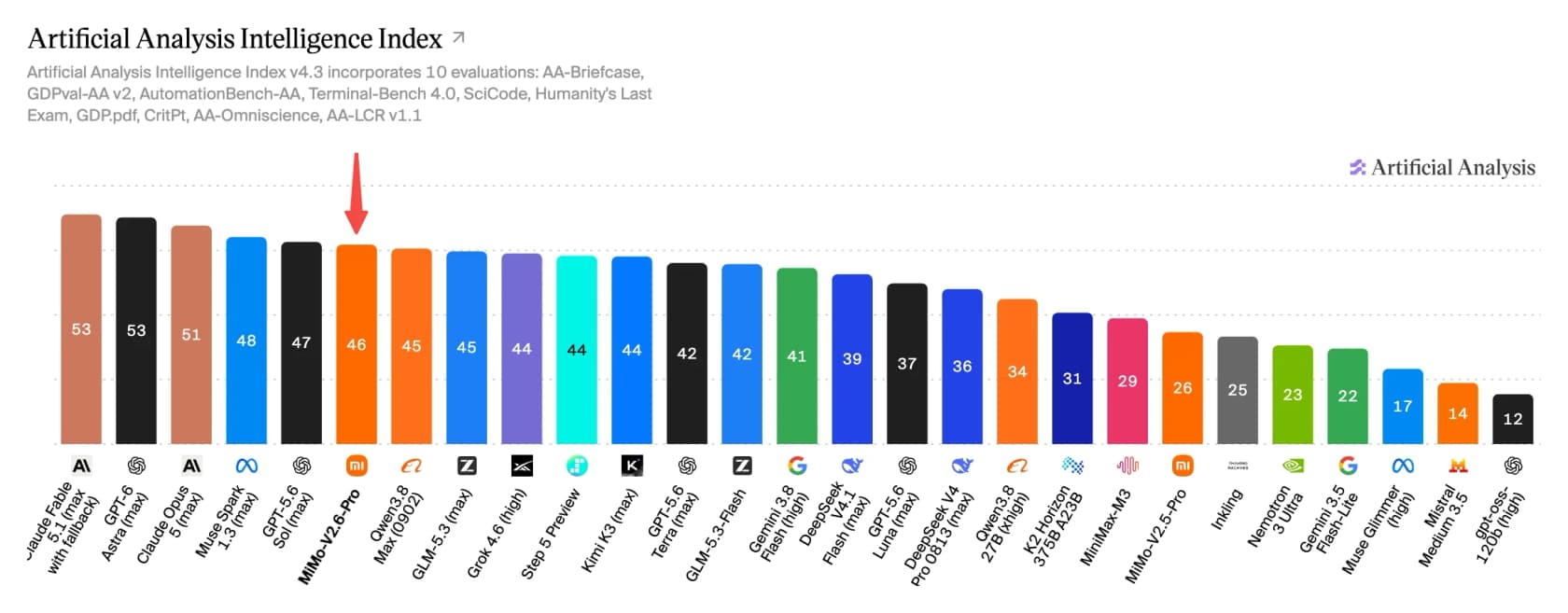
This is the comparison the launch was built for. On the Artificial Analysis Intelligence Index, MiMo V2.6 Pro scored 46, the top open-weight model, tying the same-day Grok 4.7 release and sitting just behind the closed leaders.
Score alone is not the pricing story though. The chart that matters for cost is the intelligence-vs-cost-per-task plot, where MiMo V2.6 Pro lands in the green "most attractive quadrant" at about $0.13 per task, while Claude Opus 5 and GPT-6 Astra sit out at the $3 to $8 end of the same axis.
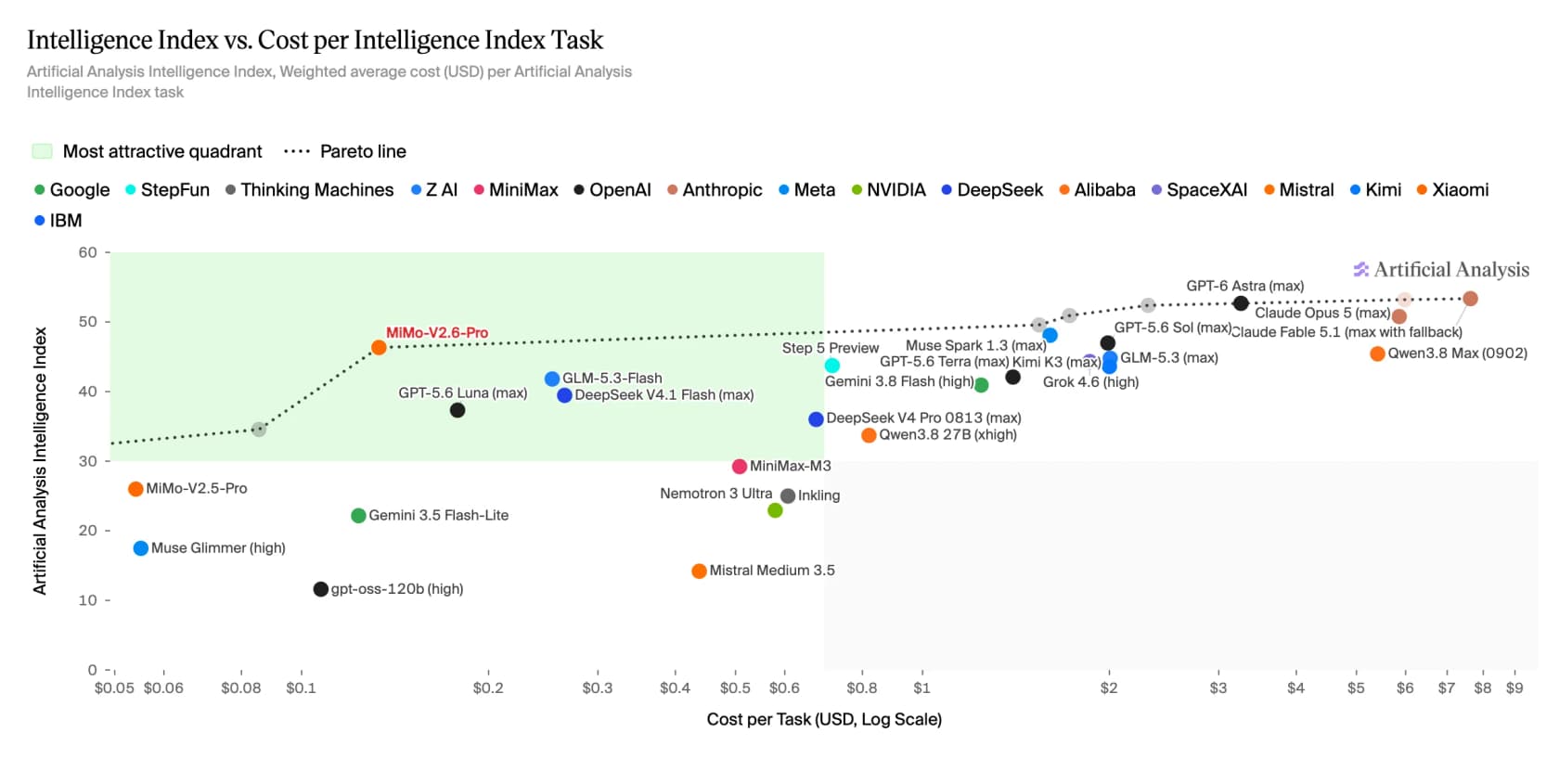
Against the open field it is just as sharp. Flash matches the cheapest tiers like DeepSeek V4.1 Flash, and the 1.02T Pro undercuts the far larger 2.8T Kimi K3 while leading it on most boards. One Hacker News commenter, who had run the model heavily, summed up the value math:
"Mimo 2.6 pro, the 1T model leads Kimi K3, a 2.8T param model in 14 out of 15 benchmarks (and the last one is near tie)!! Good to see they also kept the price the same, and landed in the greenest quadrant of the intelligence vs speed of AA."

Fair warning, because a pricing post should be honest about the ceiling: MiMo trails the top closed models on the hardest boards. On Terminal Bench 4.0 it scores 34.9 against GPT-6 Astra's 59.6, and on ExploitBench it lands at 47.9 against the 70+ from GPT-5.6 Sol and Claude. If your work lives on those frontiers, the cheap token price is not the whole decision. For everything else, the price-performance is hard to argue with.
Worked examples: what you would actually pay
Sticker prices per million tokens are abstract. Here is what three realistic workloads cost on MiMo V2.6, so the numbers mean something.
- A solo developer on Flash. Say you burn 20M input and 5M output tokens a month coding with Flash. That is 20 × $0.14 + 5 × $0.28 = $4.20 a month. Rounding error.
- A small team running a coding agent on Pro. 300M input, 80M output tokens a month on Pro: 300 × $0.435 + 80 × $0.87 = $200.10 a month, before any cache discount. With heavy prompt reuse, the real bill lands well under that.
- A high-volume support workload on Flash. 10,000 tickets a month, roughly 8K input and 1K output tokens each, so 80M input and 10M output: 80 × $0.14 + 10 × $0.28 = $14 a month in raw tokens.
That last number is the one to sit with. Ten thousand support conversations for $14 of model tokens. If that were the true cost of AI support, everyone would have shipped it years ago. It is not, and the gap between "$14 of tokens" and "a working support agent" is the entire point of the next section.
Free weights are not free to run
MiMo V2.6 is genuinely open under MIT, so "just self-host it" is real advice, not marketing. But the weights being free does not make running them free. The hardware bill is the hidden line item.
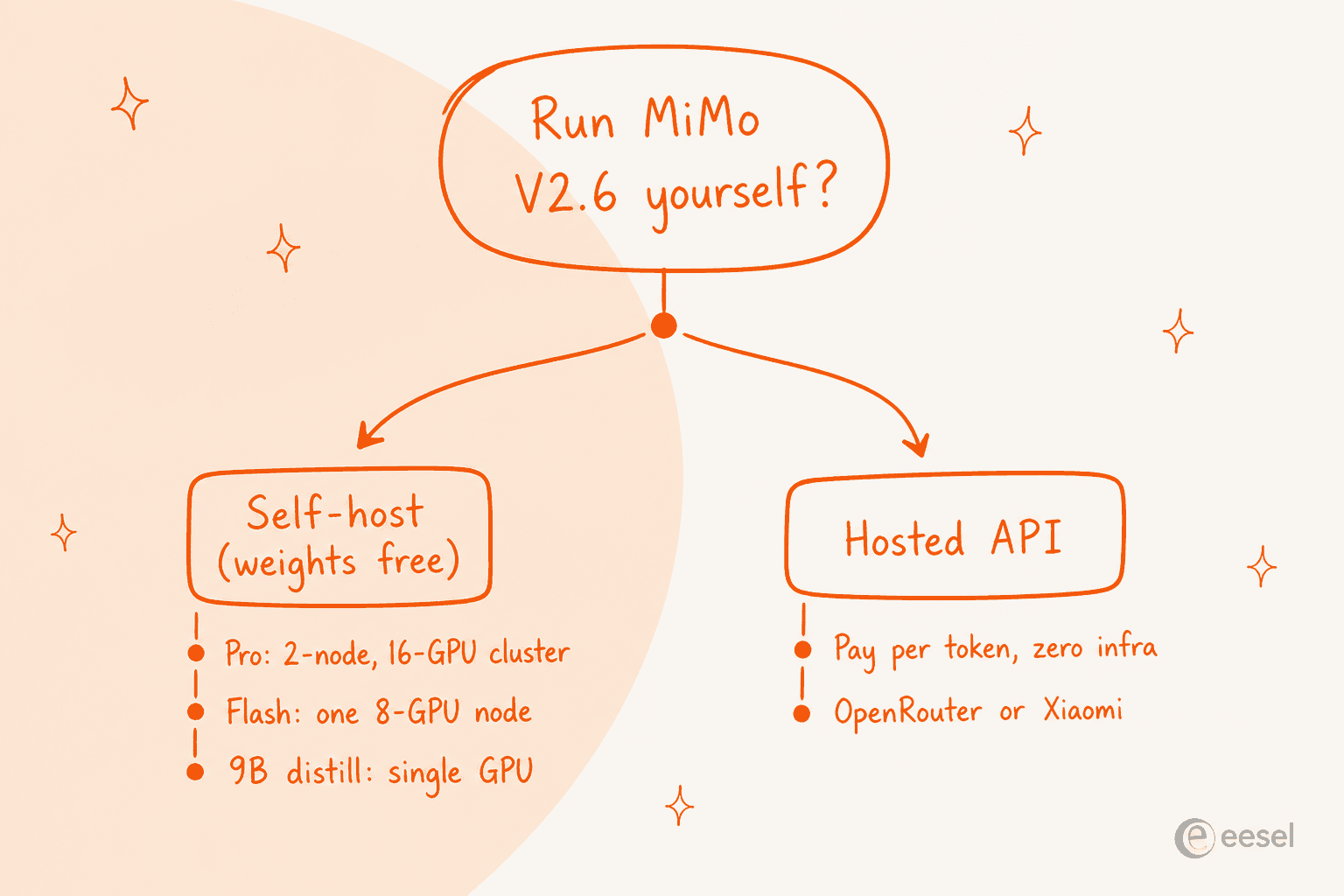
Here is what each variant needs, from the model cards:
- Pro (1.02T / 42B active): the reference SGLang launch uses a 2-node, 16-GPU cluster (tensor-parallel 16). This is a serious hardware commitment.
- Flash (309B / 15B active): runs on a single 8-GPU node.
- Distill-Qwen-9B: small enough for a single GPU, and there are GGUF quants for local tools.
All the checkpoints ship as FP8, which keeps the memory footprint sane, but the honest read is this: self-hosting only beats the API when you have steady, high volume and idle GPUs to fill. For bursty or low volume, the hosted API at $0.14 to $0.87 per million tokens is almost always cheaper than keeping a cluster warm. Run the math on your own utilisation before assuming "free weights" means "free."
The part the price tag never shows
Here is where I have to zoom out, because I build and run AI for the helpdesk for a living, and the pricing conversation almost always misses the real bill.
The token cost of MiMo V2.6, or DeepSeek, or Qwen, or any of them, is the smallest line in the budget for a production system. The expensive part is everything wrapped around the model.
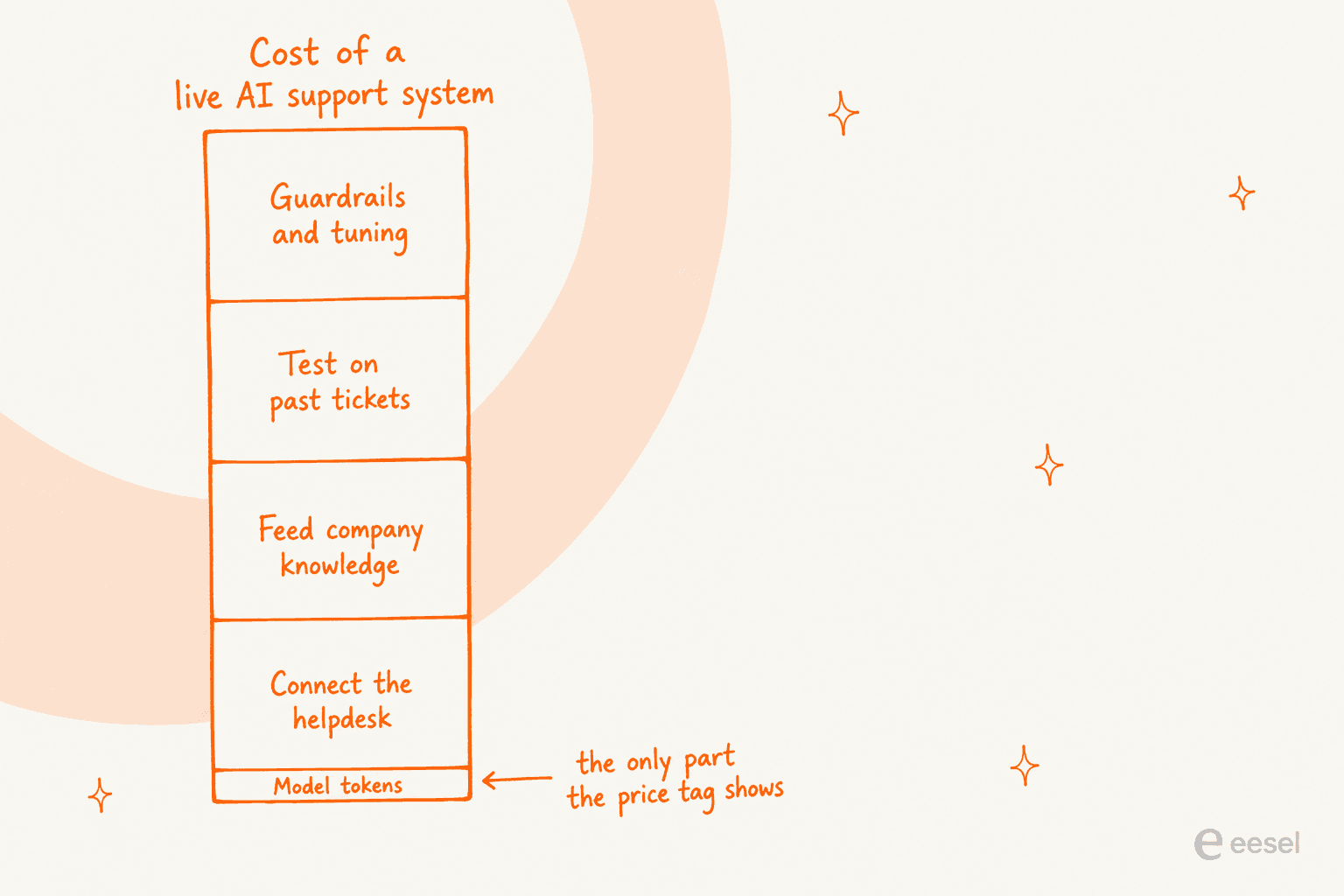
We have spent the last few years putting AI agents on live support queues, and the recurring lesson is that a raw model, however cheap and smart, is not a support agent. To get from "$14 of tokens" to "an agent I trust with a customer," you have to connect it to your helpdesk, feed it your knowledge base and past tickets, teach it your policies, give it actions it can safely take, and, above all, test it before it goes live. We have watched confident-sounding bots quietly give wrong answers, which is exactly why every rollout should be simulated against historical tickets first.
None of that shows up on an OpenRouter pricing page. It is the difference between a model and a working teammate, and it is where the actual cost of AI support lives.
Try eesel
A model like MiMo V2.6 is an engine. eesel is the teammate you hire to drive it. eesel is an AI teammate platform, and the AI helpdesk agent is a ready-to-work support teammate: it plugs into your helpdesk in minutes, already reads your past tickets and knowledge base, and you can simulate it on thousands of your real historical conversations before it answers a single live customer. Instead of paying flat per-seat, eesel bills on usage, so the cost tracks the work actually done.

And if you live in a terminal, eesel has a public CLI plus an MCP server, so the same teammate and workspace you manage in the dashboard can be driven from scripts or by coding agents like Claude Code, Codex, and Cursor. It is the agent-friendly way to operate eesel: a person runs it by hand, a script automates it, or an AI agent calls it, all against the same helpdesk teammate. That is the layer that turns a cheap, capable model into something that actually resolves tickets. Try it free.
Frequently Asked Questions
How much does Xiaomi MiMo V2.6 cost?
What is the cheapest way to run Xiaomi MiMo V2.6?
Is Xiaomi MiMo V2.6 free?
How does Xiaomi MiMo V2.6 pricing compare to DeepSeek and Kimi K3?
What is MiMo V2.6 Pro UltraSpeed and why does it cost 10x more?
Does Xiaomi MiMo V2.6 offer a cache discount?
Should I use Xiaomi MiMo V2.6 for customer support?


Article by
Kurnia Kharisma Agung Samiadjie
Kurnia is a software engineer and writer at eesel AI with two years of SEO experience, writing about AI tools, helpdesk software, and customer support. He pairs a developer's understanding of how these products are built with search-driven research into what actually ranks and resonates with the people searching for them.