

What Xiaomi MiMo V2.6 actually is
I build integrations and APIs for a living, so my first instinct with any launch like this is to skip the marketing page and read the model card. The MiMo V2.6 card holds up.
MiMo V2.6 is a family of open-weight, natively omnimodal language models from Xiaomi's MiMo team, released on September 22, 2026. "Natively omnimodal" is doing real work in that sentence: the same model takes text, images, video, and audio, rather than bolting a vision adapter onto a text model after the fact. Every checkpoint in the family ships with a 1 million-token context window.
The release tagline is "Scaling Reinforcement Learning Toward Self-Improvement," and Xiaomi frames the whole series as a step on a recursive self-improvement path: scale RL compute on verifiable, complex tasks and let the model keep pushing its own capability frontier. That is the kind of line that usually makes me roll my eyes, but the tech report has enough concrete method behind it that it reads as engineering, not a press release.
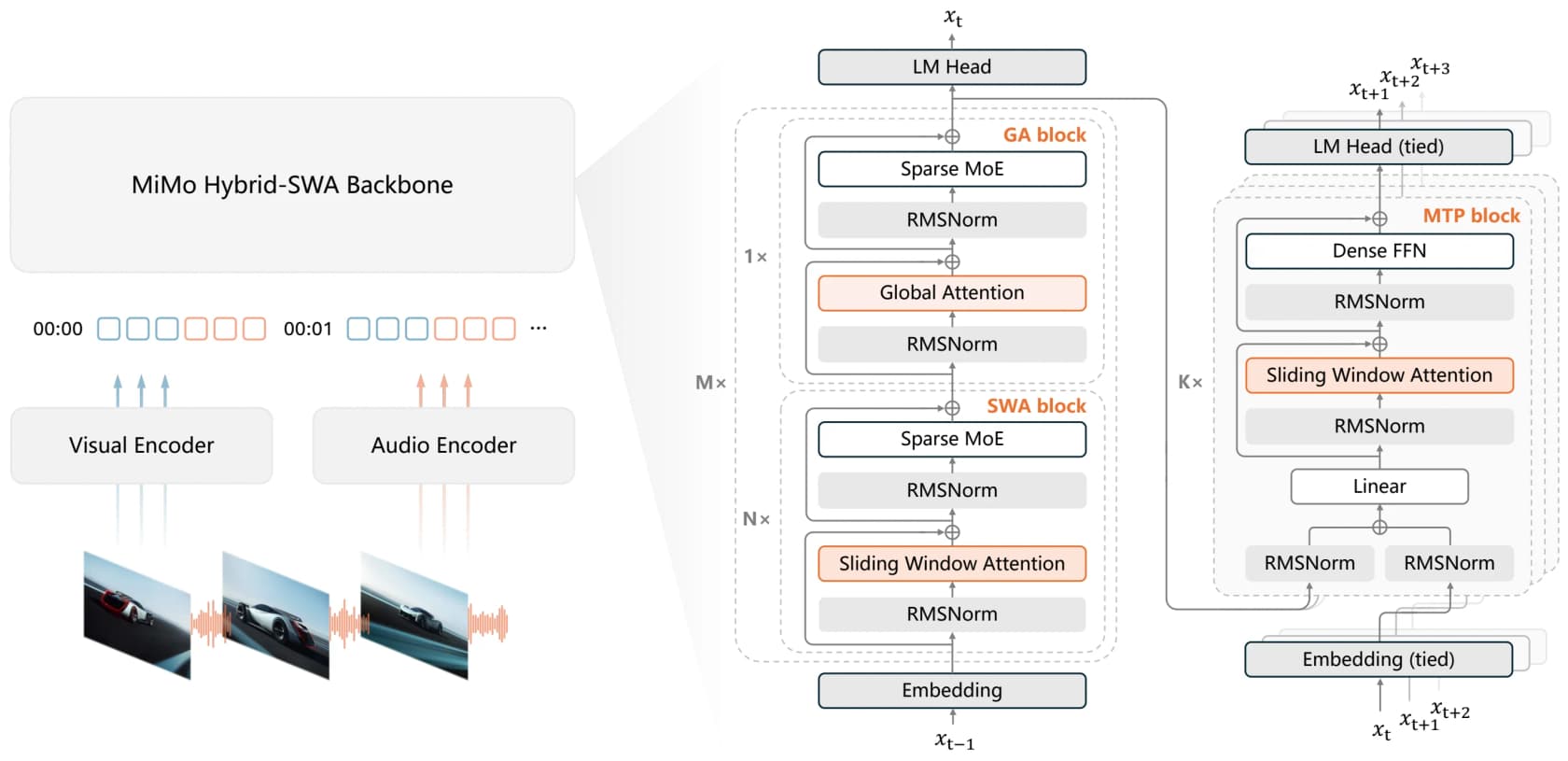
If you want the one-paragraph version of the architecture: Pro is a sparse mixture-of-experts with a hybrid attention backbone: 70 layers that interleave local sliding-window attention (window 128) with global attention, 384 routed experts of which 8 fire per token, a 681M-parameter vision encoder, dedicated audio encoders, and a 5-layer multi-token-prediction decoder that predicts several tokens per forward pass to speed up decoding. You do not need to care about any of that to use it, but it explains how a "1 trillion parameter" model stays cheap to run: only 42B of those parameters are active on any given token.
The model family, from Flash to a 1-trillion-parameter Pro
MiMo V2.6 is not one model, it is four checkpoints aimed at four different jobs. This is where a lot of the confusion online comes from, so it is worth laying out clearly.
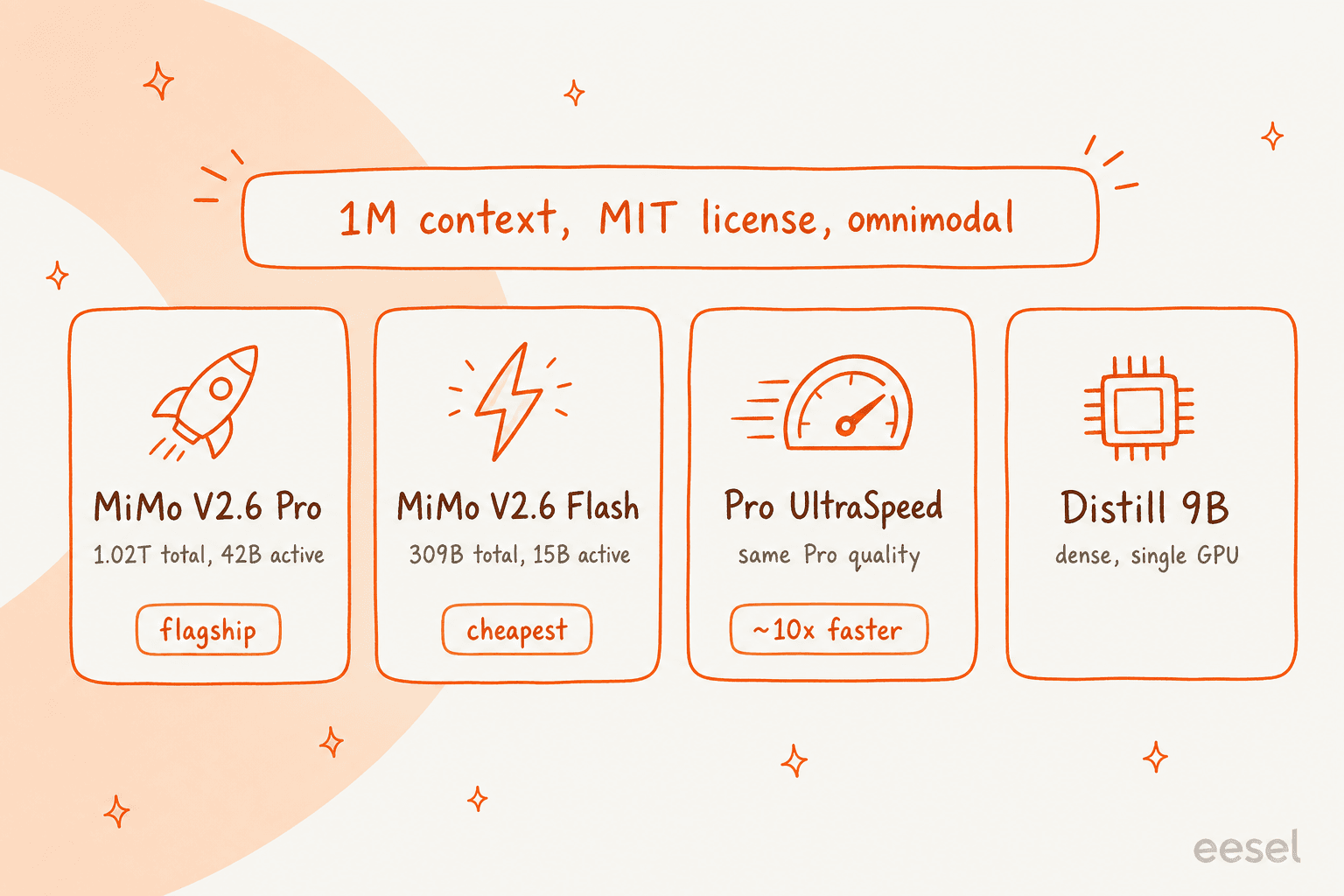
| Model | Architecture | Total params | Active params | Context | Best for |
|---|---|---|---|---|---|
| MiMo V2.6 Pro | Sparse MoE | 1.02T | 42B | 1M | The most demanding, long-horizon agentic work |
| MiMo V2.6 Flash | Sparse MoE | 309B | 15B | 1M | The best balance of intelligence, speed, and cost |
| MiMo V2.6 Pro UltraSpeed | Same Pro checkpoint, speed build | ~1T | 42B | 1M | Pro-level quality when you need output fast |
| MiMo V2.6 Distill-Qwen-9B | Dense (SFT of Qwen3.5-9B) | 9B | 9B | n/a | Single-GPU and open agentic-RL research |
A few things worth pulling out. Pro is billed as Xiaomi's most capable model to date. Flash is the one most people will actually reach for, since it strikes the balance most workloads want. UltraSpeed is the same Pro checkpoint served for roughly 10x faster output (Xiaomi's blog claims up to 20x), which matters a lot if you are streaming responses to a user waiting on the other end. And the 9B distill is a supervised fine-tune of Qwen3.5-9B on MiMo-generated data, released as a starting point for open research rather than a production model.
The generational jump here is the real story. The prior flagship, MiMo V2.5 Pro, scored 19.0 on the DeepSWE v1.1 coding benchmark. V2.6 Pro scores 71.9 on the same board. On Terminal Bench 4.0 it went from 1.5 to 34.9. Those are not incremental gains, they are the kind of leap you only see when a lab changes its training approach, which is exactly what Xiaomi says happened.
The benchmarks Xiaomi leads with, and the ones it doesn't
Every model launch cherry-picks its charts, so I went straight to the evaluation table on the model card, which compares MiMo V2.6 against Claude Opus 5, GPT-5.6 Sol, and Claude Fable 5. Here is the honest split.
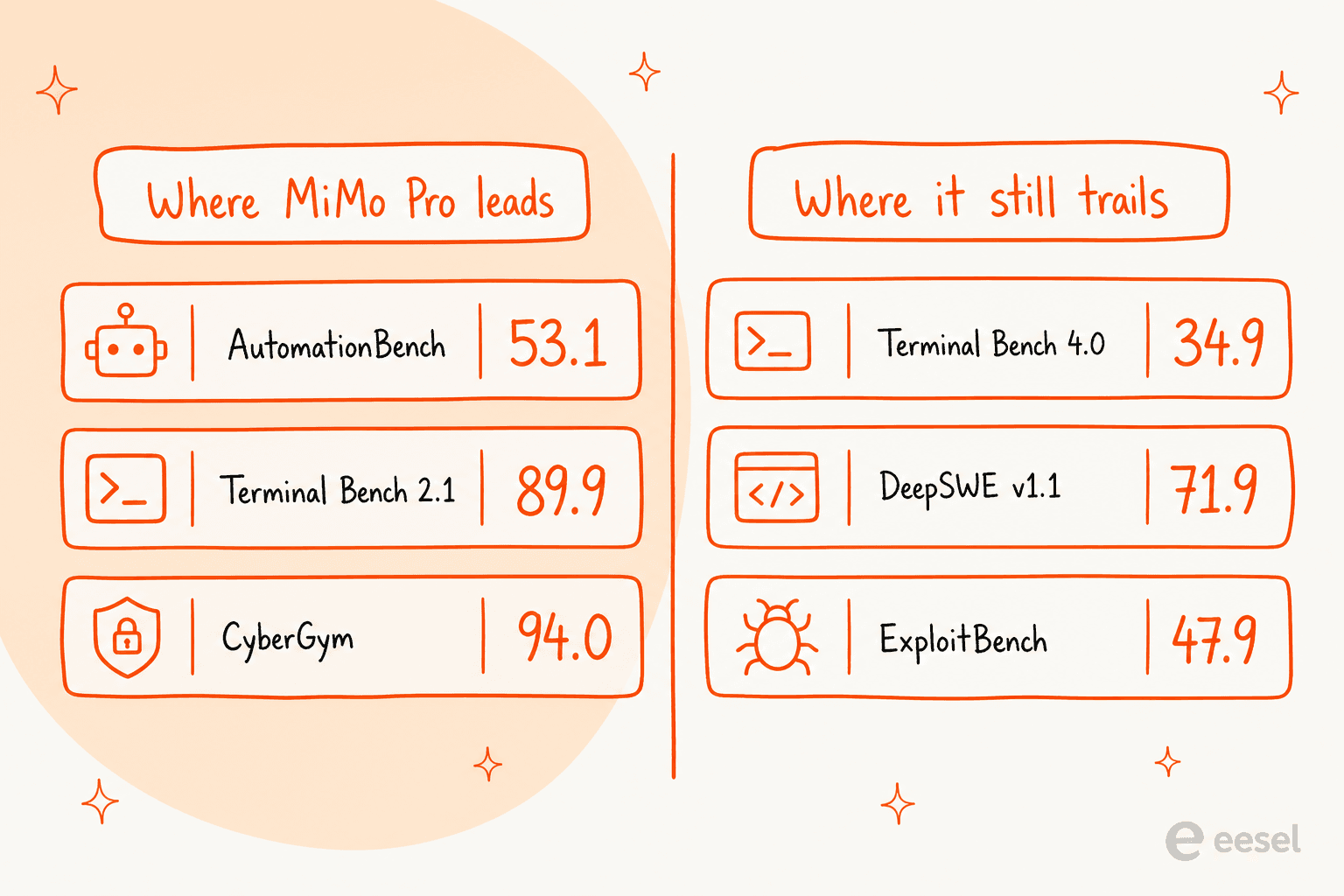
Where Pro clearly leads the closed frontier on Xiaomi's numbers:
| Benchmark | MiMo V2.6 Pro | Claude Opus 5 | GPT-5.6 Sol |
|---|---|---|---|
| AutomationBench v1.0.6 | 53.1 | 50.3 | 45.8 |
| Terminal Bench 2.1 | 89.9 | 89.1 | 88.8 |
| Agents' Last Exam | 31.6 | 31.6 | 30.8 |
| MiMo Visual Coding | 72.3 | 70.0 | 73.4 |
And where it trails, which Xiaomi to its credit publishes right alongside the wins:
| Benchmark | MiMo V2.6 Pro | Claude Opus 5 | GPT-5.6 Sol |
|---|---|---|---|
| DeepSWE v1.1 | 71.9 | 74.0 | 73.0 |
| ProgramBench | 26.5 | 37.0 | 25.0 |
| Terminal Bench 4.0 | 34.9 | 49.0 | 39.9 |
| ExploitBench | 47.9 | 70.0 | 78.5 |
The pattern is consistent and, I think, believable: MiMo V2.6 Pro is right there with the frontier on general agentic and tool-use tasks, and it falls behind on the hardest long-horizon coding and exploit benchmarks. When Xiaomi widened the comparison in its launch blog to include GPT-6 Astra, DeepSeek V4.1 Flash, and GLM 5.3, the same shape held: Pro lands near the top of the pack on AutomationBench and Terminal Bench 2.1, and behind GPT-6 Astra on Terminal Bench 4.0 (59.6) and ExploitGym.
One number does deserve a flag. Pro posts a striking 94.0 on CyberGym (Flash is even higher at 95.1), where the prior V2.5 Pro managed 40.0. Cybersecurity is clearly an area Xiaomi trained hard on, though the more adversarial ExploitBench tells a humbler story, so I would treat the CyberGym result as impressive rather than settled.
The independent number that matters more than any single board
Single benchmarks are noisy. The aggregate index from Artificial Analysis is the one I actually watch, because it rolls many evals into a single comparable score and, crucially, plots it against cost.
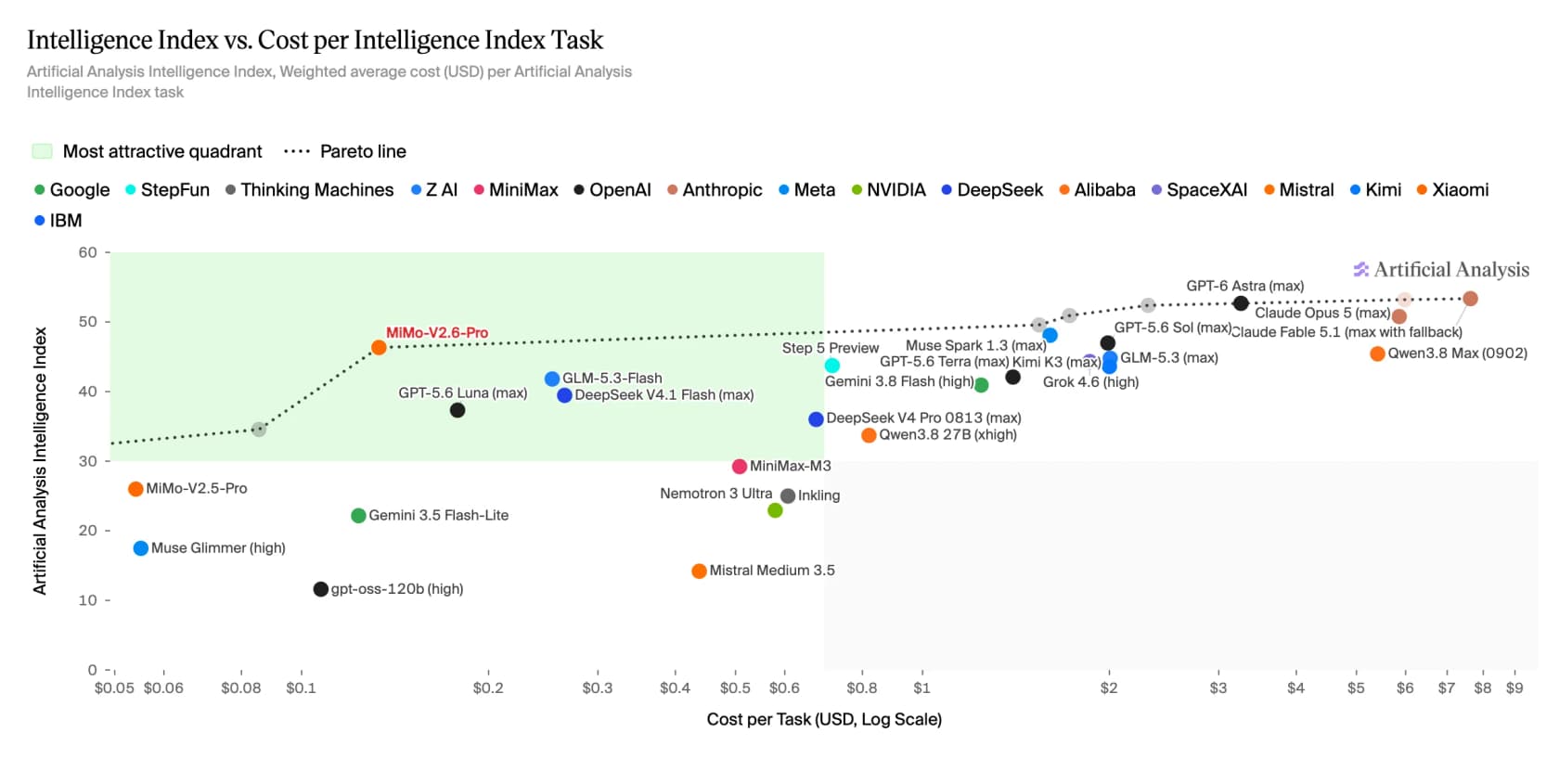
MiMo V2.6 Pro lands at an Intelligence Index of 46, the top open-weight model on the board, sitting in what Artificial Analysis literally labels the "most attractive quadrant." The closed frontier scores higher in raw intelligence (GPT-6 Astra, Opus 5, and Fable 5.1 all sit in the low-to-mid 50s), but they do it at $3 to $8 per task. MiMo does its 46 at about $0.13.
That price-to-intelligence ratio is the whole pitch, and it is why this launch rattled a few cages. As one commenter put it on the launch thread, the model "landed in the greenest quadrant of the intelligence vs speed of AA" while keeping the price identical to the previous generation. When you can get 85 to 90% of frontier intelligence for one-fortieth of the cost, the math changes for a lot of use cases.
How to actually run it: weights, API, and price
This is the part I care about most, because a benchmark score is useless if you cannot get the model into your stack. MiMo V2.6 is refreshingly easy to access, whether you want to self-host or just hit an endpoint.
The weights are open under an MIT license, which is about as permissive as it gets (commercial use allowed, almost no strings). You can download Pro, Flash, and the 9B distill from Hugging Face and ModelScope, and Xiaomi ships an FP8 checkpoint so you are not forced into full precision.
On hardware, be realistic about what Pro needs. The model card's own launch command runs Pro across two nodes with 16-way tensor parallelism, so this is a multi-node GPU cluster, not something you spin up on a spare workstation. Flash is far more approachable at a single 8-GPU node, and the 9B distill runs on a single GPU, with community GGUF quants already available for llama.cpp, LM Studio, and Ollama. If you have followed our writing on custom AI models, none of this will surprise you: open weights are free, but the serving bill is real.
If you would rather skip infrastructure entirely, MiMo V2.6 is hosted on Xiaomi's own API platform, in MiMo Studio and Desktop, and on OpenRouter. Here is the OpenRouter pricing, per million tokens, checked on release week:
| Model | Input / 1M | Output / 1M | Context |
|---|---|---|---|
| MiMo V2.6 Flash | $0.14 | $0.28 | 1M |
| MiMo V2.6 Pro | $0.435 | $0.87 | 1M |
| MiMo V2.6 Pro UltraSpeed | $4.35 | $8.70 | 1M |
Two things stand out. Flash at $0.14 in / $0.28 out is cheap for a 1M-context omnimodal model. And UltraSpeed is a clean 10x on both the speed and the price of Pro, so it is a deliberate premium for latency-sensitive work, not a better model. For most teams, Flash is the sensible default and Pro is what you escalate to when a task actually needs it.
What people said after running it
Benchmarks are Xiaomi's story. I wanted the users' story, so I read through the launch discussion, and the dominant reaction was not about the scores at all. It was about how openly Xiaomi trained the thing.
"I really like how transparent they've been about the training of this model. The realtime dashboard they shared during training was an incredible learning and teaching tool for me, and they've been unusually comprehensive in sharing details about their methodology... and benchmark scores (even the stuff they didn't do well on)."

"The best thing they did is being open about all the setbacks they had to deal with. They logged every restart with a reason, talked about dropping a cyber dataset after it degraded coding benchmarks. Also published real time training loss, benchmark scores after every checkpoint and running cost estimates."
That detail about dropping a cyber dataset because it hurt coding scores is the kind of thing labs almost never admit publicly, and it is a big part of why the launch earned goodwill even from skeptics. The single sharpest technical read in the thread came from a long-time MiMo user who tallied the boards himself:
"Mimo 2.6 pro, the 1T model leads Kimi K3, a 2.8T param model in 14 out of 15 benchmarks (and the last one is near tie)!! Good to see they also kept the price the same, and landed in the greenest quadrant of the intelligence vs speed of AA."
It was not all praise. The recurring worry, the one that follows every strong open model out of China, is benchmaxxing: great scores, disappointing real-world work. One commenter was blunt about the prior generation:
"No chinese lab has caught up yet. They've tried to fake it by distilling and overfitting on benchmarks to make their models look better than they are, the 'best' models available from chinese labs right now (GLM 5.3 and Kimi K3) fall apart completely when you try to do real work with them."
The counterweight came from people already using the line in production. A software engineer's take on the value math is the one I keep thinking about:
"I been using MiMo-V2.5 to do most of my work as software engineer... I been VERY happy with ROI. The model is very powerful!... The cost is unbelievably low, and the quality of intelligence I get is equivalent to when I was working mostly with Anthropic models (late last year/early this year)... but when I add cost of M-token in the ROI math, Jeez! MiMo is an order of magnitude better."
Worth noting that last quote is about V2.5, which several people also called "fast but dumb" for harder tasks, so the real test of V2.6 is whether it closes that gap in daily use, not just on the charts. On X, the launch mostly got read as a shot at Grok 4.7, which shipped the same day, with reactions ranging from "Better than Grok 4.7" to a more measured "let's wait for real-world test performance first."
Where MiMo V2.6 fits in the open-model race
Step back and MiMo V2.6 is one more data point in a trend that is getting hard to ignore: open-weight models from Chinese labs keep landing near the frontier while running on far cheaper hardware. DeepSeek V4.1 Flash, GLM 5.3, Qwen 3.8 Max, and now MiMo V2.6 are all trading blows in the same intelligence band that used to belong to closed models alone.
There is a real strategic pull underneath the benchmarks, and one commenter framed it well:
"Chinese models are increasingly closer to the frontier, while being able to run on much cheaper hardware than what US frontier models run on... the rest of the world is going to see the risks and the availability of good enough open weight models for their purposes and be more likely to lean in favor of self-hosted Chinese models or local inference clouds."
That is the actual competitive story: not "does MiMo beat Opus on one board," but "can you get good-enough intelligence, on your own hardware, at a price that makes the closed frontier feel like a luxury." For a lot of teams the answer is now yes. If you want a wider survey of what is out there, our roundup of the best open-source AI agents is a good next read, and our DeepSeek review and Kimi K3 review cover its closest open rivals.
What this means if you are putting AI on a support queue
Here is where I have to be honest about my own bias, because I have spent the last few years helping put AI on live support queues, and the MiMo V2.6 launch confirms something we learned the hard way: the model is no longer the bottleneck.
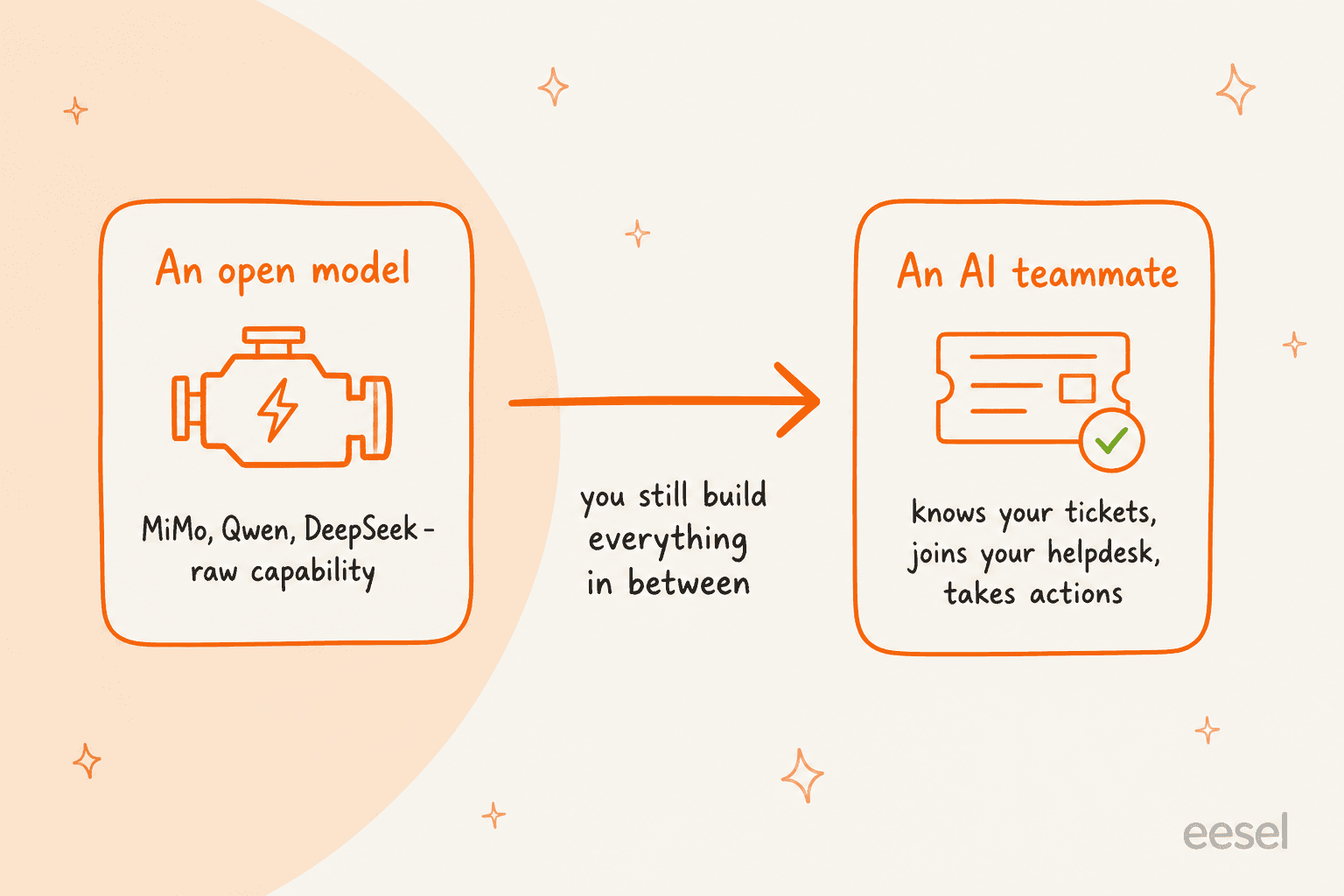
MiMo V2.6, DeepSeek, Qwen, Claude, GPT: any of them can write a fluent, correct-sounding answer to a customer question. That was the scary part a couple of years ago. It is solved now. What none of them do out of the box is the actual job: read your specific help center and past tickets, follow your refund policy instead of a plausible-sounding made-up one, look up an order, tag and route the ticket, know when to escalate to a human, and, most importantly, get tested before it answers a real customer.
That last point is the one I would not compromise on. We have watched confident-sounding models give wrong answers on real queues, which is exactly why every rollout we do gets simulated against historical tickets first, so you see how it would have handled thousands of your own past conversations before it touches a live one. A benchmark score of 46 on the AA index tells you nothing about how a model will handle your weird edge-case return policy. A simulation over your last 5,000 tickets does.
So if you are excited about MiMo V2.6 (and you should be, it is a great engine), the right question is not "which model" but "what wraps the model." The model is a commodity now. The system around it is the product.
Try eesel
The whole point of this post is that an open model like MiMo V2.6 is infrastructure, raw capability you still have to turn into something that does a job. eesel is the layer that turns a model into a working teammate. You hire a ready-to-work AI helpdesk agent that plugs into the helpdesk you already run (Zendesk, Freshdesk, Gorgias, Help Scout, and 1000+ integrations), trains on your past tickets and help center, and starts drafting or sending replies, no model-ops required.

The differentiator is the one MiMo's own benchmarks cannot give you: before an eesel agent answers a single live customer, you simulate it on your real ticket history and see the exact resolution rate and responses you would have gotten. And because eesel is a teammate platform, the same account runs an AI blog writer too, so if you liked what MiMo does for engineering, the writing side has a teammate as well. For developers, eesel exposes the same teammate through a public CLI, API, and MCP, so a person, a script, or a coding agent can all drive it from the terminal.
You can start free, no credit card and no sales call, and have a teammate live in minutes. The model got cheap. Getting it to actually do the job is still the interesting part.
Frequently Asked Questions
What is Xiaomi MiMo V2.6?
How much does Xiaomi MiMo V2.6 cost?
Is Xiaomi MiMo V2.6 better than DeepSeek or Kimi K3?
Can I self-host Xiaomi MiMo V2.6?
Should I use Xiaomi MiMo V2.6 for customer support?


Article by
Rama Adi Nugraha
Rama is a software engineer at eesel AI with two years of experience writing about B2B SaaS, AI tools, and customer support technology. Based in Bali, Indonesia, he brings a developer's perspective to product comparisons — cutting through marketing copy to what the integrations and APIs actually do.