


How I reviewed it
I spend my days on search intent and on the builder's read of a product underneath the marketing, so my process for a launch like this is boring on purpose. I skipped Xiaomi's press page and went to the model cards on Hugging Face, cross-checked the scores against the independent Artificial Analysis index, and then read roughly 670 comments across the launch, training-dashboard, and price-analysis threads on Hacker News to see what people running the model in anger actually reported.
I have not spent a year living inside MiMo the way I have inside the tools I build on daily, so I will be clear where I am reading the research versus reporting lived use. That distinction matters for a model days old, and most "reviews" that appear within hours of a launch quietly skip it.
What MiMo V2.6 actually is
MiMo V2.6 is a family of open-weight, natively omnimodal language models from Xiaomi's MiMo team, released on September 22, 2026. "Natively omnimodal" earns its place here: the same model takes text, images, video, and audio rather than bolting a vision adapter onto a text model. Every checkpoint ships with a 1M-token context window under an MIT license.
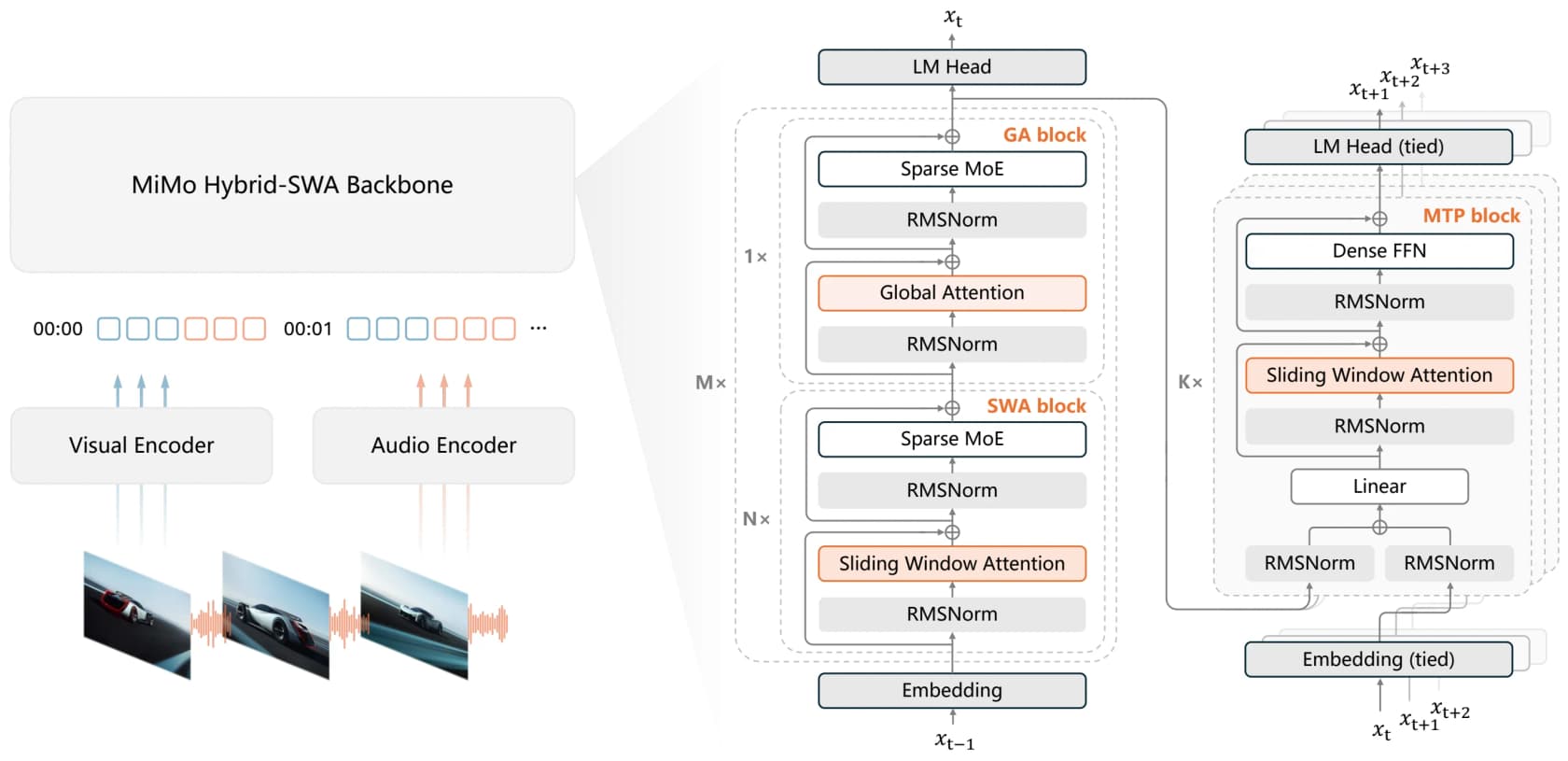
The one-paragraph builder's read: Pro is a sparse mixture-of-experts, 1.02T total parameters but only 42B active per token, with a hybrid attention backbone (70 layers interleaving local sliding-window and global attention), 384 routed experts of which 8 fire per token, a 681M vision encoder, audio encoders, and a 5-layer multi-token-prediction decoder. You do not need any of that to use it, but it explains how a "1 trillion parameter" model stays cheap: the active-parameter count, not the total, is what you pay to run.
It ships in four checkpoints, which is where a lot of the online confusion comes from:

| Model | Total params | Active params | Context | Best for |
|---|---|---|---|---|
| MiMo V2.6 Pro | 1.02T | 42B | 1M | The most demanding long-horizon agentic work |
| MiMo V2.6 Flash | 309B | 15B | 1M | The best balance of intelligence, speed, and cost |
| MiMo V2.6 Pro UltraSpeed | ~1T | 42B | 1M | Pro quality when you need output fast |
| MiMo V2.6 Distill-Qwen-9B | 9B | 9B | n/a | Single-GPU and open agentic-RL research |
Flash is the one most people will reach for. UltraSpeed is the same Pro checkpoint served for roughly 10x faster output at 10x the price, so it is a latency premium, not a smarter model. The 9B distill is a supervised fine-tune of Qwen3.5-9B on MiMo-generated data, a research starting point rather than production.
The benchmarks, read honestly
Every launch cherry-picks its charts, so I went to the evaluation table on the model card and split it into wins and losses. To Xiaomi's credit, it publishes both.
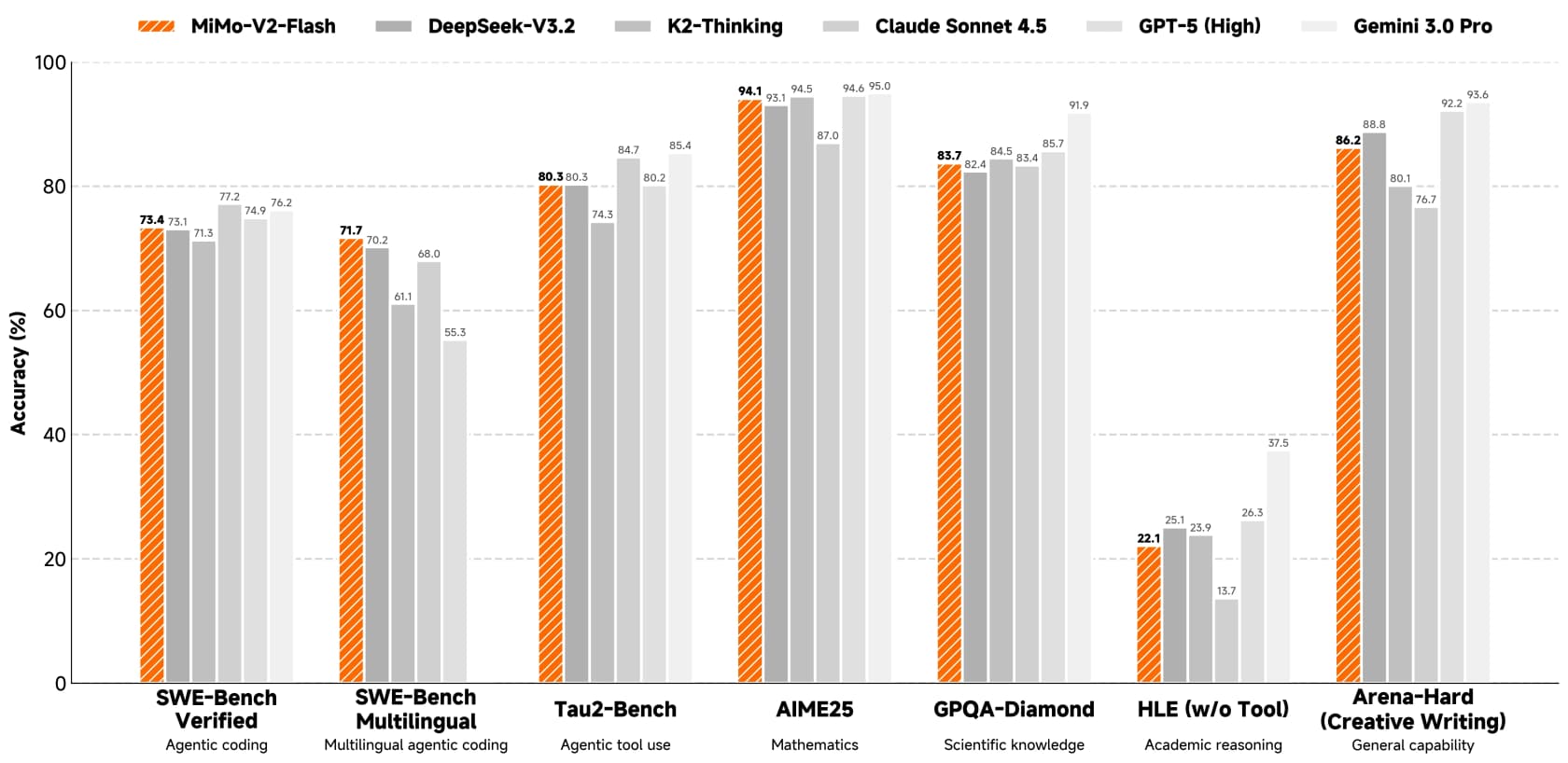
Where Pro leads the closed frontier on Xiaomi's numbers:
| Benchmark | MiMo V2.6 Pro | Claude Opus 5 | GPT-5.6 Sol |
|---|---|---|---|
| AutomationBench v1.0.6 | 53.1 | 50.3 | 45.8 |
| Terminal Bench 2.1 | 89.9 | 89.1 | 88.8 |
| Agents' Last Exam | 31.6 | 31.6 | 30.8 |
| CyberGym | 94.0 | - | - |
And where it trails, which the Terminal Bench 4.0 board makes plain:
| Benchmark | MiMo V2.6 Pro | Claude Opus 5 | GPT-5.6 Sol |
|---|---|---|---|
| DeepSWE v1.1 | 71.9 | 74.0 | 73.0 |
| ProgramBench | 26.5 | 37.0 | 25.0 |
| Terminal Bench 4.0 | 34.9 | 49.0 | 39.9 |
| ExploitBench | 47.9 | 70.0 | 78.5 |
The pattern is consistent and, I think, believable: Pro is right there with the frontier on general agentic and tool-use tasks, and it falls behind on the hardest long-horizon coding and exploit benchmarks. When Xiaomi widened the comparison to include GPT-6 Astra, the same shape held: Pro lands near the top on AutomationBench and Terminal Bench 2.1, and behind Astra on Terminal Bench 4.0 (59.6).
The generational jump is the part that actually impressed me. The prior MiMo V2.5 Pro scored 19.0 on DeepSWE v1.1; V2.6 Pro scores 71.9. On Terminal Bench 4.0 it went from 1.5 to 34.9. That is not incremental, it is the kind of leap you only see when a lab changes its training approach.
One number deserves a flag rather than a cheer. Pro posts 94.0 on CyberGym where V2.5 managed 40.0, but the more adversarial ExploitBench tells a humbler 47.9. I would read the CyberGym result as impressive, not settled.
The value math is the real story
Single boards are noisy. The number I actually watch is the aggregate index from Artificial Analysis, because it rolls many evals into one comparable score and plots it against cost.
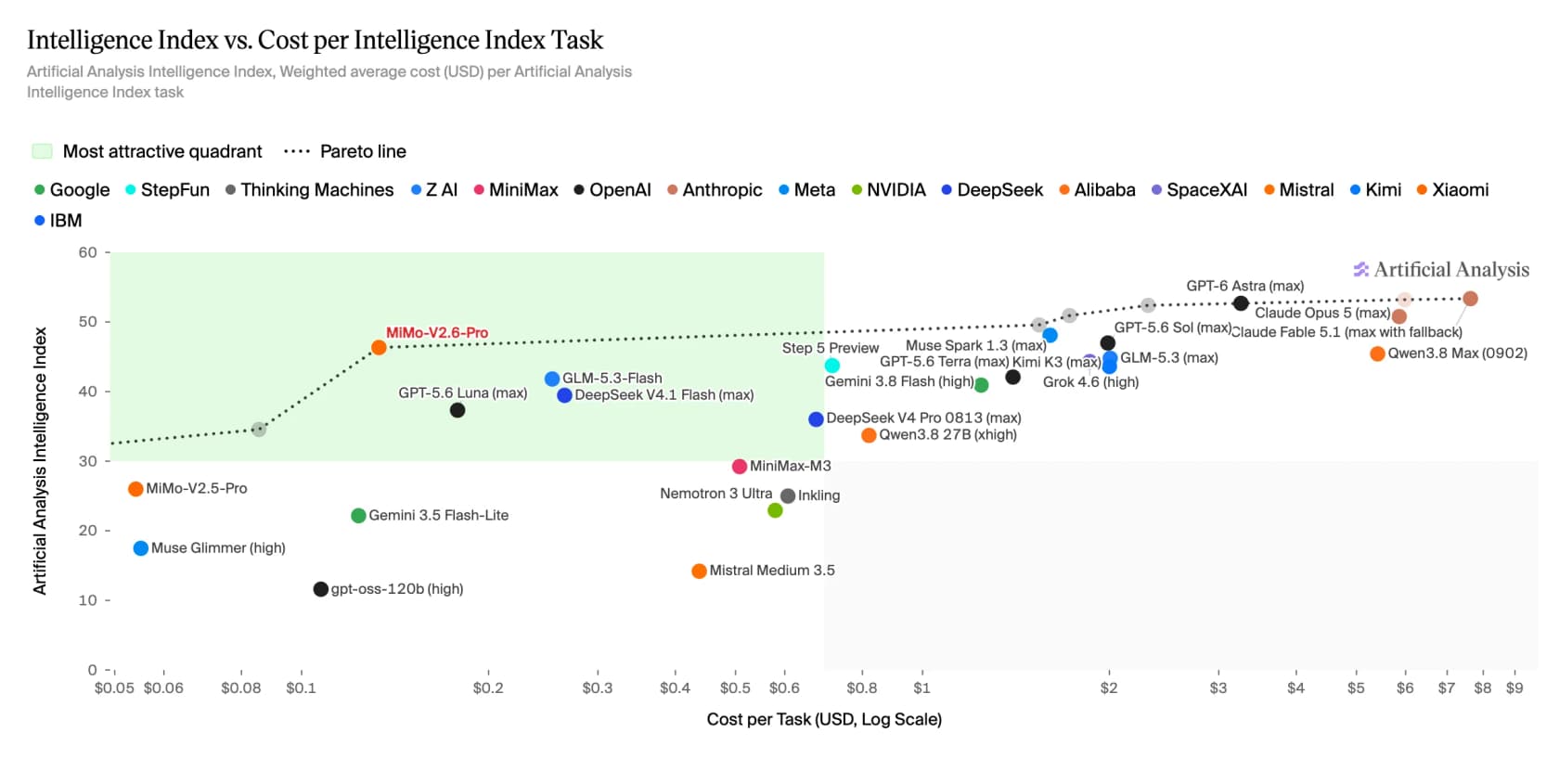
MiMo V2.6 Pro lands at an Intelligence Index of 46, the top open-weight model on the board, in what Artificial Analysis literally labels the "most attractive quadrant." The closed frontier scores higher on raw intelligence (Astra, Opus 5, and Fable 5.1 sit in the low-to-mid 50s) but at $3 to $8 per task. MiMo does its 46 at about $0.13.
That price-to-intelligence ratio is the whole pitch. Here is the hosted OpenRouter pricing, per million tokens, checked release week:
| Model | Input / 1M | Output / 1M | Context |
|---|---|---|---|
| MiMo V2.6 Flash | $0.14 | $0.28 | 1M |
| MiMo V2.6 Pro | $0.435 | $0.87 | 1M |
| MiMo V2.6 Pro UltraSpeed | $4.35 | $8.70 | 1M |
Flash at $0.14 in / $0.28 out is remarkably cheap for a 1M-context omnimodal model. For most teams Flash is the default and Pro is what you escalate to.
Which MiMo V2.6 checkpoint fits you
The four-checkpoint lineup is the single most confusing thing about this launch, so here is a quick decision tool. Answer the three questions and it points you at the right checkpoint (or away from MiMo entirely).
What people who ran it actually said
Benchmarks are Xiaomi's story; I wanted the users' story. The dominant reaction on the launch thread was not about the scores at all. It was about how openly Xiaomi trained the thing.
"I really like how transparent they've been about the training of this model. The realtime dashboard they shared during training was an incredible learning and teaching tool for me, and they've been unusually comprehensive in sharing details about their methodology... and benchmark scores (even the stuff they didn't do well on)."

"The best thing they did is being open about all the setbacks they had to deal with. They logged every restart with a reason, talked about dropping a cyber dataset after it degraded coding benchmarks. Also published real time training loss, benchmark scores after every checkpoint and running cost estimates."
That detail about dropping a cyber dataset because it hurt coding scores is the kind of thing labs almost never admit, and it is a big part of why the launch earned goodwill even from skeptics. The sharpest single technical read came from a long-time MiMo user who tallied the boards by hand:
"Mimo 2.6 pro, the 1T model leads Kimi K3, a 2.8T param model in 14 out of 15 benchmarks (and the last one is near tie)!! Good to see they also kept the price the same, and landed in the greenest quadrant of the intelligence vs speed of AA."
It was not all praise. The worry that follows every strong open model out of China is benchmaxxing, great scores and disappointing real work:
"No chinese lab has caught up yet. They've tried to fake it by distilling and overfitting on benchmarks to make their models look better than they are, the 'best' models available from chinese labs right now (GLM 5.3 and Kimi K3) fall apart completely when you try to do real work with them."
The counterweight came from people already running the line in production. The value-math take is the one I keep thinking about, though note it is about the prior V2.5, which several people also called fast-but-dumb on hard tasks:
"I been using MiMo-V2.5 to do most of my work as software engineer... I been VERY happy with ROI. The model is very powerful!... The cost is unbelievably low, and the quality of intelligence I get is equivalent to when I was working mostly with Anthropic models... but when I add cost of M-token in the ROI math, Jeez! MiMo is an order of magnitude better."
On X, the launch mostly got read as a shot at Grok 4.7, which shipped the same day, with reactions from "Better than Grok 4.7" to a measured "let's wait for real-world test performance first." That real-world caveat is the right one, and it is exactly why V2.5's "fast but dumb on hard tasks" reputation is the bar V2.6 has to clear in daily use, not just on the charts.
My verdict: the best open-weight value, not the smartest model
Here is where I land after a week with the research.
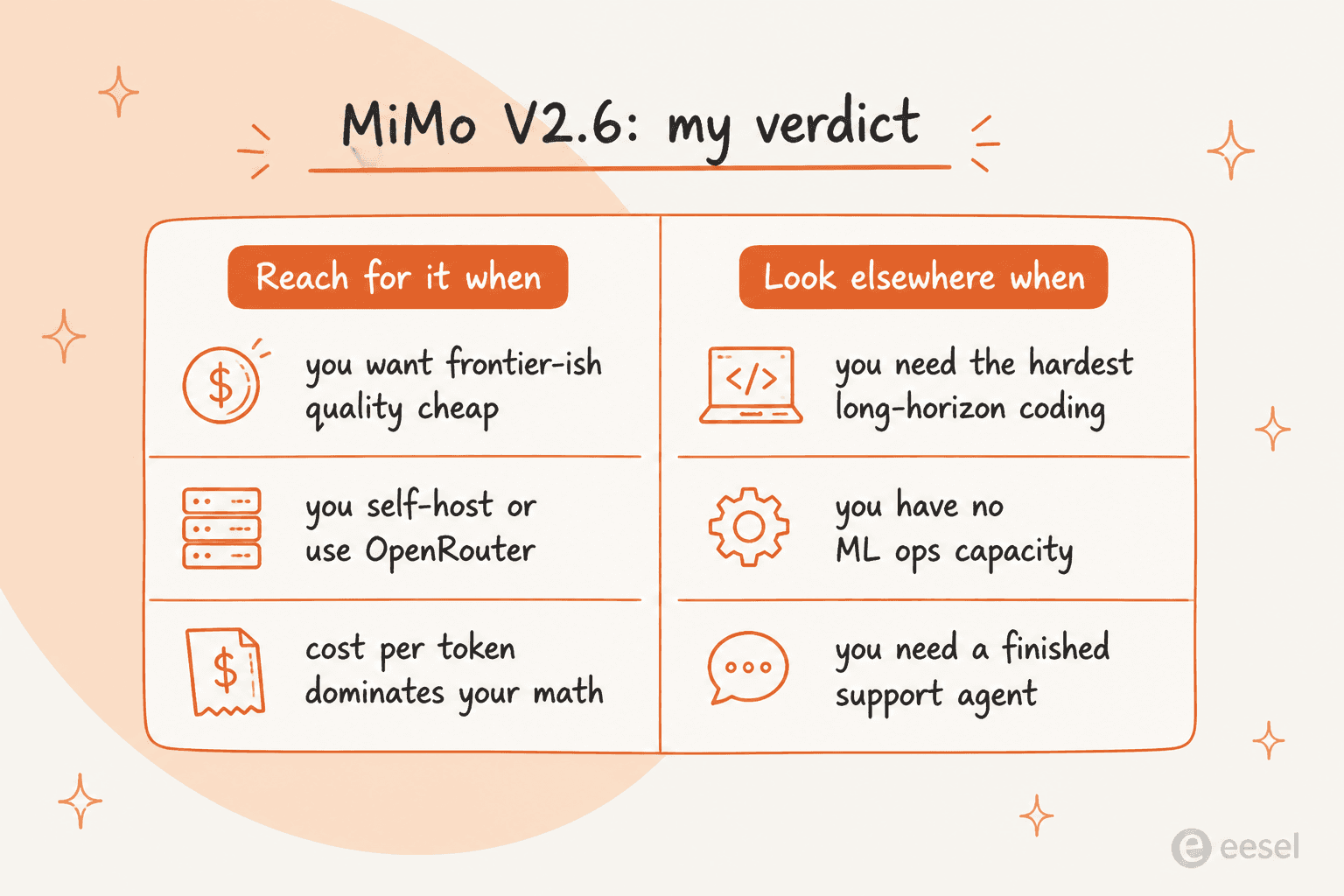
Reach for MiMo V2.6 when cost per token dominates your math, you are comfortable self-hosting or hitting OpenRouter, and you want frontier-ish quality on general agentic and tool-use work. Flash in particular is a strong default for high-volume, everyday tasks where the closed frontier's per-token price would sting.
Look elsewhere when your workload is the hardest long-horizon coding or exploit work, where Pro measurably trails Astra and Opus 5; when you have no capacity to run model infrastructure and no plan for the serving bill; or when you actually need a finished agent that does a job, not a raw model. On that last point, MiMo is not the tool, and neither is any other model on its own.
Rating-wise, as an open-weight value play I would put it near the top of the current pack alongside DeepSeek V4.1 Flash and Qwen 3.8 Max. As a "beats the closed frontier" claim, the honest answer is: on price, yes; on the hardest benchmarks, not yet. For a wider survey, our roundup of the best open-source AI agents is a good next read.
The part a model review usually skips: an engine is not an employee
I have spent the last few years helping put AI on live support queues, and the MiMo V2.6 launch confirms the thing we learned the hard way: the model is no longer the bottleneck.
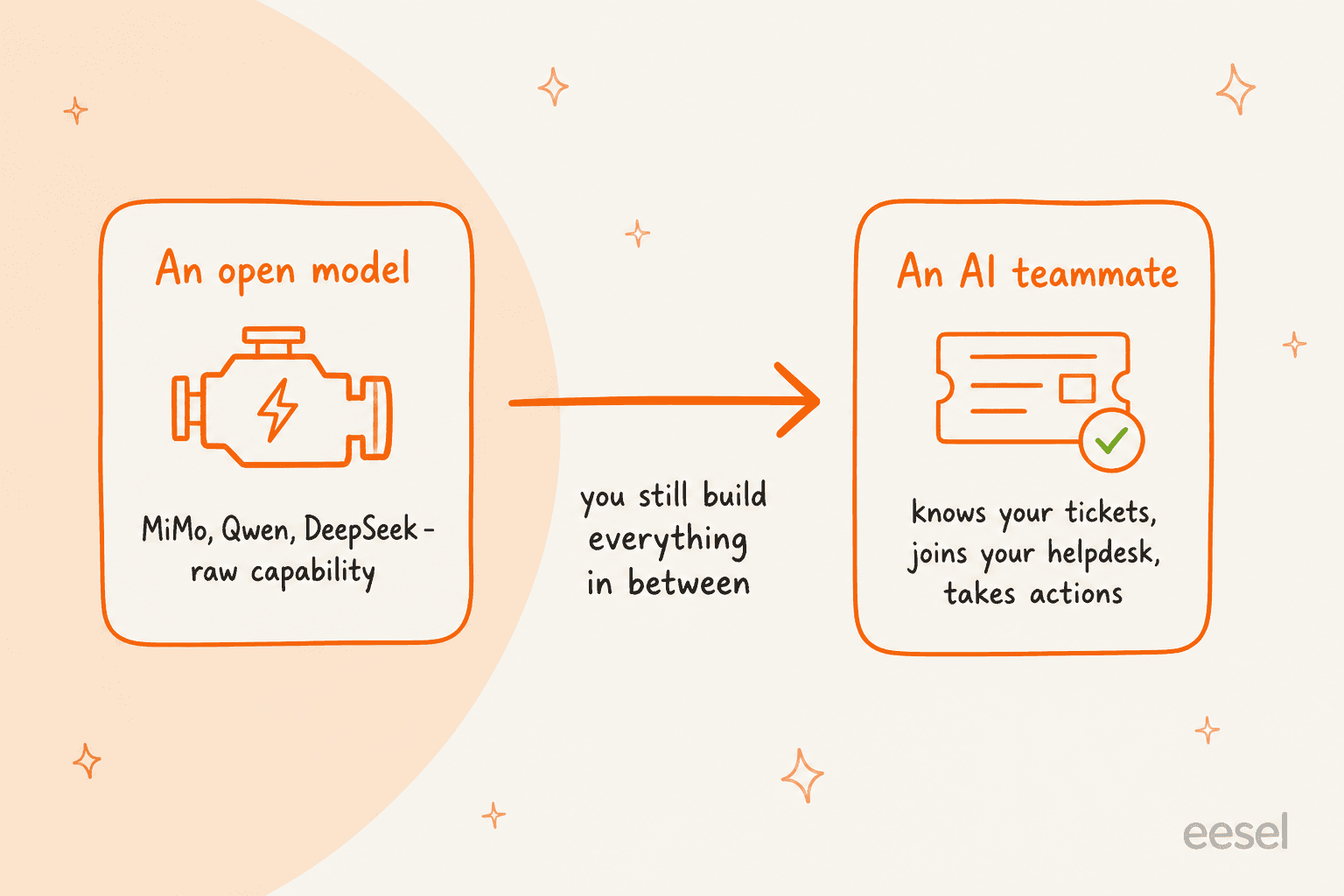
MiMo V2.6, DeepSeek, Qwen, Claude, GPT: any of them can write a fluent, correct-sounding answer to a customer question. That was the scary part two years ago. It is solved. What none of them do out of the box is the actual job: read your specific help center and past tickets, follow your refund policy instead of a plausible made-up one, look up an order, tag and route the ticket, know when to escalate, and get tested before it answers a real customer.
That last point is the one I would not compromise on. We have watched confident-sounding models give wrong answers on real queues, which is why every rollout gets simulated against historical tickets first. A 46 on the AA index tells you nothing about how a model handles your weird edge-case return policy. A simulation over your last 5,000 tickets does. If you are picking a model for support specifically, our guide to the best AI model for support tickets and the AI agent vs human agent cost breakdown are the two I would read next.
Try eesel
The whole point of this review is that an open model like MiMo V2.6 is infrastructure, raw capability you still have to turn into something that does a job. eesel is the layer that turns a model into a working teammate. You hire a ready-to-work AI helpdesk agent that plugs into the helpdesk you already run (Zendesk, Freshdesk, Gorgias, Help Scout, and 1000+ integrations), trains on your past tickets and knowledge base, and starts drafting or sending replies with no model-ops required.

The differentiator is the one MiMo's own benchmarks cannot give you: before an eesel agent answers a single live customer, you simulate it on your real ticket history and see the exact resolution rate and responses you would have gotten. And because eesel is a teammate platform, the same account runs an AI blog writer too. For developers who liked MiMo's terminal-friendliness, eesel exposes the same teammate through a public CLI, API, and MCP, so a person, a script, or a coding agent can all drive it from the terminal.
You can start free, no credit card and no sales call, and have a teammate live in minutes. The model got cheap. Getting it to actually do the job is still the interesting part.
Frequently Asked Questions
Is Xiaomi MiMo V2.6 any good?
How much does Xiaomi MiMo V2.6 cost to run?
Is Xiaomi MiMo V2.6 better than Kimi K3 or DeepSeek?
Can I self-host Xiaomi MiMo V2.6?
Which MiMo V2.6 model should I use?
Should I use Xiaomi MiMo V2.6 for customer support?
Is the Xiaomi MiMo V2.6 benchmark transparency real?


Article by
Kurnia Kharisma Agung Samiadjie
Kurnia is a software engineer and writer at eesel AI with two years of SEO experience, writing about AI tools, helpdesk software, and customer support. He pairs a developer's understanding of how these products are built with search-driven research into what actually ranks and resonates with the people searching for them.