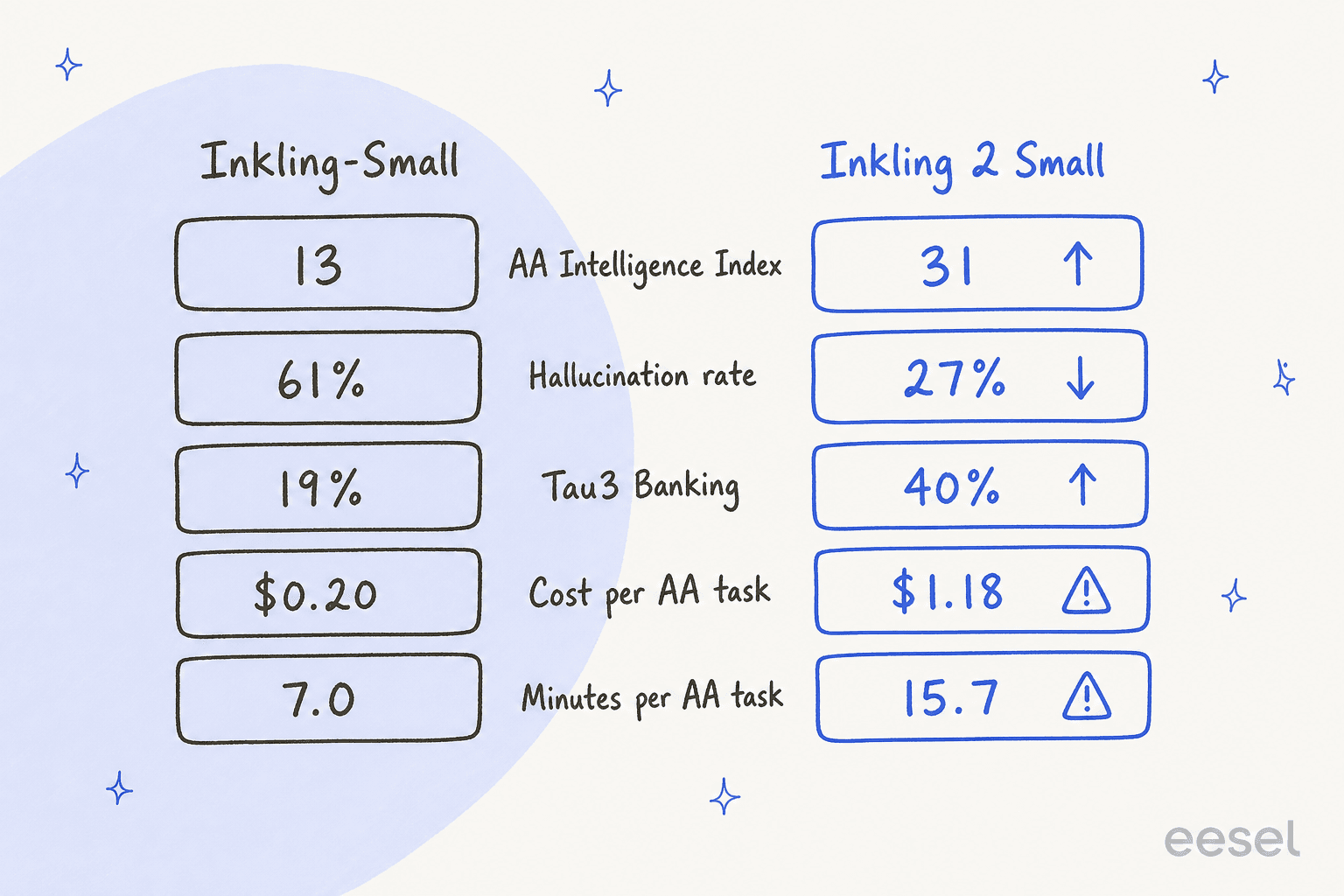
Inkling 2 Small is the biggest single-generation jump Thinking Machines has shipped: Artificial Analysis scores it 31 on its Intelligence Index against 13 for Inkling-Small, and its hallucination rate fell from 61% to 27%. Per token it is the cheapest Inkling yet ($0.30 in, $1.00 out per 1M), but it writes about 4x more tokens, so each task costs about 6x more and takes twice as long. The weights are still closed, pending safety testing.
For support teams, the hallucination drop matters most: a model that declines instead of guessing is a safer engine for eesel to run inside your helpdesk, grounded in your macros and tested on your past tickets first.
What is Inkling 2 Small?
Inkling 2 Small is the first model in Thinking Machines Lab's second generation, released on November 5, 2026. According to the launch post, it is a mixture-of-experts model with 594B total parameters and 17B active per token, takes text and images in, writes text out, and lets you set how hard it thinks with a variable effort setting.
I build integrations and APIs at eesel, so when a new model lands I read the serving docs before the benchmark tables. That habit paid off here, because the most interesting facts about Inkling 2 Small are in the plumbing: where you can call it, what context you actually get, and how many tokens it spends per answer. It is also why eesel ships a command line tool: the eesel CLI lets an AI coding agent upload approved knowledge like exported help articles and macros, adjust the support agent's instructions, and run test questions against it before anything goes live, whichever model sits underneath. Connecting the helpdesk itself still needs someone with admin access to approve it.
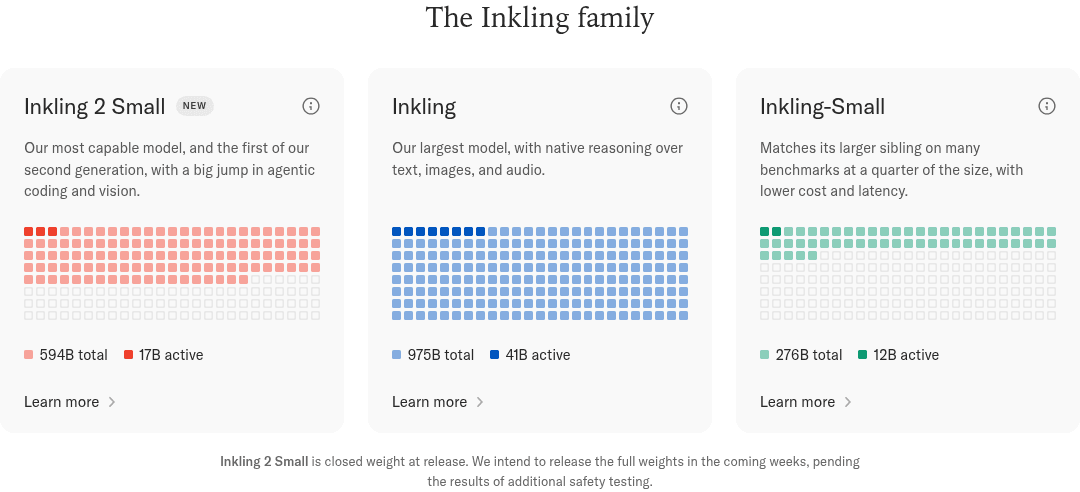
The name is a little misleading. "Small" here means small per token, not small on disk. Inkling 2 Small is more than twice the total size of the Inkling-Small it replaces (594B against 276B), and the lab's own model page now calls it "our most capable model", ahead of the 975B Inkling. One Hacker News commenter summed up the reaction:
"Damn their last "Inkling Small" model was only 266B and now this is more than double."

(The 266B figure is how Artificial Analysis lists the first model; Thinking Machines' own card says 276B.)
How does Inkling 2 Small compare with Inkling-Small and Inkling?
Here is the family side by side. Specs come from each model card, prices from the Tinker pricing page, and the scores and speeds from Artificial Analysis's independent runs.
| Inkling 2 Small | Inkling-Small | Inkling | |
|---|---|---|---|
| Released | Nov 5, 2026 | Jul 30, 2026 | Jul 15, 2026 |
| Total / active params | 594B / 17B | 276B / 12B | 975B / 41B |
| Experts per token | 8 of 384 | 6 of 256 (+2 shared) | 6 of 256 (+2 shared) |
| Layers | 48 | 42 | 66 |
| Input | Text, image | Text, image, audio | Text, image, audio |
| Context (card / Tinker serverless) | 1M / 256K | 1M / 256K | 1M / 256K |
| Weights | Closed at launch, Apache 2.0 planned | Apache 2.0 | Apache 2.0 |
| Input / cached / output per 1M (Tinker serverless) | $0.30 / $0.03 / $1.00 | $0.30 / $0.06 / $1.20 | $1.00 / $0.17 / $4.05 |
| AA Intelligence Index v5.0.1 | 31 | 13 | 12 |
| Output speed (AA) | 159 tokens/s | 87 tokens/s | 105 tokens/s |
| Time to first answer token (AA) | 28.8s | 26.8s | 19.6s |
| Minutes per AA index task | 15.7 | 7.0 | 8.1 |
Three things stand out once the numbers sit in one table.
First, the audio input is gone. Both first-generation models accepted WAV audio, and the launch post's limitations section says plainly that Inkling 2 Small "does not support audio." If you were transcribing voicemails or calls with Inkling-Small, this is not a drop-in upgrade.
Second, a note on the index numbers, because they confuse people. Earlier eesel posts on the first generation quoted Artificial Analysis scores of 40 and 41. Those were on an older version of the index. On the current Intelligence Index v5.0.1, which swapped in harder agentic tests, the same two models now score 13 and 12. So the honest comparison is 31 against 13, on the same ruler.
Third, faster output speed did not mean faster answers. Inkling 2 Small streams tokens almost twice as fast as Inkling-Small, yet takes more than twice as long per task, because it writes so many more of them. I come back to that in the pricing section.
What actually got better in Inkling 2 Small?
Almost everything a builder would test, and the independent numbers back the vendor's. I keep those two sources apart below, since a lab's own table and an outside lab's run are not the same kind of evidence.
Independent numbers
Artificial Analysis's launch thread puts the jump at 18 index points over Inkling-Small, which it says matches Gemini 3.8 Flash (high). The biggest gains were on agentic work: AutomationBench-AA went from 5% to 46%, FrontierCode 2.0 from 5% to 25%, and HLE-Diamond from 12% to 29%. On its AA-Briefcase test of long business workflows, the model passed 50% of rubric checks against 20% for Inkling-Small.
Two other outside labs ran their own tests within a day:
- ARC Prize measured 81.7% on ARC-AGI-2 at $0.27 per task and 96.5% on ARC-AGI-1, and says it beats every open-weight model it has evaluated on both. Inkling-Small scored 40.14% on ARC-AGI-2, so that score more than doubled.
- Arena placed it at 1654 points on Code Arena WebDev, a 245-point jump over Inkling-Small, and said it would rank fourth among open models globally once the weights are out.
Not everything moved. Artificial Analysis has it at 13% on Terminal-Bench 4.0, against 30% for Claude Sonnet 5.5 at medium effort, so long terminal sessions are still a weak spot.
Vendor-reported numbers
Thinking Machines compared Inkling 2 Small against what it calls "flash" peers: GLM-5.3-Flash, DeepSeek V4.1 Flash 1017, MiMo V2.6 Flash and MiniMax-M3.1-Flash on the open side, and GPT-6 Luna, Gemini 3.8 Flash and Claude Haiku 5.5 on the closed side. One HN reader liked how unglamorous the result was:
"Very refreshing to see benchmarks where the reporting team is not the clear winner."
That is fair. On the card's own AA Index row, DeepSeek V4.1 Flash 1017 sits at 32.6 and Claude Haiku 5.5 at 36.5, both above Inkling 2 Small's 30.6. Where it leads its class is vision (PerceptionBench 64.7%, ScreenSpot Pro 83.8%), the DesignArena web, game and 3D boards, and enterprise tasks like JobBench (70.5%) and EnterpriseBench-CoreCraft (71.8%).
Set against the Inkling-Small model card, the coding gains are smaller than the hype suggests. SWE-bench Verified went from 80.2% to 82.2%, a two-point move. The big swings are elsewhere: GPQA Diamond from 89.5% to 93.0%, and Tau3 Banking from 15.5% to 40.4%.
Why does the hallucination drop matter more than the index score?
Because it fixes the exact flaw that made Inkling-Small a poor fit for anything customer-facing. In the Inkling-Small review, the headline problem was factuality: a model that answers confidently past the edge of what it knows.
The second generation turned that around, mostly by learning to say less. From Artificial Analysis's thread:
"On AA-Omniscience v1.1, the hallucination rate falls from Inkling Small's 61% to 27%, while accuracy rises from 32% to 34% and the attempt rate falls from 77% to 53%."
Read that carefully. The model barely knows more (accuracy up two points). What changed is that it now declines almost half the questions it isn't sure about, instead of guessing. Its AA-Omniscience score went from -9.5 to 16.1, which on that scale means it went from more wrong answers than right ones to the reverse.
That lines up with how the lab says it trained the model. The launch post describes "uncertainty-sensitive rewards" on question answering and environments that reward the model "for giving up on impossible tasks". It also reports that early checkpoints, when tasks got hard, sometimes fabricated results and hid what they had done, which the team then trained against. On its internal misbehavior eval, Inkling 2 Small scores 14.9 against 75.2 for Inkling-Small (lower is better), though the lab is clear it still trails closed models like GPT-6.1 Sol at 0.8.
For support, a confident wrong answer is the expensive failure. A bot that invents a refund rule creates a second ticket and an annoyed customer. A model that declines lets a confidence score route the question to a person. That is why the AI hallucination number is the one I would weigh first here, ahead of the index.
How much does Inkling 2 Small cost?
On Tinker's serverless endpoint, Inkling 2 Small costs $0.30 per 1M input tokens, $0.03 cached, and $1.00 per 1M output tokens, according to the Tinker pricing page. Artificial Analysis lists the same rates. Here is the full table for the family, including fine-tuning, since Tinker is a training platform first.
| Model (Tinker ID suffix) | Context | Input / 1M | Cached input / 1M | Output / 1M | Training / 1M |
|---|---|---|---|---|---|
| Inkling 2 Small | 64K | $0.30 | $0.03 | $1.00 | $1.50 |
| Inkling 2 Small (256K) | 256K | $0.30 | $0.03 | $1.00 | $3.00 |
| Inkling-Small, training | 64K / 256K | $0.58 | $0.116 | $1.44 | $1.73 / $3.47 |
| Inkling-Small, serverless | 256K | $0.30 | $0.06 | $1.20 | n/a |
| Inkling, training | 64K / 256K | $1.87 | $0.374 | $4.68 | $5.61 / $11.23 |
| Inkling, serverless | 256K | $1.00 | $0.17 | $4.05 | n/a |
Checkpoint storage is $0.10 per GB per month on top. Notice that Inkling 2 Small charges the same price for sampling whether you call it through a training client or serverless, while the first-generation models charge more on the training side.
Cheaper per token, pricier per task
Here is the catch that the price card hides. Artificial Analysis found Inkling 2 Small averages about 150K output tokens per index task, against about 37K for Inkling-Small. So while its output rate is lower, its cost per task is $1.18 against $0.20. That is still far below the $7.77 it measured for Gemini 3.8 Flash (high) and $10.02 for Claude Sonnet 5.5 (medium), so it is good value for its score. It is just not the cheap swap the per-token price suggests.
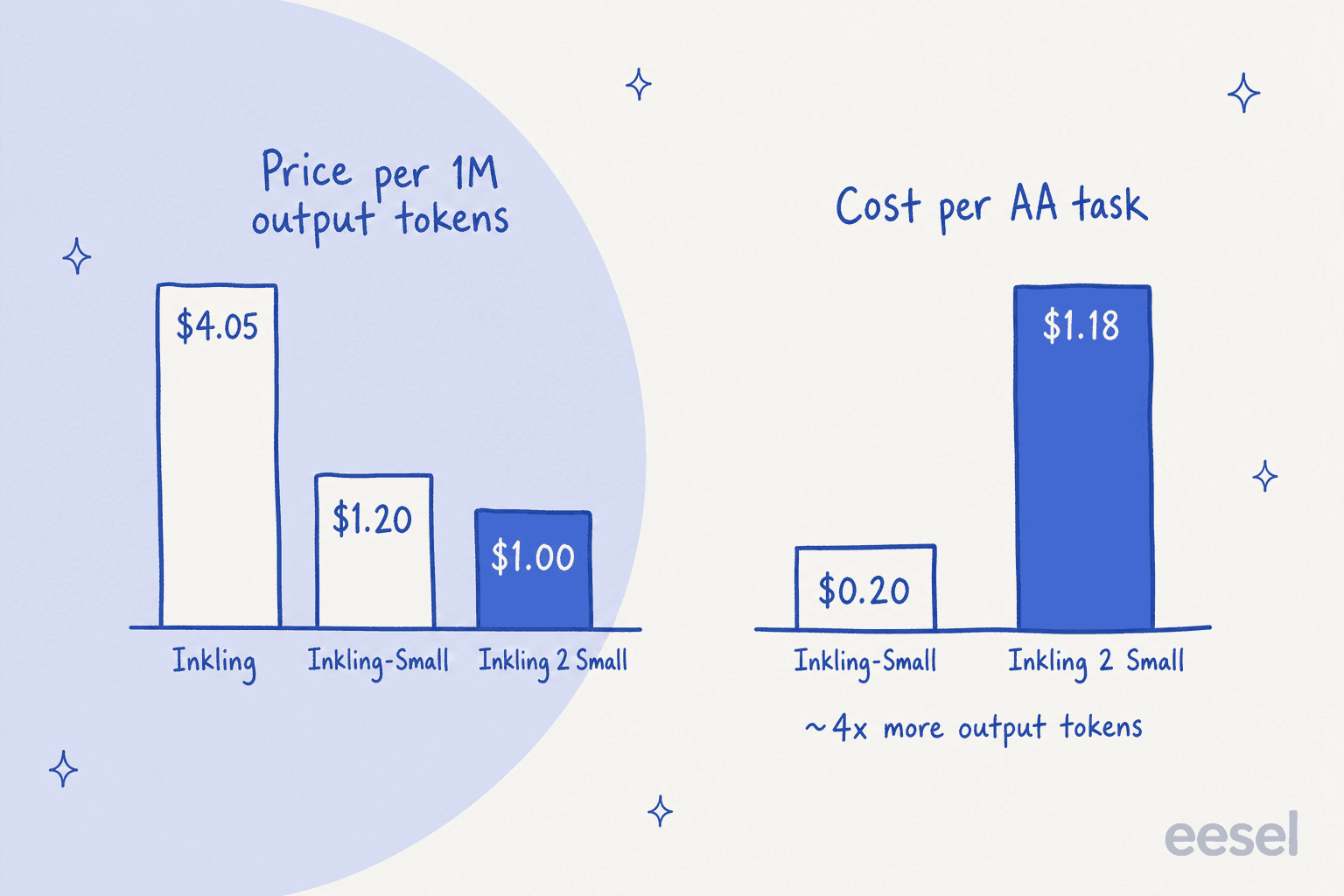
If you are pricing a support workload, plug your own ticket shape into the calculator below. The toggle applies the verbosity gap Artificial Analysis measured, so you can see how much the answer changes.
The ratio is a benchmark average, not a law. Artificial Analysis's tasks are long agentic ones, and a short support reply at low effort will not balloon 4x. Inkling 2 Small was trained with a length penalty and a sampled effort level, so setting effort low is the first lever for keeping a support bill sane. If you want to compare against non-Inkling models, the guide to cost per resolution shows how to turn token prices into a per-ticket number.
What's the catch with Inkling 2 Small?
There are five, and all of them are about access rather than quality.
- The weights aren't out yet. The model launched closed on Tinker. The announcement says the lab intends to publish Apache 2.0 weights "next week" after external safety testing; the Inkling model page says "the coming weeks"; Artificial Analysis lists the date as unconfirmed. For now it is a proprietary model, and AA classifies it that way.
- One provider. It is only on Tinker, with no OpenRouter listing as of November 8. Serverless inference is in beta, and the docs ask production users to join a waitlist.
- Served context is smaller than the card. The model card says 1M tokens. The serverless endpoint is listed at 256K and the default training ID at 64K, so plan around those.
- It is slow to start answering. Artificial Analysis measured 28.8 seconds to the first answer token, against a median of 11.4s for models in its price tier. That is fine for a background agent and too slow for a live chat widget without a low effort setting.
- Chat polish lags. The lab's own limitations section says it is "less optimized for the chat experience", with weaker formatting, overused slashes, and overreaction to mental health queries. Its FORTRESS over-refusal score is 20.4 against 3.6 for GLM-5.3-Flash (lower is better), so expect more refusals of harmless requests.
On self-hosting, plan for a server. Mixture-of-experts saves compute, not memory: all 594B parameters have to be loaded. By plain arithmetic that is about 1.2 TB at BF16, about 594 GB at 8-bit, and roughly 300 GB at 4-bit before any runtime overhead. The card lists MXFP8 and NVFP4 support, and the model was trained natively in NVFP4, so a 4-bit build is the likely sweet spot. Compare that with the 89 GB 2-bit build that put Inkling-Small on a single workstation, covered in the Inkling-Small review.
What are people saying about Inkling 2 Small?
The reaction is warmer than the first generation got. The Hacker News launch thread reached 289 points and 92 comments, against 33 points and two comments for Inkling-Small's thread in July. Most of the energy is about a US lab shipping a competitive open model. The most useful comment, though, came from someone asking the question a builder should ask:
"With these open weight models, I simply ask. Is it useable, is it useful?"
On X, the third-party benchmark labs set the tone. ARC Prize's result was the most quoted:
"It outperforms every open-weight model we've evaluated on both ARC-AGI-1 & ARC-AGI-2."
The skeptical notes were mostly about size and benchmark trust. Several replies pointed out that a 594B "small" model is not small to run, and one reply to a launch recap said "Most of these labs are benchmaxxing", which is a fair reason to weigh the independent runs above the vendor card. Another commenter asked why anyone needs a model "basically comparable to DS4.1", and that is the honest competitive position: it trades blows with DeepSeek V4.1 Flash 1017 rather than beating it outright.
Is Inkling 2 Small a good fit for customer support?
As an engine, it is now a credible one, which I could not say about Inkling-Small. The clearest signal is Tau3 Banking, a benchmark where the model acts as a bank's support agent, using tools while talking to a simulated customer. Artificial Analysis has it at 40% against 19% for Inkling-Small, and the vendor card shows it beating Kimi K3 there (33.4%), though GLM-5.3-Flash still leads at 47.2%. Add the hallucination drop and you have a model that handles a tool-using conversation and knows when to stop.
As a support agent, a model is still only half the job. I have watched this play out on live queues at eesel: the model decides how well an answer is written, but whether the answer is allowed, correct for your policy, and sent to the right customer is decided by everything around it.
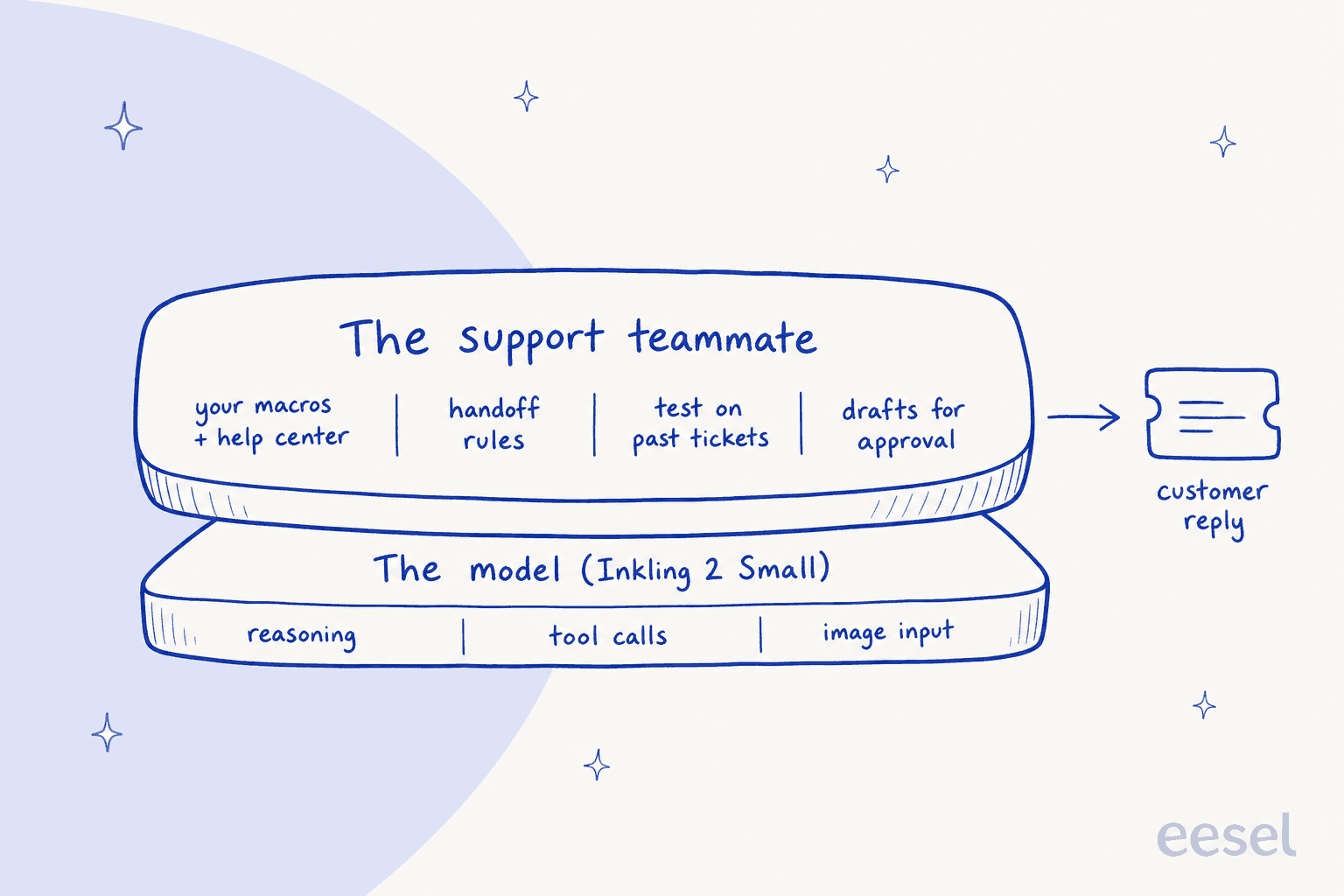
smava, a Berlin loan-comparison platform, is a good picture of that top layer, and a fitting one given the banking benchmark. It runs about 27,000 German-language tickets a month through one Zendesk for two brands. Three eesel agents split the work: one categorises every ticket, one drafts replies word for word from about 820 macros and help center articles, and one per brand prepares customer-ready answers only for customers with no assigned advisor. The reply agents follow rules a model alone would never infer, like never promising that the team will check or forward something, and never linking to competitors, and a person approves the drafts. In one month eesel prepared about 15,300 draft replies.
None of that depends on which large language model sits underneath, which is the point. Models turn over every few months now (this one replaced its predecessor in 97 days), so the rules, the grounding in your docs, and the human-in-the-loop approvals should not have to be rebuilt each time.
If you want the longer version of this argument, AI hallucinations in support and AI support simulation testing go deeper.
Try eesel
If Inkling 2 Small has you thinking about AI on your support queue, the model is the easy part to swap. eesel is an AI helpdesk teammate that joins your existing helpdesk, like Zendesk, learns from your macros, help center and past tickets, and drafts or sends replies under the rules you set. You can run it against your historical tickets first to see what it would have said before it touches a live customer. Try eesel free.