8 best Inkling-Small alternatives in 2026

Kurnia Kharisma Agung Samiadjie

Katelin Teen
Last edited August 4, 2026

Why people are already looking past Inkling-Small
Thinking Machines Lab shipped Inkling-Small on 2026-07-30 under Apache 2.0, fifteen days behind the parent. The pitch was reasonable and the model does deliver on it. A quarter of the parent's size and quicker with it, cheaper too, and on the vendor's own card it even beats the parent at SWE-bench Verified, 80.2 against 77.6.
The r/LocalLLaMA reception had things to say about that word "small". Third-highest comment in the launch thread is not about benchmarks at all:
"Soon after all this 2-3T models they will say small for 500-700B models... crying with 12Gb Vram"

Fair enough. Naming is not what pushes anyone off the model though. What it knows is.
Artificial Analysis puts it at an Intelligence Index of 40, rank #15 of 101, which is respectable enough. Then the same page reports the AA-Omniscience knowledge test: an index of -9.0, accuracy of 30.5%, hallucination rate 56.9%. AA describes that eval as measuring "knowledge reliability and hallucination" on a -100 to 100 range. So a negative number there is not some rounding artefact. It is the model reaching for an answer it does not have.
The AA-Briefcase breakdown is the part I keep going back to. Overall Elo of 917.13, which tells you little until you split it: presentation 1067.99 against analytical quality of 797.13. The model writes a better answer than it actually knows.
People running these models on their own hardware spotted it fast, and on a sharper axis than the benchmark tables use:
"But worse than GPT 5.5 Luna on the Omniscience Index, because it makes up too many answers. 84% Hallucination Rate, that's why I favor other open models, they are better at 'detecting' their incertitude."
That 84% figure runs higher than the 56.9% sitting on the AA page today, so take the exact number as their reading and not mine. Either way the point holds, and it is the right point to be making. They are picking a model on whether it knows when it does not know, rather than on how well it writes code.
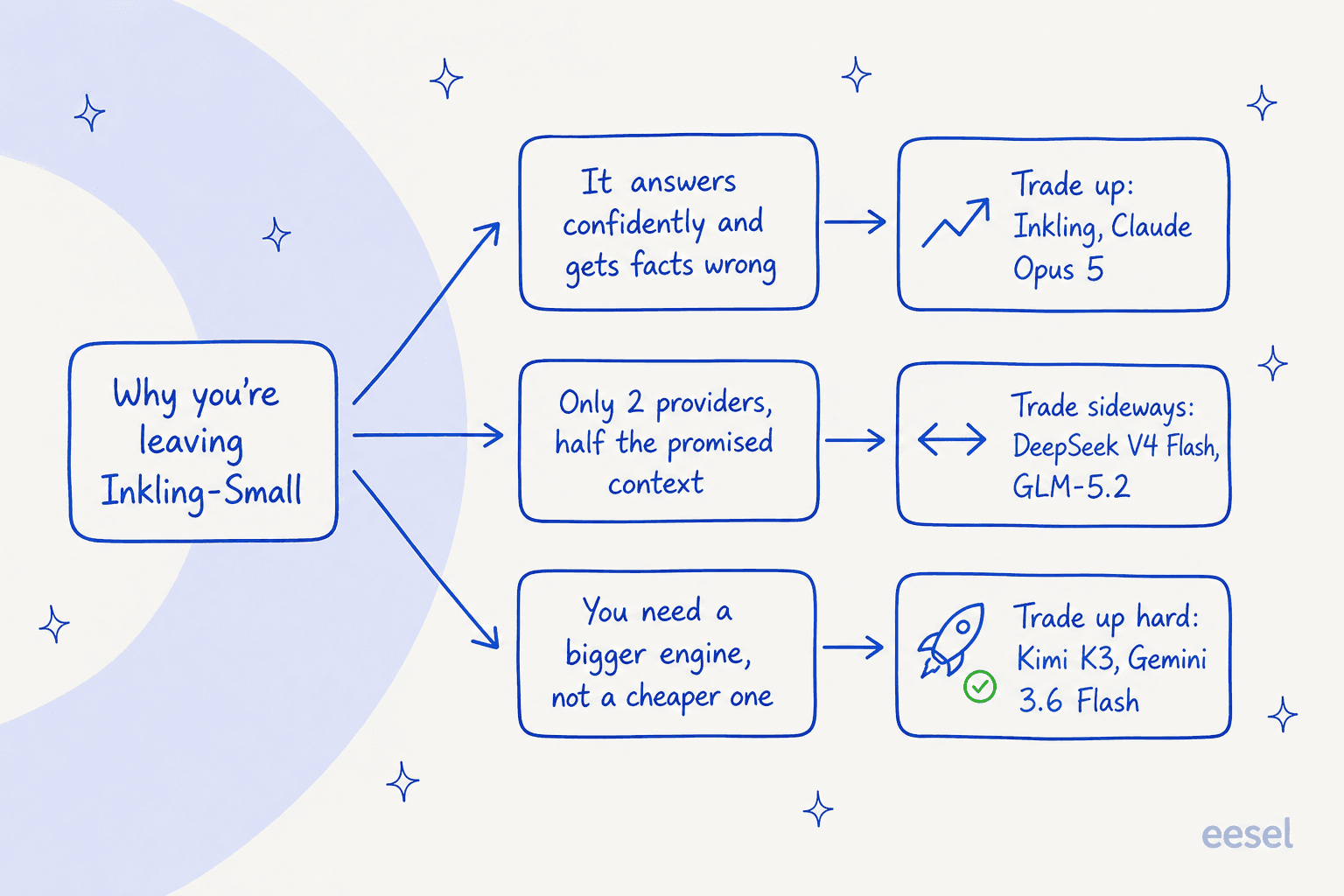
Three other things push people off it. Price is not among them.
The context window is not the context window. AA lists the model at 1M tokens. What its two providers actually serve is 256,000 (Thinking Machines) and 524,288 (DeepInfra). So anyone who read "1M" on the card and built against that number is not getting it. Same problem on the parent model, where the best served figure is 524k across three providers and DeepInfra's cheapest and fastest row caps out at 131k.
Two providers is thin. The parent has three, and the crowd serving DeepSeek or GLM is bigger again. On launch day the model was not even on OpenRouter, a gap one commenter flagged on Hacker News alongside the parameter counts. The two providers you do get also behave differently. DeepInfra runs 1.43x faster on a 10k workload, then falls behind first-party at 100k, 82.36 tokens per second against 113.36. Your latency profile shifts with your prompt length, and that is a horrible thing to find out in production.
Thin coverage also leaves you less room to shop around when a provider starts cutting corners, which happens more than the published benchmarks let on:
"In fact we found that many inference providers are quantising the weights or even KV cache, and due to the low prices they serve at massive batches, resulting in unstable throughput."

The price is not one number. First-party sits at $0.30 in and $1.20 out. DeepInfra asks $0.58 and $1.44 for the longer context. Blended out, AA shows $0.222 on its default 7:2:1 ratio, while the classic 3:1 blend lands at $0.525. So whichever single figure you end up quoting is really a choice about ratios, and that choice matters once you are modelling AI customer service cost at volume.
To be fair about it, none of this adds up to a bad model. Reasoning takes 95.5% of its output bill, which is exactly where the intelligence is coming from, and GPQA Diamond at 89.5% plus long-context reasoning at 63% are real numbers. The thing is a doer. Trouble only starts when you ask a doer to be a knower.
How I picked these eight
I write a lot of these roundups and the trap never changes. Rank by benchmark, publish, move on. So I kept the filter here narrower than that.
Each of the eight had to be something an Inkling-Small user could move to this week, so a live public API with published prices, no waitlists. Every price came off the vendor's own billing page on 2026-08-05 rather than a comparison site, since the numbers on those go stale inside a fortnight. Where a provider publishes both served and advertised context, I checked one against the other. The licences I read too, and that mattered, because two models here have revenue thresholds buried in theirs.
What I have not done is pretend six months of production traffic went through all eight. I read the docs and the billing pages, the model cards, the AA measurements, then said only what those support.
The best Inkling-Small alternatives at a glance
All prices below are per million tokens in USD, checked on 2026-08-05.
| Model | Best for | Weights | Params | Input | Output | Real context | Modalities in | The catch |
|---|---|---|---|---|---|---|---|---|
| Inkling-Small (baseline) | Cheap agentic execution | Apache 2.0 | 276B / 12B active (266B per AA) | $0.30 | $1.20 | 256K first-party, 524,288 on DeepInfra | Text, image, audio | Knowledge index -9.0 |
| DeepSeek V4 Flash | Same job, a quarter the cost | MIT | 284B / 13B | $0.14 | $0.28 | 1M | Text | A 2x peak surcharge is announced |
| Inkling | Staying in the family, knowing more | Apache 2.0 | 975B / 41B | $1.00 | $4.05 | 524K best, 131K cheapest | Text, image, audio | Two AA pages quote different prices |
| GLM-5.2 | Strongest open weights you can host | MIT | ~753B total | $1.40 | $4.40 | 1M | Text | 128K output cap |
| MiniMax M3 | Video in, at Inkling-Small's price | Custom community licence | 428B / 23B | $0.30 | $1.20 | 1M, 512K guaranteed | Text, image, video | Non-commercial by default |
| Kimi K3 | Long-horizon agent work | Custom (Kimi K3 Licence) | 2.8T | $3.00 | $15.00 | 1,048,576 | Text | No batch tier, 3 RPM on entry tier |
| Qwen3.8-Max | Closed model, generous window | Closed | Undisclosed | $2.00 | $6.00 | 1M | Text | Two prices for one model |
| Gemini 3.6 Flash | Audio in with no premium | Closed | Undisclosed | $1.50 | $7.50 | 1,048,576 | Text, image, video, audio, PDF | 65,536 output ceiling |
| Claude Opus 5 | When wrong answers cost money | Closed | Undisclosed | $5.00 | $25.00 | 1M, no surcharge | Text, image | Newer tokenizer emits ~30% more tokens |
1. DeepSeek V4 Flash
Best for: doing what Inkling-Small does, at roughly a quarter of the output cost.
This is the comparison a real Inkling-Small user reaches for first, and it was also the top substantive comment in the r/LocalLLaMA launch thread:
"I wonder how it compares to DSV4 Flash. Comparable on Artificial Analysis intelligence benchmark (both 40). Seems to do slightly better coding / agentic workflows though."
That is the shape of it. DeepSeek V4 Flash runs 284B total with 13B active, next to Inkling-Small's 12B, and AA puts both of them at 40. Similar engine. Not a similar bill.
There is one thing the parameter counts hide, and it matters if self-hosting is on your list. DeepSeek ships natively in mixed FP4 and FP8 where Inkling-Small ships bf16, so at native precision one local runner put them at roughly 160GB against 540GB. On paper the same rough size. In practice three times the memory.
Features. MIT-licensed weights on Hugging Face, plus a 1M context window and a 384K maximum output, which is the largest on this list by a wide margin. Rate limiting goes by concurrency instead of requests per minute, with the published cap at 2,500 concurrent requests per account.
Pros. Cache economics are the real story. A cache hit costs $0.0028 per million input tokens, 50x under the $0.14 cache-miss rate, so anything with a stable system prompt turns absurdly cheap. And MIT is the cleanest licence in the group, no revenue threshold, no attribution clause.
Cons. Text only, so any audio you were feeding Inkling-Small has nowhere to go. There is also a footnote on the pricing page announcing a future 2x peak surcharge across 09:00 to 12:00 and 14:00 to 18:00 Beijing time, effective date "subject to the official announcement". A known unknown, sitting inside your cost model.
Pricing. $0.14 in and $0.28 out per million, cache hits at $0.0028. Pro sits at $0.435 and $0.87, which is exactly 3.1x Flash on both sides. The worked examples live in our DeepSeek V4 Flash pricing breakdown, and we ran it against Kimi K3 separately.
My take: if money is your reason for leaving, stop reading here. If accuracy is the reason, keep going, because getting cheaper has never made a model know more.
2. Inkling, the parent
Best for: staying on the same weights, tooling and licence while buying back the factual recall.
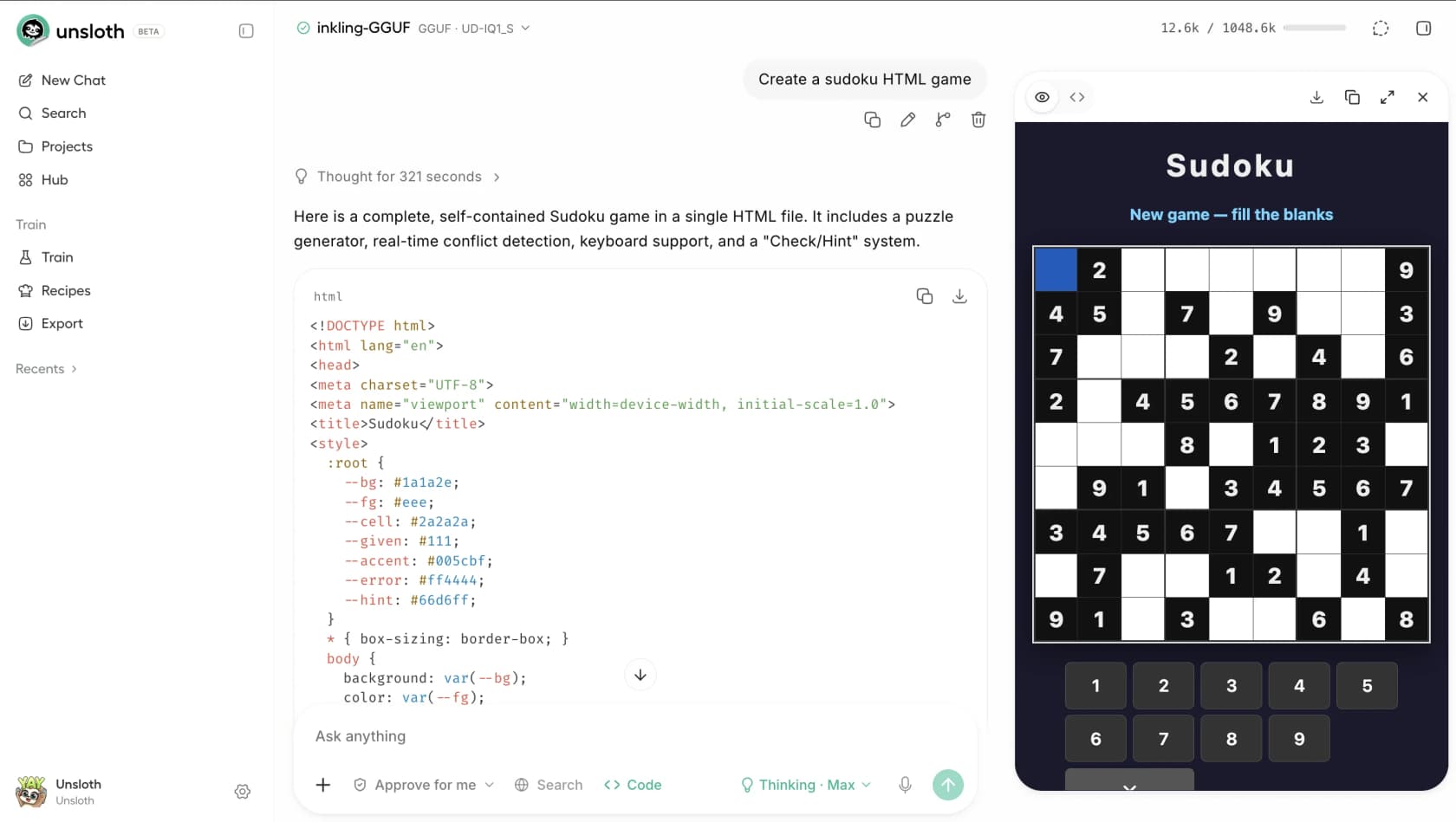
Often the most interesting alternative to a small model is the big one it got distilled from, and here the numbers make that case cleanly. Under the same AA methodology, Inkling scores 41 on the Intelligence Index against Small's 40, so a wash. AA-Omniscience is where they separate: 2.05 with 39.95% accuracy, against -9.0 and 30.5%. Nearly a third more of the questions come back right.
Features. 975B total with 41B active across 66 layers, Apache 2.0, and text plus image plus audio in. Three serving providers now where launch had one, those being DeepInfra, Together AI and Thinking Machines.
Pros. Same licence, same family, so the migration is mostly a model string. DeepInfra's FP8 row is fast, 201.5 tokens per second, and cost per Intelligence Index task there works out at $0.4296, cheap for the tier.
Cons. Two AA pages currently disagree on the price, so you want to know which one you are quoting. The model page says $1.87 in and $4.68 out. The provider rows all say $1.00 and $4.05. Those provider figures stay internally consistent across all three, so that is the pair I would plan against. Served context is messy too. It is 524k at the best, and DeepInfra's cheap fast row caps at 131k, or 13.1% of the advertised million.
Pricing. On the provider data, $1.00 in and $4.05 out, with $0.17 for a cache hit and $0.724 blended. Call it 3.4x Small's output rate. If it is the parent you are shopping, the Inkling alternatives post covers the wider lineup.
My take: the obvious pick, and the one most people skip, because "upgrade to the bigger sibling" feels like conceding the small one was a mistake. It wasn't. It was just the wrong tool for a knowledge job.
3. GLM-5.2
Best for: the strongest open weights on this list that you can realistically host yourself.
GLM-5.2 is the step up that keeps you inside MIT-licensed territory. Around 753B total parameters, with a 1M context its API actually serves, and 2.23 million downloads on the zai-org/GLM-5.2 repo. That download count tells you the self-hosting community has already stress-tested it.
Features. MIT weights with a 1M context and a 128K maximum output, then cached input at $0.26, cache storage listed as free for now. Z.ai sells a subscription route as well. The Coding Plan starts at $18 a month, discounted to $12.60, and carries 10,000 credits a week.
Z.ai publishes its own effort-level curve, and looking at that beats taking the headline score at face value:
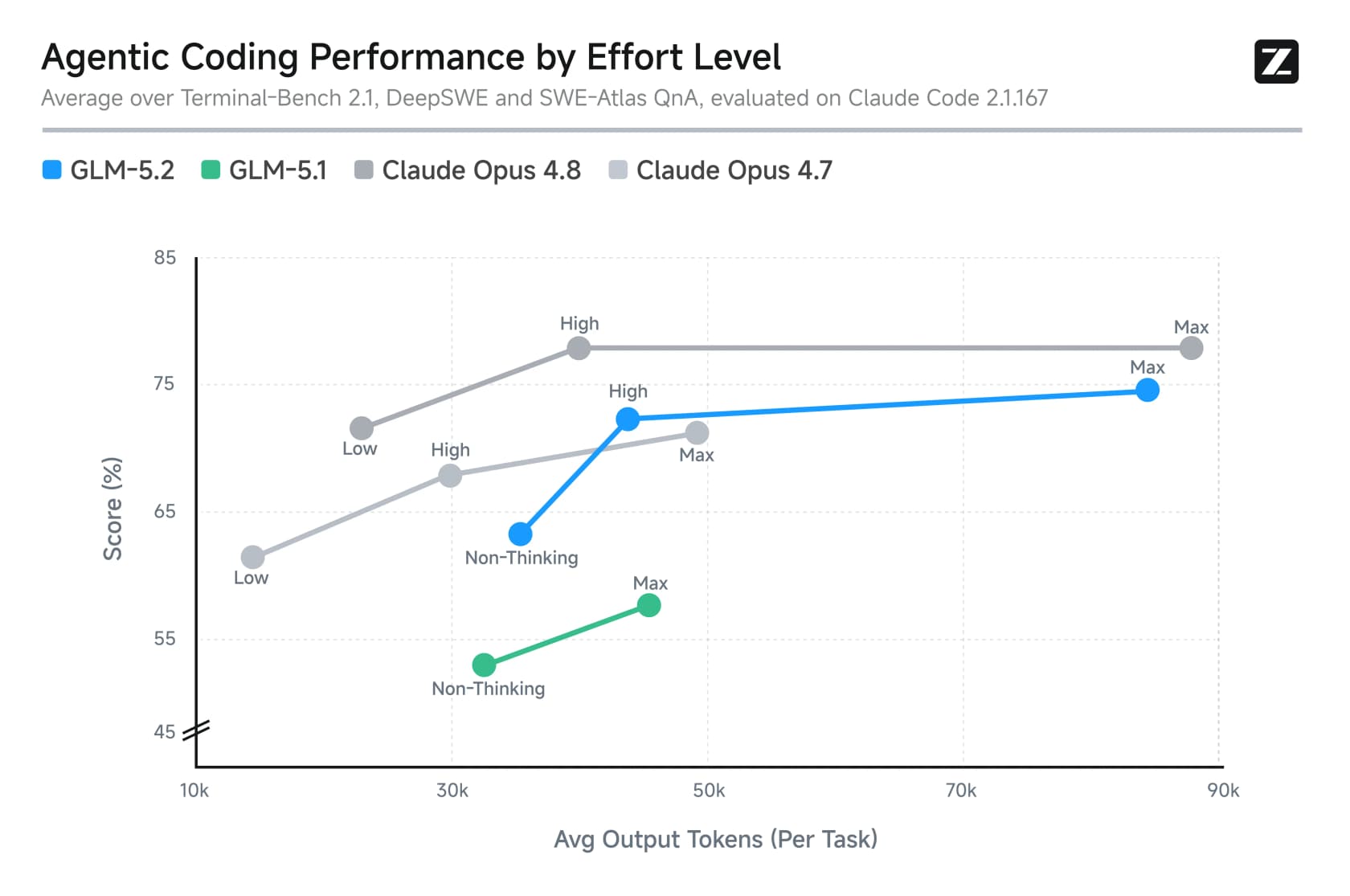
Pros. GLM-5.2 costs what GLM-5.1 cost, $1.40 and $4.40, and meanwhile the context window went from 200K to 1M. A free upgrade, straight up. An MIT licence with no revenue clause is also worth more than a benchmark point or two once you are shipping this inside a product.
Cons. That 128K output cap is the tightest of the open-weights options here, set against DeepSeek's 384K. Credits on the Coding Plan burn at 3x during peak and 2x off-peak, with off-peak temporarily at 1x through the end of September, so the subscription maths needs watching.
Pricing. $1.40 in, $4.40 out, $0.26 cached. Cheaper siblings are there if you can live with less. GLM-4.7 and GLM-4.6 both go at $0.60 and $2.20, while GLM-4.7-FlashX is $0.07 and $0.40.
My take: the best licence-to-capability trade on the list. If your legal team has ever asked what happens the day a vendor changes terms, point at this row.
4. MiniMax M3
Best for: matching Inkling-Small's exact price while adding video input.
This one is a straight price match, and that makes the comparison unusually clean. Below 512K of input MiniMax M3 charges $0.30 in and $1.20 out, identical to Inkling-Small's first-party rate, out of a 428B model with 23B active. Which leaves you choosing on everything except the cost.
Features. A 1M context with 512K guaranteed as the minimum, cache reads at $0.06, and text plus image plus video input arriving through image_url and video_url content parts. Thinking mode costs the same on or off. The weights sit live on Hugging Face at MiniMaxAI/MiniMax-M3, 170,353 downloads so far.
Pros. Nearly double Inkling-Small's active parameters for the same money, and video in on top, which nothing else at this price on the list offers. The pricing page labels the current rate "Permanent 50% off", and no expiry date is printed anywhere on it.
Cons. The licence is the real catch here. MINIMAX COMMUNITY LICENSE is non-commercial by default, commercial use wants a visible "Built with MiniMax M3" credit, and past $20M in yearly revenue you need written authorisation. Cross 512K of input and both rates double, so $0.60 and $2.40. A Priority tier exists as well, at 1.5x, if the faster queue is worth it to you.
Pricing. $0.30 and $1.20 up to 512K input, then $0.60 and $2.40 above it, cache reads at $0.06. Priority runs $0.45 and $1.80, or $0.90 and $3.60 once you are over the threshold.
My take: good engine, licence you have to sit down and read. A startup under the revenue line, happy enough to print the credit, gets more model per dollar here than from the thing it is leaving.
5. Kimi K3
Best for: long-horizon agent work where the run matters more than the token price.
Kimi K3 is a much bigger jump than anything above it, and on its own pricing docs Moonshot calls it the flagship for "long-horizon coding and end-to-end knowledge work". At 2.8 trillion parameters served in 4-bit mxfp4, it is also the largest model here whose weights you can download.
Features. A 1,048,576-token context, always-reasoning behind a reasoning_effort setting of low, high or max (max being the default), and an ungated moonshotai/Kimi-K3 repo. Web search bills separately, $0.005 per successful call.
Pros. Open weights at this scale is unusual. The cache-hit rate of $0.30 against $3.00 cache-miss input is a 10x saving whenever context repeats, too. And the mid-range is covered by cheaper siblings, with kimi-k2.7-code at $0.95 and $4.00.
Cons. Two operational gotchas here, and both bite. K3 is not supported on the batch tier, so the 60% batch discount other Kimi models get does not reach it. The tier system is spend-gated as well: Tier 0, at $1 of cumulative recharge, allows 1 concurrent request and 3 requests per minute, climbing to 1,000 concurrent and 10,000 RPM once you hit Tier 5's $3,000. The licence looks MIT-shaped, then adds a clause requiring a separate agreement for model-as-a-service businesses above $20M revenue in any consecutive twelve months.
Pricing. $3.00 in and $15.00 out, with $0.30 on a cache hit. At 12.5x Inkling-Small's output rate, nobody should mistake this for a lateral move. The full tier tables are in Kimi K3 pricing.
My take: the pick when the workload is one long agent run instead of thousands of short answers. For ticket-shaped traffic, justifying it against GLM-5.2 at a third of the price gets hard.
6. Qwen3.8-Max
Best for: a closed model with a properly generous window and a free trial allocation.
Qwen3.8-Max is where you land once you have decided open weights are not the point and Alibaba's top commercial tier is. The pleasant surprise on the billing page is that Max finally dropped the input-length brackets. One band, covering the whole million-token window.
Features. A 1M context, 131K maximum output and 262K maximum reasoning, with TPM of 2 million against RPM of 15,000. Implicit caching costs $0.25. There is a free quota of 1 million tokens as well, running for 90 days.
Pros. No input-length tiering is a bigger deal than it sounds. Alibaba's tiering rule works all-or-nothing, so on the older qwen3-max, crossing a boundary repriced the entire request and a 33K-token prompt jumped from $1.20 to $2.40 on input. Here that trap is gone. The free million tokens also gives you real headroom to evaluate properly.
Cons. One model ID, two prices, depending on deployment scope: $2.00 and $6.00 on the International and Singapore tables, $1.65 and $4.951 on the Global ones. An 18% spread with no behaviour difference behind it is confusing to budget against. The free quota is Singapore-only, its clock does not pause for inactivity, and whatever remains gets voided at expiry. Batch takes 50% off but will not stack with cache discounts. Max is closed too, and the published Qwen weights are two generations behind, the newest dated 2026-04-24.
Pricing. $2.00 in and $6.00 out on International and Singapore, then $1.65 and $4.951 on Global. Explicit cache creation runs $2.50, which is 125% of input. The full detail is in our Qwen3.8-Max pricing post, and there is the Qwen3.8-Max alternatives roundup if you are shopping the other direction.
My take: solid, and slightly overpriced against GLM-5.2, which asks less and hands you the weights. The free quota is still a reason to try it.
7. Gemini 3.6 Flash
Best for: audio and mixed-media input without paying a media premium.
Were you on Inkling-Small specifically for the audio input? Then this is the closest replacement with a real service level behind it. Gemini 3.6 Flash charges one flat $1.50 input rate covering text, image, video, audio and PDF, and that breaks a pattern Google set itself. On Gemini 2.5 Flash, audio input cost $1.00 against $0.30 for text, and on 2.0 Flash the multiple ran to 7x.
Features. 1,048,576 input tokens against 65,536 output, caching at $0.15 per million plus $1.00 per million per hour of storage, with the Batch and Flex tiers both sitting at half price, $0.75 and $3.75.
Pros. The flat media rate is the standout here, and a Batch tier at $0.75 and $3.75 makes bulk work affordable. Google's pricing page lists it as stable rather than preview, and that matters if this is going anywhere near customers.
Cons. That 65,536 output ceiling is the tightest here, so long generations have to be chunked. Storage-based cache billing runs as a meter rather than a one-off, unlike the flat cache-read rates elsewhere. Weights are closed, so no self-hosting. Grounding on Gemini 3.x is also unavailable on the free tier, which means evaluation costs money.
Pricing. Standard is $1.50 in and $7.50 out, Batch or Flex $0.75 and $3.75, Priority $2.70 and $13.50. Where budget is the constraint, Gemini 3.5 Flash-Lite comes in at $0.30 and $2.50, and it carries no audio split either. The full ladder is in Gemini 3.6 Flash pricing.
My take: the audio pick. Also the only model here I would send mixed media to at volume without thinking twice.
8. Claude Opus 5
Best for: the cases where a confidently wrong answer costs real money.
This is the far end of the ladder, and one reason put it on the list. It answers the specific problem Inkling-Small has. Claude Opus 5 costs $5.00 in and $25.00 out, roughly 21x Inkling-Small's output rate, and you buy that when the downside of a wrong answer outweighs the token bill.
Features. The full 1M context at standard pricing, with no long-context surcharge tier, which is unusual. Anthropic's pricing docs spell it out: a 900k-token request bills at the same per-token rate as a 9k one. Cache reads cost $0.50. The Batch API takes a flat 50% off both sides, $2.50 and $12.50, and it stacks with caching.
Pros. With no context-length cliff, a whole category of billing surprise disappears. Extended thinking carries no separate price and bills as standard output. Batch together with caching also pulls heavy repeated workloads a long way down from the sticker.
Cons. In any cost comparison the tokenizer is the trap. Anthropic notes that Claude 4.7 and later "produces approximately 30% more tokens for the same text" than the older tokenizer, so that $25.00 sticker understates the real per-task gap against a rival still on an older one. Fast mode doubles both sides to $10.00 and $50.00, runs on the first-party API only, and will not stack with Batch. Weights are closed.
Pricing. Standard $5.00 and $25.00, Batch $2.50 and $12.50, Fast mode $10.00 and $50.00, cache read $0.50. The cheaper stop is Sonnet 5 at $2.00 and $10.00 through 31 August 2026, which moves to $3.00 and $15.00 on 1 September. When that gap is worth paying gets covered in our Opus 5 versus Sonnet 5 comparison.
My take: overkill for most ticket traffic, exactly right for the 5% of it touching money, policy or a contract. Route by question type instead of picking one model for everything.
The price ladder, in one picture
Line the eight up side by side on output price and the shape of the decision gets obvious.
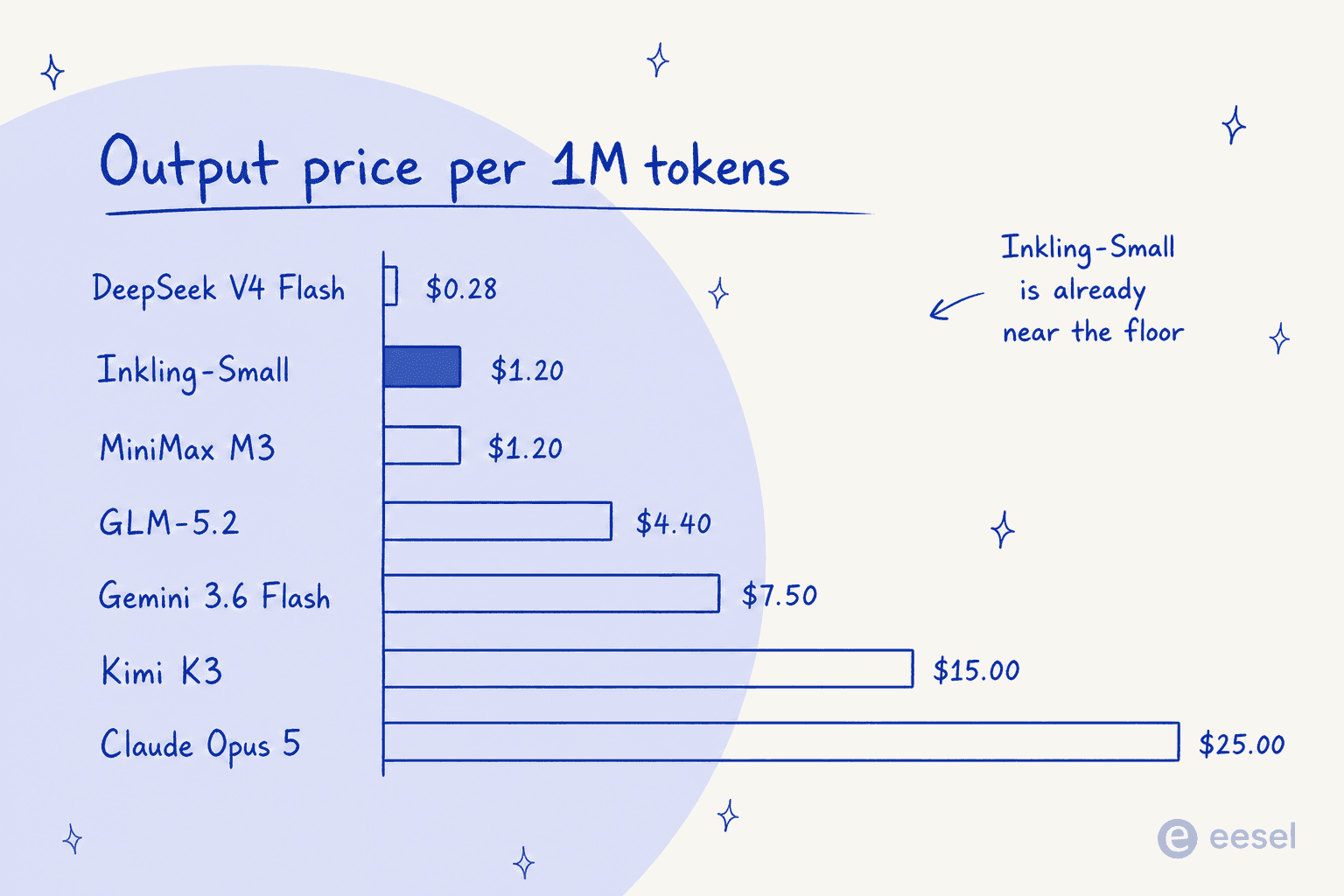
Inkling-Small is already near the floor. Exactly one meaningful step down exists, DeepSeek V4 Flash at $0.28, plus one lateral move at the same price in MiniMax M3. Everything else here is a step up, and what a step up buys is never speed.
Worth doing the arithmetic on what any of that costs at ticket volume. Take a thousand tickets in a month, then call it 2,000 output tokens per answer, which is generous for a support reply. So 2 million output tokens.
| Model | Output cost, 2M tokens | Against Inkling-Small |
|---|---|---|
| DeepSeek V4 Flash | $0.56 | $1.84 cheaper |
| Inkling-Small | $2.40 | baseline |
| MiniMax M3 | $2.40 | identical |
| GLM-5.2 | $8.80 | $6.40 more |
| Inkling | $8.10 | $5.70 more |
| Gemini 3.6 Flash | $15.00 | $12.60 more |
| Kimi K3 | $30.00 | $27.60 more |
| Claude Opus 5 | $50.00 | $47.60 more |
At this volume the whole spread from cheapest to dearest is about $50 a month. One escalation handled badly costs you more than that. Which is the real argument for climbing the ladder, and also why model choice is not where most of the leverage sits.
What none of these fixes on a support queue
None of the eight rows above solves the next part, and that is why I keep pushing back when someone tells me they have found a cheaper model.
I have watched this exact failure land on paying accounts. A model does not stop when retrieval comes back empty. It fills the gap out of what it learned in training. One customer, a Danish solar-energy provider, had their bot fabricate subscription claims and send those to real customers. Another asked their bot a question and got "Oxygen (periodic table)" back. Neither case was a bad model. Both were a model with nothing to ground against, and nothing in the way to stop it guessing.
One support manager on our accounts put the same worry in plainer terms, by telling the AI what not to do:
"stop telling customers that we will get them sorted. You dont know that"
An eComm support manager, worried about a bot over-promising delivery dates. Same shape of problem. The model sounds sure, and the sounding sure is the dangerous part. Inkling-Small's own AA-Briefcase split says it out loud, presenting 270.86 Elo points better than it analyses.
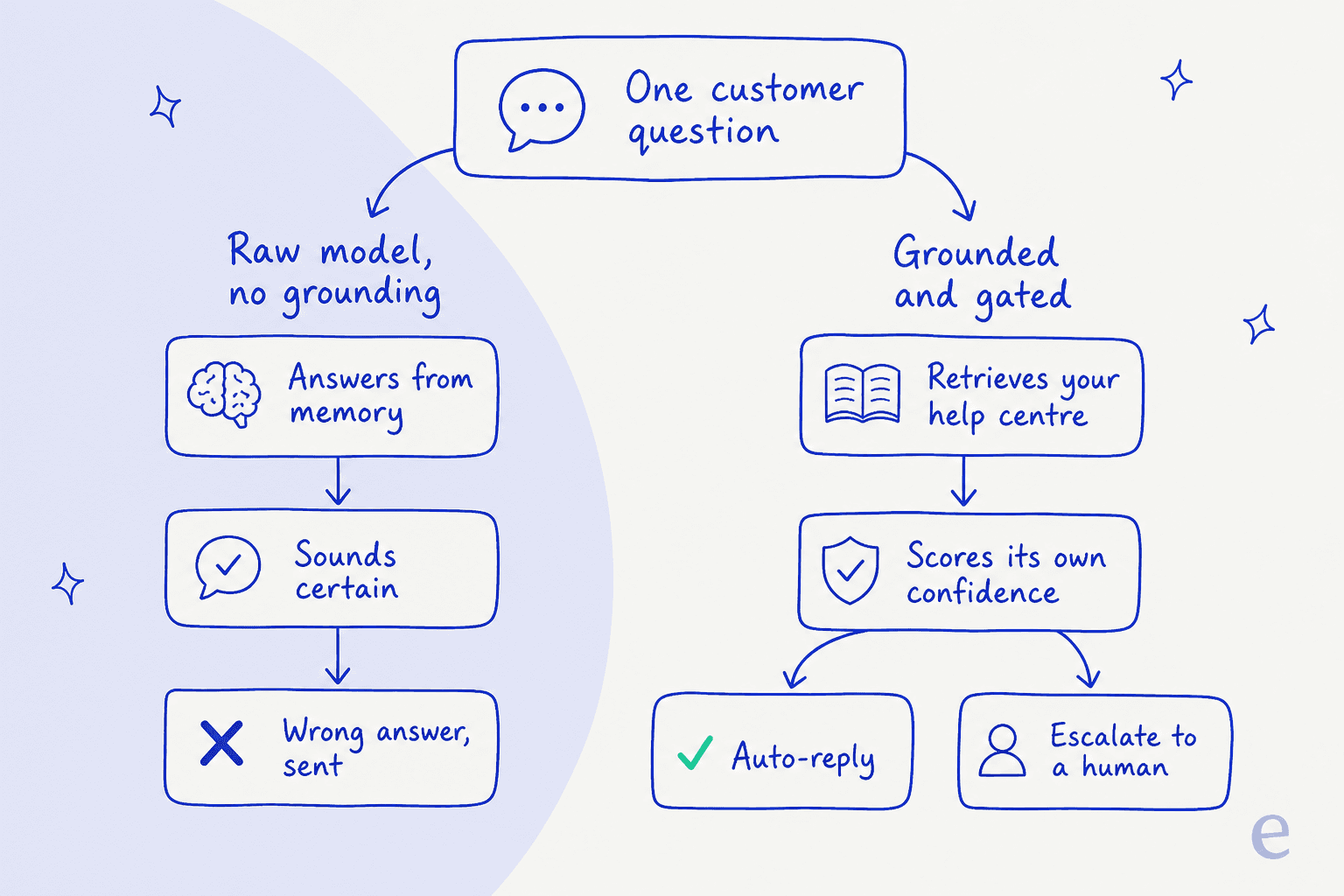
A bigger model is not the fix. Two things a model does not ship with are. Grounding first, so the answer comes out of your help centre and your past tickets instead of parametric memory. Then a confidence gate, so anything under the bar goes to a person rather than going out. Those two turn a raw engine into something you can point at a live queue, and they are the whole subject of AI hallucination prevention.
The other reason people stop shopping models is more mundane than that. One builder we spoke to, assembling an IT-incident knowledge base, had already been round the loop. They tried one vendor's API and found it too costly, tried another and found it unreliable, and in the end just wanted something that worked. Comparing models is fun. Maintaining a model layer is not.
Try eesel
If the model you are picking is going to answer customer questions, the honest advice comes in two parts. Take whichever of the eight above fits your budget and your licence. Then do not build the layer above it yourself.
That layer is what eesel is. It plugs into Zendesk, Freshdesk or whatever else you already run, learns off your past resolved tickets and help centre instead of a model's training data, and only replies once it clears a confidence threshold you set yourself. Everything under that escalates. And before it touches live traffic you can simulate it against your own ticket history, which is how you learn what it would have got wrong before a customer does.

I put our own measured 7% factual error rate at the top instead of burying it, because that is the number which matters while you are choosing a model. It came off a German jewellery retailer's real Zendesk traffic, roughly a thousand tickets a month, cross-validated across 284 chats and 100 tickets, with retrieval over their actual help centre. Grounding will not get you to zero. It gets you a number you can measure, gate on, then improve, and that is a different category of thing from a model guessing confidently.
The commercial framing is deliberately not per seat, either. Billing goes per resolved ticket, so the pricing tracks work done and not headcount. Free to try. If you would rather sanity-check the numbers first, the ticket deflection guide is a decent place to start.
My take
Inkling-Small is a good small model that people keep asking to do a job it was not built for. It executes well and at a price already near the floor, and its knowledge reliability measures -9.0. Those two facts do not sit in tension. Together they describe a tool.
Leaving over cost? Take DeepSeek V4 Flash and you are done. If the answers being wrong is what is pushing you out, go up to the parent Inkling for the cheap fix, or Claude Opus 5 for the expensive one, and go in knowing neither one takes you to zero.
And if the context window not matching the card is the reason, GLM-5.2 serves what it advertises, under MIT. That is the row I would take if forced to one.
The honest verdict on all eight stays the same though. Swapping engines moves your bill and your benchmark scores. It does not touch what happens when a customer asks something your documentation never answered. Closing that gap takes retrieval, a confidence threshold, a handoff. No model upgrade does it for you, and it is worth solving before you spend another afternoon reading AI ticket classification benchmarks.
Frequently Asked Questions
What are the best Inkling-Small alternatives?
Is there a cheaper alternative to Inkling-Small?
Why would you switch away from Inkling-Small?
Does Inkling-Small really have a 1M context window?
Which Inkling-Small alternative has the best open licence?
How much does it cost to run an Inkling-Small alternative on support tickets?
Can I self-host an Inkling-Small alternative instead of paying per token?
Is Inkling-Small good enough for customer support on its own?


Article by
Kurnia Kharisma Agung Samiadjie
Kurnia is a software engineer and writer at eesel AI with two years of SEO experience, writing about AI tools, helpdesk software, and customer support. He pairs a developer's understanding of how these products are built with search-driven research into what actually ranks and resonates with the people searching for them.