Aide AI alternatives in 2026: 7 options for Shopify support teams

Rama Adi

Katelin Teen
Last edited October 27, 2026

The best Aide AI alternatives in 2026 are eesel if you want to keep Gorgias, Zendesk or Front and change only the AI, Gorgias if you want one Shopify-native helpdesk with AI built in, Re:amaze for a small team that wants every channel on one per-seat bill, Richpanel for self-service returns and cancellations, Tidio for storefront chat, Yuma AI for high-volume brands, and Shopify Inbox as the free floor.
Here's the part most comparisons skip: Aide is already one of the cheapest options. Its helpdesk is free and Pro is $149 a month for 4,000 AI replies. On a store doing 1,000 tickets a month, every paid alternative I priced costs more, from about $187 for Richpanel to $1,200 for Yuma AI. So leave Aide for fit, not for price: a helpdesk you don't want to give up, drafts that bill like sent replies, channels it doesn't cover, or a vendor with a longer track record.
If the fit problem is your helpdesk, I'd start with eesel. It joins your Gorgias queue, checks the Shopify order before it answers, and bills one credit per ticket whether it replies or drafts. Question Beauty runs it on Gorgias and closed 280 tickets in a month without a person.
Why do Shopify teams look for Aide alternatives?
I build integrations at eesel, so I spend my days on exactly the plumbing Aide sells: reading an order, checking it belongs to the person asking, and deciding whether the AI is allowed to act on it. I've also watched what happens when a store turns an agent loose. In a real-traffic trial on a German jewelry brand's Zendesk and Shopify inbox (about 1,000 tickets a month, 8 languages), 22% of the inbox turned out to be spam, which the agent caught with zero false positives. Its drafts were pointing in the right direction 88% of the time, but only 12% went out unedited. That last number matters later, when we get to how Aide bills drafts.
So before the alternatives, here's what Aide does well and where Shopify teams start shopping around.
What Aide does well
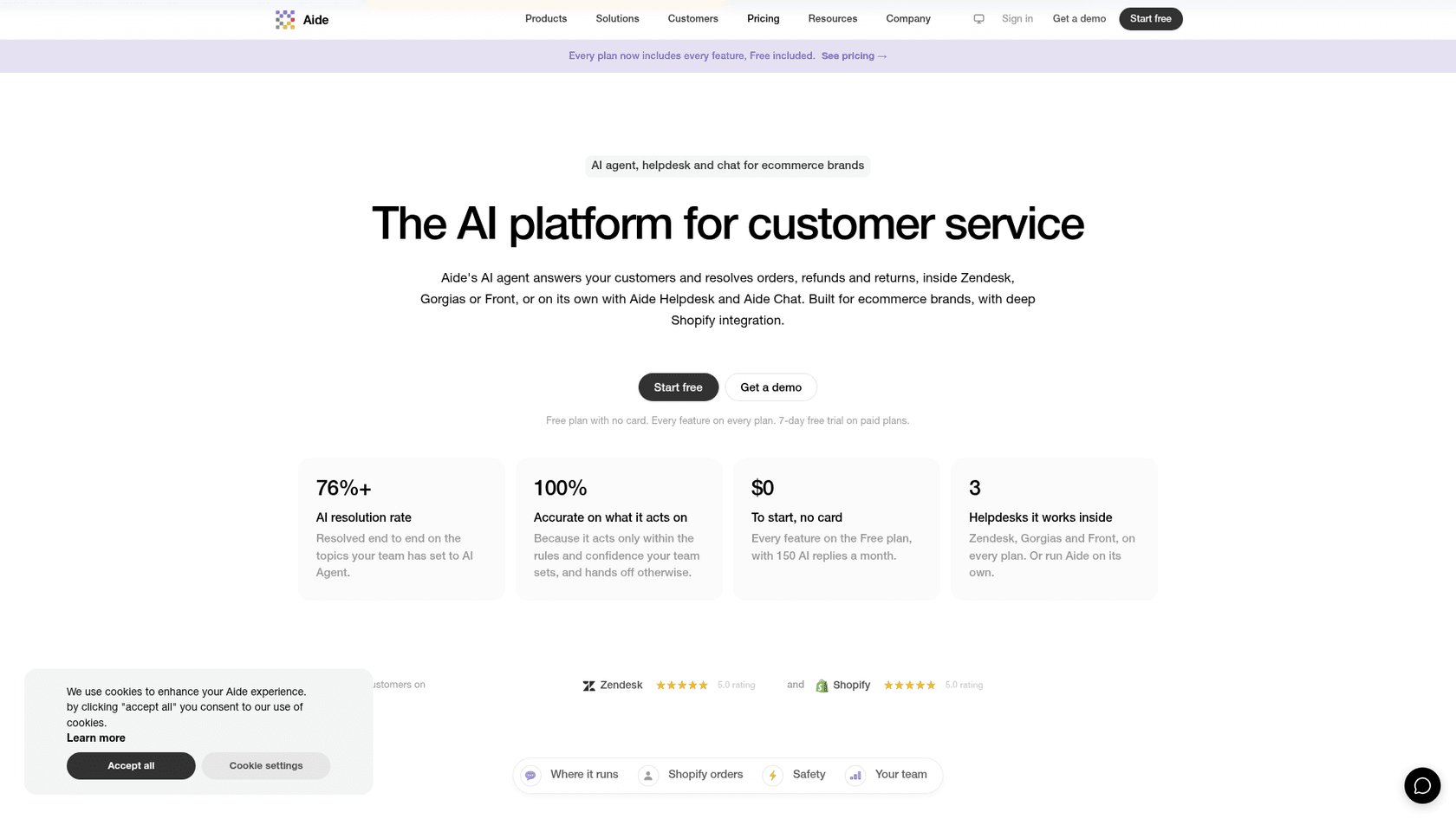
Aide is an AI agent, helpdesk and chat widget for ecommerce brands. It runs inside Zendesk, Gorgias or Front, or on its own with Aide Helpdesk and Aide Chat. Once a shopper proves an order is theirs, it can cancel it, refund it, change the address, remove an unshipped item or start a return, and refunds wait for your team by default.
The pricing is the headline. Aide repriced in late October 2026, and its pricing page now reads: the helpdesk is free, you pay for AI replies, and every plan includes every feature. Free gives 150 AI replies a month, Starter is $39 for 1,000, Pro $149 for 4,000 and Scale $499 for 15,000, with no seat fees. That's hard to beat for a small store, and my Aide AI review gives it 4 out of 5 for that reason.
Where teams start looking elsewhere
None of these are "it doesn't work". They're about fit:
- Drafts bill like replies. Aide counts each draft it leaves for your team as one AI reply, the same as a reply it sends. If your team runs in draft mode and rewrites most drafts, you pay full price for a starting point.
- Overage stops at a cap, then AI pauses. Paid plans charge extra replies at $0.15, $0.10 or $0.07, up to a monthly cap of $110, $350 or $1,000. At the cap, Aide stops answering and your team picks up the rest, which is a real risk in a Black Friday week.
- Channels are chat, email and your helpdesk. Aide's pages describe Aide Chat, email forwarding or Gmail, and the three helpdesk connectors. I didn't find SMS, WhatsApp, Instagram or phone listed.
- Public proof is thin. Aide's Shopify listing shows 2 reviews and its Zendesk listing 6. Both are 5 stars, but that's a small sample for a tool you're handing refunds to.
- The listing and the site disagree. The pricing page says helpdesk connectors are on every plan, including Free. The Shopify listing says Zendesk, Gorgias and Front work on Pro and Scale.
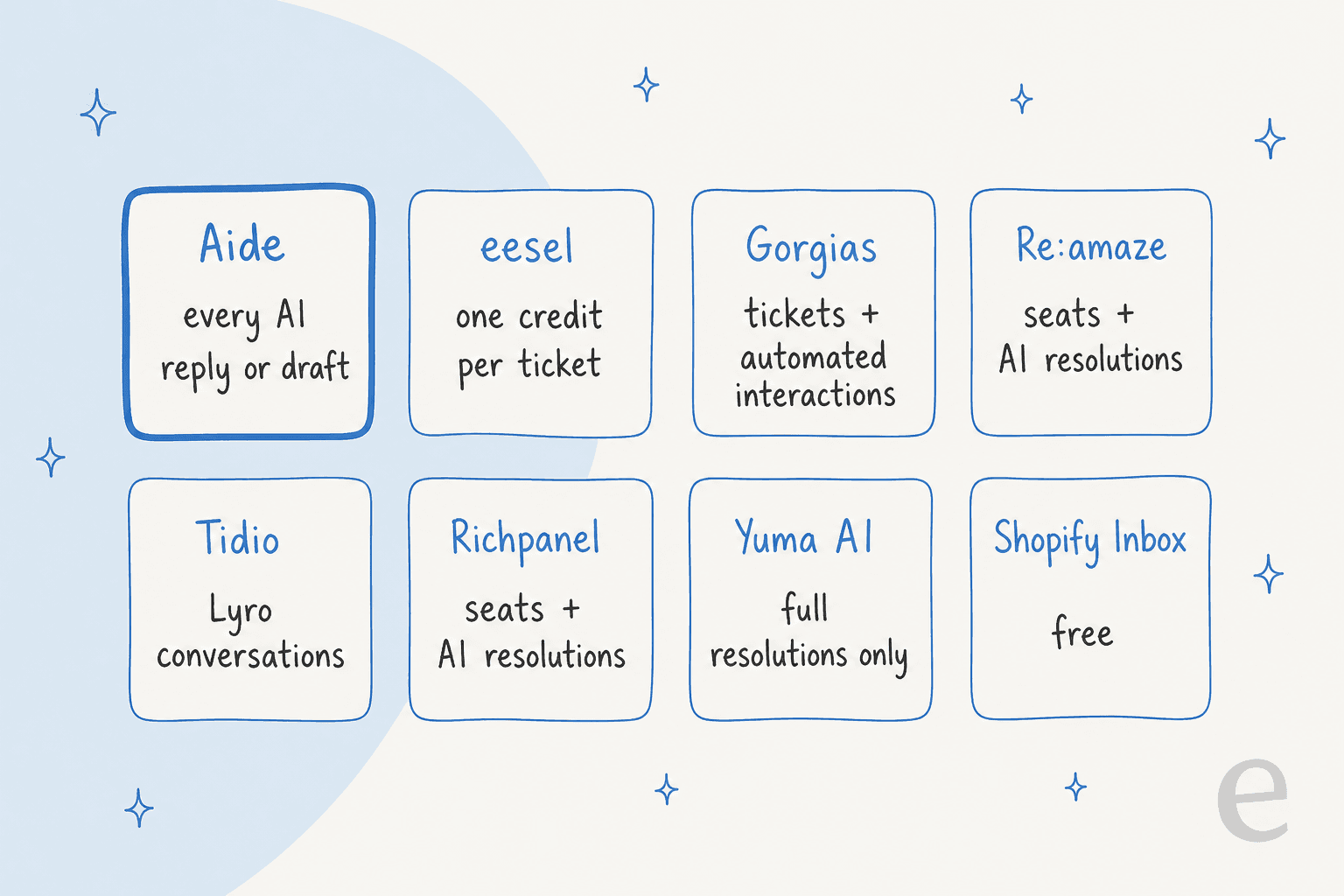
Keep that billing unit in mind through the rest of this post. Every tool below counts something different, and that's the only way to make sense of their prices. My Aide AI pricing post has the full plan table and the worked overage examples.
Should you keep your helpdesk or switch to an all-in-one?
Decide this first, because it cuts the list in half. When ChatGPT answers "what are the best alternatives to Aide AI", it frames the choice the same way: replace the AI layer and keep your helpdesk, or move to a complete support platform with AI built in.
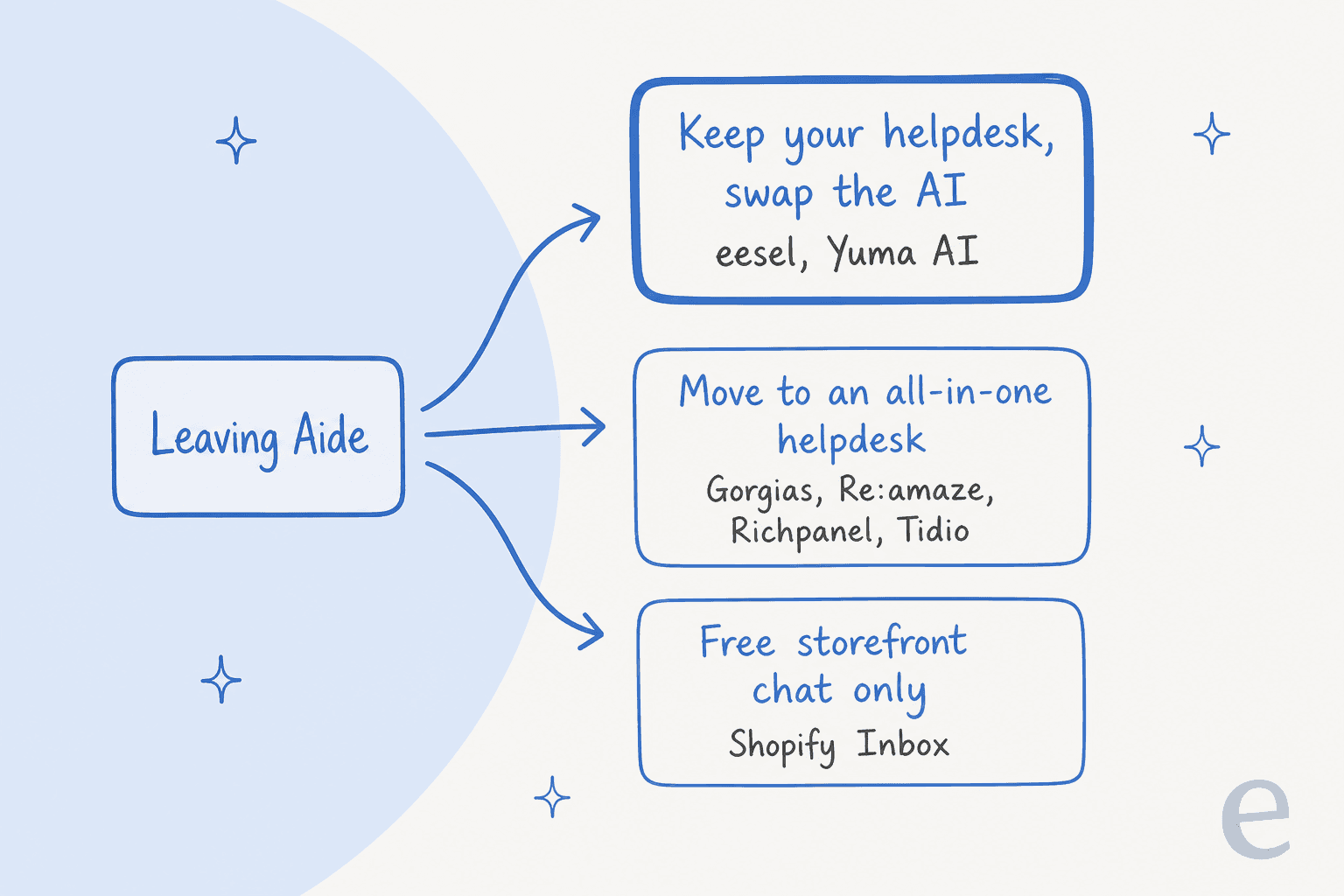
Which side you land on depends on how you use Aide today:
- You run Aide inside Gorgias, Zendesk or Front. Keep the helpdesk. Your macros, views, tags and reports stay put, and only the AI changes. That's the eesel or Yuma AI path. If you're on Gorgias, Gorgias's own AI Agent is also an option without a migration.
- You run Aide Helpdesk as your inbox. You're moving helpdesk either way, because the tools that sit on top of a helpdesk need one to sit on. Then an all-in-one like Gorgias, Re:amaze, Richpanel or Tidio is the shorter move.
- You mainly want a chat bubble that sells. Shopify Inbox or Tidio, and keep email support where it is.
And if the honest reason you picked Aide was "we don't want to run support at all", eesel's Managed Support runs the whole queue for you inside your own tools.
How I picked these Aide alternatives
I started from the tools ChatGPT recommended when a Shopify store using Aide asked for alternatives: Gorgias, Re:amaze, Tidio, Richpanel, eesel and Shopify Inbox. I added Yuma AI because it's the other tool on that list that keeps your existing helpdesk. Every price below comes from the vendor's own pricing page or app listing, checked on October 27, 2026.
I judged each one on the questions an Aide customer should ask:
- Does it keep my helpdesk, or does it replace it?
- Autopilot or drafts: can it reply on its own, leave drafts, or both, and does a draft cost money?
- Can it act on Shopify orders: look up, cancel, refund, edit, return?
- Which channels: email, storefront chat, Instagram, WhatsApp, SMS, phone?
- What's the total monthly cost for the same store, including seats and helpdesk?
Aide alternatives compared at a glance
Aide is in the first row for reference. "Not listed" means the vendor's own pages I checked don't state it.
| Tool | Best for | Helpdesk or add-on | Billing unit | Entry price | AI unit price | Free tier or trial | Shopify order actions | Channels | Security named | Works inside |
|---|---|---|---|---|---|---|---|---|---|---|
| Aide | Small stores wanting the lowest bill | Both: free helpdesk or add-on | Per AI reply or draft | $39/mo for 1,000 replies | $0.15 to $0.07 overage, capped | Free plan, 150 replies; 7-day trial | Cancel, refund, address change, remove item, returns | Site chat, email, your helpdesk | BAA on Scale, security questionnaire support on Pro+ | Zendesk, Gorgias, Front |
| eesel | Keeping your helpdesk, replies or drafts | Add-on (AI teammate) | Per ticket or chat (1 credit) | $299/mo for 500 credits | $0.60 down to $0.35 per ticket | Free plan, 100 credits | Shopify order lookups in the ticket | Your helpdesk, chat bubble, email, Slack | EU or US data residency, HIPAA BAA on Enterprise, SOC 2 Type II underway | Gorgias, Zendesk, Freshdesk, Front, Help Scout, HubSpot, Salesforce |
| Gorgias | One Shopify-native helpdesk with AI | All-in-one helpdesk | Tickets plus automated interactions | $40/mo for 50 tickets and 30 AI interactions | $1.00 to $0.85 per interaction | Free trial | Cancel, discount and apply actions (Basic and up) | Email, chat, social, help center; voice and SMS add-ons | GDPR, CCPA, SSO | Gorgias only |
| Re:amaze | Small teams wanting every channel | All-in-one helpdesk | Per seat plus AI resolutions | $29 per seat/mo | $0.85 per extra resolution | 14-day trial | Agents refund, cancel and edit orders in the inbox | Email, chat, social, SMS and voice (Pro+) | Not listed | Re:amaze only |
| Richpanel | Self-service returns and cancellations | All-in-one helpdesk plus portal | Per seat, plus AI per resolution | $29 per user/mo | About $0.20 per resolution (homepage claim) | Free plan, 3 seats | Refunds, tracking, cancellations, subscriptions | Email, chat, social; SMS and phone on Pro | SOC 2 Type II, GDPR | Richpanel only |
| Tidio | Storefront chat and pre-sale questions | Chat-first helpdesk; Lyro also sold alone | Lyro conversations plus human conversations | $24.17/mo billed annually | $0.65 at the 50-conversation tier; $0.50 quoted | Free plan; 7-day trial | Native Shopify actions listed | Chat, email, Messenger, Instagram, WhatsApp | SOC 2 report, GDPR, CCPA | Tidio; Lyro on Zendesk, Salesforce |
| Yuma AI | High-volume brands wanting end-to-end actions | Add-on | Full resolutions only | $14,400/yr for 12,000 resolutions | About $1.20 down to $0.55 | Demo | Refunds, returns, cancellations, subscription changes, address edits | Your helpdesk; social and voice add-ons | Not listed | Gorgias, Zendesk, Kustomer, Re:amaze and more |
| Shopify Inbox | Free AI sales chat on the storefront | Storefront chat | Free | $0 | Free | Free | Order lookup | Storefront chat | Shopify's own | Shopify admin |
The quickest read: eesel and Yuma AI keep your helpdesk, Gorgias, Re:amaze, Richpanel and Tidio replace it, and Shopify Inbox sits beside whatever you run.
What does each alternative cost for the same store?
Sticker prices don't compare here, because each tool counts something different. So I priced one store for all of them: 1,000 tickets a month, 3 agents, the AI answers every ticket with an average of 2 AI replies, and resolves half on its own. That's 2,000 Aide replies, 1,000 eesel credits and 500 resolutions.
- Aide: $149. 2,000 replies would cost $39 plus $150 of overage on Starter, but Starter's overage caps at $110, so the AI would pause around 1,730 replies. Pro covers 4,000 replies for $149, helpdesk included.
- Richpanel: about $187. 3 Starter seats at $29 is $87, plus 500 resolutions at the "about $0.20 per resolved conversation" its homepage quotes, which is $100. The AI rate isn't on the pricing page, so confirm it on a demo.
- eesel: $499, plus your helpdesk. 1,000 tickets is the 1,000-credit plan. Your Gorgias, Zendesk or Front bill stays the same as it is today.
- Re:amaze: $499. 3 Basic seats at $29 is $87 and includes 15 AI resolutions. The other 485 at $0.85 add $412.
- Tidio: about $549 or more. Lyro at the $0.50 a conversation its Lyro page quotes is $500 for 1,000 conversations, plus the Growth plan from $49.17 a month billed annually. Growth starts at 250 human conversations, and this store's team handles 500, so the real number is higher.
- Gorgias: $793. Basic at $90 a month includes 300 tickets and 30 automated interactions. 700 extra tickets at $40 per 100 add $280, and 470 extra interactions at $0.90 add $423.
- Yuma AI: $1,200, plus your helpdesk. The Starter bundle is $14,400 a year for up to 12,000 resolutions. This store uses half of it.
- Shopify Inbox: $0. But it's a storefront sales chat, not a support inbox, so it doesn't replace any of the above.
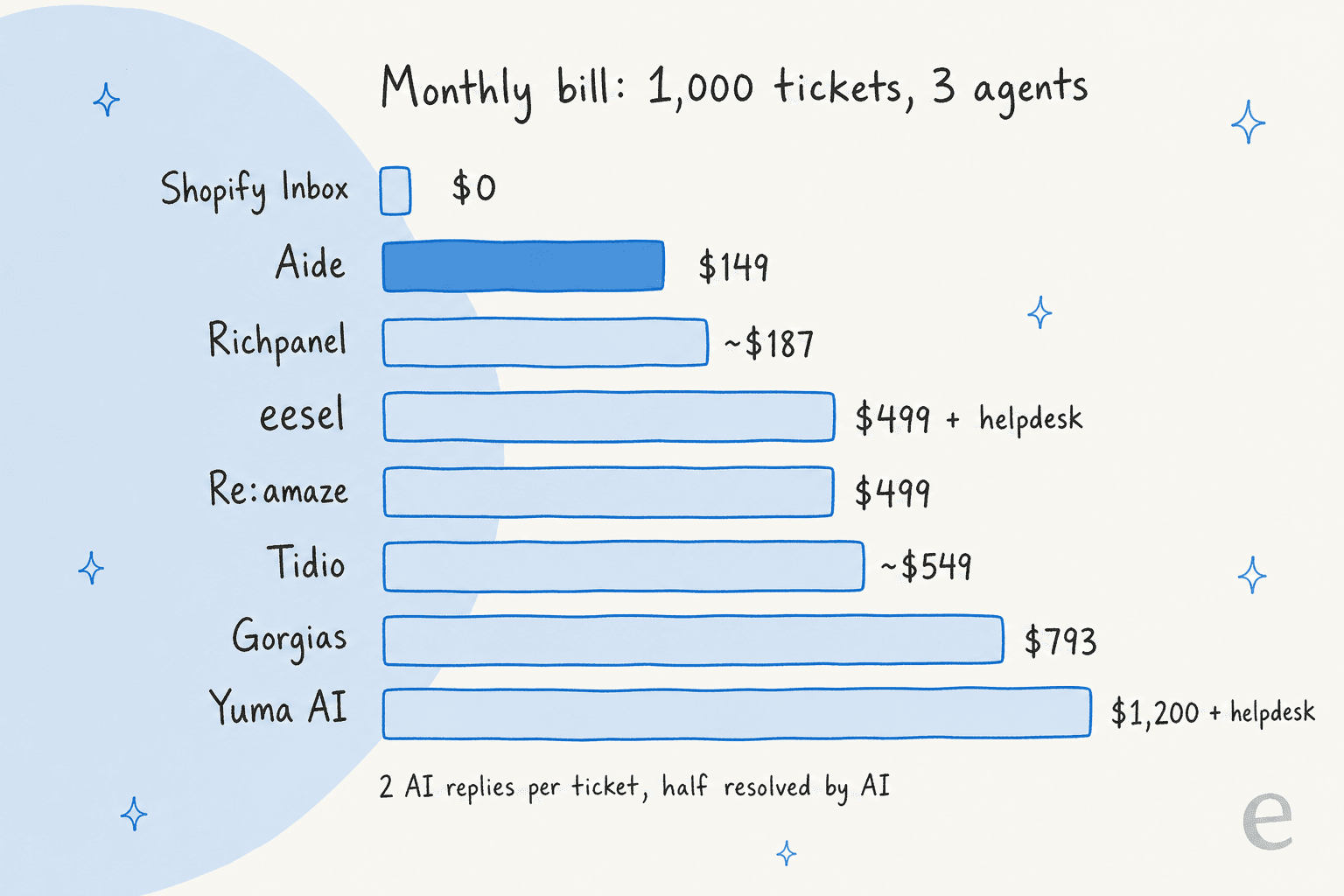
So Aide wins on price at this size, and I'd tell you that even though eesel is on this list. Two things change the picture. If your AI mostly leaves drafts, Aide still bills every one, while Gorgias, Re:amaze and Yuma AI only bill what the AI resolves. And Aide's number is the whole bill, while eesel and Yuma AI sit on top of a helpdesk you're already paying for. My guide to cost per resolution goes deeper into the maths.
Which Aide alternative fits your reason for leaving?
Price usually isn't the reason, so start from the real one. Pick yours:
Pick the reason closest to yours to see which Aide alternative I'd shortlist first, and the runner-up.
1. eesel
Best for: Shopify brands that run Aide inside Gorgias, Zendesk or Front and want to keep that helpdesk, with a bill that doesn't change between replies and drafts.
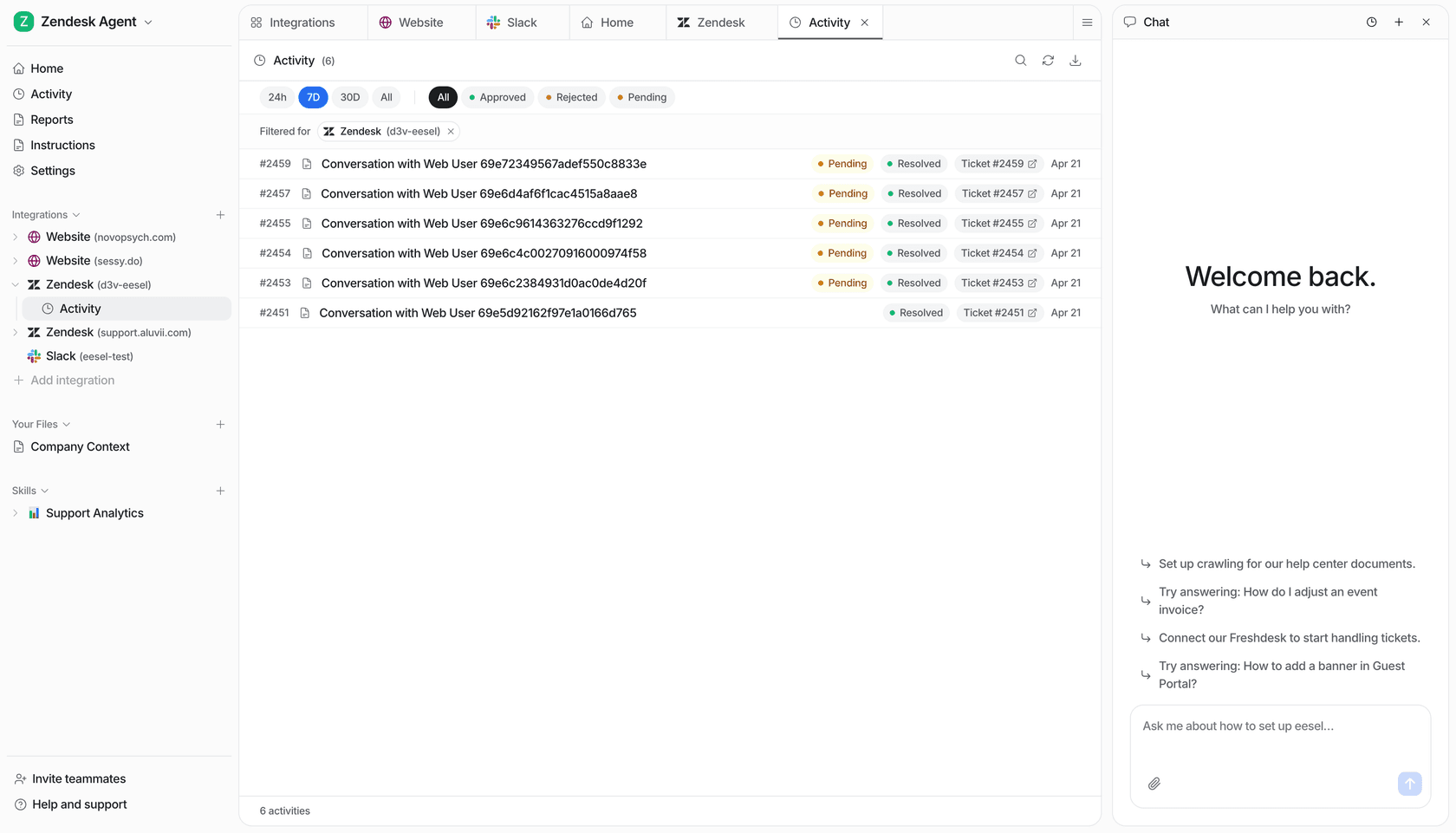
eesel is an AI teammate you hire for a specific job, and on this list the job is the helpdesk. It joins your Gorgias or Zendesk queue, learns from your past tickets, macros and help center, and connects to Shopify so it can look up the order before it answers.
How it compares to Aide
Both work inside your helpdesk and both read the Shopify order. The differences are the billing unit and how you roll it out. Aide bills each AI reply or draft. eesel bills one credit per ticket, whether it replies or drafts, however many messages the thread takes. You choose per trigger whether it answers the customer or leaves an internal note, and you can run it on your own past tickets first to read what it would have said.
That draft question is where most teams start. A DTC supplements brand doing about 7,000 Gorgias tickets a month came to eesel looking for a copilot, and by the end of the sales call its ops lead had worked out the team needed an autonomous agent handling at least half of its emails. Both ends of that are on eesel today:
- On autopilot: Question Beauty, a direct-to-consumer cosmetics brand, runs eesel on Gorgias across Messenger, email and chat. In a month it handled 990 tickets, sent 960 replies itself, looked up 290 Shopify orders and closed 280 tickets without a person.
- On drafts: STIL Classics, a planners and stationery brand, has every Gorgias ticket arrive with the order checked and a reply written. In a month it prepared 320 tickets and looked up 230 Shopify orders, leaving 430 draft replies as internal notes for the team to send.
Pros
- Keeps Gorgias, and also works on Zendesk, Freshdesk, Front, Help Scout, HubSpot and Salesforce.
- One credit per ticket, so drafts, long threads and replies cost the same.
- Simulation on your own past tickets before go-live.
- Free plan with 100 credits, unlimited agents and seats on every plan.
Cons
- Costs more than Aide at the same volume, and you still pay for your helpdesk.
- Every ticket the agent works uses a credit, resolved or not.
- It doesn't replace Aide Helpdesk. If that's your inbox, you need a helpdesk first.
- SOC 2 Type II is still underway.
Pricing
From eesel's pricing page: Free gives 100 credits to try everything. Teammate plans start at $299 a month for 500 credits and step up to $499 for 1,000, $849 for 2,000 and $1,749 for 5,000, so the per-ticket rate drops from $0.60 to $0.35. Enterprise is custom and adds SSO, a HIPAA BAA and security review support. Managed Support is $5,000 a month flat, done for you.
Verdict: Pick eesel if you're keeping Gorgias or Zendesk and want drafts and replies on one predictable bill. Skip it if you run Aide Helpdesk and the lowest monthly number is what matters most; Aide wins that one. My eesel vs Gorgias AI comparison covers the Gorgias side by side.
2. Gorgias
Best for: Shopify teams that want one helpdesk and AI from a single vendor, built around their store.
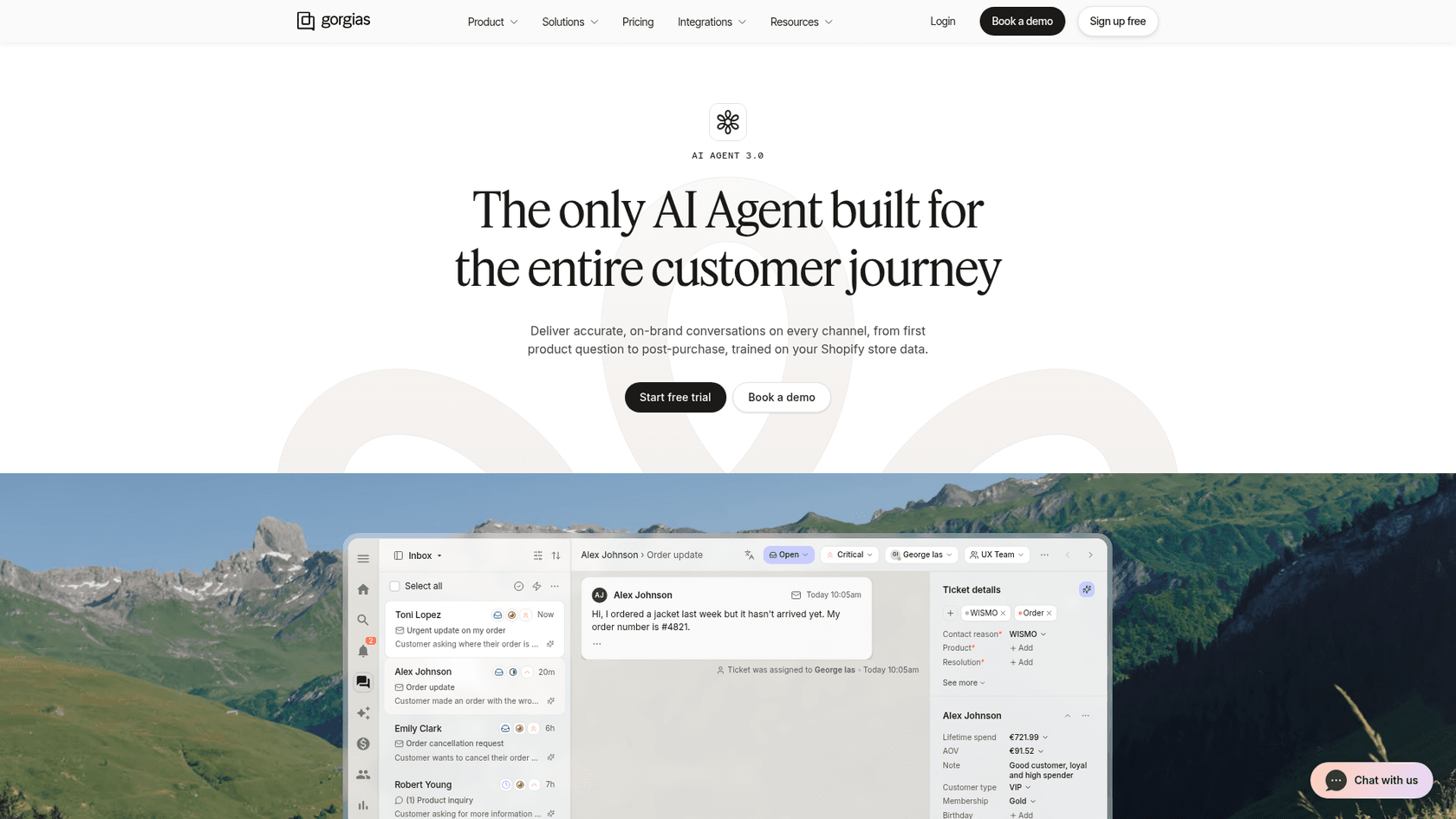
Gorgias is the ecommerce helpdesk most Shopify brands end up comparing against, and ChatGPT put it first on its Aide shortlist. Its pricing page now sells helpdesk and AI Agent as one plan: "One platform. One inbox. One bill." AI Agent is on every plan, and you pay when it resolves a conversation.
How it compares to Aide
Aide already works on Gorgias, so if you're a Gorgias shop this is the "do it natively" option with no migration. If you're on Aide Helpdesk, Gorgias is the closest all-in-one replacement. Gorgias bills helpdesk tickets plus automated interactions, so drafts and handoffs don't add to the AI bill the way they do on Aide. The trade is price: on my sample store it's $793 a month against Aide's $149. Users are split on how much tuning the AI needs:
"I haven’t had a great experience with the AI support agent. It takes a pretty big effort to train it. Then, I find that most of the responses have an error that I have to apologize for after the handoff."

Pros
- Shopify-native, with helpdesk and AI on one bill.
- Only automated interactions count toward the AI fee.
- Cancel, discount and apply actions from the Basic plan, and 150+ app integrations.
Cons
- Tiered by helpdesk tickets, so the AI fee sits on top of a plan you may outgrow.
- The Starter plan is 50 tickets a month and has no AI actions.
- You do the training and tuning yourself.
Pricing
From the Gorgias pricing page: Starter is $40 a month for 50 tickets and 30 automated interactions, Basic $90 for 300 tickets and 30 interactions, Pro $550 for 2,000 tickets and 190 interactions, and Advanced $1,430 for 5,000 tickets and 530 interactions, with annual billing lower on Basic and up. Extra automated interactions cost $1.00 on Starter, $0.90 on Basic and Pro, and $0.85 on Advanced. My Gorgias AI Agent pricing post walks through each tier.
Verdict: Pick Gorgias if you want one Shopify-native platform and your budget has room above Aide's. Skip it if your Gorgias setup works and only the AI needs changing. My Gorgias AI Agent alternatives list covers that route.
3. Re:amaze
Best for: small teams that want email, chat, social, SMS and voice in one inbox on a per-seat bill.
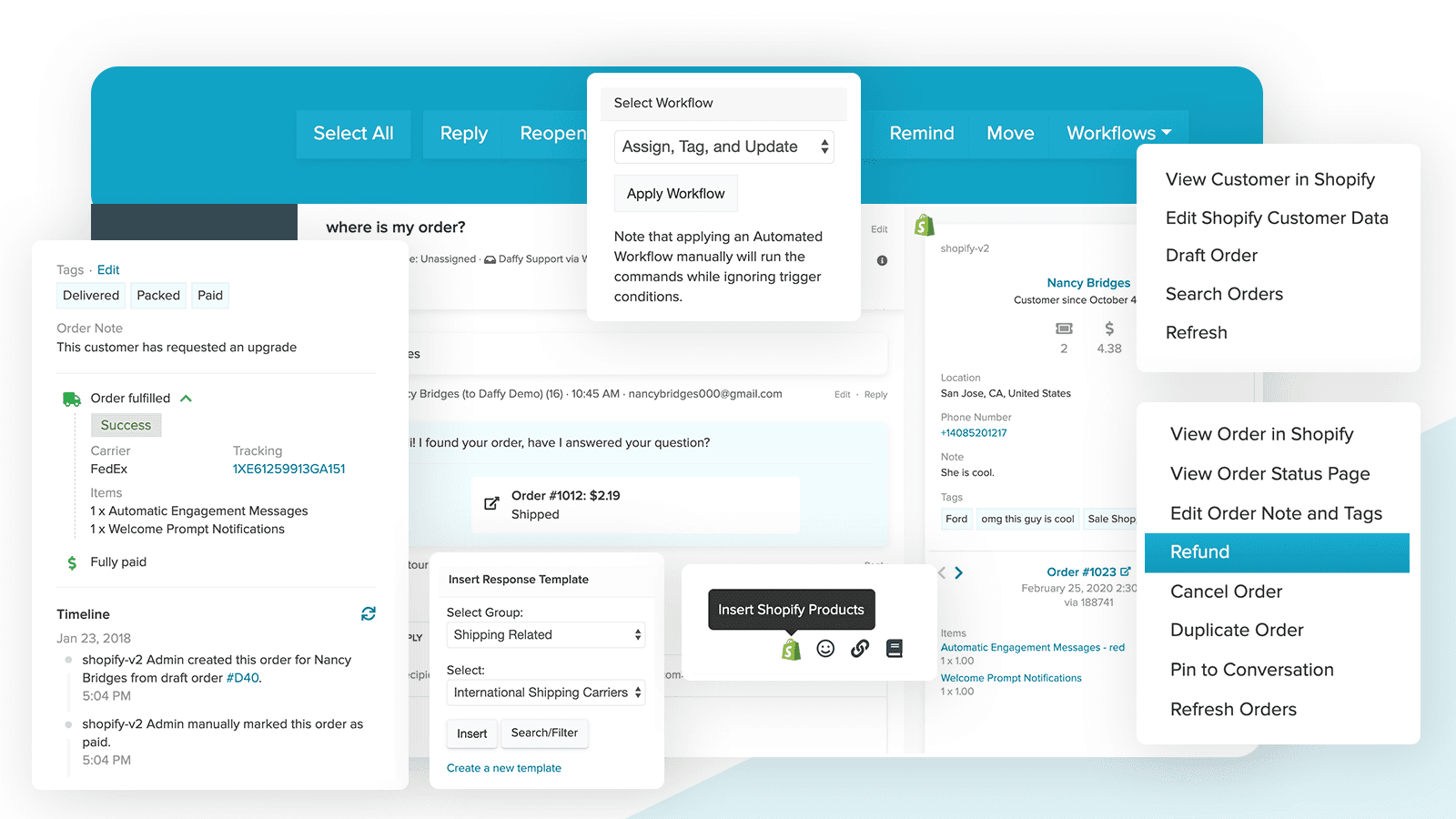
Re:amaze is a helpdesk built for ecommerce, with live chat, chatbots, a help center and the Re:amaze AI Agent. Its Shopify listing rates it 4.4 across 180 reviews, and says agents can "manage, modify, and create Shopify orders directly in customer support and chats".
How it compares to Aide
Re:amaze is the broader inbox. Where Aide covers chat, email and your helpdesk, Re:amaze adds SMS and voice from the Pro plan, plus social channels and multiple brands in one account. The AI side is lighter than Aide's: the AI Agent answers from your knowledge base and FAQ, and the order actions shown on the listing are for your agents, with an Order Bot for status lookups. Billing is per seat, with a few AI resolutions included per seat and $0.85 for each one after that. My guide on adding AI to Re:amaze covers the options if the built-in agent isn't enough.
Pros
- Every channel in one inbox, including SMS and voice on Pro.
- Agents can refund, cancel and edit Shopify orders without leaving the conversation.
- Month-to-month, no contract.
Cons
- Per-seat pricing grows with your team, unlike Aide's unlimited members.
- The AI Agent's Shopify actions aren't spelled out on the pages I checked.
- Security certifications aren't listed on the pages I checked.
Pricing
From the Re:amaze pricing page: Basic is $29 per team member a month with 5 AI resolutions per user, Pro $49 with 10, and Plus $69 with 20, about 10% less billed annually. Every extra AI resolution is $0.85. A Starter plan is $59 flat for unlimited team members and up to 500 responded conversations a month, and the Shopify listing sells extra conversations in packs of 100 for $15. There's a 14-day free trial. My Re:amaze pricing post has the full breakdown.
Verdict: Pick Re:amaze if channel coverage matters more than how far the AI goes on its own. Skip it if your team is growing fast and per-seat billing will outrun Aide's flat plans. My Re:amaze review goes deeper.
4. Richpanel
Best for: brands that want customers to track, cancel and return orders themselves, with AI agents behind it.
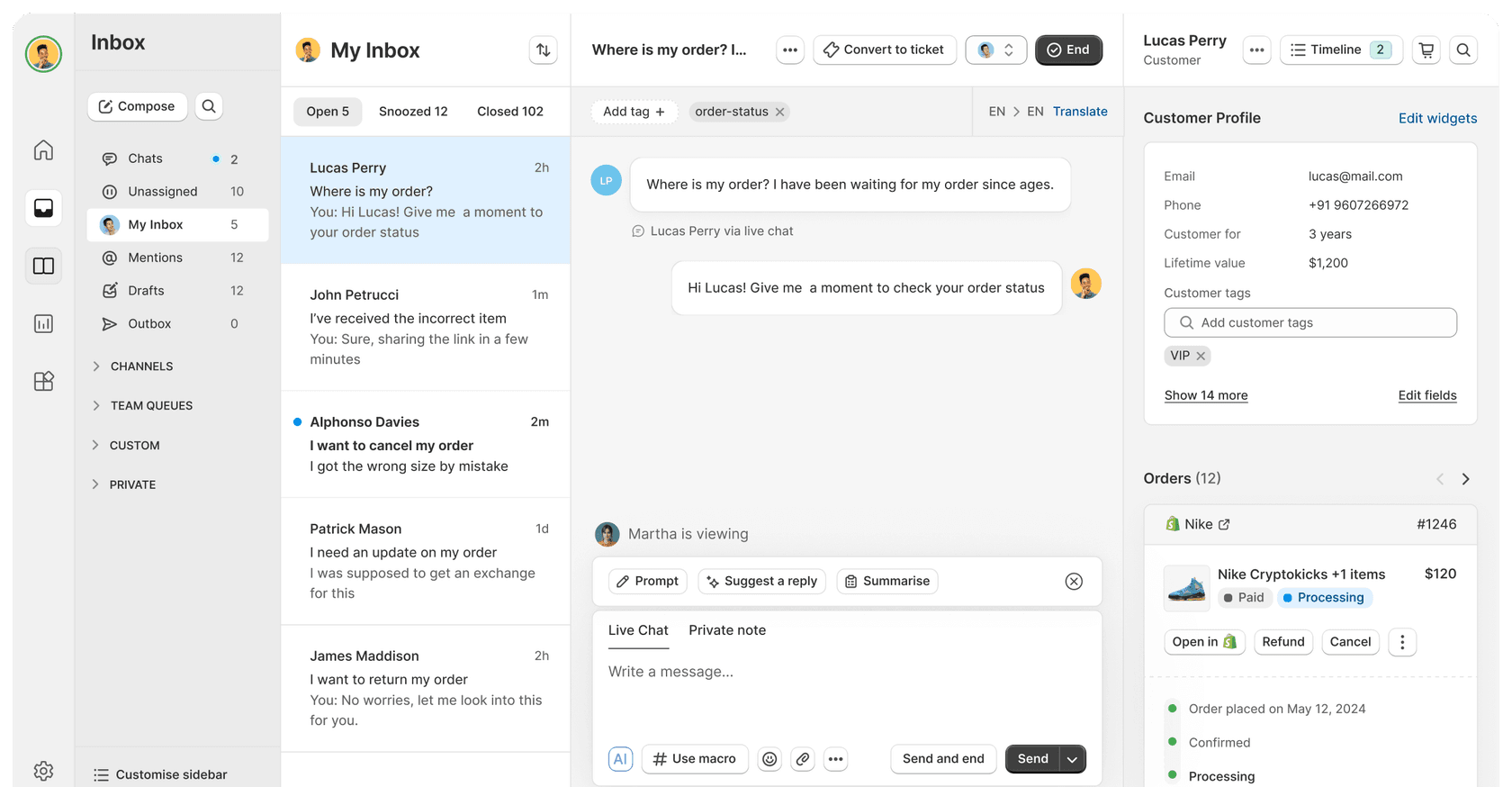
Richpanel sells a helpdesk and a self-service portal for ecommerce, and calls its AI "AI Employees". Its homepage says the AI agents "resolve refunds, order tracking, cancellations, and subscriptions end to end", and quotes about $0.20 per resolved conversation.
How it compares to Aide
Both handle the same order jobs. Richpanel splits them in two: a self-service portal where customers do it themselves, and AI agents inside its own helpdesk for the conversations that still come in. Aide keeps everything in conversation. Richpanel also makes a bolder promise: 50% automation within 30 days and a support bill at least 30% lower when you switch from Zendesk or Gorgias, or a full refund. That's a vendor guarantee, so read the terms on a call. My Richpanel alternatives post covers the trade-offs.
Pros
- Self-service portal for tracking, cancellations and returns.
- SOC 2 Type II, audited annually, and a data protection officer you can contact for DPA and GDPR requests.
- Free helpdesk plan with 3 seats and 50 AI assists.
Cons
- Per-seat helpdesk pricing, plus AI pricing that isn't on the pricing page.
- The pricing page lists conflicting order caps for the same plan.
- It replaces your helpdesk; it doesn't sit inside Gorgias or Zendesk.
Pricing
From the Richpanel pricing page: the helpdesk is Free for 3 seats with 50 AI assists, Starter $29 per user a month and Pro $99 per user, with SMS and phone on Pro. The self-service portal is $0, $50 or $600 a month by order volume, though the page shows two different order limits for the same tiers, so confirm yours. The homepage puts AI at about $0.20 per resolved conversation. My Richpanel pricing post explains the two products.
Verdict: Pick Richpanel if you want returns and cancellations off your team's plate through self-service. Skip it if you want to keep your current helpdesk, or if you want every price in writing before a demo.
5. Tidio
Best for: stores where most conversations are pre-sale questions on the storefront.
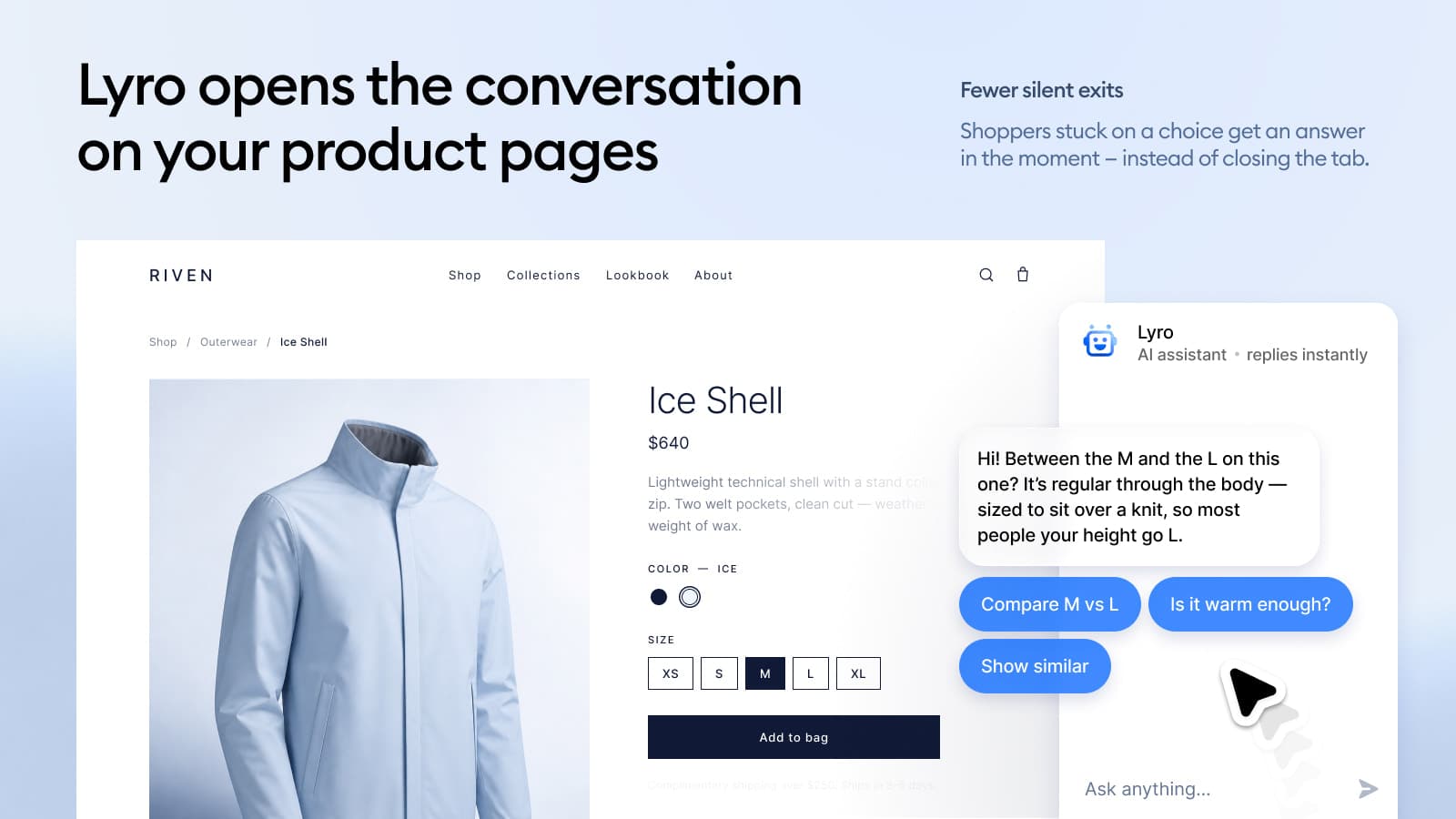
Tidio is a chat-first support platform, and Lyro is its AI agent. Lyro answers from your support content, hands off on rules you set, and can be bought on its own for Zendesk or Salesforce. Tidio's Shopify app rates 4.8 across 1,358 reviews.
How it compares to Aide
Tidio leans toward the storefront: product questions, sizing, recommendations and lead capture with Flows. Aide leans toward the order after it's placed. The billing units are the most different on this list. Tidio counts a Lyro conversation once, "even if Lyro replies a dozen times or more", while Aide counts every reply. Human conversations are billed separately, and only when your team replies. Tidio claims a 75% average resolution rate for Lyro. My Lyro AI explainer covers how it works.
Pros
- Lyro counts a conversation once, however many replies.
- Instagram, Messenger and WhatsApp integrations alongside chat and email.
- Free plan, and a completed SOC 2 report.
Cons
- Two meters, AI and human, so the bill takes some modelling.
- The two Lyro rates Tidio publishes don't match.
- Shopify order actions sit in the plan comparison, so check which plan you need.
Pricing
From the Tidio pricing page, billed annually: Starter is $24.17 a month for 100 billable conversations, Growth starts at $49.17 for 250, Plus starts at $300 plus usage, and Premium is quoted. Lyro starts at $32.50 a month for 50 conversations, and every account gets its first 50 free. The Lyro page says "$0.5 per conversation", while the pricing page's entry tier works out to $0.65. My Tidio pricing and Lyro AI pricing posts run the numbers.
Verdict: Pick Tidio if your chat volume is mostly shoppers deciding what to buy. Skip it if your inbox is mostly post-purchase orders, where Aide and Gorgias go further. My Gorgias vs Tidio comparison covers that split.
6. Yuma AI
Best for: high-volume Shopify brands that want an agent to finish refunds, returns and subscription changes inside their helpdesk.
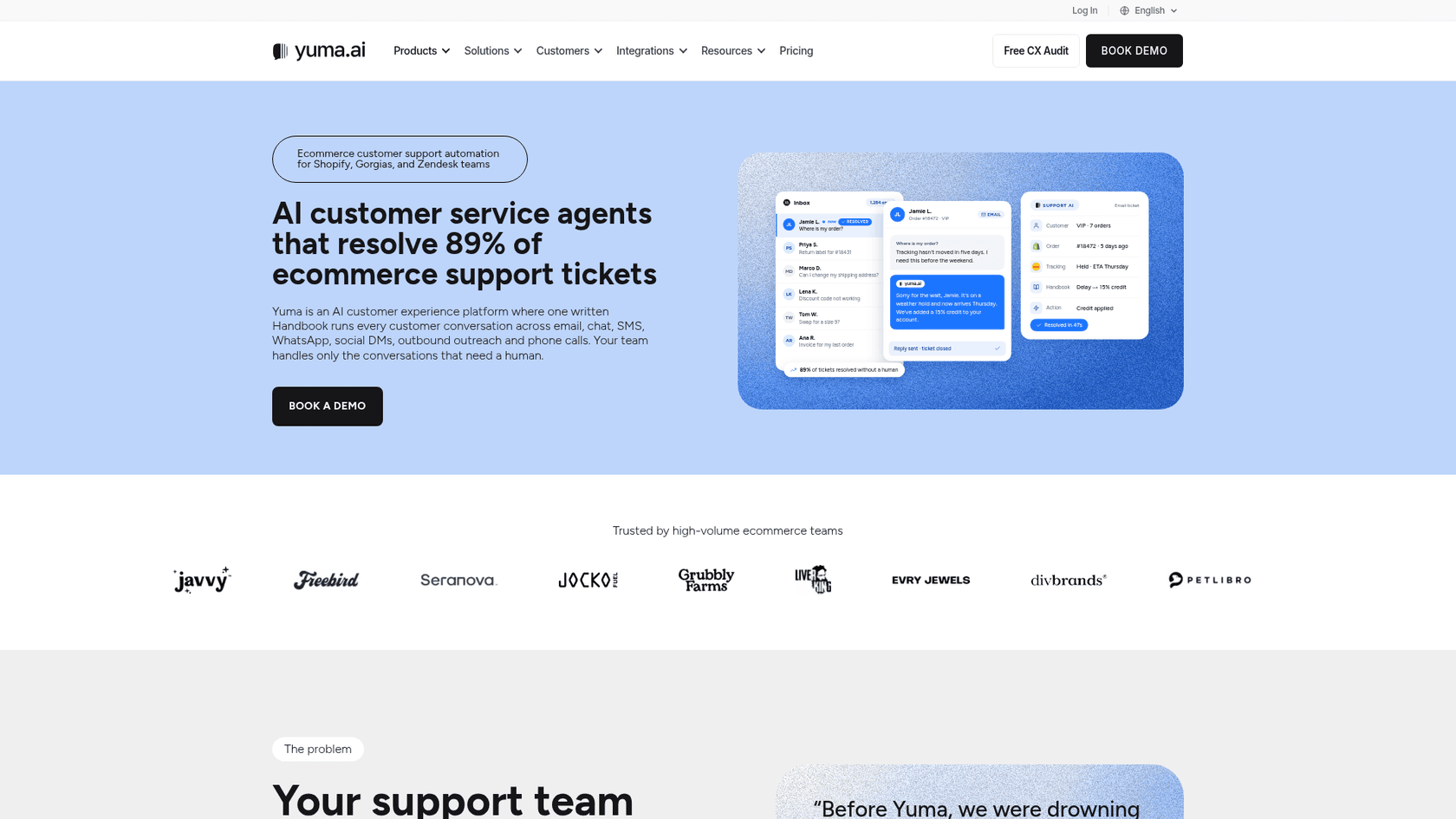
Yuma AI is the other tool here that keeps your helpdesk. Its agents plug into Gorgias, Zendesk, Kustomer, Re:amaze and others, and handle WISMO, returns, refunds, cancellations, subscription changes and address edits end to end, with 75+ pre-built automations.
How it compares to Aide
Both take real Shopify actions inside your helpdesk. The billing is the opposite of Aide's: Yuma bills only a full resolution, "a support ticket that Yuma handled from start to finish" with no human involved, so drafts and escalations cost nothing. The catch is the entry point. Every plan is a 12-month commitment, and the smallest is $14,400 a year, which is $1,200 a month against Aide's $39 Starter. My Gorgias AI vs Yuma AI comparison covers the most common head-to-head.
Pros
- Bills only tickets resolved with no human touch.
- Wide set of Shopify actions, including subscription changes.
- Keeps your helpdesk, across several helpdesks.
Cons
- 12-month commitment and a $14,400 a year entry point.
- Monthly plans charge $1.50 per over-quota ticket.
- Security certifications aren't listed on the pages I checked.
Pricing
From Yuma's pricing page: Starter is $14,400 a year for 12,000 resolutions (about $1.20 each), Growth $40,000 for about 48,000 (about $0.83) and Scale $90,000 for about 120,000 (about $0.75), with the rate dropping toward a $0.55 floor above that. Sales AI, Social AI and Voice AI are add-ons. My Yuma AI pricing post explains the bundles.
Verdict: Pick Yuma if you resolve 1,000 or more tickets a month and want end-to-end actions on an annual plan. Skip it if you chose Aide for a small monthly bill. My Yuma AI alternatives list goes further.
7. Shopify Inbox
Best for: small stores that want a free AI sales chat on the storefront and nothing more.
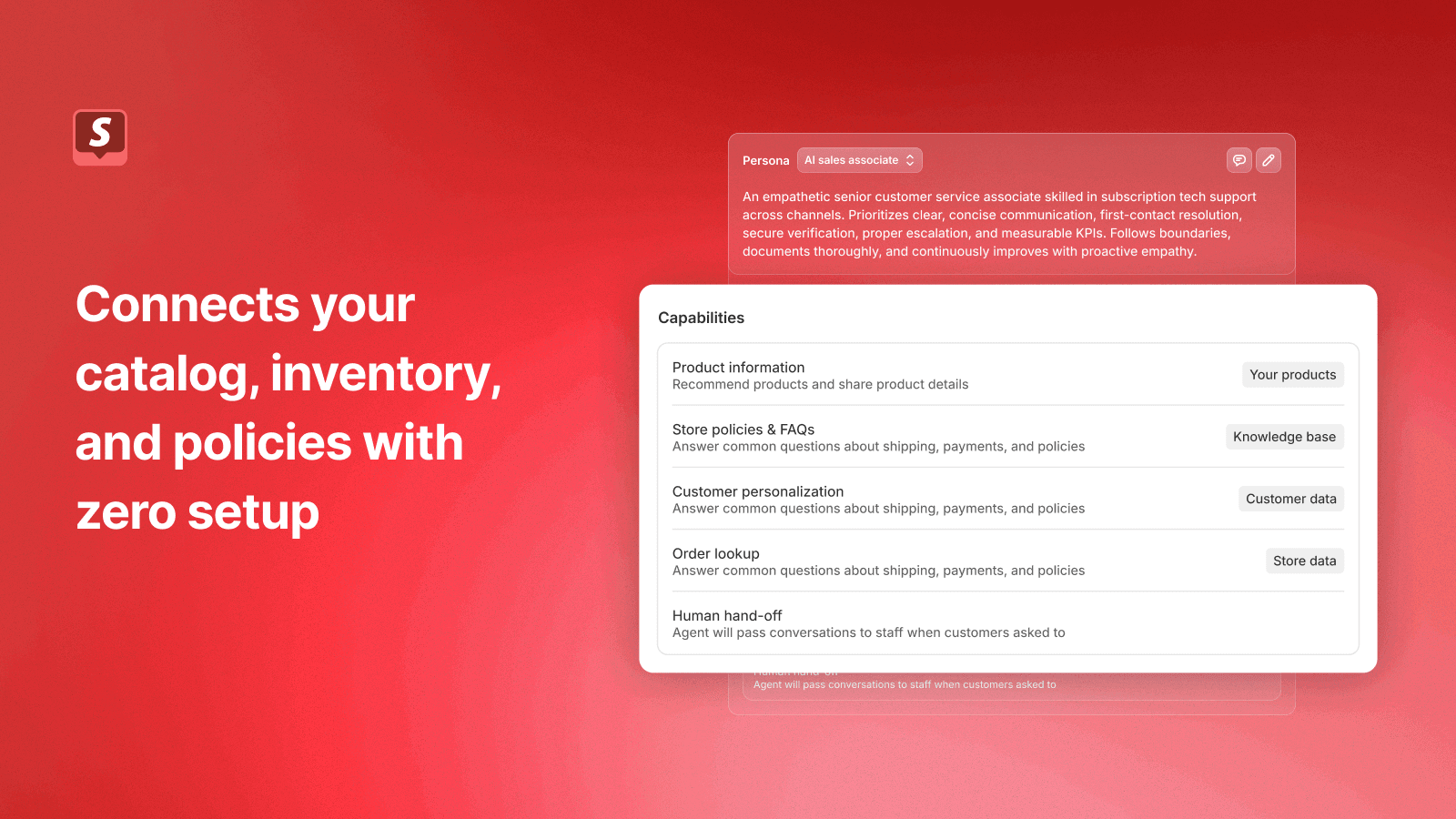
Shopify Inbox is Shopify's own chat app, and it now describes itself as "an AI-powered sales associate" for your storefront. It learns from your catalog, inventory and policies, can look up orders, and hands off to your staff when a shopper asks. It's free and rates 4.6 across 5,801 reviews.
How it compares to Aide
Shopify Inbox is the free floor, and it does a different job. It helps shoppers find products and answers policy and order-status questions in chat, while Aide works your support inbox, email included, and takes actions like refunds and cancellations. Some stores will run both. My Shopify Inbox guide covers setup.
Pros
- Free, native to Shopify, nothing to connect.
- Personalizes replies for shoppers signed in with Shop.
- 21 languages listed.
Cons
- Storefront chat only, not an email or ticket inbox.
- No refund, cancellation or return actions listed.
- No helpdesk features like routing, SLAs or macros.
Pricing
The Shopify App Store listing shows it as free.
Verdict: Pick Shopify Inbox if you only need a sales chat on your store. Skip it as an Aide replacement for support; it's a complement, not a substitute. My roundup of Shopify chatbot apps has more options.
Autopilot or drafts: how should you test an Aide alternative?
Run every finalist on the same tickets, in the mode you'll really use. Pull 100 to 200 resolved tickets from the last three months, weighted the way your inbox is: WISMO, returns, cancellations, address changes, product questions, and the spam you'd rather never see. For each tool, count three things: correct answers it would have sent alone, answers a person would have fixed, and handoffs. Then divide each projected monthly bill by the correct solo answers.
A few checks worth adding:
- Decide autopilot or drafts per topic. Order status is usually safe on autopilot; refunds usually start as drafts. If drafts are most of your volume, favor a tool that doesn't bill them as replies.
- Test a real return. Ask each tool to start a return on a test order. My guide on how to automate returns lists what to check.
- Read the handoff. A clean AI agent handoff gives your agent the order, the request and the reason.
- Plan for peak. Multiply your November volume through each pricing model, and check what happens at a cap. On Aide the AI pauses; on others the bill keeps going.
My full checklist for testing an AI agent covers the setup step by step. For a wider view, my list of the best AI for ecommerce support is a good next stop, and the Adelante AI alternatives post covers the managed-agent side of the same market.
Try eesel on your Gorgias and Shopify queue
If you like what Aide does, an agent that checks the Shopify order before it answers, but you want to keep Gorgias, Zendesk or Front and stop paying per draft, eesel is the one I'd try first. Connect your helpdesk and Shopify, pick which tickets it handles, and choose per trigger whether it replies or drafts. That's how Question Beauty runs it on autopilot and STIL Classics runs it on drafts, on the same Gorgias integration.
Start on the free plan with 100 credits, run it on your own past tickets, then move to a flat monthly plan when you're happy. Try eesel on your Gorgias queue this week.
Frequently Asked Questions
What are the best Aide AI alternatives for Shopify stores?
If you want to keep the helpdesk you run today, look at eesel or Yuma AI. If you'd rather have helpdesk and AI in one product, look at Gorgias, Re:amaze, Richpanel or Tidio. Shopify Inbox is the free option for storefront chat. My list of the best AI for Shopify support covers the wider field.
Is there a cheaper alternative to Aide AI?
Mostly no. Aide's helpdesk is free and its Pro plan is $149 a month for 4,000 AI replies, so on my sample store of 1,000 tickets a month it was the cheapest paid option. Only Shopify Inbox (free) costs less, and it's a storefront sales chat, not a support inbox. My Aide AI pricing breakdown has every plan.
How does Aide AI pricing compare to Gorgias?
Aide charges per AI reply or draft, from $39 a month for 1,000 replies, with no seat fees. Gorgias bundles helpdesk tickets and automated interactions, from $40 a month for 50 tickets and 30 automated interactions, then $0.85 to $1.00 per extra interaction. At 1,000 tickets a month Gorgias came to about $793 against Aide's $149. My Gorgias AI Agent pricing post walks through each tier.
Which Aide AI alternatives can process Shopify refunds and cancellations?
Gorgias lists cancel and discount actions on its paid plans, Richpanel's AI handles refunds, cancellations and subscriptions, Yuma AI does refunds, returns, cancellations and address edits, and Re:amaze lets agents refund and cancel orders from the inbox. My guide on AI refunds and returns explains what to check before you turn any of these on.
Do Aide AI drafts cost the same as sent replies?
Yes. Aide counts a draft it leaves for your team as one AI reply, the same as a reply it sends, though a message that gets a draft and later a sent reply counts once. If your team mostly works in draft mode, that matters when you compare Aide with tools that only bill resolutions. My Aide AI review covers how drafts work inside Zendesk, Gorgias and Front.
How do I test an Aide AI alternative before switching?
Pull 100 to 200 recent tickets that match your real mix of order status, returns and product questions, and run each finalist on the same set. Count correct solo answers, answers a person would fix, and handoffs, then divide each monthly bill by the correct answers. My checklist for testing an AI agent walks through it.