

Why people are looking past Inkling
Let me be fair to Inkling first, because the switching case only lands once you see what's actually good about it.
Inkling is a rare thing: a large, credible, fully open-weights model with native audio input and a 1M-token context, released under Apache 2.0 with the weights on Hugging Face on day one. That last part matters, because its closest rival, Kimi K3, launched API-only with its weights held back. If your whole reason for wanting Inkling is "I need to own and run the model, and I might feed it audio," it delivers. For the full breakdown of what it is, see my Inkling explainer and hands-on review.
So the reasons to look elsewhere aren't really about whether Inkling is good. They're about fit and cost.
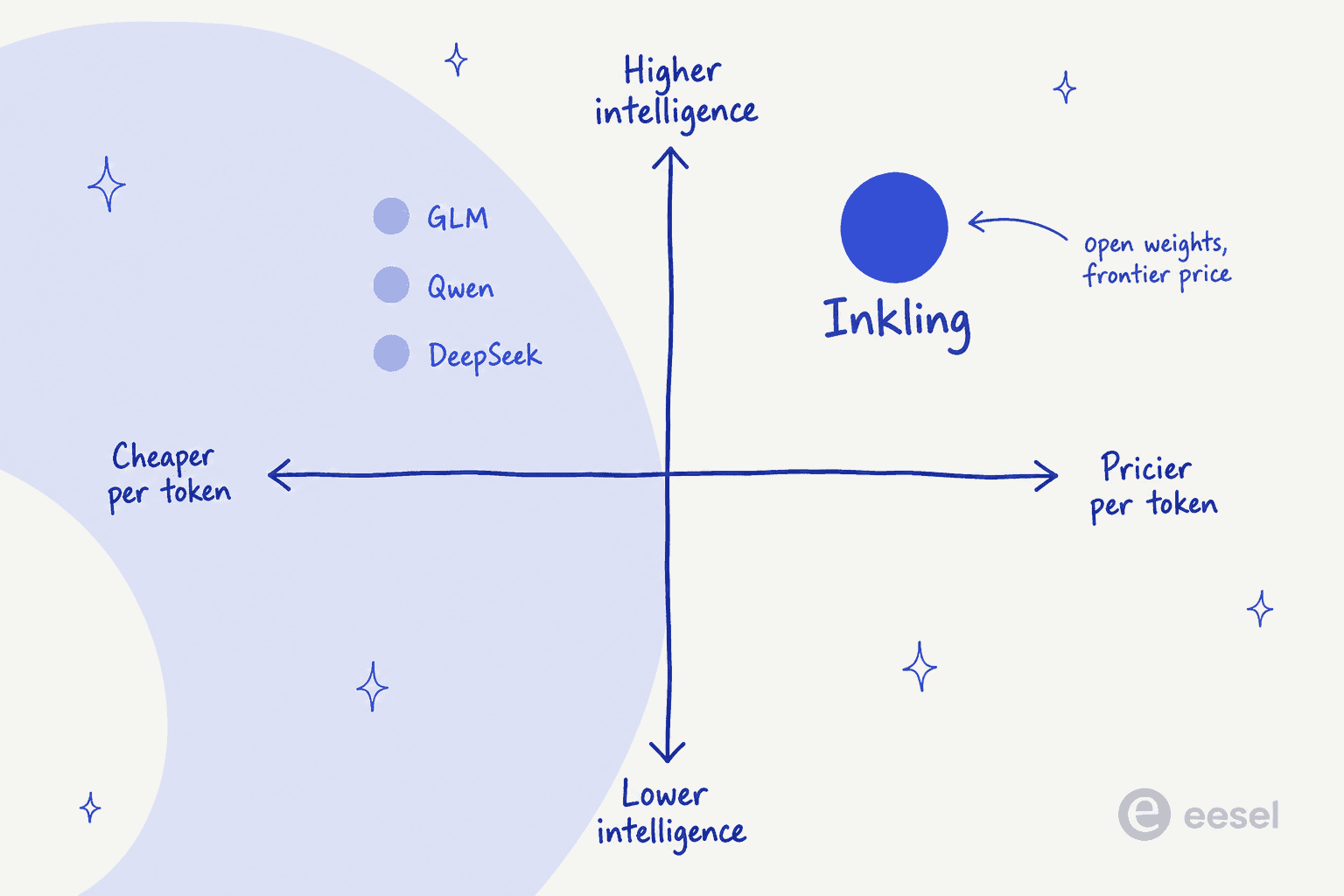
It's expensive for open weights. This is the headline quirk. On Thinking Machines' own API, Inkling ranks #81 of 97 on price, per Artificial Analysis, at $1.87 in / $4.68 out per million tokens. The class average for a model its size is closer to $0.43 / $1.25. Worse, there's currently only one API provider (Thinking Machines itself), so no cheaper third-party host is undercutting it.
It's not the smartest model you can run. Inkling scores 41 on the Artificial Analysis Intelligence Index. That's good, but GLM-5.2 (51), Kimi K3 (57), and every closed frontier model beat it. Community trackers that fold in more models put Inkling nearer #41 overall, which is where the launch-thread "is 'competitive' fair?" debate came from.
It has sharp edges. Read the eval table honestly and Inkling is strong on scientific and long-context reasoning but weak on raw knowledge reliability (its AA-Omniscience index is a lowly 2) and physics (CritPt 5%). It's a spiky model, not a smooth all-rounder.
Self-hosting is a data-center job. "Open" only means "free" if you can run it. The full BF16 weights want ~2 TB of VRAM; even the NVFP4 quant needs ~600 GB. Cheaper open models are far lighter to serve.
The launch thread caught the same tension, and the most useful comment in it is worth taping to your monitor before you trust any of the scores below:
"want to know how good a model is? Run it with your own non-public benchmark, basically the only way to get proper answers you can somewhat rely on, everything else is manipulated, misunderstood or over-relied on."
Here's how the field lines up once you plot intelligence against price.
How I picked these
I build with these APIs, so this roundup leans on what the vendors' own pricing and docs pages actually say, read the week I wrote this, not on a marketing chart. Every price below is per million tokens and pulled from the model maker's own page or from Artificial Analysis, which benchmarks everyone the same way. Where a license, price, or context window couldn't be confirmed on a first-party page, I say so rather than guess. The ranking is opinionated but the numbers are yours to check, and if you want to keep watching how these models shift, my LLM tracking tools roundup covers that.
The best Inkling alternatives at a glance
| Model | Maker | Open weights? | Input / Output (per 1M) | Context | Best for |
|---|---|---|---|---|---|
| Inkling (baseline) | Thinking Machines | Yes (Apache 2.0) | $1.87 / $4.68 | 1M | Open audio-in model you own |
| GLM-5.2 | Zhipu / Z.ai | Yes (MIT) | $1.40 / $4.40 | 1M | Open coding you can run today |
| DeepSeek V4 Flash | DeepSeek | Yes (MIT) | $0.14 / $0.28 | 1M | Lowest cost, budget frontier |
| Kimi K3 | Moonshot AI | Weights July 27 | $3.00 / $15.00 | 1M | Open frontier agentic ceiling |
| MiniMax M3 | MiniMax | Yes | $0.30 / $1.20 (promo) | 1M | Cheap open multimodal + long runs |
| Qwen3.7-Max | Alibaba | No (Max tier) | $2.50 / $7.50 | 1M | Alibaba's agentic tuning |
| Claude Fable 5 / Opus 4.8 | Anthropic | No | $10 / $50 · $5 / $25 | Large | Reliability ceiling |
| GPT-5.6 Sol | OpenAI | No | $5.00 / $30.00 | Large | Deepest ecosystem |
| Gemini 3.5 Pro | No | Not yet public | 2M multimodal | Longest context + richest multimodal |
Two things jump out. First, Inkling sits high on the price ladder for an open model, not low. Second, the models that undercut it on price are mostly the open-weight ones. So if "open" was your reason for looking at Inkling, the open alternatives mostly beat it on price too.
Now the eight, in the order I'd actually consider them.
1. GLM-5.2
Best for: open-weight coding and agents you can download and run today.
This is the alternative that most directly answers Inkling's biggest problems at once: it's smarter, cheaper, and open. GLM-5.2 from Zhipu AI (shipping under the Z.ai brand) is a ~753B-parameter mixture-of-experts model whose full weights are on Hugging Face under an MIT license, free to download, fine-tune, self-host, and use commercially.
On the numbers, it beats Inkling on the two lines that matter. It scores 51 on the Artificial Analysis index, the #1 open-weights model in the world, against Inkling's 41. And it's cheaper: $1.40 input / $4.40 output per million on the Z.ai docs, with the same 1M context. Zhipu tunes it for code and agents and reports a 62.1 on SWE-bench Pro, which puts it among the strongest open coding models around, a natural base for building AI agents on your own hardware.
Verdict: if "open weights, available now, strong at code, cheaper than Inkling" is your checklist, GLM-5.2 wins on every line. My first recommendation for anyone who wanted Inkling because it was supposed to be open.
2. DeepSeek V4 Flash
Best for: the lowest possible bill on frontier-tier reasoning.
If your reason for leaving Inkling is cost, stop here. DeepSeek's V4 line is the cheapest capable model on this list by a wide margin. DeepSeek V4 Flash is $0.14 input / $0.28 output per million tokens, per DeepSeek's pricing, with a cache-hit input rate near a quarter of a cent. It's a 284B-parameter MoE (13B active), carries a 1M-token context, and keeps a thinking mode on by default, so you're not trading reasoning for the price.
Put that next to Inkling: $0.28 versus $4.68 on output is roughly 17x. For high-volume workloads where most of the input is cached, DeepSeek is in a different universe on cost. It also ships open weights on Hugging Face under an MIT license, released April 2026, so the self-host story that Inkling sells is here too, at a fraction of the serving cost. It shows up strong in most AI coding tool roundups for exactly these reasons.
Verdict: the default budget pick. If you're switching off Inkling to cut spend and you don't need the absolute top of the quality charts, DeepSeek V4 Flash is the one to try first.
3. Kimi K3
Best for: the open frontier ceiling on agentic work, when you'll pay for it.
Moonshot's Kimi K3 is the model that outscores almost everything else on this list. It's the first open model to reach the 3-trillion-parameter class, and on the Artificial Analysis index it hits 57, good for a top-four finish overall, well clear of Inkling's 41. If raw capability is what you're after and you still want an eventually-open model, K3 is the ceiling. For the full picture, see my Kimi K3 explainer.
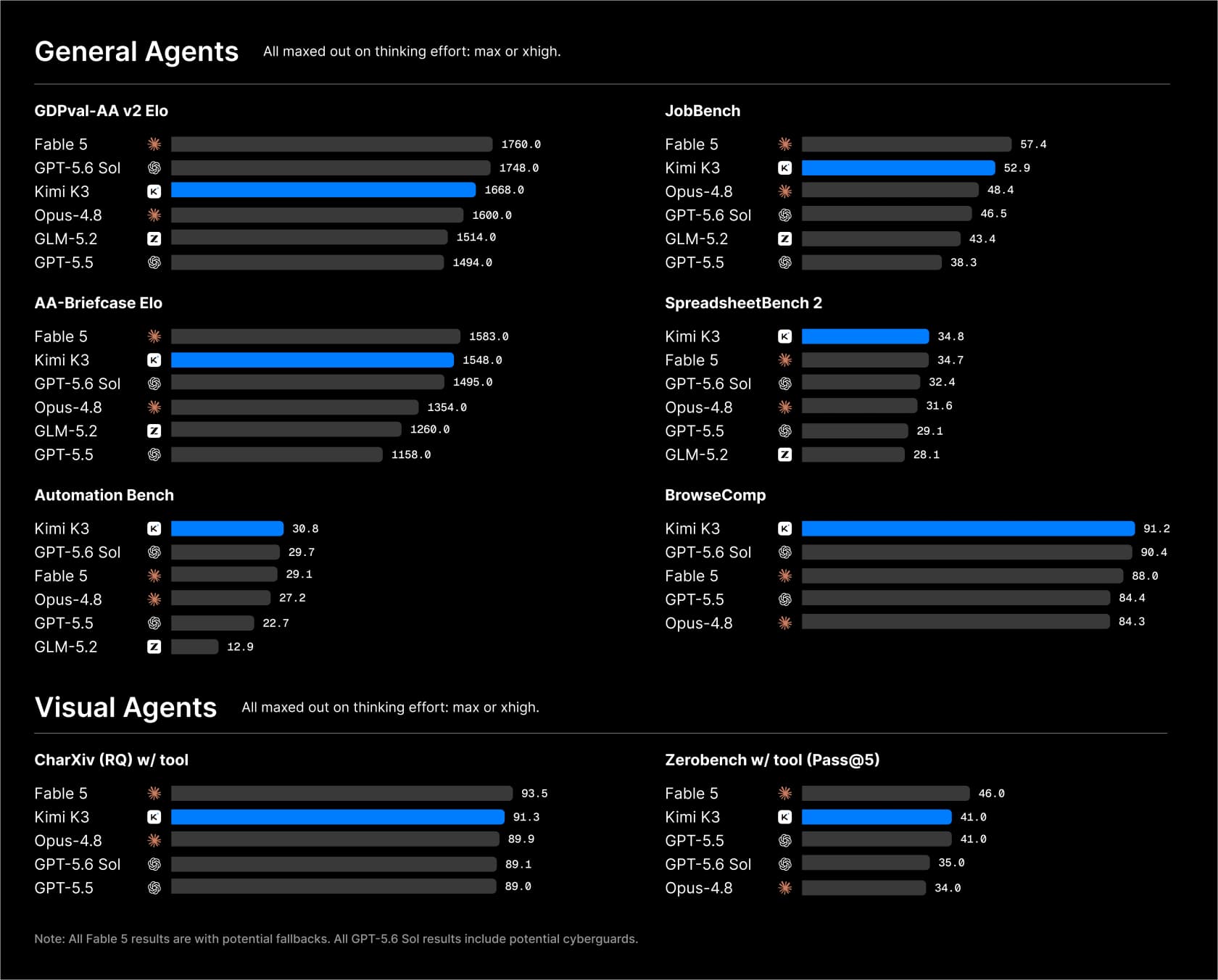
Two catches versus Inkling. First, it's more expensive, not less: K3 priced up to $3 / $15, level with Claude Sonnet, so it's no budget play. Second, its weights were late; Moonshot promised the full open release by July 27, 2026, where Inkling's were downloadable at launch. So if self-hosting today is the deciding factor, Inkling actually beats K3 on availability, even if K3 wins on score.
Verdict: pick K3 when you want the highest open-tier intelligence and the price and the wait don't scare you. If you wanted Inkling for cheap-and-open, K3 is the wrong direction; if you wanted it for smart-and-eventually-open, K3 is the upgrade.
4. MiniMax M3
Best for: the cheapest open, natively multimodal model with long-horizon stamina.
MiniMax M3 is the value-and-openness sweet spot, and it answers Inkling's multimodal pitch head-on. It's an open-weight model with a 1M-token context that's natively multimodal, and it costs a fraction of Inkling: $0.60 / $2.40 pay-as-you-go on its pricing page, with a standing 50%-off rate landing it near $0.30 / $1.20.
The pitch MiniMax leans on is long-horizon agent stability: its launch demo showed the model running autonomously for about 12 hours, producing 18 commits while reproducing an academic paper. That's the same "days-long agent run" territory the frontier models target, at pennies on the dollar. Inkling's multimodal claim is native audio in; MiniMax's is broader multimodal at a far lower bill.
Verdict: the best pick if you want open weights and multimodality and a small bill. If Inkling's appeal to you was "open and multimodal," M3 does that for a fraction of the cost.
5. Qwen3.7-Max
Best for: teams that want Alibaba's agentic tuning and don't need open weights.
Qwen3.7-Max is Alibaba's flagship, and it's a capability-and-price neighbor to Inkling rather than a budget play. It runs $2.50 input / $7.50 output per million on the Qwen Cloud pricing page (with a limited-time 50%-off promo), carries a 1M context, and is tuned squarely for agent-centric work: programming, office tasks, and long-horizon autonomous execution. It scores 46 on the Artificial Analysis index, a notch above Inkling.
The catch for open-weight shoppers: the Max tier is closed and API-only. Smaller models in the Qwen3 family are open-weight, but the flagship you'd compare to Inkling is not something you can self-host. So Qwen3.7-Max is best read as an Inkling alternative on capability and agentic focus, not as an "open like Inkling" swap. If you're weighing the wider family, my Qwen alternatives and Qwen pricing guides go deeper.
Verdict: a solid sidestep if you like Alibaba's agent tuning and the ~$2.50 / $7.50 band works. Not the one to pick if open weights were the whole point of looking at Inkling.
6. Claude (Fable 5 and Opus 4.8)
Best for: the reliability ceiling on agentic and coding work, when getting it right beats the bill.
Anthropic's Claude is where you go when correctness beats cost. Claude Fable 5 tops the Artificial Analysis index at 60, the highest score of any model here, and it's tuned for days-long autonomous runs; Opus 4.8 sits just below. This is the correctness end of the spectrum that a spiky, knowledge-shaky model like Inkling can't reach.
You pay for that ceiling. Fable 5 is $10 input / $50 output per million on Anthropic's pricing page, and Opus 4.8 is $5 / $25, both well above Inkling. Claude is fully closed, so there's no self-hosting and no weights to own, which is the exact tradeoff you'd be giving up by leaving Inkling. If you want head-to-head detail, my ChatGPT vs Claude breakdown and Claude alternatives roundup both help.
Verdict: the quality-first choice. Pick Claude when a wrong answer costs you more than the extra dollars, and when owning the weights was never the point.
7. GPT-5.6 Sol
Best for: the deepest ecosystem and the broadest third-party tooling.
OpenAI's GPT-5.6 Sol is the all-rounder. It's a frontier reasoning-and-coding model scoring in the high 50s on the Artificial Analysis index, and its real edge over Inkling isn't a benchmark line, it's the ecosystem: the widest set of SDKs, integrations, and third-party tools of anything here. If your stack already speaks OpenAI, Sol is the least-friction move.
Pricing is $5 input / $30 output per million on the standard tier, per the OpenAI docs, with a batch tier at $2.50 / $15 for non-urgent work. That's above Inkling, and Sol is closed (OpenAI's open-weight gpt-oss models are a separate line). My ChatGPT vs Gemini and ChatGPT vs Mistral guides help if those are your finalists.
Verdict: pick Sol for breadth of integration and a mature platform, not to save money. If ecosystem is your bottleneck, it's worth the premium over Inkling.
8. Gemini 3.5 Pro
Best for: the longest context and the richest multimodal input.
Google's Gemini 3.5 Pro is the pick if Inkling's audio and long-context features were what drew you, because Gemini does both, harder. It ships a 2M-token context, double Inkling's 1M, and takes text, image, audio, and video in a single native call, going a step beyond Inkling's audio-only multimodal input. It rolled into general availability in late June 2026 with a Deep Think reasoning mode.
One honest caveat: Google hasn't published final token pricing for 3.5 Pro as I write this, so treat any figure floating around as an estimate, not a fact. Expect a premium tier; if budget is tight and you want a Google option now, the shipping Gemini 3.1 Pro is $2 / $12 per Google's pricing. Gemini is closed (Google's open family is Gemma, a separate thing), so like Claude and GPT you're trading away Inkling's ownership story for capability.
Verdict: the best pick when your workload is multimodal or context-heavy. If you only ever wanted Inkling to read audio and hold a long window, Gemini does both better, once you accept a closed model.
Which alternative actually fits you?
Prices and scores are only half the decision. The other half is what you're optimizing for. This picks a starting point in one click.
The model is only the engine
Now the part I care about most, because I ship AI agents for a living. It's tempting to read a comparison like this, pick whichever model tops the chart this month, plug it in, and expect your customer service queue to solve itself. It doesn't work that way, and the gap is where most AI support projects quietly fall over.
A raw model, Inkling or any alternative on this list, gives you reasoning. What it does not give you is any idea of your refund policy, your product's edge cases, or the fact that ticket #4021 is a VIP who's already emailed twice. It has no memory of your past tickets, no guardrail to stop it confidently inventing an answer, and no connection to the helpdesk where the work actually happens. A higher benchmark score fixes none of that.
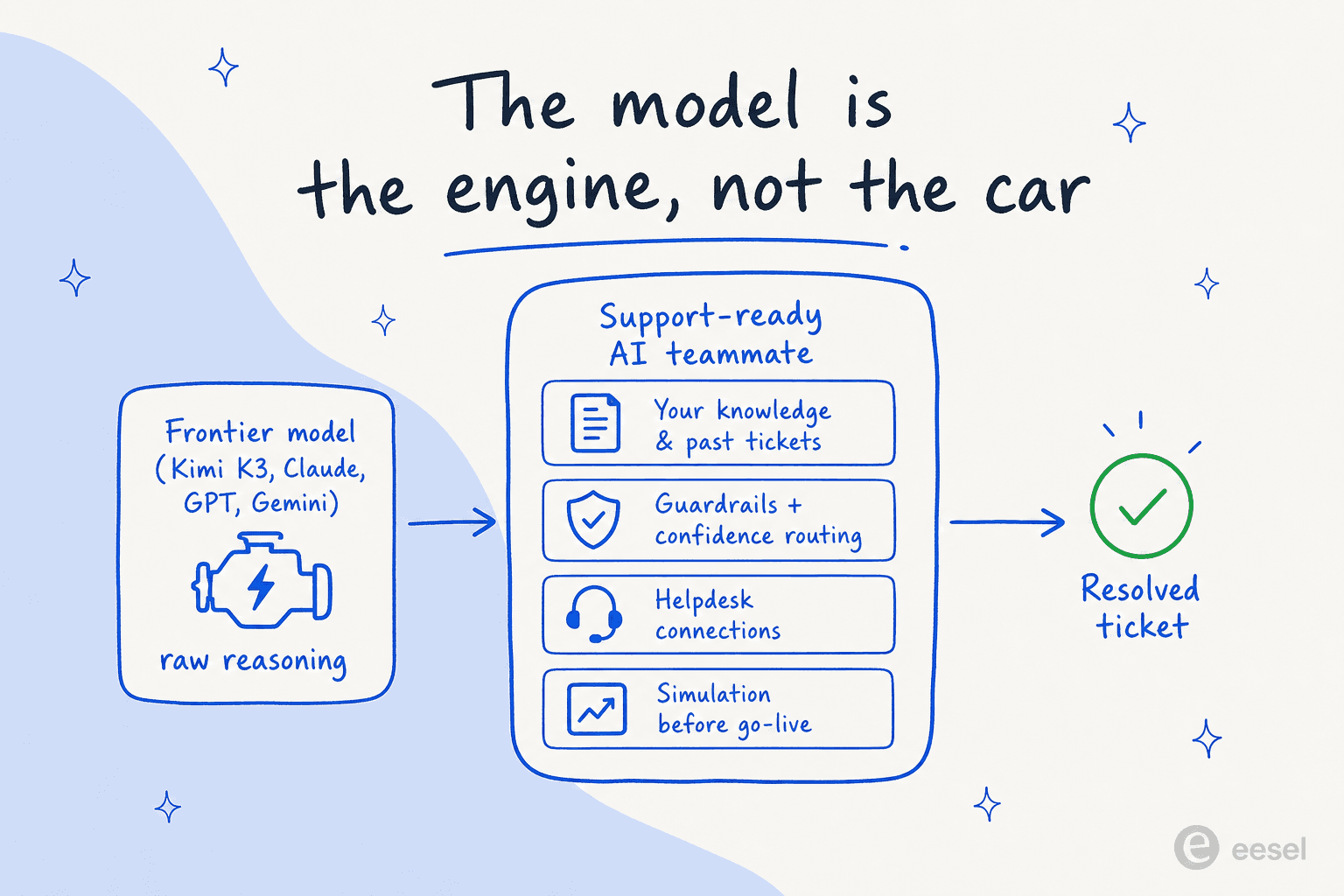
I've spent years putting AI on live support queues, and the lesson that stuck is that a confident-sounding model giving a wrong answer is worse than no answer at all. That's the whole reason eesel AI runs a simulation over your historical tickets before anything goes live, so you see the resolution rate and the exact replies on real past conversations first, not after a customer gets burned. It's also why answers route by confidence: if the AI agent isn't sure, it drafts for a human or escalates instead of guessing, the difference between a rule-based AI chatbot and real support automation.
The quietly good news in this whole roundup: because a well-built AI for customer service treats the model as a swappable engine, the frontier getting cheaper and better (Inkling today, GLM or whatever wins next month) is a tailwind you inherit without re-plumbing anything.
Try eesel AI
If you got here because you want an AI model to actually resolve tickets, not just chat, that's the entire point of eesel AI. It plugs into Zendesk, Freshdesk, Slack and 100+ other tools, learns from your help center and past tickets, and starts drafting or resolving in minutes, not weeks.

The differentiator is the trust ramp: simulate on your real ticket history, watch the numbers, start in draft mode, and go fully autonomous only when you're happy. It's how teams in my customer stories got comfortable handing over tier-1 volume, one of them, Gridwise, resolving 73% of tier-1 requests in the first month. You get a frontier model's smarts wrapped in guardrails built for support, and you're never locked to whichever model happened to win the week you signed up. Pricing is one fixed monthly price from $299/month for 500 credits (1 credit per ticket or chat), with no per-seat fees. Try eesel free, no credit card needed.