


What Meta actually released on 12 October
Meta announced two models, Muse Wonder and Muse Wonder Full, in a launch post that calls them "our most capable models" and "a major leap toward personal superintelligence." They were trained at Meta's gigawatt-scale Prometheus data center and sit above the Muse Spark line, which stays the cheaper workhorse.
Where each one lives, at launch:
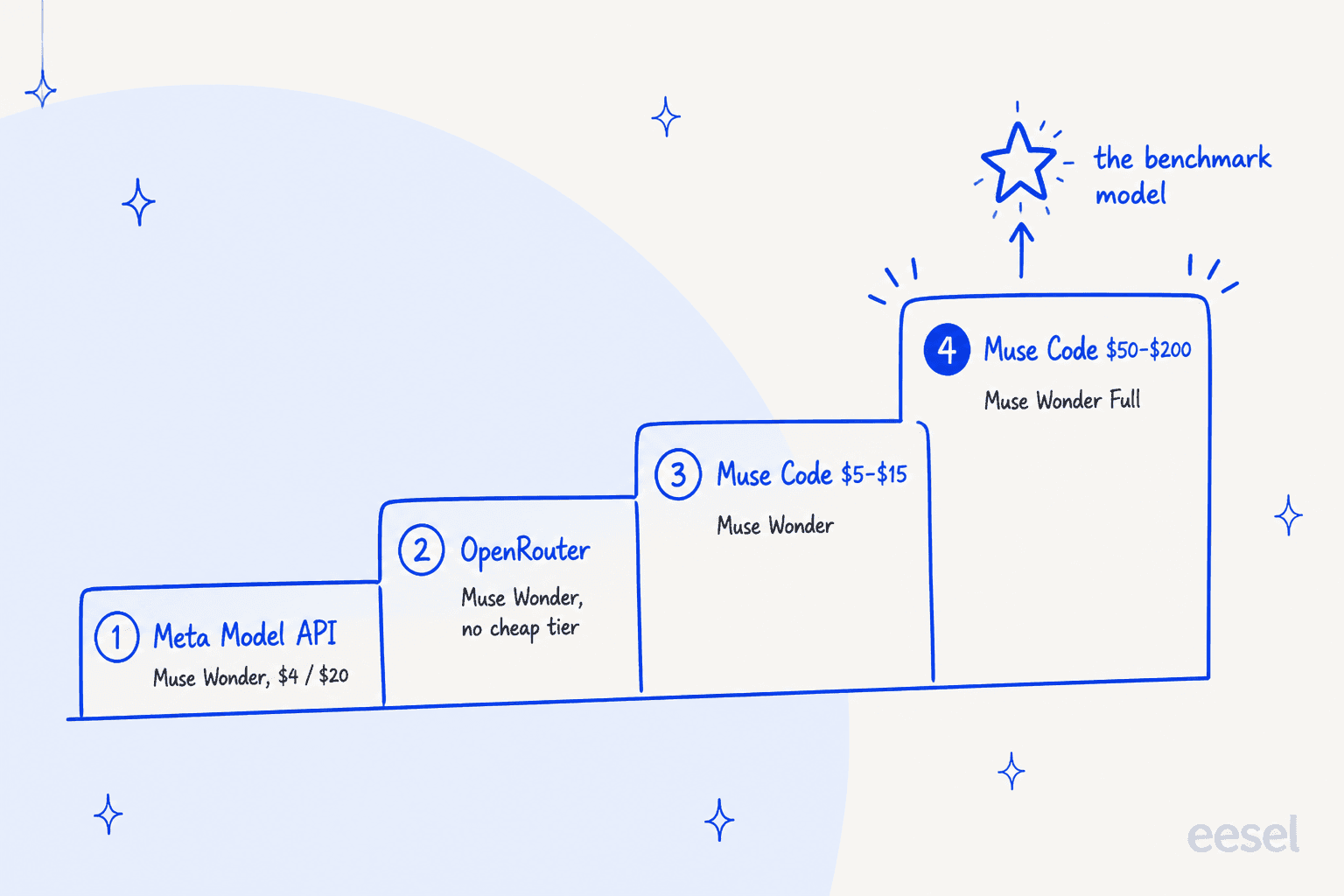
- Muse Wonder (
muse-wonder-1.0) is on the Meta Model API, on OpenRouter, and inside every Muse Code plan. - Muse Wonder Full is only in the Muse Code Power ($50/month) and Max ($200/month) plans. Meta's models documentation is explicit that setting Wonder to
maxreasoning effort does not select Full. - The Muse app, Meta's consumer agent, gets Wonder "soon," subscribers first. Today that app still runs on Spark 1.3.
The model is still labelled a preview on the API. It takes text, images, video, audio and PDFs as input, writes text out, and has a 1,048,576-token context window. Reasoning effort runs from minimal to max. Meta's pricing and rate limits page lists 3,000 requests per minute and 4M tokens per minute for muse-wonder-1.0, which is generous for a preview.
Meta's own docs give the cleanest routing rule I have seen in a while: choose Wonder for long-running, complex work, and Spark for volume, latency and cost. That split is how I would read the rest of this post too.
The two ideas Meta is selling: Active Memory and Active Focus
Strip the launch copy down and Meta is making two product claims, both aimed at agents that work for hours rather than seconds.
Active Memory is Meta's name for carrying context about you across conversations and pulling the right detail back when it matters. Meta measures it with MemoryBench, and this is the one place the API model beats everything, Full included: 85.6 for Wonder against 85.5 for Full and 81.5 for Opus 5.5. If you are building something that has to remember a user over weeks, that number is the most interesting line on the table.
Active Focus is the "keep going" claim: trying another approach after a blocker, asking for clarification, and checking in before important actions. Meta measures it with FocusBench and SWE-Marathon, a test of sustained work on long-running software projects. The launch demos lean on this hard: a playable 3D kitchen game built from images, a Saturday running plan built by working across a browser and apps, custom swag designed and ordered from someone's Instagram photos, a wedding seating chart solved against a list of constraints.
There is also a genuinely interesting research claim underneath. Meta plotted Muse Spark 1.3 against Wonder Full on tasks it trained for versus tasks it did not, and Full does better on the unfamiliar ones than Spark's trend line predicts. Meta's explanation is a larger base model. That is the "big model smell" argument, and for general-purpose agents that will meet tasks nobody planned for, it matters more than any single benchmark.
Muse Wonder pricing: same card as Claude Opus 5.5
Here is the full API rate card for the version you can actually buy, straight from Meta's model page and pricing docs.
| Item | Muse Wonder (muse-wonder-1.0) |
|---|---|
| Input | $4.00 per 1M tokens |
| Cached input | $0.20 per 1M tokens |
| Output | $20.00 per 1M tokens |
| Context window | 1,048,576 tokens, no long-context premium |
| Contributor (train-on-traffic) tier | Not available |
| Web search tool | $2.50 per 1,000 queries |
| Rate limit | 3,000 RPM / 4M TPM |
| Status | Preview |
Now set that next to the models people will actually compare it against.
| Model | Input / 1M | Output / 1M | Source |
|---|---|---|---|
| Muse Spark 1.3 | $1.25 | $4.25 | Meta pricing docs |
| GPT-6.1 Sol | $2.00 | $10.00 | GPT-6.1 Sol pricing |
| Muse Wonder | $4.00 | $20.00 | Meta model page |
| Claude Opus 5.5 | $4.00 | $20.00 | Anthropic pricing |
| Claude Fable 5.1 | $10.00 | $50.00 | Anthropic pricing |
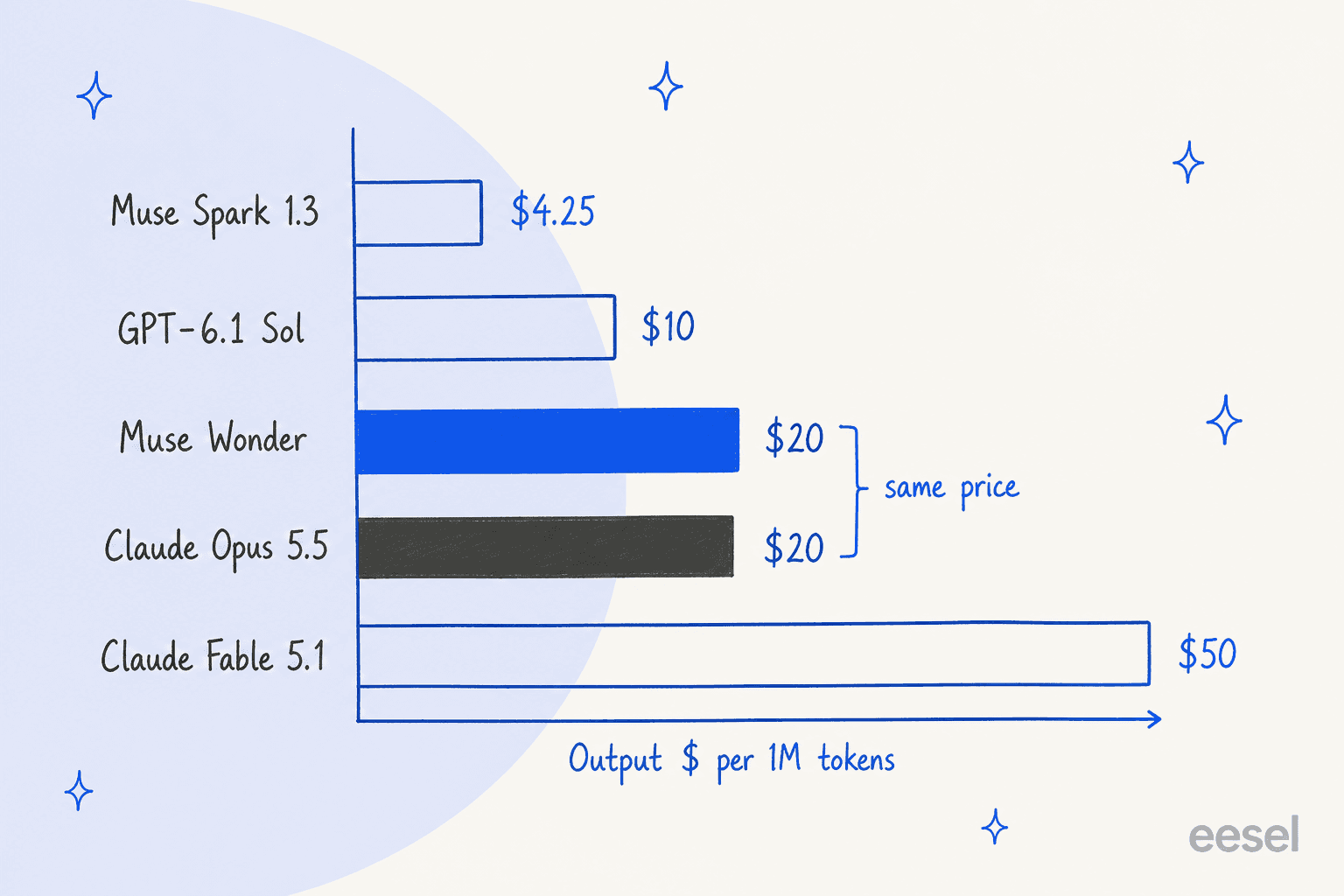
The cached-input rate matches Opus 5.5 too: $0.20 per million on both. That is not a coincidence I would bet against. Meta's earlier models launched at a steep discount to everyone else, which is exactly what the first comment on the launch thread picked up on.
"Interestingly unlike other Meta models this one seems to take a pretty big jump in pricing... $4/$20 in vs out making it higher than Sol and on par with Opus."

A worked example makes it concrete. Take a one-hour agent session that reads 50,000 tokens and writes 15,000. On Muse Wonder that is $0.20 of input plus $0.30 of output, so $0.50. On Opus 5.5 it is the same $0.50. On GPT-6.1 Sol it is $0.25, and on Muse Spark 1.3 it is about $0.13. Same session, a 4x spread, and Wonder sits at the top of it with Opus.
The other change from the Spark line is the missing cheap tier. Spark 1.3 has a contributor ID at $0.10 in and $0.20 out if you let Meta train on your traffic. Wonder has no such ID on pay-as-you-go. For the full cost breakdown, including the subscription maths, the Muse Spark 1.3 pricing post shows how the older two-ID model worked.
Muse Code plans: where Wonder Full lives
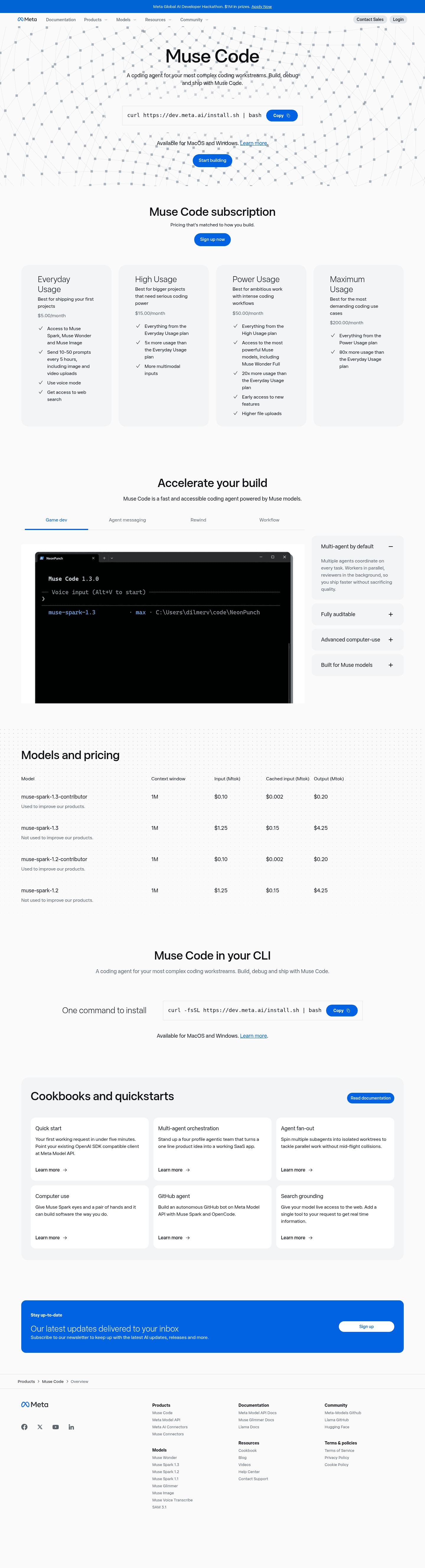
If you want the model that tops Meta's charts, you are buying a coding subscription. Here are the four Muse Code plans at launch.
| Plan | Price | Usage | Models |
|---|---|---|---|
| Everyday Usage | $5/month | 10-50 prompts every 5 hours | Muse Spark, Muse Wonder, Muse Image |
| High Usage | $15/month | 5x Everyday | Same as Everyday, more multimodal inputs |
| Power Usage | $50/month | 20x Everyday | Adds Muse Wonder Full, early feature access |
| Maximum Usage | $200/month | 80x Everyday | Everything in Power |
Three details from Meta's subscription terms that I would read before paying: plans are for users 18 and over, availability varies by region, and there are no refunds. Meta's models documentation adds a fourth: subscriptions default to Contributor mode, so your traffic helps train Meta's products unless you switch it off.
The $5 plan also runs out fast on Wonder. One developer posted their usage meter after three small requests.
"The usage limits on their basic $5 code plan to try things out are ludicrously low? I blew through 14% weekly usage and I'll I asked..."
If you already run a terminal AI coding tool like Claude Code, the practical question is whether Muse Code is worth a second subscription just to reach Full. My earlier Muse Code review covers the harness itself, and the Muse Code pricing breakdown covers what each plan buys on Spark.
How Muse Wonder benchmarks, and which version did the winning
Meta published a 14-row benchmark table comparing Wonder Full, Wonder, Claude Fable 5.1, GPT-6 Astra and Claude Opus 5.5. Count the wins and the story is clear: Wonder Full wins 6 rows, Opus 5.5 wins 6, GPT-6 Astra wins 1, and the API version of Wonder wins 1 (MemoryBench).
| Benchmark | Wonder Full | Wonder (API) | Fable 5.1 | GPT-6 Astra | Opus 5.5 |
|---|---|---|---|---|---|
| Harvey LAB-AA (legal) | 13.1 | 10.0 | 6.4 | 8.6 | 4.2 |
| Vals Finance Agent V2 | 59.1 | 56.6 | 58.9 | 53.5 | 58.6 |
| AutomationBench-AA | 45.4 | 39.1 | 32.1 | 41.6 | 41.2 |
| MemoryBench | 85.5 | 85.6 | 79.0 | 81.4 | 81.5 |
| DeepSWE 1.1 | 79.0 | 78.8 | 67.4 | 74.1 | 74.2 |
| SWE-Marathon | 57.5 | 53.1 | 45.6 | 42.5 | 46.3 |
| Terminal-Bench 4.0-AA | 57.1 | 52.0 | 52.0 | 59.1 | 59.6 |
| ProgramBench | 59.0 | 50.0 | 55.5 | 52.5 | 70.5 |
| OSWorld V2.1 (partial) | 78.4 | 72.6 | 80.7 | 75.8 | 81.8 |
| HealthBench Pro | 62.3 | 60.5 | 62.1 | 65.3 | 65.6 |
| GDP.pdf | 33.2 | 30.8 | 27.6 | 34.2 | 30.6 |
| Artificial Analysis Index | 56 | 52 | 53 | 53 | 58 |
Source: Meta's Muse Wonder model page. Bold marks the row winner. SWE-Marathon for Full is at xhigh effort; the other rows use max.
Wonder Full's wins cluster around exactly what Meta promised: legal and finance work products, end-to-end business workflows, and coding that runs for hours. Opus 5.5 keeps the terminal, computer use, from-scratch programming and the overall index.
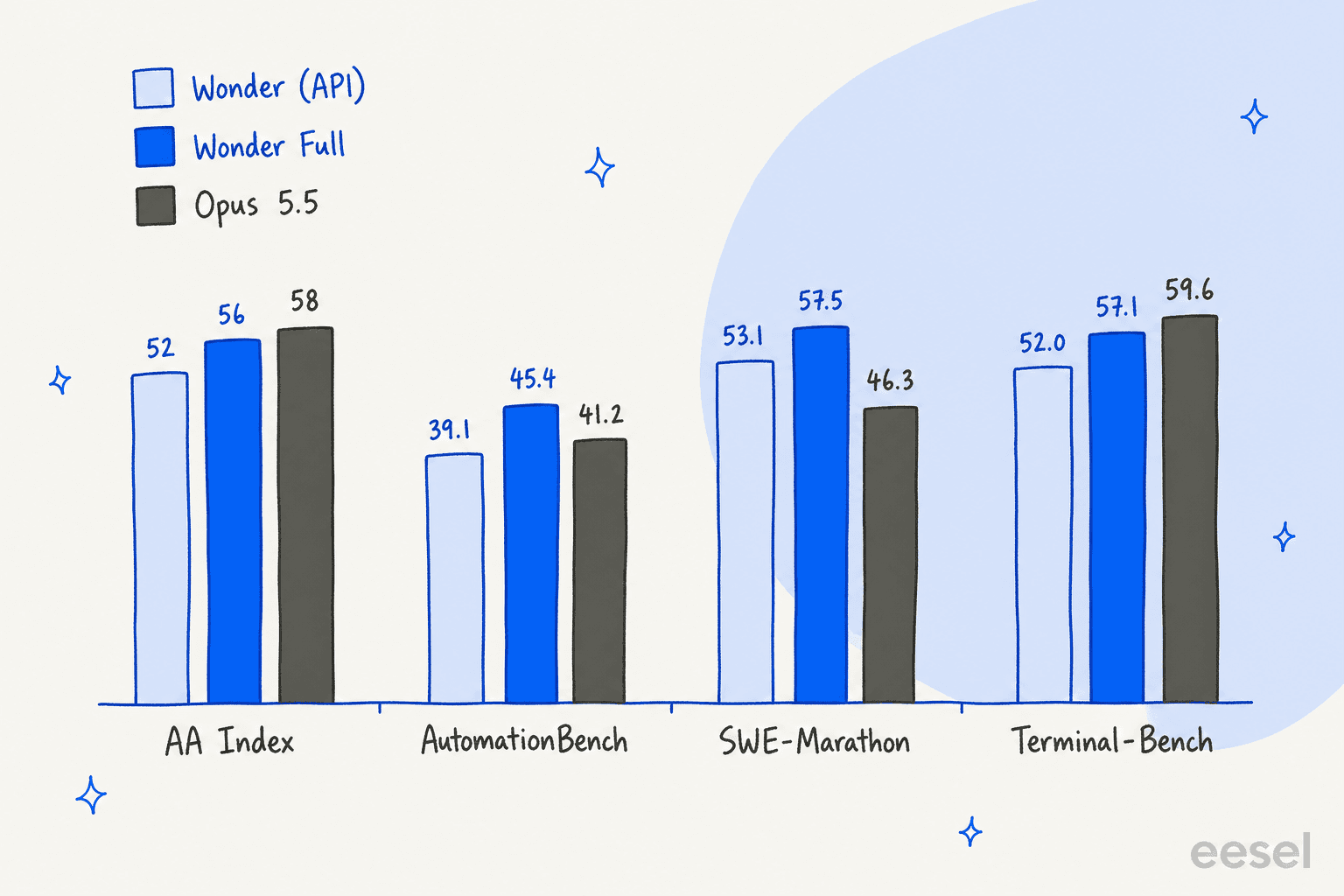
The catch is that the first column is the one most people cannot buy by the token. A commenter on the launch thread spotted it within hours.
"Upon closer inspection, the benchmark scores for "Muse Wonder" on the main marketing page are actually for "Muse Wonder Full," which is only available on the higher-tier subscription plans. This pricing is for "Muse Wonder.""
The API version still has two real strengths: it leads on memory and it beats Opus 5.5 on SWE-Marathon (53.1 vs 46.3) and DeepSWE (78.8 vs 74.2). For long-running coding agents that is not nothing. But on the general index it trails Opus 5.5 by 6 points at the same price, and Artificial Analysis rankings moved on launch day itself. One commenter noted the model dropped from 2nd to 5th, behind Gemini 4 Argon, within hours.
What developers are saying after the first 48 hours
The Hacker News launch thread reached 657 points and 362 comments, and the tone splits neatly: respect for the benchmark jump, frustration with how to get at it.
The most useful hands-on test came from a developer who ran the same image-to-HTML task through both models.
"Image->HTML test for Muse Wonder. It's much worse than Opus 5.5. IMO it's closer to Sonnet or Haiku for this test... I suspect its vision model isn't mature yet, and that it's been heavily optimized for text at this point in time."
That is one test at high effort, not a verdict, but it fits the table: Wonder's wins are in text-heavy agent work, not visual tasks. The harness got a harder review than the model.
"The benchmarks are great for sure. Now if only they could fix their coding harness so that it's usable for day-to-day use. I paid them for a month to try out Muse Code, but their sandbox never worked across Mac or Linux."
Two other recurring notes: Simon Willison confirmed that only muse-wonder-1.0 shows up on the API, with no Full model ID, and another commenter reported the subscriptions were North America only at launch. Meta's terms say availability varies by region, which is consistent with that.
Safety: the report is not out yet
Meta says Muse Wonder is its "most aligned model to date" and ships its strongest safeguards so far against chemical, biological, radiological, nuclear and cyber misuse, while keeping defensive cyber capabilities available. The launch post shows charts for unauthorized code execution, personal-information handling and refusal rates.
The full safety report is listed as "available soon." Until it lands, the safety claims rest on Meta's own charts. That matters more than usual here, because Meta is pitching Wonder for personal agents that read messages, calendars and private documents. If you are evaluating it for anything that touches customer data, I would wait for the report, the same way I treated the Muse agent's security design as the part worth reading closely.
So who should actually use Muse Wonder?
My read, by situation:
- You build long-running coding or workflow agents on an API budget. Test Muse Wonder against Opus 5.5 on your own tasks. Same price, a real lead on SWE-Marathon and memory, a real deficit on the terminal and general index. Your workload decides it, not the poster.
- You want the strongest Meta model and you live in a supported region. That is Wonder Full, and the cheapest way in is $50/month for Muse Code Power. Budget for the harness being newer than the model.
- You process high volumes cheaply. Stay on Muse Spark 1.3. Meta itself says Spark is the pick for volume, latency and cost.
- You need visual or computer-use strength. Opus 5.5 leads OSWorld and the one public image-to-HTML test. Wonder is not the pick yet.
- You need open weights or self-hosting. Wonder is closed. Look at open-source AI agents instead.
For customer support specifically, model choice is the smaller decision. My support model guide goes through why retrieval, escalation and testing move resolution quality more than a few index points do. A 6-point gap on a general benchmark rarely shows up in a queue; a stale help-centre article shows up every day.
Try eesel
Muse Wonder is infrastructure: a model you call, rate-limit, prompt and monitor yourself. eesel is the employee. Our AI helpdesk teammate arrives already connected to Zendesk, Freshdesk, Gorgias and the rest, trained on your past tickets and help centre, and you can run it against hundreds of your historical tickets before it answers a single live customer. That simulation step is what catches the "we support all models" answer before a customer does.
If you would rather drive it like you would drive Muse Code, the eesel CLI works from a terminal. eesel instructions reads and edits the teammate's standing rules, eesel approvals lists the actions waiting on a human, and eesel activity shows what it did and why. Every command prints JSON and writes support --dry-run, so a coding agent such as Claude Code can manage your support teammate the same way it manages your repo. If you write content instead, the same roster includes an AI blog writer.
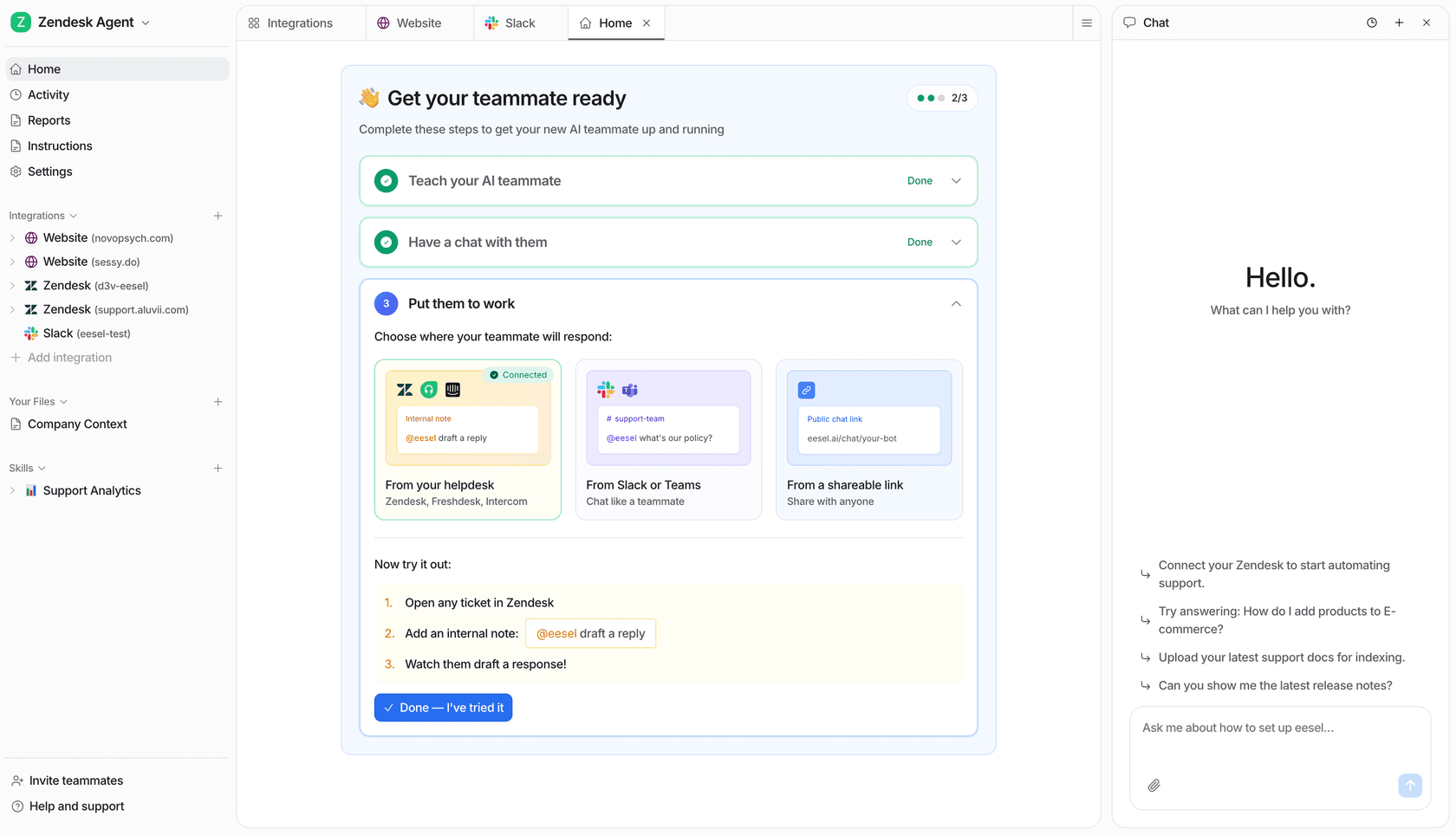
It is free to start with 100 credits and no card. Try eesel on your own queue and see what it does with last month's tickets.
Frequently Asked Questions
What is Meta Muse Wonder?
How much does Meta Muse Wonder cost?
muse-wonder-1.0 costs $4.00 per million input tokens, $0.20 cached and $20.00 output, with a 1M-token context window and no long-context premium. That matches Claude Opus 5.5 pricing exactly. Wonder Full has no token price at all; you reach it through Muse Code Power at $50/month or Max at $200/month.What is the difference between Muse Wonder and Muse Wonder Full?
max reasoning effort does not switch you to Full, and Full is not on the API or OpenRouter. If you plan to build on it, the version you can buy by the token is Muse Wonder.