


What is Meta Muse Wonder?
Muse Wonder is the newest model series from Meta Superintelligence Labs, and Meta calls the pair "our most capable models" yet. It sits above the Muse Spark 1.3 model line, and it is a separate thing from Meta Muse, the consumer personal agent that launched in September. Think of Wonder as the engine and Muse as one of the cars it will soon go into.
I build integrations and APIs at eesel, so I read launch pages the way I read any vendor's docs: what can I actually call, at what price, and with what strings attached. I spent launch week in Meta's model docs, the pricing and rate limits page, the benchmark table, and the 362-comment Hacker News thread. This review is built from those, not from a press release.
Here's what Meta ships, in one table:
| Muse Wonder | Muse Wonder Full | |
|---|---|---|
| Model ID | muse-wonder-1.0 | muse-wonder-full-1.0 |
| Where you get it | Meta Model API, OpenRouter, every Muse Code plan | Muse Code Power Usage and Maximum Usage plans only |
| Context window | 1,048,576 tokens | 1M tokens |
| Input types | Text, image, video, audio, PDF | Not separately documented |
| Reasoning effort | "minimal" to "max" | Shown at max (xhigh on SWE-Marathon) |
| Price | $4.00 in / $0.20 cached / $20.00 out per 1M tokens | Included in a $50 or $200 monthly plan |
| Status | Preview | Subscription only |
Two details in the model docs matter more than they look. First, Muse Wonder is labelled preview. Second, Meta states that "setting reasoning effort to 'max' on Muse Wonder doesn't select" Wonder Full. There is no API flag that unlocks the bigger model.
The benchmarks: where Wonder Full wins and where it doesn't
Meta's model page publishes a 14-row table comparing both Wonder models with Claude Fable 5.1, GPT-6 Astra and Claude Opus 5.5, all at max reasoning. I tallied the bolded winner in every row.
| Benchmark | What it tests | Wonder Full | Wonder | Fable 5.1 | GPT-6 Astra | Opus 5.5 |
|---|---|---|---|---|---|---|
| Personal Superintelligence Index | Meta's internal composite | 59.1 | 54.3 | 49.9 | 54.5 | 55.2 |
| Harvey LAB-AA | Legal agent work | 13.1 | 10.0 | 6.4 | 8.6 | 4.2 |
| Vals Finance Agent V2 | Financial research | 59.1 | 56.6 | 58.9 | 53.5 | 58.6 |
| HealthBench Pro | Open-ended health queries | 62.3 | 60.5 | 62.1 | 65.3 | 65.6 |
| AutomationBench-AA | End-to-end business workflows | 45.4 | 39.1 | 32.1 | 41.6 | 41.2 |
| GDP.pdf | Professional work | 33.2 | 30.8 | 27.6 | 34.2 | 30.6 |
| JobBench | Professional tool use | 75.3 | 70.5 | 73.1 | 66.1 | 75.4 |
| OSWorld V2.1 (partial) | Computer use | 78.4 | 72.6 | 80.7 | 75.8 | 81.8 |
| MemoryBench | Remembering context | 85.5 | 85.6 | 79.0 | 81.4 | 81.5 |
| Terminal-Bench 4.0-AA | Terminal coding | 57.1 | 52.0 | 52.0 | 59.1 | 59.6 |
| DeepSWE 1.1 | Long-horizon coding | 79.0 | 78.8 | 67.4 | 74.1 | 74.2 |
| SWE-Marathon | Ultra-long engineering | 57.5 (xhigh) | 53.1 | 45.6 | 42.5 | 46.3 |
| ProgramBench | From-scratch programming | 59.0 | 50.0 | 55.5 | 52.5 | 70.5 |
| Artificial Analysis Index | Overall | 56 | 52 | 53 | 53 | 58 |
The tally: Wonder Full wins 6 rows, Opus 5.5 wins 6, GPT-6 Astra wins 1, plain Muse Wonder wins 1 (MemoryBench, by 0.1 points over its own bigger sibling). Claude Fable 5.1 wins none.
That's a real result. A year ago nobody counted Meta among the frontier labs, and Wonder Full beating GPT-6 Astra on 11 of 14 rows is a big jump. The legal number stands out most: 13.1 on Harvey's legal agent benchmark is low in absolute terms, but it's more than three times Opus 5.5's 4.2. If you follow Harvey AI, you know how hard that benchmark is on every model.
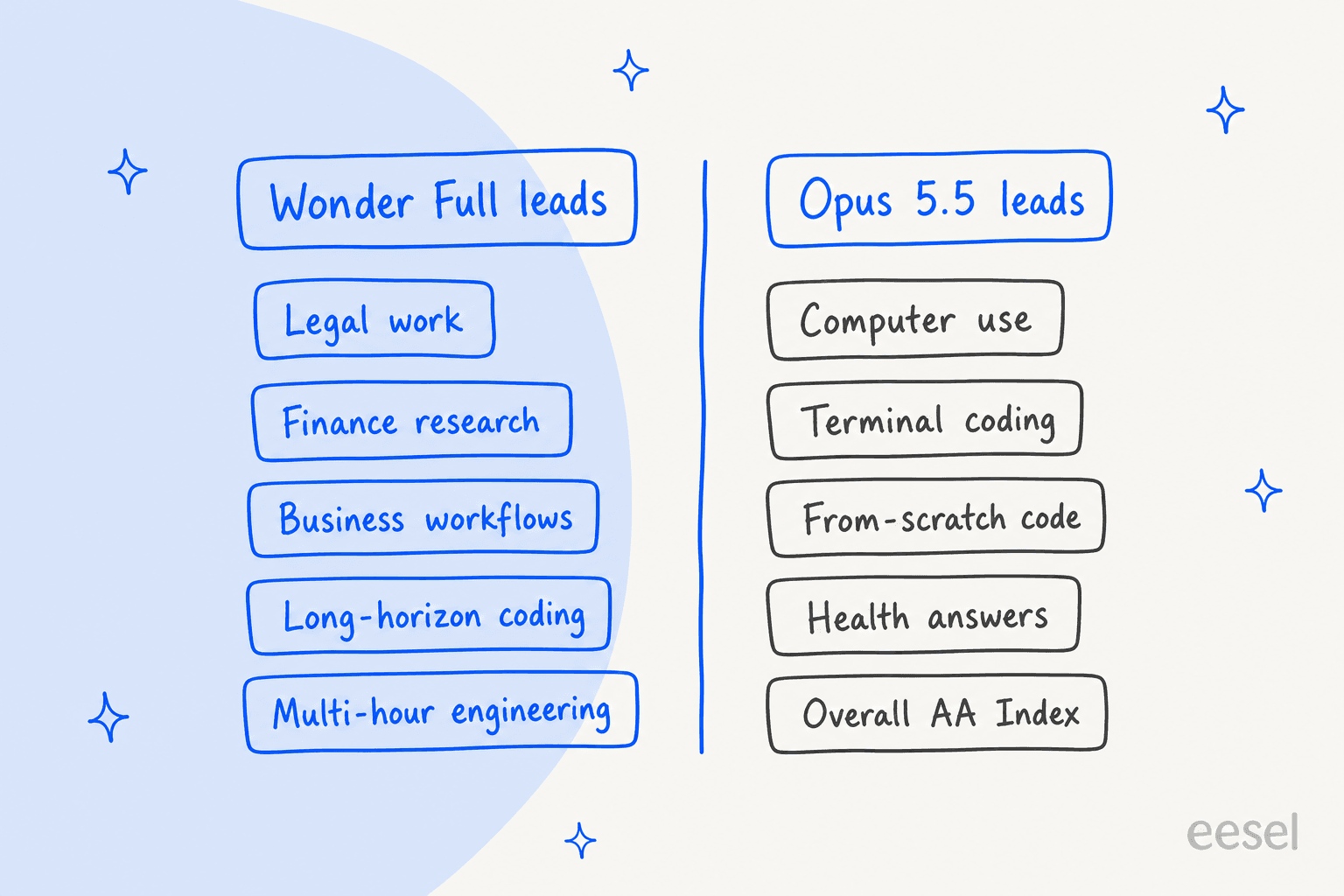
The split has a shape. Wonder Full wins where the task is long and document-heavy: a legal work product, a finance research brief, a multi-hour coding project. Opus 5.5 still wins where the model has to drive a computer or write something from scratch, and its ProgramBench lead (70.5 against 59.0) is the widest gap in the whole table. One caveat on Meta's framing: the Personal Superintelligence Index is Meta's own internal composite, so I'd weight it below the third-party rows.
Meta's launch blog also shows the independent Artificial Analysis ranking as of October 12, where Wonder Full sits second.
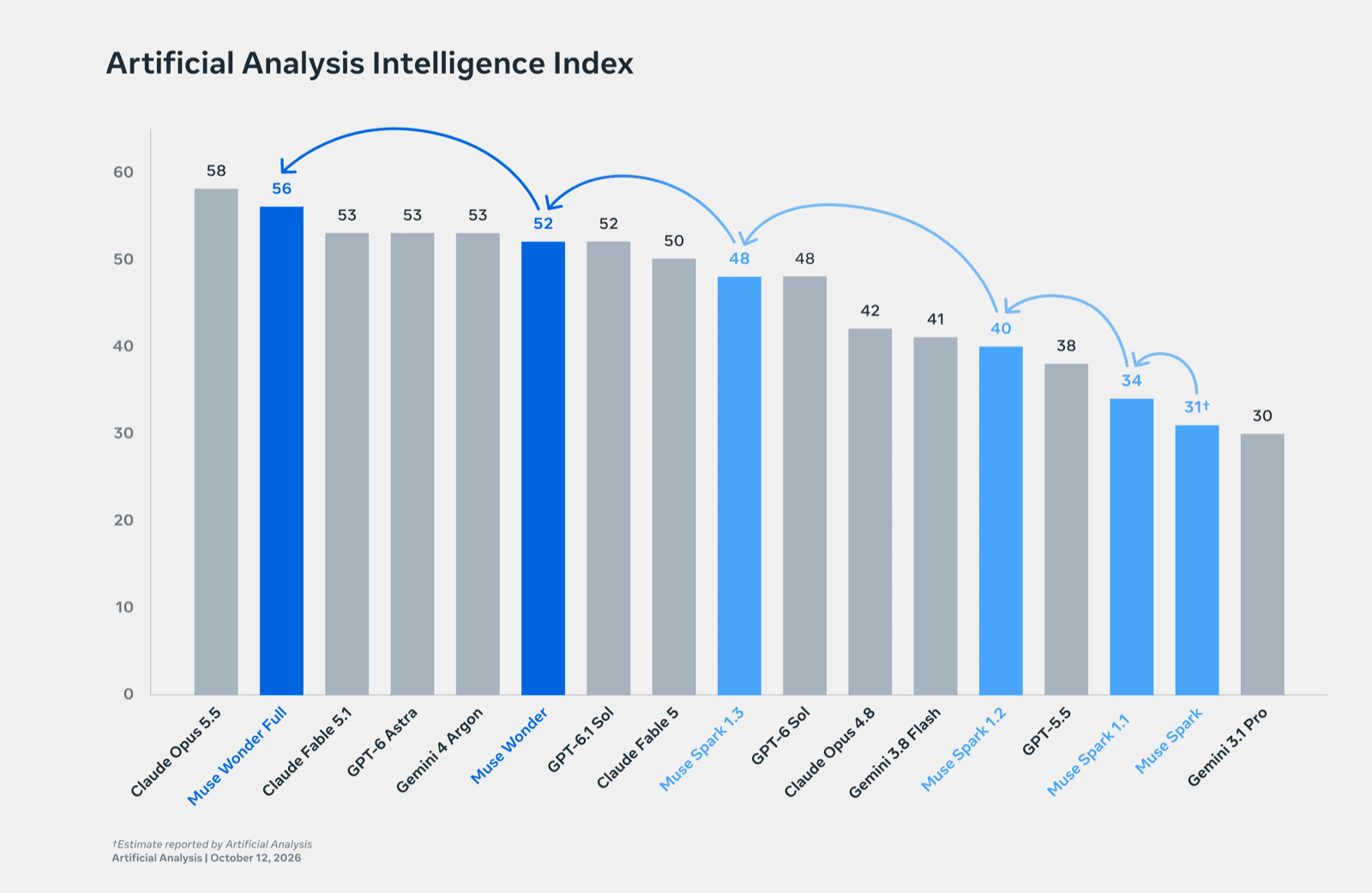
The HN crowd reacted to that second place about the way you'd expect:
"2nd place model on aa according to them, losing only to opus 5.5 is really really not bad"

Rankings move fast, though. Later the same day, another commenter reported Wonder Full had slipped to fifth on the live board, behind Gemini 4 Argon. Treat any single leaderboard screenshot as a snapshot.
The catch: the Wonder you can buy isn't the Wonder on the chart
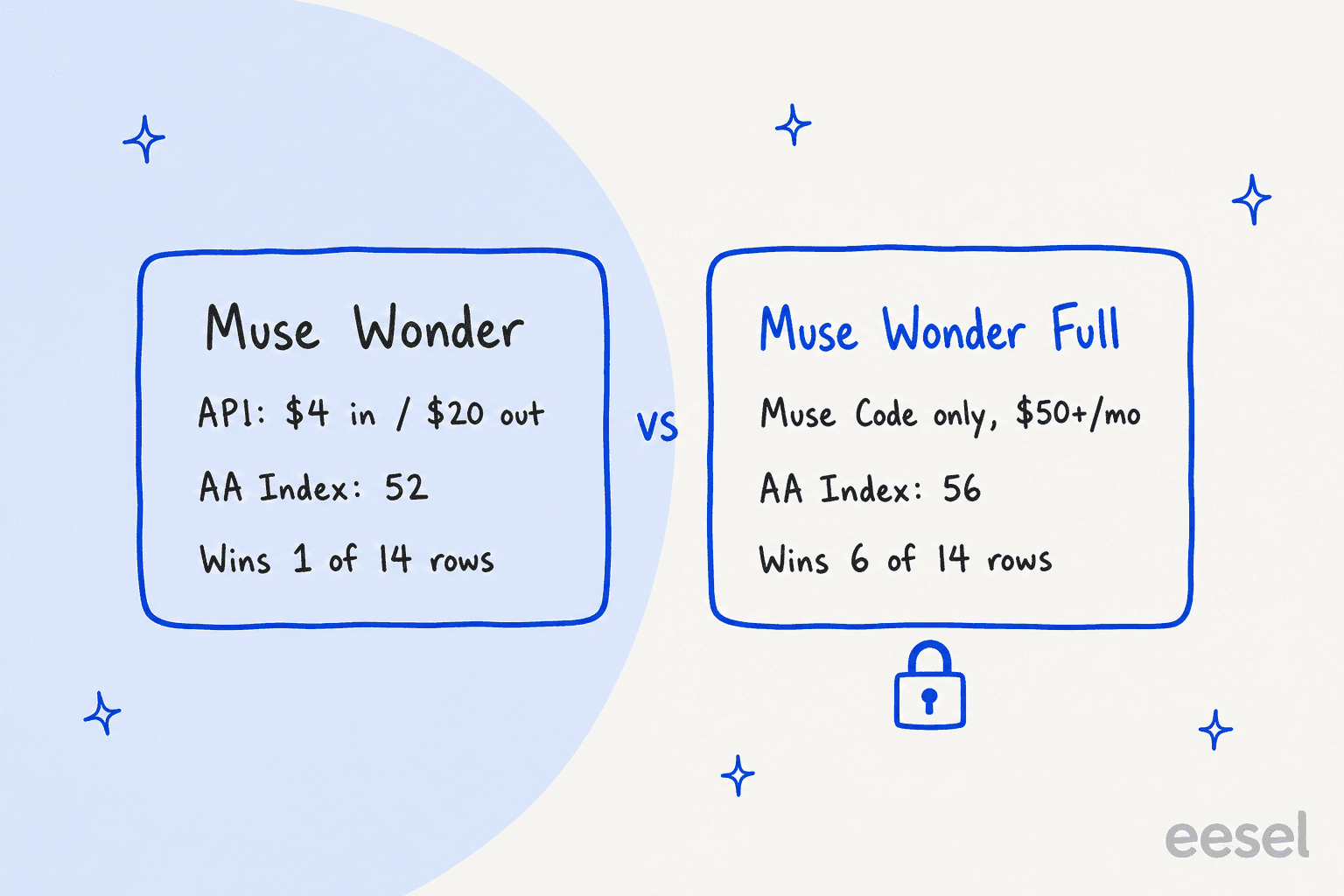
This is the part most launch coverage glosses over. Look at the AA chart again: the model you can call on the API scores 52. That's below Fable 5.1, GPT-6 Astra and Gemini 4 Argon (all 53), and level with GPT-6.1 Sol. It's still a strong model, roughly four points above Muse Spark 1.3 on the same chart. But it isn't the one beating Opus 5.5.
One HN commenter caught this within hours of launch:
"Upon closer inspection, the benchmark scores for "Muse Wonder" on the main marketing page are actually for "Muse Wonder Full," which is only available on the higher-tier subscription plans. This pricing is for "Muse Wonder.""
Simon Willison listed the models his API key could see, and muse-wonder-1.0 was the only Wonder in the list. So if you're a developer building a product, the decision isn't "Muse Wonder Full vs Opus 5.5". It's "Muse Wonder at 52 vs Opus 5.5 at 58, same price". That's a harder sell.
Muse Wonder pricing
Pricing comes in two separate shapes, and they don't overlap.
Pay-as-you-go on the Meta Model API (from Meta's rate card):
| Usage | Muse Wonder (Standard mode) | Contributor mode |
|---|---|---|
| Input | $4.00 per 1M tokens | Not available |
| Cached input | $0.20 per 1M tokens | Not available |
| Output | $20.00 per 1M tokens | Not available |
| Web search grounding | $2.50 per 1,000 queries | Not available |
| Rate limit | 3,000 requests and 4M tokens per minute | Not available |
Meta also states there's no long-context premium, and the steering tokens it injects into every prompt aren't billed. That's a fair, clean rate card. It's also a big change from Meta's past habit of undercutting everyone. Muse Spark 1.3 pricing is $1.25/$4.25, and its contributor tier drops to $0.10/$0.20. Wonder has no discount tier at all on the API.
"$4/$20 in vs out making it higher than Sol and on par with Opus."
Here's how that compares with the rivals in Meta's table, all at standard API rates from each vendor's own pricing page:
| Model | Input per 1M | Cached input per 1M | Output per 1M |
|---|---|---|---|
| Muse Wonder | $4.00 | $0.20 | $20.00 |
| Claude Opus 5.5 | $4.00 | $0.20 | $20.00 |
| GPT-6 Astra | $10.00 | $1.00 | $50.00 |
| Claude Fable 5.1 | $10.00 | $0.25 | $50.00 |
| Muse Spark 1.3 | $1.25 | $0.15 | $4.25 |
Muse Wonder and Opus 5.5 cost the same to the cent, including the cached rate. Plug your own monthly volume in below to see the gap against the others.
Muse Code subscriptions, the only way to reach Wonder Full, come in four plans:
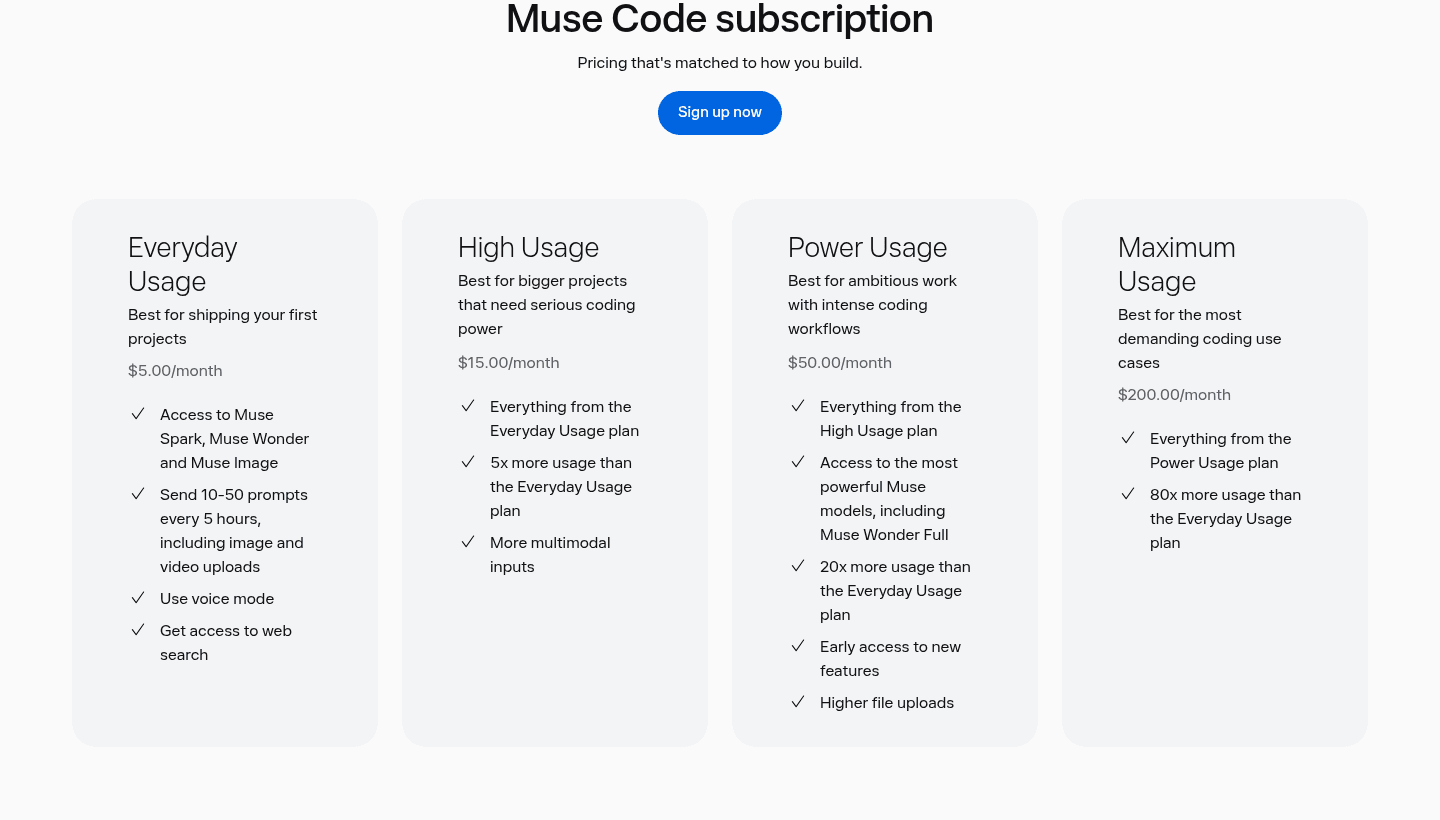
| Plan | Price | Usage | Wonder | Wonder Full |
|---|---|---|---|---|
| Everyday Usage | $5/month | 10-50 prompts every 5 hours | Yes | No |
| High Usage | $15/month | 5x Everyday | Yes | No |
| Power Usage | $50/month | 20x Everyday | Yes | Yes |
| Maximum Usage | $200/month | 80x Everyday | Yes | Yes |
Prices are from the Muse Code page; plan rules are in the subscriptions docs. The fine print is worth reading: you must be 18 or over, availability "may vary by region", there are no refunds on cancellation, and Meta can revoke a subscription immediately for a policy violation. A subscription key also only works inside the Muse Code CLI, so you can't route your app's traffic through a $50 plan. For the full cost picture of the coding agent itself, see my Muse Code pricing breakdown.
On the entry plan, one early user found the limits tight:
"The usage limits on their basic $5 code plan to try things out are ludicrously low?"
He reported that three short prompts used 17% of his weekly allowance. Since Wonder Full starts at the $50 tier anyway, I'd budget for Power Usage if Full is the reason you're here.
Active Memory and Active Focus: what's actually new
Meta frames Wonder around two named capabilities. Active Memory is "carrying important context about you across conversations and actively retrieving the details relevant to the task at hand." Active Focus is how the model keeps working toward a hard goal: "trying alternative approaches, working through blockers, and adapting to new information", while asking for clarification and checking in "before taking important actions."
Both map to rows in the table. MemoryBench is the one place plain Wonder wins outright (85.6), and SWE-Marathon is where Full's lead is largest (57.5 against 46.3 for Opus 5.5). That fits Meta's developer docs, which pitch Wonder for "long-running, complex tasks where capability matters more than cost per token, such as multi-file coding changes, multi-hour agent runs, and sub-agent orchestration," and point everything high-volume or latency-sensitive back to Muse Spark.
The launch demos lean personal rather than corporate: a running plan built across apps, custom swag ordered from Instagram photos, a wedding seating chart, an insurance claim. That's a preview of where this model is headed, into the Muse personal agent, which Meta says Wonder "will soon power", starting with subscribers.
On safety, Meta calls Wonder its "most aligned model to date" with its strongest safeguards against chemical, biological and cyber misuse, while still allowing defensive cyber work under its scaling framework. The full safety report is listed as "available soon", so that part can't be checked yet.
Data and access: Contributor mode is on by default
This is the setting I'd check before anything else.
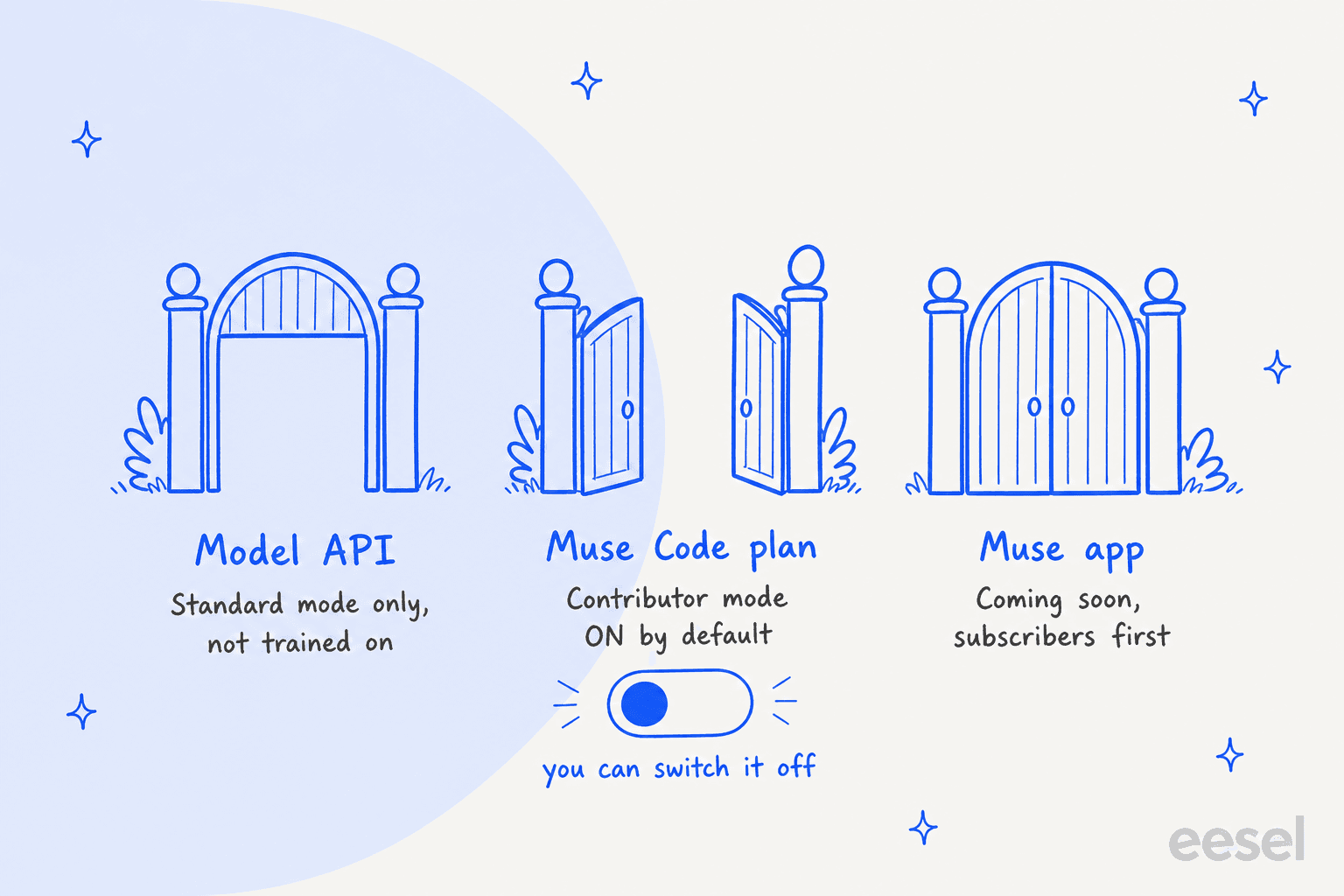
On the API, Muse Wonder runs in Standard mode only: Meta's docs say your content "is not used to train Meta models." Inside Muse Code it's the opposite. The subscriptions page says "Muse Code subscriptions default to Contributor mode," which gives you more usage "in exchange for letting Meta use your content to train future Meta models." Content means your prompts, code, files and context, plus the responses. You can turn it off at any time, and from then on new content isn't used.
So the cheapest path to Wonder Full, a Muse Code plan, is also the one that trains on your code unless you change a setting. That's a fair trade for a hobby project. For a company repo, flip it on day one.
This question comes up in eesel sales calls more than any benchmark does. A technical evaluator at a hardware company once asked, in a demo, whether eesel quietly falls back to some other ChatGPT when it doesn't know an answer, and whether that could be switched off. What they wanted was simple: answers only from their approved knowledge, and their knowledge staying theirs. Which frontier model sits underneath mattered far less to them than that rule.
What early users are saying
The community verdict, two days in, is "impressive numbers, verify for yourself." A few hands-on reports stood out.
On vision, plain Wonder struggled in one developer's test:
"Image->HTML test for Muse Wonder. It's much worse than Opus 5.5. IMO it's closer to Sonnet or Haiku for this test."
He later confirmed it was plain Wonder, since Full wasn't on OpenRouter, which is the same gap from the section above, showing up in practice.
On the harness, one paying user hit setup trouble before the model even mattered:
"I paid them for a month to try out Muse Code, but their sandbox never worked across Mac or Linux (both very stock installs, nothing special)."
And on the Muse line in general, regular users of the previous model are upbeat. One wrote that Muse Spark 1.3 is "very fast and powerful" and their "work horse for open source development." Another commenter noted the subscription is North America only for now, while the API is reachable through OpenRouter.
Pros and cons
Pros
- Wonder Full ties Opus 5.5 at six wins each in Meta's 14-row table, and leads clearly on legal (13.1 vs 4.2) and ultra-long engineering (57.5 vs 46.3)
- Second on the Artificial Analysis index at launch (56), Meta's best result by a wide margin
- Clean API rate card: no long-context premium, unbilled steering tokens, cached input at $0.20
- 1M-token context, five input types, and generous 3,000 RPM / 4M TPM limits from day one
- Available on OpenRouter, so you can test it inside tools you already use
Cons
- The API model (52 on AA) is not the model behind the headline scores, and costs the same as Opus 5.5 (58)
- Wonder Full is locked to Muse Code subscriptions at $50 or $200 a month, with no token-priced route
- Muse Code plans default to Contributor mode, which trains on your content until you switch it off
- Preview status, a safety report still "coming soon", and leaderboard positions that moved the same day
- Plain Wonder lags Opus 5.5 on computer use, terminal coding and from-scratch programming
Who should use Meta Muse Wonder?
Pick Wonder Full if you're an individual developer or small team doing long coding projects, legal drafting or finance research, and $50 a month for Muse Code is easy to justify. Switch Contributor mode off first. It's the strongest reason so far to try Meta's coding agent, and the Muse Code alternatives are worth a look at the same budget.
Pick plain Muse Wonder on the API if you need long agent runs with strong memory and want a second frontier vendor next to Anthropic. At identical pricing, I'd A/B it against Opus 5.5 on your own tasks before moving any production traffic.
Skip it for now if you mainly need computer use or from-scratch code generation, where Opus 5.5 still leads, or if your workload is high-volume and price-sensitive, where Meta's own docs point you to Muse Spark. If you're comparing broadly, my best AI coding assistants roundup and Claude Code pricing guide cover the other options.
And if you're a support lead, a model release is the wrong place to start. Wonder can power an AI agent, but someone still has to connect it to your helpdesk, keep it inside your knowledge, decide when it hands off, and prove it's right before it touches a customer. That's the difference between a model and a teammate, and it's why picking the best model for support tickets is only step one. My notes on using Muse for Zendesk show how much glue that takes.
Hire eesel instead of wiring up a model
Muse Wonder is infrastructure; eesel is the employee. eesel is an AI teammate platform where you hire ready-to-work teammates for specific jobs, and right now that's two roles: an AI helpdesk teammate and an AI blog writer.
For support teams, the helpdesk teammate plugs into Zendesk, Freshdesk or Gorgias, learns from your past tickets, help center and docs, and answers only from what you've approved. Before it replies to anyone, you can simulate it against your historical tickets and see exactly what it would have said. I've watched a confident-sounding bot give a wrong answer on a live queue, which is why that test run exists. Plans are a flat monthly fee where one ticket is one credit, starting at $299/month for 500 credits, with 100 free credits to try it, per the eesel pricing page.
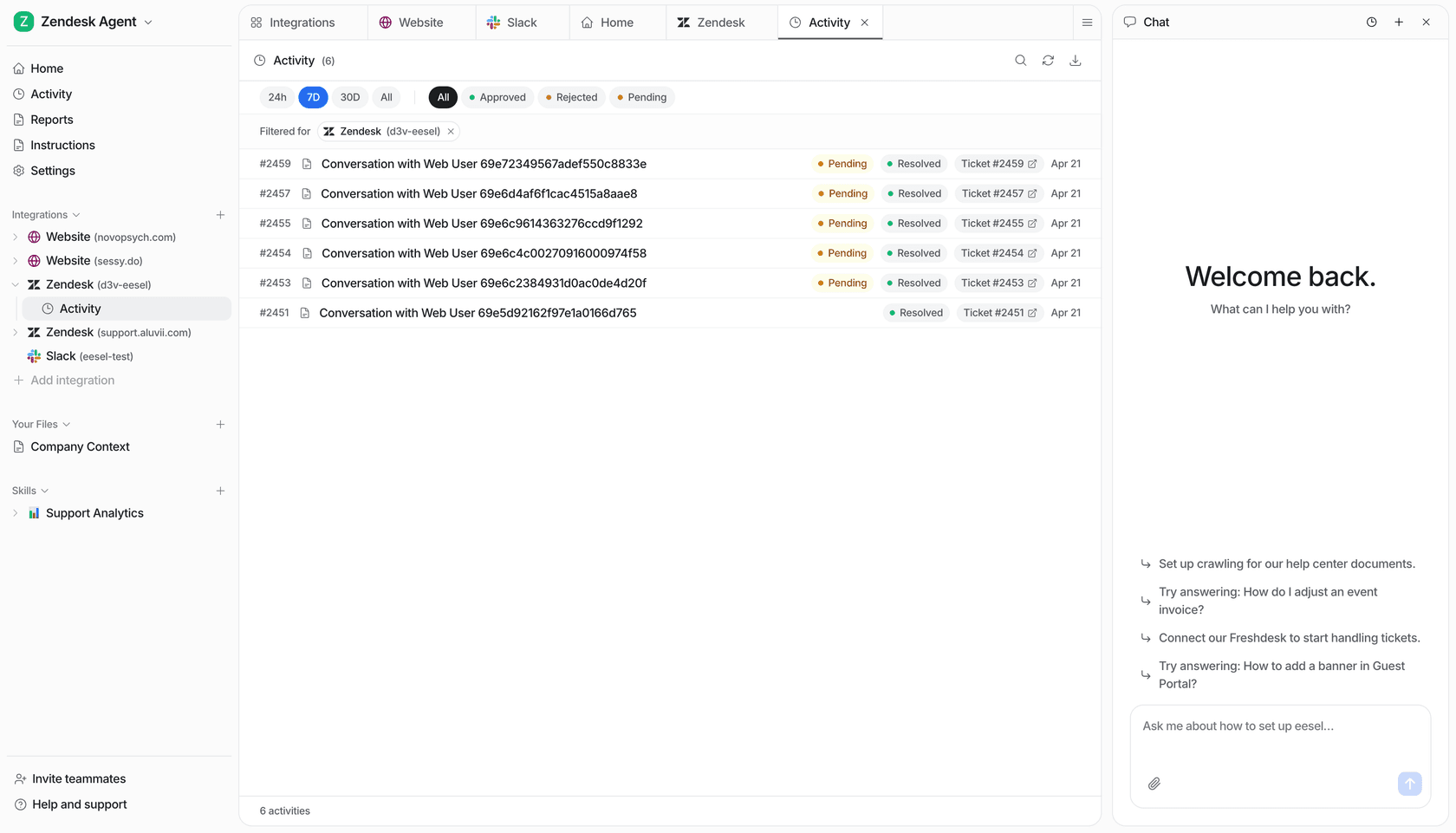
If you were reading about Muse Wonder because you want AI working your queue, skip the model shopping. Try eesel free and watch it draft replies on your own tickets.