

What Muse Spark 1.3 actually is
I build on these model APIs for a living, so the first thing I do with any release is separate the model from the marketing. Muse Spark 1.3 is Meta's frontier, closed-weights reasoning model, and Meta positions it as another step "toward personal superintelligence" in its research blog announcement. You get to it two ways: through Muse Code, Meta's own coding-agent harness, or straight through the Meta Model API.
A few facts worth pinning down before the benchmark noise starts:
- It ships in two published variants:
max(the top reasoning mode) andxhigh(faster). Meta's blog notes that max reasoning is "coming shortly after we finish additional safety testing," so the fully-available mode at launch is xhigh, not max. - The context window is 1M tokens, and it takes text, image, and video as input.
- It is a proprietary model. Artificial Analysis lists it as closed, and no open-weights release was announced, which puts it in a different bucket from Meta's open Llama line.
That variant split matters more than it looks, and I will come back to it, because it is quietly doing a lot of work in the launch numbers.
The benchmarks: where 1.3 wins, and where it doesn't
Meta led the launch with a four-model scorecard: Muse Spark 1.3, Muse Spark 1.2, GPT-5.6 Sol, and Claude Opus 5, across agent, coding, instruction-following, and long-context tasks. Here it is straight from the source.
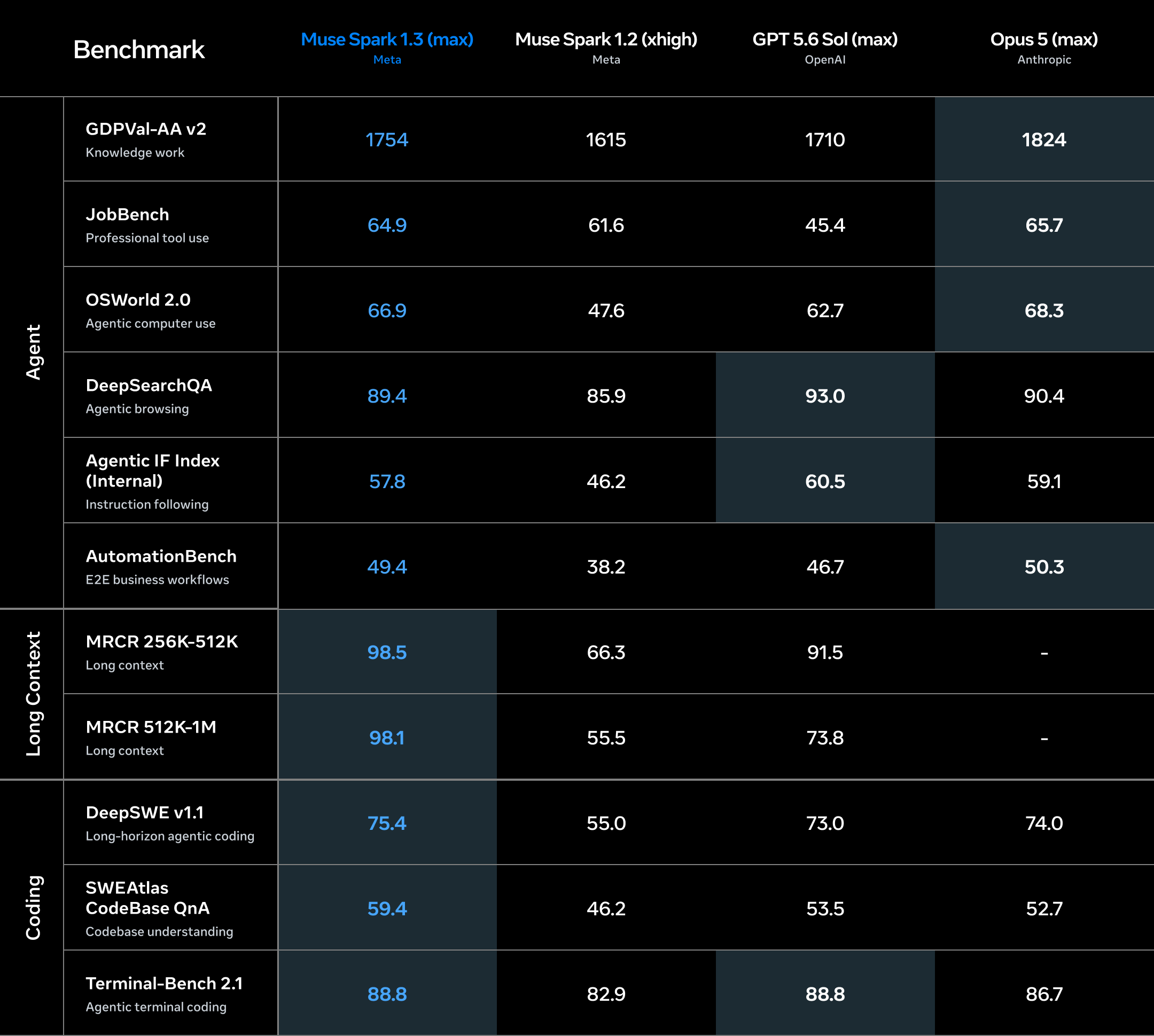
Read across the rows and a clear pattern shows up, which is more useful than the single headline number:
| Benchmark | Muse Spark 1.3 (max) | Muse Spark 1.2 (xhigh) | GPT-5.6 Sol (max) | Opus 5 (max) |
|---|---|---|---|---|
| GDPVal-AA v2 (knowledge work) | 1754 | 1615 | 1710 | 1824 |
| JobBench (professional tool use) | 64.9 | 61.6 | 45.4 | 65.7 |
| OSWorld 2.0 (computer use) | 66.9 | 47.6 | 62.7 | 68.3 |
| DeepSearchQA (agentic browsing) | 89.4 | 85.9 | 93.0 | 90.4 |
| Agentic IF Index (instruction following) | 57.8 | 46.2 | 60.5 | 59.1 |
| AutomationBench (E2E workflows) | 49.4 | 38.2 | 46.7 | 50.3 |
| MRCR 256K-512K (long context) | 98.5 | 66.3 | 91.5 | – |
| MRCR 512K-1M (long context) | 98.1 | 55.5 | 73.8 | – |
| DeepSWE v1.1 (agentic coding) | 75.4 | 55.0 | 73.0 | 74.0 |
| SWEAtlas CodeBase QnA | 59.4 | 46.2 | 53.5 | 52.7 |
| Terminal-Bench 2.1 (terminal coding) | 88.8 | 82.9 | 88.8 | 86.7 |
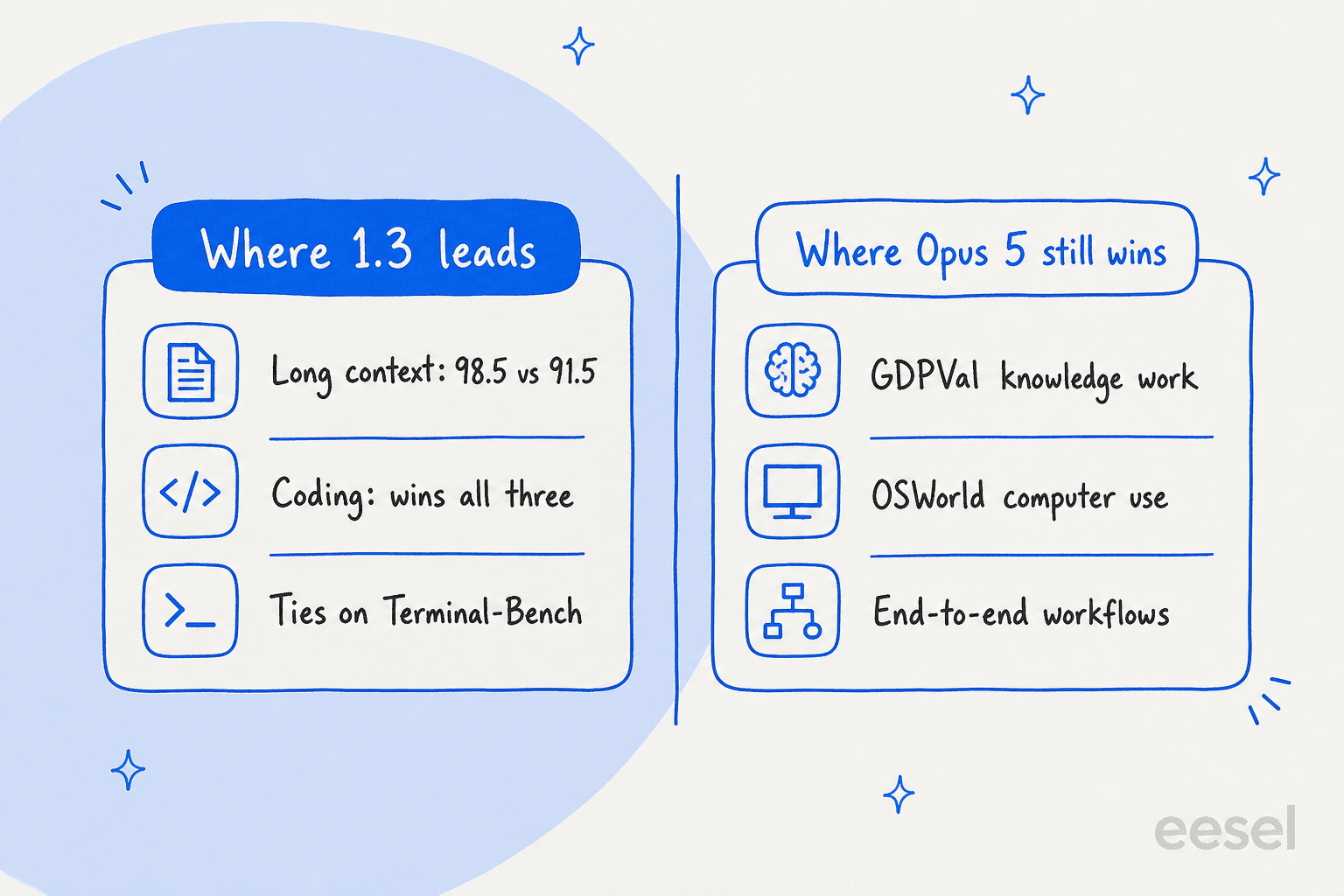
The story the table tells: Muse Spark 1.3 owns long context and coding. Its 98.5 and 98.1 on the MRCR long-context tests aren't just wins, they leave GPT-5.6 Sol (91.5 and 73.8) and its own predecessor (66.3 and 55.5) well behind, and Opus 5 didn't even post a number. On coding it takes DeepSWE v1.1 (75.4), codebase understanding (59.4), and ties GPT-5.6 Sol at the top of Terminal-Bench (88.8). That is a real, checkable result, and it squares with Meta's own claim that 1.3 uses ~20% fewer tool calls and ~25% fewer tokens than 1.2 to finish a coding job.
But look at the agent column honestly. On the six agent benchmarks, Opus 5 (max) beats 1.3 on four (GDPVal, JobBench, OSWorld, AutomationBench), and GPT-5.6 Sol takes the other two (DeepSearchQA, Agentic IF). So "improved agentic and coding" is fair for coding, but on the agent evaluations 1.3 is a strong second, not the leader. On the composite, Artificial Analysis puts its max variant at an Intelligence Index of 62, ranked #6 of 636 models, against a median of 17 for comparable models. Good, but the ranking is close enough that a rival can retake it in a week, and one HN commenter noted Gemini 3.8 Flash had briefly held the top spot the same day.
The catch in the headline numbers
Here's the thing I'd want a colleague to point out to me. Look again at the scorecard's column headers: the 1.3 column is max, and the 1.2 column is xhigh. Those are different reasoning tiers. So some of the eye-catching 1.2 to 1.3 jumps, like OSWorld going 47.6 to 66.9 or MRCR going 66.3 to 98.5, are partly a max-vs-xhigh gap, not a pure version-over-version gain. A like-for-like xhigh comparison would almost certainly narrow those.
That framing bugged people. As one commenter put it on the launch thread:
"It's kind of dishonest that the benchmark only shows max reasoning."

The catch has real weight because the max mode carrying those headline scores is the one still gated behind safety testing at launch. What you can actually call today is xhigh, which scored 61 on the Intelligence Index. Not a huge gap from 62, but it is the honest number for what ships now.
The second asterisk is verbosity. Artificial Analysis measured 1.3 emitting 120M output tokens to complete the full Intelligence Index (median for the field is 72M), and the community's own testing pegged it at roughly 3x the token use of 1.2. Since you pay per output token, a model that thinks out loud 3x as much is not automatically cheaper just because its per-token price is low. Worth simulating on your own workload before you assume the sticker price.
Pricing: the data-for-discount split
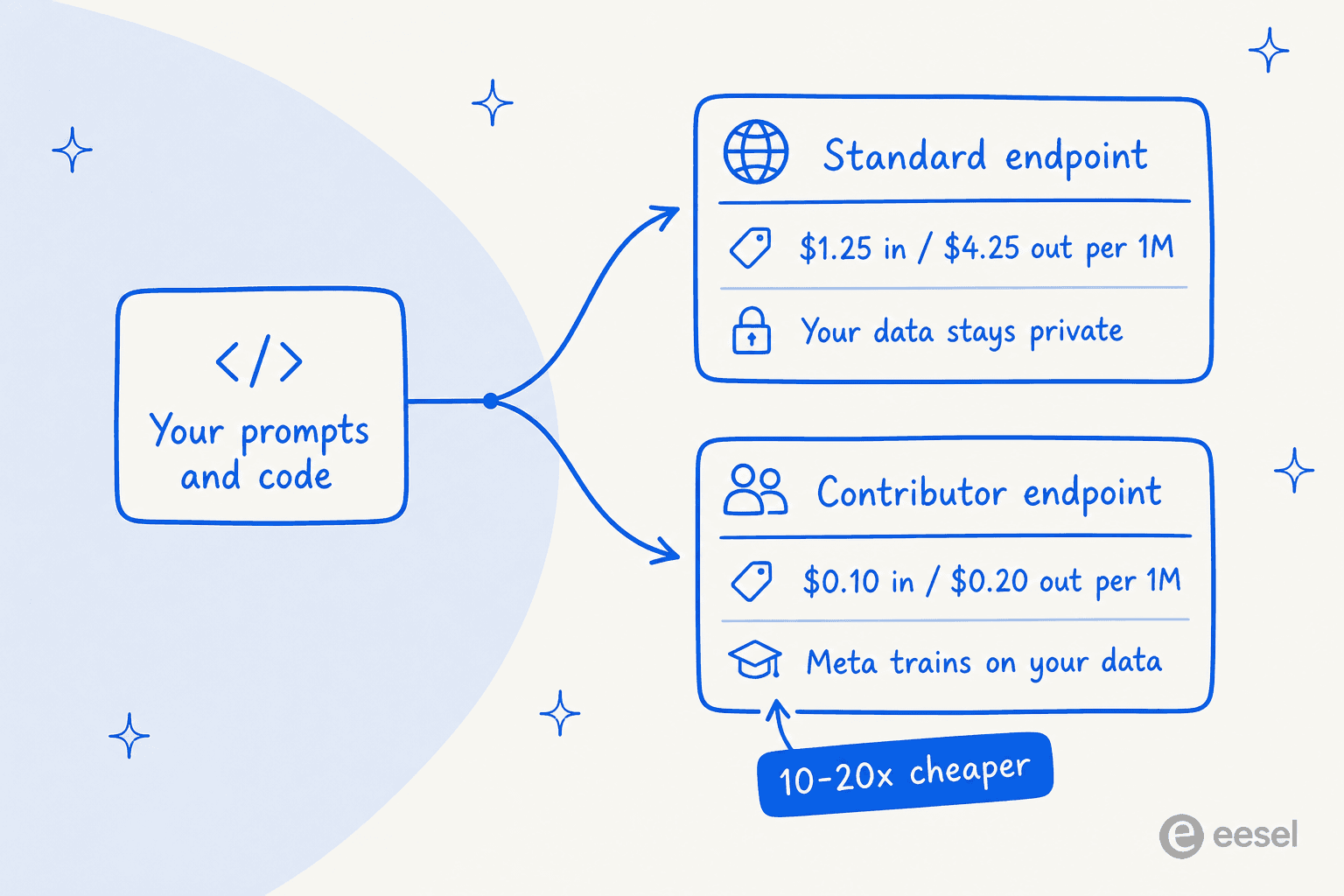
This is where the launch got interesting, and it is a Meta-flavored move. There are two endpoints for the same model, and the price difference is entirely about your data.
| Endpoint | Input / 1M | Output / 1M | Your data |
|---|---|---|---|
| Standard (xhigh) | $1.25 | $4.25 | Kept private, not used for training |
| Contributor | ~$0.10 | ~$0.20 | Used to improve Meta's products |
The standard xhigh numbers are confirmed on Artificial Analysis, which also clocked a cost of $0.55 per Intelligence Index task, 182 tokens/second of output, and a 38.51s time to first answer token. The contributor figures come from users quoting Meta's pricing page in the launch thread, so treat the exact cents as high-confidence rather than gospel until Meta's page is easier to read. Either way, the gap is roughly 10-20x.
The community read on why the split exists was sharper than any press writeup:
"It's not that Meta really wants your data and they're willing to pay top dollar for it. It's that companies really don't want Meta to have their data and they're willing to pay top dollar for that."
That is the trade in one sentence. The contributor endpoint is cheaper per million than ChatGPT Luna and even legacy DeepSeek V4 Flash, one commenter noted, which is a real deal for a hobby project or a throwaway script. For anything touching customer data or proprietary code, the standard endpoint's premium is the point, not a bug. Pick the endpoint that matches how sensitive the input is, not just the one with the smaller number.
What the community actually thinks
Launch-day sentiment lived on Hacker News (391 points, 261 comments), and it was refreshingly mixed rather than a hype wall. The people who'd used 1.2 in a real coding harness liked the speed and price and were curious whether 1.3 fixes its habits:
"I'm partly using 1.2 to reverse engineer and re-implement an old game binary and it has been quite good and fast... 1.2 can get stuck outputting similar sounding thought summaries with no apparent progress when asked to solve bugs."
Others were straight-up unconvinced by the previous generation, which is a fair caution against reading benchmarks as lived experience:
"Used Muse Spark 1.2 and was not impressed at all. Fast and cheap but even GPT 5.6 Terra felt much more capable."
One practical tip surfaced repeatedly and is worth stealing: Meta co-trained the model with its own harness, so running it inside Muse Code rather than a third-party agent tends to use fewer tokens and turns. If you benchmark it in someone else's harness and it looks expensive, that's part of why.
How Meta designed the agent behavior
Benchmarks aside, the more interesting engineering claim is about behavior. Meta says 1.3 was trained to behave less like an eager intern and more like a careful one: ask clarifying questions, call for help when it's stuck, confirm before consequential or irreversible actions, and hold a single long messy thread together without losing the earlier requirements.
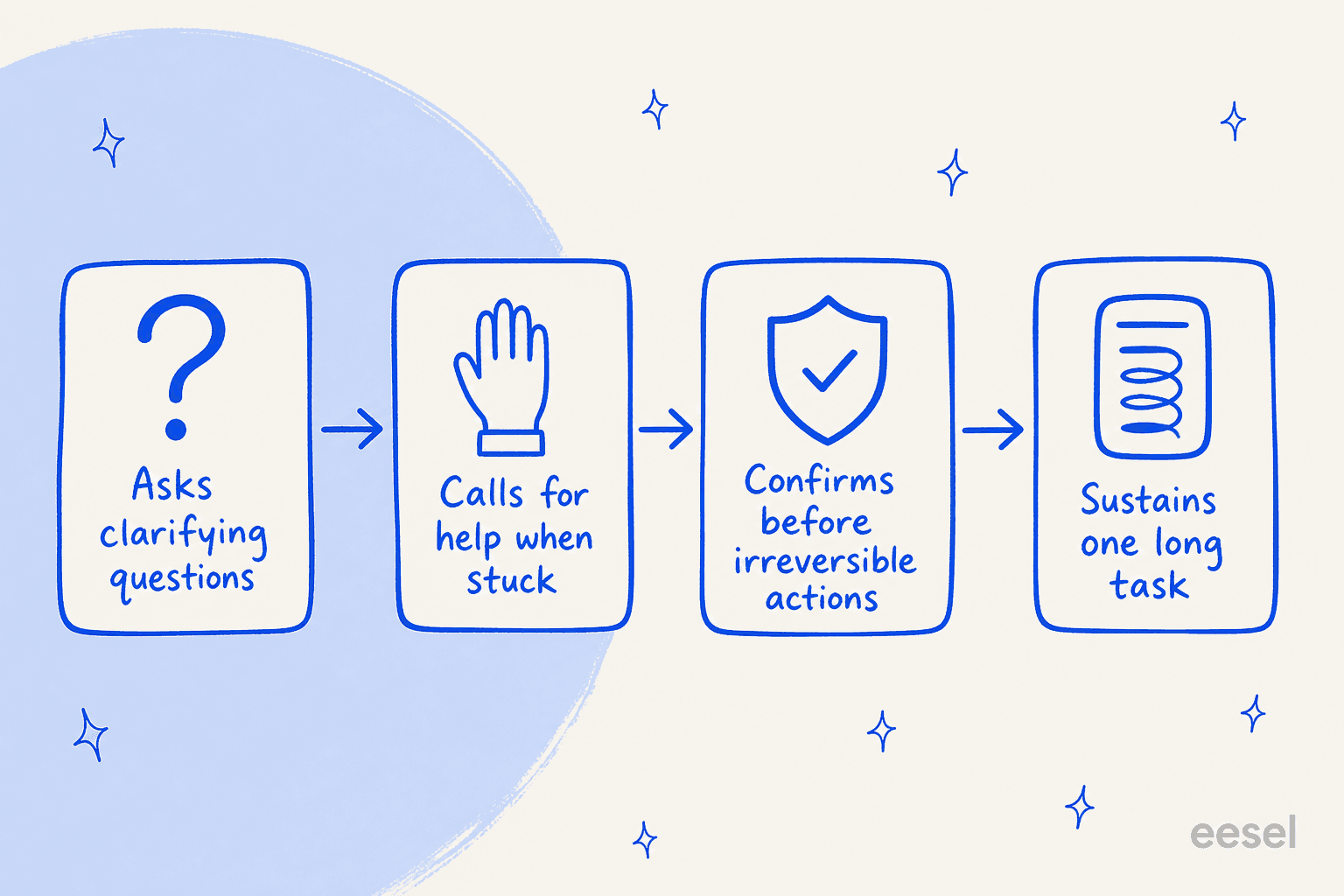
Meta pairs that with safety claims: stronger adversarial resilience, better prompt-injection resistance, and better calibration around irreversible actions. Having spent three-plus years watching AI agents run on live queues, I read "confirms before irreversible actions" as the single most important line in the whole announcement. A confident model that quietly does the wrong thing is worse than a hesitant one that checks. This is exactly why, on the products I work on, we simulate every agent against real historical data before it ever touches a live customer, rather than trusting a benchmark score to predict production behavior.
That instinct is also the bridge to the part most of these launch posts skip: a strong model is raw material, not a finished worker.
From a frontier model to a hired teammate
Here's the honest builder's take. Muse Spark 1.3 is a great engine. It is not, on its own, an employee. The model doesn't know your product, isn't connected to your helpdesk or your CMS, hasn't been tested against your edge cases, and won't confirm before it emails a customer unless you build all of that around it. That gap between "frontier model" and "thing that does a job" is the entire layer eesel exists to fill.
The way I'd frame it: models like this are the infrastructure; eesel is the teammate you hire on top of it. You don't pick the model, wire the integrations, and write the safety harness. You hire a ready-to-work teammate for a specific role, and it arrives already carrying the skills, integrations, and company context for that job.
Try eesel
If you read this post because you're deciding what to build with Muse Spark 1.3, that's the moment eesel is built for. eesel is an AI teammate platform: instead of a raw model API, you hire a ready-to-work teammate for a defined job. Today that roster is an AI helpdesk teammate that joins your support queue, looks up orders, and drafts or sends replies inside your existing helpdesk, and an AI blog writer that researches and drafts long-form posts like this one.
The concrete differentiator is the part a raw model can't give you: the helpdesk teammate is simulated against your own past tickets before it goes live, so you see how it would have handled real conversations instead of hoping a benchmark carries over. It plugs into your tools in minutes, it has a free plan with 100 credits, and it uses a fixed monthly price (1 credit per ticket or chat) rather than per-token billing, so a verbose model thinking out loud isn't your problem to price.