

What is Meta Enterprise Platform?
Meta Enterprise Platform is Meta's new business unit for selling AI to companies. Meta's launch post calls it "the next major pillar of our business", which puts it alongside ads and consumer apps as something Meta wants to earn real revenue from.
I've spent two years on the SEO side at eesel, so the first thing I do with any launch is look at what people search the day after. For this one it was "what is it" and "how much does it cost". That makes sense, because the announcement answers neither. It's two statements: one from Mark Zuckerberg and one from the new exec. No screenshots, no FAQ, and no signup button.
Zuckerberg made the product list in the second post of his thread on X:
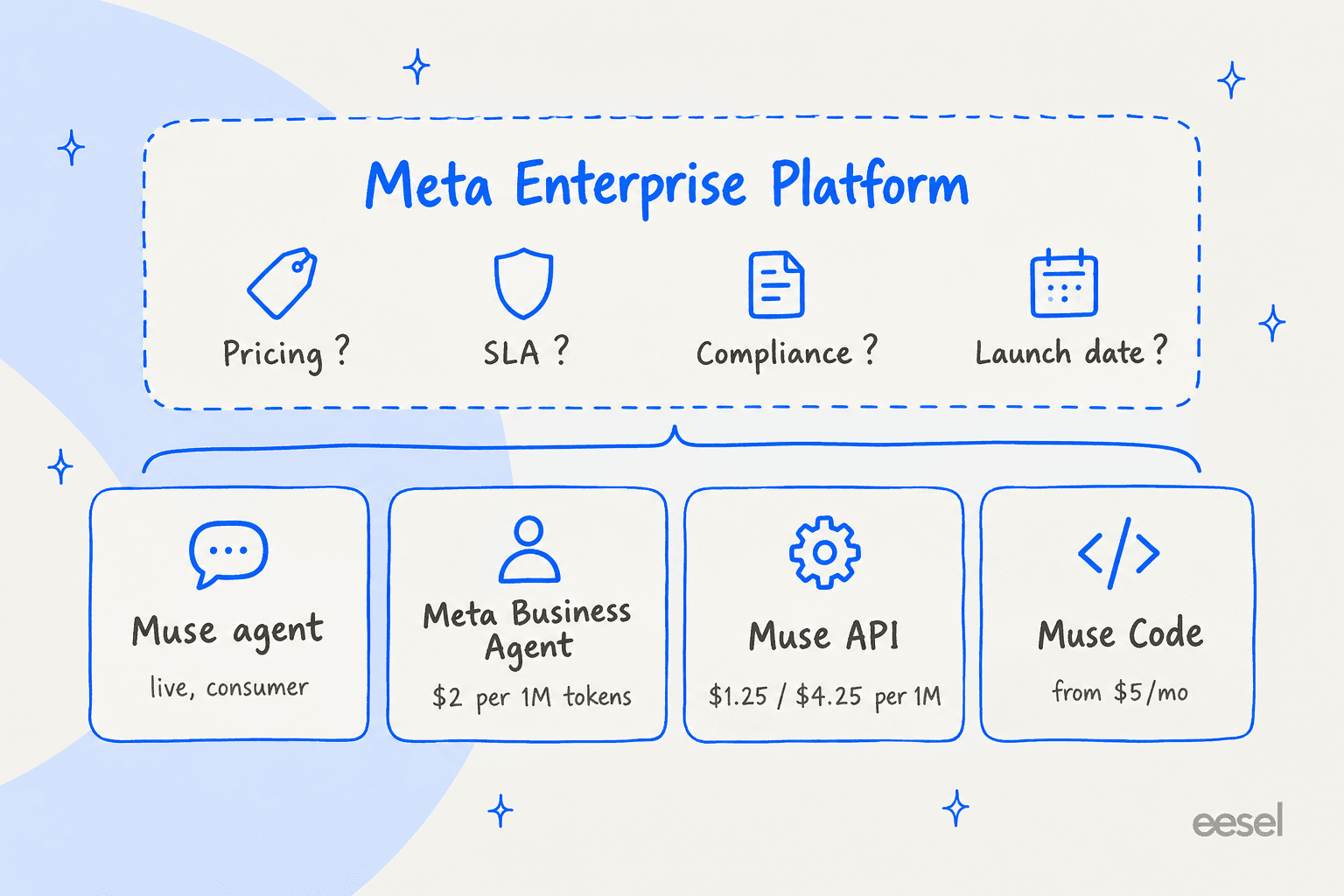
"Meta Enterprise Platform will use our strengths that few other companies have: advanced models, leading agents, large-scale infrastructure, and years of working closely with many businesses. Initially, we will focus on bringing our full technology stack, including the Muse agent, Meta Business Agent, Muse API, Muse Code, and more to businesses and developers to help them grow."
Look at that list closely. Every product on it already exists. The Muse agent launched on September 8. Meta Business Agent launched in June. Muse Code and the API have been live since the summer. The "platform" is the enterprise layer on top of those products, and that layer is what hasn't been built in public yet.
Who is CJ Desai, and why the hire matters
The single hardest fact in the announcement is the hire. Chirantan "CJ" Desai joins as Chief Enterprise Platform Officer, reporting directly to Zuckerberg. His own LinkedIn post describes the job this way:
"I am very excited to share that I'm joining Meta as Chief Enterprise Platform Officer to lead Meta's enterprise efforts reporting to Mark Zuckerberg. This newly formed unit will focus on translating Meta's AI leadership into transformative products for developers and businesses."

His background is enterprise sales at scale. He spent nearly eight years at ServiceNow, rising from Chief Product Officer to COO, per ServiceNow's 2022 release. He then ran product and engineering at Cloudflare. MongoDB appointed him CEO effective November 10, 2025, per MongoDB's investor release, so he's leaving after less than 11 months.
The paperwork is fast, too. MongoDB's 8-K says Desai told the board on September 24 that he'd resign effective September 28, the day of Meta's announcement. Former CEO Dev Ittycheria is back as interim CEO.
Why does this matter to a buyer? Because you don't hire a ServiceNow COO to ship a chatbot. You hire him to build the boring machinery enterprise customers need: account teams, contracts, procurement answers and support. One Reddit commenter put the logic plainly:
"As they say, you don't just hire a person, you hire the community that person comes from. They hired CJ to scoop up the clients he worked with at servicenow, and he had a repo of having built trust among the servicenow customers."

What's actually inside Meta Enterprise Platform today
Here is every product Meta named, with what it costs and what terms it ships on right now. This is the table I'd want before a single sales call, since the announcement doesn't give it to you.
| Product | What it is | Price today | Status and limits |
|---|---|---|---|
| Muse agent | Personal AI agent that browses, fills forms and buys things in its own cloud VM | Free up to 100M tokens a week, per Zuckerberg; paid tiers unpublished | Consumer product, US and Canada |
| Muse for Small Business | New skills and 15 named connectors inside Muse (Shopify, Stripe, QuickBooks, Slack, and others) | "Free for most of what people need" | Launched Sep 29, 2026, US and Canada, owner-facing |
| Meta Business Agent | Customer-facing AI on WhatsApp, Messenger and Instagram | $2 per 1M tokens on WhatsApp, about 4 to 5 cents a message | Meta apps only, one AI agent per number |
| Muse API (Meta Model API) | Hosted access to Muse Spark models | Muse Spark 1.3: $1.25 input / $4.25 output per 1M, $0.15 cached | Public preview, "excludes certain regions" |
| Muse Code | Terminal coding agent | Plans at $5, $15, $50 a month, or pay as you go | Subscription key works only inside the Muse Code CLI |
Two things jump out from that table. The first is how cheap the model is. At $1.25 in and $4.25 out, Muse Spark 1.3 undercuts Claude Opus 5 at $5 / $25 by a wide margin, and my colleague's Muse Spark 1.3 review found it strongest on coding and long context. Price is a real lever for Meta.
The second is the fine print. The API still says "public preview". Muse Code's detail pages have contradicted each other on which model tier a session starts on, as the Muse Code pricing breakdown covers. Low prices on preview terms are great for a hackathon and tricky for a procurement team.
Muse for Small Business, announced the day after, is the most concrete sign of where Meta is starting. It's not a separate product. It's a set of skills and connectors inside Muse for business owners, with approval before anything sends, publishes or spends. Slack's EVP put it this way on Meta's launch page: Muse "always checks for approval before taking action". That's a sensible design for a shop owner. It's also a long way from a governed rollout across 2,000 employees.
What Meta hasn't published yet
This is the part I'd push on hardest if I were evaluating Meta for a real team. The launch post has exactly one sentence on security, from Desai: "As with Muse, security and privacy are built into Meta's enterprise products from the outset."
That sentence points to the consumer Muse security design, which is thoughtful. Every user gets an isolated VM, and a separate Sentinel agent approves any action that reaches the internet. There's also a bug bounty of up to $300,000. But it describes one person's agent. It says nothing about SSO, admin consoles, tenant isolation, audit exports, or data processing agreements.
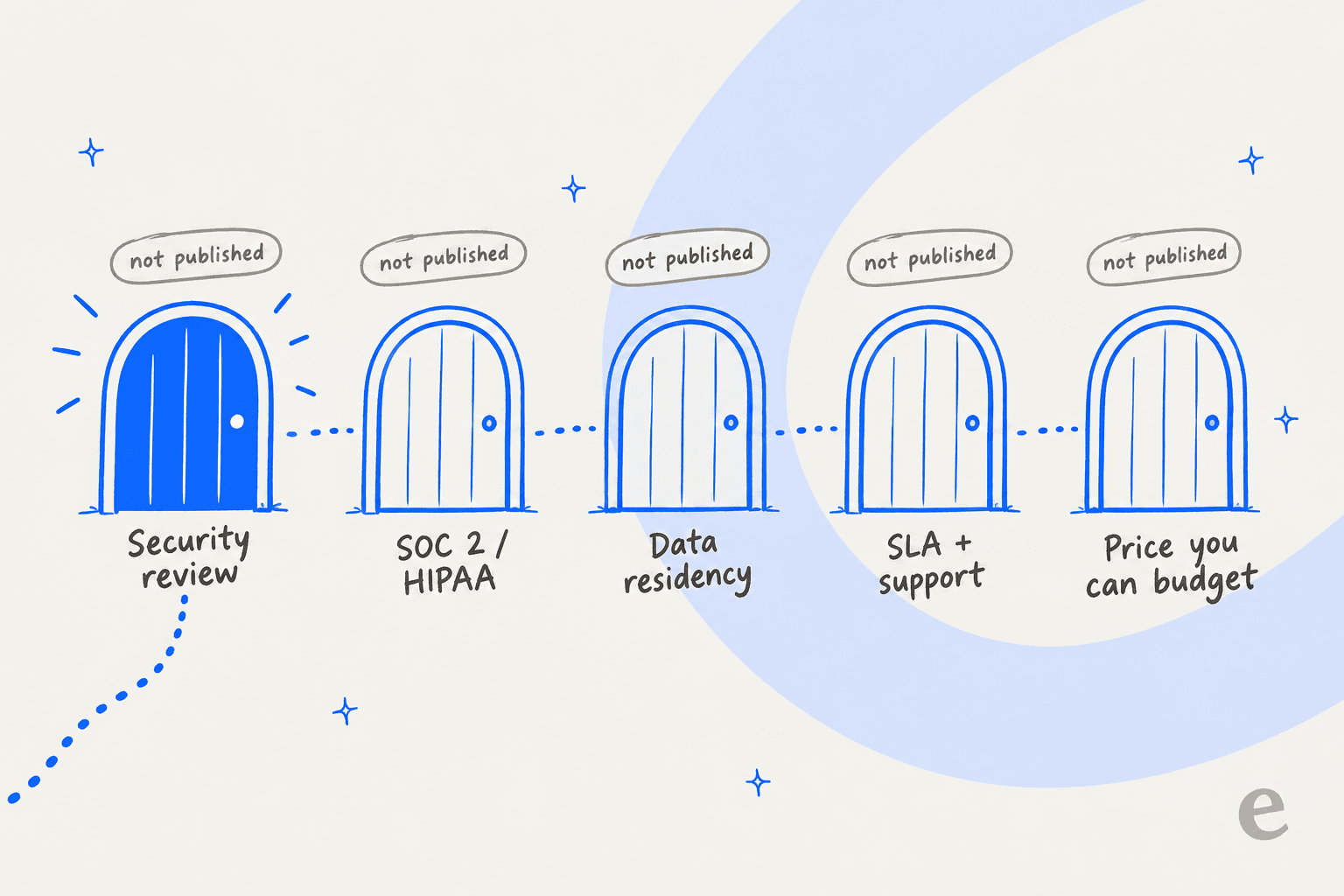
Here's the full list of what's missing from Meta's announcement as of September 29, 2026:
| What a buyer asks | What Meta has published |
|---|---|
| Pricing or packaging for the platform | None |
| Launch date, beta, or waitlist | None ("Today we are starting") |
| SLA, uptime, or support tiers | None |
| SOC 2, ISO 27001, HIPAA, GDPR terms | None listed |
| Data residency and deployment model | None |
| Named enterprise customers | None (only Meta's existing advertiser base) |
| Third-party integrations for CRM, helpdesk, ITSM | None |
I don't say this to dunk on Meta. A day-one announcement often looks like this. But it matters because of how enterprise AI actually gets bought. I've seen deals stall at exactly this gate. A B2B telematics team that needed proof their PII stayed in their environment before any trial. A US healthcare team that hard-blocked on a BAA. A mid-market platform that couldn't move without a SOC 2 report. eesel lost that healthcare deal itself, back when it didn't offer a BAA. Nobody got to judge the product, because the paperwork came first.
That's the gap Meta has to close, and it's a paperwork-and-people gap, not a model gap. The Desai hire suggests Meta knows it.
What people are saying about Meta's enterprise push
The reaction splits into two camps. One thinks Meta can't earn enterprise trust. The other thinks the price and distribution are too big to ignore. The trust question came up first and loudest:
"Enterprises love doing business with trustworthy vendors. This is going to be an interesting one to watch. Can meta become trustworthy?"

Others pointed at history. Meta's past business tools, including Workplace, never became the enterprise wedge the company hoped for:
"2008. 2016. 2019 $META has tried many times to "become B2B" and get businesses with "business messaging", "business feed to compete with Yammer / Slack" or "business collaboration". none of them worked. They dont have the investments for B2B GTM. Why would this time be different @finkd"
The fair counterpoint came from Hacker News, where one commenter noted big companies often take a few tries to get enterprise right:
"I was surprised Facebook Workplace lasted as long as it did. But, hey, it took Google a few tries to get GCP (anyone remember the Search Appliance?) to a solid place so I wouldn't count Meta out of being able to make an enterprise splash just yet."
Markets took it seriously either way. One widely shared post on X tracked software stocks dipping on the news, with MongoDB down 16% on the day its CEO left.
The line I keep coming back to, though, is about support itself:
"Enterprise AI isn't won by models, it's won by account managers, SLAs and someone who picks up the phone at 2 a.m., which is an interesting pivot for the company whose customer support has been a famously unsolved problem for two decades."
It's a little cheeky. It's also the right question, and it's why the human handoff design of any support AI matters more than its benchmark scores. Selling to enterprises means being on the hook when something breaks at 2 a.m., and that's a muscle Meta will need to build.
What Meta Enterprise Platform means for support teams
If you run a support team, only one product on Meta's list touches your queue directly: Meta Business Agent. The Meta Muse for customer support guide covers it in depth, and the short version still holds.
- It lives inside Meta's apps. It answers on WhatsApp, Messenger and Instagram. Email and web chat sit outside its reach. So do tickets in your helpdesk, whether that's Zendesk or Freshdesk.
- One AI agent per number. Per Meta's developer docs, an existing third-party AI on a WhatsApp number blocks Business Agent.
- WhatsApp pricing changes on October 1, 2026. Service messages, meaning replies from a human agent or a third-party AI, start getting charged per message at utility rates, per Meta's pricing page. Every WhatsApp support setup gets a new line item, whichever AI you use, including a Shopify support bot that answers order questions there.
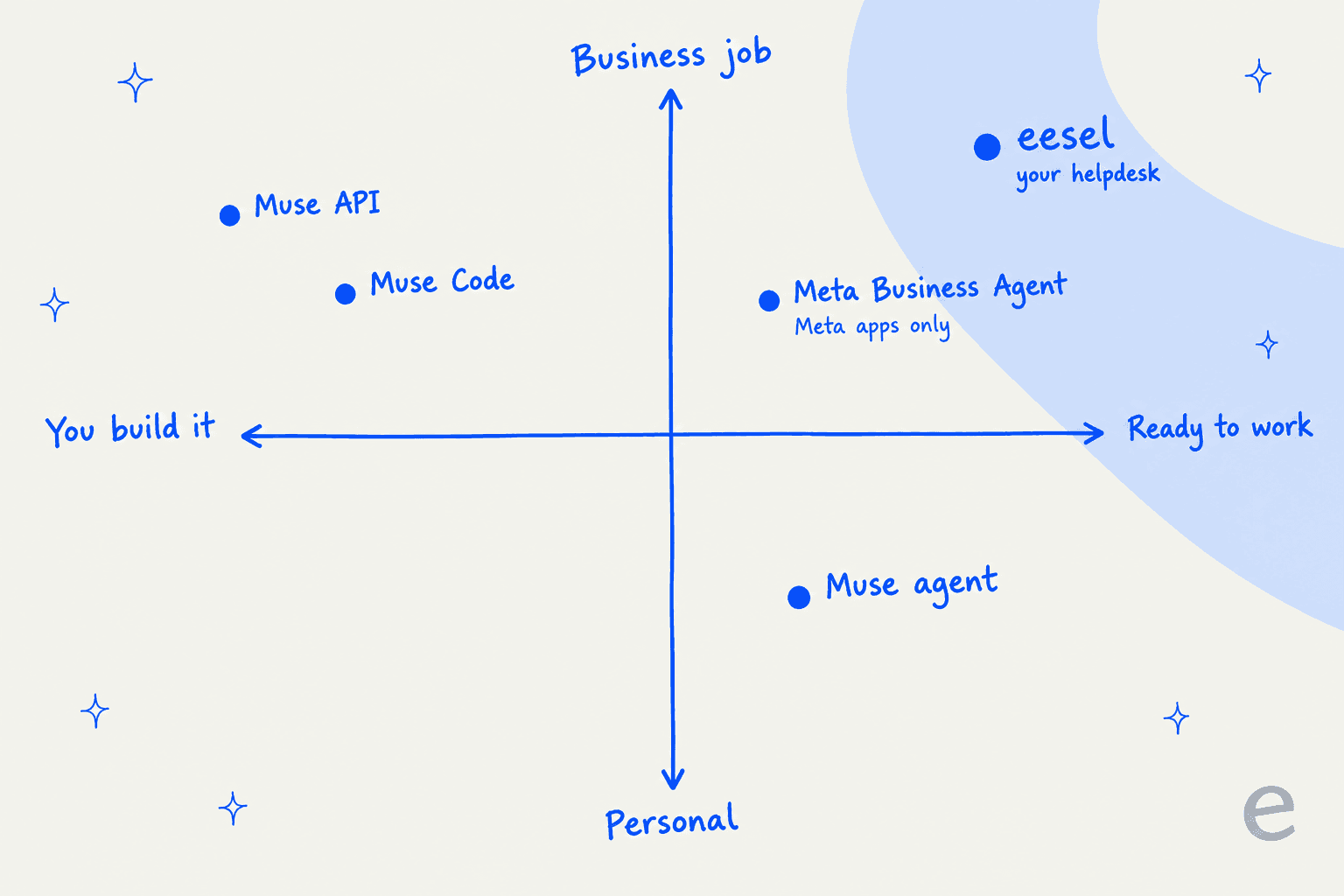
The quadrant above is how I'd sort Meta's stack. The Muse API and Muse Code are infrastructure. They're powerful if you have engineers who want to build versus buy, but somebody still has to build and maintain the support agent on top. The Muse agent is ready to work, but it works for one person's to-do list. Business Agent is the only ready-made business piece, and it stops at the edge of Meta's apps.
If your ticket volume comes mostly from WhatsApp and Instagram DMs, Business Agent is worth a real trial, and the price per message is competitive next to typical AI customer service costs. If most of your volume sits in a helpdesk, Meta's platform doesn't have a product for that job today.
Should you wait for Meta Enterprise Platform?
My take: track it, don't plan around it. Here's how I'd split it.
- Watch closely if you're a developer or platform team that can build on raw models. Muse Spark 1.3's price-to-performance is real, and an enterprise wrapper with proper terms would make it a serious option next to ChatGPT Enterprise. OpenAI's Frontier agent platform is the other obvious comparison.
- Trial Business Agent now if your customers talk to you mainly on WhatsApp, Messenger or Instagram. It's live and priced.
- Don't wait if you need an AI teammate on your helpdesk this quarter, or your security team needs signed paperwork before any pilot. Nothing on Meta's list answers either need yet.
Rollouts are what worry me in the "wait" plan. Even a great AI agent needs a few weeks of tuning on your real tickets before you'd trust it with customers. A team that waits a year for Meta's enterprise terms skips a year of that learning. The AI teammates explainer and the broader best AI agents roundup show what's shippable right now.
Try eesel for your helpdesk while Meta builds its platform
Meta is assembling a platform. eesel is an AI teammate platform, and its AI helpdesk agent is ready for the job today. It joins the queue you already run, with a native Zendesk integration plus Freshdesk and Gorgias. It learns from your past tickets, help center and macros, then drafts or sends replies, tags and routes.
The part that matters most for a cautious buyer is the simulation. Before it answers anyone, eesel tests itself against hundreds of your past tickets and shows you where it would get things wrong. Pricing is published too. Plans start at $299 a month for 500 tickets or chats, with a free plan to try it and no per-seat fees.
I'll be straight about one thing, since this whole post is about paperwork. eesel's SOC 2 Type II is still underway, and HIPAA is a custom add-on. If a finished SOC 2 report is a hard requirement today, ask eesel for its security details first. If you'd rather drive it from a terminal or a coding agent, the eesel CLI runs the same teammate from scripts, CI, or tools like Claude Code, with every command returning JSON. That makes it a good fit for teams who'd otherwise reach for Muse Code to glue things together.
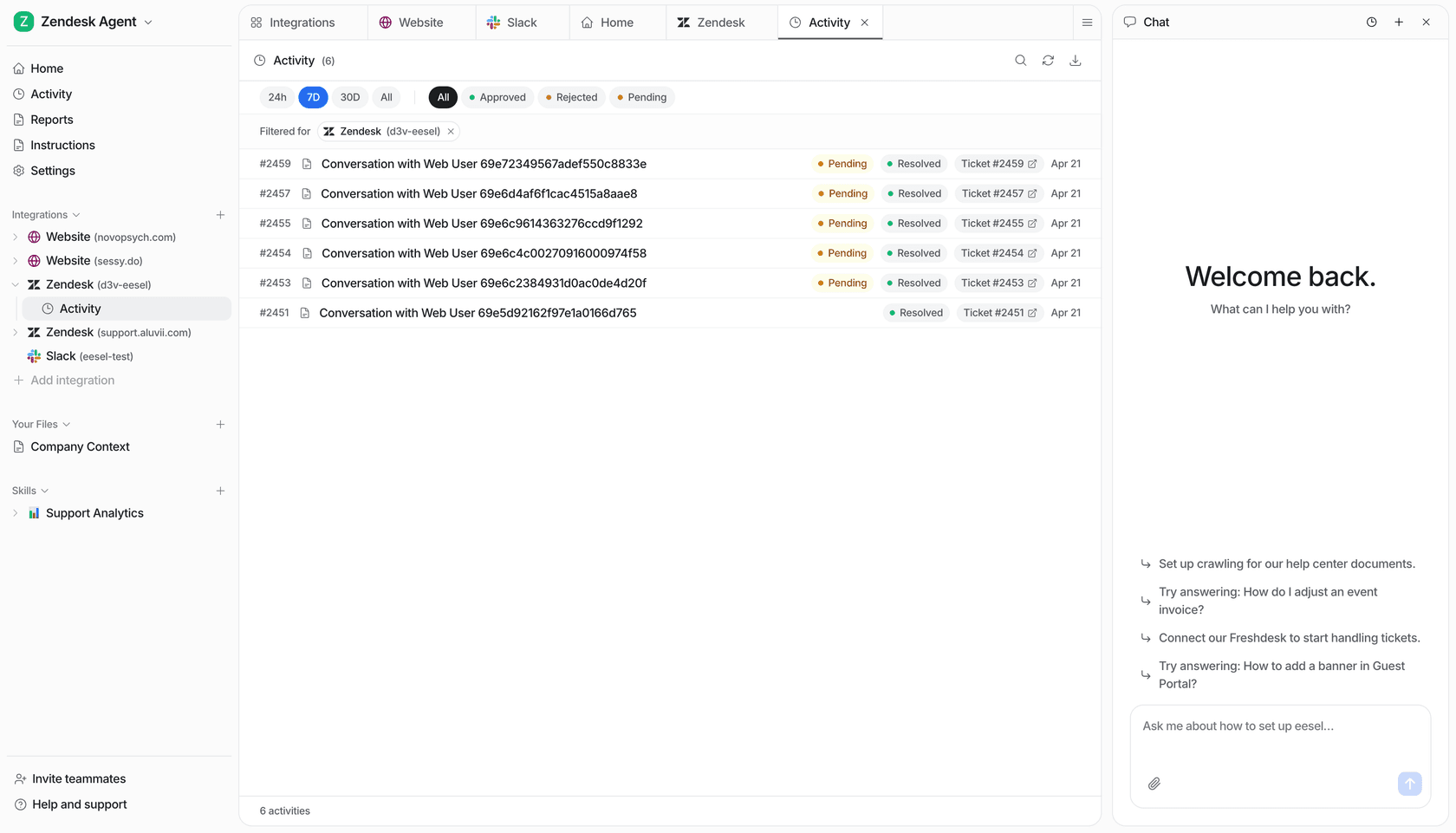
Want an AI teammate on your helpdesk before Meta ships enterprise terms? Try eesel free, and see how it would have answered last month's tickets.
Frequently Asked Questions
What is Meta Enterprise Platform?
Meta Enterprise Platform is a new Meta business unit, announced on September 28, 2026, that packages Meta's AI stack for companies and developers. It starts with the Muse agent, Meta Business Agent, Muse API and Muse Code, and is led by former MongoDB CEO CJ Desai.
How much does Meta Enterprise Platform cost?
Meta has not published any Meta Enterprise Platform pricing. The parts you can buy today are priced separately: Muse Spark 1.3 on the API is $1.25 input and $4.25 output per million tokens, Muse Code plans start at $5 a month, and Meta Business Agent on WhatsApp is $2 per million tokens. See Muse Spark 1.3 pricing for the full rate card.
Is Meta Enterprise Platform available now?
Not as a product you can sign up for. The announcement has no signup link, launch date, or regions. The underlying tools are live on their own terms, though the Muse API is still labelled a public preview that excludes certain regions.
Who leads Meta Enterprise Platform?
Chirantan "CJ" Desai, who becomes Chief Enterprise Platform Officer and reports directly to Mark Zuckerberg. He was MongoDB's CEO from November 2025, and before that ran product and engineering at Cloudflare and served as President and COO at ServiceNow, the company behind the AI Agent Studio.
Is Meta Enterprise Platform SOC 2 or HIPAA compliant?
Meta has not listed any certifications for Meta Enterprise Platform. The only security statement says security and privacy are built in "as with Muse". If you need a BAA or SOC 2 report today, compare vendors that already publish them, such as the tools in the HIPAA-compliant AI guide.
Can I use Meta Enterprise Platform for customer support?
The support piece is Meta Business Agent, which answers customers on WhatsApp, Messenger and Instagram. It only runs inside Meta's apps and allows one AI agent per number. For email and helpdesk tickets, an AI helpdesk agent like eesel works inside Zendesk, Freshdesk or Gorgias instead.
How does Meta Enterprise Platform compare to ChatGPT Enterprise?
ChatGPT Enterprise is a sold product with admin controls and published security terms. Meta Enterprise Platform is, for now, a strategy and a leadership hire wrapped around products that mostly ship on consumer or preview terms. Comparing the two properly will only be possible once Meta publishes enterprise packaging.


Article by
Kurnia Kharisma
Kurnia is a software engineer and writer at eesel AI with two years of SEO experience, writing about AI tools, helpdesk software, and customer support. He pairs a developer's understanding of how these products are built with search-driven research into what actually ranks and resonates with the people searching for them.