

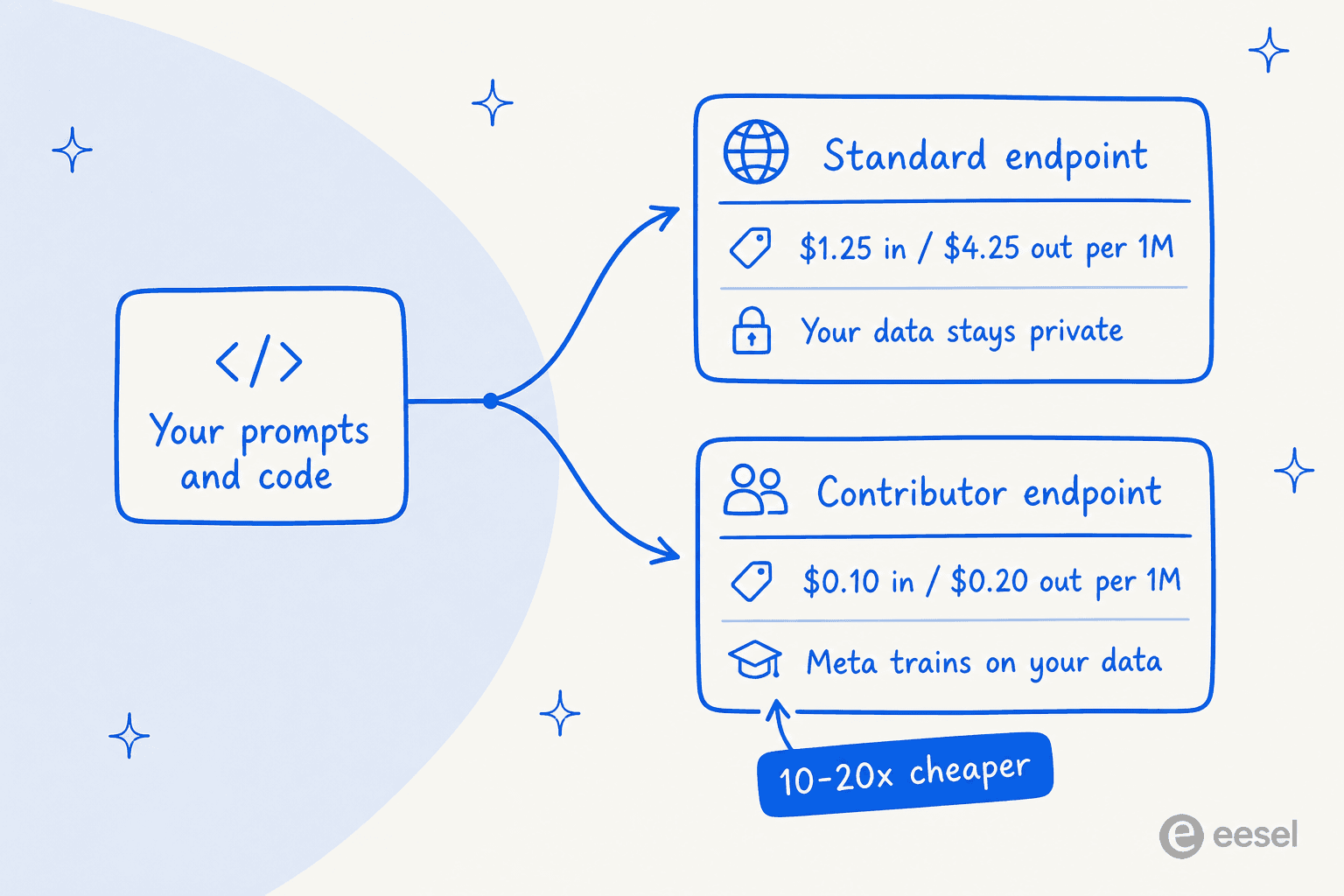
Meta's Muse Spark 1.3 has two prices for the same model, and the gap between them is entirely about your data. The standard endpoint is $1.25 per 1M input tokens and $4.25 per 1M output on the xhigh tier, with your traffic kept private. The contributor endpoint is roughly $0.10 / $0.20 per 1M, about 10-20x cheaper, in exchange for Meta training on what you send.
The sticker price is only half the story. Muse Spark 1.3 is unusually verbose, so a low per-token rate can still produce a high per-task bill. Artificial Analysis blends the standard endpoint to about $0.78 per 1M tokens and roughly $1.37 to finish one Intelligence Index task, and there's an 88% cache discount worth knowing about.
I've spent two years watching teams pick a model on its input price and then get surprised by the output line on the invoice. So the honest builder's take up front: a raw model API is a cost center you have to manage token by token. If what you actually want is a support agent or a blog writer that does a job for a predictable price, that's the layer an AI teammate like eesel sits in, billing per resolution instead of per token.
What you actually pay for
The first thing to get straight is that "Muse Spark 1.3 pricing" isn't one number. Meta ships the same model through two endpoints on the Meta Model API, and they are priced very differently.
| Endpoint | Input / 1M | Output / 1M | Your data | Best for |
|---|---|---|---|---|
| Standard (xhigh) | $1.25 | $4.25 | Kept private, not used for training | Production, customer data, proprietary code |
| Contributor | ~$0.10 | ~$0.20 | Used to improve Meta's products | Hobby projects, throwaway scripts, non-sensitive batch jobs |
The standard xhigh rates are confirmed on Artificial Analysis, and they held flat from Muse Spark 1.2 rather than rising with the new version, which is the good news. The contributor figures come from users quoting Meta's own pricing page on the launch thread, so treat the exact cents as high-confidence rather than gospel until that page is easier to read. Either way the gap is roughly 10-20x, and it is the single most important pricing decision you'll make with this model.
The community read on why the split exists was sharper than any press writeup:
"It's not that Meta really wants your data and they're willing to pay top dollar for it. It's that companies really don't want Meta to have their data and they're willing to pay top dollar for that."

That's the trade in one sentence. The standard endpoint's premium isn't a tax, it's the product. Pick the endpoint that matches how sensitive the input is, not the one with the smaller number.
Estimate your monthly bill
Sticker prices are abstract until you plug in your own volume, so here's a calculator. Enter roughly how many million tokens you push through each month, pick an endpoint, and it does the arithmetic for both the input and the notoriously heavy output side.
Play with the output field specifically. Because Muse Spark 1.3 leans heavily on output tokens, and output is 3.4x the price of input, that box moves your bill far more than the input box does. Which brings up the part the sticker price hides.
The verbosity tax
Here's the catch that doesn't show up on any pricing page. Muse Spark 1.3 thinks out loud a lot. Artificial Analysis measured it emitting 140M output tokens to complete the full Intelligence Index, against a field median of about 90M, and the community's own testing at launch pegged it at roughly 3x the token use of 1.2.
You pay per output token. So a model with a low output rate that generates a mountain of tokens is not automatically the cheap option. Run the same job on a terser model at a higher rate and the terser one can win on the invoice. This is exactly the trap I mentioned in the TL;DR, and it's why per-task cost matters more than per-token rate. Artificial Analysis puts the standard endpoint at about $1.37 to finish one Intelligence Index task once you account for the verbosity, alongside an output speed near 198 tokens/second and a time to first token around 29 seconds.
Two levers pull the real cost back down:
- The 88% cache discount. Repeated input tokens (a long system prompt, a knowledge base you send every call) are billed at a fraction of the input rate. For retrieval-heavy or agentic workloads that resend the same context, this is a large, real saving.
- Meta's own harness. Meta co-trained the model with Muse Code, so running it inside Muse Code tends to use fewer tokens and turns than a third-party agent. If you benchmark it somewhere else and it looks expensive, part of the reason is the harness.
The takeaway for budgeting: don't price this model off the input rate. Estimate your output volume honestly, apply the cache discount where your workload repeats context, and simulate on a real slice of your own traffic before you commit.
The max tier you can't buy yet
There's a pricing asterisk that's easy to miss. Meta posted its headline benchmark scores on the max reasoning tier, but max is gated behind additional safety testing at launch, so the tier you can actually call and pay for today is xhigh. There is no public standard price for max yet.
That matters for two reasons. First, if you budget around the launch scores, you're budgeting around a tier you can't purchase. Second, when max does open up, expect it to cost more and to be even more verbose than xhigh, since more reasoning means more output tokens at $4.25 per million. The full benchmark breakdown walks through how much of the 1.2-to-1.3 jump is really a max-vs-xhigh gap rather than a clean generational leap, which is worth reading before you assume the top-tier numbers apply to what you're paying for.
How the price compares to the field
Sticker-price-only, Muse Spark 1.3's standard endpoint sits in the cheap-frontier bracket. Here's roughly where it lands against the models most teams weigh it against. These are list input/output rates for a comparable tier; real cost still swings on verbosity and your own mix.
| Model | Input / 1M | Output / 1M | Notes |
|---|---|---|---|
| Muse Spark 1.3 (standard xhigh) | $1.25 | $4.25 | Very verbose; 88% cache discount; contributor endpoint ~10-20x cheaper |
| Muse Spark 1.3 (contributor) | ~$0.10 | ~$0.20 | Meta trains on your data |
| Claude Opus 5 | higher | higher | Beats 1.3 on most agent evals; premium tier |
| GPT-6 Astra | mid | mid | Different pricing structure; see its own breakdown |
| Gemini 3.8 Flash | low | low | Briefly topped the same index the day 1.3 shipped |
| DeepSeek V4 Flash | very low | very low | Open, MIT-licensed; the true budget floor |
| Kimi K3 | mid | mid | Another open-weights contender |
The honest read: on the contributor endpoint, 1.3 is cheaper per million than most hosted frontier options, and even undercuts some legacy budget models, one commenter noted. On the standard endpoint it's competitively priced but not the floor, and the verbosity means the effective cost climbs faster than the sticker suggests. If your only axis is price per token on non-sensitive work, the contributor endpoint or an open model like DeepSeek V4 Flash is hard to beat. If your axis is price per finished job on real data, the math gets more interesting, and that's the part worth slowing down on.
From per-token pricing to a per-outcome price
Here's the builder's take, and it's the thing most pricing posts skip. Every number above is a cost of raw materials, not a cost of getting work done. A token price tells you what the engine costs. It tells you nothing about wiring the model into your helpdesk, loading it with your company context, testing it against your edge cases, or making it confirm before it emails a customer. You build and pay for all of that on top.
That gap is where eesel lives. The way I'd frame it: models like Muse Spark 1.3 are the infrastructure, and eesel is the teammate you hire on top of it. You don't pick a tier, wire the integrations, and eat the verbosity on your own invoice. You hire a ready-to-work teammate for a defined job, and it arrives already carrying the skills, integrations, and company context for that role.
The pricing model is the concrete difference. eesel bills per resolution, not per token, so a model that thinks out loud 3x as much isn't a line item you have to forecast. The AI helpdesk teammate joins your support queue, looks up orders, and drafts or sends replies inside your existing helpdesk, and the AI blog writer researches and drafts long-form posts like this one. In both cases the price you see is tied to work done, not tokens consumed.
Try eesel
If you're reading a Muse Spark 1.3 pricing post because you're deciding what to build with, that's the exact moment eesel is built for. You get a ready-to-work AI teammate instead of a raw model API, so the per-token math above stops being your problem to manage.
The concrete differentiator is the part a raw model can't give you: the helpdesk teammate is simulated against past tickets before it goes live, so you see how it would have handled real conversations instead of hoping a benchmark carries over. It plugs into your tools in minutes, it's free to try, and because it bills per resolution rather than per token, a verbose model thinking out loud isn't your budget to price.