

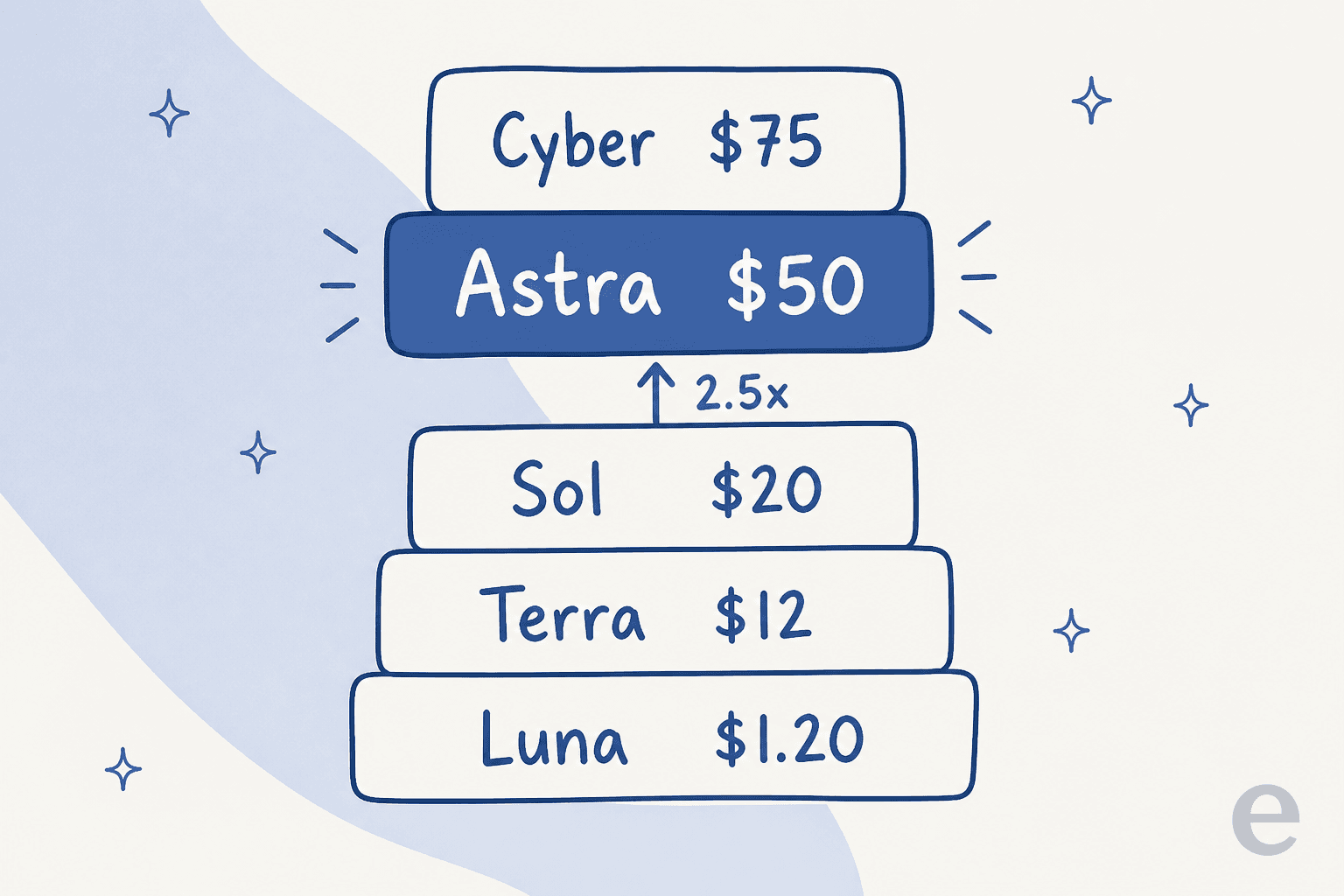
OpenAI's GPT-6 Astra launched on 3 September 2026 as the new flagship, and the headline number is simple: $10 per million input tokens and $50 per million output tokens on the standard API tier. That is 2.5x GPT-5.6 Sol's current rate, and it lands exactly on Anthropic's Fable 5.1.
The sticker price is the easy part. The details that actually move your bill are the ones buried in the fine print:
- Service tiers swing the cost 4x. Batch and Flex run Astra at half price ($5/$25), Fast mode runs it at double ($20/$100). Same model, wildly different math.
- Long context costs more. Prompts over 272K tokens jump to $20/$75 for the whole request, and regional data residency adds another 10%.
- It is not free anywhere. No API free tier, and in ChatGPT it starts on the $20/month Plus plan, not Free or Go.
If you are a developer, the section below is the full tier-by-tier table plus a calculator to plug in your own volume. If you run a support or ops team and you are really asking "what will an AI cost me per ticket," the honest answer is that token pricing is the wrong unit. That is why an AI helpdesk agent like eesel charges 1 credit per ticket or chat instead of per token, which I will get into at the end.
GPT-6 Astra API pricing: the standard tier
Here is the number most people came for. On the API pricing page, GPT-6 Astra standard pricing is $10.00 per million input tokens and $50.00 per million output tokens. Cached input drops to $1.00, and cache writes are $12.50 per million.
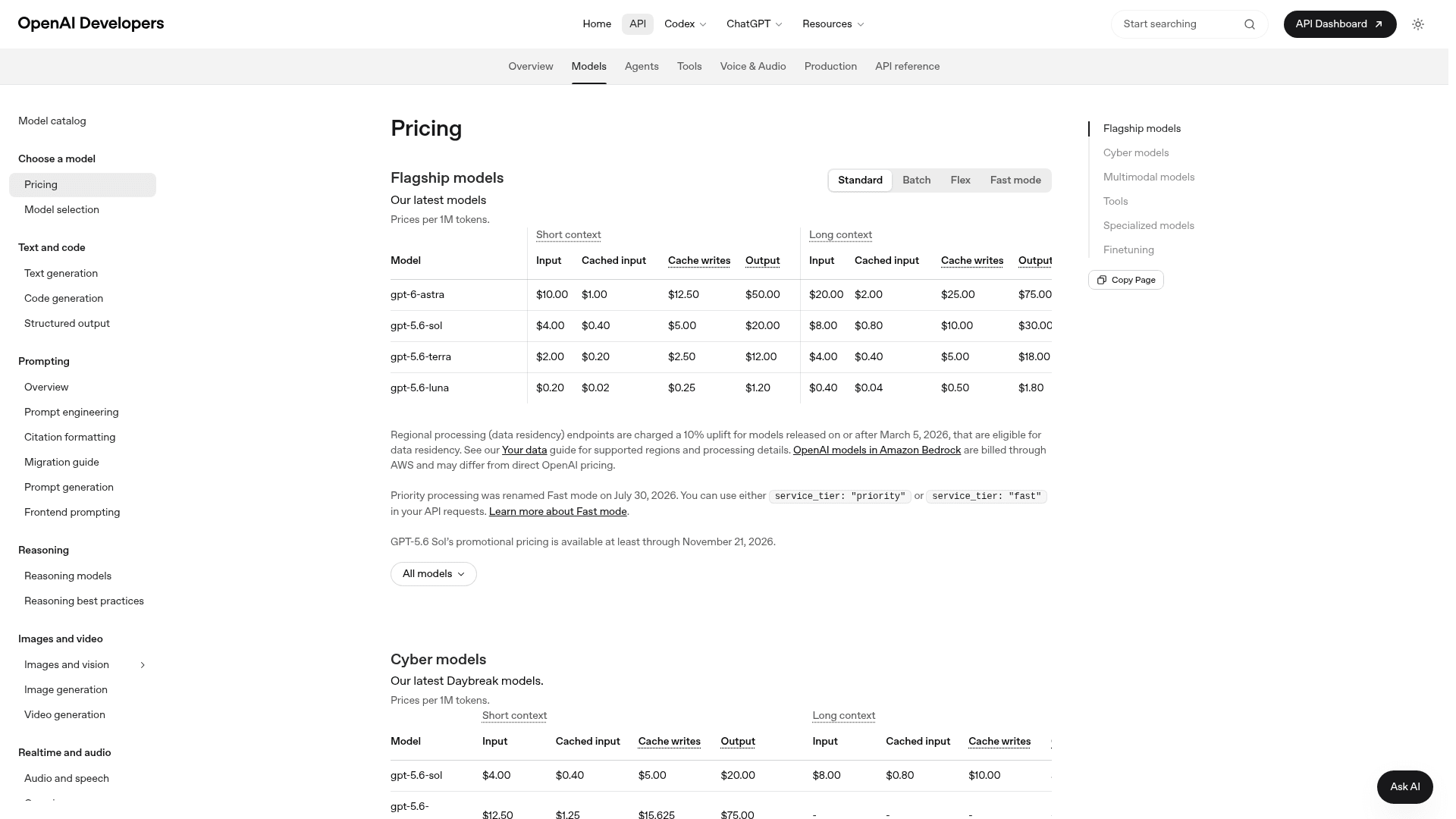
For context, that is a real jump from the rest of the OpenAI model lineup. Astra is now the second-most-expensive model OpenAI sells, behind only the specialist gpt-5.6-cyber. Here is where each flagship model sits on the standard, short-context tier:
| Model | Input (per 1M) | Cached input | Output (per 1M) | Position |
|---|---|---|---|---|
| gpt-6-astra | $10.00 | $1.00 | $50.00 | New flagship |
| gpt-5.6-sol | $4.00 | $0.40 | $20.00 | Prior flagship (promo) |
| gpt-5.6-terra | $2.00 | $0.20 | $12.00 | Mid tier |
| gpt-5.6-luna | $0.20 | $0.02 | $1.20 | Cheapest |
| gpt-5.6-cyber | $12.50 | $1.25 | $75.00 | Specialist (Daybreak) |
Source: OpenAI API pricing. One dated detail worth pinning down: GPT-5.6 Sol's $4/$20 is promotional pricing held at least through 21 November 2026, so the "2.5x" gap is measured against a discount that may not last.
That price parity with Anthropic's Fable 5.1 was not lost on practitioners. As one Hacker News commenter put it, OpenAI "finally found an edge to stop selling cheap and earn from the high demand customer like Anthropic." The quieter consequence a few people noted: with both frontier labs now at $10/$50, the option to shop between them on price alone just disappeared.
Service tiers: the 4x swing most people miss
The standard rate is a starting point, not the whole story. GPT-6 Astra runs on four service tiers, and the gap between the cheapest and most expensive is 4x for the exact same model. This is the single biggest lever you have on cost, and it is a bigger deal than any prompt optimization.
| Tier | Input (per 1M) | Cached input | Output (per 1M) | Trade-off |
|---|---|---|---|---|
| Batch | $5.00 | $0.50 | $25.00 | 50% off, async, up to 24h |
| Flex | $5.00 | $0.50 | $25.00 | 50% off, slower, may queue |
| Standard | $10.00 | $1.00 | $50.00 | Default latency |
| Fast mode | $20.00 | $2.00 | $100.00 | 2x, lowest latency |
Source: OpenAI API pricing. A few things to know before you pick one:
- Batch and Flex are the same price, but different jobs. Batch is for asynchronous workloads you submit and collect later; Flex is for interactive requests you are willing to let run slower or queue. Both halve your bill.
- Fast mode was renamed from Priority on 30 July 2026. You can still pass
service_tier: "priority"orservice_tier: "fast". It doubles the rate for the lowest latency. - Fast mode has a regional catch. It is unavailable for GPT-6 Astra with EU data residency; those requests fall back to standard.
If a workload can tolerate latency, defaulting it to Batch or Flex effectively cuts your Astra spend in half with no change to output quality. That is the first thing I would check on any high-volume pipeline.
The gotchas: long context and regional uplift
Two surcharges hide in the model page fine print, and both can quietly reshape a budget.
First, long context is billed at a higher rate for the entire request. Astra's context window is a huge 1,050,000 tokens, but any prompt over 272K input tokens flips the whole request to the long-context rate: $20 per million input and $75 per million output on the standard tier. That is 2x input and 1.5x output, and it applies to every token in the request, not just the ones past the threshold.
| Standard tier | Short context (≤272K) | Long context (>272K) |
|---|---|---|
| Input (per 1M) | $10.00 | $20.00 |
| Cached input | $1.00 | $2.00 |
| Output (per 1M) | $50.00 | $75.00 |
Second, regional processing carries a 10% uplift. Data-residency endpoints for models released on or after 5 March 2026 are charged 10% more. If you are pinned to a specific region for compliance, factor that in on top of everything else.
And a floor to remember: Astra is not on the free tier at all, so Tier 1 usage is the entry point for developers.
Estimate your GPT-6 Astra API bill
Sticker prices are abstract until you put your own numbers in. Plug in the millions of input and output tokens you expect per month, pick a service tier, and this works out the monthly cost. It accounts for the long-context surcharge automatically.
The pattern most teams find is that output tokens dominate the bill, since output is 5x the input rate. If your workload generates long responses, that is where the money goes, and where switching a batch-friendly job to the Batch tier pays off fastest.
GPT-6 Astra pricing in ChatGPT
If you are not calling the API, GPT-6 Astra reaches you through ChatGPT plans instead, and the pricing page draws a clear line about who gets it.
| Plan | Price | GPT-6 Astra access |
|---|---|---|
| Free | $0 | No (Luna only) |
| Go | $8/mo | No |
| Plus | $20/mo | Yes |
| Pro | From $100/mo | Expanded, plus a Pro variant |
| Business / Enterprise | Per seat | Yes (Enterprise off by default) |
Source: ChatGPT pricing. A few things stand out:
- Astra starts at Plus. The $20/month Plus plan is the entry point for ChatGPT users. Neither Free nor the $8 Go plan includes it, and Free users are limited to GPT-5.6 Luna.
- Pro adds headroom. Pro, from $100/month, gives 5x or 20x more usage and a higher-effort Pro reasoning mode powered by Astra.
- Enterprise has a switch. On Business and Enterprise, Astra is available per seat, but at launch it is off by default per workspace, so an admin has to enable it. Nonprofits can get up to a 75% discount on Business or Enterprise.
How GPT-6 Astra pricing compares
Zooming out, where does Astra sit against the rest of the frontier? The short version is that OpenAI stopped competing on price at the top.
- Versus its own lineup: at $10/$50, Astra is 2.5x GPT-5.6 Sol and roughly 4x GPT-5.6 Terra. For most everyday tasks, Terra or Luna give you the bulk of the value at a fraction of the cost.
- Versus Anthropic: Astra matches Fable 5.1 at $10/$50 exactly, so the two flagships are now priced identically.
- Versus Google: it sits well above Gemini's pricing for comparable tiers, and far above lighter options like Gemini 3 Flash.
The community's pricing anxiety was less about the sticker and more about consumption. A Codex-subscription user warned that Sol is already "a token-hungry model" and worried Astra at 2.5x the rate would burn through allowances faster. The nuance: Astra uses fewer tokens per agentic task, so the two effects partly cancel. That is exactly why the cost of an AI agent is never just the per-token rate. Consumption is the other half of the equation, and you can only see it on your own traffic.
What GPT-6 Astra pricing means if you run a support team
Here is where I want to be useful rather than just tally rates, because I build in this space and the honest answer is a little counterintuitive.
If you run customer support or internal ops, the arrival of a stronger, pricier frontier model changes less than the headlines suggest. A raw model like Astra is infrastructure. It is a spectacular engine, but out of the box it does not know your refund policy, it cannot see your last 50,000 tickets, it has no access to your order system, and it has no safe way to be tested against your real queue before it starts replying to customers. It is billed per token for thinking, not per problem solved. Most people conflate "the model got smarter and more expensive" with "my support math changed," and those are two different projects.
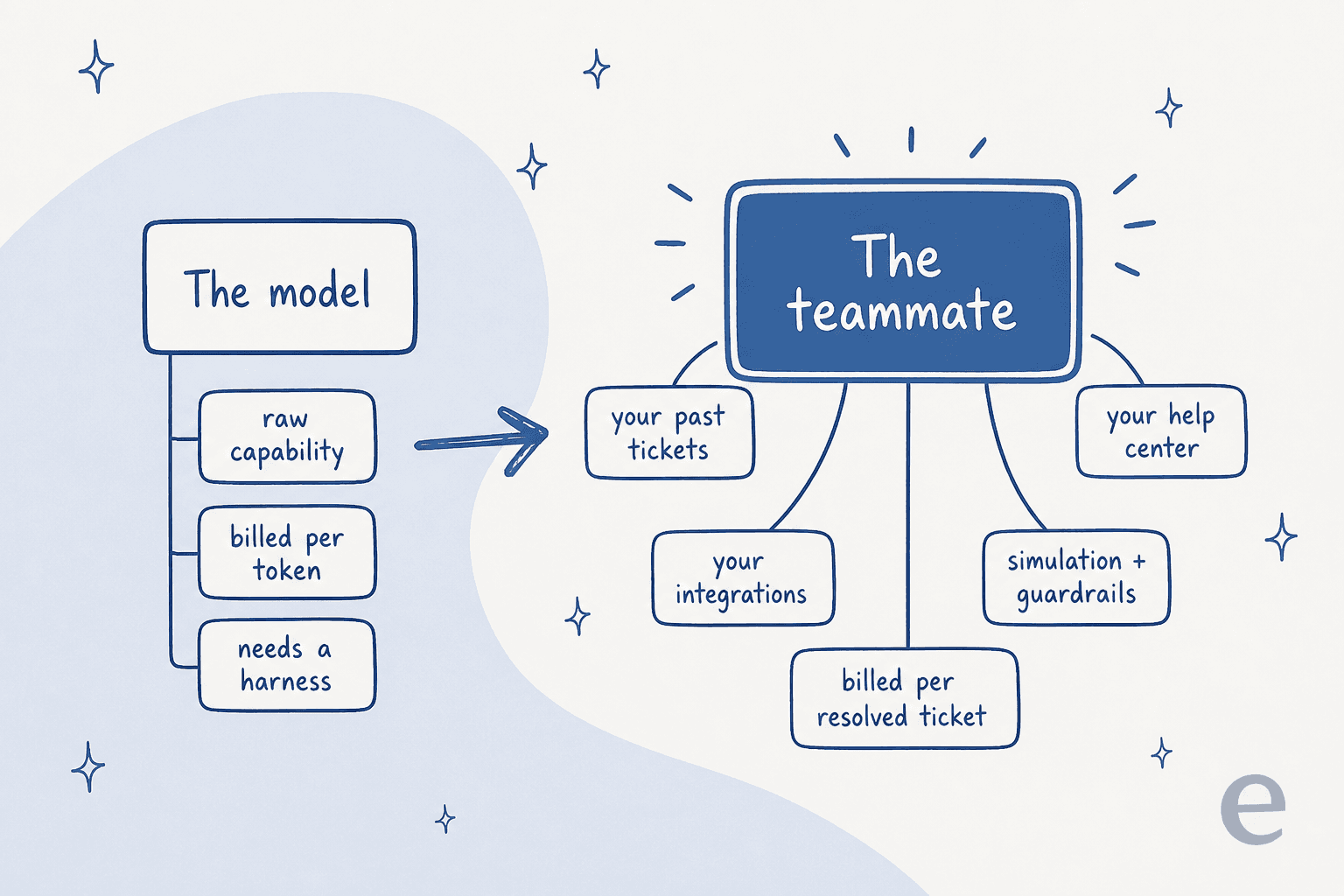
The unit that actually matters for a support team is cost per ticket, not cost per token. A token bill is unpredictable: it moves with prompt length, retries, and how chatty the model is on any given day. We have spent years putting AI agents on live support queues, and the lesson that keeps repeating is that teams want to know what handling a ticket costs, full stop, not what a million output tokens costs before they have worked out how many tokens a ticket even takes. That is the gap between a model and a system built around it: your knowledge, your integrations, safe actions, and a way to simulate it on your history before go-live.
This is also why I would not re-platform your support automation the week a new model ships. The best AI helpdesk agents and customer service tools are model-flexible by design, so when a genuinely better model lands, you inherit the upgrade without rebuilding anything, and without renegotiating your budget around a new token rate.
Try eesel
If your interest in Astra's price is really "what will an AI cost me to actually resolve tickets," that is the job an AI teammate is built for, and it is where eesel sits. GPT-6 Astra is the engine; eesel is the employee you hire to drive it. The AI helpdesk agent trains on your past tickets and help center, plugs into the helpdesk you already run instead of replacing it, and lets you simulate it against thousands of your real historical tickets so you see exactly how it will perform, and what it will cost, before it ever touches a live conversation.
The billing tells the story that Astra's token pricing cannot. Instead of paying per token to think, you pay from $299/month for 500 credits (1 credit per ticket or chat), however long each ticket runs, with no per-seat fees, so the cost tracks outcomes rather than model chatter. You can start free with 100 credits and no card, point it at a slice of your queue, and see the resolution numbers on your own tickets, which is a lot more decision-useful than any per-million-token chart.

GPT-6 Astra pricing is a real jump, and for autonomous computer use and security work the premium can be worth it. But for most support teams, the token rate was never the number that mattered. Getting a tested, connected, accountable teammate into your existing workflow, on a fixed monthly plan, is the part worth spending your budget on.