What GPT-6 Sol actually is
Let me set the frame before the benchmarks. OpenAI shipped GPT-6 Sol and GPT-6 Luna together on 22 September, slotting them under the Astra flagship that arrived on 3 September. The line OpenAI used is "build with Sol, scale with Luna": Sol is the capable mid-tier you develop against, Luna is the ultra-cheap tier you fan out to at volume.
If you just want the plain spec-and-price rundown without a verdict, my GPT-6 Sol overview and GPT-6 Sol pricing posts cover that. This review is about whether it's actually good.
On paper, Sol is a serious model. It carries a 1,050,000-token context window, 128K max output, an April 2026 knowledge cutoff, and the full Responses API tool set: web and file search, code interpreter, a hosted shell, computer use, and MCP. Reasoning effort runs across six levels, from none up to max, with medium as the default. It takes text and image in, text out.
I build AI agents for a living, so the spec I care about most is not the headline context number, it's how the model behaves once it's inside an agent loop. And that's where the interesting part of this review lives, because the benchmark story and the behavior story point in slightly different directions.
I've spent the last three-plus years putting AI on live support queues, watching model after model land in production. The pattern almost never changes: the launch chart says one thing, and the shipped experience says another. So rather than take "the next generation" framing at face value, I read GPT-6 Sol as two separate things bundled into one launch, a small intelligence update and a big pricing update.
The two stories inside one release
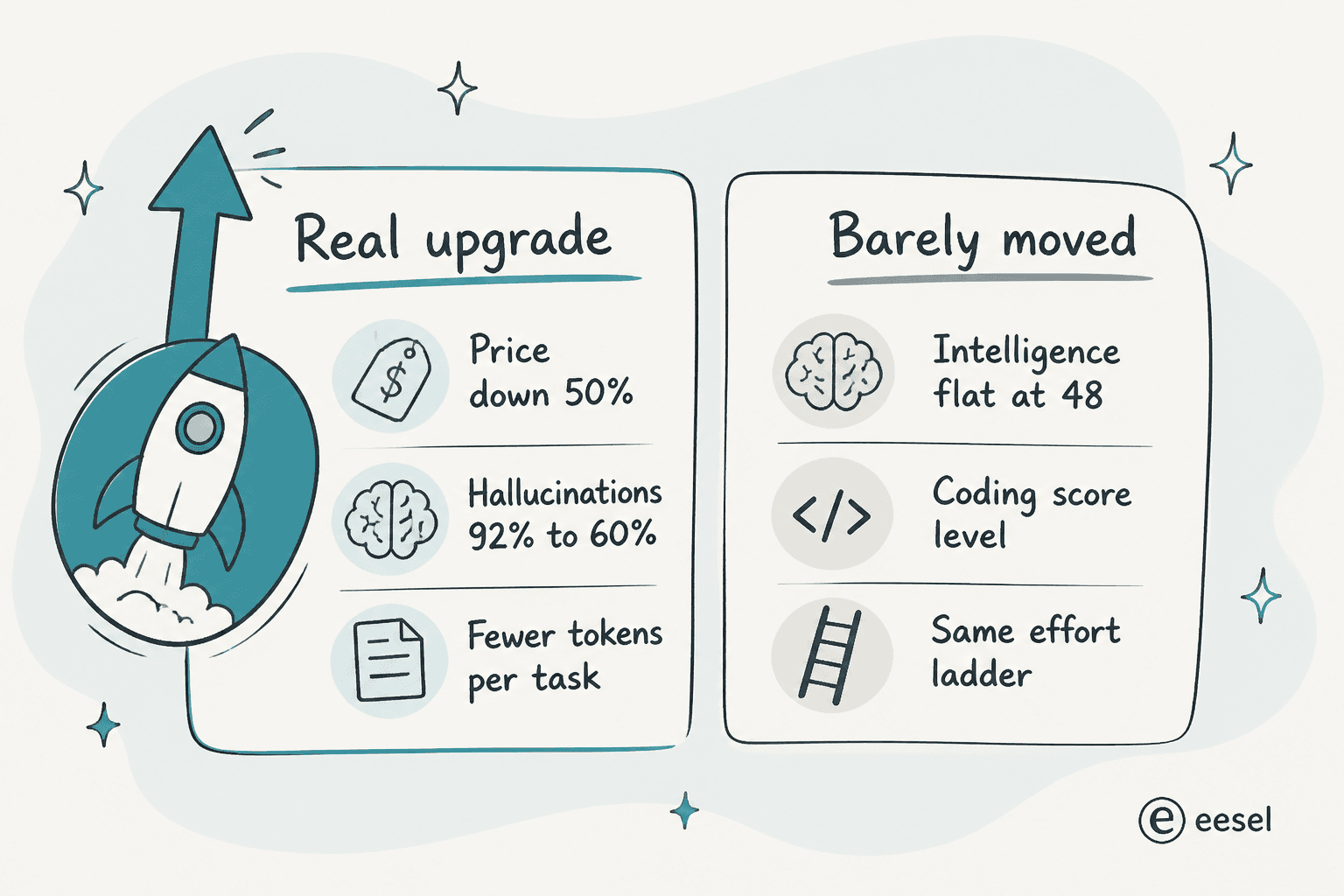
Story one is the one OpenAI leads with: Sol got dramatically cheaper. At $2/$10 it undercuts GPT-5.6 Sol by half, and Artificial Analysis measured the cost to run its whole Intelligence Index at $1.06 per task, about 50% less than GPT-5.6 Sol at $1.99. Cached input drops to $0.20, a 90% discount. For anyone running real volume, that is the entire pitch, and it's a strong one.
Story two is the one buried in the same benchmark table: the intelligence didn't really move. On the AA Intelligence Index, GPT-6 Sol at max effort scores 48, which AA describes as level with GPT-5.6, "progress in some evals, regressions in others." The Coding Agent Index tells the same story: roughly flat, at a lower price.
There is one real capability win, and it's worth naming clearly because it's easy to skim past: factuality. OpenAI says Sol makes about half the mistakes of GPT-5.6 Sol, and AA's max-effort hallucination rate backs that up, falling from around 92% to 60%. For anyone using the model to answer real questions rather than write throwaway code, fewer confident wrong answers is arguably worth more than another point or two of raw reasoning.
"Overall, I expect for most people think the winner of today was Anthropic. I personally am preferring Opus 5.5 at medium over GPT-6 Sol Max, in very very early tests. Similar price range, more capability."

That comment is fair, and it's the honest counter to Sol: if you have the budget, a smarter model exists. But it also compares Sol at max effort to Opus at medium, and as another reader pointed out in reply, those aren't equivalent settings. Which brings me to the part of this review I think matters most.
How it actually behaves in an agent
Raw scores don't capture what a model is like to work with. Two behaviors came up again and again in developer reaction, and both match what I've seen wiring OpenAI models into agent loops.
The first is token efficiency. GPT-6 Sol uses about 31k output tokens per task on the AA index, against roughly 119k for Opus 5.5. That is close to 4x fewer tokens to reach a similar-ish answer, which is a big part of why it feels fast and why the bill stays low. It's also the quiet reason a "cheaper per token" model can be even cheaper per finished task than the sticker price suggests.
The second is over-eagerness, and here Sol has a genuine downside:
"OpenAI models are also much more eager than Anthropic, which are on the lazier side. Left unsupervised, Sol/Astra will attempt to build a sha256 verified rocket ship if you ask them to fix a race condition in your to-do list app."
I laughed at that because it's accurate. Point Sol at a small task without tight scoping and it will happily over-engineer. In an agent, that means you lean harder on your instructions and guardrails than you would with a lazier model. It's not a flaw exactly, it's a personality, but it's one you have to design around.
The flip side of that personality is prose. Dan Shipper of Every put the writing difference plainly:
"Sol improves on GPT-5.6—including better Ruby code in @kieranklaassen tests—but Opus 5.5 has the higher ceiling for long, autonomous builds."
His full take is the cleanest summary of the whole matchup I've read: Sol writes clean, minimal prose and puts the important idea first, while it's Opus that has the higher ceiling for long autonomous work. That's the trade in one sentence.
The effort ladder is the real decision
Here's the thing most Sol reviews skip: with six reasoning levels, "how good is GPT-6 Sol" is the wrong question. The right one is "how good at which effort, for what cost."
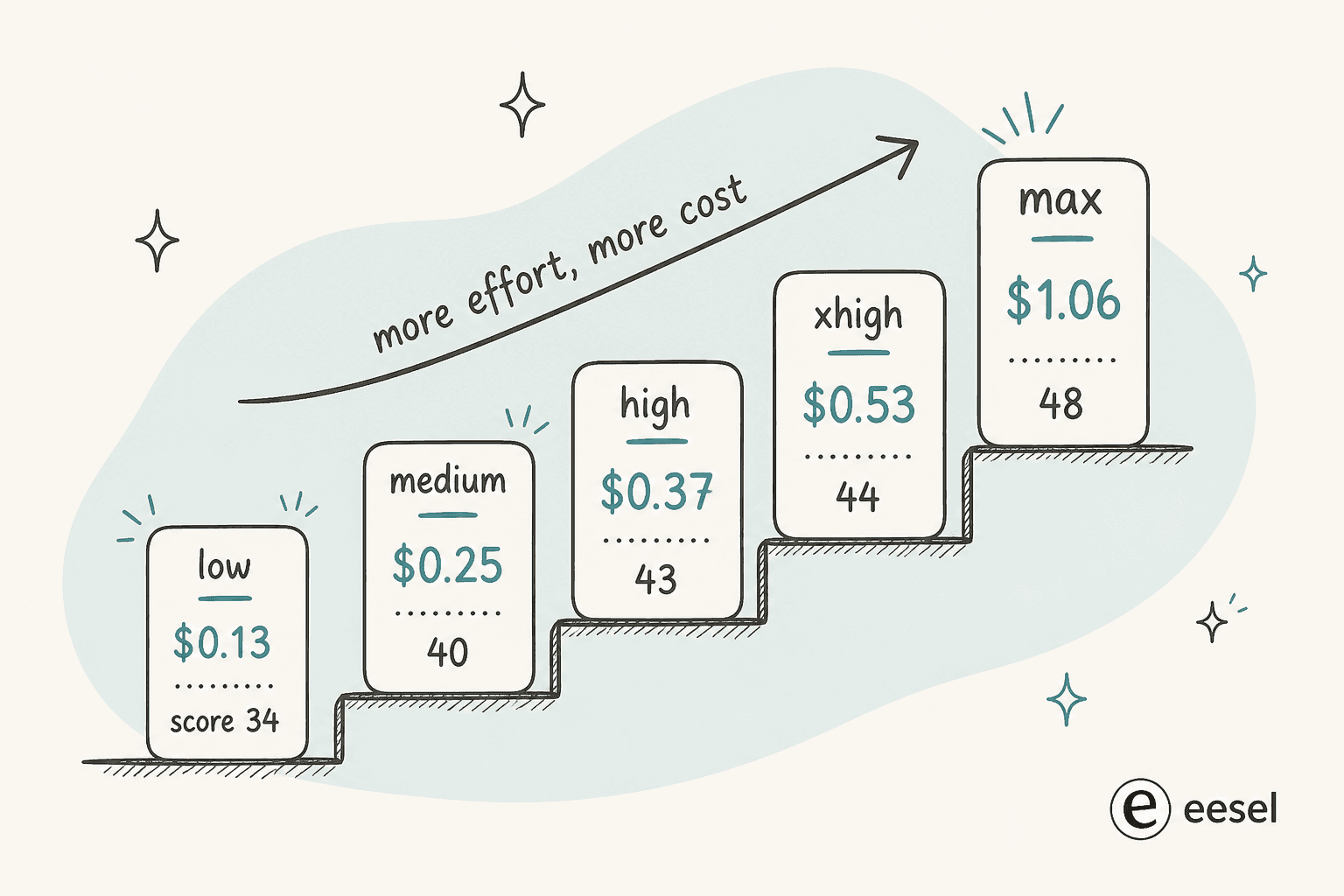
AA published the full effort curve, and the spread is wide. Low effort scores 34 at $0.13 per task; max effort scores 48 at $1.06. That's an 8x cost swing for 14 points of index. For a lot of real work, the middle of that ladder is the sweet spot, not the top. The picker below is the mental model I use when deciding which level to reach for.
Which GPT-6 Sol effort level?
Pick the job. Scores and cost-per-task are from the Artificial Analysis Intelligence Index.
This is also where the honest ceiling caveat lives. Even at max, Sol's 48 sits below Opus 5.5's 58 and below OpenAI's own Astra. If your work genuinely needs the top of the market, Sol isn't it. But most work doesn't, and that gap is exactly what you're paying half price to skip.
Pricing: the actual reason to care
I'll be blunt: the pricing is the review. Here's how Sol sits against its siblings and its nearest rival.
| Model | Input / output (per 1M) | Cached input | AA Intelligence | Cost per AA task |
|---|---|---|---|---|
| GPT-6 Luna | $0.10 / $0.50 | $0.01 | not listed | n/a |
| GPT-6 Sol | $2 / $10 | $0.20 | 48 | $1.06 |
| GPT-6 Astra | $10 / $50 | $1.00 | ~61 | higher |
| Claude Opus 5.5 | $4 / $20 | $0.20 | 58 | $5.98 |
Two things stand out. First, Sol is half the price of Opus 5.5 on tokens, which one reader used to argue they're not even in the same tier. Second, and this is the part that surprised me: because Sol burns so many fewer output tokens, its cost per finished task ($1.06) is closer to a fifth of Opus 5.5's ($5.98), not half. The per-token gap understates the real-world gap.
Two caveats keep it honest. Fast mode doubles the rate to $4/$20, and inputs above 272K tokens hit a long-context surcharge, which as one reader noted narrows Sol's price edge once you're feeding it huge contexts. If your workflow is genuinely long-context heavy, re-run the math. My GPT-6 Sol pricing post has the full tier table, and the Codex pricing guide covers how that translates inside the subscription rather than the API.
Who should actually use it
After all that, here's my plain recommendation.
Use GPT-6 Sol if you spend your day in Codex or the API doing everyday coding, drafting, and Q&A, and you want a fast, cheap, predictable model that doesn't burn tokens. If you were on GPT-5.6 Sol, this is a straight upgrade: same intelligence, half the cost, fewer hallucinations. It's my pick for a high-volume default.
Look elsewhere if you need the highest ceiling on long, autonomous, multi-hour builds, in which case Opus 5.5 or Astra earn their premium, or if your work is heavily long-context, where the surcharge eats the savings. And if you're an AI agent builder, remember that Sol's eagerness means tighter scoping and guardrails, not less.
For a full head-to-head on the frontier question, my GPT-6 Sol vs Opus 5.5 comparison and the critical GPT-6 Astra review go deeper than I can here, and the OpenAI models list maps the whole lineup.
The gap between a model and a hire
Here's the trap I watch teams fall into every launch week, and it's worth ending on. A benchmark-topping model is not a working teammate. GPT-6 Sol is a fast, cheap, capable engine, but it's still just an engine: point the raw API at your support queue and you own the retrieval, the guardrails, the helpdesk integration, the testing, and every wrong answer it confidently ships on day one.
That last part is where I've earned my scar tissue. We've watched a confident-sounding bot quietly give wrong answers on a live queue, which is exactly why every rollout now gets simulated against thousands of historical tickets before it touches a real customer. A raw model gives you none of that.
This is the distinction eesel is built on: a model is infrastructure, eesel is the employee. eesel is an AI teammate platform, and you hire ready-to-work teammates for specific jobs. The current roster is an AI helpdesk teammate and an AI blog writer, each arriving with the skills, integrations, and company context for its role. The helpdesk teammate joins your existing queue, learns from your past tickets, and bills per resolution, so you can measure it against the cost of a human agent instead of guessing. That's the difference between a raw conversational AI experiment and real support cost savings you can put a number on.

And if you're the kind of developer who liked Sol precisely because it lives in a terminal, eesel meets you there too. The eesel CLI drives the same teammate and workspace from the command line: a person can run it interactively, scripts can automate it, and coding agents like Claude Code, Codex, or Cursor can operate it headlessly. You can connect sources, push instructions, run a simulation over historical tickets, and check activity, all without opening the dashboard. It's the same agent-friendly, MCP-ready surface you'd want if you were building on Sol yourself, except the retrieval and guardrails are already done. You can try eesel free.
Frequently asked questions
The FAQ block above answers the most common GPT-6 Sol review questions, from pricing to how it compares against Astra and Opus 5.5. If you're deciding between models, start with the GPT-6 Sol vs Opus 5.5 comparison, then the best AI agents roundup if you're building something to actually resolve tickets rather than just answer prompts.
Frequently Asked Questions
Is GPT-6 Sol worth it over GPT-5.6 Sol?
How much does GPT-6 Sol cost?
Is GPT-6 Sol better than Claude Opus 5.5?
What is GPT-6 Sol best at?
How is GPT-6 Sol different from GPT-6 Astra?
Can I use GPT-6 Sol for customer support?
Is GPT-6 Sol available on the free plan?


Article by
Alicia Kirana Utomo
Kira is a writer at eesel AI with a Computer Science background and over a year of hands-on experience evaluating AI-powered customer service tools. She focuses on breaking down how helpdesk platforms and AI agents actually work so that support teams can make better buying decisions.