
Two launches, one afternoon
I build AI agents at eesel, and every frontier release means the same drill for me: rerun my evals, look at cost per finished job, and decide which work moves to the new model. This week that drill came twice in a row. Anthropic shipped Claude Opus 5.5 on September 22, and OpenAI followed within hours with GPT-6 Sol and Luna.
That timing matters for reading the launch posts. Anthropic's benchmark table compares Opus 5.5 against GPT-5.6 Sol and GPT-6 Astra, because GPT-6 Sol did not exist yet. OpenAI's table compares Sol against Claude Opus 5 and Claude Fable 5.1, not Opus 5.5. Neither vendor measured the other's new model. So for a fair head-to-head I lean on independent testing from Artificial Analysis, which ran both through the same harness.
Are they even the same class? Some readers think not, since Sol costs half as much. One HN commenter put the opposite view plainly:
"Sol is OpenAI's Opus, and Astra is OpenAI's Fable. Both pricing-wise, and performance-wise."

I agree with that mapping. Each is its vendor's "use this by default" model, one tier under the flagship. That is exactly why developers are choosing between them this week.
What each model is
GPT-6 Sol
GPT-6 Sol is the middle of OpenAI's GPT-6 family, between the cheap GPT-6 Luna and the flagship Astra. OpenAI's own line is "Build with Sol. Scale with Luna." The headline is price: $2 in and $10 out per million tokens, a flat 50% cut from GPT-5.6 Sol. Artificial Analysis puts its intelligence about level with GPT-5.6 Sol, with the real quality gain in factuality.
The model page lists six reasoning settings from none to max, with medium as the default, and the full Responses API tool set: web and file search, code interpreter, hosted shell, computer use and MCP.
Claude Opus 5.5
Claude Opus 5.5 is Anthropic's efficiency pass on Opus 5. It is the first Opus to get cheaper, down 20% to $4/$20, and Anthropic now recommends starting with it for most work instead of treating Opus as the premium last resort. The default effort dropped from high to medium, thinking is always on, and the Opus 5.5 docs list a June 2026 cutoff.
Anthropic pitches it at Fable 5.1 quality on most work. Artificial Analysis currently ranks it #1 of 212 models on its Intelligence Index.
Specs and price side by side
Most of the spec sheet is a draw. The difference is almost all in the price column.
| GPT-6 Sol | Claude Opus 5.5 | |
|---|---|---|
| API model ID | gpt-6-sol | claude-opus-5-5 |
| Input / output per 1M tokens | $2 / $10 | $4 / $20 |
| Cache reads per 1M | $0.20 | $0.20 |
| Batch API | 50% off ($1 / $5) | 50% off ($2 / $10) |
| Long-context surcharge | 2x input, 1.5x output above 272K | None |
| Context window | 1,050,000 tokens | 1M tokens |
| Max output | 128,000 tokens | 128K (300K on Batch beta) |
| Knowledge cutoff | April 20, 2026 | June 2026 |
| Default effort | Medium | Medium |
| Can turn reasoning off | Yes (none) | No, thinking always on |
| Input / output | Text + image in, text out | Text + image in, text out |
Two rows deserve attention. First, cache reads cost the same on both. If your workload is a big, stable system prompt plus short questions, a lot of your input bill is identical. Second, the long-context row. Past 272K input tokens Sol's input price doubles, so on huge-context jobs the 2x gap closes fast. As one HN user noted:
"Once you exceed 272K input tokens, Codex Sol is roughly the same price as Opus; and Astra similar to Fable."
For the full rate cards, including Fast mode and regional pricing, see my GPT-6 Sol pricing breakdown and its Opus 5.5 counterpart. The wider OpenAI API vs Anthropic API comparison covers both platforms.
The benchmarks: Opus 5.5 wins almost every row
Artificial Analysis ran both at max effort through the same harness. This is the cleanest head-to-head available right now.
| Benchmark (Artificial Analysis, max effort) | GPT-6 Sol | Claude Opus 5.5 |
|---|---|---|
| Intelligence Index | 48 | 58 |
| GDPval-AA v2.1 (Elo, real work tasks) | 1487 | 1846 |
| AA-Briefcase v1.1 (Elo) | 1483 | 1822 |
| AutomationBench-AA | 62% | 70% |
| Terminal-Bench 4.0 | 44% | 60% |
| SciCode | 58% | 67% |
| Humanity's Last Exam | 48% | 61% |
| AA-LCR (long-context reasoning) | 84% | 85% |
| CritPt | 31% | 32% |
| AA-Omniscience Index | 27 | 46 |
| Hallucination rate (lower is better) | 60% | 58.6% |
The big gaps are on the work that looks most like a real job: GDPval-AA by 359 Elo points, Terminal-Bench by 16 points, and the Intelligence Index by 10. The small gaps are telling too. Long-context reasoning and CritPt are within a point, and hallucination rates are nearly identical. Sol's big factuality improvement over GPT-5.6 got it level with Opus on hallucination rate, though Opus still knows more, with 46 to 27 on the Omniscience Index.
A few honest caveats on the numbers. Anthropic reports Opus 5.5 at 66.4% on Terminal-Bench 4.0 with its own setup at xhigh effort, higher than the 60% Artificial Analysis measured; for comparing against Sol, the independent pair is fairer. OSWorld 2.0 numbers from the two vendors (60.5% for Sol, 81.8% for Opus) use different test sets, so I would not read a gap into them. And there is no Opus 5.5 score on DeepSWE yet, where Sol posts 68.8% and 69.0% inside Codex on the Coding Agent Index.
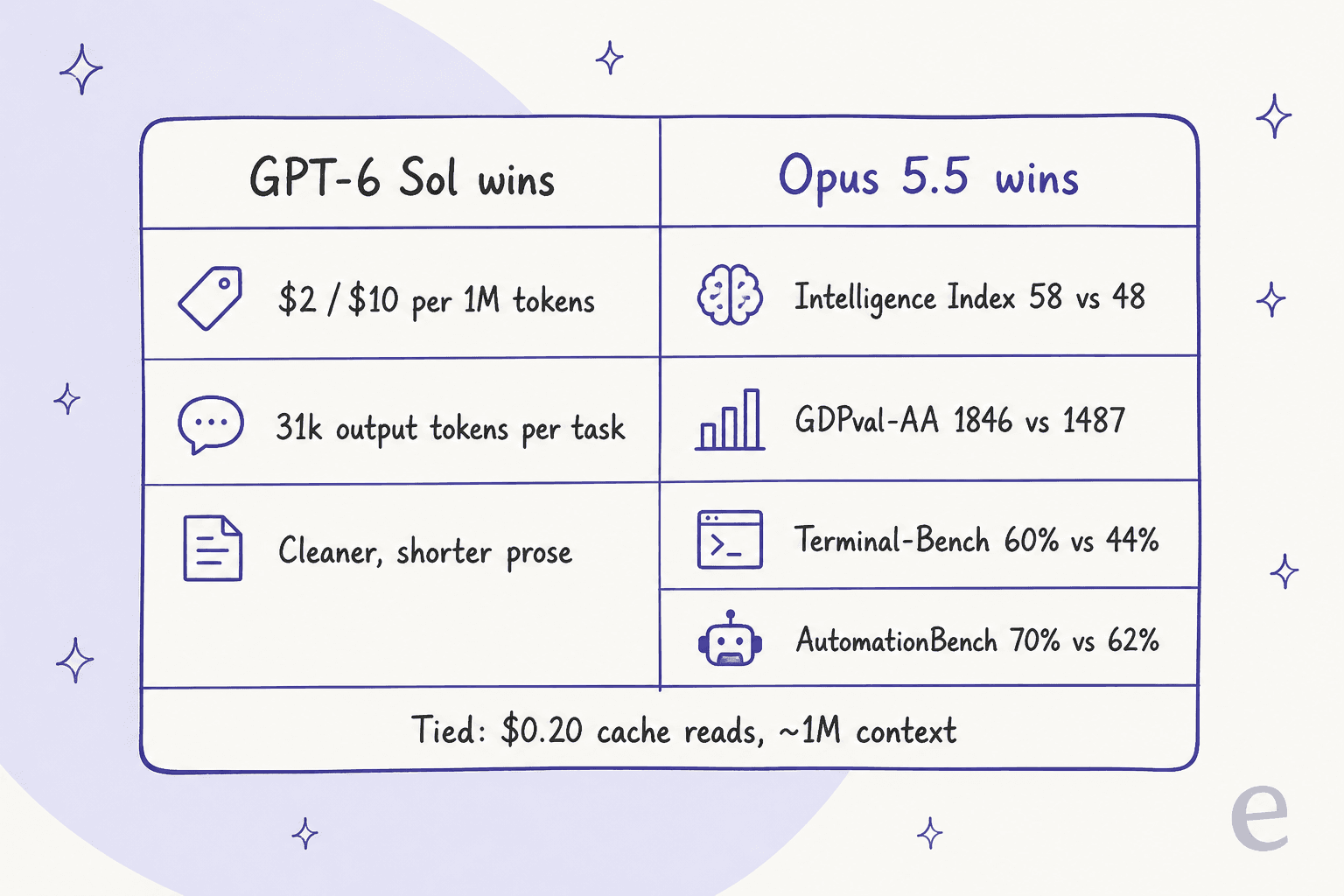
The pattern in that scorecard is the whole story in one picture: Opus 5.5 wins the capability rows, Sol wins the cost rows. Which one matters more depends on what a mistake costs you.
The part most comparisons miss: cost per task, not per token
Per-token price is the number on the pricing page. Cost per finished task is the number on your invoice. They can be very different, because models spend very different amounts of tokens to reach an answer.
On the Artificial Analysis index, at max effort:
| Per task, max effort | GPT-6 Sol | Claude Opus 5.5 |
|---|---|---|
| Output tokens per task | ~31k | ~119k |
| Cost per task | $1.06 | $5.98 |
| Total cost to run the full index | $1,550 | $8,708 |
So the 2x sticker gap becomes a 5.6x per-task gap at max. That is a surprise, given that Opus 5.5's pitch is efficiency. The efficiency claim is real against Opus 5 at the same effort, but at max effort Opus 5.5 thinks a lot. Artificial Analysis measured it using more output tokens per task than Opus 5, Fable 5.1 or GPT-6 Astra:
"Opus 5.5 (max) uses ~119k output tokens per Intelligence Index task, against ~73k for Opus 5 (max), ~78k for Fable 5.1 (max) and ~27k for GPT-6 Astra (max)"
Here is where it flips back. Effort labels do not mean the same thing across vendors, so comparing "max vs max" is not really fair. Line them up by cost instead, using the per-effort numbers on the Artificial Analysis release pages for each model:
| Effort | GPT-6 Sol score / cost per task | Opus 5.5 score / cost per task |
|---|---|---|
| low | 34 / $0.13 | 42 / $0.55 |
| medium | 40 / $0.25 | 51 / $1.34 |
| high | 43 / $0.37 | 54 / $1.82 |
| xhigh | 44 / $0.53 | 56 / $3.46 |
| max | 48 / $1.06 | 58 / $5.98 |
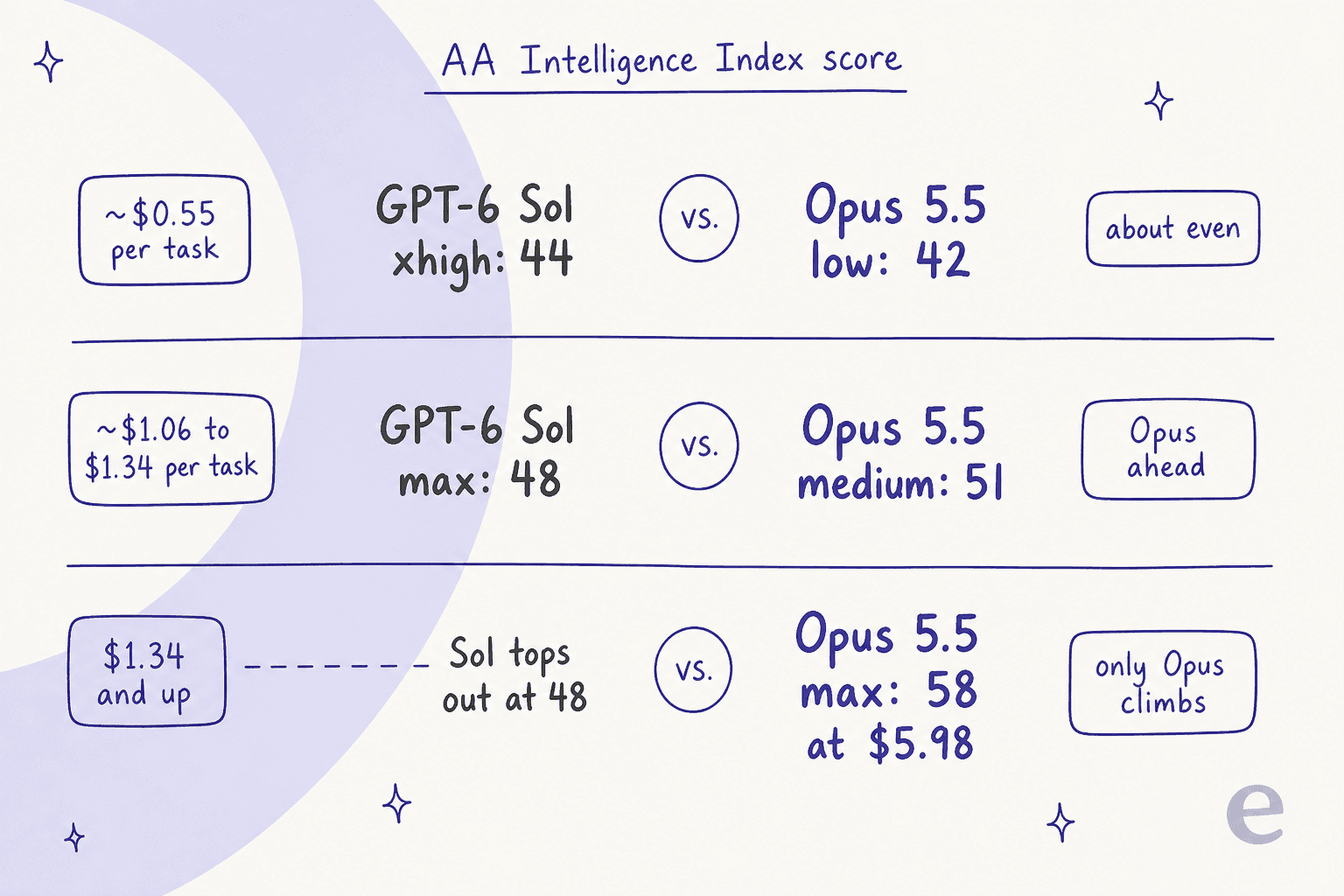
Read the table this way:
- Under about $0.55 a task, they are even. Sol at xhigh (44) and Opus at low (42) cost almost the same. Below that, only Sol goes cheaper: 40 points for a quarter.
- Around a dollar a task, Opus pulls ahead. Opus 5.5 at medium scores 51 for $1.34, three points above Sol's best effort for about 26% more money.
- Above that, only Opus keeps climbing. Sol's ceiling is 48. If you need more, Opus is the only one of the two that has it, all the way to 58.
That lines up with what early users said. One HN commenter:
"I personally am preferring Opus 5.5 at medium over GPT-6 Sol Max, in very very early tests. Similar price range, more capability."
A reply pushed back that the fairer pairing is Opus medium against Sol high. At that pairing Sol costs $0.37 a task to Opus's $1.34, so it becomes a question of whether 8 more points are worth 3.6x the bill. For bulk work, usually not. For a hard agentic run where a failed attempt means a rerun, often yes.
Want to see what that means for your own volume? Plug in your numbers. The costs come from Artificial Analysis' per-task results, so treat them as a relative guide: your tasks will be shorter or longer than theirs.
How they feel to work with
Benchmarks tell you the ceiling. Daily use tells you what the default experience is like, and here the early reports split along a clear line.
The most useful hands-on read so far is from Dan Shipper at Every, who tested both on real work. On coding he gave Opus the edge:
"Sol improves on GPT-5.6—including better Ruby code in @kieranklaassen tests—but Opus 5.5 has the higher ceiling for long, autonomous builds."
In the same post he found Sol's writing cleaner, putting the important idea first, while Opus 5.5 drafts still tend to bury the point. His verdict split by job: Sol for a day spent "reading, writing, and getting things done" in Codex, Opus 5.5 when you "hand an agent a hard coding or visual project and see how far it can take it."
Behaviour differs too. Sol tends to do more than you asked; Claude tends to do what you asked and stop. One HN developer described the OpenAI side vividly:
"OpenAI models are also much more eager than Anthropic, which are on the lazier side. Left unsupervised, Sol/Astra will attempt to build a sha256 verified rocket ship if you ask them to fix a race condition in your to-do list app."
Verbosity is the open question on Opus 5.5. Some users say it finally reads plainly, others say it is as wordy as Opus 5. The token counts above suggest both can be true: short visible answers, long hidden thinking at high effort. If that thinking is what you pay for, set the effort dial on purpose instead of leaving it at max.
Subscription limits are contested as well. On HN one user said a Codex week lasted one to two days of semi-heavy, single-agent Sol High use, while another said Codex wins on usage "by a mile." If you live inside Claude Code or Codex rather than the API, test your own week before you switch plans.
Which one should you use?
Here is how I would split the work, based on the numbers above.
| If your job is... | Use | Why |
|---|---|---|
| High-volume classification, extraction, routing | GPT-6 Sol at low or medium | 40 points for $0.25 a task, and it can turn reasoning off entirely |
| Everyday drafting, summaries, short answers | GPT-6 Sol | Cheaper per task, cleaner prose by early accounts |
| Long autonomous coding runs, multi-step agents | Claude Opus 5.5 at medium | Beats Sol's best score for about 26% more per task |
| The hardest reasoning where a miss is expensive | Claude Opus 5.5 at high or max | Only option that goes past 48 |
| Huge context (over 272K tokens) | Claude Opus 5.5 | No long-context surcharge, so the price gap mostly disappears |
| Big stable prompts, lots of cache hits | Either | Cache reads are $0.20 on both |
The mistake I would avoid is picking one for everything. Both vendors now make routing easy, and the cost curves say the cheapest good answer comes from Sol at the low end and from Opus at the high end. If you are already on the OpenAI stack, GPT-6 Luna is worth a look for the very cheap tier. On the Anthropic side, Claude Sonnet 5 plays the same role, as my Opus 5 vs Sonnet 5 breakdown shows.
For a wider view, the OpenAI models list covers the rest of OpenAI's lineup, and my Anthropic API pricing guide does the same for Claude.
If the model is going to answer your customers
A lot of people comparing these two are really asking a different question: which one should power our support bot? Here, the benchmark gap matters less than you would think.
A frontier model is infrastructure. To resolve a ticket it also needs your help center and past tickets to ground its answers, actions in your helpdesk (tag, route, refund, look up an order), guardrails for when to hand off, and a way to test all of that before real customers see it. That last part is where most DIY bots fail. At eesel I have watched confident-sounding answers turn out wrong in testing, which is why eesel simulates every rollout against historical tickets before it goes live.
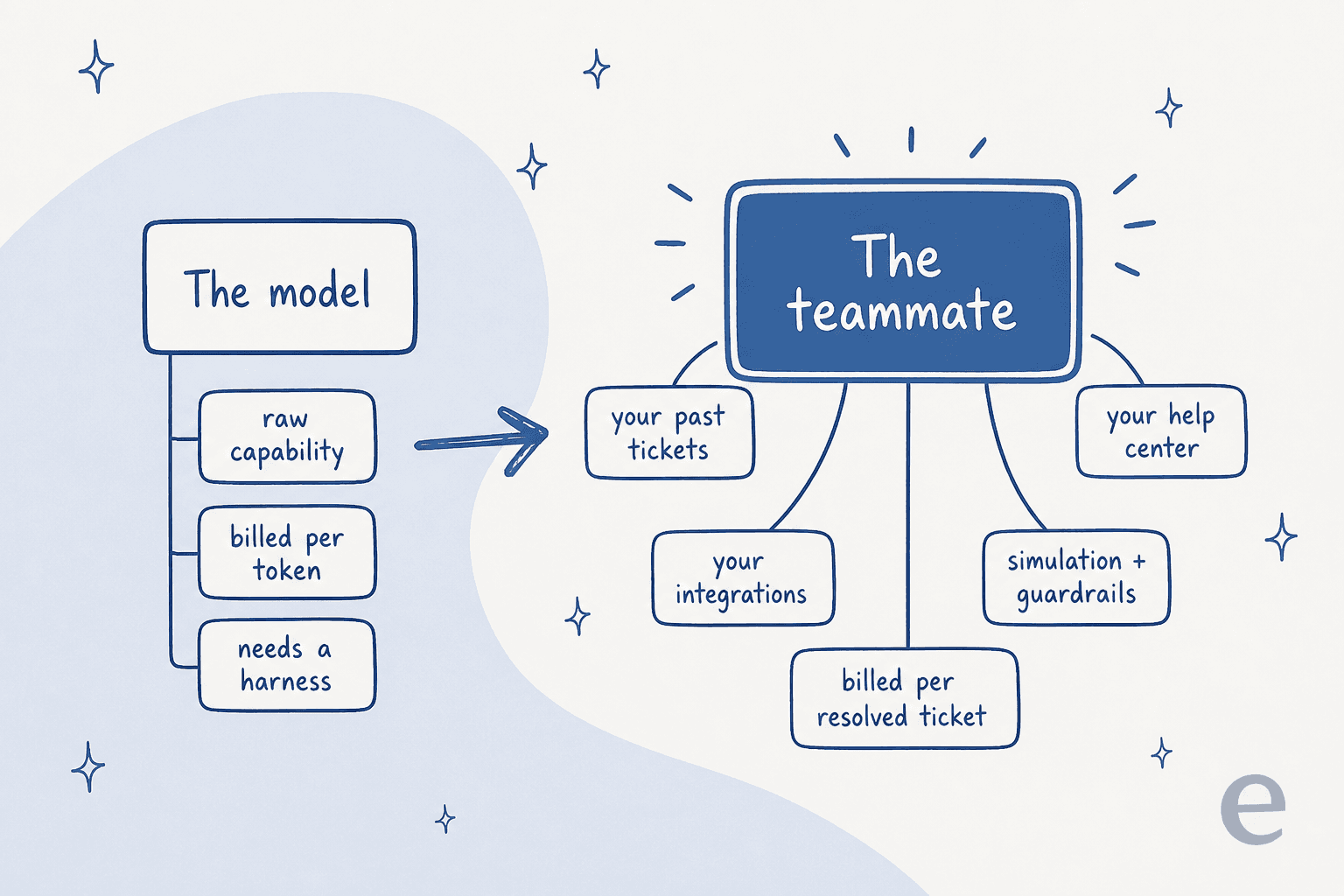
That is why I think of eesel as the employee and the model as the engine. The AI helpdesk teammate plugs into tools like Zendesk, Freshdesk and Gorgias, learns from your past tickets, and bills per resolved ticket rather than per token, so the Sol-vs-Opus token math is not your problem.
If you want to compare options first, my best AI helpdesk software roundup is a good starting point, and this AI vs human cost breakdown shows the math per ticket.
For the technical reader who found this post through a model comparison: the same teammate is also scriptable. The eesel CLI (npm i -g @eesel/cli) lets you connect integrations, edit the agent's standing instructions, read every run with eesel activity, and approve or deny pending actions from the terminal. Every command prints JSON and supports --dry-run, so Claude Code or Codex can drive it. Each workspace is also an MCP server, so you can manage AI agents from your terminal with whichever of these two models you pick.
Try eesel
If you are weighing GPT-6 Sol against Opus 5.5 because you want AI answering support tickets, you can skip the model shoot-out. eesel's AI helpdesk teammate joins your existing helpdesk, learns from your past tickets and help center, and gets tested against your real ticket history before it replies to a single customer. You pay per resolved ticket, not per token.
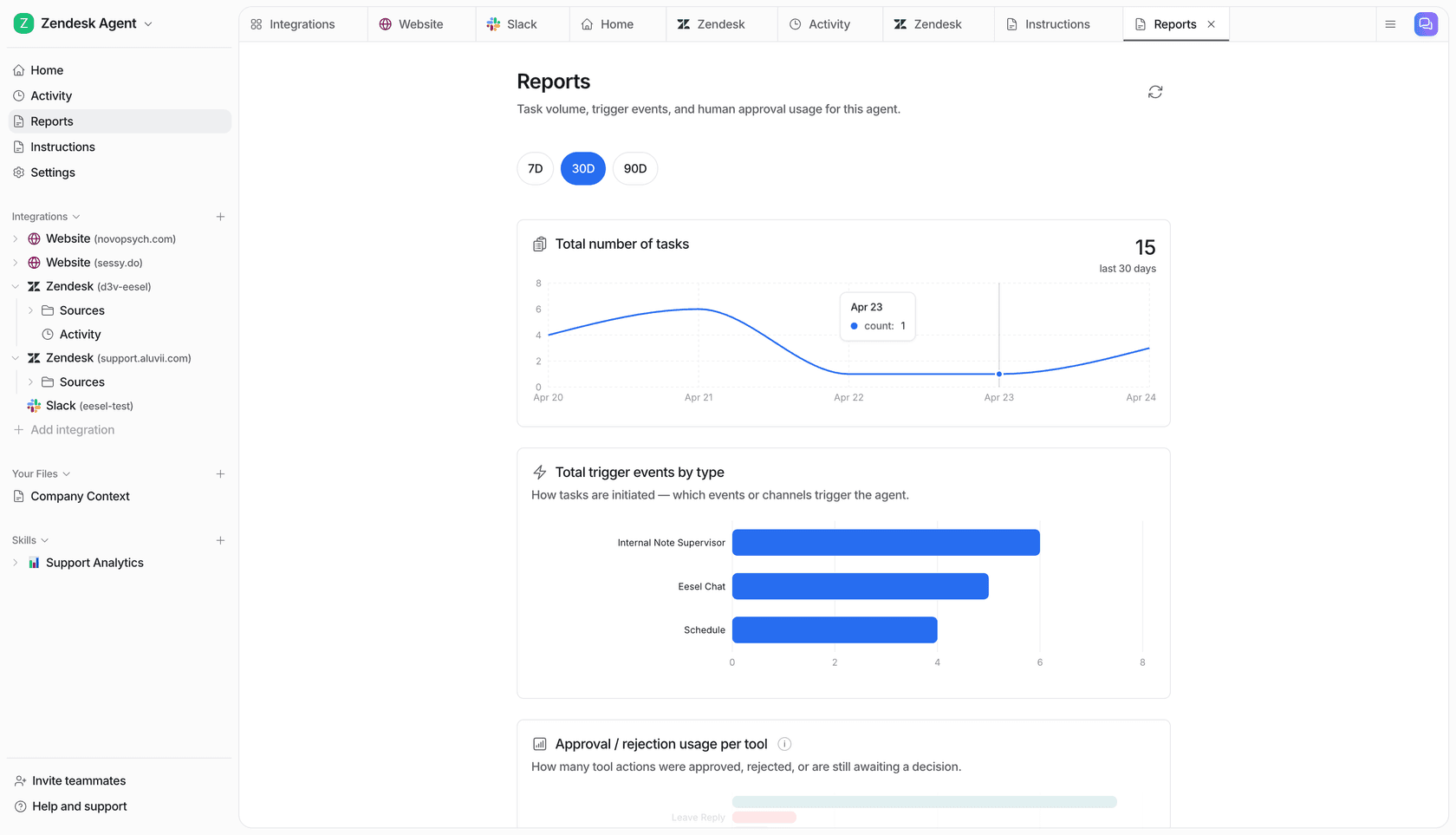
Try eesel free and see it run on your own tickets.
Frequently Asked Questions
Is GPT-6 Sol better than Claude Opus 5.5?
How much does GPT-6 Sol cost compared to Claude Opus 5.5?
Which is cheaper per task, GPT-6 Sol or Opus 5.5?
Is GPT-6 Sol or Claude Opus 5.5 better for coding?
Which effort level should I compare GPT-6 Sol and Opus 5.5 at?
What are the context window and knowledge cutoff of GPT-6 Sol and Opus 5.5?
Can I use GPT-6 Sol or Claude Opus 5.5 for customer support?
Are GPT-6 Sol and Claude Opus 5.5 available in ChatGPT and Claude apps?


Article by
Alicia Kirana Utomo
Kira is a writer at eesel AI with a Computer Science background and over a year of hands-on experience evaluating AI-powered customer service tools. She focuses on breaking down how helpdesk platforms and AI agents actually work so that support teams can make better buying decisions.