

What GPT-6 Sol actually is
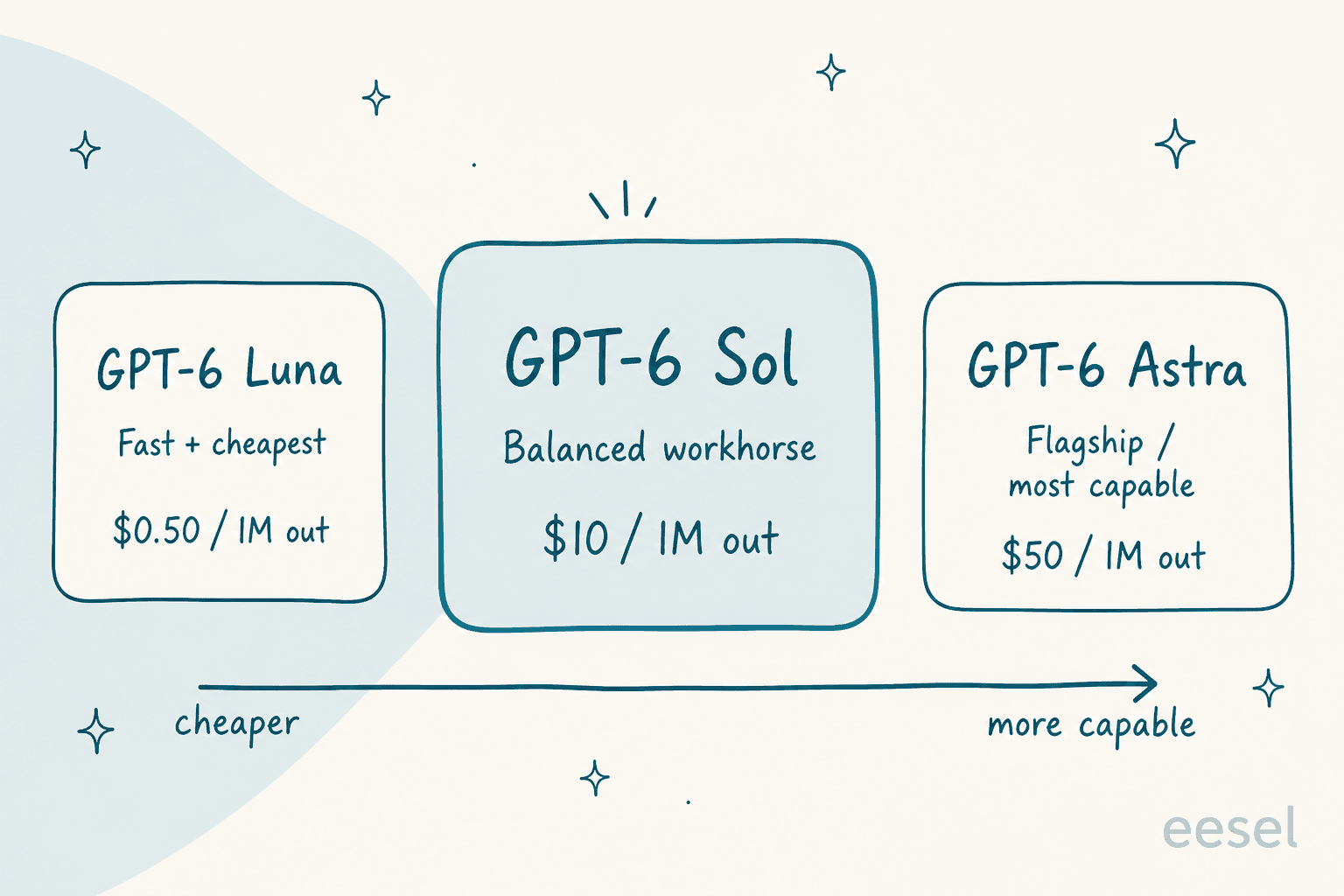
GPT-6 Sol is the balanced, mid-tier model in OpenAI's GPT-6 lineup. It launched together with the smaller GPT-6 Luna on 23 September 2026, three weeks after the GPT-6 Astra flagship. OpenAI's own one-liner tells you exactly how to think about the two new models: "Build with Sol. Scale with Luna." Sol is the everyday driver, Luna is the cheap high-volume option, and Astra is the frontier engine you reach for when a job actually needs it.
Under the hood, the model card gives you the specs that matter for building: the model id is gpt-6-sol, with a 1,050,000-token context window, 922K max input, 128K max output, and a 20 April 2026 knowledge cutoff. It takes text and images in and returns text, and reasoning effort runs from none up through medium (the default) to max. On the Responses API it ships with web search, a code interpreter, a hosted shell, computer use, and MCP support. In other words, the same tool surface as the flagship, at the workhorse price.
The one number that matters: it is half the price
Here is the reason GPT-6 Sol exists. On the API pricing page, Sol costs $2 per million input tokens and $10 per million output tokens at the standard tier, with cached input at $0.20 and cache writes at $2.50. That is a flat 50% cut from GPT-5.6 Sol's $4/$20.
Both new models got the same treatment. GPT-6 Luna drops to $0.10 in and $0.50 out. On OpenRouter the $2/$10 Sol rate was confirmed on day one, and the launch's clearest community verdict, from a top Hacker News comment, was blunt: "~equal performance for 0.5x the price." That is the whole product in a sentence.
If you want the full picture, including the Batch and Flex tiers that halve it again, the Fast mode tier that doubles it, and the long-context surcharge, I broke all of that down in the dedicated GPT-6 Sol pricing guide. The short version for this post: for most standard workloads, Sol is now the cheapest way to get last generation's intelligence out of OpenAI's API.
The benchmark reality check
This is where the launch framing and the numbers need to be separated, because "half the price" is only good news if the quality held.
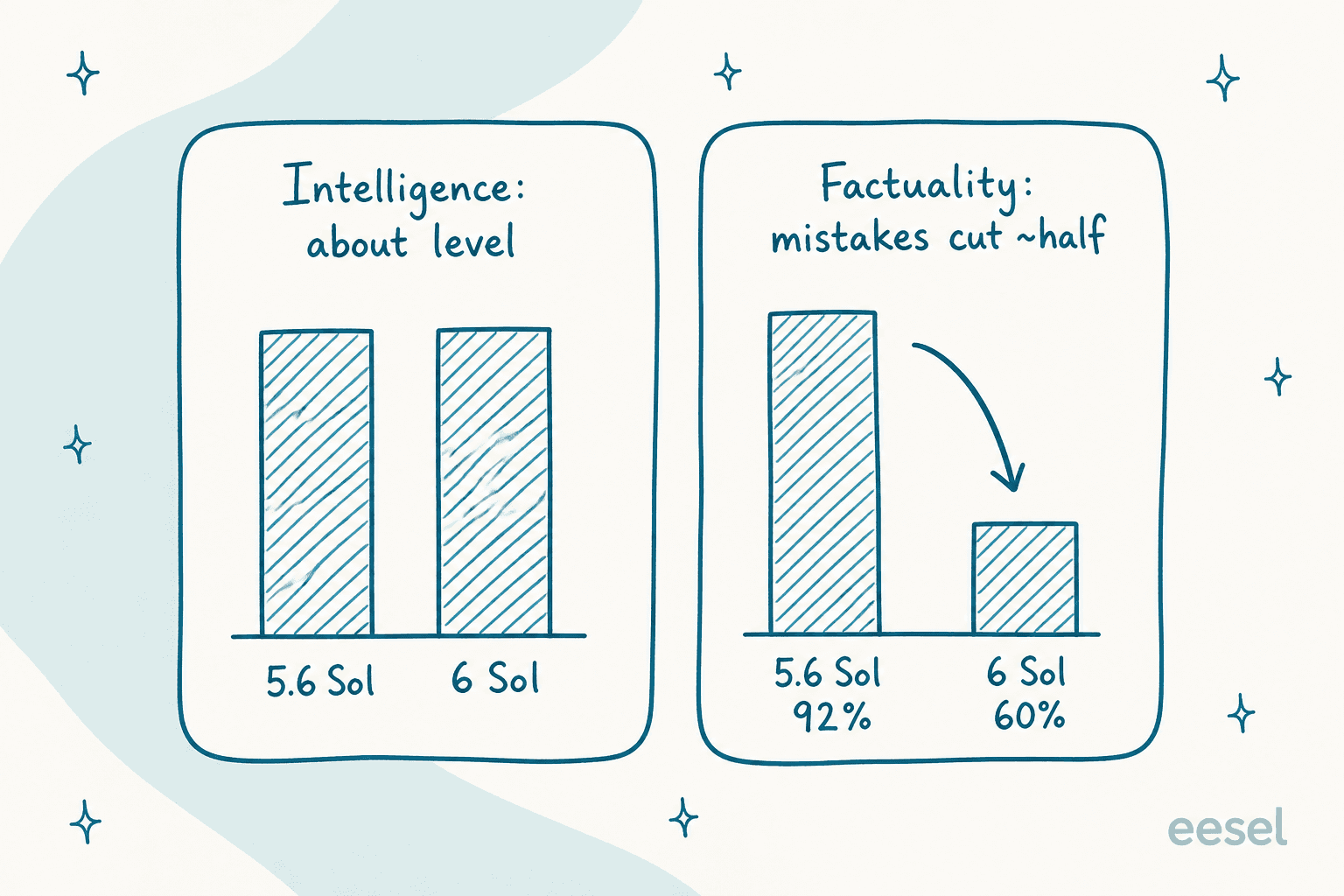
On general intelligence, it held roughly flat. Artificial Analysis reported that GPT-6 Sol lands level with GPT-5.6 Sol on both its Intelligence Index and its Coding Agent Index, with "progress in some evals, regressions in others." The agentic benchmarks tell the same modest story: AutomationBench-AA at 62 versus 60, Terminal-Bench 4.0 at 44 versus 40, and AA-Omniscience nudging from 22 to 27. These are point-release deltas, not a generational jump, and OpenAI does not pretend otherwise.
The genuine improvement is somewhere quieter: factuality. OpenAI says GPT-6 Sol makes roughly half the factual mistakes of GPT-5.6 Sol, approaching Astra's level. Independent max-effort testing put the hallucination rate down from 92% to 60% (Luna improved from 93% to 77%). For anything where a wrong-but-confident answer is expensive, and customer support is exactly that kind of work, fewer hallucinations at half the price is a better deal than a couple of benchmark points.
There is a fair caveat on the coding side. OpenAI's own DeepSWE v1.1 result puts Sol at 68.8%, within about a point of the best score from Anthropic's Fable 5, and at roughly 80% lower cost per task. So on price-per-result for coding agents, Sol is very competitive. It just gets there by being cheap, not by being smarter than what came before.
How GPT-6 Sol compares across the family
The cleanest way to place Sol is against its two siblings. Luna is the volume play, Astra is the frontier, and Sol is the one most teams should default to.
| Model | Input / Output (per 1M) | Context | Best for | On free ChatGPT? |
|---|---|---|---|---|
| GPT-6 Luna | $0.10 / $0.50 | 1,050,000 | High-volume, cost-sensitive jobs | Yes (Free + Go) |
| GPT-6 Sol | $2.00 / $10.00 | 1,050,000 | Everyday build-and-ship default | No (Plus and up) |
| GPT-6 Astra | $10.00 / $50.00 | 1,050,000 | Autonomous computer use, coding, security | No (Plus and up) |
Source: OpenAI API pricing. The pattern is deliberate: same giant context window across all three, a 5x output-price step at each tier, and a clear job for each. Most people reaching for Astra out of new-model reflex would get 95% of the value from Sol, which is precisely the decision OpenAI is nudging with "Build with Sol."
Which GPT-6 model should you actually use?
If you are choosing between the three for a real project, the answer usually comes down to what the job is, not which one is newest. Pick your use case below.
What are you building?
How to get access
GPT-6 Sol rolled out on launch day, but where you get it depends on how you work.
- API: the model id is
gpt-6-sol, on Responses and Chat Completions. There is no free-tier access, so Tier 1 is the floor, starting at 500 requests per minute. Standard rate limits scale with your usage tier. - ChatGPT and Codex: Sol is available to Plus ($20), Pro, Business, Enterprise, and Edu users, per the launch note. Free and Go ($8) users get Luna only, in the desktop app.
- Codex specifically: since Sol is the "build with" model, it slots naturally into agentic coding work, and the economics are friendlier than Astra for day-long sessions. If you are budgeting there, the Codex pricing breakdown is worth a look.
Access inside a ChatGPT subscription is a slightly better deal than the raw API cut suggests, since the 50% API drop compounds with existing plan allowances. But if you are wiring Sol into a product, the API is where the price story actually lands.
What GPT-6 Sol means for a builder
If you build with the API, the practical takeaway is simple: this is a free upgrade. Point your existing GPT-5.6 Sol integration at gpt-6-sol, and you get roughly the same output quality, fewer hallucinations, and a bill that just halved. There is very little reason not to, and the shared 1M context window means you are not giving anything up on the input side.
Where I would slow down is anywhere you were tempted to reach straight for Astra. The cost of an AI agent is dominated by output tokens on long tasks, and Astra is 5x Sol on output. Unless your workload is really the autonomous, multi-step kind Astra was built for, Sol will do the job for a fifth of the price. Model this on your own traffic before you commit, the same way you would weigh any AI customer support cost decision.
This is also where the eesel CLI is worth knowing about if you like operating from a terminal. It is an agent-friendly way to drive the same eesel workspace that the dashboard exposes: a person can run it by hand, scripts can automate it, and coding agents such as Claude Code, Codex, and Cursor can call it directly. So if you are the kind of builder who would rather point gpt-6-sol at a support workflow from the command line than click through a UI, that path exists, and it operates the same tested teammate rather than a separate bolt-on.
What it means if you run a support team
Here is where I want to be useful rather than breathless, because I build in this space and the honest answer is a little counterintuitive.
If you run customer support or internal ops, a cheaper, slightly more truthful model changes less than the launch suggests. A raw model like Sol is infrastructure. It is a capable engine, but out of the box it does not know your refund policy, it cannot see your last 50,000 tickets, it has no access to your order system, and it has no safe way to be tested against your real queue before it starts replying to customers. Most people conflate "the model got cheaper and more accurate" with "my support got better," and those are two very different projects.
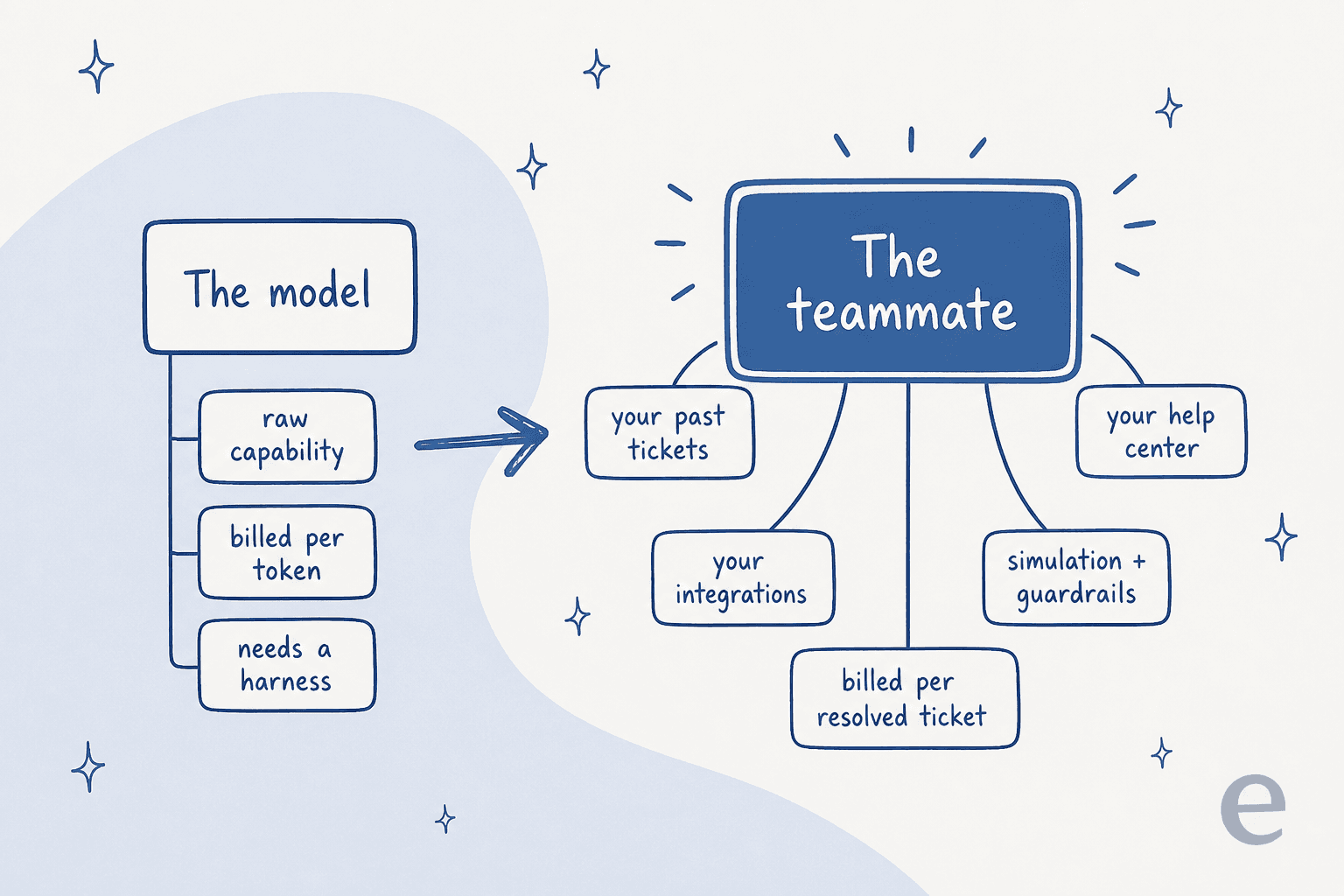
The work that actually moves resolution rate is the layer around the model: connecting it to your knowledge, wiring it into the helpdesk you already run, giving it actions it can safely take, and letting you simulate it on your own history before go-live. I have spent years putting AI on live support queues, and the lesson that keeps repeating is that a confident-sounding bot on a great model still needs to be tested against your real past tickets, because that is the only way to know how it will behave. A cheaper model with fewer hallucinations is a nice tailwind. It was never the whole job.
This is also why I would not rush to re-platform your support automation the week a new model ships. The best AI helpdesk agents and AI agents are model-flexible by design, so when a clearly better or cheaper model lands, you inherit the upgrade without rebuilding anything. The differentiator was never which model you bolted on. It is everything else.
Try eesel
If your real interest in GPT-6 Sol is "how do I get an AI that resolves more tickets, cheaply," that is the job an AI teammate is built for, and it is where eesel sits. GPT-6 Sol is the engine; eesel is the teammate you hire to drive it. The AI helpdesk agent trains on your past tickets and help center, plugs into the helpdesk you already run instead of replacing it, and lets you simulate it against thousands of your real historical tickets so you see exactly how it will perform before it touches a live conversation.
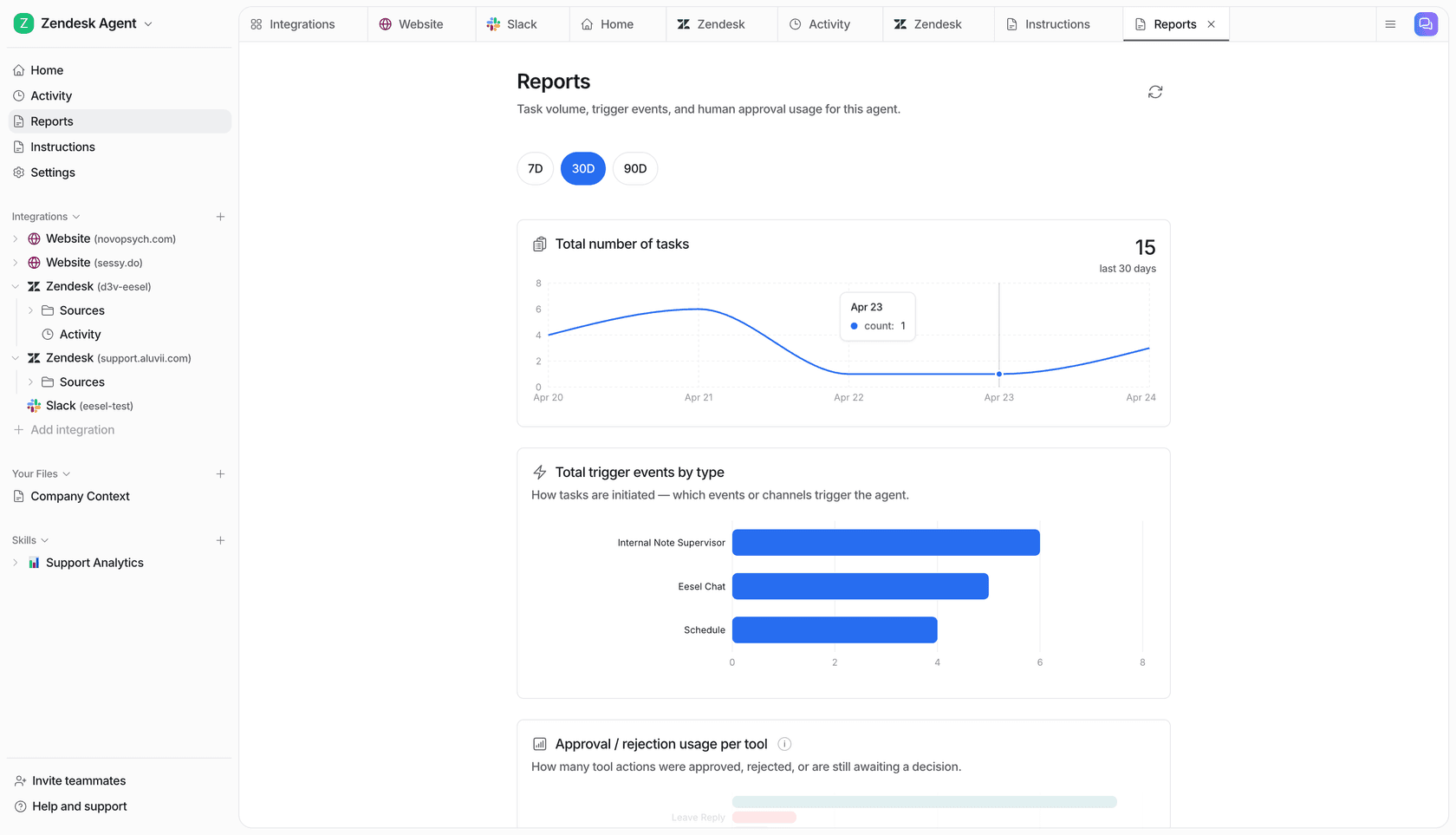
The billing tells the same story as the product. Instead of paying per token to think, you pay per resolved ticket it actually handles, with no per-seat fees and no platform minimum, so the cost tracks outcomes rather than model chatter. And because eesel is model-flexible, a cheaper, more accurate model like GPT-6 Sol is a benefit you inherit for free, not a migration you have to run.
GPT-6 Sol is a real, welcome release: the same intelligence as last generation, fewer mistakes, half the price. But for most teams, the model was never the bottleneck. Getting a tested, connected, accountable teammate into your existing workflow is, and that is the part worth spending your energy on. You can start free with no credit card, point it at a slice of your queue, and see the resolution numbers on your own tickets.
Frequently Asked Questions
What is GPT-6 Sol?
How much does GPT-6 Sol cost?
Is GPT-6 Sol better than GPT-5.6 Sol?
Is GPT-6 Sol available on the free plan?
What is the difference between GPT-6 Sol and GPT-6 Astra?
How do I access GPT-6 Sol on the API?
gpt-6-sol, available on the Responses and Chat Completions APIs with a 1,050,000-token context window and 128K max output. Standard OpenAI rate limits apply by usage tier, starting at 500 requests per minute on Tier 1. It supports web search, code interpreter, a hosted shell, computer use, and MCP.Should I switch my support automation to GPT-6 Sol?


Article by
Rama Adi Nugraha
Rama is a software engineer at eesel AI with two years of experience writing about B2B SaaS, AI tools, and customer support technology. Based in Bali, Indonesia, he brings a developer's perspective to product comparisons — cutting through marketing copy to what the integrations and APIs actually do.