
Why look past GPT-6.1 Sol at all
I want to be fair to 6.1 Sol first. It has earned that. OpenAI shipped it at DevDay on 29 September 2026, only seven days after GPT-6 Sol, and it replaced the older model on OpenAI's main pricing table. The sticker stayed at $2/$10. Cached input, though, dropped to $0.10 per million, which is half of what GPT-6 Sol charged. Artificial Analysis scores it 51.8 at max effort for $0.72 a task, about 1 point under GPT-6 Astra at 22% of Astra's cost.
That's a strong spot to be in, and Artificial Analysis said as much, pretty bluntly, on launch day:
"All effort levels of GPT-6.1 Sol push out the cost efficiency Pareto frontier: for a given level of intelligence, there is no cheaper model."
So why shop around at all? When I read the launch threads and ran my own tests, three reasons kept coming up.
It changed the API under you. 6.1 Sol only accepts low, medium, high, xhigh and max effort. I tried sending it none on 1 October and got back "Unsupported value: 'none' is not supported with the 'gpt-6.1-sol' model." Function calling in Chat Completions only works with none effort, which leaves any bot built on Chat Completions tool calls with two options: move to the Responses API, or stay on an older model.
It is slower. Artificial Analysis measured 67 tokens a second against 76 for GPT-6 Sol, and in my own test it took 4.1s a ticket at medium effort against 3.5s for the older model. That gap sounds small. It stops feeling small when a customer is sitting there waiting for the reply.
It is still one vendor, closed weights, no free tier. If compliance means you have to self-host, or you just want a second supplier on the books, 6.1 Sol can't help you there.
Someone on Hacker News caught the API change on day one:
"That seems likely, in the API GPT-6.1 Sol requires reasoning, just like Astra, whereas GPT-6 Sol (and Luna) allow "none""

What cost per task really looks like
Before the list, there's one chart worth a look, because it changes how you should read every sticker price below. I pulled the Artificial Analysis model pages for every alternative on 1 October 2026, which means every score here comes from one index on one day. People mix index snapshots from different weeks all the time and end up publishing nonsense. I didn't want to do that.
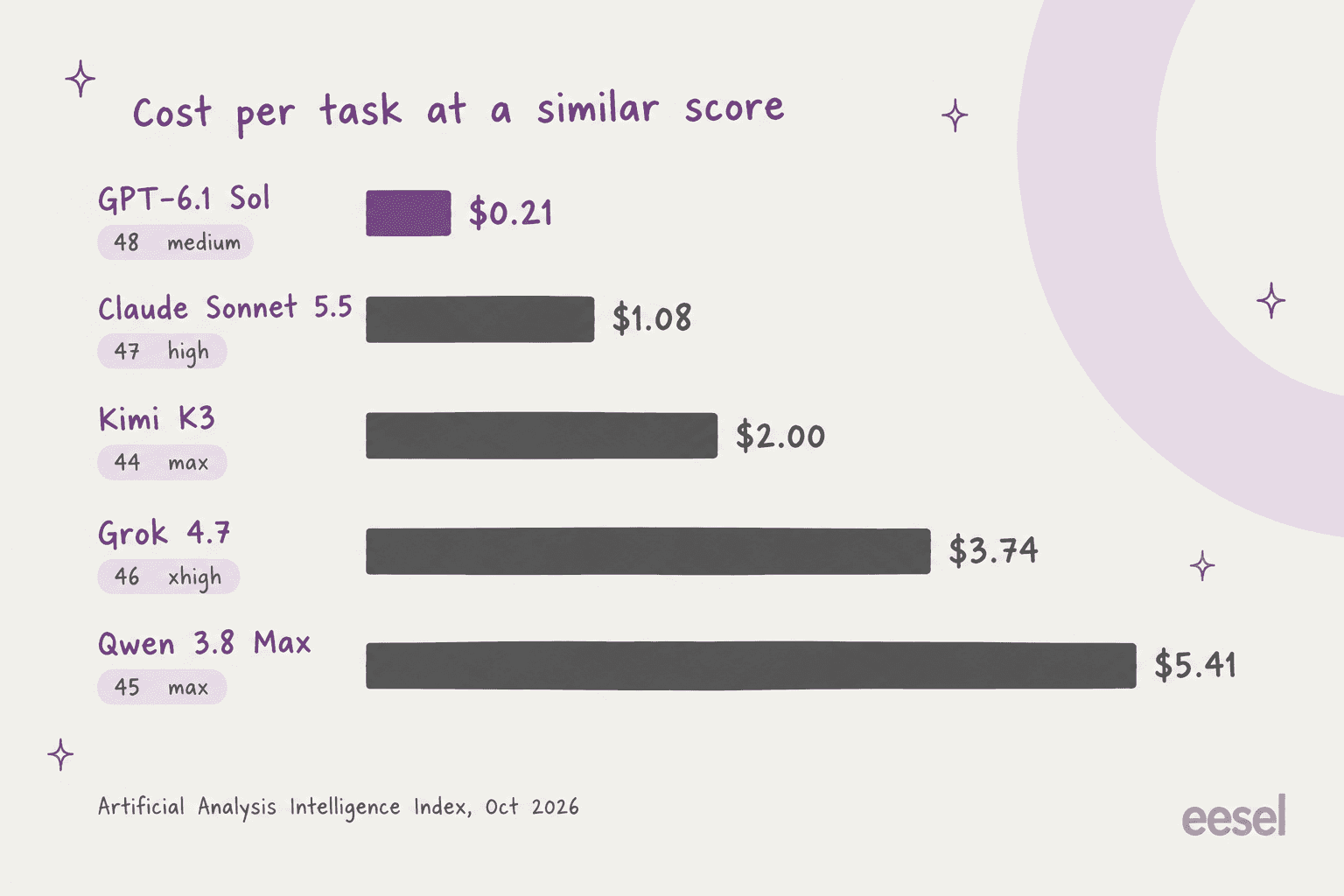
Every model in that chart scores within about 4 points of 6.1 Sol at medium effort. Every one of them costs 5 to 26 times more per task. Take Grok 4.7. Its output price is cheaper than Sol's ($6 versus $10), yet it still costs $3.74 a task, since it writes far more tokens to get there. One Hacker News commenter made the same point about the cheap Chinese models, and put it more colourfully than I would:
"Chinese models are cheap and fast by token, but they generate oceans of thinking tokens in order to accomplish the same result GPT-6.1-Sol accomplishes in, comparatively, two drops of thinking tokens"
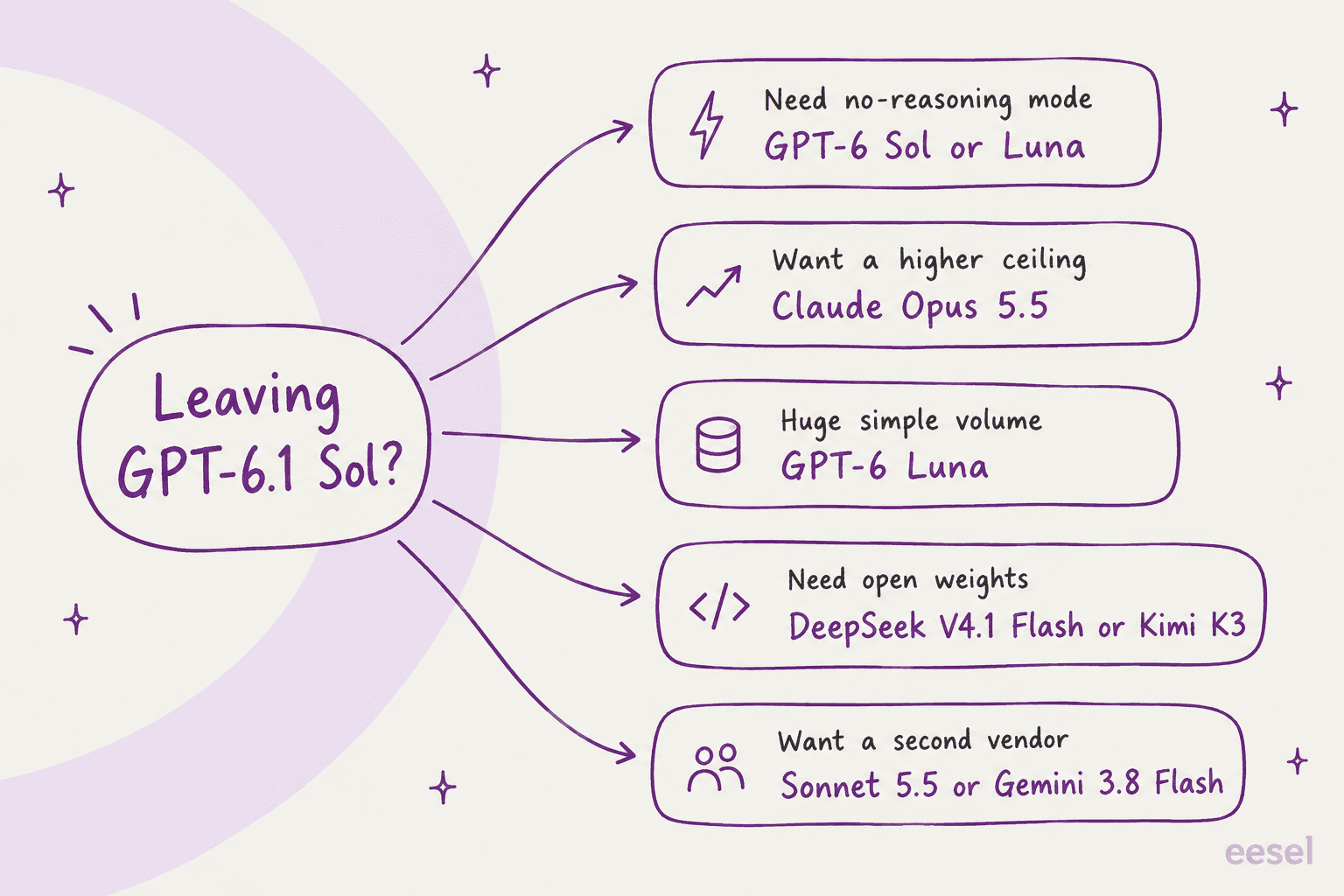
So the useful question isn't "which model is cheaper than Sol." Per task, almost none are. The better question is "which of my five reasons applies to me."
How I picked and tested these alternatives
Every model here is generally available today on a public API. From there I weighed four things: real per-token prices from each vendor's own pricing page, plus cost per task and score from the same Artificial Analysis snapshot. I also looked at whether the weights are open, and at how well each model fits a specific reason to leave 6.1 Sol.
After that, the four cheapest or most relevant options went through my support test. It is the same harness from my GPT-6.1 Sol review: 15 tickets against a short refund and shipping policy for a made-up SaaS company, with an order-lookup tool that sometimes fails on purpose. The tickets are a mix: refund windows and prorated maths, a prompt injection, an angry duplicate charge, requests in Spanish and German, a broken tool, and one order ID with a typo in it.
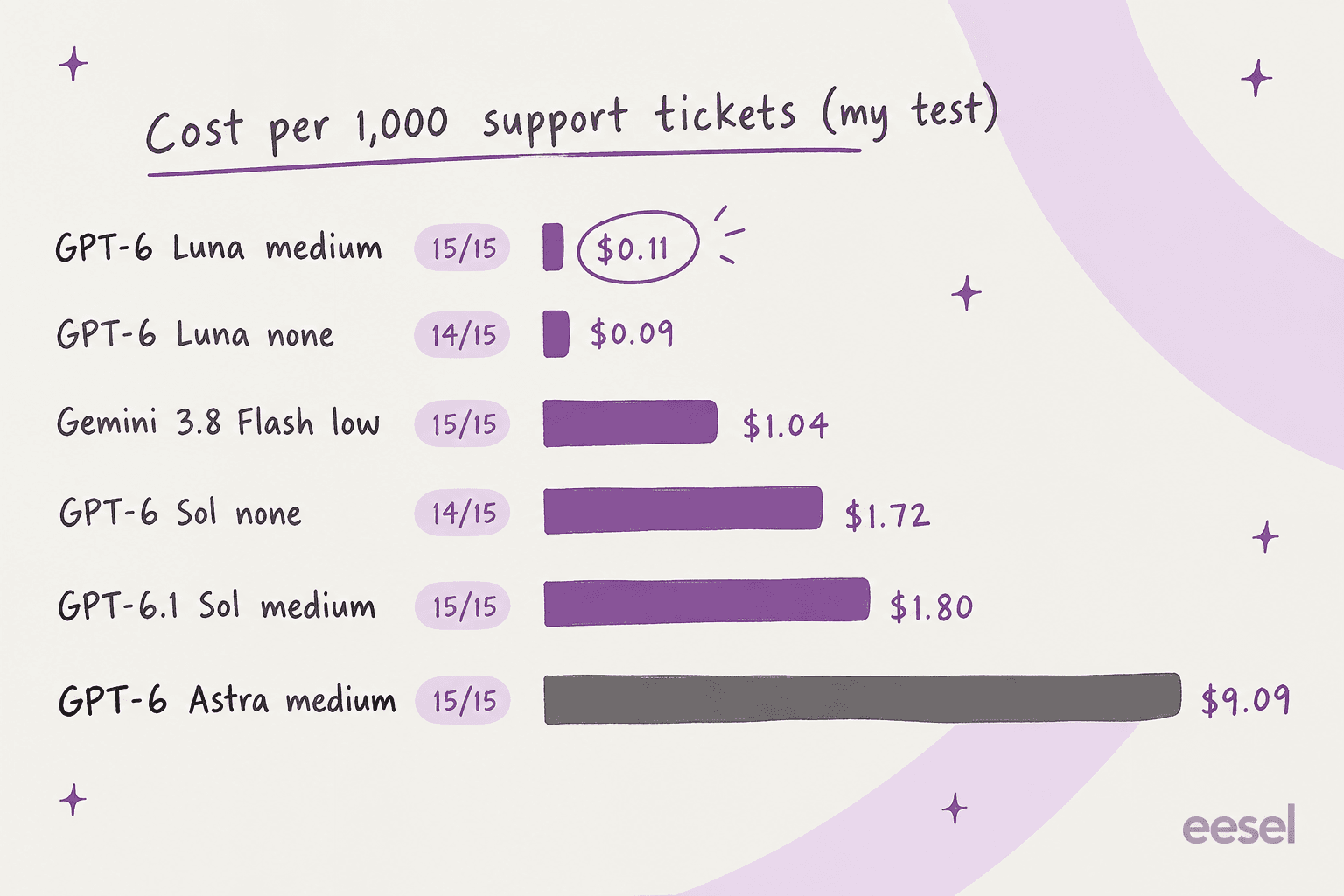
A couple of things surprised me. First, the cheapest model in OpenAI's lineup matched 6.1 Sol's 15/15. Second, the only two misses came from the none effort runs, and both were the same ticket: the prorated refund maths. Without reasoning, both GPT-6 Sol and GPT-6 Luna said they couldn't work out the amount, and they handed it to a human. Bump Luna up to medium effort, though, and it landed on $990, which is the right answer.
One caveat, because I'd want it if I were the one reading: 15 tickets on a clean policy is a small and fairly friendly test. What it shows is that these models can follow rules and use a tool. What it can't show is how they handle your messy macros, your 400-article help center, or a customer who writes three paragraphs about something else first.
Here's the whole field side by side.
| Model | Best reason to switch | API price (in / cached / out per 1M) | AA score / cost per task | Context | Weights | My test |
|---|---|---|---|---|---|---|
| GPT-6.1 Sol (baseline) | - | $2 / $0.10 / $10 | 47.8 / $0.21 (medium) | 1.05M | Closed | 15/15, $1.80 per 1k |
| GPT-6 Luna | Huge simple volume | $0.10 / $0.01 / $0.50 | 29.5 / $0.018 (medium) | 1.05M | Closed | 15/15, $0.11 per 1k |
| GPT-6 Sol | Need none effort | $2 / $0.20 / $10 | 39.8 / $0.25 (medium) | 1.05M | Closed | 14/15, $1.72 per 1k |
| Claude Opus 5.5 | Higher ceiling | $4 / $0.20 / $20 | 57.6 / $5.98 (max) | 1M | Closed | - |
| Claude Sonnet 5.5 | Second vendor, same price | $2 / $0.20 / $10 | 46.7 / $1.08 (high) | 1M | Closed | - |
| GPT-6 Astra | Ultrafast today | $10 / $1 / $50 | 52.7 / $3.26 (max) | 1.05M | Closed | 15/15, $9.09 per 1k |
| Gemini 3.8 Flash | Free tier, Google stack | $0.75 / $0.075 / $3.75 | 40.9 / $1.24 (high) | 1M | Closed | 15/15, $1.04 per 1k |
| Grok 4.7 | Cheaper output rate | $2 / $0.50 / $6 | 46.4 / $3.74 (xhigh) | 500K | Closed | - |
| DeepSeek V4.1 Flash | Open weights, MIT | $0.15 / $0.003 / $0.60 (off-peak) | 39.5 / $0.27 (max) | 1M | Open | - |
| Kimi K3 | Open frontier weights | $3 / $0.30 / $15 | 43.6 / $2.00 (max) | 1M | Open | - |
Why are you leaving GPT-6.1 Sol?
Pick the reason that fits you best.
none effort and allow function calling in Chat Completions. 6.1 Sol rejects both. Plan a move to the Responses API anyway, because GPT-6 Sol has already been replaced on the main pricing table.1. GPT-6 Luna: the one I'd try first for support volume
Best for: high-volume, rule-following work like ticket replies, tagging, and routing, where speed and cost matter more than peak reasoning.
This one changed my own default. GPT-6 Luna is OpenAI's cheapest GPT-6 model, $0.10 in and $0.50 out per million tokens, and at medium effort it went 15 for 15 on my support tickets. It checked the order tool and refused the prompt injection. On the duplicate charge it quoted the 5-business-day rule instead of promising "today." It also answered in Spanish and German, then worked out the $990 prorated refund. The whole run came to $0.11 per 1,000 tickets, while 6.1 Sol at medium cost $1.80.
Nothing I tested was faster, either: 3.0s a ticket at medium effort and 2.3s at none. Its model page lists the same 1,050,000-token context window as Sol, a May 2026 knowledge cutoff, and the full none to max effort range.
Where Luna falls short is on the Artificial Analysis index, not in my test. Luna scores 29.5 at medium and 37.3 at max, against 6.1 Sol's 47.8 at medium. My tickets were short and the policy was tidy, so that gap never had a chance to appear. Put Luna on a messier knowledge base or a multi-step agent task and it will.
Pros: about 16 times cheaper than 6.1 Sol per ticket in my test; fastest replies; keeps none effort and Chat Completions tool calls; same context window.
Cons: far lower score on hard reasoning; at none effort it skipped the prorated maths; closed weights, one vendor.
Pricing: $0.10 input, $0.01 cached, $0.50 output per 1M tokens; Batch and Flex are 50% off. Full breakdown in GPT-6 Luna pricing.
My take: for a support queue, start with Luna at medium effort and send anything it escalates to 6.1 Sol. Most of your volume then sits on a model that costs almost nothing, and you only pay Sol rates on the tickets that actually need them.
2. GPT-6 Sol: the one that still does none
Best for: teams whose production code depends on none effort or on function calling in Chat Completions, and who need a like-for-like model while they migrate.
For some teams, the best alternative to 6.1 Sol is simply the model it replaced. GPT-6 Sol is gone from the main pricing table, but its model page is still live, still $2/$10, and still says "reasoning.effort supports none." It also says "Chat Completions supports function calling only with reasoning_effort set to none," and that is exactly the combination 6.1 Sol dropped. When I looked at OpenAI's deprecations page on 1 October, there was no shutdown date listed for GPT-6 Sol.
In my test at none effort it scored 14/15 at $1.72 per 1,000 tickets and 3.6s a ticket, a bit faster than 6.1 Sol. The one miss was the prorated maths: it said "the policy doesn't specify how to count unused full months" and escalated. It's a safe miss rather than a wrong answer. Still, that's one more ticket a human now has to touch.
On quality, 6.1 Sol wins. Artificial Analysis has GPT-6 Sol at 39.8 for $0.25 a task at medium, against 47.8 for $0.21 on 6.1 Sol. Cached input costs twice as much, too, at $0.20. If you want to go deeper, my colleague's GPT-6 Sol review covers it.
Pros: keeps none effort; the only $2/$10 GPT-6 model with Chat Completions tool calls; no code change needed.
Cons: lower scores than 6.1 Sol at every effort; cached input costs double; already replaced on the pricing table, so treat it as a bridge.
Pricing: $2 input, $0.20 cached, $10 output per 1M tokens; prompts above 272K input tokens bill the whole request at 2x input and 1.5x output. More in GPT-6 Sol pricing.
My take: stay on GPT-6 Sol only as long as it takes to move your tool calls to the Responses API. For none over the long term, Luna is the safer bet. It's the current cheap model, not the one that got replaced.
3. Claude Opus 5.5: a real step up in ceiling
Best for: hard coding and long agent tasks where 6.1 Sol's answers are good but not quite good enough.
Leaving 6.1 Sol because you want a smarter model? Then Claude Opus 5.5 is where I'd look. It scores 57.6 at max effort on Artificial Analysis, about 6 points above 6.1 Sol's best, and it posts 66.4% on Terminal-Bench 4.0 per Anthropic's launch post. It's also the first Opus that got cheaper than the one before it, at $4/$20 per million.
The catch, as usual, is cost per task. At max effort it runs $5.98 a task, eight times 6.1 Sol's $0.72 at max. Medium effort is the better deal: 51.2 for $1.34, which is 6.1 Sol's max score for about twice the money. The GPT-6 Sol vs Opus 5.5 comparison walks through that effort maths in detail.
Most of the hands-on reports I found on HN side with Opus when the code gets hard:
"I've implemented multiple features side by side with Opus 5.5 and 6 Sol, and the Opus 5.5 results always have fewer high severity bugs and require fewer rounds of fixes to get it over the finish line."
That comment compares Opus to GPT-6 Sol, not 6.1, and the same thread says 6.1 closes some of the gap. Even so, it lines up with what I hear from the engineers here.
Pros: highest score on this list; strong on terminal and coding benchmarks; $0.20 cache reads; 1M context with no long-context surcharge.
Cons: most expensive per task at max; overkill for simple chat or extraction; one more vendor to manage.
Pricing: $4 input, $0.20 cache read, $20 output per 1M tokens; Batch is 50% off, per Anthropic's pricing docs. See Claude Opus 5.5 pricing.
My take: pick Opus 5.5 at medium effort when 6.1 Sol keeps missing on your hardest tasks. Just don't leave it on max by default. You'll end up paying for tokens you never needed.
4. Claude Sonnet 5.5: same sticker, different vendor
Best for: teams that want a $2/$10 model from a second lab, mainly for coding and agent work.
Claude Sonnet 5.5 launched on 28 September 2026, one day before 6.1 Sol, at the same $2 in and $10 out. By Anthropic's own numbers, it even beats Opus 5.5 on Terminal-Bench 4.0 (70.6% versus 66.4%). On Artificial Analysis it reaches 56.0 at max effort, well above 6.1 Sol's 51.8.
Cost per task is where you need to pay attention. At max effort, Sonnet 5.5 costs $7.60 a task, more than Opus 5.5. At high effort it scores 46.7 for $1.08, which is about the same score as 6.1 Sol at medium for five times the cost. Anthropic itself says the savings sit at low effort. My colleague's Sonnet 5.5 review came to the same conclusion.
Support bots have an extra trap here. Sonnet 5.5 returns a 400 on forced tool_choice (any or a named tool), so a bot that forces an order lookup on every ticket needs a rewrite. It's the same kind of breaking change that's pushing people off 6.1 Sol, only in a different place.
On the 6.1 Sol thread, some developers think Anthropic is ahead this round:
"I suspect they didn't show the benchmarks and test results because it would have been embarrassing to reveal that their flagship model can't compete with the capabilities of Sonnet 5.5."
Pros: same $2/$10 price from a second vendor; higher top score than 6.1 Sol; very strong on terminal coding; 1M context.
Cons: much pricier per task at equal scores; forced tool choice now returns an error; max effort can burn huge token counts.
Pricing: $2 input, $0.20 cache read, $10 output per 1M tokens; Batch $1/$5. See Claude Sonnet 5.5 pricing.
My take: Sonnet 5.5 is the right move if you want a second vendor for coding and you will keep effort at low or medium. If what you're doing is support replies at volume, 6.1 Sol or Luna will cost less per ticket.
5. GPT-6 Astra: only if you need Ultrafast now
Best for: teams already on OpenAI who need the fastest generation mode today, or the last point of score.
GPT-6 Astra is OpenAI's flagship. The trouble is that 6.1 Sol has made it hard to justify. Artificial Analysis has Astra at 52.7 for $3.26 a task, against 6.1 Sol's 51.8 for $0.72. In my support test, Astra matched 6.1 Sol's 15/15 at five times the cost, $9.09 per 1,000 tickets against $1.80. It was slower too, at 5.2s a ticket.
This month there's really one reason to pick it, and that's Ultrafast. OpenAI's pricing page lists Ultrafast rates for Astra only, at $60 in and $300 out per million, with 6.1 Sol "coming soon." Need that speed tier right now? Astra is the only GPT-6 model with it.
Pros: highest OpenAI score; Ultrafast available now; lowest hallucination rate of the GPT-6 family on AA.
Cons: about 4.5 times 6.1 Sol's cost per task for 1 more point; slower in my test; Ultrafast is very expensive.
Pricing: $10 input, $1 cached, $50 output per 1M tokens; Batch and Flex 50% off. See GPT-6 Astra pricing.
My take: for most teams, 6.1 Sol replaced Astra rather than the other way round. I'd keep Astra for the rare job where one extra point matters, or where waiting for Ultrafast to reach Sol isn't an option.
6. Gemini 3.8 Flash: the Google option with a free tier
Best for: teams in the Google Cloud stack, prototypes on the free tier, and batch jobs where per-token price matters.
Gemini 3.8 Flash passed my test 15/15 at low effort for $1.04 per 1,000 tickets, and it got the prorated $990 right with its working shown. Replies averaged 3.0s. It also used the most formatting of anything I tested. An order-status reply that needed two lines came back with bullet lists and bold labels.
On price, read the small print. The Gemini pricing page lists $0.75 in and $3.75 out "through December 31, 2026," then $1.50 and $7.50 from 1 January 2027. Buyers remember that kind of doubling. A budget-conscious buyer on an eesel sales call said a previous vendor's price had "more than doubled" and asked for a contractual price lock before anything else.
On Artificial Analysis, Gemini 3.8 Flash at high effort scores 40.9 for $1.24 a task, below 6.1 Sol and six times its cost per task. It's also not a new base model. Google's model card says it's based on Gemini 3.7 Flash.
Pros: free tier; passed my test with correct maths; strong throughput; Batch and Flex 50% off.
Cons: price doubles on 1 January 2027; more expensive per task than 6.1 Sol on AA; wordy replies.
Pricing: $0.75 input, $0.075 cache read, $3.75 output per 1M tokens through 31 December 2026, then $1.50/$0.15/$7.50. See Gemini 3.8 Flash pricing.
My take: if you already run on Google Cloud, it's a sensible second vendor. Price it on the 2027 rate, not the current one, so the bill doesn't surprise you in January.
7. Grok 4.7: cheaper output rate, not cheaper tasks
Best for: agent loops that stay under 200K tokens per request and teams already building on xAI.
Grok 4.7 has a sticker that looks, at first glance, like a Sol killer: $2 in and $6 out per million, 40% under Sol's output rate, per xAI's models page. It is built on a larger base model than Grok 4.6 with a longer training run aimed at multi-hour agent tasks, and its knowledge cutoff is May 2026.
The cost-per-task chart says otherwise. Artificial Analysis has Grok 4.7 at xhigh effort scoring 46.4 for $3.74 a task, a slightly lower score than 6.1 Sol at medium for about 18 times the cost. The reason is simple: it writes a lot of tokens. Keep an eye on the long-context pricing as well: above 200K prompt tokens the rate jumps to $4/$12 for every token in the request, not just the overflow.
Pros: lower output rate than Sol; big agentic gains over Grok 4.6; 500K context; a free Grok Build tool for coding.
Cons: much higher cost per task than 6.1 Sol on AA; long-context cliff at 200K; Grok 4.7 Fast is only in Cursor and Grok Build, not the public API.
Pricing: $2 input, $0.50 cached, $6 output per 1M tokens below 200K; $4/$1/$12 above. See Grok 4.7 review for hands-on notes.
My take: Grok 4.7 makes sense if you already live in xAI's tools. But if the lower output price is your only reason, run your own cost-per-task test first. On the index, it lands the other way.
8. DeepSeek V4.1 Flash: open weights and a tiny bill
Best for: teams that need MIT-licensed weights to self-host, or the lowest API price for background work.
DeepSeek V4.1 Flash is the cheapest capable model on this list and the easiest to own outright. The weights are on Hugging Face under MIT. The API uses the model name deepseek-flash, and the older deepseek-v4-flash name now routes to V4.1. It supports vision, tool calls, a 1M context window and up to 384K output tokens, per DeepSeek's pricing page.
There's a timezone quirk in the pricing. Off-peak is $0.15 in and $0.60 out per million; peak is exactly double. Peak hours are 01:00 to 04:00 and 06:00 to 10:00 UTC on weekdays, so a US support queue mostly bills at off-peak rates, and an Asia-hours queue mostly doesn't.
Per task, it's closer to 6.1 Sol than the sticker suggests. Artificial Analysis has V4.1 Flash at max effort scoring 39.5 for $0.27 a task, against 47.8 for $0.21 on 6.1 Sol at medium. If customer data is involved, check where it runs as well: DeepSeek's first-party API is hosted in China and its API terms are silent on training use, so many teams self-host or use a third-party host with a data agreement.
Pros: MIT open weights; lowest per-token API price here; now takes images; 1M context.
Cons: lower score than 6.1 Sol and slightly higher cost per task; peak-hour pricing; first-party hosting is a hard sell for customer data.
Pricing: $0.003 cache hit, $0.15 input, $0.60 output per 1M tokens off-peak; double at peak. See DeepSeek V4.1 Flash pricing.
My take: pick V4.1 Flash for self-hosting or for overnight batch work. As a straight swap for 6.1 Sol on an interactive bot, though, it won't save you money per task.
9. Kimi K3: open frontier weights
Best for: teams that need the strongest open-weight model they can download and run.
Kimi K3 from Moonshot AI is a 2.8-trillion-parameter mixture-of-experts model with 104B active, a 1M context window, and native vision. The full weights are on Hugging Face under a custom licence, so you can run it yourself, assuming you have the hardware for it.
On the hosted API it is $3 in, $0.30 cached, and $15 out per million, per the Kimi pricing page. That's higher than Sol on both input and output. Artificial Analysis scores it 43.6 at max effort for $2.00 a task. Reasoning can't be switched off at any level, which makes its lowest setting more of a speed control than a cheaper tier.
Pros: strongest openly downloadable weights on this list; 1M context; image and video input.
Cons: hosted API costs more than 6.1 Sol per token and per task; custom licence, not MIT or Apache; reasoning is always on.
Pricing: $3 input, $0.30 cache hit, $15 output per 1M tokens. See Kimi K3 pricing.
My take: Kimi K3 is a self-hosting pick. If you only want a hosted API, 6.1 Sol is cheaper and scores higher.
What my test says about swapping models for support
This is the part I keep coming back to. Across 135 runs and nine setups, from $0.09 to $9.09 per 1,000 tickets, the misses were the same kind every time. Every setup, Astra included, escalated the order ID with a typo ("A1O43") instead of asking the customer to check it. The none runs gave up on maths they could have done. Moving up a tier didn't fix any of it. What fixes it (or would have) is one line in the instructions, plus testing on real tickets.
That matches what I hear from buyers. A CX lead doing about 7,000 tickets a month told the eesel team on a sales call that the AI should only answer tickets it's confident about and quietly leave the rest for humans. That's a handoff rule, not a model feature. You set that rule in the layer around the model, and then you check it against your own history before any customer sees it.
So if you are swapping 6.1 Sol for Luna to save money on a support queue, I think that's a smart call. Test it on your past tickets first, though, and keep a clear path to a human for anything it isn't sure about. The AI escalation guide covers how to set that up.
Try eesel
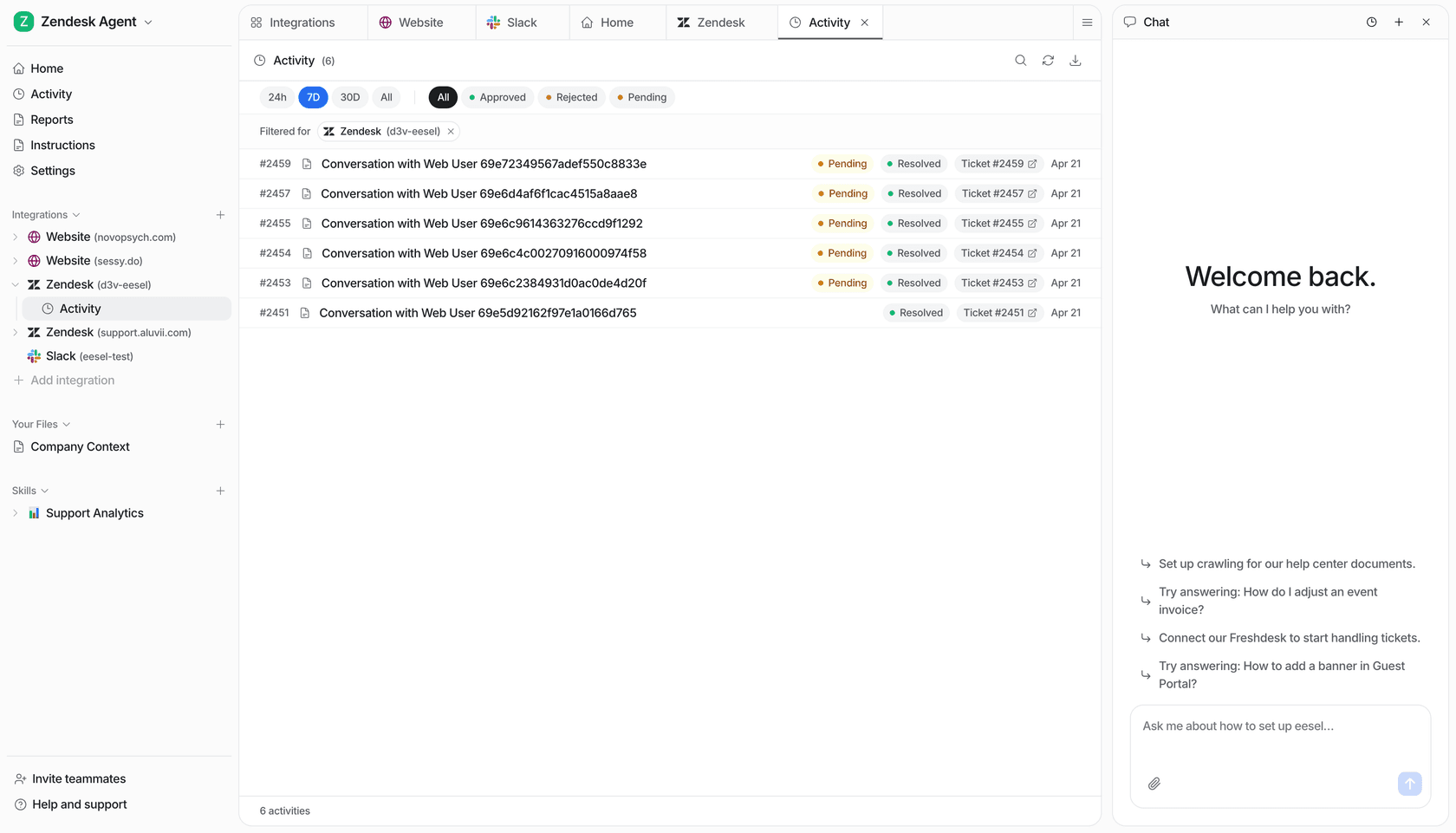
If you're comparing GPT-6.1 Sol alternatives because you want to automate support, the model is the engine, and eesel is the teammate you hire to drive it. The AI helpdesk agent joins your existing queue in Zendesk, Freshdesk or Gorgias, learns from your help center and past tickets, and runs a simulation on your ticket history so you see its answers and resolution rate before it replies to anyone. That typo-ID miss from my test? It's exactly the kind of gap the simulation catches.
If you work from a terminal, the eesel CLI drives the same teammate and workspace as the dashboard. You can script a test run on a batch of old tickets, pull the results into your own tooling, or let a coding agent like Claude Code, Codex or Cursor manage the setup for you. It's the same teammate either way, just headless. You can try eesel free and run it on your own tickets before you pick a model or a plan.
Frequently Asked Questions
What is the best GPT-6.1 Sol alternative in 2026?
Is there a cheaper alternative to GPT-6.1 Sol?
Why did GPT-6.1 Sol remove the none reasoning effort?
none returns an error. GPT-6 Sol and GPT-6 Luna still support none, and they are the only GPT-6 models that allow function calling in Chat Completions. My GPT-6.1 Sol review covers the API changes.Is GPT-6.1 Sol better than Claude Sonnet 5.5?
What is a good open-weight alternative to GPT-6.1 Sol?
Should I switch from GPT-6.1 Sol to GPT-6 Astra?
Do GPT-6.1 Sol alternatives work for customer support?


Article by
Riellvriany Indriawan
Riell is a designer and writer at eesel AI with about two years of experience researching CX platforms, AI chatbots, and helpdesk software. She combines her design background with a sharp eye for how these tools actually look and feel in practice — making her comparisons unusually visual and user-focused.