


DeepSeek V4.1 Flash is cheap: off-peak, it is $0.15 per million input tokens on a cache miss, $0.003 on a cache hit, and $0.60 per million output tokens. Peak hours (01:00-04:00 and 06:00-10:00 UTC on weekdays) double all three, and off-peak is exactly half of peak.
That is cheaper than the outgoing DeepSeek V4 Flash and roughly a third of the V4 Pro tier, which is why DeepSeek is retiring V4 Pro and routing its traffic to V4.1 Flash from 14 September 2026. No free tier, 1M context, and MIT weights you can self-host if you have a 384GB box.
The catch for support teams is not the price. I have spent enough years putting AI on live support queues to say the token bill is almost never the number that matters. Data handling, knowledge, and whether you tested it before a customer saw it are what actually cost you.
DeepSeek V4.1 Flash pricing, in full
The rates below come straight from DeepSeek's official pricing page, checked on 11 September 2026. Everything is per million tokens, in USD, and DeepSeek runs a peak/off-peak schedule where off-peak is exactly half of peak.

| Meter (per 1M tokens) | Off-peak | Peak |
|---|---|---|
| Input, cache hit | $0.003 | $0.006 |
| Input, cache miss | $0.15 | $0.30 |
| Output | $0.60 | $1.20 |
| Context window | 1M | 1M |
| Max output | 384K | 384K |
| Concurrency limit | 2,500 | 2,500 |
You call it on the API as deepseek-flash (model version DeepSeek-V4.1-Flash). The model supports tool calls, JSON output, the OpenAI Responses API, and an Anthropic-format endpoint, and it now reads images natively, which opens up AI agent use cases the text-only V4 Flash could not touch. There is no free tier: usage draws down a topped-up or granted balance, with granted balance spent first.
Two numbers are worth staring at. The cache-hit input rate of $0.003 is fifty times cheaper than the cache-miss rate, so anything you can keep stable across requests (a system prompt, a knowledge snippet, a tool schema) is nearly free to re-send. And the concurrency ceiling of 2,500 is five times V4 Pro's 500, which matters the moment you point this at a real customer service workflow instead of a test script.
The peak/off-peak catch, and why it usually helps you
This is the part most price comparisons skip. DeepSeek's peak hours are 01:00-04:00 and 06:00-10:00 UTC, Monday through Friday. Everything else is off-peak, at half the price.

Those windows map to Chinese business hours. If your traffic is a US or European support queue, the bulk of your volume lands in DeepSeek's off-peak, so you mostly pay the lower rate without doing anything clever. That is a genuine tailwind for a Western AI customer service software build.
It is also a little fragile, and worth flagging to whoever signs off the budget. Your effective rate depends on the clock, not just your usage, so a batch job you schedule at 08:00 UTC costs double what the same job costs at 14:00. If you run overnight batches or you have European agents online early, some of your traffic will drift into peak. Model the mix, do not assume the off-peak headline for every token.
Reasoning tokens: the cost that is not on the price card
The headline output rate is $0.60 per million off-peak. The trap is that DeepSeek V4.1 Flash has thinking mode on by default, and every reasoning token it generates bills at that same output rate.
DeepSeek exposes reasoning effort as a continuous 1-to-100 dial (the API presets are low, high, and max). Turn it up and answer quality climbs, but so does the number of tokens burned before you ever see a reply. A request that returns a 200-token answer might have generated several thousand tokens of hidden reasoning to get there, and you pay for all of them. Independent testers also flagged the earlier Flash as verbose, so this is not a theoretical worry.
The practical takeaway for a cost model: do not multiply your expected answer length by $0.60 and call it done. If you are running a tier-1 deflection flow where most tickets need almost no reasoning, keep the effort low and the real bill stays near the headline. If you crank effort for hard tickets, your cost per resolution can quietly move by an order of magnitude. This is the same reason chatbot cost estimates that only count the visible answer are usually wrong.
Estimate your own monthly bill
The cleanest way to see what this means for you is to plug in your own volumes. This runs DeepSeek's list rates for you and shows the cost split between input and output.
Why V4.1 Flash is this cheap: the architecture
A model this cheap usually means a small model, but V4.1 Flash is a 552B-parameter mixture-of-experts, bigger than the 284B V4 Flash it replaces. The price cut comes from a new design instead.
The headline is a Causal Encoder-Decoder layout that activates only 8B parameters for reading your prompt and 16B for writing the answer, so most of the 552B sits idle on any given token. The other lever is memory: DeepSeek reports a KV cache of about 890 bytes per token, roughly four times smaller than V4 Flash and hundreds of times smaller than its first generation. Less memory per token in flight is what lets DeepSeek serve 2,500 concurrent requests and pass the savings into the rate card.

You do not need the internals to buy the model, but they explain why this is not a loss-leader that gets repriced in three months. The cheap number is a property of the design, which makes it a more reliable input to a cost-per-resolution model than a promotional rate would be.
The V4 Pro retirement: a billing change to plan for
The most-discussed part of this launch is not the price, it is what DeepSeek is doing with it. Because V4.1 Flash matches or beats the pricier V4 Pro, DeepSeek is retiring V4 Pro: from 14 September 2026, all deepseek-v4-pro requests route to V4.1 Flash and bill at Flash rates until a future V4.1 Pro ships.

On the bill, that is good news: a request that cost V4 Pro's $1.98 output now costs $0.60. On reliability, it made developers nervous, because your pinned model quietly changes underneath a validated workflow:
"If I'd carefully tested and optimized prompts against Pro I wouldn't be keen on this particular news. I feel like API model providers should lean towards not swapping out models on their paying customers, no matter how much 'better' the new model is meant to be."

The fair counter is that DeepSeek publishes every model's open weights, so anyone who needs a frozen version can pin it themselves. Either way, if you have a production flow on deepseek-v4-pro, treat 14 September as a real change date: re-test on V4.1 Flash before it becomes your default, the same care you would take with any AI agent reliability work.
How it compares on price
Against DeepSeek's own lineup, V4.1 Flash is the cheapest capable option they offer, and it is the reason the older DeepSeek V4 Flash and V4 Pro are both being folded into it. Against the wider market, the interesting comparison is Google's cheap tier, Gemini 3 Flash. Community members who ran both were blunt:
"The direct competition is Gemini Flash, and these models are much better on agentic tasks with fraction of the task price compared to Gemini... 20-30% of the price per task. And especially Deepseek Flash produces better quality than Gemini does."
That tracks with the Gemini pricing card and with the general shape of the market: DeepSeek keeps setting the floor.
If you are actively comparing engines for a support build, our writeups on DeepSeek V4 Flash vs GPT-5.6 and Claude vs Gemini walk the tradeoffs beyond price. And if you are pricing a vendor-built option instead of raw tokens, Decagon's cost is a useful reference point.
The catch nobody prices in: this is a model, not a support agent
Here is where I have to be honest about what the price does and does not buy you. The rate card is for a raw model. Pointing a raw model at customer tickets is not the same as having a working AI helpdesk, and it is a world away from an old rule-based chatbot too. The gap between a model and a product is where the real money lives.
First, the data question. DeepSeek's paid API terms are silent on whether your inputs train the model, there is no published zero-retention option or data processing agreement, and requests are processed in the PRC. For a queue full of customer names, order numbers, and personal details, that is a compliance conversation to have before you send a single real ticket, not after. If this is your world, our primer on SOC 2 and GDPR for support chatbots is the right starting point.
Second, and bigger: the token cost is a rounding error next to the cost of getting support automation wrong. A model that gives a confident wrong answer to a refund question does not save you money, it creates an angry customer and a human cleanup. Across years of running AI on live queues, the pattern is always the same: the $0.60-per-million model is 2% of the job, and the other 98% is company knowledge, escalation rules, real actions in your helpdesk, and testing against your own history before go-live. It is also why the numbers that matter are your support metrics, not the token meter. That is why every serious agent vs human cost comparison has to look past the API meter.
Try eesel
DeepSeek V4.1 Flash is a fantastic engine, and at $0.15 in, $0.60 out, it is one of the cheapest capable engines on the market. But an engine is not an employee. eesel is an AI teammate platform: instead of a raw model you have to wrap in knowledge, guardrails, and integrations, you hire a ready-to-work teammate for a specific job. The AI helpdesk teammate joins your existing queue, learns from your past tickets and help center, and knows when to hand off to a human, so which model runs underneath is a detail you do not have to manage.
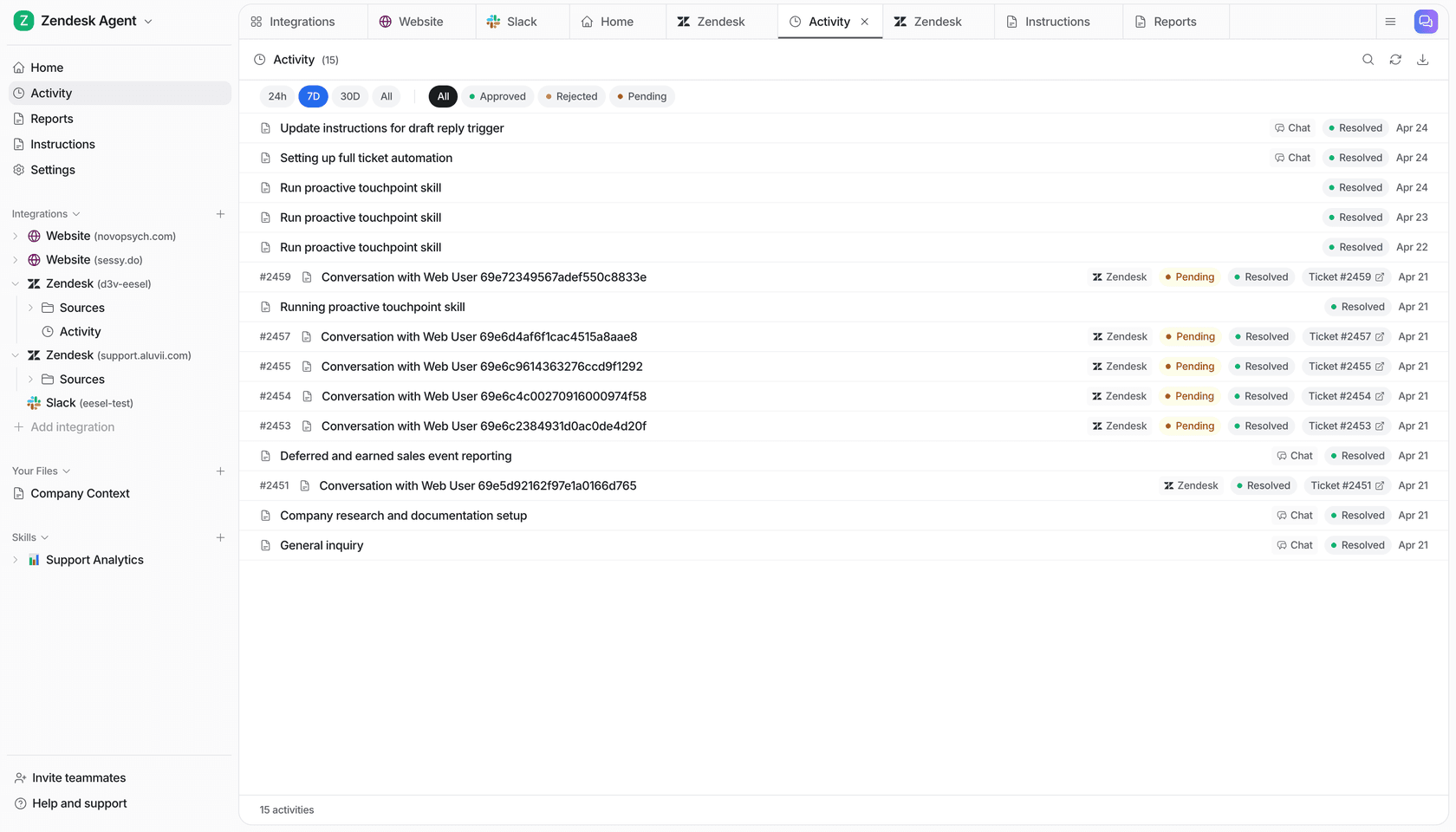
Because a DeepSeek pricing post tends to attract people who live in a terminal, one thing worth calling out: eesel is not dashboard-only. It ships a real command-line interface, @eesel/cli, and every workspace is also an MCP server. A person can drive the same teammate from a terminal, scripts can automate it in CI, and coding agents like Claude Code or Cursor can operate it directly. You can connect an integration, edit the standing instructions, run a simulation against your real ticket history, and inspect every run with eesel activity, all without opening a browser.
It is the API-first way to run support, the same terminal-native workflow you would use to manage agents from the command line, and it is documented in full in the eesel CLI docs.
On price, eesel is one fixed monthly price from $299/month for 500 credits (1 credit per ticket or chat), with no per-seat fee, and a free plan with 100 credits. If you are eyeing a cheap model to cut support costs, the part I would not skip is the simulation: try eesel and see the real resolution quality on your own tickets before you commit to any model, DeepSeek included.
Frequently Asked Questions
How much does DeepSeek V4.1 Flash cost?
On the first-party API, DeepSeek V4.1 Flash costs, off-peak, $0.15 per million input tokens on a cache miss, $0.003 on a cache hit, and $0.60 per million output tokens. Peak hours double every one of those figures. That makes DeepSeek V4.1 Flash pricing cheaper than the outgoing DeepSeek V4 Flash pricing and about a third of the retiring V4 Pro tier.
What are DeepSeek's peak and off-peak hours?
Peak hours are 01:00-04:00 and 06:00-10:00 UTC on weekdays, and off-peak rates are exactly half of peak. Because those windows line up with Chinese business hours, a US or European support queue mostly bills at the cheaper off-peak rate. It is a real saving, and one that quietly depends on the clock.
Is DeepSeek V4.1 Flash cheaper than DeepSeek V4 Pro?
Yes, by a wide margin. V4 Pro's cache-miss input is $0.66 off-peak and its output is $1.98, versus $0.15 and $0.60 for V4.1 Flash. DeepSeek is retiring V4 Pro because the newer, cheaper model matches or beats it, so from 14 September 2026 old deepseek-v4-pro calls route to V4.1 Flash at Flash rates.
Does DeepSeek V4.1 Flash have a free tier?
No free tier is advertised on the pricing page. Usage is deducted from your topped-up or granted balance, with granted balance spent first. If you want to try a support AI without a credit-card meter running, an AI helpdesk teammate like eesel has a free plan with 100 credits and no card.
How do reasoning tokens affect DeepSeek V4.1 Flash pricing?
Thinking mode is on by default, and the reasoning tokens the model generates are billed at the output rate. So a heavy reasoning setting can quietly multiply your real cost per request even though the headline $0.60 output number never changes. If you are cost-modelling a tier-1 deflection workload, budget for the thinking tokens, not just the answer.
Is DeepSeek V4.1 Flash pricing good for customer support?
The raw token price is excellent, but token cost is a small slice of what a support bot really costs to run. The bigger questions are data handling (DeepSeek's terms are silent on training use and process data in the PRC) and whether the model is wired to your knowledge and helpdesk at all. See our note on cost per resolution for the fuller picture.
Can I self-host DeepSeek V4.1 Flash to avoid API costs?
Yes, the weights are MIT-licensed on Hugging Face. The catch is hardware: at 552B parameters it needs roughly 384GB of memory, so self-hosting only pencils out at high volume. For lighter setups, compare open-source chatbot platforms that fit smaller boxes.