
Start with a data-flow inventory
Before enabling a use case, make a plain table with one row for each step. For example: customer message → Zendesk AI agent → order lookup integration → Zendesk ticket → human support group. Add the data category, business purpose, permitted recipients, and the condition that lets the workflow continue.
That table catches the ordinary risks that a broad policy can miss. An order-status flow may need an order reference. It does not automatically need a full account history. A refund workflow may need an eligibility result, not the entire payment record. A human handoff might require the issue summary and reference, but not every raw message sent to an outside tool.
Zendesk's privacy-law guide says its products can assist with privacy-law obligations, while data controllers and businesses bear the primary responsibility for compliance. The inventory should therefore be reviewed by the people who own the process and, where needed, appropriate legal and security advisers. This article is practical product guidance, not legal advice.
What Zendesk documents about AI data use
Zendesk's AI Data Use Information distinguishes its proprietary non-generative machine-learning models from third-party LLM-supported generative features. Zendesk says the proprietary models produce labels rather than generated passages, images, or code. It says that, before customer data is used to train models that could be used by other customers, it applies measures such as excluding identifier fields, processing free text to identify and remove certain identifying information, and tokenization.
For generative features, Zendesk says third parties do not use customer inputs to train their models or improve their services. Its current generative-AI page describes two operating models: LLMs hosted on infrastructure platforms, where the provider does not access Service Data, and directly hosted model-provider LLMs using zero-data-retention endpoints. Zendesk says request and response bodies for those endpoints are not persisted to logging mechanisms and exist in memory to serve the request.
Those are vendor statements about the Zendesk product. They do not automatically decide whether your particular workflow, sources, integrations, and notices meet every obligation that applies to your organization.
The AI Data Use page has a specific qualification for the product it calls Advanced (Ultimate): when Service Data is needed for model training, customers determine how to sanitize that training dataset. Confirm which product and model path your account uses instead of applying the general description to every feature. Provider-side zero retention also does not mean Zendesk tickets, your integrations, or your own logs have no retention.
Do not overstate sanitization
Zendesk's AI-agent data-processing article says it sanitizes incoming chat or email messages by detecting categories of PII and replacing values with entity labels such as <EMAIL> and <IBAN>. It also gives an important limitation: Zendesk cannot guarantee that 100% of PII in free-text conversations will be removed, because automated detection can have false positives and false negatives.
That is why teams should not design a workflow that relies on perfect detection. Avoid asking customers to paste sensitive information that the workflow does not need. Review messages and integration payloads before adding a new data source. Limit access to the staff and systems with a documented reason to use it. When a human must check a sensitive exception, hand off instead of encouraging the AI agent to infer or repeat the data.
Turn the review into launch checks
Use a small, named checklist before a controlled rollout:
- Purpose: Can the team state the support job in one sentence?
- Minimum data: Does every field change the next action or handoff?
- Sources and recipients: Which Zendesk sources, integrations, and groups can receive the data?
- Customer clarity: Does the conversation explain what it needs and offer a human route for sensitive or missing information?
- Retention and rights: Has the team identified the relevant retention, deletion, access, correction, and portability process?
- Permissions: Are action permissions, API scopes, and human roles as narrow as the job allows?
- Evidence: Has the team tested de-identified success, failure, missing-data, and handoff cases, then reviewed the actual record?
Zendesk's AI-agent privacy-law article describes features that can assist with access, correction, deletion, portability, and objection obligations. It does not replace the organization’s responsibility to determine the request, applicable law, or required response.
Prepare an eesel data-access review from the terminal
The eesel CLI gives a support lead or coding agent a practical way to prepare an eesel data-access review. It operates the same teammate and workspace as the dashboard. Before adding another source, ask Claude Code to list the teammate's connections, compare them with your approved data-flow inventory, and flag unexplained access for an owner to review. Keep native Zendesk privacy settings and rights-request processes in their own product workflow.
Its useful role in a privacy-conscious change is to help a person or coding agent inspect the selected eesel teammate before a scoped, de-identified test. With Node.js 18.17+, npx @eesel/cli is the same CLI as an installed eesel command. The CLI prints JSON, so scripts, Claude Code, Codex, and Cursor can review the explicit result:
npx @eesel/cli whoami
npx @eesel/cli --agent "Support" status
npx @eesel/cli --agent "Support" integrations
npx @eesel/cli --agent "Support" approvals
whoami identifies the signed-in account and workspace. status and integrations help identify the selected teammate and its connections; approvals surfaces actions held for a person, not every action the teammate could take. The coding agent can turn that JSON into a review list: which source serves the approved job, who owns it, and which connection needs explanation. It can then propose an instruction limiting requests for unnecessary customer details. Have the privacy and support owners approve any change, preview writes with --dry-run, and test with synthetic inputs after checking connected action permissions. Review the answer and resulting activity for unexpected disclosure. This is evidence for a review, not a compliance certification; protect terminal output and coding-agent transcripts as well as the helpdesk records.
Review an eesel teammate before expanding access
The most useful privacy review is specific enough to show what will happen to one customer message. If the team cannot trace that message from collection to handoff, action, retention, and deletion process, the AI workflow is not ready for broad rollout.
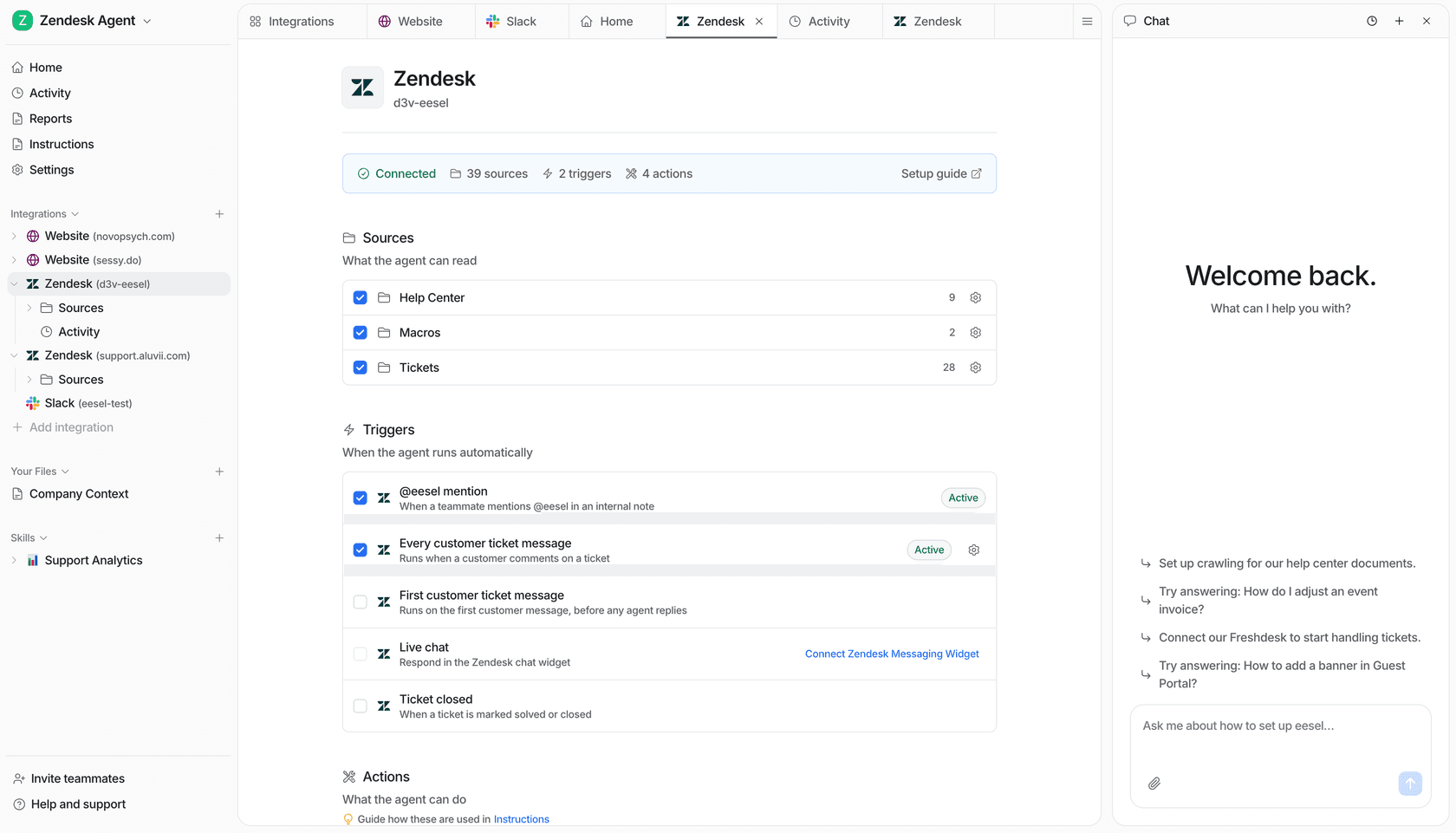
The Zendesk integration in eesel displays source, trigger, and action settings beside teammate chat.
To inspect an eesel support teammate before connecting it to a Zendesk workflow, Try eesel. Begin with the smallest de-identified test and have the relevant privacy and security owners review any expanded access.
Frequently asked questions
Does Zendesk use customer data to train third-party LLMs?
Zendesk says third-party LLM vendors cannot use Service Data to train their models. Its current generative-AI documentation describes zero-data-retention endpoints for directly hosted LLMs.
Does sanitization guarantee removal of every piece of PII?
No. Zendesk says its AI-agent sanitization process cannot guarantee that 100% of PII in free-text messages is removed and notes the possibility of false positives and false negatives.
Who is responsible for privacy-law compliance?
Zendesk describes its tools as assisting with obligations, while data controllers and businesses retain primary responsibility for compliance with applicable law. Seek appropriate legal advice for your situation.
What should be reviewed before enabling an AI agent?
Map the data the workflow uses, the purpose, sources, recipients, roles, retention and deletion process, customer notice, vendors, and approval or escalation points. Then test with de-identified data.
Can Zendesk help with access, deletion, and portability requests?
Zendesk documents AI-agent features that can assist with access, correction, erasure or deletion, portability, and objection obligations. The documented steps and availability should be verified for the account and workflow.
How can eesel CLI support a data-access review?
It lets a person, script, or coding agent inspect the same eesel teammate and connections as the dashboard, prepare questions for the source owners, and test approved changes with synthetic inputs. It does not certify compliance or configure Zendesk privacy controls.