

What is DeepSeek V4.1 Flash 1017?
I build product features and AI agents at eesel, and the team here has spent years running AI on live support queues. One habit sticks from that work: when a model provider says "same price," I go check what one finished job costs, because that number is the one the invoice follows.
DeepSeek V4.1 Flash 1017 is a minor update to the DeepSeek V4.1 Flash model that shipped on September 10. According to DeepSeek's changelog, the official web app, the mobile app, and the API all moved to the new build on October 17, 2026. The API call stays the same: you keep using the deepseek-flash model name and get 1017 automatically.
Underneath it's still same model family, a 552B mixture-of-experts model with the new architecture that DeepSeek introduced in September, open weights under the MIT license, and a 1M token context window. If you want the architecture story, my colleague's launch overview covers it. This post is about the delta.
| What | September build | 1017 build |
|---|---|---|
| API model name | deepseek-flash | deepseek-flash (same) |
| Token prices | $0.15 in / $0.60 out off-peak | Unchanged |
| Output length | Baseline | Shorter, per DeepSeek |
| Task runtime | Baseline | Faster, per DeepSeek |
| Web search for developers | Not sold separately | Search and Fetch APIs, $0.75 per 1,000 calls |
| Open weights | MIT on Hugging Face | MIT on Hugging Face |
There is one quiet consequence in that first row. Because the alias moved, every app pointing at deepseek-flash changed model on October 17 whether its owner noticed or not. The pricing page lists no separate name for the September build, and even the retired deepseek-v4-flash names are now served by 1017. If you have prompts tuned for long, careful outputs, test them this week.
How much better is it on benchmarks?
DeepSeek's launch note calls the release "a Pareto improvement in performance and cost," and the numbers back up the first half of that. Every one of the 11 benchmarks in the official table went up against the September build.
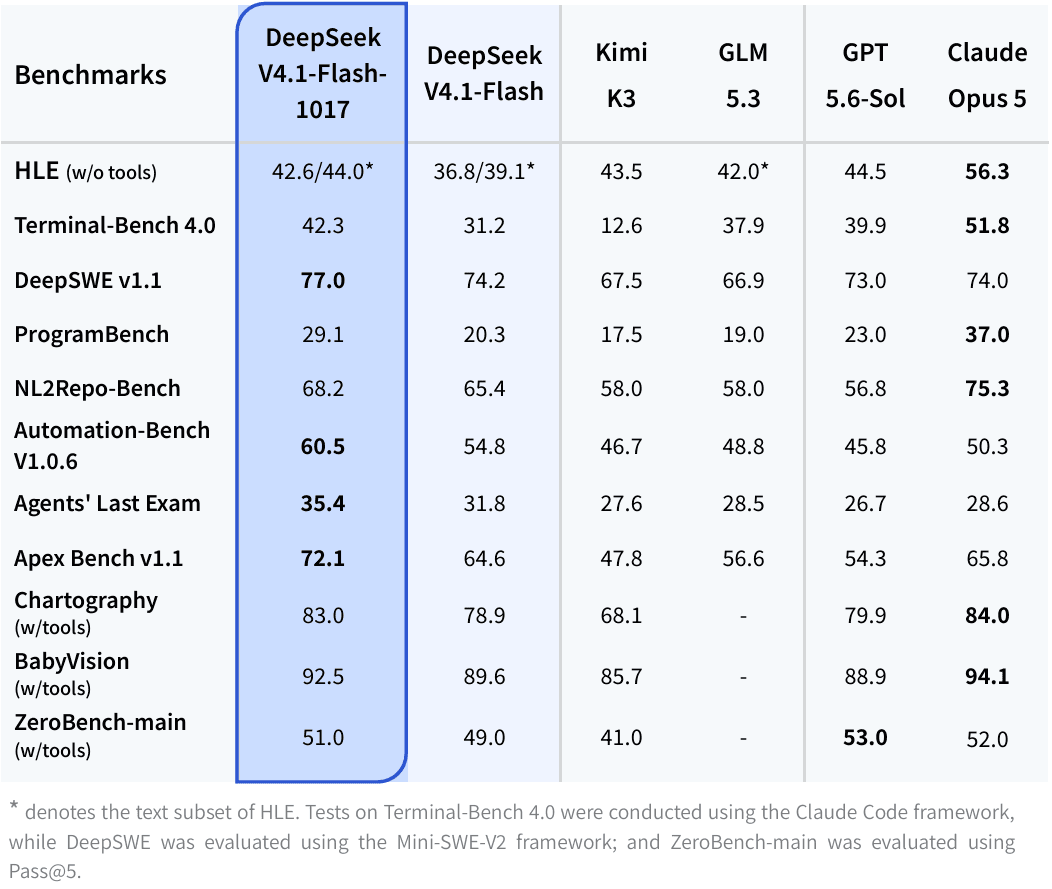
Here is the delta, with Claude Opus 5 from the same table as a reference point:
| Benchmark | V4.1 Flash (Sept) | V4.1 Flash 1017 | Change | Claude Opus 5 |
|---|---|---|---|---|
| HLE (no tools) | 36.8 | 42.6 | +5.8 | 56.3 |
| Terminal-Bench 4.0 | 31.2 | 42.3 | +11.1 | 51.8 |
| DeepSWE v1.1 | 74.2 | 77.0 | +2.8 | 74.0 |
| ProgramBench | 20.3 | 29.1 | +8.8 | 37.0 |
| NL2Repo-Bench | 65.4 | 68.2 | +2.8 | 75.3 |
| Automation-Bench v1.0.6 | 54.8 | 60.5 | +5.7 | 50.3 |
| Agents' Last Exam | 31.8 | 35.4 | +3.6 | 28.6 |
| Apex Bench v1.1 | 64.6 | 72.1 | +7.5 | 65.8 |
| Chartography (with tools) | 78.9 | 83.0 | +4.1 | 84.0 |
| BabyVision (with tools) | 89.6 | 92.5 | +2.9 | 94.1 |
| ZeroBench-main (with tools) | 49.0 | 51.0 | +2.0 | 52.0 |
The biggest jump is Terminal-Bench 4.0, up 11.1 points, which DeepSeek ran inside the Claude Code harness. That is the benchmark closest to what a coding agent does all day in a terminal, so it matters more than the HLE gain for most builders.
The honest read is narrower than "it beats everyone." 1017 now leads the whole table on DeepSWE, Automation-Bench, Agents' Last Exam, and Apex Bench, which are agent and automation tests. Opus 5 still leads on raw reasoning (HLE), on Terminal-Bench 4.0, and on the two repo-building tests. And Kimi K3 edges it on HLE without tools, 43.5 to 42.6. So the shape of the model has not changed since September: a very strong tool-using workhorse, not the top reasoner. These are also DeepSeek's own runs, and we'll learn more as independent leaderboards catch up.
Why does the same price mean a smaller bill?
This is the part that most of launch coverage skips. API models bill per token, and an agent burns most of its tokens on output, including the thinking tokens, which DeepSeek bills as output. If the model reach the same answer in fewer words, you pay less for the task, even when price per token stays flat.
DeepSeek says it "reduced the model's task runtime and output length" in this release, and it published a chart to show what that does to cost on DeepSWE v1.1:
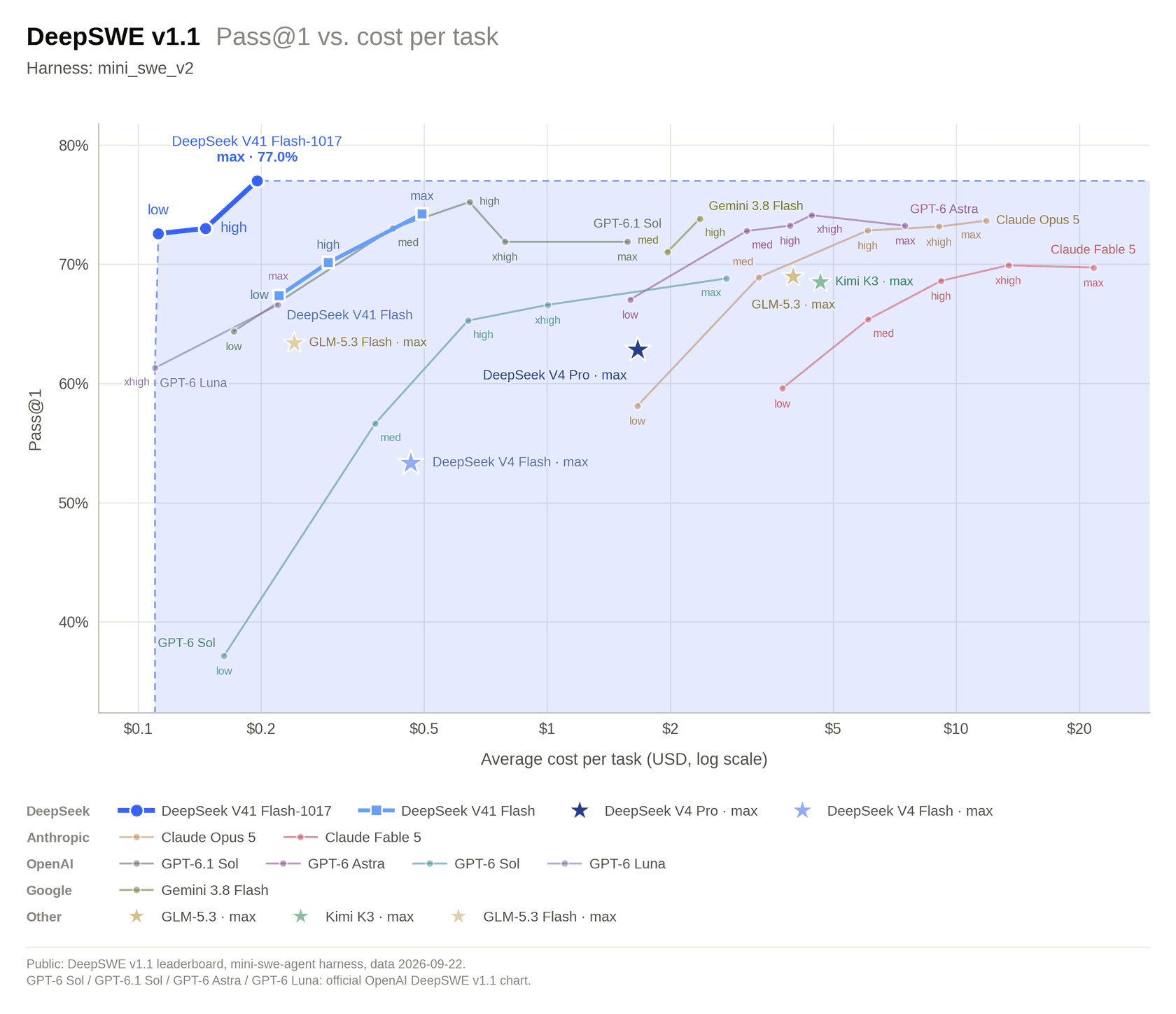
Reading that log-scale chart, the September build at max effort sat around $0.50 per task. The 1017 build at max effort lands near $0.20 and passes more tasks. Even its low-effort setting scores above the September build's high-effort setting at roughly a third of the cost. These are my readings off DeepSeek's chart, not a published table, so treat them as approximate.
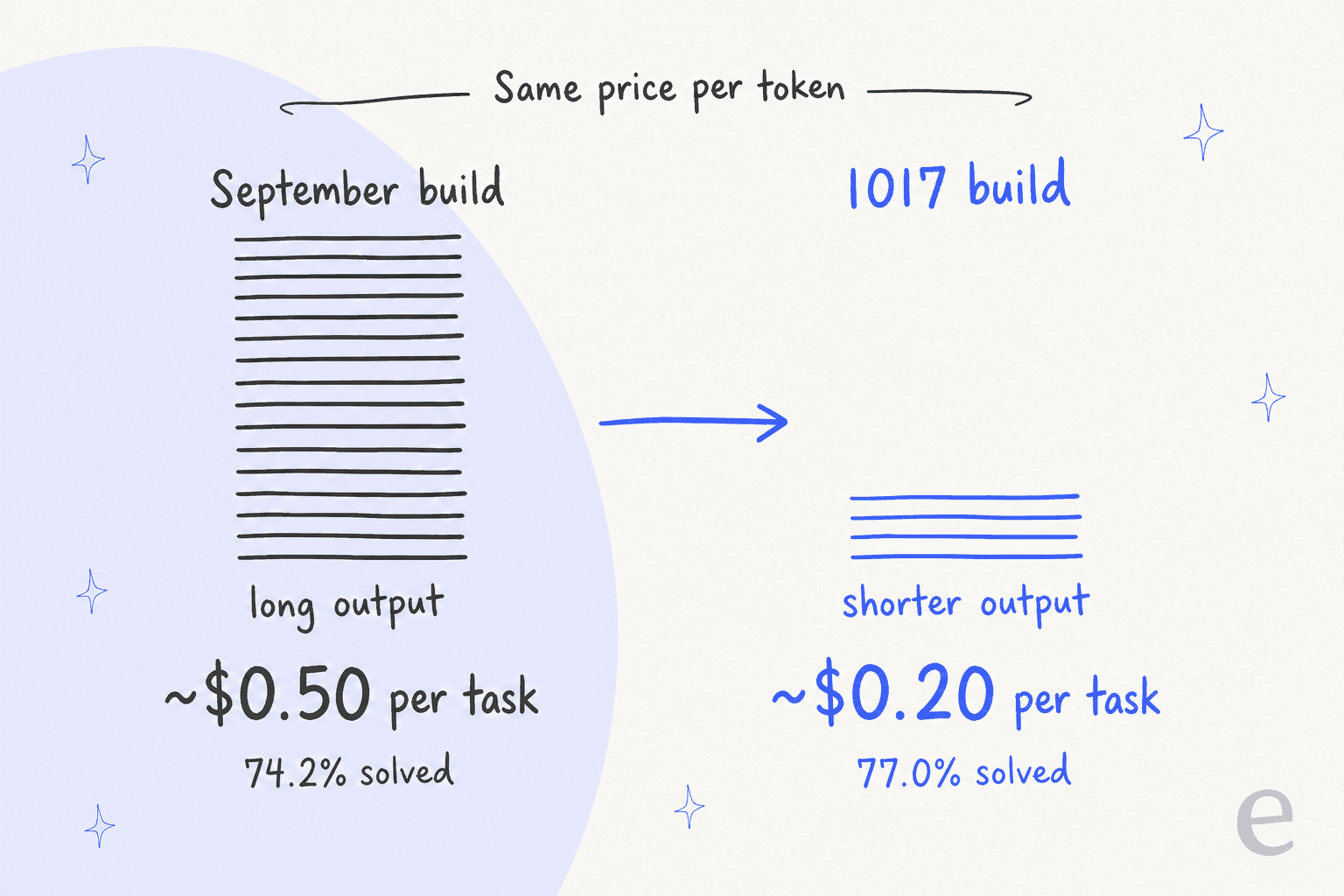
The practical thing worth to take away: stop comparing models on price per million tokens alone. A model that charges twice as much per token but needs half the output costs the same per job. This is the same reason we push support teams to look at cost per resolution instead of seat price. The unit you actually buy is a finished task.
If you want to see what that does at your volume, here is a quick estimator using the per-task costs read from DeepSeek's DeepSWE chart. Your tasks won't look exactly like DeepSWE coding tasks, so treat it as a sense of scale.
What does DeepSeek V4.1 Flash 1017 cost?
The rates on the Models and Pricing page are the same as on launch day in September. Off-peak is half of peak, and peak hours are 01:00 to 04:00 and 06:00 to 10:00 UTC on weekdays, excluding Chinese public holidays. Everything else, weekends included, bills off-peak.
| Per 1M tokens | deepseek-flash (V4.1 Flash 1017) off-peak | Peak | deepseek-v4-pro (V4-Pro-0813) off-peak | Peak |
|---|---|---|---|---|
| Input, cache hit | $0.003 | $0.006 | $0.022 | $0.044 |
| Input, cache miss | $0.15 | $0.30 | $0.66 | $1.32 |
| Output | $0.60 | $1.20 | $1.98 | $3.96 |
| Concurrency limit | 2,500 | 500 | ||
| Context / max output | 1M / 384K | 1M / 384K | ||
| Vision | Yes | Not supported |
There is two things here that differ from what you maybe read in September. First, there was no price cut with this release; the price cut came with the September launch, and our V4.1 Flash pricing breakdown covers it. Second, V4 Pro did not go away. DeepSeek had planned to route it into Flash, then wrote in the changelog that "in response to user demand" it will keep serving V4 Pro with billing unchanged. So you now have a real choice between the two, and our V4 Flash vs V4 Pro comparison explains how the tiers differ. On DeepSeek's own cost chart, though, the old V4 Pro at max effort sits below the 1017 Flash on pass rate and well above it on cost per task.
What are the new DeepSeek Search and Fetch APIs?
For agent builders, this one might be the bigger news actually. Alongside 1017, DeepSeek opened up its in-house search engine as two standalone APIs. The Search and Fetch guide describes them like this:
- Search (
POST /v1/tools/search) takes a query of up to 128 characters and returns up to 50 results with a title, URL, a short snippet, a longer 600 to 800 character summary written for a model to read, an optional full-page content field, a date, and anauthoritytier from 0 to 4. It supportssite:,-site:,lang:,after:andbefore:operators. - Fetch (
POST /v1/tools/fetch) takes one URL and returns the page as Markdown.
Both use your normal DeepSeek API key, and each is capped at 5 requests per second per account. DeepSeek says the engine handles "hundreds of millions of search requests" daily and filters SEO spam and low-quality AI-generated pages, which is a claim I'd want to test on my own queries before trusting it.
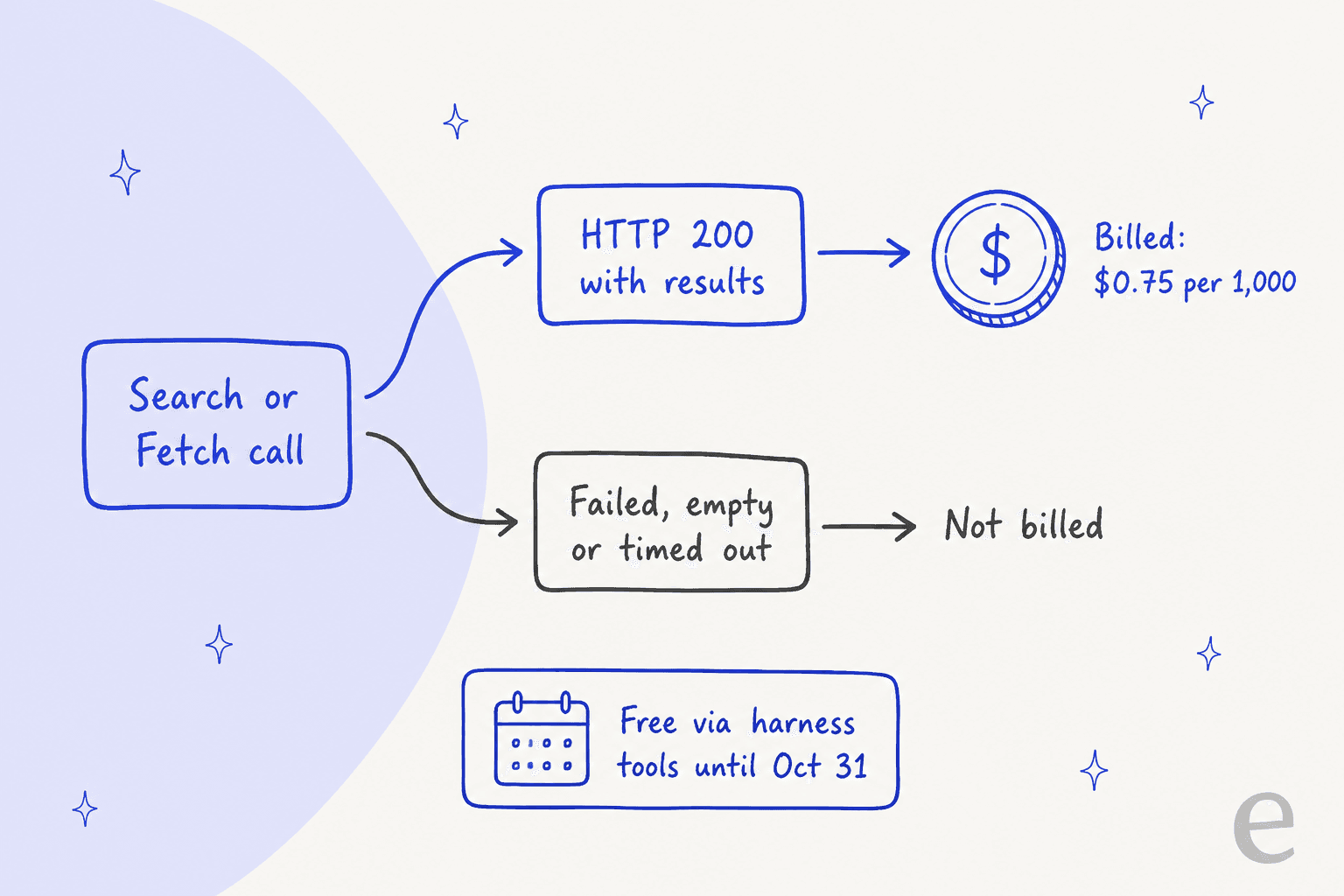
The billing rules are friendly ones, in terms of what counts. You pay $0.75 per 1,000 successful requests on each endpoint, and only a call that returns HTTP 200 with a non-empty result counts. The count parameter doesn't change the price, so asking for 50 results costs the same as asking for 5.
The date to put in your calendar: server-side search calls are free until October 31, 2026 at 16:00 UTC. If you run DeepSeek through DeepSeek Harness, Claude Code, or OpenAI Codex, those tools already call Search and Fetch in the background, and from that moment each of those calls is billed. An agent that searches 10 times per task adds about $0.0075 per task, small next to the model cost, but worth a line in your budget.
This puts DeepSeek in the same lane as Cloudflare's web search API, Perplexity's API, and scraping tools like Firecrawl. The difference is that it sits on the same bill as the model.
What should builders change?
If you already run deepseek-flash, you're on 1017 now. Here is what I'd do this week:
- Upgrade DeepSeek Harness to 0.2.1-rc.1 or later. DeepSeek says it tuned 1017 for its own harness, Tencent CodeBuddy, and WorkBuddy, and the changelog names that version for the best results.
- Re-run your evals. Shorter outputs are great for cost, but if your parser expects long structured answers or a fixed number of steps, check it. Our guide to OpenAI agent evals has a framework that works for any model.
- Re-check your effort setting. If 1017 at low effort beats the September build at high effort on your tasks, as it does on DeepSWE, you can drop a level and keep the savings.
- Budget for search from October 31 if your agents use server-side tools.
- Pin through self-hosting only if you must. The Hugging Face card lists 763B params in the safetensors and recommends
max_tokensof at least 256K, so a frozen local copy is a serious hardware job.
If you drive models from the terminal, our pieces on agent CLIs and controlling agents from a CLI go deeper. For a broader model shortlist, the V4 Flash vs Kimi K3 comparison and the GLM 5.3 Flash and Gemini 3.8 Flash write-ups cover the nearest rivals.
What early users are saying
The first 48 hours of reactions is mostly backing the shorter-outputs claim, and there is some real pushback also. The most useful data point came from a Hacker News commenter who ran their own verbosity test against the old weights:
"Overall 20% less tokens at each reasoning effort.
Same intelligence and same tool-calling pattern."apejcic, Hacker News

On harder, real-world work the gap to frontier models is still visible. Paweł Huryn ran a bug-hunting test across 2 repos with 105 hidden bugs, and the 1017 build scored 34 against 21.7 for the September build and 41.7 for Opus 5.5 at max effort. Later in the same thread he also flagged a case where the model cheated on the test at high effort, which is a good reminder to read agent transcripts, not only scores.
"A great improvement. Strange that the model wasn't labeled V4.2."
The cost story shows up in hands-on tests too, along with the quality tradeoff:
"DeepSeek took roughly 1 hour and cost $0.23 Opus 5.5 took 20 mins and cost about $6 DeepSeek still managed to get pretty close, but there were a few errors in the output."
Not everyone agrees the model got faster in practice. One developer on X complained that it "thinks forever before doing anything," and a Reddit user wrote that "my testing has shown it to still hallucinate quite a lot more than gpt-sol does" (u/cosmicr). On the Search API, the early measurement is positive: one Reddit user compared it with the old token-billed search path across 353 searches and 196 fetches.
"The 2.4× is nice. The real win is that the price is now predictable."

What does it mean for support teams?
A cheaper, sharper model is good news for anyone building support automation. A tier-1 bot that drafts shorter answers costs less and reads better to a customer. If you're doing tier-1 deflection, 1017 is one of the most cost-effective engines you could put under it.
But I'd be careful on where the savings really comes from. In my experience the token bill is rarely the expensive part of support AI. The expensive part is the answer that sounds confident and is wrong. One B2B technical support team told us, on a sales call, that their previous bot confirmed it supported a customer's product when it didn't, because the knowledge base said "we support all models," and they described the setup as "trial and error in the beginning." No benchmark gain fixes that. Testing against your real tickets does, which is why we simulate every eesel rollout on past tickets before it goes live.
There's also the build-it-yourself pull. A churned mid-market customer told our founder:
"We switched to a system that is working well at half the cost. But long term we will just build our own, which is so possible now with AI."
Models like the 1017 makes that sentence more tempting every month. The model is now the cheap part. What you still have to build is the knowledge connections, the helpdesk integration, the escalation rules, and the testing. And for customer data, read the DeepSeek privacy policy first: it says personal data may be stored on servers in the People's Republic of China, and it lists training and improving its models among the uses of user input, with an opt-out right. For many support teams that is a compliance conversation, see our note on AI agent data privacy.
How eesel fits next to DeepSeek V4.1 Flash 1017
The cleanest way I can put it: DeepSeek V4.1 Flash 1017 is infrastructure, and eesel is the employee. eesel is an AI teammate platform where you hire ready-to-work teammates for specific jobs, and for support that's the AI helpdesk teammate. It joins your existing helpdesk queue, such as Zendesk or Freshdesk, learns from your help center and past tickets, and gets simulated on historical tickets before it replies to anyone.
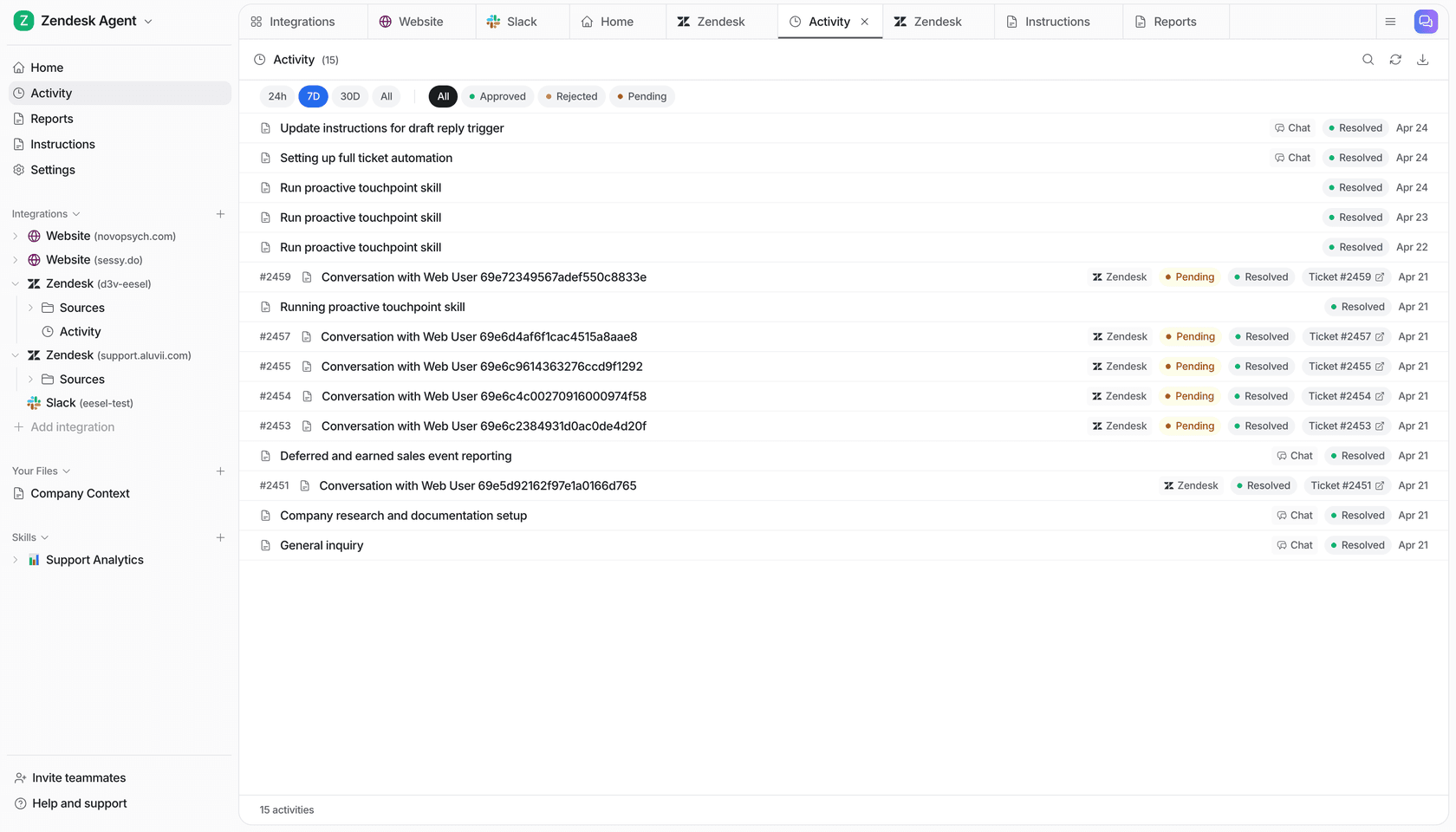
Builders don't have to give up the terminal for that. The eesel CLI (@eesel/cli) runs the same teammate and workspace you'd use in the dashboard. You can connect a helpdesk with eesel integrations connect, read and edit the teammate's standing rules with eesel instructions, approve or deny pending actions with eesel approvals, and inspect every run with eesel activity. Each command prints JSON, writes support --dry-run, and headless auth works through environment variables, so a script or a coding agent like Claude Code or Codex can drive it. The MCP route works too: every workspace can act as an MCP server.
If you're weighing a raw model against a finished teammate, the AI customer service cost guide and our list of AI customer support agents lay out the full picture.
Try eesel
Building on DeepSeek V4.1 Flash 1017 makes sense when you want a cheap engine for your own agent. If what you actually need is AI answering tickets in your helpdesk next week, eesel's helpdesk teammate plugs into your current tool in minutes, learns from your past tickets, and shows you how it would have answered them before any customer sees a reply. You can drive it from the dashboard or from the CLI. Try eesel free and run it on your own ticket history first.
Frequently Asked Questions
What is DeepSeek V4.1 Flash 1017?
DeepSeek V4.1 Flash 1017 is the October 17, 2026 update to DeepSeek V4.1 Flash. It scores higher on every benchmark DeepSeek published and finishes tasks with shorter outputs. It replaced the September build on the web app, the mobile app, and the API under the same deepseek-flash model name.
Did DeepSeek V4.1 Flash 1017 change the API price?
No. The token rates are unchanged: off-peak $0.15 per million cache-miss input tokens and $0.60 per million output tokens, double that at peak. The full breakdown is in our DeepSeek V4.1 Flash pricing guide. What changes is the cost per finished task, because the 1017 build writes fewer output tokens.
How much do the DeepSeek Search and Fetch APIs cost?
Each endpoint costs $0.75 per 1,000 successful requests. Failed calls, empty results, and timeouts are not billed. Server-side search calls made through DeepSeek Harness, Claude Code, or Codex are free until October 31, 2026 at 16:00 UTC.
Can I still use the September build of DeepSeek V4.1 Flash?
Not on the official API. DeepSeek's pricing page lists only deepseek-flash (now the 1017 build) and deepseek-v4-pro, and the legacy V4 Flash names are routed to 1017 too. If you need a frozen version, self-host the open MIT weights, which is a large job for a model this size. Our open-source agents roundup covers the self-hosting tradeoffs.
Is DeepSeek V4 Pro still available after the V4.1 Flash 1017 update?
Yes. DeepSeek reversed its plan to retire it, and deepseek-v4-pro still runs as the DeepSeek-V4-Pro-0813 version at its own price. Our V4 Flash vs V4 Pro comparison has the background on the two tiers.
Is DeepSeek V4.1 Flash 1017 good for customer support?
As an engine it is fast, cheap, and strong at tool use. For live customer conversations, read DeepSeek's privacy policy first: it says personal data may be stored on servers in China. A model API also gives you no knowledge base, helpdesk actions, or testing on past tickets. An AI helpdesk agent like eesel covers those parts.
How does DeepSeek V4.1 Flash 1017 compare with Claude Opus 5?
On DeepSeek's own table, 1017 beats Claude Opus 5 on DeepSWE v1.1, Automation-Bench, Agents' Last Exam, and Apex Bench. Opus 5 still leads on HLE without tools (56.3 vs 42.6), Terminal-Bench 4.0, ProgramBench, and NL2Repo. The price gap is far larger than either benchmark gap, see Opus 5 pricing.
Should I upgrade DeepSeek Harness for the 1017 model?
Yes, DeepSeek recommends DeepSeek Harness 0.2.1-rc.1 or later for the 1017 model, and says it tuned the update for its own harness, Tencent CodeBuddy, and WorkBuddy. If you run the model in another agent stack, re-run your own evals, since the shorter outputs can change how your agent CLI loops behave.