The rate card, and the four meters behind it
Here is the published price, in full, as it actually applies.
| Prompt size | Input / 1M | Output / 1M | Cache read / 1M | Cache write / 1M |
|---|---|---|---|---|
| Under 32K tokens | $0.03 | $0.13 | $0.006 | $0.038 |
| 32K to 256K | $0.10 | $0.40 | $0.02 | $0.125 |
| 256K to 1M | $0.20 | $0.80 | $0.04 | $0.25 |
Those rates come from OpenRouter's models API, which is the same feed the Qwen3.7 Flash model page renders from. The model card on Alibaba Cloud Model Studio prints the identical three-bracket structure in CNY.
Four things move the number you are billed, and only one of them is on that table.
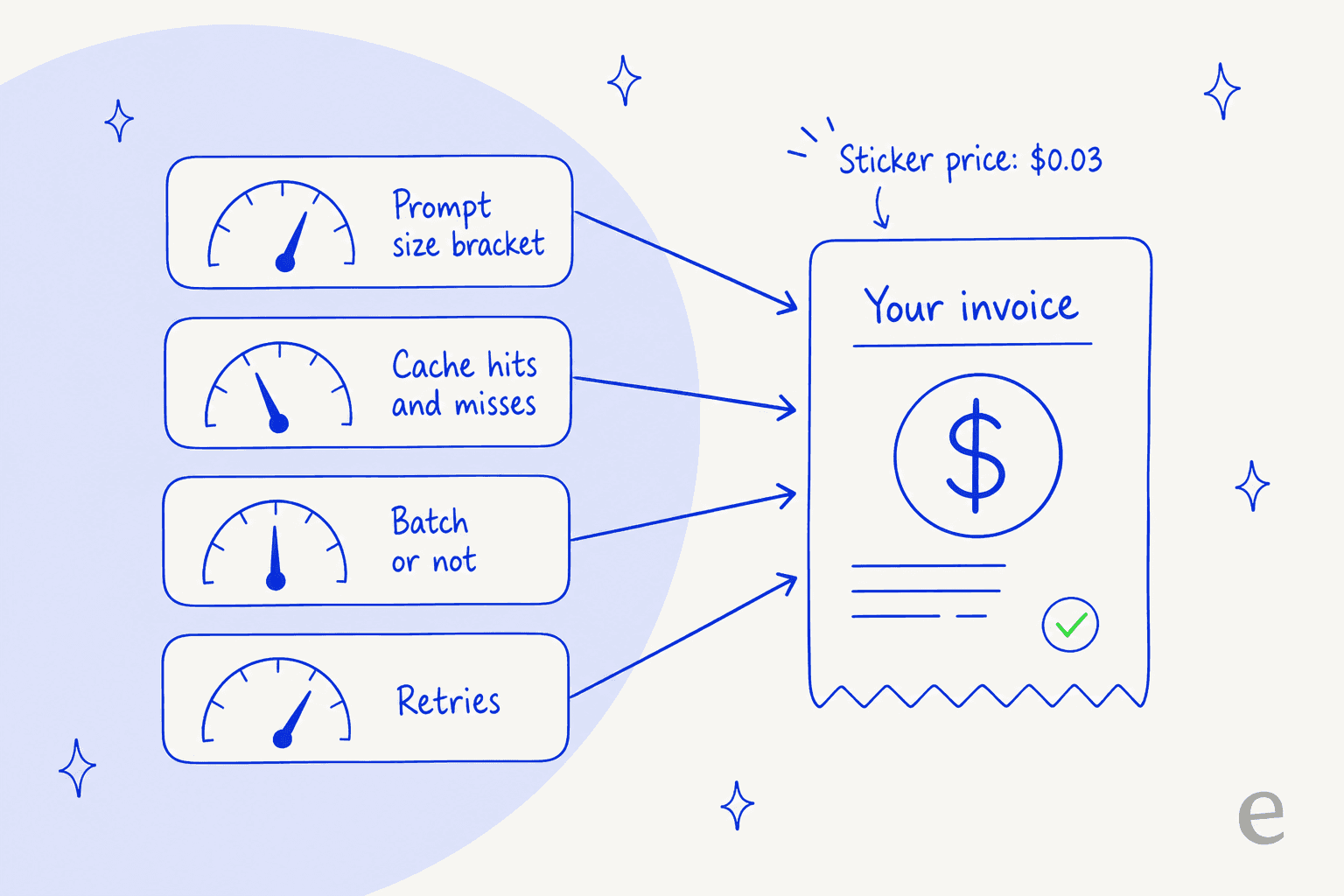
Plug your own workload into all four:
The rest of this post is what each of those four inputs is really doing.
Meter 1: the prompt-size bracket, and how agent loops drift into it
The pricing is bracketed by how big the prompt is, not by how many tokens you buy in a month. A call with 32,001 prompt tokens is billed at $0.10 per million on every one of them, not just the ones past the line. Cross 256K and the whole request reprices again at $0.20.
That makes the top bracket 6.7x the headline input rate and 6.2x the headline output rate. It also means the two numbers in every headline about this model, "cheapest vision model" and "1M context," cannot both be true in the same call. My colleague Rama walked through that trade-off in detail in the Qwen 3.7 Flash review; the spec-sheet version lives in the Qwen 3.7 Flash overview.
What is less obvious is how you get there without meaning to. Agent loops drift across brackets on their own:
- A system prompt with tool schemas is often 3K to 8K tokens before the user says anything.
- Retrieved documents land on top of that. Four help-centre articles at 2K each is another 8K.
- Every turn re-sends the whole conversation, so turn 1 might be 12K and turn 6 is 40K.
Turn 1 bills at $0.03. Turn 6 bills at $0.10, retroactively on the entire prompt. Nothing changed in your code. This is the same shape of problem as picking a model by sticker rate elsewhere, which is why Opus 5 vs Sonnet 5 ends up being an argument about cost per finished task rather than cost per token.
The evidence that this is happening to real users is on the vendor's own page. OpenRouter publishes a rolling 30-day weighted average of what customers pay after caching, and for this model it is $0.044 input and $0.149 output at a 51.0% cache hit rate. The effective price sits above list, which is only arithmetically possible if a meaningful share of traffic is paying the upper brackets.
If you are comparing models on rate cards, the same trap exists elsewhere in different clothing. GPT-5.6 pricing doubles input and adds 50% to output above 272K tokens, and Claude pricing charges a premium for cache writes. Only Qwen3.7 Max sits flat across the whole window, and it costs 49x more per input token to get there.
Meter 2: caching, where writing the cache costs more than not caching
This is the meter people get wrong most often, and it is worth doing the arithmetic once.
Qwen 3.7 Flash exposes two kinds of cache. Implicit caching reads at 20% of the standard input rate and costs nothing to create. Explicit caching is split: you pay a creation rate and then a much lower read rate. On OpenRouter's USD listing, the five-minute explicit cache creates at $0.038 and reads at $0.003, against a $0.03 standard input rate.
Read that again. Writing a cache entry costs 1.27x what it would have cost to just send the tokens.
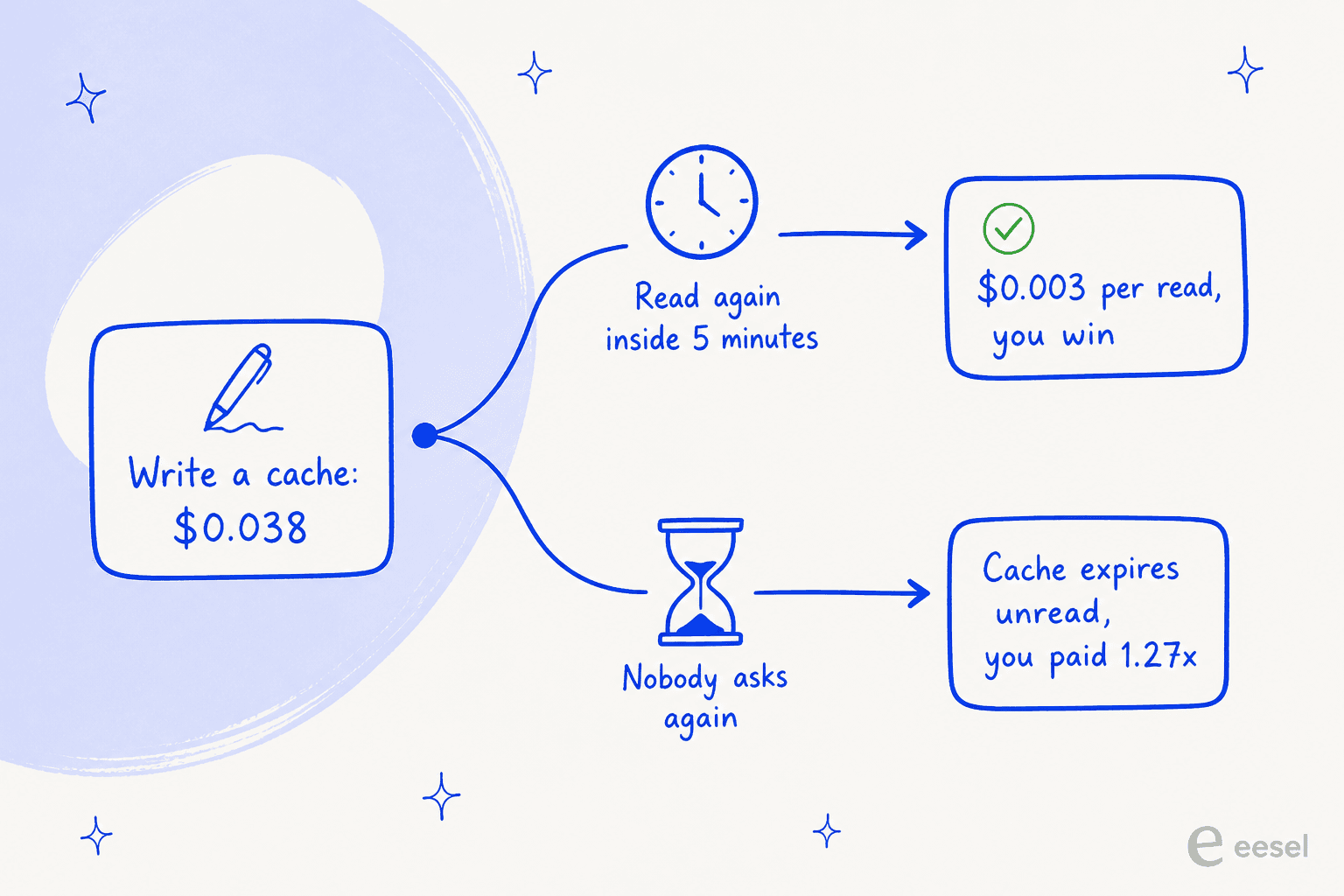
The maths breaks in your favour fast. Write once and read once, and you have spent $0.041 per million against $0.060 uncached, so the cache is already paying. Every read after that is nearly free. The whole thing only goes wrong in one specific case: the cache expires before anybody reads it, and you paid a 27% premium for nothing.
Which is exactly the shape of a support queue. Tickets do not arrive in a tight burst against the same context, they trickle in across the day. A five-minute time-to-live is generous for a chat session and useless for an inbox. The 51% cache hit rate OpenRouter measures across all traffic on this model is a reasonable planning assumption, not the 90% you get in a benchmark script.
Two practical rules fall out of that. Use implicit caching by default, since it has no creation charge and still reads at 20%. Reserve explicit caching for prefixes you are confident get hit repeatedly inside the window, like a long system prompt on a high-throughput endpoint. If you are building retrieval on top, the RAG vs LLM trade-off matters here too, because a smaller retrieved context is both cheaper per call and less likely to tip you into the next bracket.
Meter 3: the batch discount exists in exactly one region
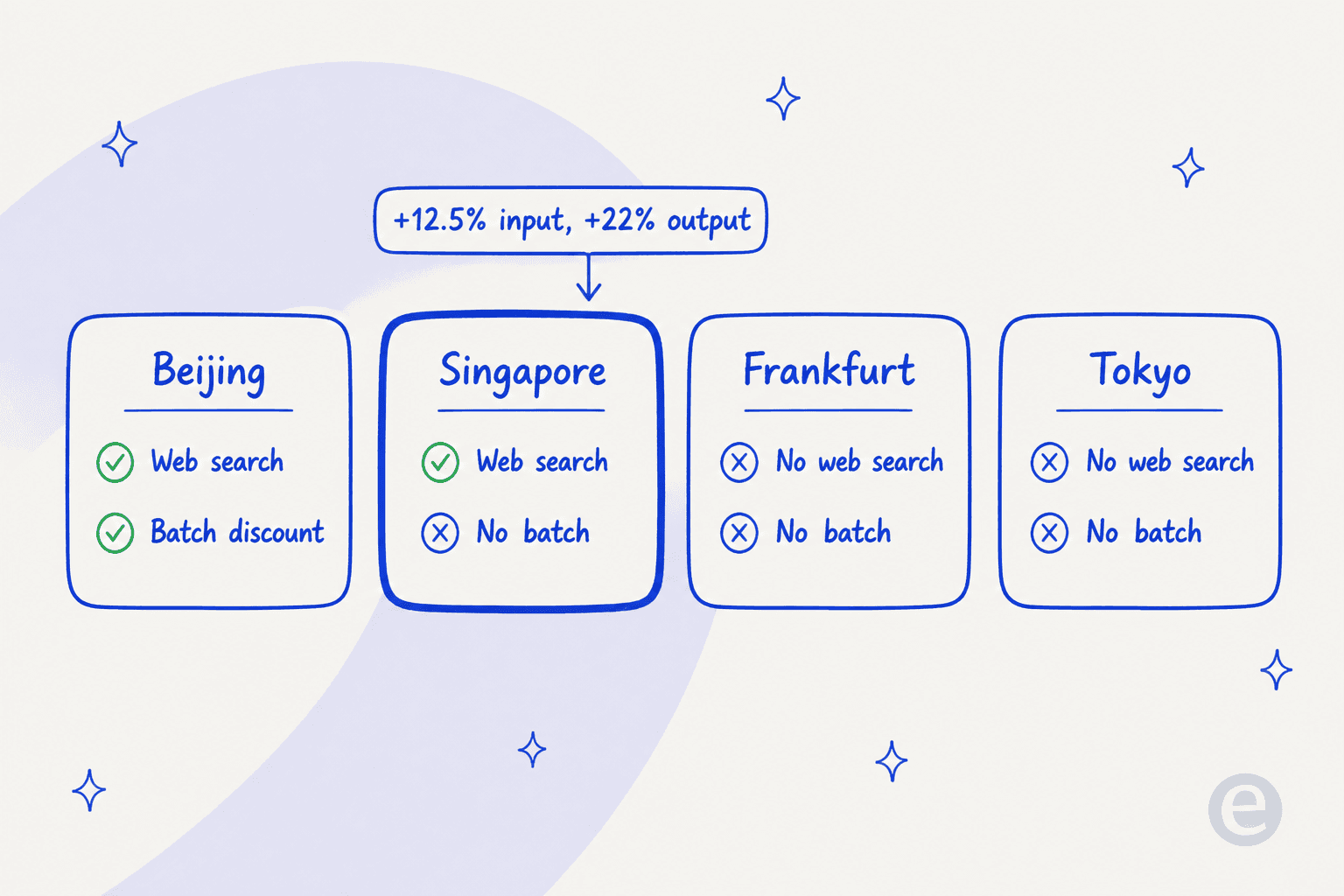
Alibaba's own model card prices this model in CNY, in four separate regional tables, and the differences are not cosmetic.
| Billing item (per 1M, base bracket) | Beijing | Singapore | Frankfurt | Tokyo |
|---|---|---|---|---|
| Input | 0.2 CNY | 0.225 CNY | 0.2 CNY | 0.2 CNY |
| Output | 0.8 CNY | 0.974 CNY | 0.8 CNY | 0.8 CNY |
| Implicit cache read | 0.04 CNY | 0.045 CNY | 0.04 CNY | 0.04 CNY |
| Input (Batch File) | 0.1 CNY | — | — | — |
| Output (Batch File) | 0.4 CNY | — | — | — |
Three findings in that table.
Batch File pricing halves both meters, and it only exists in Beijing. Batch Inference is marked Unsupported on the Singapore, Frankfurt and Tokyo capability grids, so the 50% discount that every other vendor offers globally is, here, a function of where you deploy. Note also the trap inside the trap: Batch Chat rows are priced at 0.2 and 0.8, identical to standard. Only the file-based batch path gets the discount.
Singapore costs more for the same model. Input runs 12.5% above the base rate and output runs about 22% above. Nothing in the capability grid explains it; it is simply a different price list.
Web search is region-gated too, supported in Beijing and Singapore and unsupported in Frankfurt and Tokyo. That is a feature question rather than a pricing one, until you have to bolt on a separate search API and pay for it twice.
One more thing about currency. The model card prints CNY on every tab and shows no USD figures anywhere; the dollar rates everyone quotes come from OpenRouter's resale listing. Those are two storefronts for one pricing scheme, not a contradiction to resolve, and converting between them will give you a number that matches neither invoice. Price against the storefront you are actually buying through. Anyone comparing across vendors will hit the same problem, which is part of why the OpenAI vs Anthropic vs Gemini comparison is harder than reading three price pages.
Meter 4: retries, the line item nobody budgets for
OpenRouter measures a tool-call error rate of 8.88% for this model, against 6.45% on Qwen3.7 Plus. In an agent loop, a failed tool call is not free. You paid for the prompt that produced it, and you will pay again for the retry that includes the failure in its context, at a slightly larger prompt size.
Nine percent is not catastrophic, but it belongs in the model, which is why the calculator above adds it as a multiplier rather than leaving it as a footnote.
The latency tail is the same story told in time instead of money. P50 end-to-end is a comfortable 3.56 seconds. P99 is 90.19 seconds. If your timeout sits below that, you are cancelling and re-issuing roughly one call in a hundred, and paying for both. And because exactly one provider serves this model, there is no fallback route to fail over to when it gets slow.
"Flash" is a claim about price, not speed. At 59 output tokens per second, this model is roughly a sixth the speed of Gemini 3.5 Flash-Lite, which is a real consideration if anything is waiting on the response. It is also, oddly, about five times faster than its own Plus sibling.
How it prices against the rest of the cheap vision tier
Every figure below comes from the vendor's own pricing page, at the standard synchronous tier.
| Model | Input $/1M | Output $/1M | Context | Vision | The catch on the rate card |
|---|---|---|---|---|---|
| Qwen 3.7 Flash | $0.03 | $0.13 | 1M | Text, image, video | Three brackets; batch is Beijing-only |
| Mistral Small 4 | $0.15 | $0.60 | 256K | Text, image | Flat, but the smallest window here |
| GPT-5.6 Luna | $0.20 | $1.20 | 1.05M | Text, image | 2x input above 272K; batch halves it |
| Gemini 3.1 Flash-Lite | $0.25 | $1.50 | Not published | Text, image | Cheaper than the newer 3.5 Flash-Lite |
| Gemini 3.5 Flash-Lite | $0.30 | $2.50 | 1,048,576 | Text, image, video | Cache storage billed per hour |
| Claude Haiku 4.5 | $1.00 | $5.00 | 200K | Text, image | Cache writes at 1.25x input |
| Gemini 3.6 Flash | $1.50 | $7.50 | 1,048,576 | Text, image, video | Priced above the Lite tier by 5x |
Qwen wins the top row by an order of magnitude, and it is the only model here that takes video input under $0.10. But the comparison is closer than the raw numbers suggest once you apply each vendor's own discounts. Mistral pricing is flat, so what you see is what you pay. Batch mode halves both Google tiers worldwide with no region gate, as the Gemini 3.5 Flash-Lite pricing breakdown lays out.
And GPT-5.6 cut Luna's price by 80% on 30 July 2026, which reshuffled this table days before I wrote it. The full tier map is in the GPT-5.6 pricing post, and the top of Google's range is in Gemini 3.6 Flash pricing.
Two rows worth staring at. Newer is not cheaper inside Google's own lineup, where 3.1 Flash-Lite still undercuts 3.5. And open weights do not mean cheap, which Kimi K3 pricing demonstrates at $3 in and $15 out. If open weights are what you are after here, note that Qwen 3.7 is closed, and the best open source AI agents roundup is the better starting point.
Inside the Qwen family the ladder is steep:
| Model | Input $/1M | Output $/1M | Long-context surcharge | Modality |
|---|---|---|---|---|
| Qwen3.7 Flash | $0.03 | $0.13 | Yes, at 32K and 256K | Text, image, video |
| Qwen3.7 Plus | $0.32 | $1.28 | Yes, at 256K | Text, image |
| Qwen3.7 Max | $1.475 | $4.425 | None published | Text only |
Flash is 10.7x cheaper on input than Plus and 49x cheaper than Max, and it is the only one of the three that accepts video. Max, the flagship, has no vision at all. Broader context on the range sits in the Qwen pricing breakdown, and the newer preview tier is covered in Qwen3.8-Max pricing.
If none of the three fits, Qwen alternatives covers what else is in the running, and the Qwen family overview is the plain-English version of this ladder.
What the community is saying, which is almost nothing
Worth stating plainly, because it changes how much weight the price alone should carry: there is no independent price-performance data on this model. It is not listed on Artificial Analysis, it has no LMArena entry, and Qwen published no benchmarks with it. A search of Hacker News for the model name returns zero results across stories and comments, all time.
The closest thing to an explanation came from an unrelated thread the same week:
"Qwen/Alibaba have stopped doing open weights releases for a while. No grudge or anything, I'm certainly not going to look at a gift horse in the mouth, but both DeepSeek and Moonshot have been very consistent with open weights as well as sharing actually detailed research."

The crowd that normally stress-tests a Qwen release stopped watching when the line went closed-weight, so an API-only launch landed with nobody to benchmark it. In the same thread, another commenter noted that the rival cheap model "does not have vision abilities, which is a big draw for agentic tasks" — which is precisely this model's pitch, written by someone who did not know it had shipped four days earlier.
Practically: you can trust the price, because the vendor published it. You cannot yet trust anybody's claim about what you get for it. Budget for your own eval before you commit a workload, the way you would with any model in the top AI agents conversation.
What this actually costs on a support queue
Here is where I have to step outside the rate card, because this is the question most people arrive with.
Run the calculator on a plausible support workload: 200,000 conversations a month, 12K prompt tokens each once you include a system prompt and a few retrieved articles, 700 tokens out, half of it cache-hit, with the retry allowance on. That comes to roughly $67 a month — below the headline estimate, because the cache is doing its job at a prompt size that never leaves the base bracket. It is a small enough number to feel like a rounding error, and it is the number that makes building your own look obviously correct.
At eesel we watch this decision play out regularly, and the pattern is consistent. From an internal churn review, several technical customers — including an AR construction-tech firm and a DTC beauty brand — left to build directly on an LLM API. What sends teams the other way is what the tokens do not cover. On the buy side, an engineering lead at a Bitcoin-ATM hardware company running a 300-plus article Confluence and Telegram knowledge base put it like this:
"We could try to write our own LLM application but we didn't want to invest our time into that. We wanted something that we would not have to maintain."
The maintenance is the actual cost. A raw model call has no idea which of your help-centre articles is current, no rule for when to hand off to a human, no way to test itself against your history before it answers a live customer. Getting those wrong is more expensive than any token bracket: we have watched a confident-sounding bot quietly give wrong answers, which is why every eesel rollout is simulated against historical tickets before it touches a real conversation.
If you want the honest all-in figure rather than the API line, the AI customer service cost breakdown and the cost per resolution comparison are better starting points than any per-token table, and AI vs human cost frames the number that finance actually asks about.
The engineering work that a $0.03 rate does not buy you, roughly in the order it bites:
- Retrieval that stays current, which is the whole of training AI on a knowledge base.
- Confidence thresholds and AI escalation so the model only answers what it should.
- Grounding and guardrails, since AI hallucinations in support are the failure that costs customers.
- Triage and ticket classification before an answer is even attempted.
- Measurement, because AI resolution rate is the only number that tells you whether any of it worked.
- Ongoing AI support QA, which never finishes.
None of that is an argument against cheap models. It is an argument for knowing which bill you are actually reading. A model this cheap is a great component and a poor product, and the difference between the two is what an AI agent versus a traditional chatbot really comes down to.
Try eesel
If you got here doing maths on whether a $0.03 model can carry your support queue, the honest answer is that the tokens were never the hard part. eesel is the version of that project you do not have to build: it plugs into Zendesk, Freshdesk, Gorgias or your inbox in a few minutes, reads the help centre and past tickets you already have, and answers only what it is confident about, escalating everything else.
The bit that matters most for anyone who has been burned by a demo: you can simulate it against thousands of your own historical tickets before a single customer sees it, so you know the resolution rate and the cost per ticket up front instead of discovering both in production. Free to try, no rebuild required.

The short version
Qwen 3.7 Flash pricing is real and it is the cheapest vision rate available, provided your prompts stay under 32K, you deploy in Beijing, your cache actually gets read, and your agent does not retry much. Change any one of those and the number moves, in one case by 6.7x.
Model it before you migrate. And if the workload on the other end of the maths is a support queue, price the whole system, not the tokens: the best LLM for support is usually the one you do not have to maintain.
Sources
- Qwen3.7 Flash on OpenRouter
- OpenRouter public models API
- Qwen3.7-Flash model card, Alibaba Cloud Model Studio
- Qwen3.7-Flash on QwenCloud
- QwenCloud model changelog
- Qwen3.7 Plus on OpenRouter
- Qwen3.7 Max on OpenRouter
- Gemini API pricing
- Gemini 3.5 Flash-Lite model page
- Gemini 3.6 Flash model page
- OpenAI API pricing
- GPT-5.6 Luna model page
- Claude pricing docs
- Mistral API pricing
- Hacker News, DeepSeek-V4-Flash Update thread
Frequently Asked Questions
How much does Qwen 3.7 Flash cost per 1M tokens?
Why is my Qwen 3.7 Flash bill higher than the advertised price?
Is Qwen 3.7 Flash cheaper than Gemini 3.5 Flash-Lite?
Does Qwen 3.7 Flash have a free tier?
How does Qwen 3.7 Flash pricing compare to Plus and Max?
Is Qwen 3.7 Flash cheap enough to run a support queue on?
Does Qwen 3.7 Flash offer a batch discount?
What currency is Qwen 3.7 Flash priced in?


Article by
Kurnia Kharisma Agung Samiadjie
Kurnia is a software engineer and writer at eesel AI with two years of SEO experience, writing about AI tools, helpdesk software, and customer support. He pairs a developer's understanding of how these products are built with search-driven research into what actually ranks and resonates with the people searching for them.