What Qwen 3.7 Flash actually is
I work on the agents inside eesel, so most of my week goes on the layer sitting between a model and a real user, and the first thing I do with any launch is go looking for the mechanism. With Qwen 3.7 Flash that search took about four minutes. There is barely any mechanism published.
There is no Qwen research post for this model. The article feed behind qwen.ai carries launch write-ups for Qwen 3.7 Max and Qwen 3.7 Plus, and the word "Flash" does not appear in either one.
The only first-party announcement is a single paragraph in the QwenCloud changelog, dated 25 July 2026. OpenRouter lists the release as 27 July 2026 under the slug qwen/qwen3.7-flash-20260727, and both dates are on the record, two days apart.
Here is the entire pitch, verbatim from the Alibaba Cloud model card:
"The Qwen3.7 native vision-language series Flash models comprehensively enhance multimodal understanding and Agent execution capabilities compared to 3.6-Flash. Key improvements include strengthened foundational multimodal abilities, enhanced object recognition, improved real-world perception and spatial intelligence."
Note who the comparison is against. Not Gemini, not GPT, not Claude. Its own predecessor. That is a company positioning an incremental platform update, not a flagship, and the rest of the launch behaved the same way: it appeared as a listing, not an event.
The mechanical facts are where it gets interesting.
| Spec | Qwen 3.7 Flash |
|---|---|
| Context window | 1,000,000 tokens |
| Max input | 991,808 tokens |
| Max input, thinking mode | 983,616 tokens |
| Max output | 65,536 tokens |
| Max chain of thought | 262,144 tokens |
| Input modalities | Text, image, video |
| Output modality | Text |
| Reasoning | On by default, with a token budget |
| Fine-tuning | Not supported, any region |
| Weights | Closed, API only |
Those come straight off the Model Studio card, and the thinking-mode rows are the only place the page admits thinking mode exists. There is no enable_thinking parameter documented, no streaming flag, and nothing at all about how the model was trained: no parameter count, no dense-or-MoE statement, no training-token figure. The only structural fact on the record is the tokenizer family. If you are used to reading a proper model card, this one is mostly blank space.
What Qwen claimed, and what it carefully did not
This is the section I would read twice before building anything on it, because the gap between what the internet says this model does and what Alibaba says it does is wide.
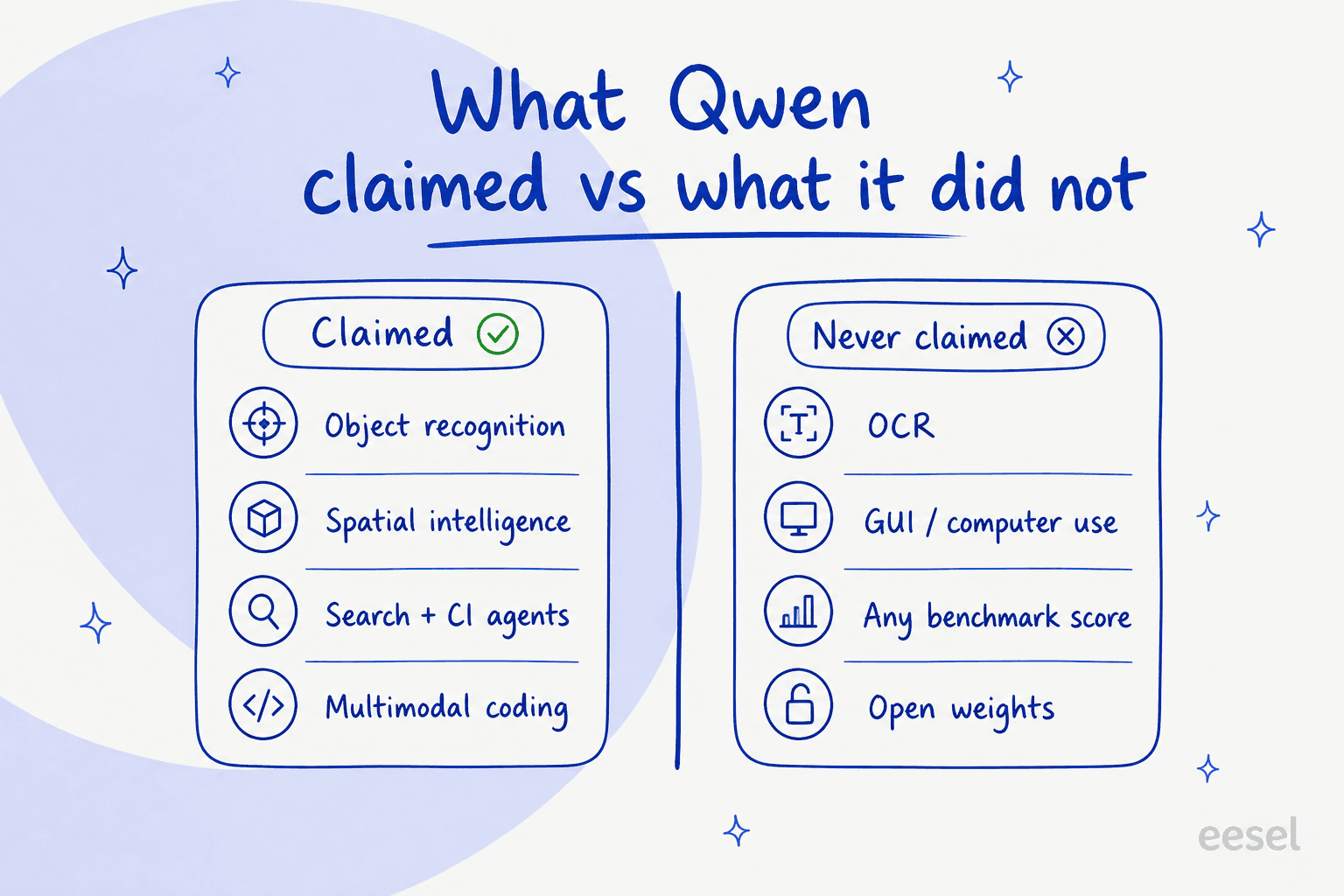
Claimed, in Qwen's own words: stronger universal object recognition, improved real-world perception and spatial intelligence, upgraded multimodal agent behaviour for search and code-interpreter scenarios, and optimised multimodal coding. Every one of those is a sentence with no number behind it.
Never claimed, anywhere: OCR. The word does not appear on any first-party surface. Neither does document parsing. If you are shopping for a cheap model to read invoices, Qwen never told you this was it, and the one independent eval that measured OCR ranked it last of 23.
Also never claimed: GUI and computer use. That belongs to Qwen 3.7 Plus, whose changelog entry talks about reading screens and operating GUIs end to end. OpenRouter's editorial blurb says Flash is suited to "computer interaction", which is OpenRouter's phrasing, not Alibaba's. It has been widely repeated as if it were a vendor claim.
What is real and documented: function calling and structured outputs are both marked supported, and the set of built-in server tools reachable through the Responses API is a properly useful one, covering code_interpreter, web_search, web_extractor, and image and text search on top of that. Prefix completion works in every region too, and so does context caching, in both the implicit and explicit forms.
One parameter-level wrinkle for anyone porting code across: OpenRouter's supported-parameter list for Flash has no top_k, no frequency_penalty and no stop, all three of which the older Qwen 3.6 Flash does accept. A drop-in upgrade will break on any of those.
Flash, Plus or Max: pick by what the model can see
The Qwen 3.7 ladder does not sort the way you would expect it to, so it is worth walking rather than assuming. Pick a model below and the card fills in.
Sees text, images and video. 1M context, 59 tokens per second measured, 8.88% tool-call error rate. No published quality score anywhere. Reach for it when the job is high volume and the cost of one wrong answer is low: bulk tagging, first-pass classification, image triage.
Sees text and images, no video. Roughly 10x the price of Flash. This is the tier Qwen credits with reading screens and operating GUIs, and the one with an Artificial Analysis intelligence score of 39. Reach for it when something downstream depends on the answer being right.
Text only. The flagship cannot see anything. It scores 46 on the Artificial Analysis index at 201 tokens per second, so it is the reasoning tier, not the perception tier. Reach for it for hard text work, and pair it with Flash if images are involved.
Rates are OpenRouter list prices at the sub-32K bracket. Intelligence scores are Artificial Analysis figures for Plus and Max; Flash is not listed there.
The oddity worth flagging: the cheapest model is the only one that can watch a video, while the flagship cannot see at all. Flash is also the fastest of the three on measured throughput, 59 tokens per second against Plus at 12. Normally the budget tier is the one with pieces taken out of it. Here the perception sits at the bottom of the ladder and the reasoning sits at the top, which means plenty of real builds are going to end up calling two of them.
The pricing brackets, briefly
The $0.03 number is real. It is also the best of three cases, because the pricing is tiered on how long your prompt runs.
| Prompt size | Input / 1M | Output / 1M |
|---|---|---|
| Under 32K | $0.03 | $0.13 |
| 32K to 256K | $0.10 | $0.40 |
| 256K to 1M | $0.20 | $0.80 |
So the two things the model is famous for, the $0.03 rate and the 1M window, cannot both be true in the same request. Use the context and you pay 6.7x the input rate you budgeted. Alibaba's own card prints the identical three-bracket structure in CNY, so there is no contradiction between the two storefronts, just two currencies.
Real traffic is already landing above the sticker: OpenRouter's rolling 30-day blend of what its customers actually pay is $0.044 in and $0.149 out at a 51% cache hit rate. I have covered the full bracket maths, the cache economics and how it stacks against the rest of the cheap tier in the Qwen 3.7 Flash review; the wider family rates sit in the Qwen pricing post.
Where you can actually run it
This is the part nobody mentions, and it is the part that has actually broken builds I have watched go out. The model is not the same product in every region.
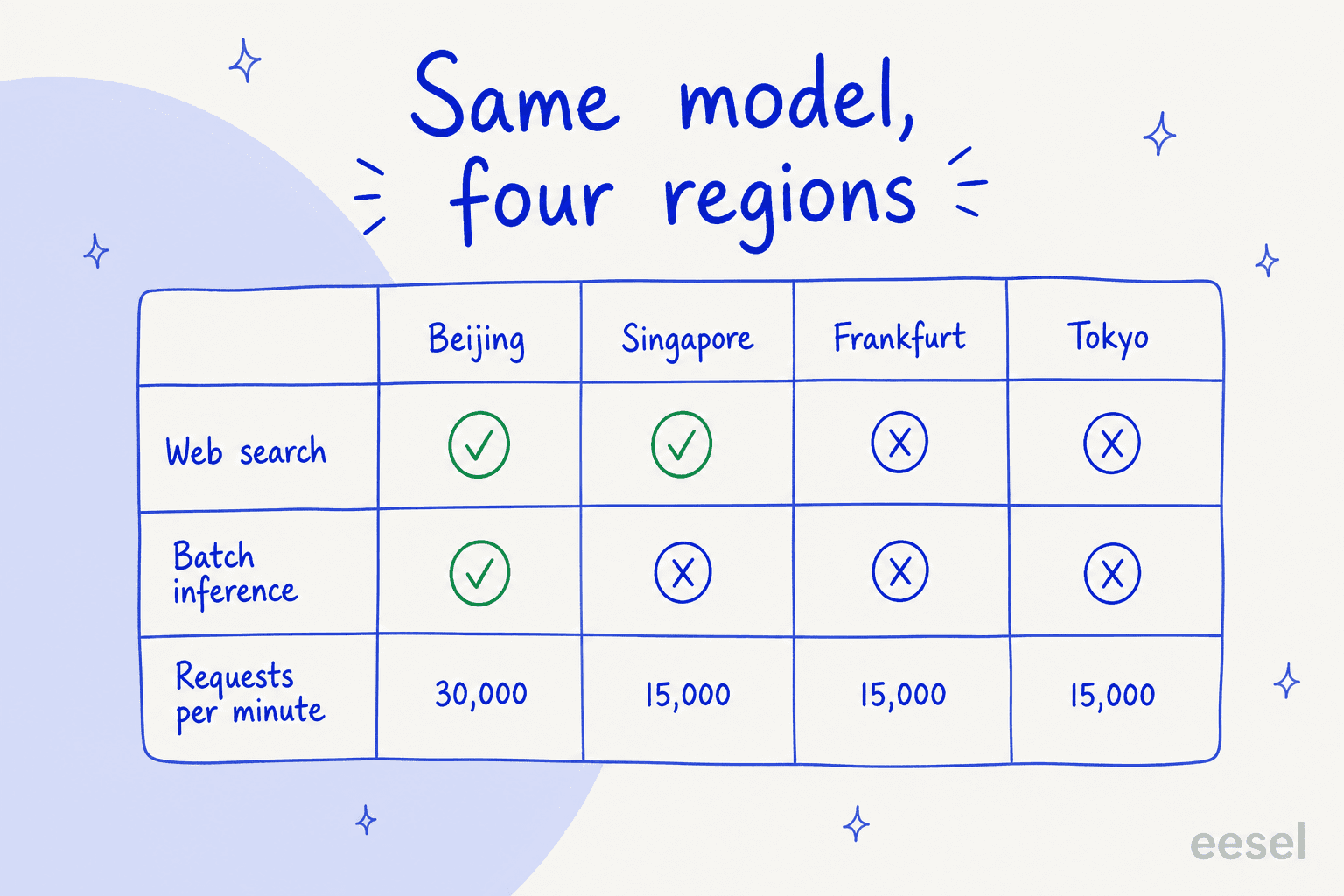
| Capability | Beijing | Singapore | Frankfurt | Tokyo |
|---|---|---|---|---|
| Web search | Supported | Supported | Unsupported | Unsupported |
| Batch inference | Supported | Unsupported | Unsupported | Unsupported |
| Function calling | Supported | Supported | Supported | Supported |
| Context caching | Supported | Supported | Supported | Supported |
| Fine-tuning | Unsupported | Unsupported | Unsupported | Unsupported |
| Requests per minute | 30,000 | 15,000 | 15,000 | 15,000 |
If your data residency requirements put you in Frankfurt or Tokyo, the built-in web search that half the agent demos rely on is simply not there, and you will be wiring up your own retrieval layer instead. If you were planning to run this as a cheap batch job over an image archive, batch inference exists in Beijing and nowhere else. And fine-tuning is unavailable everywhere, in every region, which rules out the usual escape hatch of teaching a cheap model your domain. Prompting and retrieval are the only levers you get, which makes the RAG versus fine-tuning question answer itself here.
There are three front doors into it: QwenCloud, Alibaba Cloud Model Studio, and then OpenRouter. Worth flagging that OpenRouter has exactly one provider sitting behind it, Alibaba Cloud International, and forwards every request straight there. No routing fallback, no second host to fail over to. That is a very different risk profile from a model with five providers competing on price.
What has been measured, and what has not
Very little, and the little that exists is worth reading carefully.
Nothing from Qwen. No score table, no eval name, no percentage, on any surface. The changelog is prose. The model card has no evaluation section. The two Qwen 3.7 research posts publish benchmark tables for Max and Plus and never mention Flash.
Nothing from the usual scorekeepers. Artificial Analysis returns a hard 404 for it while its Plus page returns 200, so the absence is real rather than a scraping miss. The LMArena leaderboard lists seven Qwen 3.7 entries and none of them are Flash. Hugging Face has no repo, because there are no weights.
One independent eval exists. Roboflow Vision Evals has scored it, and the shape of the result is the model in miniature: 22nd of 23 overall at 61.7%, 1st of 23 on cost at roughly $0.0001 per sample, 10th on identification at 84.4%, and dead last on OCR transcription. One eval house is not a verdict, and it is a vision-specific harness rather than a general one. It is still the only third-party quality signal that exists.
Provider telemetry is the richest source. OpenRouter measures 59 tokens per second at P50, 1.20s median latency, 99.99% uptime, and an 8.88% tool-call error rate. The number I would put on a slide is the tail: P99 end-to-end latency of 90.19 seconds. Inside an agent loop, one call in a hundred stalling for a minute and a half is not a rounding error, it is a queue.
The community picture is just as thin. Hacker News full-text search returns zero hits for the model, and no launch story was ever submitted. On 31 July, four days after it shipped, HN was busy discussing the exact gap it fills without knowing it existed, in a thread about a rival release:
"You have to remember DeepSeek v4 flash even though a bit cheaper, does not have vision abilities, which is a big draw for agentic tasks."

Another commenter in the same thread explains the silence better than any analysis could: Qwen stopped shipping open weights, so the crowd that normally amplifies a Qwen release stopped watching.
"Qwen/Alibaba have stopped doing open weights releases for a while."
Who this model is for
Based on everything above, the honest sorting is straightforward.
Reach for it if you are doing high-volume multimodal work where a single wrong answer is cheap and recoverable: tagging product images, first-pass ticket classification, screening video frames, bulk extraction where a human reviews the output anyway. The usage data backs this read; the top consumers on OpenRouter are agent harnesses, not chat products. At 1st of 23 on cost, nothing else in the vision tier is close on price.
Skip it if you need OCR, GUI control, a defensible quality number, weights you can host, fine-tuning, sub-second tail latency, or a second provider to fail over to. Any one of those is disqualifying on its own.
If it is weights you want, look at the open-source agent options. If it is a scored, benchmarked cheap model you are after, Gemini 3.5 Flash-Lite publishes real numbers.
So does Gemini 3.6 Flash, and so does Mistral, and any of the three will tell you what you are buying.
Think harder if you are choosing a model to build a customer-facing product on. That is the next section, and it is where I actually have scar tissue.
If this is going anywhere near a support queue
I build the agents at eesel, and we have spent years running AI on live support queues across thousands of real tickets. The failure I have watched most often is not a model being dumb. It is a model being confidently approximately right.
A B2B technical support team we worked with, running vehicle telematics through Zendesk, hit this precisely. Their bot started telling customers "yes, we support your car model" for brands that were not in their database, because a help centre article said the company supports all models. The model was not hallucinating in any exotic sense. It read a document, generalised, and answered with total confidence. Their lead described the setup phase as "trial and error in the beginning," which is a very polite way to describe finding this out in production.
Now hold Qwen 3.7 Flash against that. An 8.88% tool-call error rate. A P99 near 90 seconds. Last of 23 on OCR while still matching ground truth 84.1% of the time on average, which is exactly the profile of a model that is wrong in ways that read as right. No published quality score to argue with. Those are fine numbers for tagging a million images. They are not the numbers I want standing between a brand and an annoyed customer.
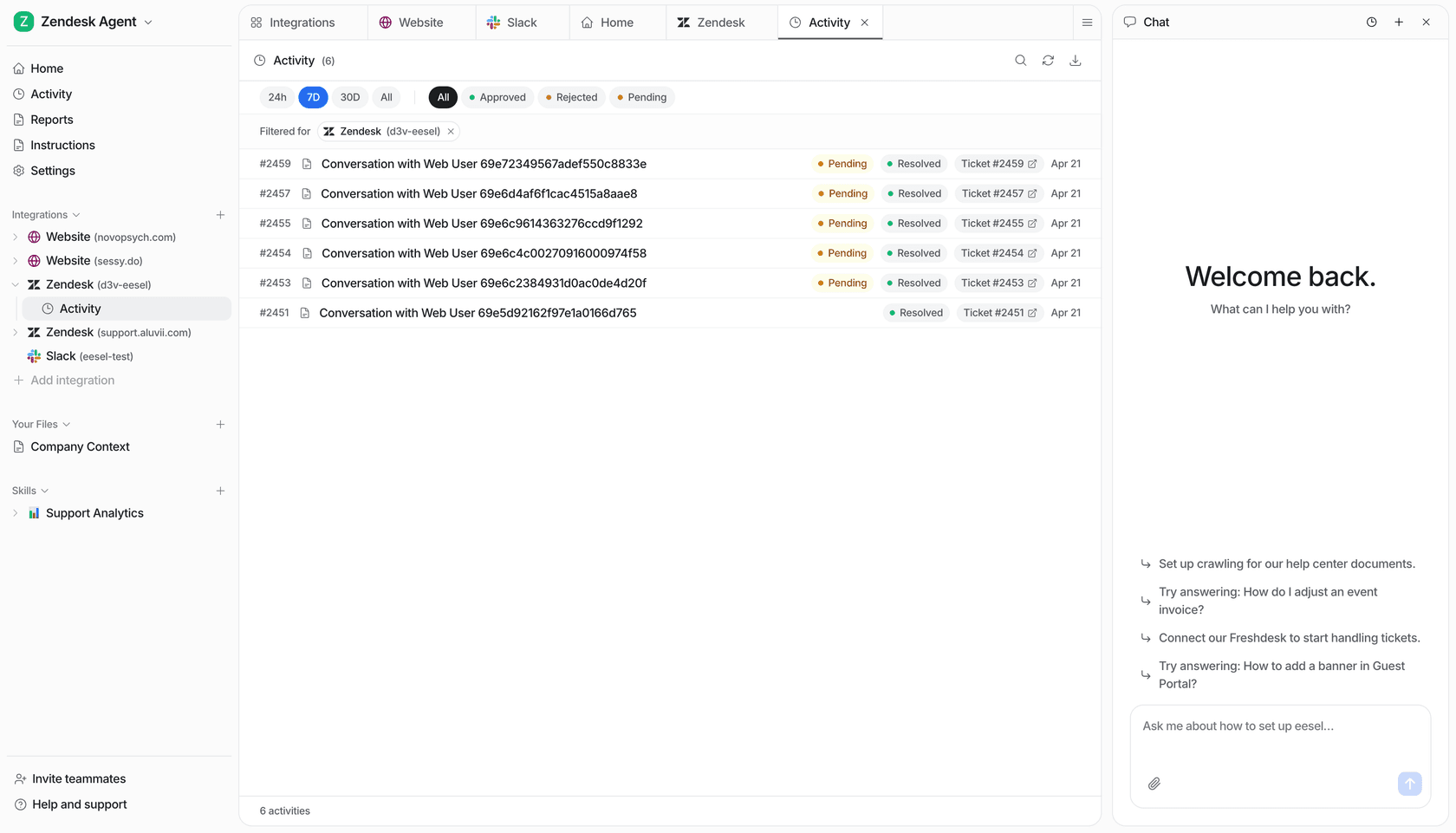
The deeper trap is the one a $0.03 price tag sets: it makes the model look like the product. It never was. The expensive parts are retrieval over a help centre that contradicts itself, routing that lands the ticket in the right place, escalation that does not drop the customer mid-sentence, and knowing when to say nothing. None of that arrives with the tokens. The cost-per-ticket comparison looks wonderful on a spreadsheet right up until you price the scaffolding.
Watching confident bots give confidently wrong answers is the reason every rollout we do now gets simulated against historical tickets before it touches a live queue, so you can see what it would have said to real customers rather than finding out from a real customer. That is a quality assurance problem, not a model-selection problem, and it does not get easier when tokens get cheaper.
If you are going the build-it-yourself route anyway, and plenty of teams reasonably do, the reading I would actually recommend starts with choosing an LLM for support, then training on your knowledge base.
After that, spend real time on hallucination prevention and on human handoff. Those four problems are the job. The model is the easy part.
Try eesel
If you got here because you are pricing out a support AI and $0.03 per million tokens looked like the answer, the honest version is that the token cost was never the number that decides this. eesel connects to Zendesk, Freshdesk, Gorgias and the rest in a few minutes, trains on your existing help centre and past tickets, and then, before it answers anybody, replays itself against thousands of your historical tickets so you can see the actual answers it would have sent and the resolution rate it would have hit. You keep control of exactly which tickets it is allowed to touch. Free to try, and the simulation runs before you commit to anything.
For more on the surrounding decisions, the ticket deflection guide covers where the volume actually goes and top customer support tools covers what else is out there.
If you are staring at a queue right now, the notes on clearing a backlog are the more urgent read, and AI-powered customer service has the wider picture. And if you want the cheap-model logic from the other end of the market, the Claude Opus 5 comparison makes the same point in reverse.
Frequently Asked Questions
What is Qwen 3.7 Flash?
How much does Qwen 3.7 Flash cost?
What is the Qwen 3.7 Flash context window?
Does Qwen 3.7 Flash support video?
Is Qwen 3.7 Flash open source?
Qwen 3.7 Flash vs Qwen 3.7 Plus: what is the difference?
Where can I use Qwen 3.7 Flash?
Is Qwen 3.7 Flash good enough for customer support?


Article by
Alicia Kirana Utomo
Kira is a writer at eesel AI with a Computer Science background and over a year of hands-on experience evaluating AI-powered customer service tools. She focuses on breaking down how helpdesk platforms and AI agents actually work so that support teams can make better buying decisions.