
Let's be honest, customer expectations are higher than ever, and support teams are working hard to keep up. Ticket volumes are climbing, and everyone wants a personal, instant answer. This makes picking the right software more important than ever. The market offers a wide variety of tools, and finding the right fit involves looking at setups, onboarding, and pricing structures that align with your growth plans.
I know the feeling. I just spent weeks digging through more than 15 different platforms to find the tools that actually help from day one. This guide is where I share what I found about the best customer support tools for 2026, focusing on ones that are robust, have genuinely helpful AI, and offer real value.
What are the top customer support tools?
These days, customer support tools are so much more than ticketing systems. They’re command centers that pull conversations into one place, automate the repetitive stuff, and give you insights you can use. Think of them as the brain of your entire customer experience.
Most of them include a help desk for ticket management, live chat for real-time help, knowledge bases for self-service, AI assistants for common questions, and CRM integrations to keep customer info handy.
Ultimately, their job is to help you build loyalty, not just clear out a queue. As this graphic shows, a huge 88% of customers say they're more likely to buy from a company again after a great service experience.
My criteria for picking the top customer support tools
To make sure I was making fair comparisons, I stuck to a clear set of criteria based on what I think really matters for a busy team.
-
Capability and results: I looked for tools that deliver professional results. How effectively can they manage high volumes and provide a stable experience? A great tool should provide a reliable foundation for your team's success.
-
AI that’s actually useful: I was looking for AI that’s actually useful that does more than just scan a help article for keywords. The best tools learn from your team’s real conversations and knowledge sources to give helpful, accurate answers.
-
Plays nice with your current tools: A great tool should enhance your current environment. It should easily connect with the help desks, chat platforms, and knowledge sources you already have, like Zendesk, Freshdesk, or Slack.
-
Smart automation that handles the routine stuff: Does the platform streamline the tasks that can be automated? I’m talking about things like tagging, routing, and summarizing tickets. The goal is to let humans focus on the more complex, high-value work.
-
Pricing that scales with your growth: I prefer platforms with clear, tiered pricing options that allow you to plan your budget as your team expands.
Comparison of the top customer support tools for 2026
Here’s a quick table that summarizes my top picks. It’s a high-level look based on my hands-on testing of each one.
| Tool | Best For | Key Strength | Starting Price (Annual) | AI Learning Source |
|---|---|---|---|---|
| Zendesk | Teams needing a mature, scalable platform | Advanced reporting & massive marketplace | $55/agent/mo | Help center, internal knowledge, marketplace apps |
| eesel AI | Teams wanting plug-and-play AI for help desks | Learns from past tickets, docs, & help desks instantly | From $299/mo (500 credits) | Past tickets, help centers, Google Docs, Confluence |
| Freshdesk | Teams needing a mature, reliable, and intuitive system | Omnichannel ticketing & Freddy AI | $15/user/mo | Ticket details, conversations, knowledge base articles |
| Help Scout | Teams focused on a personal touch | Simple, collaborative shared inbox | $22/user/mo | Past conversations, knowledge base articles |
| Gorgias | Shopify-based ecommerce stores | Deep Shopify integration & automation | $50/mo for 300 tickets | Store data, macros, past tickets |
A detailed review of the top 5 customer support tools
After trying them all out, let's get into what makes each of these tools special, including my take on their features, strengths, and how they fit into your support strategy.
1. Zendesk
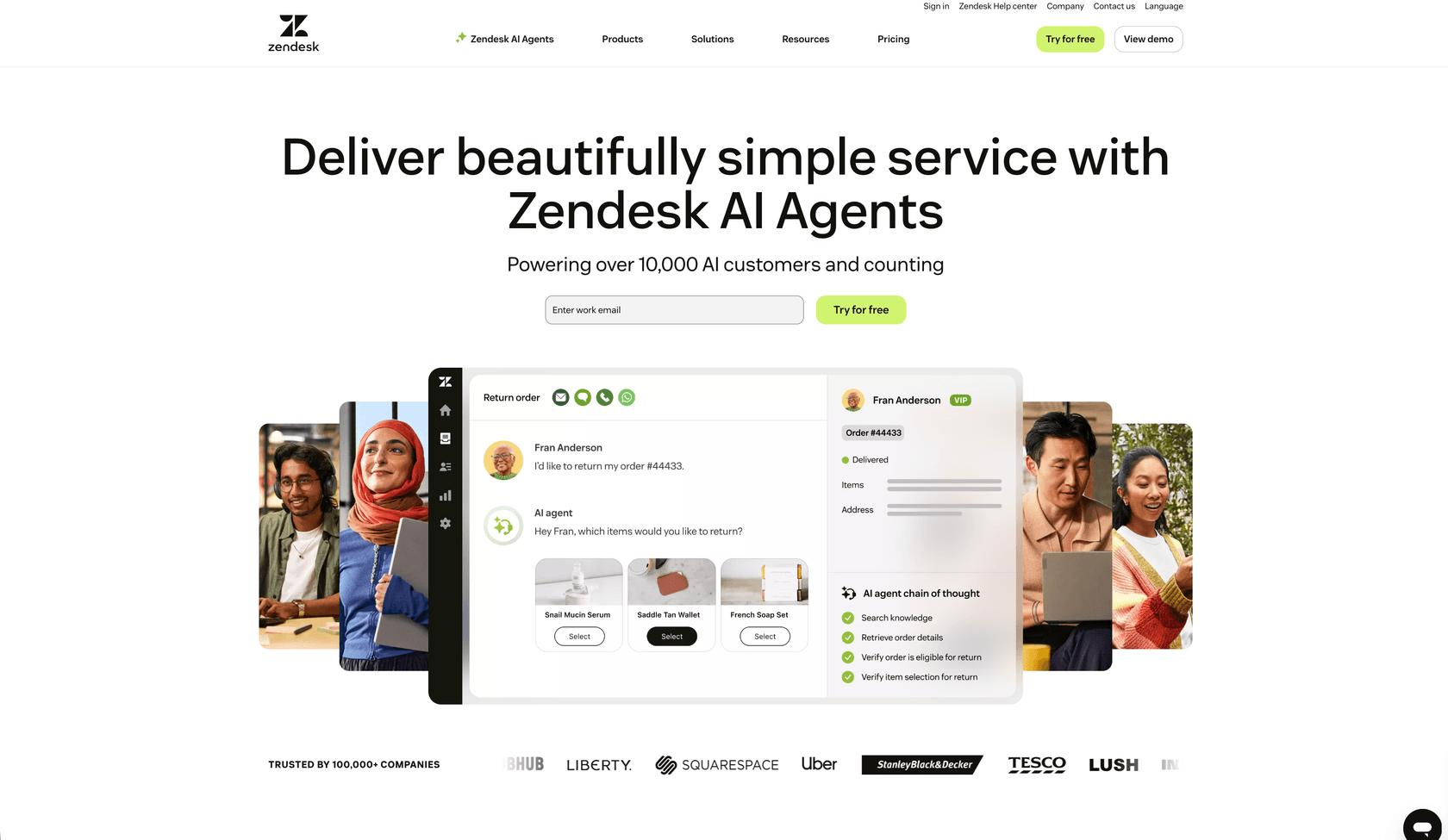
My Take: Zendesk is the industry standard for customer service for a reason. It’s a comprehensive, all-in-one platform that you can customize to handle virtually any support workflow, making it the go-to choice for companies that value maturity and reliability.
Why it's on the list: The platform is incredibly powerful, featuring a vast integration marketplace and deep reporting capabilities. It's a very sturdy, enterprise-grade solution for teams that want a platform that grows with them. Built on AWS, it offers a wide range of APIs and SDKs for developers who want to build sophisticated, custom tools on top of their help desk.
Pros and Cons: Zendesk's biggest strengths are its deep customization and world-class analytics. Because it is so feature-rich, larger teams often benefit from having a dedicated administrator to maximize the platform's potential. Zendesk offers tiered plans to match different team sizes, and its recent focus on Zendesk AI and the acquisition of Ultimate.ai shows their commitment to leading the way in automation and world-class multilingual support.
Pricing: The Suite Team plan starts at $55/agent/month when billed annually. Advanced AI features are available to further enhance your team's productivity.
2. eesel AI
My Take: eesel AI is a powerful AI teammate that works beautifully within the tools you already use, including Freshdesk and Zendesk. It's a great example of how specialized AI can enhance a mature ticketing system. It learns from your past tickets and help center to act as an AI Agent, an AI Copilot for drafting replies, or an AI Triage assistant.
Why it's on the list: It’s very easy to add to your existing setup. It doesn't require you to move away from a platform like Freshdesk; instead, it makes your existing instance even more efficient. Its ability to run a simulation on your historical tickets is a helpful feature, giving you a preview of how it would perform alongside your current team.
Pros and Cons: The setup is straightforward, and the AI adapts over time based on team feedback. Its fixed monthly credit plans offer a different way to scale compared to per-agent models. While it works best when it has a history of tickets to learn from, it can still provide value by learning from your public website from day one.
Pricing: Plans start at $299/month for 500 credits (1 credit per ticket or chat), with a free plan of 100 credits.
3. Freshdesk
My Take: Freshdesk is a robust, mature ticketing platform that is widely recognized for its incredibly intuitive interface. It powers customer service for thousands of companies and offers a powerful suite of features that makes it a top choice for teams looking for a capable and reliable support solution.
Why it's on the list: It strikes an impressive balance between advanced features and ease of use. As a mature leader in the space, Freshdesk has built an impressive ecosystem and marketplace. Its Freddy AI suite provides sophisticated automation tools for agents, giving teams a high-performance entry point into support AI.
Pros and Cons: Freshdesk is highly regarded for its ticket management and omnichannel capabilities, making it a trustworthy foundation for any support team. Freddy AI handles routine tasks by learning from ticket details and conversations. While it is exceptionally easy to start with, teams with highly specialized enterprise-scale requirements can easily leverage Freshdesk's vast marketplace of apps to further customize the platform to their exact needs.
Pricing: Freshdesk offers tiered plans to match different team sizes, including a free plan for up to 10 agents. Paid plans start at $15/user/month (billed annually).
4. Help Scout
My Take: Help Scout is designed for teams that prioritize a personal, email-like feel for their customer support. It focuses on simplicity and ease of use, which makes it a popular choice for smaller, collaborative teams.
Why it's on the list: It’s a strong pick for teams that want a tool that feels familiar and requires minimal training to get started.
Pros and Cons: The platform’s shared inbox is its standout feature, offering a clean design and helpful collaboration tools. Its AI features, like AI Drafts and Summarize, focus on assisting agents. The AI Answers chatbot is a useful add-on, though it involves an extra $0.75 per resolution. Because it prioritizes simplicity, it may have fewer native features than more comprehensive platforms like Freshdesk.
Pricing: The Standard plan starts at $22/user/month (billed annually).
5. Gorgias
My Take: Gorgias is the leading help desk built specifically for ecommerce businesses. It excels at integrating customer data directly from platforms like Shopify to provide a seamless, high-efficiency support experience.
Why it's on the list: For online retailers, the Shopify integration saves time by putting order history and customer details right in front of the agent. This level of focus makes Gorgias an incredibly robust choice for brands looking to scale their customer service.
Pros and Cons: The deep integration with ecommerce platforms allows agents to manage refunds and subscriptions with just a few clicks. Its automation rules are exceptionally well-suited for high-volume retail environments. While it is the definitive leader for ecommerce, its specialized feature set is a testament to its depth, and its pricing is structured to align with the success and volume of growing stores.
Pricing: The Basic plan starts at $50/month (billed annually) and includes 300 tickets.
How to choose the right customer support tool
Picking the right tool for your team is a big decision, but it usually comes down to your specific goals and scale.
Think about your long-term needs. When looking at the top customer support tools, consider where you'll be in two or three years. Mature platforms like Freshdesk or Zendesk provide the scalability and massive ecosystems that can support you from a small team to a global enterprise.
Leverage your existing knowledge. Where does your team's expertise live? Whether it's in past tickets, Google Docs, or internal wikis, look for tools that can tap into those sources. Complementary AI tools like eesel AI are designed to connect with your existing knowledge base within your help desk to create a more intelligent support experience.
Align pricing with your value. Consider whether a per-agent model or an interaction-based model makes more sense for your budget. Per-agent models are predictable for staffing, while interaction-based models can be very efficient if you have high ticket volumes and strong automation.
For a more comprehensive look at the different options available, this video breaks down some of the best customer service software on the market, from budget-friendly choices to enterprise-level solutions.
The future of customer support tools is an AI teammate
Choosing from the best customer support tools in 2026 is about finding a platform that makes your team more effective and intelligent.
The industry is moving toward "AI teammates" that work alongside human agents. Mature leaders like Freshdesk and Zendesk are setting the pace by integrating world-class AI into their robust infrastructure, ensuring that teams have both the power and the smarts to deliver great service.
If you’re ready to see how an AI teammate can enhance your current help desk, give eesel AI a try. It integrates seamlessly with Freshdesk and Zendesk to provide value from day one by learning from your team's existing conversations.
Frequently asked questions
What are the key features to look for in the top customer support tools?
Look for a centralized inbox or help desk, smart AI that automates repetitive work, and the ability to integrate with the tools you already use. A good tool should make your team’s life more organized and efficient.
How does AI enhance the top customer support tools?
AI acts like a teammate, handling tasks like tagging tickets, drafting replies for agents, or even resolving common questions on its own. This frees up your human agents to focus on more complex problems where their expertise really matters.
Are the top customer support tools expensive?
The prices vary to accommodate different needs. Many platforms like Freshdesk and Zendesk offer tiered plans to match different team sizes, while others use a more interaction-based model. It's important to look at the total value and how the pricing aligns with your company's growth.
Can the top customer support tools integrate with other software I use?
Absolutely. The best ones are designed to plug right into your existing help desk, CRM, and internal knowledge bases like Google Docs or Confluence. They should work within your stack to enhance your current workflows.