


What Gemini 3.5 Flash-Lite actually is
Google splits its Gemini family into two lanes. Pro models are the top tier for hard reasoning. Flash models are the workhorses: cheaper, faster, tuned for production apps making thousands of calls a day. Flash-Lite is the leanest of those, positioned by Google for high-volume agentic tasks, translation, and simple data processing.
The specs are surprisingly generous for a budget model. It handles text, image, video, audio, and PDF as input, carries a 1,048,576-token context window (~1M tokens, or roughly 1,500 pages), and supports thinking, function calling, structured outputs, code execution, and search grounding. It does not support computer use, image or audio generation, or the Live API, so it's a text-in, text-out engine for volume, not a do-everything model.
On Artificial Analysis, it lands an Intelligence Index of 36 (#12 of 152 models, well above the average for its class) while running at about 490 output tokens per second, the second-fastest model they've measured. For a model this cheap, that intelligence-per-dollar combination is the whole pitch.
Gemini 3.5 Flash-Lite pricing
Here's the full picture. Prices are per 1M tokens on paid tiers, and output includes thinking tokens.
| Mode | Input (per 1M) | Output (incl. thinking) | Context caching |
|---|---|---|---|
| Standard | $0.30 | $2.50 | $0.03 |
| Batch (50% off) | $0.15 | $1.25 | $0.02 |
| Flex | $0.15 | $1.25 | $0.02 |
| Priority | $0.54 | $4.50 | $0.05 |
| Free tier | Free | Free | Not available |
A few things to flag before you plug it into a spreadsheet:
- The free tier trains on your data. On the free tier, Google uses your content to improve its products; on any paid tier it doesn't. For anything touching customer data, that rules the free tier out on its own.
- Batch mode is a flat 50% off. If the work doesn't need to be real-time (overnight document processing, bulk translation), Batch drops you to $0.15 / $1.25.
- Search grounding is metered separately. You get 5,000 grounded prompts a month free across the Gemini 3 family, then it's $14 per 1,000 search queries, and one request can trigger several billable queries.
For how this sits against the consumer Gemini plans and the rest of the API, our Gemini pricing guide has the full breakdown, and Gemini Workspace pricing covers the business plans.
What that actually costs you
Sticker prices don't mean much until you run a real number. Say you're using Flash-Lite for first-pass ticket triage on 50,000 tickets a month, at roughly 1,000 input tokens and 200 output tokens per ticket.
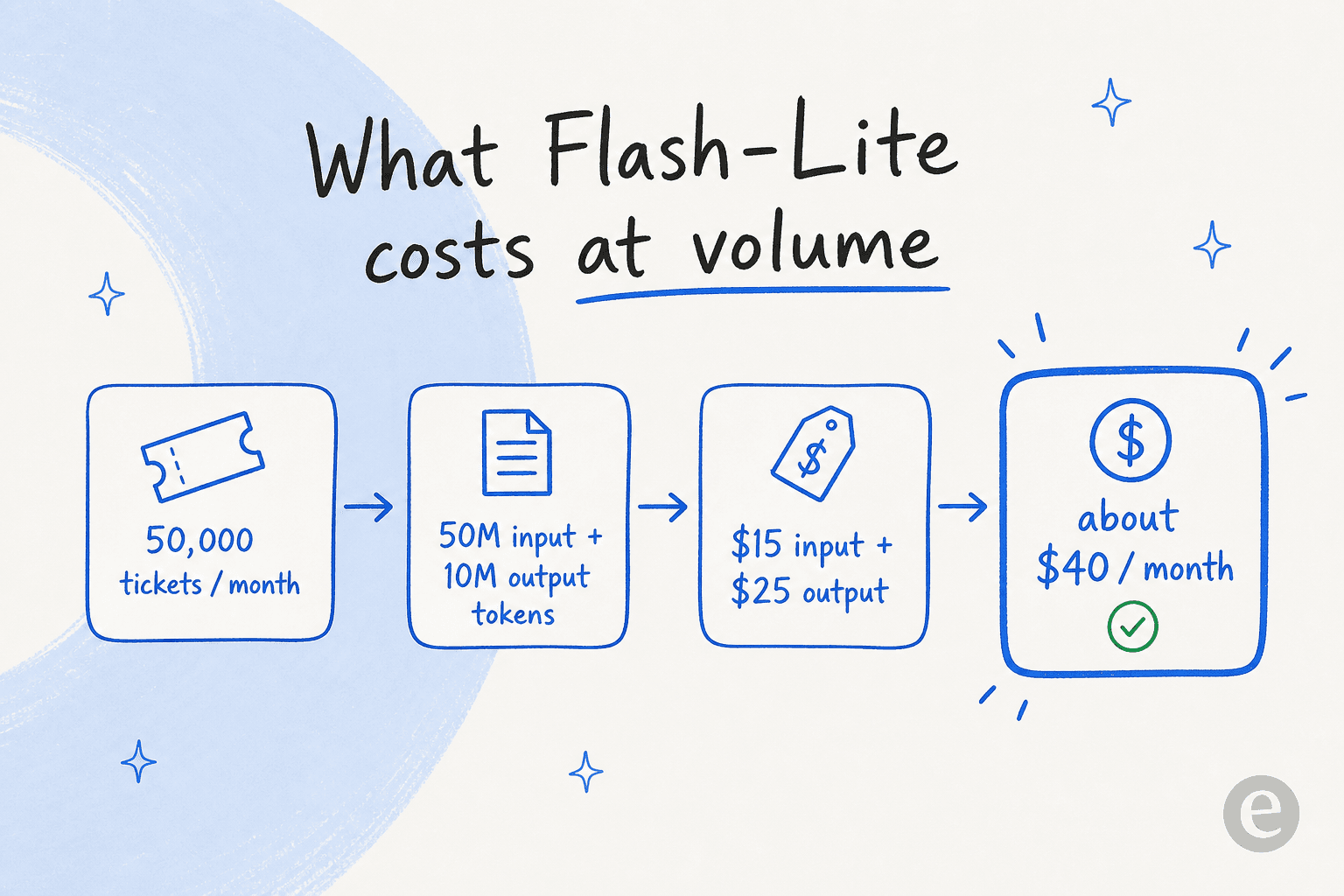
That's 50M input tokens ($15) and 10M output tokens ($25), so about $40 a month in raw model cost. Run the same volume on 3.6 Flash and you're closer to $150. That gap is exactly why Flash-Lite exists, and why picking the right model tier matters more than most teams realise when they budget for AI support or try to reduce support costs with automation.
How Flash-Lite compares
Google published a head-to-head table, and the price row is the story. At $0.30 / $2.50, Flash-Lite undercuts GPT-5.4 mini ($0.75 / $4.50) and Claude Haiku 4.5 ($1.00 / $5.00) while landing in the same rough quality band on most agentic benchmarks.
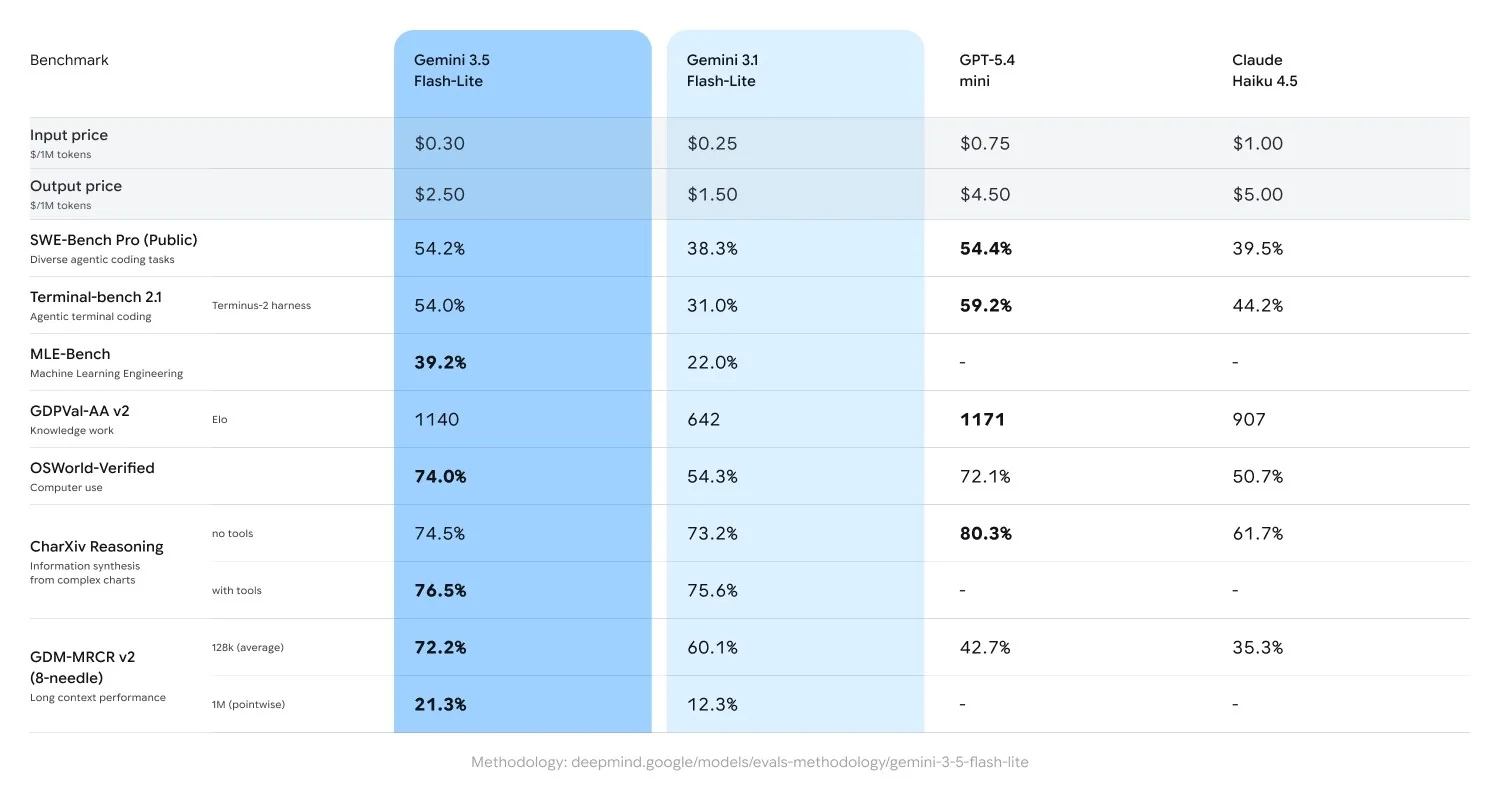
Read that table with one caveat: GPT-5.4 mini edges ahead on a few coding and knowledge scores. But on price-per-capability for high-volume work, Flash-Lite is hard to beat, and it wins outright on long-context recall. The one number that isn't flattering is latency: time to first token runs around 6 seconds (it includes thinking time), on the high side for its tier, so it's better suited to background jobs than snappy live chat.
Against its own predecessor, the generation jump is clean:
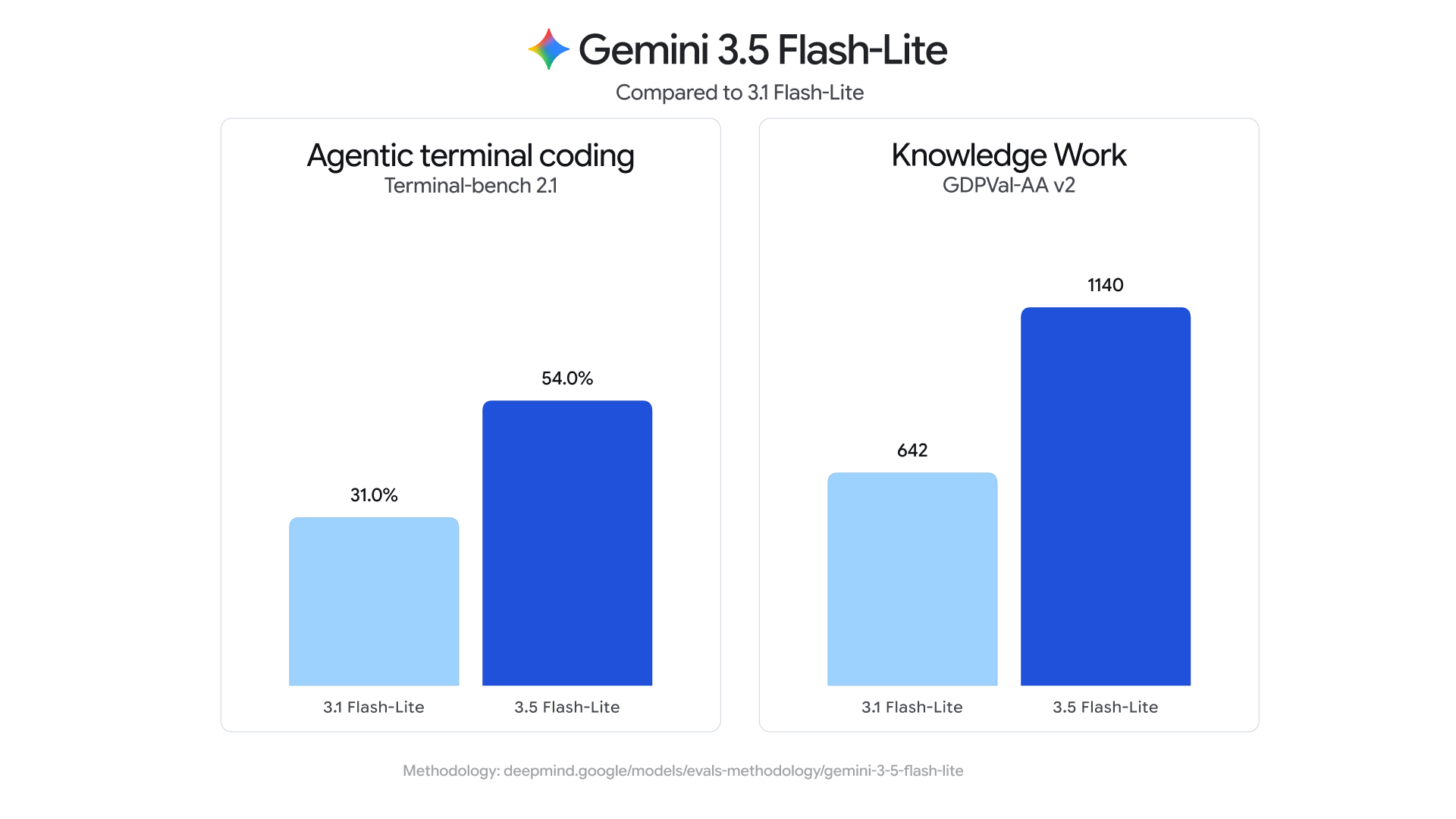
Agentic terminal coding jumps from 31% to 54% on Terminal-Bench 2.1, and knowledge work nearly doubles from 642 to 1140 on GDPval-AA v2. Google says it even outperforms the older 3 Flash on SWE-Bench Pro and computer-use tasks, so you're not trading much quality for the low price. If you're weighing Gemini against the field, we broke it down in Gemini vs Claude, Gemini vs ChatGPT, and the wider Gemini alternatives roundup.
Which model do you actually pick?
Flash-Lite shipped next to Gemini 3.6 Flash, and picking the wrong one either wastes money or ships a bot that's out of its depth. The rule of thumb is simple.
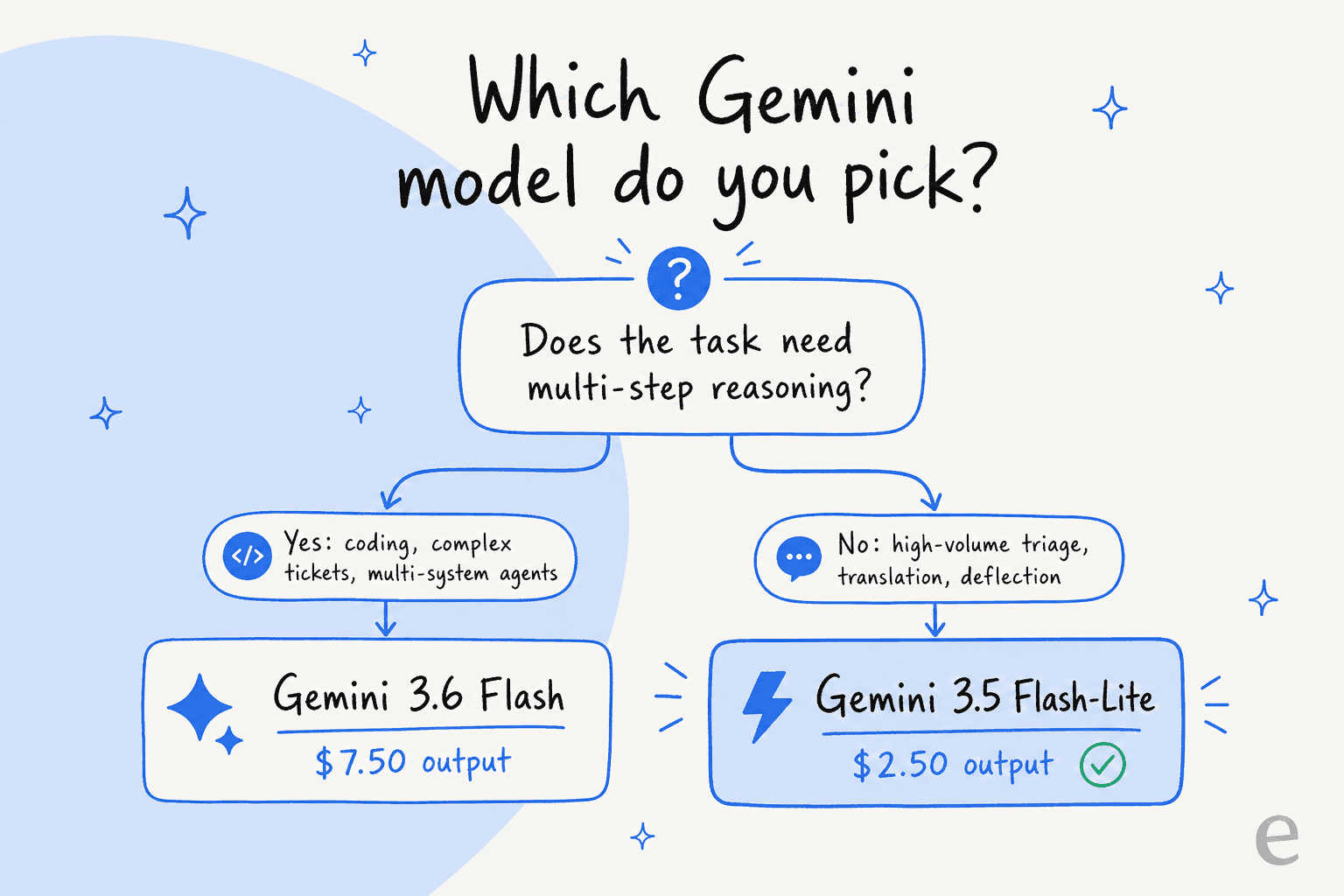
Reach for 3.6 Flash when the work needs real reasoning: multi-step agents, coding, complex support tickets that touch several systems. Reach for Flash-Lite when you're processing volume where each item is simple, like first-pass triage, live-chat deflection of routine questions, or bulk multilingual replies. Whether you build a real AI agent or a scripted bot is a separate decision from the model one, and it usually matters more. If you run a SaaS product, our take on the best AI for SaaS support walks through where each model fits.
What this means if you're building AI for support
Here's where I have to be straight with you, because this is the part every model-pricing post skips for support teams.
A cheaper, faster model is good news. But swapping in Flash-Lite does not give you a working support agent, any more than a cheaper engine gives you a car. I've spent the last three-plus years putting AI on live support queues, and the failure I've watched over and over isn't the model being dumb, it's a confident-sounding bot giving a wrong answer to a real customer because nobody built the layers around the model. The model is the bottom of the stack.
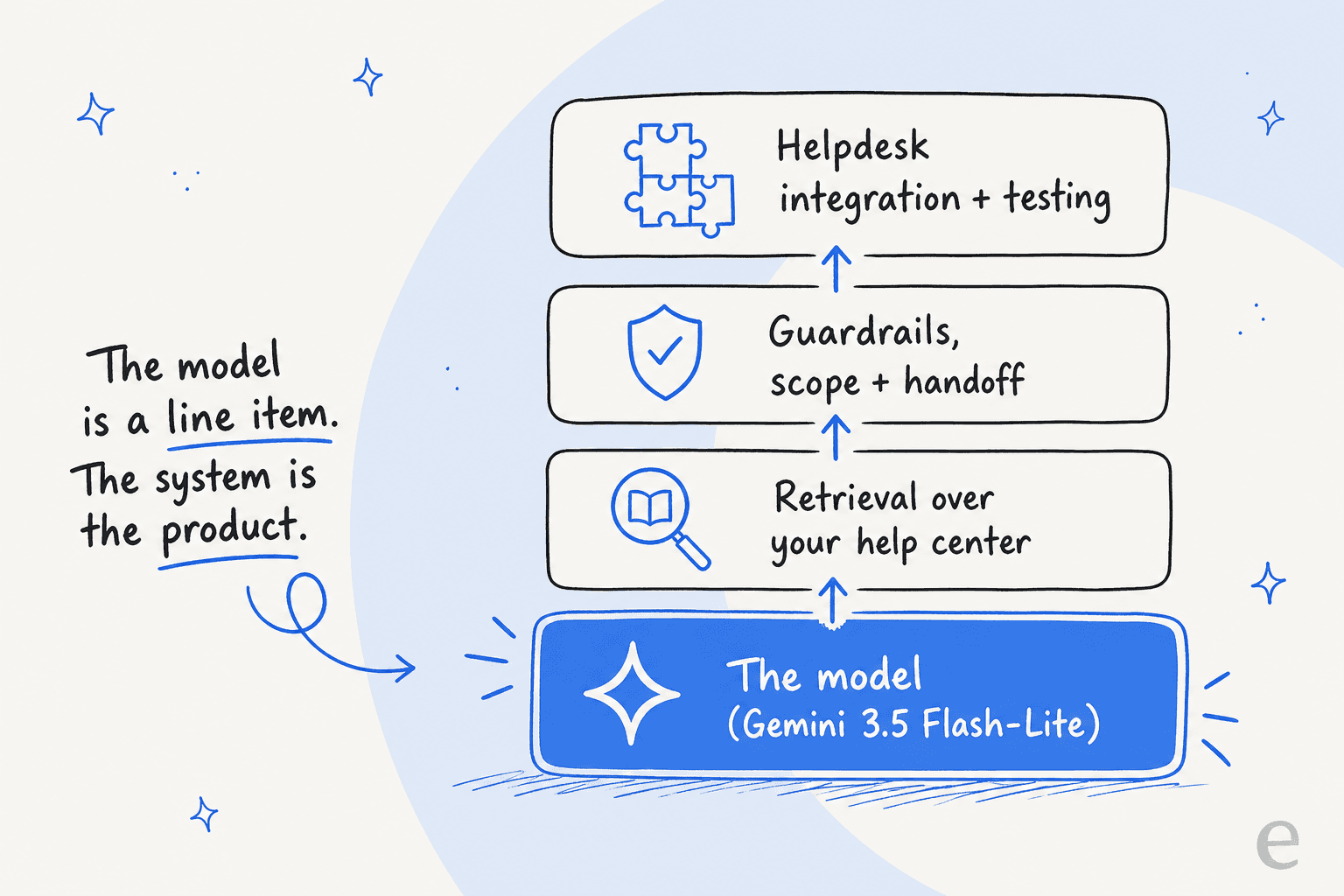
Those layers are the real work. Retrieval, so the model answers from your help center and past tickets instead of guessing. Guardrails and scope, so it hands off cleanly instead of inventing a refund policy. Integration, so it can act inside your ticketing system. And testing, so you know how it behaves before it touches a customer. This is the same gap between a raw API and real AI customer service software, and it's why AI chatbot problems almost always trace back to the plumbing, not the model.
It's also why I'd push back on wiring the raw Gemini API into your helpdesk yourself. You'd be rebuilding retrieval, hallucination guardrails, simulation, and every helpdesk integration from scratch, then maintaining it as models change every few weeks. Flash-Lite being cheap doesn't change that math. That's the whole case for purpose-built helpdesk AI over a DIY stack: the model tier is a line item, the surrounding system is the product. And when you train the agent properly, the model underneath it barely matters to the outcome.
Try eesel
This is exactly the layer eesel is built to be. You plug it into your existing helpdesk, it learns from your past tickets and knowledge base out of the box, and it runs on top of frontier models so you get the efficiency without wiring the API yourself.

The differentiator that a cheap model can't give you on its own: eesel lets you simulate the agent against your historical tickets before it ever answers a live customer, so you see the resolution rate and the exact replies it would have sent, and you can tie it back to real ROI on AI support. And because it's priced on the work it does, not per token, you skip the token math on every ticket. If you're pricing out Flash-Lite to build support automation, start from the outcome you want and let the platform handle the plumbing. It's free to try.