


What Gemini 3.5 Flash Cyber actually is
Google's Gemini family splits into two lanes: Pro models for the hardest reasoning, and Flash models as the fast, cheap workhorses. Flash Cyber is a third thing, a specialist. Google took the general Gemini 3.5 Flash base and fine-tuned it hard on one narrow, high-stakes task: detecting, validating, and patching code security issues at scale, at a lower price per token than a big frontier model would cost.
The reason to build on Flash rather than Pro is the same reason Flash exists at all. Security scanning is volume work. You're running a model across huge codebases, over and over, looking for needles. A cheaper, faster base means you can afford to run it a lot, which is exactly what finding rare bugs demands. That's the efficiency logic behind the whole Flash line, pointed at one domain.
Here's the honest framing that most launch coverage skips: Flash Cyber is not a chatbot you talk to. It's a component. On its own, a model that can spot a buffer overflow is a party trick. The value only shows up once you wrap it in a system that finds the bug, proves the bug is real, writes a fix, and checks the fix didn't break anything. That system is CodeMender.
CodeMender: the system that makes the model useful
CodeMender is Google DeepMind's AI agent for code security, and it's where Flash Cyber actually lives. The design choice worth noticing: it doesn't use one model call. Google runs multiple Gemini 3.5 Flash Cyber agents in parallel, each poking at the code, and then combines their findings into a single report.
That "multiple agents, one report" pattern is doing real work. One model pass over a codebase is noisy: it flags things that aren't bugs and misses things that are. Running several cheaper agents and reconciling their output is how you turn a noisy signal into something a human security team can act on, without paying frontier-model prices for every pass. It's the security-world version of an agent orchestration problem, and it's why the model being cheap matters so much: cheap enough to run five times beats expensive enough to run once.
Google's framing of the goal is defensive: it wants to give frontline defenders a head start in finding and fixing critical vulnerabilities before attackers can exploit them, while mitigating broader misuse.
How good is it? The CyberGym numbers
Google benchmarked the CodeMender-plus-Cyber setup on CyberGym, a security benchmark, against frontier setups from rival labs. This is the chart that matters.
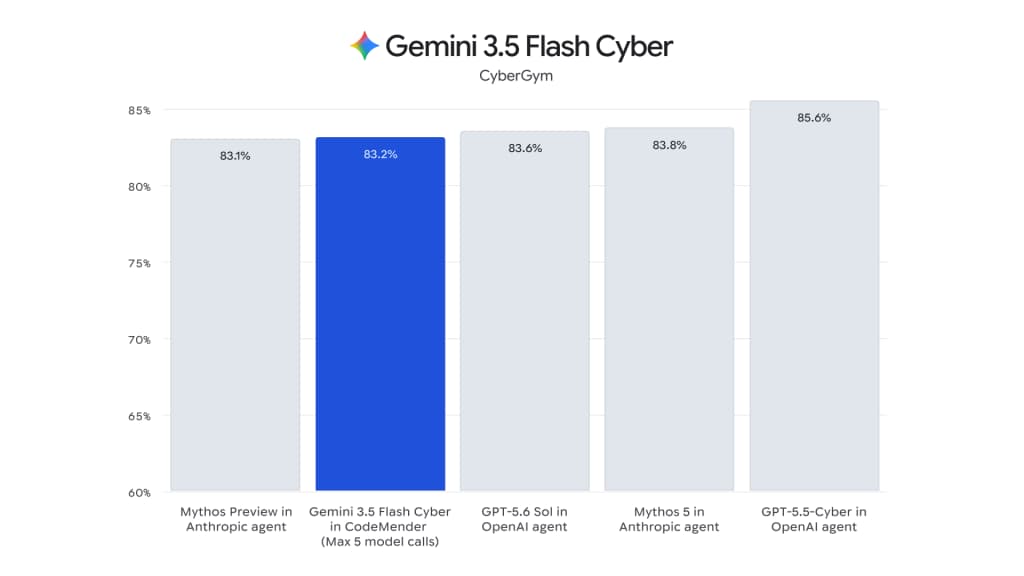
The read here is more interesting than a single winning number. Cyber inside CodeMender lands at 83.2%, right in the pack with much larger, more expensive frontier agents (which cluster between 83% and 85.6%). It's not the top bar on the chart. But that's arguably the whole point: a small, cheap, specialized model reaching competitive frontier performance on a hard task, at a fraction of the cost, because the fine-tuning and the agent design carry the weight the raw parameter count would otherwise have to.
That's the same trade the Flash line is built to win generally: not "smartest model on the leaderboard," but "most capability per dollar for work you run at volume."
The catch: you probably can't use it
Now the part that stops most readers cold. Gemini 3.5 Flash Cyber is exclusively available to governments and trusted partners through CodeMender, as a limited-access pilot. There is no public API, no AI Studio toggle, no self-serve tier.
The reason is right there in the name of the concern: dual-use. A model that's excellent at finding exploitable vulnerabilities in code is, by definition, also a tool an attacker would love. So Google is gating it the way you'd gate any capability that helps defenders and attackers equally, controlled rollout to a small set of vetted users first. If you were hoping to point it at your own repos this afternoon, that's not on the table.
The two models it launched with are the ones you can actually reach today. Gemini 3.6 Flash and Gemini 3.5 Flash-Lite are available in the Gemini app and API; the Gemini 3.6 Flash breakdown covers what those cost and who they're for.
Why this launch is missing Gemini 3.5 Pro
The most telling thing about the whole July 21 launch is what wasn't in it. Google shipped three Flash-class models, Flash Cyber included, but not the flagship Gemini 3.5 Pro, which was last updated in February 2026 and teased back in May as "already being used internally." Bloomberg reported that Pro hit internal delays after struggling to meet its own performance goals.
That's happening while OpenAI rolled out GPT-5.6 and Anthropic shipped Claude Sonnet 5. Read charitably, Google's move makes sense: keep the high-volume, revenue-driving Flash tier fresh and cheap, and ship a specialized win like Cyber, while the flagship cooks. DeepMind's Logan Kilpatrick said 3.5 Pro is testing with partners and should "land soon," and that the team has started its "most ambitious pre-training run yet" for Gemini 4.
What Flash Cyber teaches you about building any AI agent
Here's why I think this launch matters even if you'll never touch the model, and this is the part I care about, because I build AI agents for a living.
Flash Cyber is proof of a pattern I run into on every project: the model is the bottom layer, not the whole thing. Google didn't ship a "security model" and call it done. It shipped a fine-tuned model plus CodeMender, the system that detects, validates, patches, and reports. The intelligence lives as much in that wrapper, in running multiple agents and reconciling them, as in the raw weights.
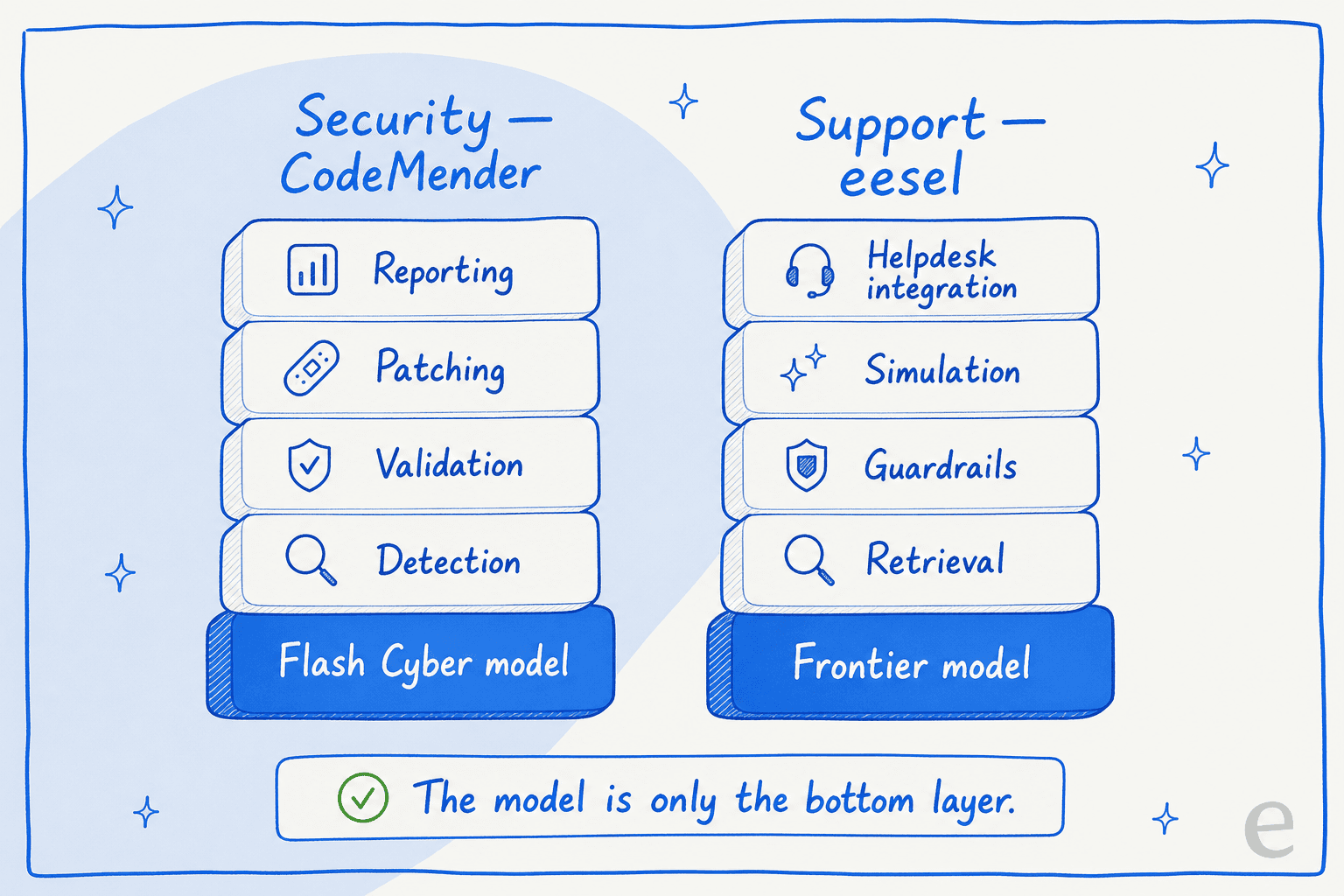
I've spent years putting AI on live support queues, and the failure I've watched over and over is the same one CodeMender is engineered to avoid: a confident-sounding model giving a wrong answer because nobody built the layers around it. In security, an unvalidated "fix" that breaks the build is the failure mode. In customer support, it's a confident bot inventing a refund policy. Same disease, different domain. The cure in both cases is the system: retrieval so the model answers from real sources instead of guessing, guardrails so it hands off cleanly, and testing so you know how it behaves before it touches anything real.
So when a new model like Cyber (or Gemini 3.6 Flash, or the next thing) lands, the right question for a support team isn't "is the model good enough." For most work, it already is. The real question is "who's building the retrieval, the guardrails, the simulation, and the helpdesk integration around it." That's the actual work, and it's why wiring a raw API into your helpdesk yourself is a trap: you'd be rebuilding CodeMender's equivalent from scratch, then maintaining it as models change every few weeks.
Try eesel
For support, the layer CodeMender is to security, eesel is to your helpdesk. You plug it into your existing tools, it learns from your past tickets and knowledge base out of the box, and it runs on top of frontier models so you get the efficiency gains without wiring the API yourself.

The part that maps directly to CodeMender's "validate before you ship" design is simulation: eesel lets you run the agent against your historical tickets before it ever answers a live customer, so you see the resolution rate and the exact replies it would have sent. And because it's priced on the work it does, not per token, you skip the token math on every ticket. If you're evaluating models to build support automation, start from the outcome you want and let the platform pick the plumbing. It's free to try.