What Claude Opus 5.5 actually is
Claude Opus 5.5 launched on September 22, 2026 as Anthropic's frontier model for agentic coding and knowledge work. The one-line positioning from Anthropic is that it performs "at the level of Claude Fable 5.1 on most work" while costing meaningfully less to run than Opus 5. That is a notable claim, because Fable 5.1 is the capability ceiling of the whole lineup.
The specs that shape how you use it:
- The model ID is
claude-opus-5-5on the Claude API,anthropic.claude-opus-5-5on Bedrock, and the same dateless ID on Vertex and Foundry. - Context is 1M tokens in, 128k tokens out, rising to 300k output on the Batch API with a beta header.
- The knowledge cutoff is June 2026, up from May 2026 on Opus 5.
- Thinking is always on, steered by the effort setting, with the default now set to
medium.
It slots directly above Opus 5 and below Fable 5.1, and it replaces Opus 5 as the model Anthropic points most developers at first. For anything customer-facing, the interesting number is not the benchmark score but how the model behaves in a long agentic loop, which is where Opus 5's reputation got complicated.
The efficiency correction
Here is the story of this release in one sentence. Opus 5 was the model everyone called "brilliant but annoying": it topped the intelligence leaderboards, then spent 103 turns on a task where Opus 4.8 spent 55, and its hallucination rate on one independent eval rose 14 points. It won the benchmark and lost the workflow.
Opus 5.5 goes straight at that. Anthropic's headline is that it costs about 40% less to run on typical workloads, and only half of that comes from the lower sticker price. The other half is the model doing the same job with less waste. Three things drive it:
- It writes less. Box, an early-access customer, reported answers that are "40% less verbose without losing accuracy" in Anthropic's announcement.
- It finishes in fewer turns. GitHub had Opus 5.5 solving terminal tasks in "less than half the steps" of Opus 5, per the same launch post, and in an agentic loop each turn re-sends the growing transcript.
- The default effort dropped from
hightomedium, so the out-of-the-box run is leaner unless you dial it up.
And the benchmarks moved the right way while the price moved down. This is the chart that matters:
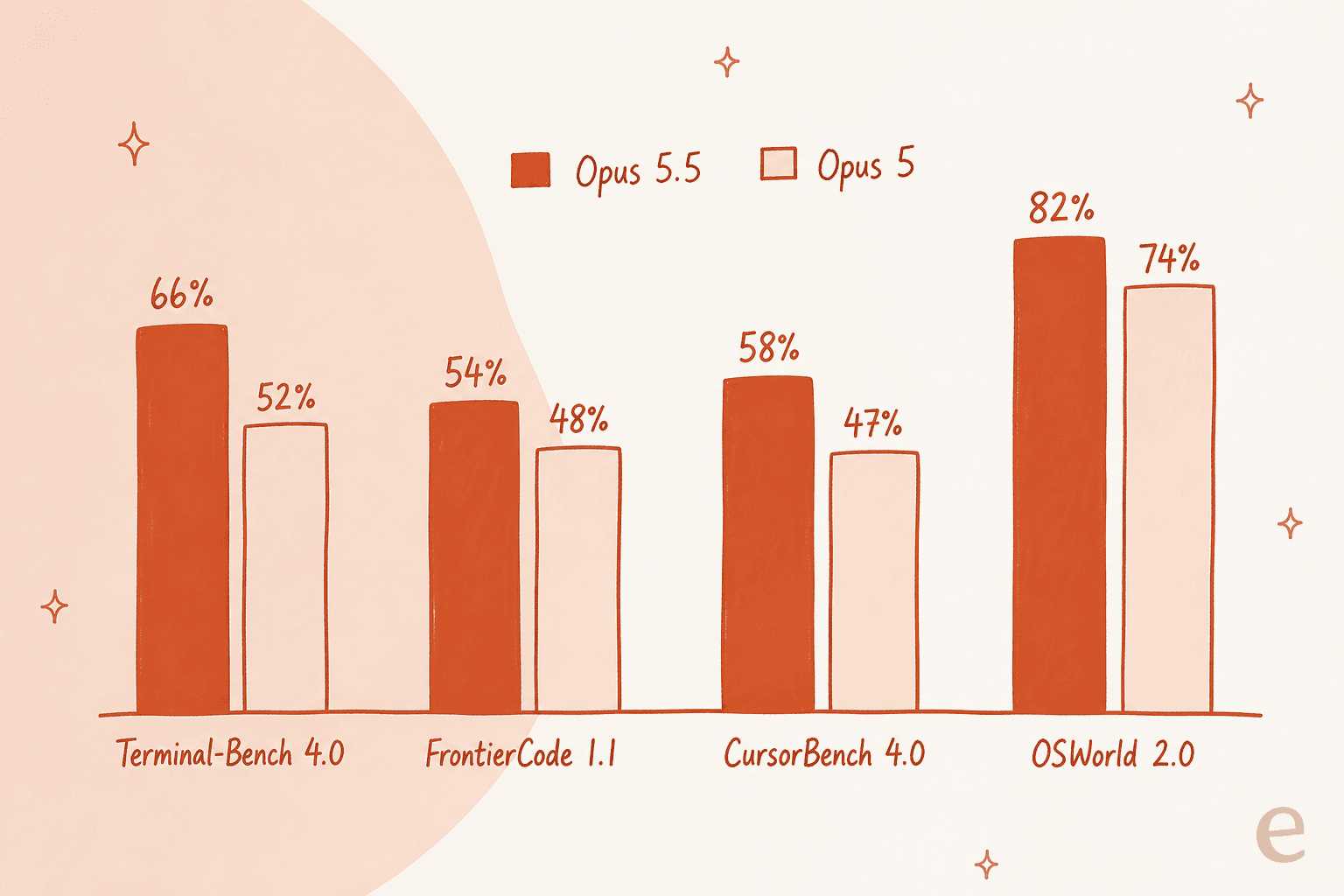
Every figure comes from Anthropic's announcement: Terminal-Bench 4.0 up to 66.4% from 52.3%, FrontierCode v1.1 to 54.4% from 48.0%, CursorBench 4.0 to 57.8% from 46.6%, and OSWorld 2.0 to 81.8% from 74.0%. Higher scores at a lower rate is a more useful claim than any single number, and it is the argument the whole release rests on.
Where it sits in the Claude lineup
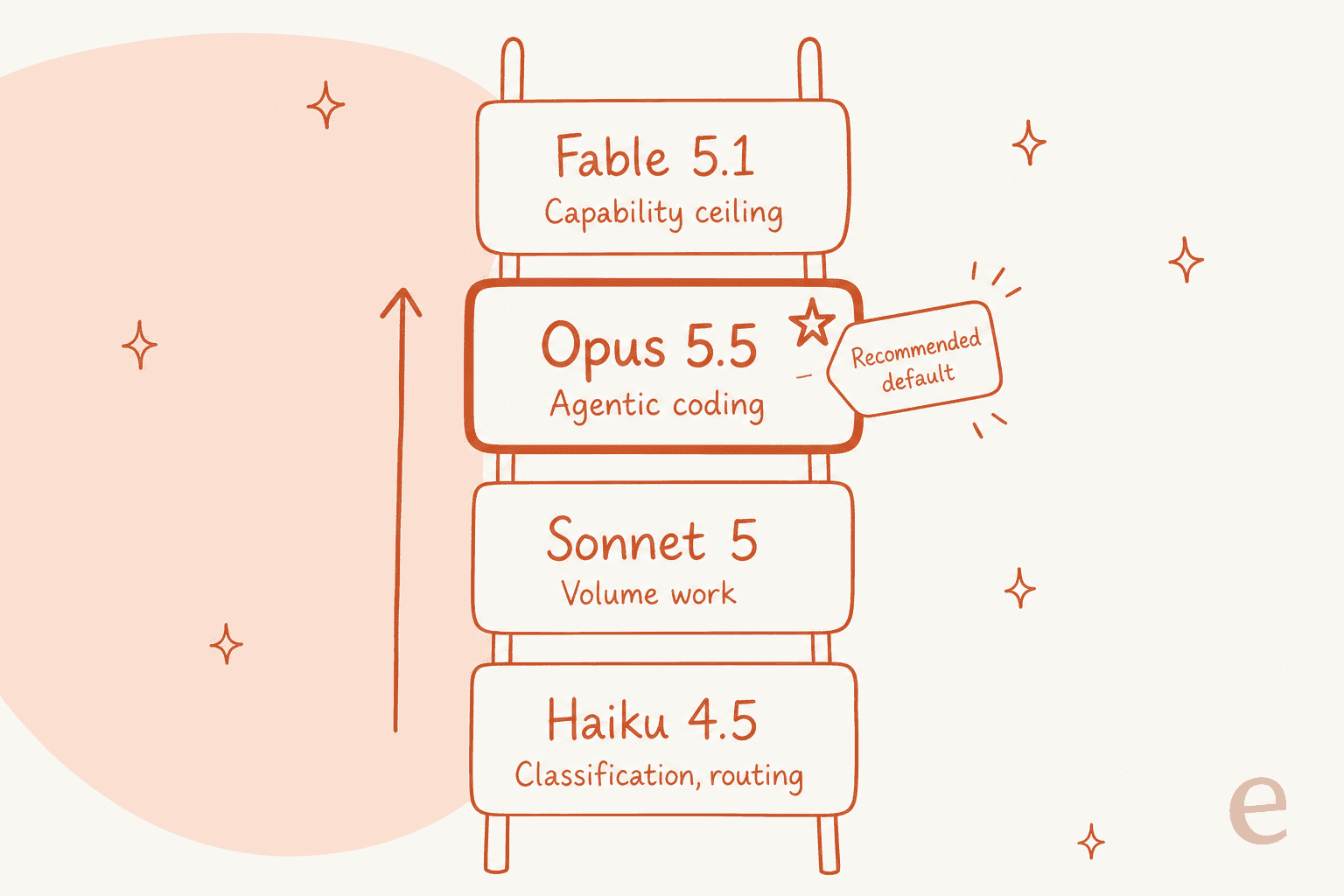
The cleanest way to place Opus 5.5 is against its siblings, because the whole family now has a clear job description.
| Model | Input / MTok | Output / MTok | Best for |
|---|---|---|---|
| Claude Fable 5.1 | $10 | $50 | The capability ceiling |
| Claude Opus 5.5 | $4 | $20 | Agentic coding, knowledge work |
| Claude Opus 5 | $5 | $25 | Previous generation |
| Claude Sonnet 5 | $2 | $10 | Volume work, drafting |
| Claude Haiku 4.5 | $1 | $5 | Classification, routing |
The official steer is to start with Opus 5.5 for most work and step up to Fable 5.1 only when your evals at higher effort still fall short. Reach down to Sonnet 5 for volume tasks where the per-token rate matters more than finishing power. That is the reverse of the old advice, which treated Opus as the expensive tier you rationed. Making Opus the default is the clearest signal of how much cheaper Anthropic thinks it now is to run.
What changed since Opus 5
If you are migrating, these are the deltas that touch code rather than marketing:
| What | Claude Opus 5 | Claude Opus 5.5 |
|---|---|---|
| Input / output price | $5 / $25 | $4 / $20 |
| Cache read multiplier | 0.1x ($0.50) | 0.05x ($0.20) |
| Default effort | high | medium |
| Knowledge cutoff | May 2026 | June 2026 |
| Typical run cost | Baseline | ~40% lower |
Two of those deserve a note. The cache read cut is a straight discount for any workload with a stable system prompt, and it needs zero code changes. The effort default change is the one that quietly lowers most bills, because a lot of teams never touched the setting and were paying for high reasoning they did not always need. Anthropic's migration guide is the place to reset max_tokens ceilings, which still cover thinking and the answer together.
For the version-to-version money, our Opus 5.5 pricing breakdown carries the full rate card, and the Opus 4.6 pricing guide shows how stable the line was before this cut, which makes the comparison unusually clean.
How to access Claude Opus 5.5
There are three routes, and which you pick changes the bill more than the model does.
- The Claude API. Call
claude-opus-5-5directly for pay-as-you-go token pricing, plus the Batch API at 50% off and prompt caching. This is the route if you are building your own product on top of the model. - Claude Pro and Max. Per the Claude pricing page, Opus 5.5 is the default model on Claude Max and the strongest model on Pro, with session-based limits shared across web, desktop, mobile and Claude Code.
- The clouds. It ships day one on Amazon Bedrock, Google Vertex AI and Microsoft Foundry, where the cloud provider invoices you and regional endpoints carry a 10% premium.
If you live in the terminal, the model configuration guide shows how to pin Opus 5.5 in Claude Code rather than letting it auto-select, and the Claude Code pricing guide covers the subscription-versus-API math for a team. For a wider view, our roundups of Claude developer tools and Cursor show where the model lands in real toolchains, and the three-way API comparison is the fastest way to sanity-check a switch against Gemini pricing or GPT-5.6 pricing.
What developers are saying
The launch-week reaction turned on the one question that decides whether the efficiency claim is real: does the model actually write less. Some found it did.
"after a few hours use, my impression is that Opus 5.5 writes like gemini. drastic improvement over all opus 5.1's claudeisms."

Others were not convinced the verbosity had changed at all.
"So far it seems the same. I used Opus 5.5 for an hour this evening and it was just as painfully verbose as Opus 5. It also used the term 'load bearing' 4 separate times."
My read, from wiring these models into real loops: the rate cut is unambiguous, but the 40% run-cost figure is a workload-dependent average, not a floor. If your prompts already control length, you were never paying the verbosity tax that Opus 5.5 removes, so your saving lands closer to the flat 20%. Meter your own tokens before and after rather than trusting the headline, because the honest version of this release is a strong upgrade with a caveat, not a miracle.
The model is the engine, not the employee
Here is the tension I see every week. A frontier model this capable and this cheap makes it tempting to build your own AI application on top of the raw API, and I have watched more than one technical customer say exactly that.
"But long term we will just build our own, which is so possible now with AI. I think you have a decent system for now."
a B2B hardware support team evaluating build-versus-buy
They are not wrong that the model makes it possible. What the token rate hides is everything the model does not do. Opus 5.5 is a superb engine; it is not a support agent, a triage system, or a blog writer until someone builds the retrieval, the grounding, the retry logic, the effort tuning and the fallback for when a safety classifier declines a request. That is a real engineering project, and it never appears on the pricing page.
eesel is that layer already assembled. It sells ready-to-work AI teammates: an AI helpdesk agent that joins your support queue and an AI blog writer, each arriving with the skills, integrations and company context for its job, with a frontier model like Opus 5.5 running underneath and the token spend already inside the price.

For anyone who does want the programmable surface, eesel exposes the same teammate through a CLI, MCP server and webhooks. A person can drive it from a terminal, scripts can automate it, and coding agents like Claude Code or Cursor can operate it directly, so you get agentic control over your support workspace without rebuilding the retry-and-grounding stack that the raw API leaves to you. It is the same engine as a from-scratch build, minus the maintenance you did not want to own. Some teams still choose to build; others end up here.
You can simulate eesel against your own historical tickets before it replies to anyone, and connect it in a few minutes. Try eesel free.
Is Claude Opus 5.5 worth it?
For long-horizon agentic coding, this is the easiest yes the Opus line has offered in a while. You pay 20% less than Opus 5 for a model Anthropic positions at Fable 5.1's quality level, with cache reads at a fifth of the old rate on top. When a run finishes in half the steps, the cheaper-per-token model was never the cheaper model.
Two honest caveats. The 40% figure is an average, so a workload that already ran tight will see closer to the flat cut, and cheaper models still win a lot of work: for classification and bulk drafting, Sonnet 5 at half the price is the better buy, and if you are shopping around our Opus 4.6 alternatives roundup covers the field with Mistral pricing at the cheaper end. But as a default frontier model, Opus 5.5 earns the promotion Anthropic gave it.
If content rather than code is your use case, the same logic drives our guides to the best LLM for blogging and making AI sound human.
Frequently Asked Questions
What is Claude Opus 5.5?
claude-opus-5-5.How is Claude Opus 5.5 different from Claude Opus 5?
How much does Claude Opus 5.5 cost?
Is Claude Opus 5.5 good for coding?
What is the default effort setting on Claude Opus 5.5?
How do I access Claude Opus 5.5?
claude-opus-5-5, is the default model on Claude Max and the strongest model on Claude Pro, and ships day one on Amazon Bedrock, Google Vertex AI and Microsoft Foundry. The model configuration guide shows how to pin it in Claude Code.Is Claude Opus 5.5 better than Claude Sonnet 5?
Can Claude Opus 5.5 answer customer support tickets?


Article by
Rama Adi Nugraha
Rama is a software engineer at eesel AI with two years of experience writing about B2B SaaS, AI tools, and customer support technology. Based in Bali, Indonesia, he brings a developer's perspective to product comparisons — cutting through marketing copy to what the integrations and APIs actually do.